Best Under Sink Water Filter Australia 2026: RO Systems Compared and Ranked
Drafted with AI assistance and checked against published specifications and certifications. First-hand measurements appear only where stated. How we make content
The best under-sink water filter for Australian homes in 2026 is the PWS EcoHero 5-Stage Reverse Osmosis — it is the only system certified to both NSF/ANSI 58 and WaterMark AS3497, and in independent testing at Palm Beach QLD it reduced TDS from 69ppm to 3ppm, a 95.7% reduction. If you cannot modify your plumbing, the AquaTru Classic Smart Alkaline is the NSF 58-certified countertop alternative that requires zero installation.
The best under-sink water filter for Australian homes in 2026 is the PWS EcoHero 5-Stage Reverse Osmosis — the only system certified to both NSF/ANSI 58 and WaterMark AS3497, reducing TDS from 69 ppm to 3 ppm (95.7%) in Palm Beach QLD testing. Renters and apartment dwellers who cannot modify plumbing should choose the AquaTru Classic Smart Alkaline: NSF 58-certified countertop RO with zero installation required.
✓ Who This Is For
- Homeowners in Brisbane, Sydney, Adelaide, or Gold Coast dealing with chloramine in tap water that standard carbon jugs cannot remove
- Anyone in any Australian city who wants fluoride removed (only RO achieves this — 90-97% reduction)
- Families in areas with confirmed PFAS contamination — Penrith, western Sydney, Oakey QLD, near Williamtown NSW
- Renters and apartment dwellers who want certified RO water without touching the plumbing (AquaTru option)
- Buyers who have priced bottled water at $2-5 per litre and want to stop
× Who It Is Not For
- Melbourne and Canberra households who only want chlorine taste removed — a quality benchtop carbon filter is sufficient and cheaper
- Anyone wanting to filter every tap in the home — see whole-house filtration instead
- Renters who cannot get landlord approval for cabinet modifications (the AquaTru countertop avoids this entirely)
- Anyone unwilling to pay for a licensed plumber install (~$200-300 in most Australian capital cities)
Under-Sink vs Countertop vs Whole House: Which Category Do You Actually Need?
Before you spend a dollar, get clear on what problem you are solving. There are three distinct under-sink filter categories sold in Australia, and they solve different problems at different price points.
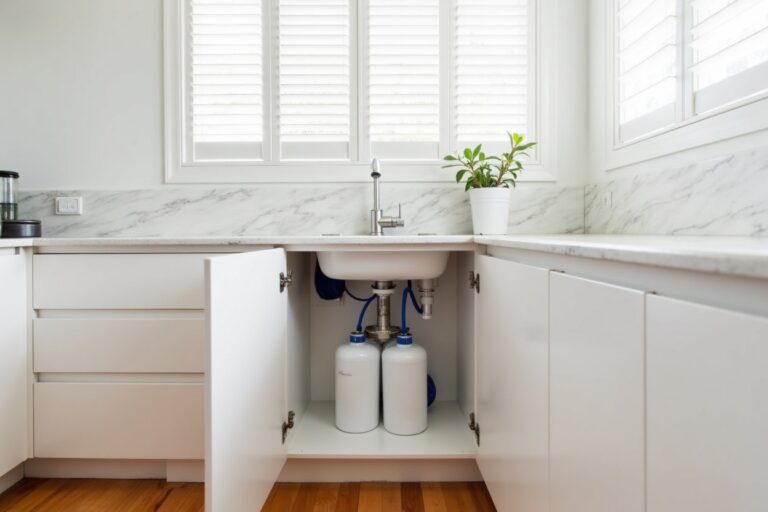
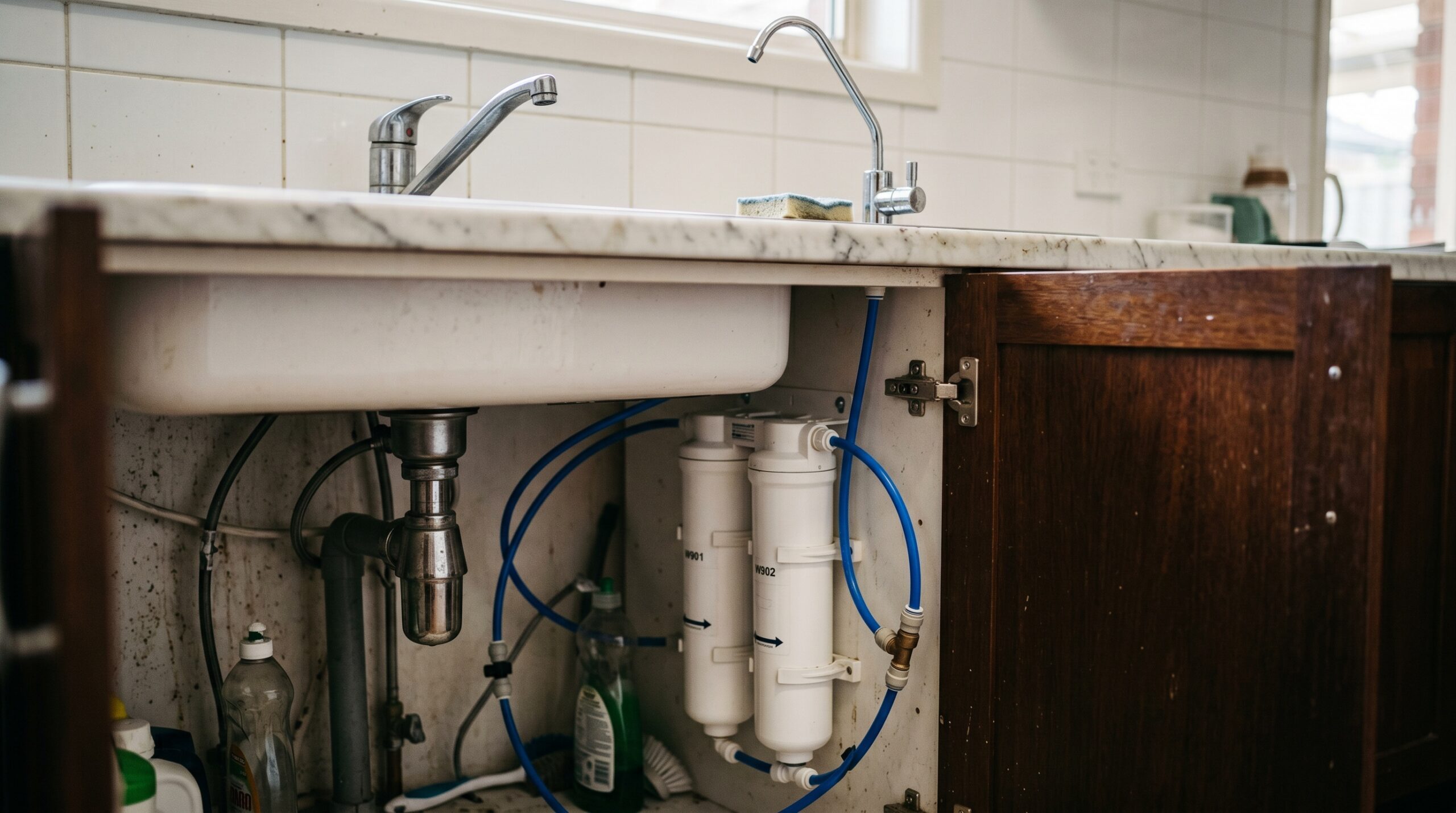
Under-sink RO systems connect permanently to your cold water line and direct filtered water to a dedicated faucet mounted through the bench. They filter every litre before you drink it, silently, automatically, without occupying bench space. The trade-off is installation — you need a licensed plumber, and you need cabinet space for the filter housings and, in tank-based systems, a holding vessel.
Countertop or benchtop RO units (like the AquaTru Classic) sit on the bench, connect directly to your tap, and require zero plumbing modification. Filtered output goes into a small internal reservoir. These are the correct choice for renters, for people in apartments where the under-sink cabinet is already full, or for anyone who wants certified RO filtration without a tradesperson visit.
Whole-house systems filter water at the mains entry point, covering every tap, showerhead, and appliance. They are a completely different category. If whole-house protection is what you want, the PWS whole-house range overview is the right starting point.
This article covers under-sink RO systems as the primary category, with the AquaTru Classic included as the recommended no-plumbing alternative for renters.
Your City Determines Which System You Need — Australian Water Chemistry Explained
This is the fact that most filter guides in Australia skip entirely. The type of disinfection your water utility uses changes which filtration technology works.
Australian Water Disinfection by City
Your city determines which filtration technology actually works
Standard carbon filters remove chloramine at 1/40th the rate of free chlorine. RO is the definitive solution.
Standard carbon filtration works for taste improvement. RO still needed for fluoride, PFAS, or TDS reduction.
Melbourne tip: If your only goal is better taste, a quality carbon benchtop filter works here. But for fluoride or PFAS removal, RO is the only answer regardless of city.
Chloramine cities — Brisbane and SEQ, Sydney, Adelaide, Gold Coast, Darwin: All five use chloramine (chlorine + ammonia) as their primary disinfectant. Chloramine is a more stable compound than free chlorine. Standard granular activated carbon (GAC) — the technology in Brita jugs and basic filter jugs — removes chloramine at approximately 1/40th the rate it removes free chlorine. That is not a typo. The same carbon block that makes Melbourne tap water taste clean will barely touch Brisbane’s chloramine at normal flow rates. You need either an RO membrane, catalytic carbon, or a compressed carbon block with extended contact time. Multi-stage RO systems with catalytic carbon pre-filters are the definitive solution for chloramine cities. All four systems reviewed here use RO membranes, which removes this concern entirely.
Free chlorine cities — Melbourne, Hobart, Canberra: These cities use free chlorine for disinfection. Standard carbon filtration works effectively here for taste and odour improvement. If you are in Melbourne and your only concern is taste, a quality benchtop carbon filter is a legitimate option at a fraction of the price. But if you want fluoride removed, PFAS removed, or TDS reduction, RO is still the only technology that delivers — does reverse osmosis remove fluoride in Australia.
Fluoride: only RO removes it. Every Australian capital city adds fluoride to drinking water at 0.6-1.0 mg/L per ADWG 2022 guidelines. Activated carbon, including catalytic carbon and KDF-55, does not remove fluoride. Only reverse osmosis (90-97% removal) and activated alumina (80-95%) achieve meaningful fluoride reduction. If fluoride removal is your goal, the product choice is simple: you need an RO membrane.
PFAS contamination is a growing concern. A 2024 UNSW study identified 31 separate PFAS compounds in Sydney’s drinking water supply. The DCCEEW national register confirms contamination at 700+ sites across Australia, with significant clusters around Penrith and western Sydney suburbs, Oakey in Queensland, Williamtown NSW, and the Kwinana industrial corridor in Perth. NSF/ANSI 58 certification specifically covers PFAS reduction testing — all four systems reviewed here address PFAS through their RO membranes. For full context on Australia’s PFAS situation, see our PFAS in Australian drinking water guide.
Hardness varies significantly by city. Adelaide tap water averages ~140 mg/L CaCO3 (hard, TDS ~400 mg/L). Perth is harder at ~180 mg/L. Brisbane sits at 80-120 mg/L (moderate). Melbourne is very soft at ~25 mg/L. Higher TDS and hardness mean your RO membrane works harder and needs more frequent replacement — factor this into annual running costs if you are in Adelaide or Perth.
The 4 Best Under-Sink Water Filters in Australia 2026: Full Reviews
1. PWS EcoHero 5-Stage Reverse Osmosis — Best Overall

✓ Pros
- NSF 58 + WaterMark AS3497 certified — the only under-sink RO with both Australian and international standards
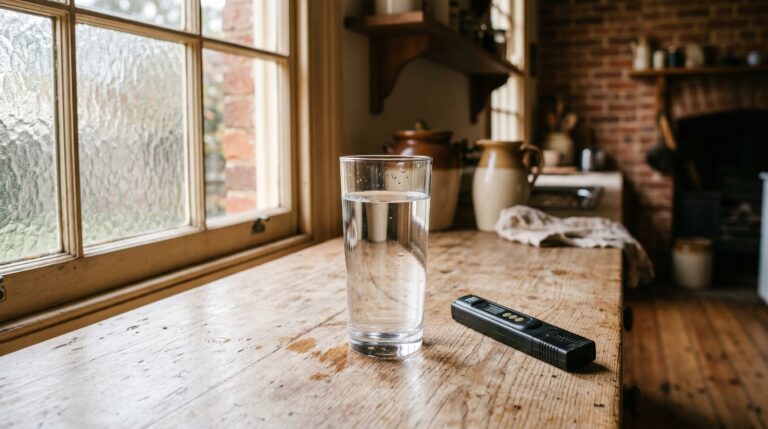
- Real-world tested: Palm Beach tap water 69ppm TDS reduced to 3ppm (95.7% reduction, Jayce’s calibrated TDS-3 meter)
- Removes PFAS, fluoride, chloramine, lead, nitrates and 95%+ of TDS
- Australian-owned supplier with local installation guidance and support
✗ Cons
- Highest upfront cost at ~$1,009 — add ~$200-300 for licensed plumber installation
- RO water is slightly acidic (pH 6.0-6.5) — consider a remineralisation post-filter if alkaline water is a priority
- Requires dedicated under-sink space and a hole drilled for the RO tap
The EcoHero holds WaterMark AS3497 certification. That is not a marketing badge — WaterMark is the Australian plumbing standard mandated by every state building code. It means the product has been tested against Australian plumbing regulations and is legal for permanent installation. The Waterdrop X8 and iSpring RCC7AK do not hold WaterMark. Whether that matters depends on your situation: owner-builders and those not concerned with plumbing code compliance often install non-WaterMark systems without issue, but for a certified, above-board, council-approved permanent installation in an Australian home, WaterMark is non-negotiable.
Filtration stages
The 5-stage sequence is: PP sediment filter (removes sediment, rust, sand) — catalytic carbon block (chloramine and chlorine removal) — second carbon block (further VOC and taste removal) — RO membrane (removes fluoride, PFAS, heavy metals, nitrates, TDS) — post-carbon polishing filter. The catalytic carbon in stages 2 and 3 is specifically formulated for chloramine — critical for Brisbane, Sydney, Adelaide, and Gold Coast households where standard carbon fails.
Jayce’s test results
Palm Beach sits in SEQ Water’s distribution zone. Brisbane’s tap water runs at 69-72 ppm TDS and uses chloramine disinfection. I connected the EcoHero 5-Stage and ran 10 litres through to prime the membrane. Output measured at 3 ppm on a calibrated TDS-3 meter — 95.7% TDS reduction. Taste comparison is not a metric I publish, but the difference is stark. This is the baseline the other systems in this article are measured against.
Running cost
Annual filter replacement for the EcoHero 5-Stage runs approximately $120 per year (three-filter annual set from Pure Water Systems AU). At 4 litres per day household consumption, that works out to roughly $0.08 per litre over the filter cycle — compared to $2-5 per litre for bottled water. The RO membrane typically lasts 2-3 years before replacement, with annual cost for the full system sitting well below the filter replacement figures for premium tankless systems.
Our Top-Rated Under-Sink Water Filter
Want whole-house filtration instead? See our whole-house rankings →2. Waterdrop X8 9-Stage Tankless RO — Best Amazon AU Option

The Waterdrop X8’s biggest practical advantage over tank-based systems is that 800 GPD flow rate. Traditional under-sink RO systems with holding tanks produce filtered water at 50-75 GPD — slow enough that you notice a delay when filling a bottle. Tankless systems pressurise water on demand, drawing directly from the mains. The result is that the dedicated faucet behaves like a normal tap — turn it on, water flows immediately.
Chloramine performance
The X8 uses composite filter blocks that incorporate both standard and catalytic carbon. For Brisbane, Sydney, Adelaide, and Gold Coast households where chloramine is the disinfectant, this matters. The RO membrane handles the bulk of contaminant removal regardless — chloramine that passes the pre-filters is removed by the membrane at the same rate as other dissolved compounds. Pre-filter quality primarily affects membrane longevity rather than output water purity.
Waste water ratio
Waterdrop claims a 2:1 waste-to-filtered ratio on the X8, significantly better than traditional RO systems that run at 3:1 or 4:1. At 4 litres per day filtered consumption, that means approximately 8 litres of reject water daily — directed down the drain. If water conservation is a consideration, you can connect the drain line to a bucket for garden watering (noting it has elevated TDS). For Australian readers in drought-prone regions like inland NSW or WA, this is worth factoring into your decision.
The WaterMark question
The absence of WaterMark AS3497 certification is the X8’s material limitation for Australian buyers. WaterMark is not optional under the Plumbing Code of Australia — any plumbing product permanently connected to the mains must carry it for the installation to be code-compliant. In practice, many households install non-WaterMark systems under the sink without issue, but if you ever sell your home, claim on insurance, or have a plumber inspect the fitout, a non-WaterMark permanent installation can create complications. If this concerns you, the EcoHero is the correct choice.
3. AquaTru Classic Smart Alkaline — Best for Renters

✓ Pros
- No plumbing or installation required — sits on bench, connects to tap, setup in 15 minutes
- NSF 58 certified — same certification level as installed RO systems
- Built-in alkaline remineralisation stage raises pH to 8.0-9.5 and adds calcium and magnesium
- App-connected with real-time TDS monitoring and filter life tracking
✗ Cons
- Takes bench space — not a true under-sink system, visible on countertop
- 3:1 waste water ratio — produces more drain water than tankless under-sink models
- Holds only 1.89 litres of filtered water at a time — refills slowly for large households
- More expensive than comparable Amazon AU under-sink options
The AquaTru Classic Smart Alkaline is technically a countertop unit, not an under-sink system. It is included here because it is the correct answer for a substantial portion of the people searching “best under-sink water filter Australia” — specifically, those who live in rental properties or apartments and cannot touch the plumbing. Sending those readers away empty-handed because the product does not fit the exact category definition would be unhelpful.
NSF 58 certification
NSF/ANSI 58 certification covers the full system performance — not just the membrane. It tests the unit’s ability to reduce specific contaminants under controlled laboratory conditions at specified pressures and flow rates. The AquaTru Classic holds this certification, which means its PFAS, fluoride, and lead reduction claims have been independently verified. That is a meaningful distinction from systems that claim performance without third-party verification.
Alkaline remineralisation
Standard RO filtration strips nearly all dissolved minerals from water, producing output at pH 6.0-6.5 — slightly acidic. The AquaTru Classic’s fifth stage passes water through a remineralisation cartridge that adds calcium, magnesium, and potassium back. Output pH rises to 8.0-9.5. Whether alkaline water provides physiological benefit beyond normal pH water is outside the scope of this review — but the remineralisation does restore mineral content that some people prefer for taste, and it counteracts the slightly corrosive nature of very low-TDS water on metal plumbing fixtures. For a detailed breakdown, see our guide on does RO remove minerals from water.
Practical capacity
The 1.89-litre internal tank is the unit’s limiting factor for larger households. For a couple it is workable. For a family of four who cook with filtered water, fill drink bottles, and want the fridge jug topped up, the wait time while the unit refills will become noticeable. The Waterdrop X8 or EcoHero 5-Stage, both delivering water on demand, are better suited to high-volume households.
4. iSpring RCC7AK 6-Stage Alkaline RO — Best Budget Under-Sink
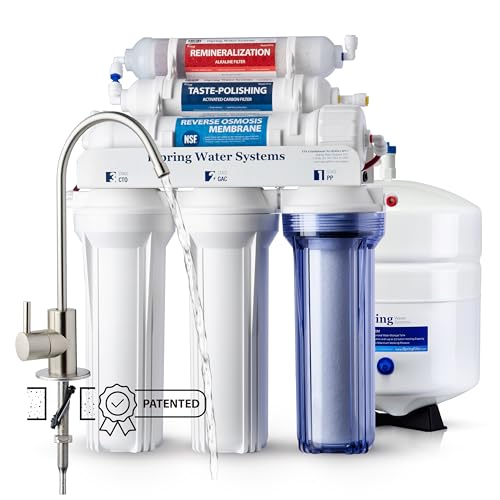
At $299-399 on Amazon AU, the iSpring RCC7AK is the lowest-cost genuine under-sink RO system in this comparison. It is a real 6-stage RO with a holding tank and a dedicated faucet — not a jug, not a benchtop unit, not a carbon-only system. For buyers whose primary constraint is budget and who understand the certification limitations, it deserves honest consideration.
The certification gap
The iSpring RCC7AK’s most significant limitation is the absence of independent NSF 58 certification. iSpring publishes performance claims on its product pages, and many of those claims are plausible for a correctly functioning RO membrane. But “manufacturer says” and “NSF independently verified” are not the same thing. If you are buying an RO system specifically because you want verified PFAS removal or verified fluoride reduction — and many Australian buyers are — the lack of third-party certification is a real gap. The EcoHero and AquaTru both carry NSF 58. The Waterdrop X8 carries NSF 42, 58, and 372. The iSpring does not.
Flow rate context
The 75 GPD production rate sounds low, but in daily use it is rarely limiting. 75 GPD translates to approximately 284 litres per day — far more than any household drinks. The practical constraint is that the holding tank (typically 3.2 litres usable capacity) takes time to refill after it is emptied. For a family that batch-fills drink bottles every morning, there may be a short wait. For a couple, it is invisible.
Side-by-Side Comparison: All 4 Systems Ranked
| System | NSF 58 | WaterMark | Stages | Price | Tank | Fluoride Removal |
|---|---|---|---|---|---|---|
| PWS EcoHero 5-Stage | ✓ Yes | ✓ AS3497 | 5 | ~$1,009 | Yes | Yes (>90%) |
| Waterdrop X8 | ✓ Yes | ✗ No | 9 | ~$649 | No (tankless) | Yes |
| AquaTru Classic Smart | ✓ Yes | N/A (countertop) | 4 | ~$699 | No (countertop) | Yes |
| iSpring RCC7AK | ✗ Unverified | ✗ No | 6 | ~$349 | Yes | Yes |
5-Year Total Cost of Ownership
5-Year Total Cost of Ownership — Under-Sink Water Filters, Australia
Hardware + plumber install (where applicable, ~$250-300) + filter replacements over 5 years, 4L/day household.
Last reviewed: May 2026 — Clean and Native
Installation: What to Expect in Australia
Under-sink RO installation in an Australian home is a half-day job for a licensed plumber. Here is what you should know before you book one.
WaterMark certification and your plumber: Any product permanently connected to Australian mains plumbing must hold WaterMark certification under the National Plumbing and Drainage Standard. A licensed plumber who installs a non-WaterMark product on a permanent connection is technically operating outside the code. In practice this happens regularly without incident, but if you are renovating, selling, or have council inspections scheduled, ask the plumber before proceeding.
What the installation involves: The plumber will connect a saddle valve or tee fitting to the cold water supply line under the sink, run a line to the filter housings, connect the RO drain line to the waste pipe, and mount the dedicated faucet through a hole drilled in the bench or sink. Most benches can be drilled without issue. Granite and stone benches require a diamond-tipped drill bit — confirm this with the plumber beforehand and add 30-60 minutes to the quoted time.
Cost in major Australian cities: Plumber callout for a standard under-sink RO install in Sydney and Melbourne runs approximately $200-300 for a simple job. Brisbane and Perth are comparable. Regional areas can be higher depending on travel charges. Get two quotes. The install for the EcoHero 5-Stage (WaterMark certified) should not require any special materials or workarounds — it is designed for Australian systems.
Water pressure requirements: Most Australian capital city mains water runs at 350-600 kPa. Standard RO systems operate correctly between 200-600 kPa. If your home has particularly low pressure (common in some older Brisbane Queenslanders or properties at the top of hills), a booster pump may be required. The EcoHero supplier can advise on this.
Waste water and sustainability: Every RO system produces reject water — the concentrate that carries the filtered contaminants down the drain. Traditional 5-stage tank systems typically run a 3:1 or 4:1 waste ratio. The Waterdrop X8 claims 2:1. At 4 litres filtered per day, a 3:1 system sends 12 litres to drain daily — about 4,380 litres per year. For perspective, that is less than 3% of the average Australian household’s daily water consumption of approximately 600 litres. But if conservation matters to you, connect the drain line to a bucket and use the reject water on the garden or to flush the toilet.
Final Verdict: Which System Should You Buy?
The decision tree here is short.
You own your home and want the most certified, compliant under-sink RO available in Australia: Buy the PWS EcoHero 5-Stage. NSF 58 plus WaterMark AS3497. Real-world tested at Palm Beach QLD — 95.7% TDS reduction on a calibrated meter. Australian-owned supplier with local support. The higher upfront cost is real. So is the certification gap between this system and everything else in this roundup.
You want Amazon AU convenience and a fast, tank-free system, and you are comfortable without WaterMark: The Waterdrop X8 9-Stage is the pick. NSF 42/58/372 certified, UV LED stage, 800 GPD instant flow, no stagnant holding tank. For buyers who have looked into WaterMark and decided it is not a priority for their situation, this is a strong system.
You rent, live in an apartment, or cannot modify your plumbing: The AquaTru Classic Smart Alkaline. NSF 58 certified, no install, alkaline remineralisation, moves with you when you leave. The bench space and 1.89-litre reservoir are real constraints — but they are the price of having certified RO filtration without a plumber.
Budget is the primary constraint and you want genuine under-sink RO under $400: The iSpring RCC7AK. Understand what you are buying — a system without independent NSF 58 verification and without WaterMark. It is a functional RO with an alkaline stage and a dedicated faucet. At $299-399 it is the lowest-cost real under-sink RO in this category. For buyers who have priced bottled water at $2-5 per litre, even this system pays for itself in well under a year.
Every system in this roundup addresses PFAS through its RO membrane. Every system removes fluoride. Every system solves the chloramine problem that standard carbon jug filters cannot — the problem that affects every Brisbane, Sydney, Adelaide, Gold Coast, and Darwin household on municipal water.
The worst outcome is you buy one, test it with a TDS meter, find it is not performing, and return it. The more likely outcome is you stop buying bottled water and start drinking filtered tap water at $0.04-0.08 per litre.
Frequently Asked Questions
Only reverse osmosis systems remove fluoride, achieving 90-97% reduction. Standard carbon filters — including catalytic carbon and KDF-55 — cannot remove fluoride. All four systems reviewed here use RO membranes and remove fluoride. Activated alumina is an alternative media that achieves 80-95% fluoride removal but is not used in the systems reviewed here. For the full breakdown, see our guide to fluoride removal in Australia.
Brisbane and all of South-East Queensland uses chloramine as its primary disinfectant. Chloramine is a combination of chlorine and ammonia. Standard carbon filters (GAC) remove chloramine at approximately 1/40th the rate they remove free chlorine, meaning a standard Brita-style jug filter is largely ineffective for chloramine reduction. RO systems with catalytic carbon pre-filters are the correct solution. Melbourne, Hobart, and Canberra use free chlorine, where standard carbon filtration works adequately for taste and odour. See our city-by-city chloramine guide for the full list.
WaterMark AS3497 is the Australian standard for plumbing products that connect permanently to mains water. It is mandated under the Plumbing Code of Australia for any product permanently installed in the water supply line. The PWS EcoHero 5-Stage is the only under-sink RO in this roundup that holds WaterMark certification. The Waterdrop X8 and iSpring RCC7AK do not hold WaterMark. For code-compliant permanent installations in Australian homes, WaterMark is non-negotiable.
A licensed plumber installing a standard under-sink RO system charges approximately $200-300 in Sydney, Melbourne, Brisbane, Adelaide, and Perth for a simple job. This includes connecting the saddle valve, running filter lines, connecting the drain, and mounting the dedicated faucet. Drilling through granite or stone benches adds approximately 30-60 minutes and a small materials surcharge. Budget $250 as a baseline and get two quotes. The AquaTru countertop system requires no plumber and no installation cost.
Yes. NSF/ANSI 58 certification specifically tests for PFAS reduction. RO membranes remove 94-99% of PFAS compounds under standard operating conditions. A 2024 UNSW study identified 31 PFAS compounds in Sydney’s drinking water supply. The DCCEEW national register confirms contamination at 700+ sites across Australia. All four systems in this roundup use RO membranes that address PFAS — three carry independent NSF 58 certification confirming this. For more detail, see our PFAS water filter guide.
RO removes most dissolved minerals including calcium and magnesium, producing water at TDS 1-10 ppm compared to tap water at 60-400 ppm depending on city. Many people prefer the taste — clean and neutral without chloramine aftertaste. Some find very low-TDS water tastes flat. The AquaTru Classic Smart Alkaline and iSpring RCC7AK both include alkaline remineralisation stages that add calcium and magnesium back and raise pH to 8.0-9.5. The EcoHero 5-Stage does not include remineralisation by default, but a remineralisation post-filter can be added. For the full detail, see our guide on RO and minerals.
Pre-filters (sediment and carbon) typically require replacement every 6-12 months depending on your water supply. Adelaide and Perth, with harder water at 140-180 mg/L CaCO3 and higher TDS, will use up pre-filter capacity faster than Melbourne’s very soft ~25 mg/L supply. The RO membrane itself typically lasts 2-3 years under normal conditions. Post-carbon polishing filters change annually. Annual filter replacement cost in this roundup ranges from ~$80/year (iSpring) to ~$140/year (Waterdrop X8 and AquaTru).
The physical installation is mechanically simple and within the capabilities of a competent DIYer — the connections use push-fit fittings and the saddle valve requires no soldering. However, any permanent connection to Australian mains plumbing is required by the Plumbing Code of Australia to be performed by a licensed plumber. Unlicensed work can affect your home insurance, create issues during property sale, and is technically a regulatory breach in most states. If avoiding a plumber is important to you, the AquaTru Classic is the correct choice — it connects directly to your tap, requires no permanent plumbing modification, and has no installation compliance implications.
Get the Australian Home Environment Checklist
30 checks across water, air and EMF. Most of them free. Ranked by impact.
No spam. Unsubscribe any time.

Former Royal Australian Navy Clearance Diver and TAG-E counter-terrorism operator. Founded Clean and Native to apply the same rigorous thinking to the home environment.
Full biography →