Best EMF Meter Australia 2026: 7 Meters Tested for Australian Homes
8 min read
This article contains affiliate links. We may earn a commission at no extra cost to you.
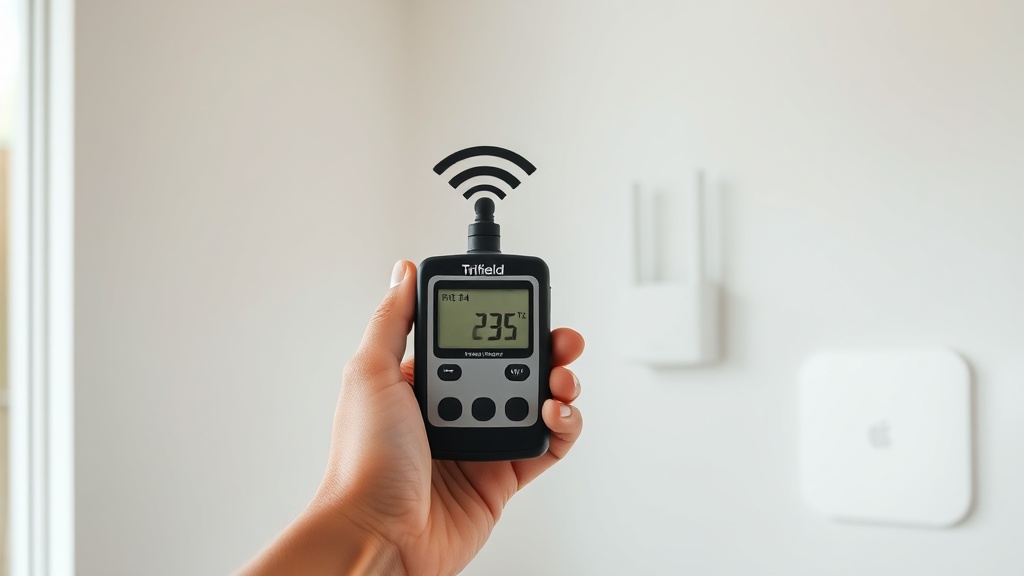
If you want to know what EMF levels actually look like in your home — near your smart meter, beside your WiFi router, next to the baby monitor, under your power lines — the only way to find out is to measure it. The problem is that the EMF meter market ranges from $35 toys to $1,500 professional instruments, and the specifications matter enormously. A meter that can’t detect RF (radio frequency) radiation tells you nothing about your WiFi router. A meter that only measures RF tells you nothing about the magnetic fields from your power lines. This guide covers the 7 best EMF meters available in Australia in 2026 and tells you exactly which one suits your needs.
Why You Need an EMF Meter (And What You’ll Actually Find)
Most people who buy an EMF meter find that their home has much higher EMF levels in some locations than they expected — and much lower in others. Common surprises in Australian homes:
- Smart meters: Emit RF pulses at regular intervals (typically every 1–30 minutes depending on the network). Peak pulse levels can be 100–1,000 times higher than the average reading, which is why time-averaging meters significantly understate smart meter exposure.
- Baby monitors: DECT-based baby monitors transmit continuously, often producing RF levels among the highest in any room in the house.
- WiFi routers: Emit RF continuously. Levels drop sharply with distance — RF follows the inverse square law, so 2 metres from a router typically gives you one quarter of the exposure compared to 1 metre.
- Power lines: 50Hz magnetic fields (ELF-MF) from external power lines and internal wiring. The ARPANSA public exposure limit is 1,000 µT — most homes are well below this, but homes directly under high-voltage transmission lines can approach meaningful levels.
- Appliances: Hair dryers, induction cooktops and electric blankets produce significant ELF-MF at close range, dropping steeply with distance.
For context on what to do with your measurements, read our how to measure EMF in your home guide and our complete guide to EMF in Australian homes.
The 3 Types of EMF a Meter Can Measure
RF (Radio Frequency / Microwave): 10MHz–300GHz. Sources: WiFi, mobile phones, 4G/5G towers, smart meters, DECT phones, baby monitors, Bluetooth. Measured in µW/cm² (microwatts per square centimetre) or mW/m². This is the most relevant field type for most people in modern homes given the proliferation of wireless devices.
ELF-MF (Extremely Low Frequency Magnetic Fields): 3Hz–300Hz. Sources: power lines, wiring, transformers, appliances. Measured in milligauss (mG) or microtesla (µT). 1 µT = 10 mG. The ARPANSA general public reference level is 1,000 µT at 50Hz.
ELF-EF (Electric Fields): 3Hz–300Hz. Sources: wiring in walls, extension cords, anything plugged in but not necessarily running. Measured in V/m (volts per metre). Less commonly discussed but some building biologists consider electric fields in sleeping areas particularly relevant.
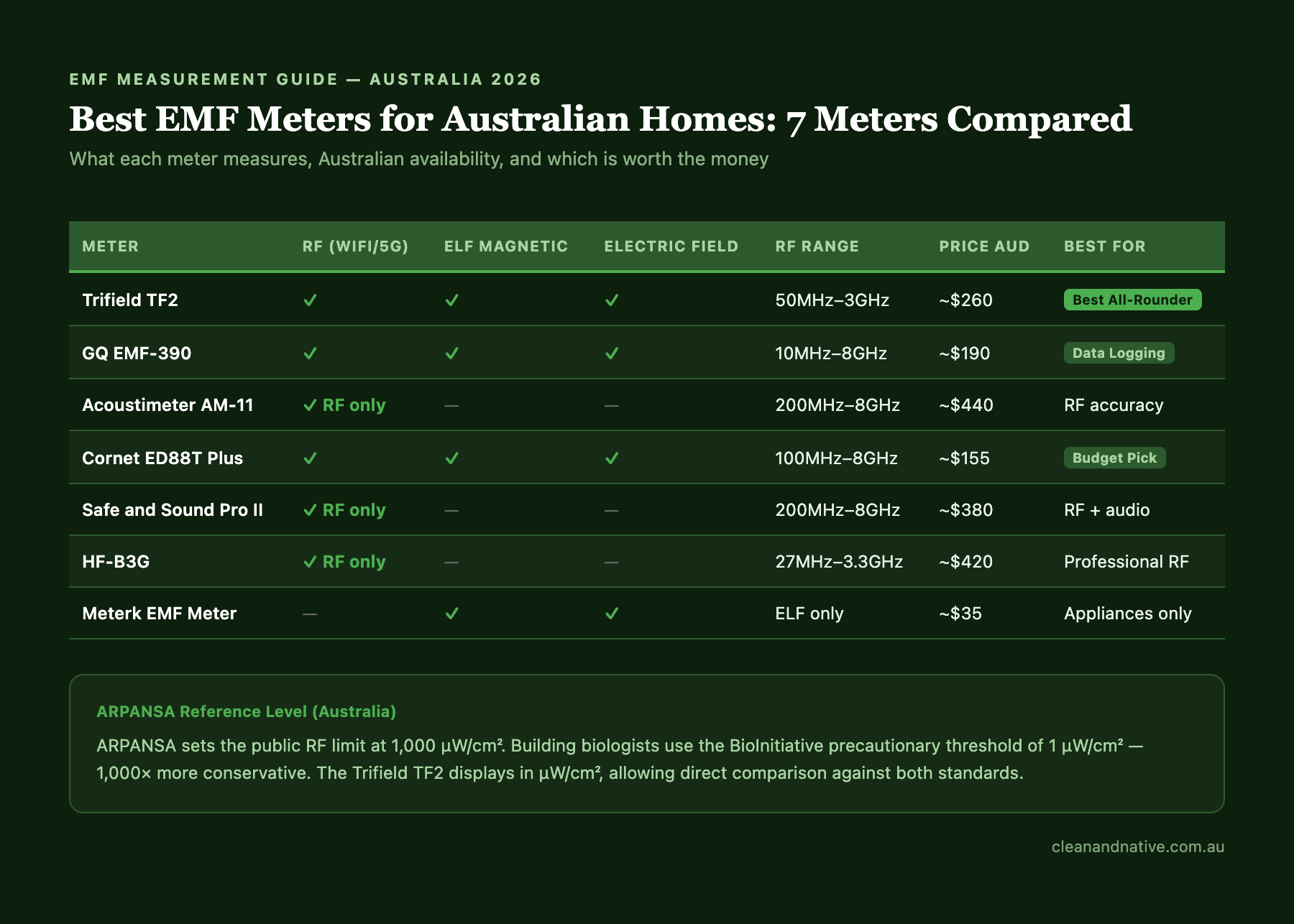
Best EMF Meters in Australia 2026
| Meter | Measures RF | Measures ELF-MF | Measures E-Field | RF Range | Price AUD | Best For |
|---|---|---|---|---|---|---|
| Trifield TF2 | ✓ | ✓ | ✓ | 50MHz–3GHz | ~$260 | Best all-rounder |
| GQ EMF-390 | ✓ | ✓ | ✓ | 10MHz–8GHz | ~$190 | Data logging |
| Acoustimeter AM-11 | ✓ RF only | — | — | 200MHz–8GHz | ~$440 | RF accuracy |
| Cornet ED88T Plus | ✓ | ✓ | ✓ | 100MHz–8GHz | ~$155 | Budget pick |
| Safe and Sound Pro II | ✓ RF only | — | — | 200MHz–8GHz | ~$380 | RF + audio feedback |
| HF-B3G | ✓ RF only | — | — | 27MHz–3.3GHz | ~$420 | Professional RF |
| Meterk EMF Meter | — | ✓ | ✓ | ELF only | ~$35 | Appliances/wiring only |
Trifield TF2 Review — The Best All-Rounder for Australian Homes
The Trifield TF2 is the meter recommended by most Australian building biologists and EMF consultants for general household use. It measures all three field types (RF, ELF-MF, ELF-EF) with a single device, uses a clear analogue-style display that shows instantaneous peaks (crucial for detecting smart meter pulses), and produces readings in the standard units used by ARPANSA and building biology guidelines.
The TF2’s RF detection range is 50MHz–3GHz, which covers WiFi (2.4GHz and 5GHz bands), most smart meters (915MHz or 2.4GHz depending on the network), mobile phone frequencies (700MHz–2.1GHz for 4G), baby monitors, and Bluetooth. It does not measure 5G mmWave (26GHz+) — but mmWave 5G coverage in Australia is still limited primarily to small urban hotspots rather than residential areas.
Its standard mode shows average RF levels. Its “peak hold” function captures transient spikes — useful for smart meters and devices that transmit in short bursts. Price: approximately $250–280 AUD, available through several Australian retailers.
How to Test Your Home for EMF (Step-by-Step)
Start with a structured room-by-room walkthrough. Turn the meter on in each room before any specific investigation — you want a baseline reading with nothing unusual happening.
RF check: Hold the meter at approximately 1 metre height, move slowly around the room. Note any significant spikes. Then move specifically to: WiFi router location, smart meter (usually on an outside wall), any base station (baby monitor, DECT phone). Record peak and average readings.
ELF-MF check: Switch to magnetic field mode. Check around the fuse box, behind the TV, near the induction cooktop, beside electric blankets and heated mattress pads. Magnetic fields drop sharply with distance — if a spike is 2mG at 30cm and drops to 0.2mG at 1 metre, the practical exposure at your normal position may be negligible.
Sleeping area priority: Spending 7–9 hours in your bedroom means it’s the highest priority area to assess. Check the wall behind the bed for wiring, the bedside table for phone chargers and clocks, and the position of the smart meter (sometimes on the other side of the bedroom wall — a common source of elevated readings).
For a full protocol, see our what is EMF radiation explainer and the EMF protection products guide for next steps once you have your readings.
What EMF Levels Are Considered Safe? (ARPANSA Standards for Australia)
ARPANSA (Australian Radiation Protection and Nuclear Safety Agency) sets the following reference levels for the general public:
- RF at 2.4GHz (WiFi): 1,000 µW/cm² (10 W/m²)
- RF at 900MHz (smart meters, mobile): 450 µW/cm²
- ELF Magnetic (50Hz): 1,000 µT (10,000 mG)
These limits are based on established thermal effects (heating of tissue) and do not account for potential non-thermal biological effects. Building biologists typically apply the BioInitiative Report’s precautionary guidelines, which recommend RF below 1 µW/cm² in sleeping areas — 1,000 times more conservative than ARPANSA’s limit. ARPANSA is among the less conservative regulatory bodies globally; by contrast, Switzerland’s precautionary NISV standard for installations is 0.4µW/cm².
The key point: a reading below ARPANSA limits is legally compliant. Whether it’s at a level you’re personally comfortable with is a separate question — and having a meter lets you make that assessment with actual data.
Frequently Asked Questions
Can I test EMF levels with my phone?
Not reliably. Phones can measure their own magnetic field sensors (which can detect ELF-MF approximately), but they can’t measure RF radiation from external sources — the phone itself is transmitting RF, which would interfere with any such measurement. Dedicated meters are the only reliable option for household EMF assessment.
What is a normal WiFi router reading in milliwatts per square metre?
At 1 metre from a standard household WiFi router, typical readings are 1–10 mW/m² (0.1–1.0 µW/cm²). At 3 metres, typically 0.1–1 mW/m². At 5 metres and beyond, usually below 0.1 mW/m². These are well below ARPANSA limits but around or above the BioInitiative precautionary threshold. Moving your router away from sleeping and sitting areas, or switching to wired ethernet for stationary devices, are straightforward ways to reduce exposure.
Do EMF meters detect 5G?
Most consumer EMF meters (including the Trifield TF2 and Cornet ED88T Plus) measure RF up to 8GHz, which covers all current 5G sub-6GHz frequencies used in Australia (600MHz, 700MHz, 850MHz, 2.1GHz, 3.5GHz). They do not measure 5G mmWave (26GHz band). Current mmWave 5G deployment in Australia is limited primarily to dense urban small cells — not yet prevalent in residential neighbourhoods.
Are cheap EMF meters accurate?
Below approximately $100 AUD, accuracy becomes inconsistent. The $35 Meterk-style meters can detect the presence of ELF fields but often overread significantly. For meaningful data you can act on, invest in a recognised meter — the Cornet ED88T Plus at ~$155 is the minimum we’d recommend for reliable RF and ELF measurements.
How do I reduce EMF in my home based on my measurements?
The most effective interventions — all based on the physics of how fields behave — are: increase distance from sources (RF and ELF both follow inverse square law: double the distance, quarter the exposure), switch stationary devices to wired ethernet connections (eliminates continuous WiFi RF), relocate WiFi routers away from sleeping and sitting areas, and ensure phone and tablet charging happens away from the bed. For detailed EMF reduction strategies, see our complete EMF guide for Australian homes.
FREE CHECKLIST
Get the Australian Home Environment Checklist
30 checks across water, air and EMF. Free PDF. No spam.
Former Royal Australian Navy Clearance Diver and TAG-E counter-terrorism operator. Founded Clean and Native to apply the same rigorous thinking to the home environment.
Full biography →