Tap Water Warning: What To Do When Mains Burst
When a burst water main triggers an ABC Emergency “do not drink” advisory, boiling your tap water will not make it safe — depressurisation during a main break allows soil, bacteria, and chemical contaminants to enter the pipe network, and no amount of heat removes those. This article explains exactly what is happening in your pipes, why the standard advice fails, and what filtration or purification systems actually work as a backup when the mains are compromised.
Why a Burst Water Main Is Not a Simple “Boil Water” Problem
Most people reach for the kettle when they see a water advisory. That response makes sense for some scenarios — boiling water to 100°C for one minute kills Cryptosporidium, Giardia, Campylobacter, and most bacterial pathogens per the Australian Drinking Water Guidelines (ADWG 2022). For a burst water main, however, that response is specifically and demonstrably wrong.
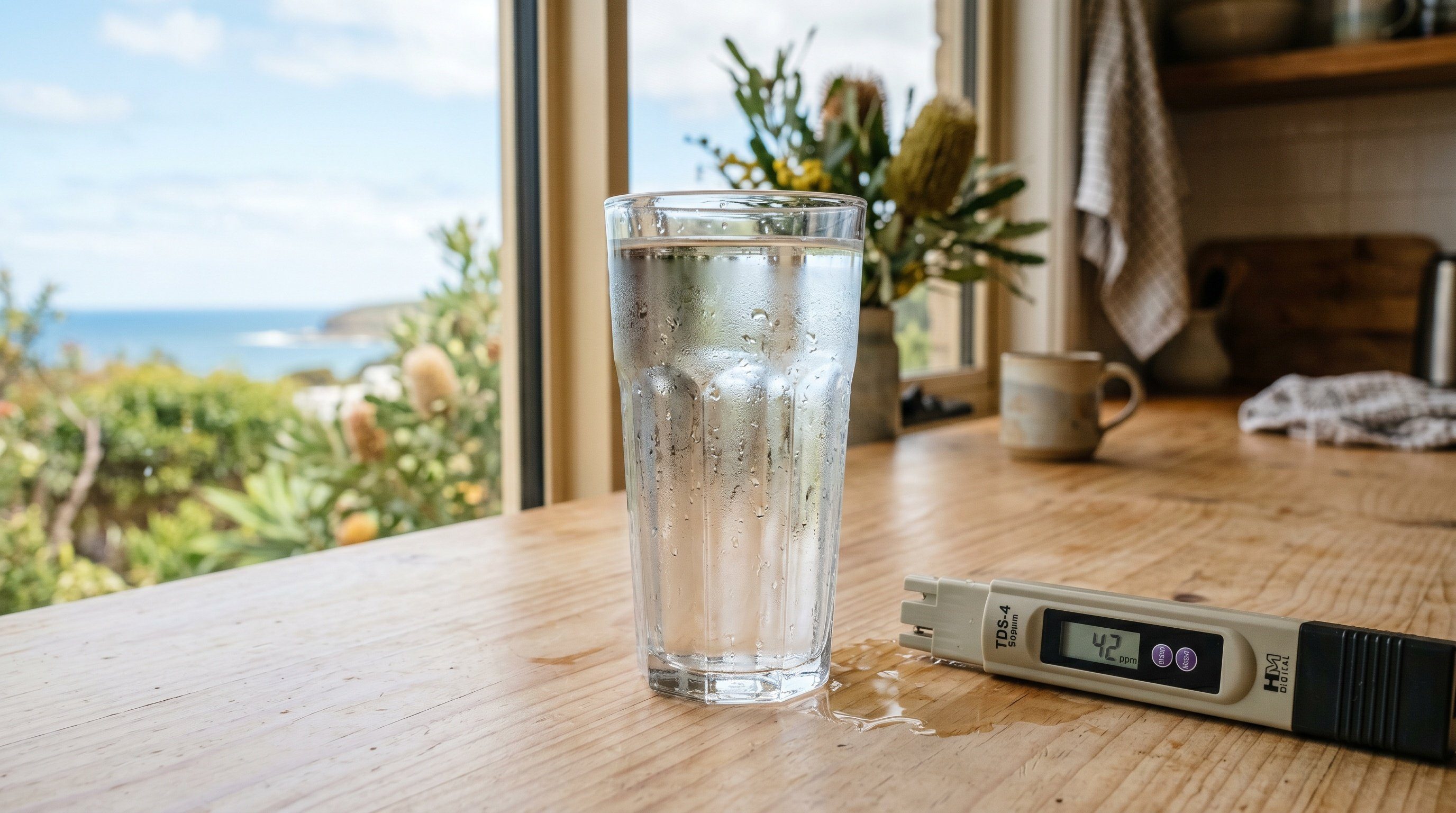
Here is what actually happens during a main break. Reticulation networks operate under positive pressure — typically 150 to 800 kPa depending on the utility and zone. That positive pressure keeps external material out of the pipe. When a main bursts, pressure in the affected section drops toward zero or goes negative. That pressure reversal acts like a syringe: it draws surrounding material — soil, groundwater, agricultural runoff, industrial chemicals, and whatever is in the trench surrounding that pipe — directly through any crack, joint, or breach point.
That ingress includes particulates, heavy metals from soil, nitrates, pesticide residues, and potentially PFAS compounds depending on the site. Boiling concentrates dissolved solids and chemicals. It does not remove them. The ABC Emergency warning system explicitly flags boiling as ineffective for burst main advisories, and South East Water, Coliban Water, and other Victorian utilities have included this clarification in their formal public notices.
Victoria alone saw concurrent advisories across Harcourt, Barkers Creek, Castlemaine, Flinders, Point Leo, and Shoreham in a single incident window documented in the ABC Emergency archive — a pattern that reflects systemic infrastructure vulnerability, not isolated bad luck. Ageing cast-iron and asbestos cement mains across Australian metro and regional networks are the underlying cause. Water Research Australia estimated in 2021 that approximately 15% of Australia’s distribution pipe network is beyond design life.
The Specific Contaminants That Enter During Depressurisation
Understanding what you are actually dealing with determines which filtration technology is appropriate. Not all contaminants behave the same way, and the one-size-fits-all “boil water” directive from older advisory frameworks does not account for mixed contamination events.
Turbidity and Particulates
Soil and sediment ingress raises turbidity — measured in nephelometric turbidity units (NTU). The ADWG 2022 aesthetic guideline is 5 NTU; the health-based guideline for disinfection efficacy is 1 NTU. High turbidity interferes with UV disinfection and reduces chlorine effectiveness. A 0.1-micron or finer filter removes particulates before any other treatment step.
Microbial Contamination
Groundwater and surface water drawn in during depressurisation can carry E. coli, Campylobacter, and Cryptosporidium oocysts. Boiling addresses this category specifically — but only this category. If particulate or chemical ingress is also present (which it almost always is after a main break), boiling alone is still inadequate.
Heavy Metals
Soil surrounding older mains often contains elevated lead, arsenic, and cadmium from historical land use. These dissolve into water at low levels and concentrate when water is boiled. The ADWG 2022 maximum acceptable values: lead 0.01 mg/L, arsenic 0.01 mg/L, cadmium 0.002 mg/L. No amount of boiling reduces these — only reverse osmosis (90-97% rejection per NSF/ANSI 58) or activated alumina addresses dissolved heavy metals.
PFAS Compounds
Per- and polyfluoroalkyl substances are present in soils at over 700 contaminated sites nationally according to the DCCEEW national PFAS register (2024 data). PFAS is heat-stable — boiling does nothing. Reverse osmosis removes PFAS at 90-95% rejection rates. The ADWG 2022 health guidance values for PFOS and PFOA are 0.00007 mg/L and 0.00056 mg/L respectively, reflecting their extreme toxicity at low concentrations.
Chemical and Agricultural Runoff
In regional Victoria and across rural Queensland, mains run adjacent to agricultural land. Herbicide and pesticide residues in groundwater can enter during depressurisation events. The ADWG lists maximum acceptable values for pesticides including atrazine (0.02 mg/L) and 2,4-D (0.04 mg/L). Carbon filtration reduces these, but only reverse osmosis provides consistent rejection across the full range of agricultural chemicals.
What Actually Works: Filtration and Purification Options Ranked
When your water utility issues a do not drink advisory, you have four practical options. Here is exactly what each one does and does not do.
Option 1: Reverse Osmosis (Countertop or Under-Sink)
Reverse osmosis forces water through a semi-permeable membrane with 0.0001-micron pore size. That is smaller than bacteria (0.2-10 microns), viruses (0.02-0.3 microns), PFAS molecules, heavy metal ions, and most dissolved agricultural chemicals. NSF/ANSI 58 certification, which tests membrane rejection rates under controlled laboratory conditions, requires a minimum 75% TDS rejection — most modern membranes achieve 90-97%.
RO does not require boiling. It does not require a second treatment step for burst main scenarios. It works on Brisbane’s chloramine-dosed water (chloramine cities: Brisbane/SEQ, Sydney, Adelaide, Perth, Darwin — standard carbon filters fail on chloramine at 1/40th the removal rate of RO). It works on Melbourne’s free-chlorine water. It is infrastructure-agnostic.
The practical limitation: most under-sink RO systems require mains pressure of 200-550 kPa to operate the membrane. During an active burst main event where pressure is severely reduced, flow rate drops and membrane performance degrades. If pressure drops below approximately 100 kPa, production stops entirely. This is when a countertop RO system with a pre-filled tank — like the AquaTru Classic — has a practical advantage, because you can pre-fill the feed tank from bottled water or a clean rain tank and run it at atmospheric pressure using the unit’s own pump.
Burst Main Emergency — Top RO Systems
Option 2: Gravity Filtration with Verified Pathogen Reduction
Gravity-fed filter systems like the Berkey use a dual-stage process: a compressed carbon block removes chemical contaminants, and a proprietary ceramic/carbon combination addresses bacteria and protozoa. Black Berkey elements are tested to NSF/ANSI 53 (cyst reduction) and claim greater than 99.9999% reduction for bacteria and greater than 99.99% for protozoa — though it is important to note that Berkey elements are not NSF-certified (the tests are third-party but not NSF-listed). Gravity filters operate with zero mains pressure — they are fully independent of the distribution network.
The limitation: Berkey-style gravity filters do not reliably remove dissolved heavy metals to the levels required for burst main contamination scenarios, and they do not remove PFAS. For a short advisory (24-72 hours) involving primarily microbial contamination, a quality gravity filter is a reasonable interim measure. For extended advisories involving chemical ingress, RO remains the safer option.
Option 3: Sealed Bottled Water
The utility directive for good reason. Sealed bottled water has a known, tested source unconnected to the affected mains. The cost burden is real and underacknowledged: a family of four consuming 2L per person per day for a 7-day advisory requires 56 litres minimum for drinking and cooking. At $1.50-$2.50/L for commercially bottled water in a supermarket, that is $84-$140 for one week. During emergency demand, shelf availability collapses within hours of a public advisory. The cost and logistics argument for a point-of-use filter system before an emergency occurs is simple.
Option 4: Standard Carbon Jug Filters (Brita, AQUA Optima)
These do not qualify as a safe option during a burst main advisory. Standard granular activated carbon (GAC) reduces chlorine taste and odour, and has partial effectiveness on some organic compounds. It does not remove bacteria, viruses, heavy metals, PFAS, or sediment above a few microns. In Brisbane, Sydney, Perth, Adelaide, and Darwin — all chloramine cities — standard GAC removes chloramine at approximately 1/40th the rate of catalytic carbon, meaning that at normal flow rates it provides negligible protection. Do not rely on a Brita during a do not drink advisory.
Disinfection Chemistry by City — Why It Matters Here
Before buying any filtration system as a burst main backup, you need to know what your utility adds to your water under normal conditions, because that determines which filter technology you actually need.
Brisbane, Sydney, Adelaide, Perth, and Darwin all use chloramine as their primary residual disinfectant. Chloramine (monochloramine, NH₂Cl) is more stable than free chlorine and persists further into the distribution network — which is specifically why it is used in large, sprawling systems. The critical point: chloramine is not removed by standard granular activated carbon or KDF-55 media at useful flow rates. It requires catalytic carbon, compressed carbon block, or RO.
Melbourne, Hobart, Canberra, Townsville, Cairns, and Toowoomba use free chlorine. Standard GAC handles free chlorine adequately. For these cities, a quality carbon block filter provides meaningful chemical protection during low-level contamination events — though it still does not address bacteria, heavy metals, or PFAS.
The implication for burst main preparedness: if you are in Brisbane, Sydney, Perth, or Adelaide, do not install a standard carbon filter as your emergency backup and expect it to handle chloramine chemistry plus contamination ingress. You need RO or catalytic carbon minimum.
Emergency Water Cost — 7-Day Advisory, Family of Four
4 people × 2L/day × 7 days = 56 litres minimum drinking/cooking water required
Cost formula: unit volume (56L) × per-litre cost. AquaTru amortised cost per litre based on RRP ~$699 + filter replacement $120/yr over 3 years, 4L/day household. Sources: supermarket average shelf pricing; AquaTru manufacturer filter specification. Bar fill #3A8A5A = RO option; #1A3326 = bottled water comparators.
Building an Infrastructure-Agnostic Water Safety Layer Before the Next Advisory
The utilities will restore pressure and issue an all-clear. But the underlying infrastructure that caused the burst is still there, ageing at the same rate it was before the break. In Victoria alone, multiple concurrent advisories across separate systems in one incident window demonstrate this is not a once-a-decade risk — it is a routine infrastructure failure pattern.
The framing that matters: a point-of-use filter system is not a luxury purchase. It is an infrastructure-independent backup that operates regardless of what is happening in the mains network. Here is how to build that layer systematically.
Tier 1: Countertop RO for Renters and Small Households
The AquaTru Classic operates from a countertop, requires no plumbing, and can be fed from any water source including bottled water during an active advisory. It uses a four-stage process: 20-micron pre-filter, carbon pre-filter, RO membrane, and carbon post-filter. The manufacturer certifies removal of over 80 contaminants including lead, chromium, chloramine, chlorine, PFAS, nitrates, and arsenic. ADWG maximum acceptable values for lead (0.01 mg/L) and nitrate (50 mg/L as NO₃) are addressed by RO at tested rejection rates. At approximately $699 RRP on Amazon AU, it is the fastest path to pressure-independent drinking water for a household without plumbing access.
Tier 2: Under-Sink RO for Permanent Installations
The PWS EcoHero 5-Stage holds WaterMark AS/NZS 3497 certification — the Australian plumbing products standard administered by the Australian Building Codes Board. WaterMark is the minimum legal requirement for any water filter permanently connected to Australian plumbing. The five stages include sediment pre-filter (5 micron), catalytic carbon block (addresses chloramine in Brisbane/Sydney/Adelaide/Perth/Darwin), RO membrane (removes fluoride 90-97%, PFAS, heavy metals, nitrates), post-carbon polish, and optional alkaline remineralisation. For permanent installation, this system works continuously so that on any given day the advisory is issued, your drinking water has already been processed through RO. The utility’s failure becomes irrelevant for drinking and cooking water.
Tier 3: Gravity Filter as Power-Independent Backup
A stainless steel gravity filter like the Berkey Royal requires no power and no pressure. It operates anywhere. During an extended advisory where mains pressure is intermittent, a gravity filter can process water from any source — rain tank, creek, or utility supply when pressure returns briefly — and deliver microbially safe water. The Royal’s 8 Black Berkey elements process up to 22 litres per hour. For regional Victoria households affected by simultaneous multi-location advisories, a gravity filter addresses the gap between the advisory and restoration without reliance on supermarket stock.
Rain Tank as Emergency Reserve
A properly maintained rainwater tank with a 20-micron pre-filter and UV sterilisation provides a pressure-independent water source that is completely disconnected from the mains network during a burst main event. The ADWG guidance on rainwater use (section 8.3, 2022) recommends a first-flush diverter, leaf guards, and regular tank inspection. UV sterilisation at 30 mJ/cm² minimum (compliant with AS/NZS 4348.1) addresses bacterial load. This is the appropriate solution for regional and semi-rural properties across Victoria, NSW, and Queensland where mains infrastructure is oldest and advisory frequency highest.
Reading the ABC Emergency Advisory: What the Language Tells You
ABC Emergency water advisories use consistent language that signals the specific risk level. Knowing how to read these notices lets you calibrate your response correctly rather than defaulting to the least protective option.
“Do not use for drinking” means drinking and cooking both. Do not brush teeth with unfiltered tap water during this advisory. Do not use for infant formula. Ice made before the advisory began in an unaffected period is generally safe; ice made during or immediately after the break is not.
“Boiling may not make water safe” is the explicit signal that the contamination is chemical or particulate, not solely microbial. This language has appeared in South East Water and Coliban Water notices following burst main events in Victoria. When you see this phrase, RO or sealed bottled water is the only appropriate response.
“Precautionary do not drink” is issued when a break has occurred and water quality testing is pending. Treat this identically to a confirmed advisory. Testing takes 18-48 hours from sample collection. The all-clear is issued only after two consecutive clean tests. That is a minimum 36-96 hour window where boiling is the default — and for burst main events, an inadequate one.
“Flush your taps before use” is the clearance instruction. Run cold water for two to five minutes after the all-clear before consuming. This purges the section of pipe servicing your property of any residual material that entered during the event. Even after the all-clear, running your RO or gravity filter provides an additional safety margin during the first 24 hours post-restoration.
The Wider Pattern: Australia’s Ageing Mains Infrastructure
The Harcourt, Barkers Creek, Castlemaine, Flinders, Point Leo, and Shoreham advisories that ran concurrently in Victoria are not anomalies. They are symptoms of a national infrastructure investment deficit that Water Research Australia has documented across multiple state systems.
Asbestos cement mains installed in the 1950s-1970s are still in active service across regional Victoria, NSW, South Australia, and Queensland. Cast iron mains from the early 20th century serve portions of inner Sydney and Melbourne. The Australian Water Association’s State of the Water Sector report (2023) identified that utilities collectively face a maintenance backlog of approximately $14 billion nationally, with pipe replacement rates running at 0.3-0.5% per year against an engineering-recommended 1% annual replacement rate for systems of this age profile.
At 0.4% annual replacement, the average main in service today will not be replaced for 250 years. That is the actual risk timeline for burst main frequency in your area.
What this means practically: burst main advisories are a recurring feature of living in any Australian city or town serviced by infrastructure built before 1980. The question is not whether your area will issue a do not drink advisory — it is how many times in the next decade it will, and whether you have a treatment layer in place when it does.
Last reviewed: June 2026 — Clean and Native
Final Verdict
When the ABC Emergency advisory says “do not drink” and “boiling may not make water safe,” the only effective household responses are reverse osmosis filtration or sealed bottled water. Standard carbon jug filters, boiling, and KDF-based shower-style filters do not address the mixed chemical, particulate, and microbial contamination profile that enters the network during mains depressurisation events. For Australian households in areas with ageing mains infrastructure — which covers the majority of the country — a point-of-use RO system is the single highest-impact investment you can make for long-term water safety independence. The AquaTru Classic requires no plumbing and works even when mains pressure is compromised. The PWS EcoHero 5-Stage is the correct permanent installation for households ready to commit to under-sink filtration with WaterMark AS/NZS 3497 compliance.
Frequently Asked Questions
A burst water main causes depressurisation that pulls external contaminants — soil, groundwater, heavy metals, and chemicals — directly into the pipe. Boiling kills bacteria but cannot remove dissolved heavy metals, PFAS, nitrates, or agricultural chemical residues. For burst main advisories, boiling is explicitly insufficient, and the ABC Emergency warning system reflects current water authority advice on this point.
Advisory duration depends on the severity of the break and testing protocol. Minor breaks with rapid repair and clean initial samples can clear in 24-48 hours. More extensive contamination events require two consecutive clean test results — minimum 36-96 hours from sample collection. Complex events involving chemical ingress have run for 7-14 days in regional Victoria and NSW cases documented in state utility records.
No. Standard granular activated carbon (GAC) jug filters like Brita reduce chlorine taste and some organic compounds only. They do not remove bacteria, viruses, heavy metals, PFAS, sediment, or the agricultural chemicals that can enter during mains depressurisation. Do not rely on a Brita during a do not drink advisory.
Brisbane, Sydney, Adelaide, Perth, and Darwin use chloramine as their primary residual disinfectant. Melbourne, Hobart, Canberra, Townsville, Cairns, and Toowoomba use free chlorine. This matters for filter selection: standard carbon filters work on free chlorine cities but fail on chloramine cities at useful flow rates. RO removes both.
Yes, with a caveat. Under-sink RO systems require minimum mains pressure (typically 100-280 kPa depending on the unit) to operate the membrane. During an active burst event where pressure is severely reduced, production rate drops and may stop entirely. If mains pressure is restored but a do not drink advisory remains in place, your RO system provides effective treatment. If pressure is still reduced, use the AquaTru countertop unit with a bottled water feed, or use sealed bottled water.
Yes. Reverse osmosis removes PFAS compounds at 90-95% rejection rates per NSF/ANSI P473 test protocol. The ADWG 2022 health guidance values for PFOS (0.00007 mg/L) and PFOA (0.00056 mg/L) are addressed by RO filtration. Carbon filters do not reliably remove PFAS at normal flow rates and contact times.
Potentially yes, if properly maintained. The ADWG 2022 recommends a first-flush diverter, sealed tank with insect screens, and UV sterilisation at minimum 30 mJ/cm² (per AS/NZS 4348.1) for potable use. An unmaintained, uncovered tank with no UV treatment is not a safe drinking source. A 20-micron pre-filter plus UV addresses the primary microbial risk from rainwater storage.
WaterMark is the Australian product certification scheme administered under AS/NZS 3497, required by law for any plumbing product permanently connected to Australian mains water supply. A filter installed under your sink without WaterMark certification is not legally compliant with Australian building and plumbing codes. The PWS EcoHero 5-Stage RO holds WaterMark AS/NZS 3497 certification. Always verify WaterMark status before purchasing an under-sink system in Australia.
Monitor the ABC Emergency website (abc.net.au/emergency) and your state water utility’s website and social channels. Utilities in Victoria notify via the Vic Emergency app; NSW uses NSW SES and Sydney Water alerts; SEQ uses Seqwater and Queensland Urban Utilities bulletins. The all-clear is issued only after two consecutive clean water quality tests at the affected section. After the all-clear, flush cold taps for two to five minutes before consuming.
Get the Australian Home Environment Checklist
30 checks across water, air and EMF. Most of them free. Ranked by impact.
No spam. Unsubscribe any time.

Former Royal Australian Navy Clearance Diver and TAG-E counter-terrorism operator. Founded Clean and Native to apply the same rigorous thinking to the home environment.
Full biography →