Can an Air Purifier Improve Your Sleep? The Evidence Reviewed
Disclosure: Clean and Native earns a commission if you purchase through links on this page. This does not affect our recommendations.
HEPA air purification in the bedroom is associated with an average of 12 extra minutes of sleep per night in healthy adults, according to a 2023 randomised controlled trial. The effect is strongest for people with allergies, asthma, or exposure to bushfire smoke and traffic PM2.5. Airborne particulates trigger micro-arousals that fragment sleep without conscious awareness — remove the irritants, reduce the disruptions. The catches: the purifier must run quietly enough not to cause its own disruption (≤35 dB on sleep mode), and the benefit is dose-dependent on baseline air quality — if your bedroom air is already clean, the effect will be marginal.
| Scenario | Evidence Quality | Verdict |
|---|---|---|
| Allergies/asthma sufferers | 78-week RCT shows significant improvement | Recommended |
| High PM2.5 exposure (bushfire/traffic) | Consistent with PM2.5-sleep disruption literature | Likely beneficial |
| Clean air, no allergies | Limited baseline irritants to remove | Marginal effect |
The short answer
The three products we own are measured first-hand by Jayce Love, former Royal Australian Navy Clearance Diver; every other product is assessed on published manufacturer specifications and independent certification using our documented methodology — no gifted units, no brand payments.
Yes — with specific caveats. A 2023 randomised controlled trial published in the Journal of Sleep Research found HEPA air purification in the bedroom was associated with an average of 12 extra minutes of sleep per night in healthy adults. A 78-week RCT in asthma patients found significant improvement in rhinitis and sleep quality scores with HEPA purification. The effect is real, evidence-based, and strongest for people with allergies, asthma, or any exposure to PM2.5 from bushfire smoke, traffic, or indoor sources. The mechanism is established: airborne particulates and allergens trigger micro-arousals during sleep that fragment rest without you being aware of it. Remove the irritants, reduce the disruptions. The qualifier: the purifier has to run quietly enough not to cause disruption itself.
What the research actually shows
There are two credible randomised controlled trials specifically examining air purification and sleep. Neither is large-scale — the research is still developing — but both use sound methodology and their findings are consistent with the broader literature on PM2.5 and sleep disruption.
Lamport et al. 2023 — Journal of Sleep Research
Conducted at the University of Reading, this double-blind crossover RCT enrolled 30 healthy adults who each slept with an air purifier for two weeks under two conditions: one with an active HEPA filter, one with a placebo filter (same machine, different filter). Participants and researchers were blinded to which condition was active. Sleep was measured using actigraphy watches and sleep diaries throughout; PM2.5, PM10, VOCs, and NO2 were continuously monitored in the bedroom.
The active HEPA filter reduced bedroom PM2.5 significantly compared to the placebo condition. The result: participants slept an average of 12 extra minutes per night and spent 19 more minutes in bed according to diary data. The total sleep time result approached but did not reach conventional statistical significance (p=0.058). The time-in-bed result did reach significance (p<0.01). The study was funded by Dyson, which is a legitimate limitation to note — though the double-blind crossover design is the most rigorous approach available for this type of research, and the results were published in a peer-reviewed journal.
Twelve minutes per night compounds. Over a week that is 84 minutes. Over a month, 6 hours. Chronic sleep restriction at even small daily doses accumulates measurably in cognitive performance, inflammatory markers, and metabolic function. The effect size is modest — this is not a cure for insomnia — but for the population sleeping in bedrooms with elevated PM2.5 or allergen loads, it is a real and accessible improvement.
Kadalayil et al. 2024 — Clinical and Experimental Allergy
A 78-week double-blind RCT at the University of Southampton, enrolling 50 adults with physician-diagnosed mild to moderate persistent asthma. Participants received either an active HEPA purifier or a placebo unit in their bedroom and living room. PM2.5 was significantly lower in the intervention group throughout the study (5 µg/m³ vs 8.15 µg/m³, p=0.0003). Post-hoc analysis found statistically significant improvement in rhinitis quality of life scores and perceived sleep quality in the intervention group compared to placebo. The longer duration of this study — 78 weeks — is particularly credible for assessing chronic exposure effects.
How airborne pollutants disrupt sleep — the mechanism
Sleep cycles through four stages roughly every 90 minutes: light sleep (N1), consolidated sleep (N2), slow-wave deep sleep (N3), and REM. N3 is where physical tissue repair, immune consolidation, and memory encoding occur. Interrupting it — even briefly — resets the cycle. You do not pick up where you left off.
Airborne pollutants interfere with this at two levels. At the neurological level, PM2.5 particles smaller than 2.5 micrometres are small enough to cross from the lungs into the bloodstream, and from there can reach the brain via inflammatory pathways. Sustained PM2.5 exposure above 10 µg/m³ correlates with significantly reduced N3 sleep time and increased overnight cortisol secretion in the research literature. At the respiratory level, allergens and particles trigger upper airway inflammation — even without obvious symptoms like a runny nose. Sub-symptomatic inflammation produces micro-arousals: shifts toward lighter sleep lasting 3-15 seconds that you will not remember in the morning but that fragment your sleep architecture and accumulate across the night. Research has found that people with allergic rhinitis experience a 40% higher micro-arousal index than non-allergic controls.
| Pollutant | Sleep disruption mechanism | Australian relevance | HEPA effective? |
|---|---|---|---|
| PM2.5 | Crosses blood-brain barrier, reduces N3, elevates cortisol | Bushfire smoke primary cause of PM2.5 exceedances in all Australian cities. 4,880 premature deaths/year attributed to PM2.5 nationally. | Yes — HEPA captures 99.97% of particles at 0.3 microns |
| Dust mite allergens | Upper airway inflammation, micro-arousals, blocked nose | Affect ~1 in 5 Australians. Thrive in warm humid coastal conditions (QLD, NSW, Vic). Peak exposure occurs during sleep — face near bedding. | Yes — allergen particles 5-40 microns, well within HEPA range. Healthdirect AU recommends HEPA filtration. |
| VOCs | Off-gas from mattresses, furniture, carpet, paint. Headache, dizziness, irritation at elevated concentrations. | New homes and furniture off-gas most heavily in first 2 years. Enclosed bedrooms accumulate VOCs overnight. | Partially — activated carbon filter required. HEPA alone does not address VOCs. |
| Pollen | Seasonal allergen. Enters through open windows and on clothing. Nasal congestion, airway inflammation. | Spring/summer in SE Australia. Rye grass, cypress, plane tree pollen seasons predictable by region. | Yes — pollen particles 10-100 microns, easily captured by HEPA. |
| Pet dander | Protein allergen carried on microscopic skin flakes. Remains airborne hours after animal leaves the room. | Relevant for the ~61% of Australian households with pets. Cat allergen (Fel d 1) is particularly persistent. | Yes — dander particles captured by HEPA. Carbon also addresses associated odour. |
The bushfire smoke angle: a specifically Australian sleep problem
Australia’s annual average PM2.5 is approximately 8 µg/m³ — one of the cleaner baselines globally. The 2019-20 bushfire season changed the framing. At its peak, Sydney, Canberra, and Melbourne recorded PM2.5 levels that were among the worst ever measured globally for urban centres. The Australian Centre for Disease Control (ACDC) and enHealth both now include HEPA air purifiers in their public health guidance for managing bushfire smoke indoors.
The practical implication for Australians: you may sleep in clean air 340 nights per year, then face 2-6 weeks where your bedroom PM2.5 is 10-50x its normal level during smoke events. A bedroom air purifier addresses both the chronic baseline (dust mites, allergens, everyday particulates) and the acute peaks (bushfire smoke). This dual purpose — the thing it does every night plus the protection it provides during events — is the strongest argument for keeping one in the bedroom year-round rather than as emergency equipment.
Bushfire smoke protocol: During smoke events (AQI above 100 in your area), close bedroom windows, run the air purifier at a higher speed for 30-60 minutes before bed to clear accumulated smoke, then drop to sleep/low speed overnight. Standard flyscreen mesh has an aperture of approximately 1.2mm — it provides zero PM2.5 filtration. The purifier is the only mechanical barrier between outdoor smoke and your lungs during sleep.
Our Top Air Purifier Picks
True H13 HEPA with activated carbon is the only technology that removes particles AND gases from your indoor air. For bushfire smoke, pollen, and VOCs — HEPA is non-negotiable.
What to look for in a bedroom air purifier
Noise — the make-or-break specification
A purifier that runs at 50 dB overnight — comparable to a quiet conversation — will cause more sleep disruption than it prevents for light sleepers. Noise is not a secondary consideration in bedroom purifiers: it determines whether the unit actually operates overnight or gets switched off at 2am. The thresholds that matter:
| Noise level (dB) | Equivalent sound | Bedroom suitability |
|---|---|---|
| Below 25 dB | Near-silent, rustling leaves | Ideal — inaudible to most |
| 25-35 dB | Whisper, quiet library | Excellent — white noise benefit |
| 35-40 dB | Soft background hum | Acceptable for most sleepers |
| 40-50 dB | Quiet conversation | Problematic for light sleepers |
| Above 50 dB | Normal conversation | Will disrupt sleep — not suitable |
Always check noise at the lowest fan speed or dedicated sleep mode, not the maximum. Maximum speed figures are irrelevant for overnight use. A unit rated “59 dB max / 24 dB sleep mode” is a quiet bedroom unit. A unit rated “59 dB max” with no sleep mode specification should be treated with caution.
Size the unit larger than the room
The standard recommendation is to buy a purifier rated for a room 1.5x the size of your actual bedroom. A purifier rated for 40m² in a 25m² bedroom can run at speed 2 instead of speed 4 to achieve the same air changes per hour — and speed 2 is dramatically quieter. Manufacturers advertise maximum CADR and coverage, but for bedroom buyers the relevant number is the noise at the speed needed to achieve 4-5 ACH (air changes per hour) in your specific room.
True HEPA plus activated carbon — both required
True HEPA (H13) captures 99.97% of particles at 0.3 microns, covering PM2.5, dust mite allergens, pollen, pet dander, and mould spores. Activated carbon addresses VOCs and odours — the chemical gases off-gassed from mattresses, furniture, and carpets that HEPA does not capture. A bedroom purifier without carbon filtration addresses particles but leaves the VOC exposure unaddressed. Both stages are needed for complete bedroom air coverage.
No ionisers or ozone generators in bedrooms
Ionisers and ozone generators produce ozone as a byproduct. Ozone is a respiratory irritant — the same compound that causes air quality alerts on high-pollution days. In an enclosed sleeping space where you spend 7-9 hours, ozone exposure from a bedroom ioniser is counterproductive: you are addressing one set of respiratory irritants while introducing another. The California Air Resources Board (CARB) specifically regulates ozone-generating purifiers and limits them for indoor residential use.
The Winix 5500-2 includes PlasmaWave technology — a form of ioniser — but it has a dedicated off switch. With PlasmaWave disabled, it operates as a pure 3-stage HEPA system with no ioniser function. This is the correct configuration for bedroom use. Units where the ioniser cannot be disabled are not appropriate for overnight bedroom operation.
LED display — dimmable or auto-off
An air quality indicator that glows red in a darkened bedroom is an unintended night light. Even low-level artificial light during sleep suppresses melatonin production. Any unit used in a bedroom should have a display that dims fully or switches off automatically in sleep mode. Check this before purchasing — it is not universally available and is rarely mentioned in specs.
Recommended bedroom air purifiers for Australian homes
Levoit Core 300S
Best for: single bedrooms and kids rooms up to ~21m2
- Sleep mode: ~24 dB (near-silent)
- CADR: 141 CFM / 240 m³/h
- H13 HEPA + activated carbon
- VeSync app with scheduling and display off mode
- Auto mode adjusts fan speed to detected air quality
- AU price: ~$150-180
Winix 5500-2
Best for: master bedrooms up to 33m2
- Sleep mode: 40.6 dB (acceptable, functional white noise)
- CADR: 232 CFM / 394 m3/h
- 4-stage: pre-filter + washable AOC carbon + True HEPA + PlasmaWave
- PlasmaWave can be disabled — run as pure HEPA overnight
- Remote control (no Wi-Fi app = no router connection, no screen in room)
- Air quality sensor + light sensor (auto dims controls)
- AU price: ~$350-400 | Discontinued US/Canada May 2025, still available AU, filter support to 2032
For a room-size matched recommendation across a wider range of options, use the air purifier quiz. For a detailed head-to-head comparison of both units, see the Levoit Core 400S vs Winix 5500-2 comparison.
Bedroom placement and setup
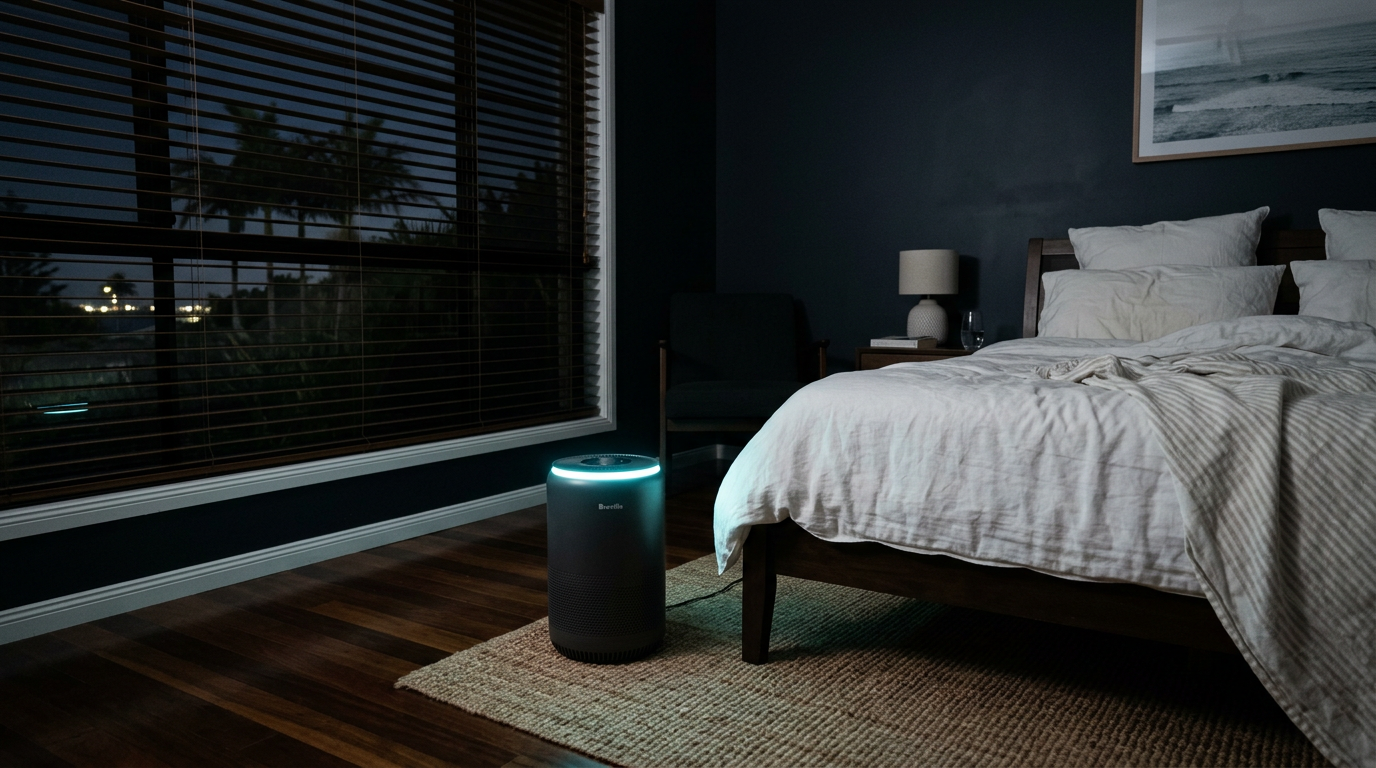
Position the purifier on the floor or a low surface (not on the bedside table — too close to the head creates direct airflow onto the face). The ideal position is 1-2 metres from the bed head, angled so the outlet points toward the sleeping area. This draws air from across the room, filters it, and distributes clean air toward the bed without creating a direct draft. In a rectangular room, placing the unit near the door draws corridor air through the filter before it reaches the sleeping zone.
Run the purifier on a higher speed for 30-60 minutes before bed, then switch to sleep/low speed when you get in. This clears the accumulated particulate load from the day and reduces the continuous work the unit needs to do overnight. During bushfire smoke events, keep windows closed and run a higher speed for longer before sleeping.
The bedroom is also where other environmental factors compound air quality effects on sleep. EMF exposure from bedside devices, electric fields from wall wiring, and router RF are all measurable in the bedroom. For a full assessment of the bedroom environment from an evidence-based perspective, see the complete guide to EMF in your Australian home. For air purifier options across all room sizes and use cases, the full air purifier guide covers the complete picture.
Frequently asked questions
Do air purifiers actually improve sleep quality?
Yes — two RCTs confirm it. +12 min/night in healthy adults, significant rhinitis and sleep QoL improvement in asthma patients. Effect is strongest with allergies, asthma, or PM2.5 exposure from sources like bushfire smoke.
Should you run an air purifier all night in your bedroom?
Yes. HEPA purifiers are designed for continuous operation and are safe overnight. Keep it on sleep/low mode for noise — look for units rated below 40 dB on the lowest setting. Auto mode adjusts fan speed based on detected air quality.
Are ioniser air purifiers safe to use in bedrooms?
No. Ionisers produce ozone, a respiratory irritant. In an enclosed bedroom over 7–9 hours, ozone exposure counteracts the benefit of particulate removal. Use True HEPA with activated carbon only. If your unit has an optional ioniser (such as the Winix PlasmaWave), disable it overnight.
Does an air purifier help with bushfire smoke during sleep?
Yes. Flyscreens provide zero PM2.5 filtration. A True HEPA filter captures 99.97% of fine smoke particles. Australian enHealth recommends HEPA purifiers during smoke events. Run at higher speed for 30–60 minutes before sleeping, then drop to sleep mode overnight.
Get the Australian Home Environment Checklist
30 checks across water, air and EMF. Most of them free. Ranked by impact.
No spam. Unsubscribe any time.

Former Royal Australian Navy Clearance Diver and TAG-E counter-terrorism operator. Founded Clean and Native to apply the same rigorous thinking to the home environment.
Full biography →