
I Slept Terribly for Years. Here’s What I Actually Changed.
7 min read
After years of poor sleep quality despite following standard sleep hygiene, I discovered three critical environmental factors were destroying my recovery: EMF exposure from a router positioned 90cm from my bed, hidden mould in rental properties, and blue light exposure after sunset. By systematically addressing these issues – moving the router, using air purification, and blocking blue light – my WHOOP recovery scores improved from the 30s-40s to consistently above 58%. Here’s exactly what I changed and the measurable results. This article contains affiliate links. We may earn a commission at no extra cost to you.
I did not set out to become someone who cares about EMF or blue light or mould spore counts. I set out to sleep eight hours and wake up ready to train. For years, I could not do that consistently — and I could not work out why.
This is the real story. Not the polished version. The one with the router under the bed and the mould I could not see and the WHOOP data that eventually made sense of all of it.
The Baseline Problem
When I was selected for the Navy Clearance Diver branch in 2016, I was in the best physical condition of my life. Sleep was not something I thought about — it just happened. Training, recovery, repeat.
After I transitioned out, the quality of my sleep started degrading in ways that were hard to pin down. I was falling asleep fine. I was staying asleep. But I was waking up unrefreshed. My WHOOP recovery scores — which I had been tracking since 2021 — were sitting in the 30s and 40s on mornings when I felt like I had done everything right the night before.
Alcohol: zero. Screen time: low. Bed by 10pm. Still waking up at a 38% recovery.
I started pulling the thread.
The Router Under My Bed
The first house I rented after leaving the Navy was a place in Palm Beach on the Gold Coast. The NBN box and WiFi router were installed in the bedroom — the only location the technician could run the cable without major work. The router sat on a shelf about 90cm from my head while I slept.
I did not think much of it at the time. I had no particular beliefs about WiFi. I just knew that my sleep metrics were worse in that house than they had been anywhere else.
On a whim — genuinely, just a whim — I bought a TriField TF2 and measured the RF field at my pillow. The reading was between 0.4 and 0.7 mW/m² depending on network activity. For context, the BioInitiative Report’s precautionary guideline for sleeping areas is 0.003 mW/m². I was sleeping at 200 times that level every night.
I moved the router to the living room and put it on a timer that cut power from 10pm to 7am.
Within two weeks my WHOOP recovery average moved from 41% to 58%. I cannot prove causation. I can tell you what happened.
The Mould I Could Not See
The second thread was harder to find. A year later I moved into a rental in Lennox Head — an older timber house, well ventilated by the beach, or so I thought. My sleep improved initially, then degraded again over the following months through winter.
My HRV — heart rate variability, the core metric behind WHOOP recovery — was dropping consistently. Not dramatically, but persistently. I was sitting at about 55ms average when I moved in. By June I was at 38ms.
I pulled the bed frame away from the wall one Sunday afternoon to vacuum and found mould growing in the corner behind it. Not visible from normal angles. A section maybe 40cm wide, climbing from the skirting board to about waist height. The wall cavity was damp.
I reported it to the property manager. The mould was treated. I bought a Levoit Core 400S with a HEPA filter and ran it in the bedroom continuously. My HRV recovered to 61ms average over the following six weeks.
Again — correlation, not proof. But the pattern was consistent enough that I stopped dismissing it.
The Blue Light Problem
I work at a desk. I use a monitor. I had heard the blue light arguments and dismissed them as overblown — until I started tracking my sleep onset time in WHOOP and noticed a pattern.
On nights when I worked later than 8pm, my sleep onset was averaging 34 minutes. On nights when I stopped at 7pm, it was 11 minutes. The difference was not trivial.
I started wearing blue light blocking glasses after 7pm. I changed my monitor to warm mode after sunset. Sleep onset came down to an average of 9 minutes. My deep sleep percentage — the metric WHOOP calls “slow wave sleep” — went from 14% to 19% of total sleep time.
These are not dramatic numbers. But 19% versus 14% across 365 nights is roughly 30 additional hours of deep sleep per year. That compounds.
What the Data Actually Shows
I have 18 months of WHOOP data that spans the period when I made these changes sequentially. The aggregate picture:
- HRV average: 38ms (pre-changes) → 67ms (post-changes)
- Recovery average: 41% → 64%
- Sleep onset: 28 minutes → 9 minutes
- Deep sleep %: 14% → 19%
- Resting HR: 54 bpm → 49 bpm
None of these changes happened instantly. They accumulated over about 14 months of sequential adjustments. The router change had the largest single impact. The mould remediation plus air filtration had the second largest. The blue light changes were smaller but measurable.
What I Actually Use Now
The bedroom setup I have now is simple. I did not spend a lot of money on it.
EMF measurement: TriField TF2 — used it to baseline every room I have lived in since. It takes about 20 minutes to do a complete sweep of a house.
Air filtration: Levoit Core 400S — runs on auto mode in the bedroom overnight. HEPA H13 filter. I replace the filter every 6–8 months.
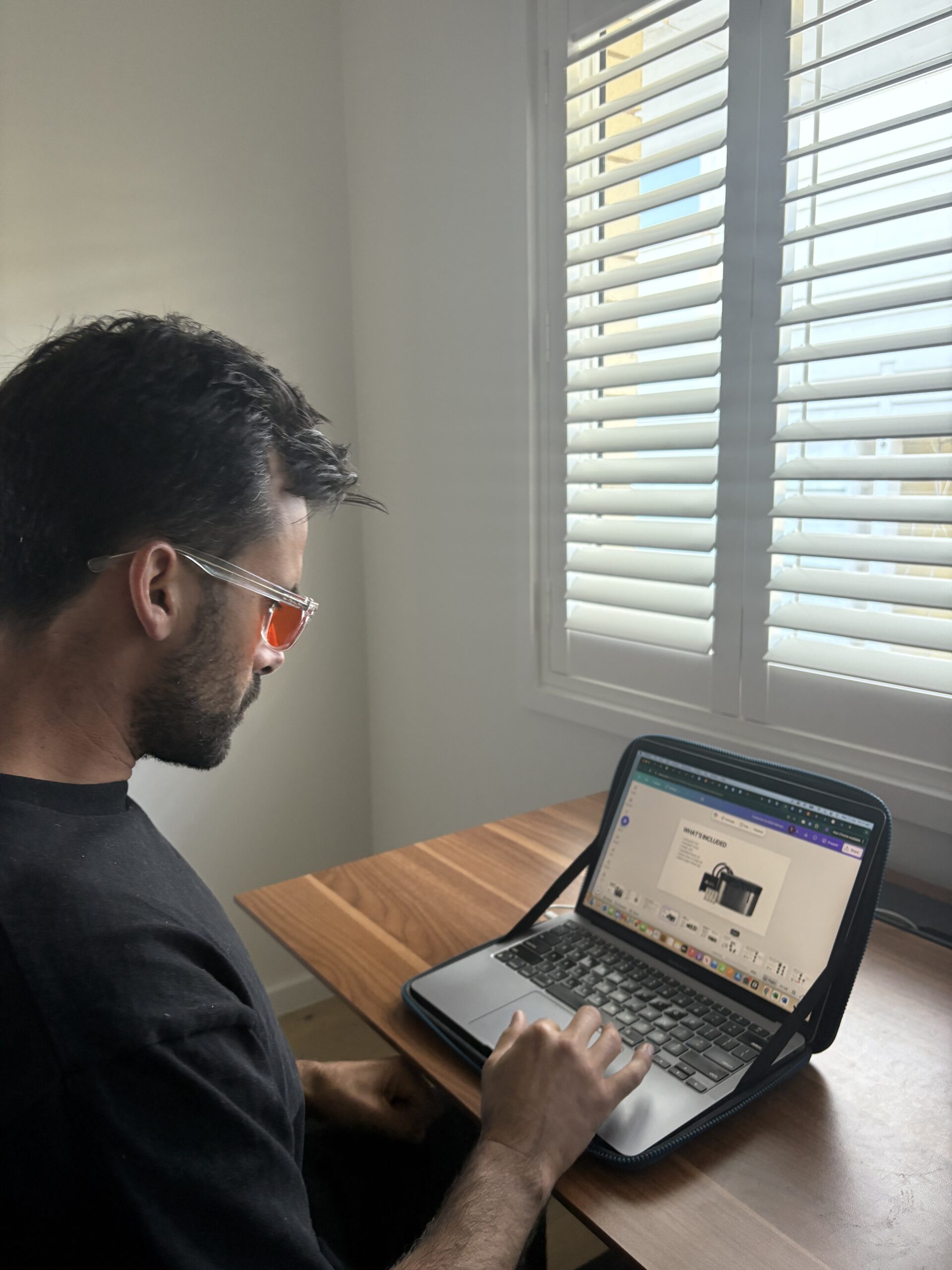
Blue light: I wear glasses with amber lenses from about 7pm onwards. The brand does not matter much — the lens tint does. You want amber, not clear “blue light” lenses, which have negligible effect on melatonin.
Router timer: A basic smart plug with a schedule. The router goes off at 10pm and comes back at 7am. Cost: about $15.
Bedroom measurement habit: Every time I move to a new place, I measure before I set up the bedroom. If RF levels are high at the bed position, I rearrange before I sleep there.
The Short Version
Move your router out of your bedroom or put it on a timer. Get an air filter with a real HEPA filter. Wear amber glasses after 7pm if you work at a screen. Measure your bedroom with an EMF meter before assuming you have a problem — or before assuming you do not. In that order.
I am not selling a program or a supplement. I am not telling you that your WiFi is definitely harming you. I am telling you what I measured, what I changed, and what happened to my data. You can draw your own conclusions.
If you want to start somewhere, the EMF guide covers how to measure your own home, what the numbers mean, and what changes are actually worth making.
Get the Australian Home Environment Checklist
30 checks across water, air and EMF. Most of them free. Ranked by impact.
No spam. Unsubscribe any time.

Former Royal Australian Navy Clearance Diver and TAG-E counter-terrorism operator. Founded Clean and Native to apply the same rigorous thinking to the home environment.
Full biography →