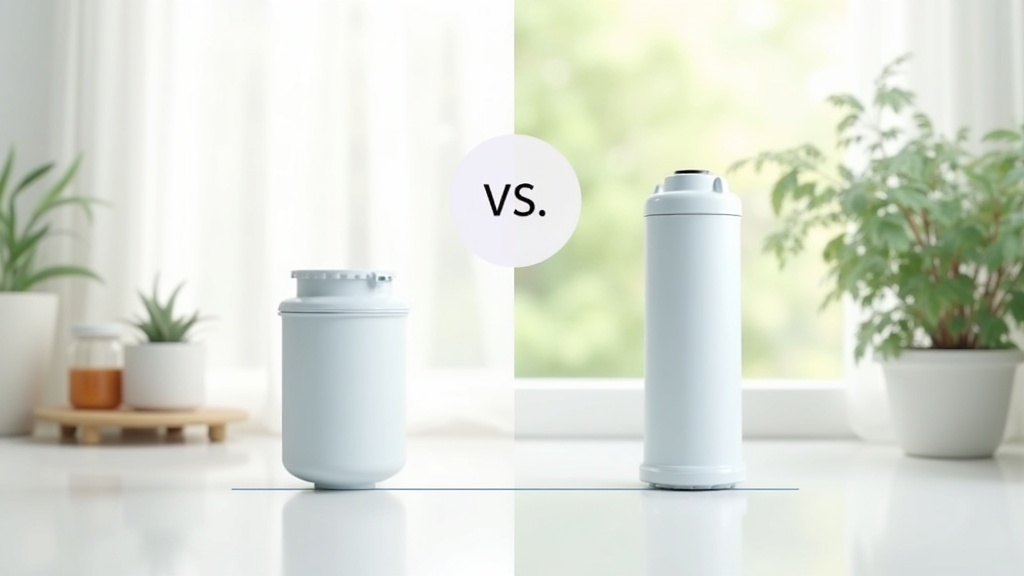
Whole House Water Filter vs Point of Use Water Filter: Which Should You Choose? (Australia 2026)
You are standing in your laundry, looking at the plumbing, wondering whether you should filter every tap in your house or just the one you drink from. As a former Royal Australian Navy Clearance Diver, I can tell you this: the answer depends on what is actually in your water, what you are trying to remove, and how much you are willing to spend over five years — not on marketing claims.
The three products we own are measured first-hand by Jayce Love, former Royal Australian Navy Clearance Diver; every other product is assessed on published manufacturer specifications and independent certification using our documented methodology — no gifted units, no brand payments.
The short answer: A point-of-use (POU) reverse osmosis system removes more contaminants from your drinking water — including fluoride, chloramine, PFAS, and heavy metals — than any whole-house (POE) system at a comparable price. But if you also need to protect your skin, appliances, and shower water from chloramine or sediment, a whole-house filter handles that job. Many Australian households benefit most from both: a basic whole-house sediment/carbon filter paired with a countertop or under-sink RO unit at the kitchen tap.
What Each System Actually Does (and Does Not Do)
Before you spend a dollar, you need to understand the mechanical difference. Marketing blurs this line constantly, and Australian consumers pay the price.
Whole House (Point of Entry / POE) Filters
A whole-house filter sits on your mains water supply line, typically near the water meter or where the pipe enters your home. Every litre of water flowing through your property passes through it — kitchen, bathroom, laundry, garden taps, everything.
The trade-off is filtration depth. Because a whole-house system must handle your entire home’s flow rate (typically 20-40 litres per minute for a 3-bedroom house), the water passes through the media quickly. Fast contact time means less contaminant removal. Most whole-house systems use one or more of these technologies:
- Sediment filters (5-20 micron): Remove dirt, rust, sand. Standard across all systems.
- Granular activated carbon (GAC): Removes free chlorine, some VOCs. Works in Melbourne, Hobart, Canberra, Townsville, and Cairns. Fails on chloramine.
- Catalytic carbon: Removes chloramine. Required for Brisbane/SEQ, Sydney, Adelaide, and Darwin supplies.
- KDF media: Reduces heavy metals and bacteria growth in the filter. Often combined with carbon.
What whole-house filters cannot do: Remove fluoride, dissolved salts (TDS), PFAS, or nitrates. No carbon-based whole-house system achieves this. The physics do not allow it at whole-house flow rates. If anyone tells you otherwise, ask for their NSF 58 certification — they will not have one.
Point of Use (POU) Filters
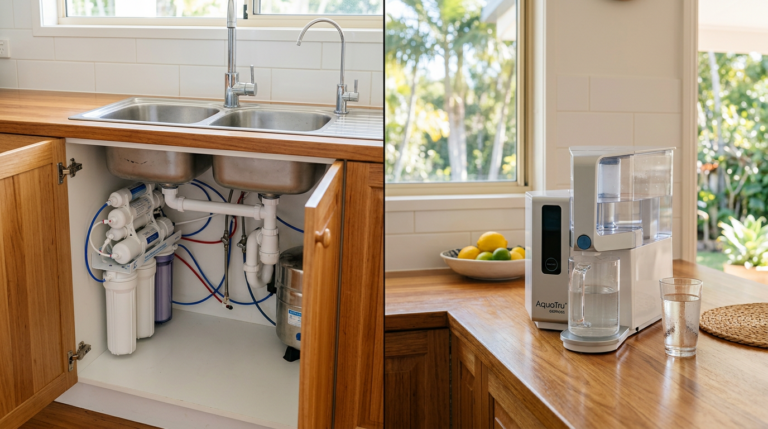
A point-of-use filter sits at a single tap — typically under your kitchen sink or on the countertop. It filters only the water you drink and cook with. Because it treats a fraction of your total water volume (2-8 litres per minute), the water has longer contact time with filtration media, enabling far deeper contaminant removal.
POU technologies range widely:
- Carbon block: Removes free chlorine, VOCs, and some pesticides. Better than GAC due to tighter pore structure. Still cannot remove fluoride or chloramine reliably.
- Catalytic carbon block: Handles chloramine in addition to chlorine. A step up for Brisbane, Sydney, Adelaide, and Darwin households.
- Reverse osmosis (RO): Forces water through a semi-permeable membrane at 0.0001 microns. Removes fluoride (90-97%), chloramine, PFAS, heavy metals, nitrates, and dissolved salts. Certified to NSF 58. This is the benchmark.
- Activated alumina: Specifically targets fluoride. Sometimes used as a standalone POU cartridge or as a stage within an RO system.
If your primary concern is the quality of your drinking water — and for most Australians, it should be — POU reverse osmosis delivers the deepest filtration available at a residential level. Let me show you exactly how the two compare head to head.
Who Should Buy a Whole-House Water Filter
- You live in a chloramine city (Brisbane, Sydney, Adelaide, or Darwin) and want chloramine-free showers and baths. Chloramine is absorbed through the skin and inhaled as vapour. A catalytic carbon whole-house system addresses every outlet. Standard GAC filters and Brita jugs cannot break the chloramine bond.
- You have bore water or tank water with high sediment. Rural and regional properties across Queensland, NSW, and WA often deal with iron staining, manganese, and particulate matter. A whole-house sediment + iron removal system protects plumbing, appliances, and laundry.
- You want to extend the life of your hot water system, dishwasher, and washing machine. Sediment and scale (particularly in hard-water areas like Perth at ~180 mg/L CaCO3 or Adelaide at ~140 mg/L) damages heating elements and seals over time.
- You own the property and plan to stay long-term. Whole-house installation requires a licensed plumber and WaterMark-certified fittings (AS/NZS 3718). It is a permanent infrastructure investment.
- You have young children who drink from bathroom taps. If you cannot control which tap your kids drink from, filtering at the mains covers all outlets.
Who Should Buy a Point-of-Use Water Filter
- You want the deepest possible contaminant removal for drinking water. Only RO achieves 90-97% fluoride removal, >95% PFAS reduction, and >95% heavy metal reduction at residential scale. No whole-house system matches this.
- You rent or live in an apartment. Countertop RO systems like the AquaTru Classic or Waterdrop D6 need zero plumbing modifications. Plug in, fill the tank, drink.
- You want fluoride removed from your drinking water. Carbon filters — whether whole-house or point-of-use — cannot remove fluoride. Full stop. You need reverse osmosis or activated alumina.
- You are on a tight budget. A quality countertop RO starts around $450 AUD. A properly installed whole-house catalytic carbon system starts at $800-$1,500 for the unit alone, plus $200-$500 for plumber installation.
- You live in a free-chlorine city (Melbourne, Hobart, Canberra, Townsville, Cairns) and only care about drinking water quality. Shower water in these cities is easier on skin because free chlorine dissipates faster than chloramine. A POU filter at the kitchen tap handles the drinking water.
Head-to-Head Comparison: Whole House vs Point of Use
| Criterion | Whole House (POE) | Point of Use (POU RO) | What This Means for You |
|---|---|---|---|
| Free Chlorine Removal | Yes — GAC or catalytic carbon (all outlets) | Yes — carbon pre-filter + RO membrane (one tap) | Both handle chlorine. Whole house covers showers too. |
| Chloramine Removal | Yes — requires catalytic carbon specifically | Yes — RO membrane rejects chloramine; catalytic carbon pre-stage also helps | If you are in Brisbane, Sydney, Adelaide, or Darwin, standard GAC fails. Demand catalytic carbon or RO. |
| Fluoride Removal | No. Carbon does not remove fluoride at any flow rate. | Yes — RO removes 90-97% (NSF 58 certified) | If fluoride is your concern, whole house cannot help. You need POU RO or activated alumina. |
| PFAS Removal | Partial — some carbon adsorption, unquantified at whole-house flow rates | Yes — RO achieves >95% rejection of PFOS/PFOA | If you live near an RAAF base (Williamtown NSW, Oakey QLD, Tindal NT) or industrial PFAS contamination zone, POU RO is your minimum standard. |
| Heavy Metals (Lead, Copper, Mercury) | Partial — KDF media reduces some metals | Yes — RO typically achieves >95% reduction (NSF 53 / NSF 58) | Older homes with pre-1980s copper or lead solder joints benefit most from POU RO at the drinking tap. |
| Sediment Removal | Yes — 5-20 micron pre-filter (all outlets) | Yes — sediment pre-filter (one tap only) | Whole house protects all appliances. Critical for bore water and tank water properties. |
| TDS Reduction | No. Carbon does not reduce TDS. | Yes — RO reduces TDS by 85-98% | Perth water at ~180 mg/L TDS and Adelaide at ~140 mg/L benefit from TDS reduction for taste. |
| Flow Rate | 20-40+ LPM (matched to household demand) | 0.5-2 LPM for RO (tank systems compensate) | Whole house delivers uninterrupted pressure to all taps. POU RO is slow but fills a storage tank automatically. |
| Installation | Licensed plumber required. WaterMark-certified fittings (AS/NZS 3718). $200-$500 labour. | Under-sink: plumber recommended. Countertop: zero installation. | Renters and apartment dwellers can only realistically use countertop POU units. |
| Certifications to Look For | WaterMark compliance, NSF 42 (aesthetic) | NSF 58 (RO membrane), NSF 53 (health contaminants), NSF 42 (aesthetic) | NSF 58 is the gold standard for RO. Always verify the claim on the NSF website directly. |
Clean Water
The right filter removes what this article describes.
Reverse osmosis is the only residential technology that reliably removes PFAS, fluoride, chloramine, and heavy metals.
See the Top-Rated Water Filters →Australian Water Chemistry: Why Your City Matters
Australia does not have one water supply. It has dozens, and the chemistry varies dramatically. The filter that works perfectly in Melbourne may fail completely in Brisbane. Here is what you need to know by city.
Chloramine Cities: Brisbane/SEQ, Sydney, Adelaide, Darwin
These cities use chloramine (a combination of chlorine and ammonia) as a long-lasting disinfectant. Chloramine is harder to remove than free chlorine because the molecular bond is more stable. Standard granular activated carbon (GAC) — the type in Brita jugs, most fridge filters, and cheap whole-house cartridges — does not break the chloramine bond effectively.
If you are buying a whole-house system in any of these cities, you must specify catalytic carbon media. Standard coconut-shell GAC is insufficient. This is the single most common mistake I see Australian buyers make. The filter looks like it is working because the water tastes slightly better, but chloramine is still passing through.
For POU units, reverse osmosis membranes reject chloramine directly. The RO membrane does the heavy lifting, and a catalytic carbon pre-filter extends the membrane’s lifespan.
Free Chlorine Cities: Melbourne, Hobart, Canberra, Townsville, Cairns
These cities use free chlorine for disinfection. Standard GAC carbon removes free chlorine effectively at both whole-house and POU flow rates. You have more options and can spend less.
Melbourne’s water is notably soft at ~25 mg/L CaCO3, sourced from protected catchments in the Yarra Ranges. Sediment is minimal. A Melbourne household concerned only about chlorine taste might find a simple carbon block POU filter sufficient for drinking water, with no whole-house system needed.
Hardness and TDS by City
| City | Disinfection Method | Hardness (mg/L CaCO3) | Implication |
|---|---|---|---|
| Melbourne | Free chlorine | ~25 | Very soft. Standard carbon works. Low scale risk. |
| Brisbane / SEQ | Chloramine | ~80-120 | Moderate hardness. Catalytic carbon required. Scale builds in hot water systems. |
| Sydney | Chloramine | ~40-80 | Catalytic carbon required. Moderate hardness. |
| Adelaide | Chloramine | ~140 | Hard water. Catalytic carbon + sediment filtration. Consider scale inhibitor for hot water. |
| Perth | Chloramine | ~180 | Hardest capital city water. Catalytic carbon mandatory. Whole-house sediment filter strongly recommended. |
| Hobart | Free chlorine | ~20-40 | Soft water. Standard carbon works fine. |
| Canberra | Free chlorine | ~30-50 | Soft to moderate. Standard carbon sufficient. |
| Darwin | Chloramine | ~30-60 | Catalytic carbon required despite soft water. |
Your city’s water chemistry should be the first thing you check before buying any filter. The Australian Drinking Water Guidelines (ADWG) set health and aesthetic guidelines, but your local water utility’s annual water quality report provides the actual numbers. Download it, read it, and match your filter to it.
The Fluoride Question: Why Whole House Cannot Help
This needs its own section because it is the most misunderstood topic in Australian water filtration. Fluoride is added to drinking water across most Australian capital cities at approximately 0.6-1.0 mg/L, per state health department mandates.
Carbon — in any form, at any flow rate, in any configuration — does not remove fluoride. Not GAC, not carbon block, not catalytic carbon. The fluoride ion is too small and does not adsorb to carbon surfaces. Anyone selling a “fluoride removal” whole-house carbon filter is either misinformed or deliberately misleading you.
Only two residential technologies reliably remove fluoride:
- Reverse osmosis: 90-97% fluoride rejection. Certified under NSF 58. The gold standard.
- Activated alumina: Adsorbs fluoride ions. Effective but requires careful pH control and regular media replacement. Less practical for most households than RO.
Both of these technologies are practical only at point-of-use scale. Running your entire house’s water volume through an RO membrane is technically possible but prohibitively expensive (systems start at $5,000-$15,000 AUD, plus significant wastewater generation). For the vast majority of Australian households, a POU RO system at the kitchen tap is the correct solution for fluoride.
If fluoride removal matters to you, skip the whole-house debate entirely for this contaminant and go straight to POU RO. The next section helps you calculate the full cost.
5-Year Cost Comparison
The upfront price is not the real price. Filters need replacement cartridges, membranes, and occasionally professional servicing. Here is what five years actually costs across the most common configurations for an Australian household.
| System Type | Upfront Cost (AUD) | Annual Running Cost (AUD) | 5-Year Total (AUD) |
|---|---|---|---|
| Whole House — Basic Sediment + GAC (twin housing) | $300-$500 + $250 install | $80-$120 (replacement cartridges every 6-12 months) | $950-$1,350 |
| Whole House — Catalytic Carbon (for chloramine cities) | $800-$1,500 + $300-$500 install | $150-$300 (media replacement every 12-24 months) | $1,850-$3,500 |
| Whole House — Premium multi-stage (sediment + catalytic carbon + KDF) | $1,500-$3,000 + $400-$600 install | $200-$400 | $2,900-$5,600 |
| POU — Countertop RO (AquaTru Classic) | ~$549 | $80-$120 (filter replacements) | $949-$1,149 |
| POU — Countertop RO (Waterdrop D6) | ~$499 | $90-$130 (filter replacements) | $949-$1,149 |
| POU — Under-sink RO (e.g., Waterdrop G3P800) | $600-$900 + $150-$250 install | $100-$150 | $1,250-$1,900 |
| POU — Carbon block tap filter (Tappwater EcoPro) | ~$99 | $60-$80 (cartridge every 3 months) | $399-$499 |
| Combined: Basic Whole House Sediment + Countertop RO | ~$900-$1,100 | $160-$240 | $1,700-$2,300 |
The combined approach — a basic whole-house sediment filter to protect your plumbing and appliances, plus a countertop RO unit for drinking water — delivers the best outcome for most Australian households at a competitive 5-year cost. You get whole-house sediment protection plus NSF 58 certified contaminant removal at the drinking tap.
Decision Tree: 3 Questions to Your Answer
Cut through the noise. Answer these three questions in order.
Question 1: Do you need fluoride, PFAS, or heavy metal removal from your drinking water?
Yes → You need a point-of-use RO system. No whole-house carbon filter achieves this. If you also want shower/bath protection, add a basic whole-house sediment and catalytic carbon filter on the mains.
No → Move to Question 2.
Question 2: Do you live in a chloramine city (Brisbane, Sydney, Adelaide, or Darwin)?
Yes → You need catalytic carbon somewhere in your system. If you want chloramine-free showers and baths, that means whole-house catalytic carbon. If you only care about drinking water, a POU filter with catalytic carbon pre-filtration or RO will do.
No → Move to Question 3.
Question 3: Do you own or rent?
Own → You can install either system. A basic whole-house sediment filter ($300-$500 installed) protects your investment in appliances and plumbing. Add a POU RO at the kitchen for drinking water if desired.
Rent → Go POU. A countertop RO like the AquaTru Classic or Waterdrop D6 requires zero plumbing, zero landlord permission, and moves with you. A tap-mounted filter like the Tappwater EcoPro is the budget option if you are in a free-chlorine city and do not need fluoride removal.
Common Mistakes Australians Make
Mistake 1: Buying a GAC Whole-House Filter in a Chloramine City
This is the most expensive mistake. You spend $800+ on a whole-house system, feel good about it, and chloramine sails straight through. If you are in Brisbane, Sydney, Adelaide, or Darwin, insist on catalytic carbon media. Ask the supplier directly: “Is this catalytic carbon or standard GAC?” If they cannot answer clearly, walk away.
Mistake 2: Believing a Whole-House Filter Removes Fluoride
Some Australian filter retailers market “fluoride reduction” whole-house systems using bone char or specialised media. The contact time at whole-house flow rates (20-40 LPM) is too short for meaningful fluoride removal. Independent testing at residential flow rates consistently shows negligible reduction. Do not pay a premium for this claim without NSF 58 certification at the specified flow rate.
Mistake 3: Skipping Sediment Pre-Filtration
Whether you choose whole-house or POU, a sediment pre-filter is not optional. Australian mains water can carry fine particles from ageing pipe infrastructure — particularly in older suburbs across Sydney’s inner west, Brisbane’s south side, and Adelaide’s inner suburbs. Sediment clogs carbon media prematurely and damages RO membranes. A $20 sediment cartridge extends the life of your primary filtration media by months.
Mistake 4: Ignoring WaterMark Compliance
Any plumbing product connected to Australia’s mains water supply must comply with WaterMark certification under AS/NZS 3718. This is a legal requirement, not a suggestion. If your plumber installs a non-WaterMark-certified fitting and a failure causes water damage, your insurance claim may be rejected. Always check the WaterMark licence number on the product or fitting.
Mistake 5: Over-Filtering Shower Water
You do not need RO-quality water in your shower. A basic catalytic carbon or vitamin C shower filter is sufficient to reduce chloramine. Save the RO budget for the tap you drink from.
Special Cases: Bore Water, Tank Water, and Bushfire-Affected Areas
Bore Water (Regional QLD, WA, SA, NSW)
Bore water varies wildly. Some bores deliver water with iron levels above 5 mg/L, manganese staining, and TDS exceeding 1,000 mg/L. A whole-house system is mandatory here — typically a multi-stage setup with sediment removal, iron/manganese oxidation, and carbon polishing. POU RO at the kitchen tap should be added for drinking water, as bore water may contain nitrates, arsenic, and other dissolved contaminants that carbon alone cannot address.
Tank Water (Rural and Semi-Rural Australia)
Rainwater tanks can harbour bacteria, bird and animal faecal matter, leaf tannins, and roof runoff contaminants. The ADWG does not regulate private supplies, but the same quality principles apply. A whole-house UV steriliser combined with sediment filtration addresses microbial risk. POU RO handles any dissolved contaminants.
Bushfire-Affected Areas (NSW and Victorian Bushfire Season, November-March)
Post-bushfire runoff introduces PAHs (polycyclic aromatic hydrocarbons), heavy metals from burnt structures, and dramatically elevated turbidity into water catchments. Suburbs in the Blue Mountains (NSW), Gippsland (VIC), and the Adelaide Hills (SA) have experienced this repeatedly. A whole-house sediment filter becomes critical to protect your plumbing during and after bushfire events. POU activated carbon removes PAHs from drinking water, and RO provides the deepest protection.
Can You Use Both? The Layered Approach
Yes. And for many Australian households, this is the correct answer.
Here is the layered system I recommend for most homeowners in chloramine cities:
- Whole-house sediment pre-filter (5 micron): Catches particulate matter before it reaches your plumbing and appliances. ~$150-$300 for the housing and first cartridge, plus plumber installation.
- Whole-house catalytic carbon filter: Removes chloramine from every outlet — showers, baths, laundry. ~$600-$1,200 for the unit.
- Point-of-use countertop or under-sink RO: NSF 58 certified. Removes fluoride, PFAS, heavy metals, nitrates, and residual TDS from drinking and cooking water. ~$450-$900.
Total investment: $1,200-$2,400 installed. This gives you chloramine-free water at every tap, sediment-protected appliances, and the deepest possible contaminant removal where it matters most — the water your family drinks.
For homeowners in free-chlorine cities (Melbourne, Hobart, Canberra, Townsville, Cairns), you can simplify: a basic whole-house sediment filter plus a POU RO at the kitchen tap. Skip the catalytic carbon stage. Total investment: $700-$1,300 installed.
What About Water Softeners?
Water softeners are a separate category. They use ion exchange resin to replace calcium and magnesium ions with sodium ions, reducing scale buildup. They are most relevant in Perth (~180 mg/L CaCO3) and Adelaide (~140 mg/L).
A water softener is not a filter. It does not remove contaminants, chloramine, fluoride, or PFAS. It only addresses hardness. If you need both softening and filtration, they are separate systems. The softener goes first on the mains line (after the sediment filter), followed by the carbon filter. POU RO at the kitchen tap completes the setup.
Note: Softened water adds sodium. If you are on a sodium-restricted diet, do not drink softened water without running it through RO first. RO removes the added sodium.
Installation Requirements: What Your Plumber Needs to Know
Whole-House Systems
- Must be installed by a licensed plumber.
- All fittings must be WaterMark-certified (AS/NZS 3718).
- Install after the water meter but before the first branch in your plumbing (usually near the front of the house or in the garage).
- Ensure a bypass valve is installed so you can service filters without shutting off the entire house.
- Confirm your plumber understands the flow rate requirements — an undersized system will cause pressure drops at multiple taps.
- Budget $200-$500 for installation labour depending on complexity and location.
Under-Sink POU Systems
- Most under-sink RO units connect to the cold water line under the kitchen sink via a T-piece adaptor.
- A separate dispensing faucet is typically mounted through the sink or benchtop (requires drilling a hole if one does not exist).
- WaterMark-certified fittings apply to any connection to mains plumbing.
- Budget $150-$250 for plumber installation if you are not comfortable doing it yourself.
Countertop POU Systems
- No plumbing required. Fill the upper reservoir manually.
- The AquaTru Classic and Waterdrop D6 both plug into a standard Australian 240V outlet.
- Benchtop footprint: approximately 30-40cm wide x 30-40cm deep. Measure your kitchen bench before buying.
- No plumber, no landlord permission, no WaterMark concerns because there is no connection to mains plumbing.
How to Verify Filter Claims: The Australian Buyer’s Checklist
Before you hand over money, run through this checklist:
- Ask for the NSF certification number. NSF 58 for RO. NSF 53 for health contaminant reduction. NSF 42 for aesthetic (taste/odour). If the seller cannot provide it, the claim is unverified.
- Check WaterMark certification. For any product connected to mains plumbing. Search the WaterMark database at www.abcb.gov.au.
- Confirm the carbon type. “Carbon” is not specific enough. Is it GAC, carbon block, or catalytic carbon? In chloramine cities, only catalytic carbon is acceptable.
- Ask about the tested flow rate. A filter might remove 95% of a contaminant at 0.5 LPM but only 40% at 5 LPM. Always check what flow rate the test was conducted at.
- Verify fluoride claims independently. If a product claims fluoride removal without RO or activated alumina technology, request the independent lab report. If it does not exist, the claim is marketing.
- Check the wastewater ratio for RO systems. Modern systems run 2:1 to 3:1 (filtered:waste). Older systems can waste 4-5 litres for every litre filtered. Ask before you buy.
Final Verdict
For most Australian households in 2026, the answer is not either/or — it is a layered approach.
If you can only choose one, choose a point-of-use reverse osmosis system for your kitchen. It removes more contaminants from your drinking water than any whole-house system at any price. The AquaTru Classic and Waterdrop D6 are the strongest countertop options for Australians who rent or want zero-install simplicity.
If you own your home, add a whole-house sediment filter (and catalytic carbon if you are in a chloramine city) to protect your plumbing, appliances, and shower water. Budget $1,200-$2,400 total for the layered setup.
If you rent, a countertop RO is your single best investment. It goes where you go, needs no plumber, and delivers NSF 58 certified contaminant removal for under $550 upfront.
Do not overthink this. Check your city’s disinfection method, decide if fluoride removal matters to you, and pick the configuration that matches. Your water quality will improve measurably on day one.
Ready to filter your water?
We have ranked the best countertop and under-sink RO systems available in Australia.
Countertop Filter Guide →Frequently Asked Questions
Do whole-house water filters remove fluoride?
No. Carbon-based whole-house filters — whether GAC, carbon block, or catalytic carbon — cannot remove fluoride. The fluoride ion does not adsorb to carbon surfaces. Only reverse osmosis (90-97% removal) or activated alumina reliably removes fluoride, and both are practical only at point-of-use scale for residential homes.
Can I use a Brita filter instead of a whole-house or POU system?
Brita jug filters use standard granular activated carbon. They reduce free chlorine taste and odour in cities like Melbourne, Hobart, and Canberra. They fail on chloramine (Brisbane, Sydney, Adelaide, Darwin), fail on fluoride, and fail on PFAS. A Brita jug is not a substitute for a proper POU filter system.
Is a whole-house water filter worth it in Melbourne?
Melbourne has soft water (~25 mg/L CaCO3) and uses free chlorine, making it one of the easiest Australian cities to filter. A basic whole-house sediment + GAC system protects appliances and removes chlorine taste from all outlets. However, if your only concern is drinking water quality, a POU carbon block or RO at the kitchen tap is more cost-effective.
What is the best whole-house filter for Brisbane?
Brisbane (SEQ Water) uses chloramine disinfection. Any whole-house system must use catalytic carbon media — not standard GAC. Look for systems explicitly rated for chloramine reduction at your household’s flow rate (typically 20-40 LPM). Pair it with a POU RO at the kitchen tap if you want fluoride and PFAS removal.
How often do I need to replace whole-house water filter cartridges?
Sediment cartridges typically need replacement every 3-6 months depending on water quality. Carbon cartridges last 6-12 months. Catalytic carbon media in larger tank-style systems can last 12-24 months. Always follow the manufacturer’s recommended schedule and monitor your water pressure — a drop in pressure indicates a clogged cartridge.
Do point-of-use RO systems waste a lot of water?
Modern countertop RO systems like the AquaTru Classic and Waterdrop D6 have waste ratios of approximately 2:1 to 3:1 (waste to filtered). This means 2-3 litres of wastewater per litre of drinking water. You can collect the wastewater for watering plants or cleaning — it is still cleaner than untreated tap water. Older or cheaper RO systems may waste 4-5 litres per litre filtered, so check the ratio before buying.
Do I need a plumber to install a whole-house water filter?
Yes. Any product connected to Australian mains water plumbing must be installed by a licensed plumber using WaterMark-certified fittings (AS/NZS 3718). This is a legal requirement. Budget $200-$500 for installation labour. Countertop POU systems do not require plumbing and can be set up by anyone in minutes.
Can a whole-house filter improve my water pressure?
No. A whole-house filter will slightly reduce water pressure because water must pass through the filtration media. A properly sized system minimises this drop to under 5 psi. An undersized system or a clogged cartridge will cause noticeable pressure loss. Always size the system to your household’s peak flow rate demand.
What is the difference between NSF 42, NSF 53, and NSF 58?
NSF 42 certifies aesthetic contaminant reduction (chlorine taste, odour, clarity). NSF 53 certifies health-related contaminant reduction (lead, cysts, VOCs). NSF 58 certifies reverse osmosis membrane performance (TDS, fluoride, arsenic, nitrates, PFAS). For drinking water safety, NSF 53 and NSF 58 are the certifications that matter. Always verify claims on the NSF website directly.
Should you filter all the water in your house or just the drinking tap?
It depends on your priority. If chloramine in shower steam, bath water, and laundry water concerns you, whole-house filtration addresses all outlets. If your primary concern is what your family drinks and cooks with, a POU RO system at the kitchen tap delivers deeper contaminant removal at a lower cost. The ideal setup for most Australians is both: a basic whole-house sediment/carbon filter for general protection, plus POU RO at the kitchen tap for drinking water.
Our Top-Rated Water Filters
Point-of-use RO delivers the cleanest drinking water for the lowest upfront cost — no plumber required. The AquaTru Classic removes PFAS, fluoride, chloramine, and heavy metals.
Get the Australian Home Environment Checklist
30 checks across water, air and EMF. Most of them free. Ranked by impact.
No spam. Unsubscribe any time.

Former Royal Australian Navy Clearance Diver and TAG-E counter-terrorism operator. Founded Clean and Native to apply the same rigorous thinking to the home environment.
Full biography →