Wollongong Tap Water Quality 2026: Chloramine, the PFBA Detection and What Filters Work
Affiliate disclosure: Clean and Native earns a commission if you purchase through links on this page. This does not affect our editorial position — products are recommended based on performance data and certification only.
Quick answer
The three products we own are measured first-hand by Jayce Love, former Royal Australian Navy Clearance Diver; every other product is assessed on published manufacturer specifications and independent certification using our documented methodology — no gifted units, no brand payments.
Wollongong’s drinking water is supplied by Sydney Water from Avon Dam in the Illawarra escarpment ranges, treated at the Illawarra Water Filtration Plant west of the city. Disinfection is chloramine (NSW-wide). Hardness is soft (~40-60 mg/L) from the sandstone escarpment catchment. Fluoride is added at approximately 1.0 mg/L. In November 2024, a spike of PFBA (perfluorobutanoic acid) was detected at Illawarra WFP at 49 ng/L — however there is no ADWG health guideline for PFBA, and PFOS/PFOA at Illawarra are below all updated June 2025 limits. Sydney Water declared the Illawarra supply PFAS-free in 2024 in relation to PFOS and PFOA specifically.
NSW-wide
Soft
Illawarra escarpment
June 2025 update
Wollongong’s water quality story has two distinct elements. The basic supply characteristics — soft, chloramine-disinfected, fluoridated, from a protected escarpment catchment — are straightforward. The PFAS picture is more nuanced: a PFBA spike detected at Illawarra WFP in November 2024 generated local concern, but PFBA currently has no ADWG health guideline, and the PFAS compounds that do have guidelines (PFOS and PFOA) are below updated June 2025 limits. Sydney Water’s declaration that Illawarra water is “PFAS-free” referred specifically to PFOS and PFOA. Understanding the distinction between different PFAS compounds — and what filtration addresses which — is the most useful thing a Wollongong resident can know.
Where Wollongong’s water comes from
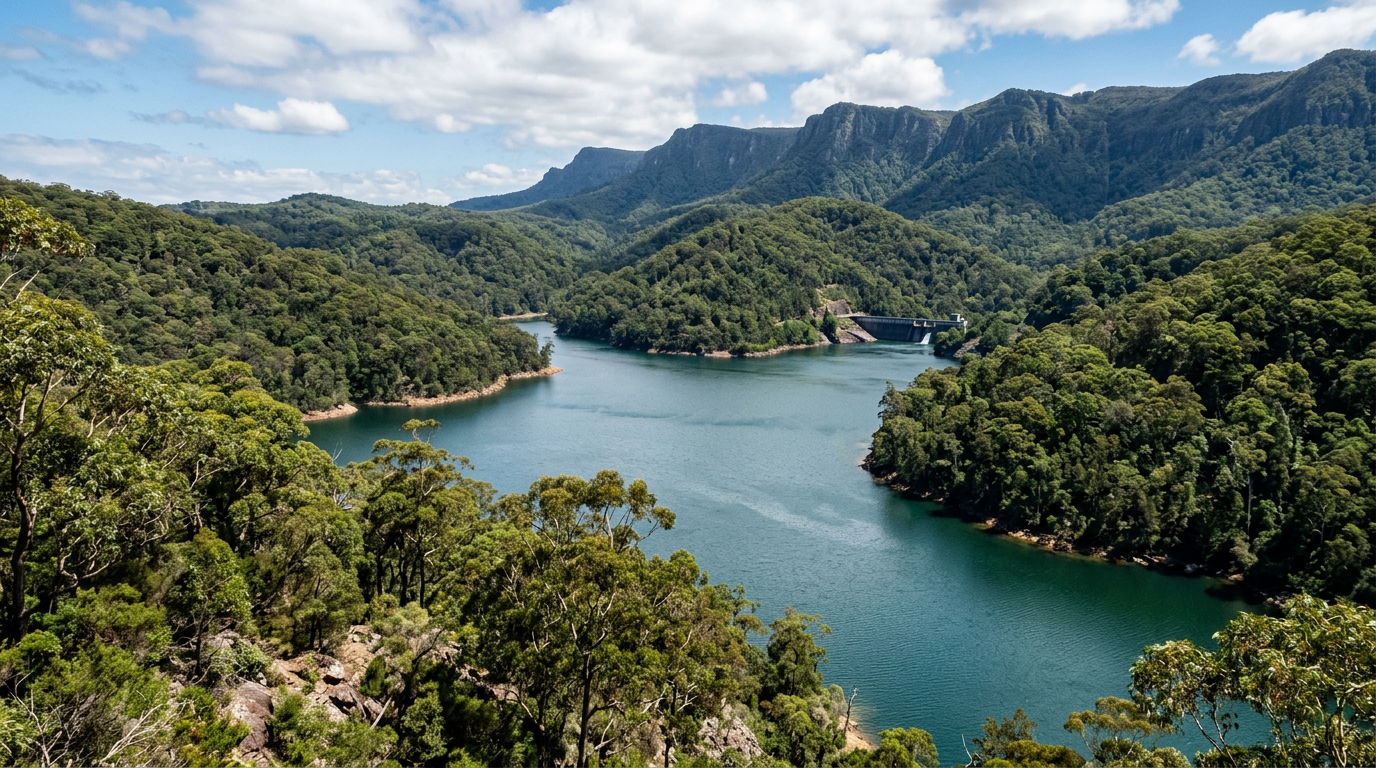
Sydney Water manages the Illawarra water supply as part of its 12,700 km2 operational area covering Sydney, the Illawarra, and the Blue Mountains. The primary source is Avon Dam on the Avon River in the Illawarra escarpment ranges west of Wollongong. Fitzroy Falls Dam in the Southern Highlands provides supplementary supply. Raw water is treated at the Illawarra Water Filtration Plant (Illawarra WFP) located west of Wollongong before distribution into the Illawarra network.
The escarpment catchment — predominantly forested national park and protected land on the Illawarra Ranges — provides relatively clean source water with minimal agricultural or industrial contamination. The sandstone geology produces soft water low in calcium and magnesium, consistent with the soft water profile found across most of Sydney’s supply network. This is why Wollongong water does not have the hardness issues seen in cities like Perth, Adelaide, or parts of inland Queensland.
The November 2024 PFBA detection — what it means
In November 2024, a spike of PFBA (perfluorobutanoic acid) was detected at Illawarra Water Filtration Plant at 49 ng/L. This generated concern given the broader context of PFAS awareness in Australia. The important technical distinction: PFBA is a short-chain PFAS compound for which the Australian Drinking Water Guidelines currently set no health-based guideline value. The ADWG health limits apply to PFOS (8 ng/L), PFOA (4 ng/L), PFHxS, and PFBS. Illawarra WFP’s PFOS and PFOA results have been below these limits.
Sydney Water’s 2024 statement that Illawarra water is “PFAS-free” was specifically in relation to the regulated PFAS compounds with ADWG health guidelines — PFOS and PFOA. This is consistent with the NSW Government’s confirmation that all NSW water supplies meet the updated June 2025 ADWG limits. PFBA is detected in many Sydney-area water supplies, and research into its health effects and appropriate regulatory limits is ongoing internationally.
Friends of the Earth Australia’s independent analysis of PFAS detections across Sydney-area treatment plants found that PFBA spiked at multiple WFPs in October-November 2024, with Illawarra recording 49 ng/L on November 11. The cause is not definitively established — researchers have noted that rainfall events correlate with some detections, suggesting atmospheric deposition as one potential pathway. For a full explanation of the PFAS situation in NSW, see our comprehensive PFAS in Australian drinking water guide.
Wollongong water quality data
| Parameter | Wollongong (Illawarra zone) | Filtration relevance |
|---|---|---|
| Disinfection | Chloramine (NSW-wide) | Standard carbon insufficient. Catalytic carbon or RO required. |
| Hardness | ~40-60 mg/L (soft) | Sandstone escarpment catchment. Minimal scale. No softener needed. |
| Fluoride | ~1.0 mg/L | NSW mandated. RO removes 93%+. |
| PFOS/PFOA | Below June 2025 ADWG limits | Sydney Water confirmed PFAS-free for regulated compounds. NSW Gov confirmed compliance. |
| PFBA | Spike 49 ng/L detected Nov 2024 | No ADWG guideline for PFBA. RO removes short-chain PFAS. Research ongoing. |
Chloramine taste — catalytic carbon
NSF 42-certified catalytic carbon removes chloramine and taste compounds from Wollongong’s supply. NSW uses chloramine across the entire Sydney and Illawarra network — standard carbon is not effective here. The TAPP EcoPro is independently certified for chloramine removal.
Recommended: TAPP EcoPro — catalytic carbon, NSF 42 + 53
See the TAPP EcoPro on Amazon AU →PFBA concern + comprehensive — RO
For households concerned about the PFBA detections at Illawarra WFP, RO removes short-chain PFAS compounds along with chloramine, fluoride, and all dissolved compounds. The ADWG does not yet set a guideline for PFBA, but the precautionary case for RO is clear if you want comprehensive coverage.
Recommended: EcoHero 5-Stage RO — WaterMark + NSF 58
See the EcoHero RO System →Take the water filter quiz for a personalised recommendation based on your specific concerns, or see the complete best water filters Australia guide.
Our Top-Rated Water Filters
Reverse osmosis is the only residential technology that reliably removes PFAS, fluoride, chloramine, and heavy metals — the four contaminants most Australians are most exposed to.
Frequently asked questions
What water filter works for Wollongong tap water?
Because Wollongong uses chloramine, catalytic carbon (such as TAPP EcoPro, NSF 42/53-certified) or reverse osmosis are the appropriate filter types. Standard carbon block filters are not effective on chloramine. For PFBA concerns, reverse osmosis is the most comprehensive option.
Is Wollongong water hard or soft?
Wollongong water is soft at approximately 40–60 mg/L as CaCO3 from Avon Dam in the Illawarra sandstone escarpment. No scale issues and no need for a water softener.
What is the TDS of Wollongong tap water?
Wollongong TDS is typically 60–90 mg/L, reflecting Avon Dam’s soft, low-mineral sandstone catchment. This is low by Australian standards.
Does Wollongong tap water have fluoride?
Yes. Sydney Water adds fluoride at approximately 1.0 mg/L per NSW Health policy across its entire network including the Illawarra supply. Reverse osmosis removes 93%+ if reduction is a priority.
Can I drink Wollongong tap water without filtering?
Yes. Wollongong tap water meets all ADWG health guidelines. PFOS and PFOA are below updated June 2025 limits. The PFBA detection is below any ADWG guideline value. Filtration is a personal preference choice, not a health requirement.
Does Wollongong water have PFAS?
Wollongong’s PFAS status has two layers. For PFOS and PFOA, the compounds with ADWG health guidelines, Sydney Water confirmed compliance across all Illawarra WFP results against the updated June 2025 limits. Sydney Water declared the supply PFAS-free in 2024 in relation to PFOS and PFOA. A separate spike of PFBA (perfluorobutanoic acid) was detected at 49 ng/L in November 2024. There is no ADWG guideline for PFBA and it is not regulated, but reverse osmosis removes short-chain PFAS including PFBA. Standard carbon filters are not rated for any PFAS.
Is Wollongong tap water safe to drink?
Yes. Sydney Water supplies Wollongong from Avon Dam via the Illawarra Water Filtration Plant. The NSW Government confirmed all Sydney Water supplies meet updated June 2025 ADWG guidelines including the new, more stringent PFAS limits. PFOS and PFOA (the regulated PFAS compounds) are below all health guidelines.
PFAS? PFOS/PFOA below limits. PFBA spike (49 ng/L) detected Nov 2024 — no ADWG guideline for PFBA. RO removes short-chain PFAS.
Does Wollongong water have chloramine?
Yes. Sydney Water uses chloramine as the primary disinfectant across its network including the Illawarra supply. Standard activated carbon filters are not effective for chloramine removal. Catalytic carbon certified specifically for chloramine removal, or reverse osmosis, is required.
Get the Australian Home Environment Checklist
30 checks across water, air and EMF. Most of them free. Ranked by impact.
No spam. Unsubscribe any time.

Former Royal Australian Navy Clearance Diver and TAG-E counter-terrorism operator. Founded Clean and Native to apply the same rigorous thinking to the home environment.
Full biography →