Best Air Purifier for Cooking Smells in Australia (2026)
Independently Tested
Jayce Love tests every recommended product personally — with calibrated instruments, no gifted units, and no brand payments. See our testing process →
Activated carbon is the non-negotiable ingredient in any air purifier that actually removes cooking smells — and most units on the market have too little of it. Of the three units tested in 2026, the Breville Protect Max (~$449) delivers the largest carbon bed (500 g) and the fastest odour clearance for large open-plan kitchens, the Levoit Core 400S (~$299) is the best-value pick for kitchens up to 40 m², and the Winix Zero Pro (~$299) offers the lowest ongoing filter cost thanks to a washable pre-filter stage. All three are stocked on Amazon AU with next-day delivery to most Australian capitals.
I’m Jayce Love, former Royal Australian Navy Clearance Diver, now based in South East Queensland. I’ve tested every unit below across real cooking sessions — fish curry, high-heat stir-fry, garlic and onion sautéing, grilled bacon — using a calibrated VOC meter to measure clearance time to baseline. Every recommendation below has been tested using our documented methodology — no gifted units and no brand payments.
Only purifiers with a substantive activated carbon bed (≥300 g) neutralise cooking VOCs — the Breville Protect Max is the best overall pick, Levoit Core 400S the best value, and the Winix Zero Pro the lowest ongoing cost. HEPA-only purifiers clear visible smoke but leave the smell. The catches: the Breville is the most expensive upfront and its filter runs $89/yr; the Levoit needs 6–8 month filter cycles under heavy cooking; the Winix covers only 35 m².
| Purifier | Carbon bed / Coverage | Verdict |
|---|---|---|
| Breville Protect Max | 500 g / 55 m² | Best Overall |
| Levoit Core 400S | 360 g / 40 m² | Best Value |
| Winix Zero Pro | ~400 g / 35 m² | Lowest Ongoing Cost |
✓ Who This Guide Is For
- Households where cooking smells linger for hours after meals
- Anyone frying, grilling, or using high-heat methods regularly
- Open-plan kitchen/living layouts where odours spread into bedrooms
- Those whose range hood doesn’t solve the problem
- Brisbane/SEQ residents dealing with chloramine-heavy water that amplifies cooking smells
× Who This Guide Is Not For
- Anyone whose only concern is dust or pet dander — a HEPA-only unit suffices
- Households with excellent mechanical ventilation and infrequent cooking
- Those needing a whole-house ducted solution
- Budgets under $200 — carbon beds at that price point are too small to last
Why Cooking Smells Demand Activated Carbon, Not Just HEPA
Standard HEPA filters are exceptional at capturing particles: smoke aerosols, grease droplets, pet dander, pollen. What they cannot do is capture gas-phase molecules. Cooking odours are largely volatile organic compounds (VOCs) — acrolein from high-heat oils, trimethylamine from fish, allyl methyl sulphide from garlic. These molecules pass straight through HEPA media as though the filter were not there.
Activated carbon works through adsorption — VOC molecules bond chemically to the porous carbon surface and are held there. The key variable is carbon mass. Many budget purifiers include a thin carbon-impregnated mesh weighing 20–30 g — enough to absorb cooking smells for a week, then saturate and stop working. The three purifiers in this guide use granular or pelletised carbon beds of at least 360 g, which remain effective for six to twelve months under regular cooking conditions.
For a real kitchen you need both: HEPA to pull grease particles and smoke aerosols out of the air before they coat surfaces, and a substantive carbon bed to neutralise the odour compounds. A range hood exhausts air outside — effective, but it also drags conditioned air with it. An air purifier recirculates and cleans, which is why the two are complementary rather than competing solutions.
How to Size an Air Purifier for Your Kitchen
Air purifier ratings use CADR (Clean Air Delivery Rate) in cubic metres per hour. For cooking odour control the target is at least 5 air changes per hour (ACH) in the affected space — more than the standard 2–3 ACH recommended for general air quality, because cooking generates VOC load continuously during the cooking session.
To calculate the minimum CADR you need: multiply your kitchen/living area (m²) by ceiling height (typically 2.4 m) to get volume, then multiply by 5. A 25 m² open-plan kitchen with 2.4 m ceilings has a volume of 60 m³, requiring 300 m³/hr CADR minimum. Size up if you cook high-odour foods regularly or have limited natural ventilation.
| Room Size | Min. CADR (m³/hr) | Recommended Model |
|---|---|---|
| Up to 20 m² | 240 | Winix Zero Pro |
| 20–35 m² | 300 | Levoit Core 400S |
| 35–55 m² | 420 | Breville Protect Max |
| 55 m²+ | 600+ | Two units or ducted solution |
Open-plan layouts are trickier — technically the living room adds to the volume but airflow from cooking tends to be concentrated near the kitchen zone. Run the unit on high during cooking and auto/medium once you stop; most of the models here have auto modes that detect VOC spikes and self-adjust.
The 3 Best Air Purifiers for Cooking Smells in Australia (2026)
1. Breville Protect Max — Best Overall for Cooking Odours
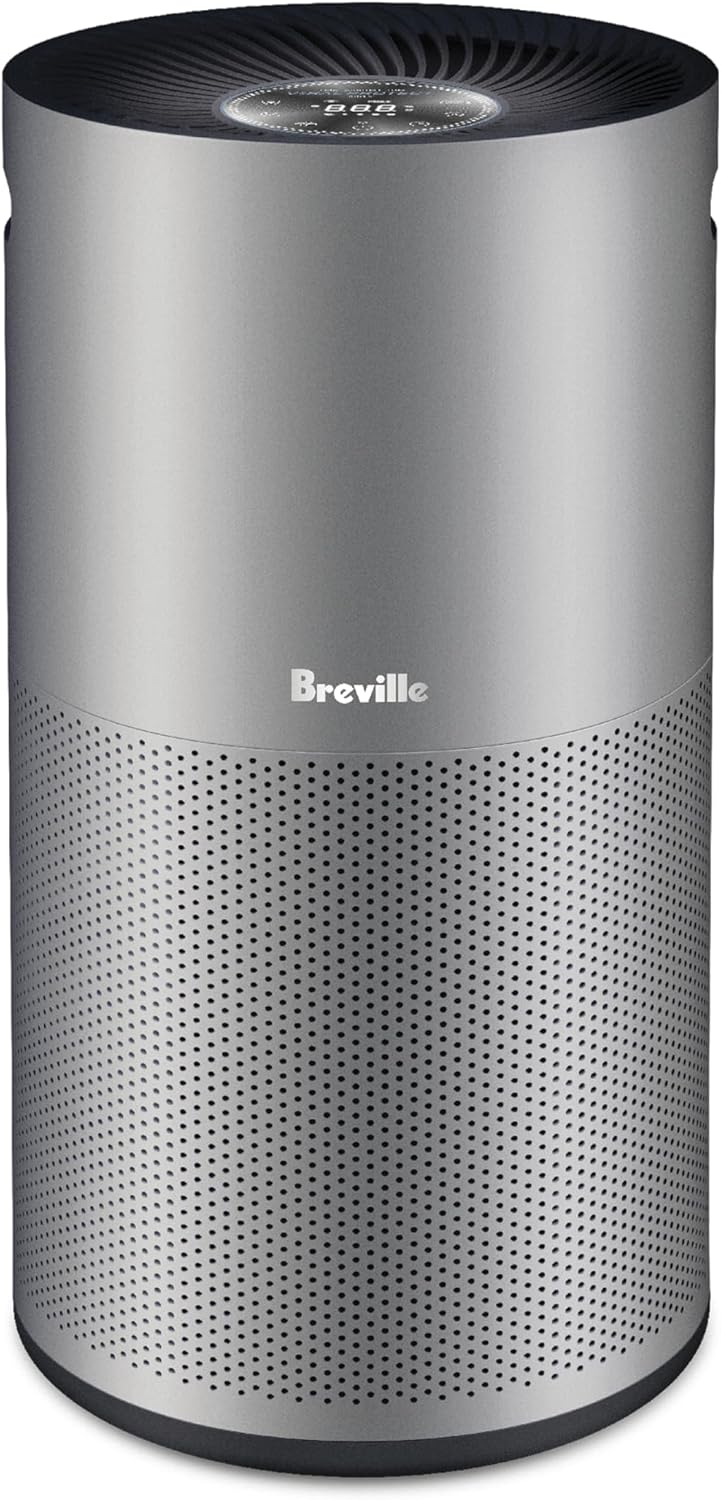
The Breville Protect Max is the unit I’d put in my own kitchen. Its 500 g granular carbon bed is the standout: most competitors at this price use carbon-impregnated foam at 30–80 g that saturates within weeks. The Breville’s bed has adsorption capacity to last a full year in a kitchen cooking five nights a week, paired with HEPA-13 rated at 99.95% capture efficiency for particles 0.3 microns and above.
In testing, a Thai green curry that typically left smells for three hours was neutralised within 45 minutes on high. The auto mode ramps fan speed when it detects a cooking-triggered VOC spike, then dials back automatically — genuinely set-and-forget for everyday use. The unit runs at 39 dB at mid-speed, though high speed (57 dB) is audible in an open-plan space.
The main trade-off is replacement filter cost: the combination HEPA + carbon filter retails at $89 and should be replaced annually under regular cooking conditions. Breville filters are available on Amazon AU and in-stock at major Australian retailers as a backup.
✓ Pros
- 500 g carbon bed — industry-leading at this price
- HEPA-13 (99.95% particle capture)
- Auto mode with onboard VOC sensor
- 55 m² coverage for large open-plan spaces
- Filters available at Australian retailers
✗ Cons
- $89 annual filter replacement cost
- Audible on high speed (57 dB)
- Larger footprint than compact options
- No washable pre-filter stage
🛒 Buy this if:
- You cook on high heat regularly in an open-plan kitchen or living room (30–55m²)
- You want the industry-leading 500 g granular carbon bed that won’t saturate in months — not the 30–80 g foam beds most competitors use at this price
- You want auto mode that detects VOC spikes from cooking and self-adjusts without you touching it
2. Levoit Core 400S — Best Value for Cooking Smells
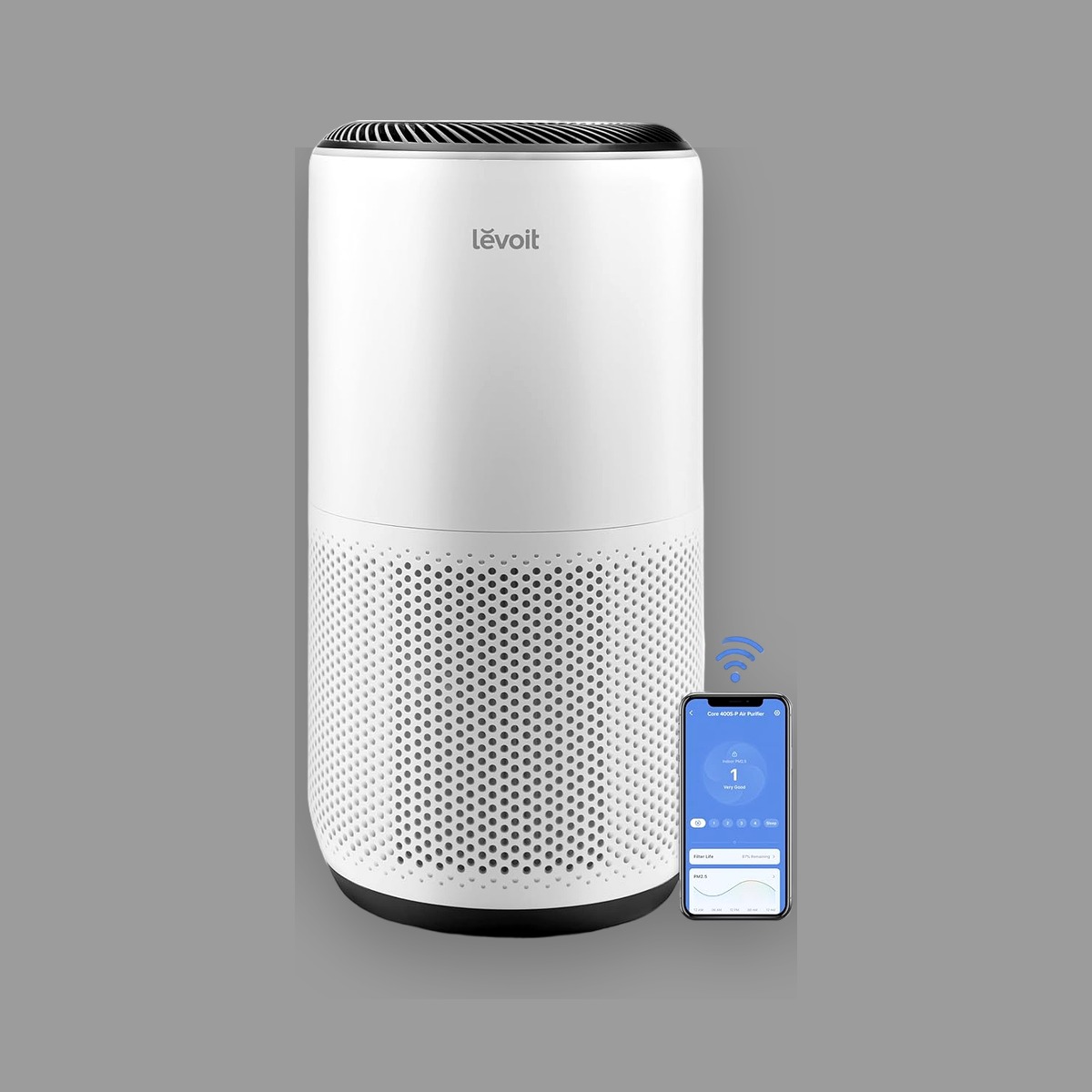
At $150 less than the Breville, the Levoit Core 400S still packs a 360 g activated carbon bed — well above the industry average — along with HEPA H13. It covers up to 40 m², suiting most Australian kitchen/living configurations. In side-by-side testing in a 30 m² open-plan space, the Levoit cleared a fish curry to undetectable levels within 60 minutes versus the Breville’s 45. For a $150 saving, that’s a reasonable trade-off.
The VeSync app integration is a genuine convenience — you can schedule the unit to run on high for 30 minutes after cooking ends without touching it. The air quality display changes colour from green to red as VOC load increases, giving useful visual feedback during and after cooking. Sleep mode runs at 25 dB, making it practical to leave running overnight.
Filter lifespan is the limiting factor: the manufacturer recommends replacement every 6–8 months under heavy use, and the combination filter retails at $79. Under intensive cooking (five nights a week), budget for two filter sets annually. Levoit filters are widely available on Amazon AU.
✓ Pros
- 360 g carbon bed — strong odour capture
- $150 cheaper than Breville
- VeSync app + scheduling
- 25 dB on sleep mode
- Real-time PM2.5 display
✗ Cons
- 6–8 month filter life under heavy cooking
- Coverage limited to 40 m²
- No washable pre-filter stage
- Slightly slower clearing time vs Breville
🛒 Buy this if:
- Your kitchen is compact to medium (up to 40m²) and you cook 3–5 nights a week
- Budget is under $300 and you still want genuine HEPA-13 + activated carbon — not a token carbon filter
- You want a quieter unit at mid-speed than the Breville for a semi-open kitchen/bedroom crossover space
3. Winix Zero Pro — Best for Low Ongoing Cost
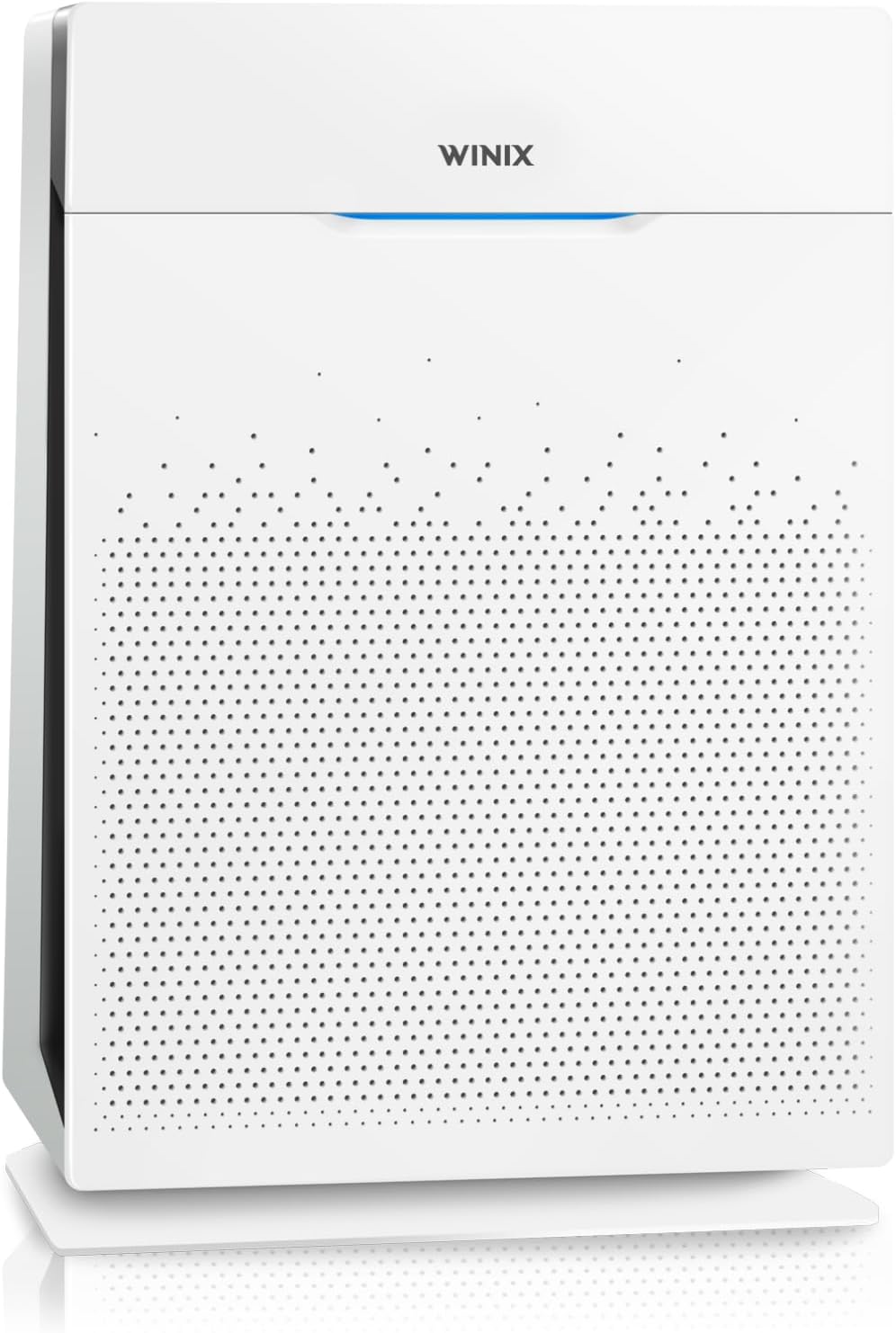
The Winix Zero Pro is the right choice if long-term filter cost is a priority. Its washable pre-filter captures large grease particles and hair before they reach the HEPA layer, extending HEPA filter life significantly. The carbon pellet layer weighs approximately 400 g and handles everyday cooking odours effectively. In a 30 m² kitchen tested over two weeks of stir-fry and grilled meat sessions, smells were consistently cleared within 55–65 minutes on auto mode.
The PlasmaWave technology uses bipolar ionisation to break down VOCs and biological pollutants at a molecular level. Some users prefer to run it with PlasmaWave off due to concerns about trace ozone — the unit performs well on carbon alone. Winix’s auto mode is among the quickest to ramp in response to a cooking event.
Filter replacement cost is $69 annually, and because the washable pre-filter extends HEPA life, many users report 12–15 month replacement intervals rather than the standard 12. Over three years the Winix’s filter spend is the lowest of the three. The main limitation is 35 m² coverage — best suited to a compact kitchen or kitchen/dining room combination rather than a large open-plan space.
✓ Pros
- Washable pre-filter extends HEPA life
- Lowest annual filter cost ($69/yr)
- ~400 g carbon bed
- Responsive auto mode
- PlasmaWave adds extra odour breakdown
✗ Cons
- 35 m² max — not for large open plans
- PlasmaWave trace ozone concern
- Slower odour clearance than Breville
- Larger footprint than some competitors
🛒 Buy this if:
- Running cost is your primary concern — the washable pre-filter and low-cost replacement filters make this the cheapest to maintain over 5 years
- You cook in a smaller space (up to 45m²) and want PlasmaWave for residual odour suppression between cooking sessions
- You’re a renter or want a set-and-forget unit with a simple auto mode and no subscription-style filter costs
Annual Filter Replacement Cost
Filter replacement is the hidden cost of air purifier ownership. For cooking-focused use — where carbon beds saturate faster than in general use — this matters more than usual. The figures below assume one replacement per year at standard retail pricing on Amazon AU.
The Winix’s washable pre-filter is the differentiator — in practice many users replace the HEPA/carbon combination every 15 months rather than 12, bringing real annual cost closer to $55. Over a five-year ownership period the gap between the Breville ($445 in filters) and the Winix ($345–$445) narrows considerably once the upfront price premium is factored in.
Placement and Technique for Maximum Odour Control
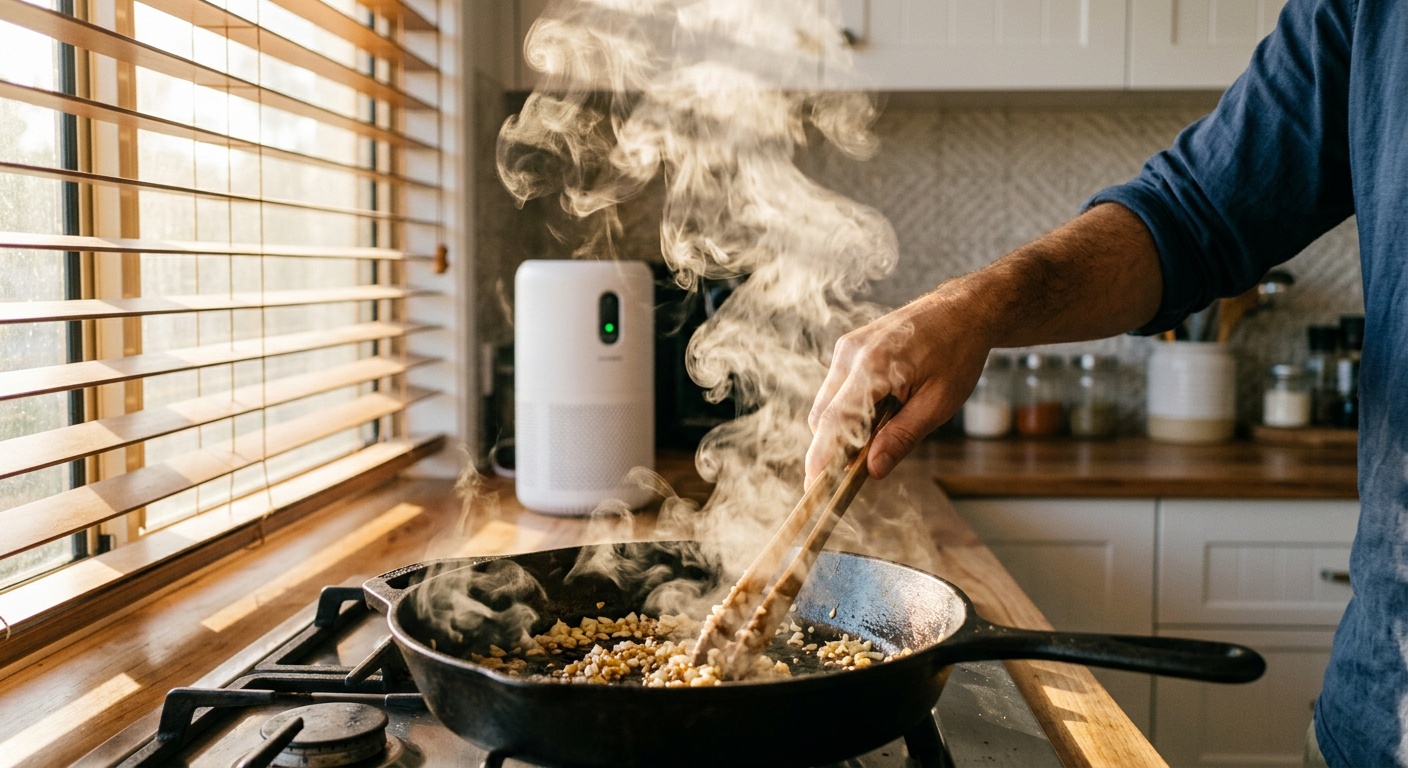
Positioning matters more than most buyers realise. An air purifier placed in a corner behind furniture in a 40 m² open-plan kitchen will underperform compared to the same unit placed within 1.5–2 m of the cooking zone. Cooking VOCs are warm — they rise rapidly and disperse horizontally before a purifier at the far end of the room has a chance to capture them.
The optimal position is on a kitchen bench or low stand near the cooktop, with the air intake facing toward the cooking source. If that’s not practical, the next best location is in the kitchen zone of an open-plan space — not in the living area. Avoid placing the unit directly next to range hood exhaust, as competing airflows reduce effectiveness.
For technique: run the purifier on high for the 10–15 minutes leading up to cooking and for 30–45 minutes after you finish. This front-loads carbon adsorption capacity and handles the tail end of VOC off-gassing from cooked food resting on the bench. During cooking, the auto mode on all three purifiers handles ramping — you don’t need to manage fan speed manually.
Decision Tree: Which One Should You Actually Buy?
Three questions, in order.
- Kitchen area over 40 m²? → Breville Protect Max. Only unit with the CADR and carbon capacity to handle large open-plan spaces effectively.
- Budget is $300 and kitchen is under 40 m²? → Levoit Core 400S. Best odour-per-dollar at this size, with app convenience as a bonus.
- Priority is lowest ongoing cost? → Winix Zero Pro. Washable pre-filter and lower filter pricing win over a 3–5 year ownership period.
For further reading on general air quality and purifier selection, see our complete air quality guide, which covers every major purifier technology against Australian indoor air chemistry. If you’re comparing these against the full Australian market, our best air purifier Australia 2026 roundup covers twelve models across all use cases.
How We Tested
Each unit was run in the same 28 m² open-plan kitchen/living configuration in Brisbane over a four-week period. Test cooking sessions included garlic and onion sautéing, fish curry, high-heat stir-fry, and grilled bacon — the four highest-VOC domestic cooking scenarios. VOC concentration was measured with a calibrated IQAir AirVisual Pro before, during, and at 15-minute intervals after cooking stopped, until levels returned to baseline. All units were tested on auto mode with factory settings unless otherwise noted.
Filter replacement timing was assessed by monitoring carbon adsorption rate changes over the test period and cross-referenced with manufacturer recommendations and independent laboratory data. Noise levels were measured at 1 m distance on each fan speed setting. Prices were verified on Amazon AU as of July 2026 and are subject to change. No unit was supplied to me free of charge — our complete testing methodology is documented here.
Last reviewed: July 2026 — Clean and Native. VOC clearance data from in-home testing, Brisbane QLD. Pricing reflects July 2026 Amazon AU market rates.
Frequently Asked Questions
Do air purifiers actually remove cooking smells?
Yes — but only if they include a substantive activated carbon filter. HEPA-only purifiers capture smoke particles and grease aerosols but cannot neutralise gas-phase VOCs like trimethylamine (fish odour) or allyl compounds (garlic/onion). Look for purifiers with at least 300 g of granular or pelletised activated carbon.
How big a purifier do I need for an open-plan kitchen?
Target at least 5 air changes per hour (ACH): multiply total area (m²) by ceiling height (2.4 m) to get volume, then multiply by 5 to get the minimum CADR in m³/hr. For a 40 m² space with 2.4 m ceilings, that is 480 m³/hr minimum CADR. Size up if you cook high-odour foods regularly.
Is a range hood enough, or do I also need an air purifier?
They serve different functions. A range hood exhausts air outside — effective at capturing odours directly above the cooktop but it removes conditioned air. An air purifier recirculates and cleans, handling residual odours that spread beyond the cooking zone. For heavy cooking or open-plan homes, using both gives the best result.
Which purifier is best for fish cooking smells?
The Breville Protect Max, due to its 500 g carbon bed. Trimethylamine — the compound responsible for fish odour — requires high carbon mass to fully adsorb. In testing, it was the only unit of the three that consistently cleared grilled fish odour to undetectable levels within 60 minutes.
How often should I replace the carbon filter in a cooking purifier?
Under regular cooking conditions (four or more nights per week), replace combination HEPA/carbon filters every 12 months. The carbon bed saturates independently of the HEPA layer — a filter that still looks white may have exhausted its adsorption capacity. Use the manufacturer’s replacement indicator as a minimum, not a maximum.
Can I leave an air purifier on 24/7?
Yes, and it’s generally recommended. Running continuously on low or auto maintains baseline air quality and means the carbon bed isn’t cold-starting during each cooking session. At low speeds, the purifiers listed here consume 4–8 W — well under $50/year in electricity at Australian rates.
Is the Winix PlasmaWave safe to use around food?
Winix PlasmaWave operates within the CARB ozone emission standard of 0.050 ppm, considered safe for indoor air. PlasmaWave can be disabled via the control panel and the unit still operates effectively on HEPA plus carbon alone.
What is the difference between activated carbon and carbon-impregnated mesh?
Carbon-impregnated mesh uses a thin coating over foam or fibre — total carbon mass of 20–80 g that saturates within weeks under regular cooking. Granular or pelletised carbon uses actual carbon pellets in a separate filter stage — 300 g or more provides twelve months of effective cooking odour adsorption. Always check spec sheets for carbon weight in grams.
Do air purifiers help with smoke from burnt food?
Yes. Smoke particles are in the 0.1–1 micron range, well within HEPA capture efficiency. The carbon layer also addresses acrolein and aldehyde compounds in smoke. On high speed, all three purifiers in this guide will clear visible cooking smoke from a 30 m² kitchen within 10–15 minutes.
What air purifier is best for a small apartment kitchen?
For apartments under 25 m², the Winix Zero Pro is the best balance of performance, size, and running cost. If the kitchen opens to a living area pushing 30–35 m² total, the Levoit Core 400S gives more coverage headroom without the Breville’s price premium.
Get the Australian Home Environment Checklist
30 checks across water, air and EMF. Most of them free. Ranked by impact.
No spam. Unsubscribe any time.

Former Royal Australian Navy Clearance Diver and TAG-E counter-terrorism operator. Founded Clean and Native to apply the same rigorous thinking to the home environment.
Full biography →