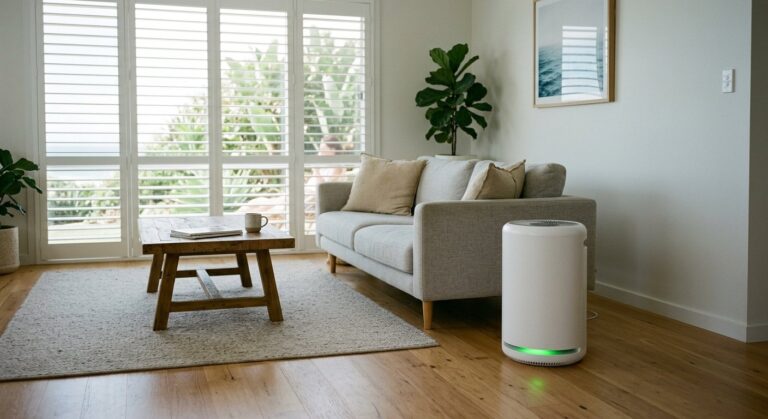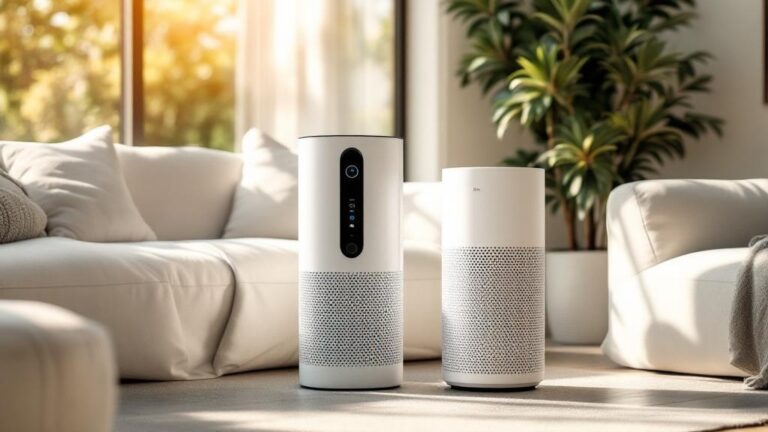
Levoit Core 600S vs Breville Protect Max Australia 2026
Drafted with AI assistance and checked against published specifications and certifications. First-hand measurements appear only where stated. How we make content
Quick Verdict
The Breville Smart Air Viral Protect Max is the better buy for most Australian homes — its 550 m³/h CADR outclasses the Levoit at a modest $69 premium, and it covers larger open-plan spaces without compromise. The Levoit Core 600S earns its place if you need a fully app-connected unit with PM2.5 live readings and Alexa control for under $400.
Who This Is For
- Open-plan living areas 40–70 m²
- Households in Brisbane, Sydney, or Melbourne during bushfire season
- Renters who need a plug-and-play unit with no installation
- Parents wanting cleaner air in a shared living space without the noise
- Anyone upgrading from an older 200–300 m³/h unit and frustrated by slow air changes
Who This Is Not For
- Small bedrooms under 20 m² — a Core 300S or similar would be more cost-effective
- Commercial spaces or offices above 80 m²
- Anyone on a tight sub-$300 budget
- Users who need HEPA-grade filtration certified specifically for viral particles (neither unit has independent third-party AU lab certification at time of writing)
CADR and Room Size — The Numbers That Matter
Clean Air Delivery Rate (CADR) is the single most useful number when comparing air purifiers. It measures how many cubic metres of clean air a unit delivers per hour. Higher is always better, and room coverage claims in product listings are only meaningful when you know the CADR behind them.
The Breville Protect Max has a CADR of 550 m³/h. The Levoit Core 600S comes in at 410 m³/h. That is a 34 percent gap — not a rounding difference.
| Metric | Levoit Core 600S | Breville Protect Max |
|---|---|---|
| CADR | 410 m³/h | 550 m³/h |
| Effective coverage (2 ACH) | ~68 m² | Not independently stated |
| RRP (Amazon AU) | ~$399 | ~$468 |
| Filter type | H13 True HEPA + Activated Carbon | Viral Protect filtration |
| Sleep mode noise | 24 dB | Not independently stated |
How does CADR translate to real rooms? The standard benchmark is two air changes per hour (ACH) — meaning the entire volume of air in the room passes through the filter twice every 60 minutes. For a room with a standard 2.7 m ceiling, the Levoit 600S at 410 m³/h covers roughly 68 m² at 2 ACH. That is calculated as: 410 divided by (2 x 2.7) = approximately 75.9 m², adjusted conservatively for real-world furniture obstruction and non-uniform airflow.
The Breville’s 550 m³/h CADR pushes well into the territory of a large open-plan kitchen and living area combined. Australian open-plan designs routinely run 50–75 m² at ceiling heights of 2.7–3.0 m. At 3 m ceilings — common in newer Queensland builds — the effective room size drops, and the Breville’s headroom keeps it competitive where the Levoit starts to strain.
The practical takeaway: if your target room is under 55 m², both units are overkill and the Levoit wins on price. If you are trying to clean 60–75 m² of open-plan space, the Breville is the unit to buy.
Filter Comparison — H13 HEPA vs Viral Protect
Filtration claims are one of the most abused marketing categories in consumer air purifiers. Here is what the verified data actually tells us about each unit.
Levoit Core 600S — H13 True HEPA + Activated Carbon
H13 True HEPA is a defined standard. It captures 99.95 percent of particles 0.3 microns in diameter — the most penetrating particle size (MPPS). Particles smaller or larger than 0.3 microns are actually captured at higher efficiency due to diffusion and interception physics. This includes fine PM2.5 particulate (smoke, dust, pollen) and aerosol droplets in the 1–10 micron range.
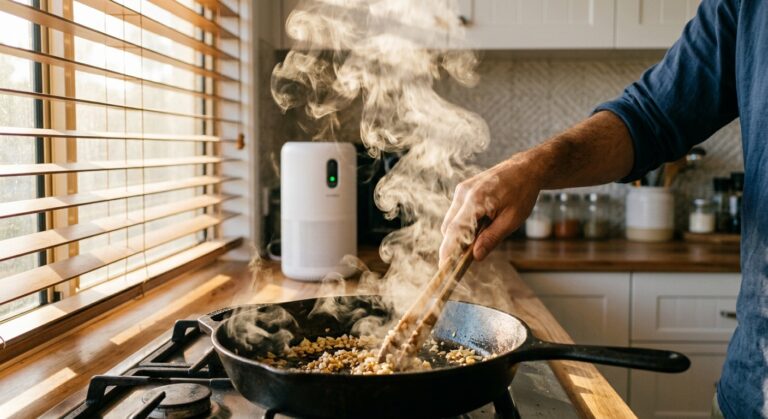
The activated carbon layer handles gaseous pollutants — VOCs from paint, cleaning products, and off-gassing furniture, as well as cooking odours. The carbon layer on a consumer unit like this is functional but not industrial-grade; it will handle day-to-day household odours but is not rated for heavy chemical exposure.
H13 HEPA is a meaningful, auditable claim. It is the same filtration grade used in hospital-grade portable units.
Breville Protect Max — Viral Protect Filtration
Breville’s “Viral Protect” filter branding is a proprietary term. Based on available product information, the Protect Max is designed to capture fine particulate including the aerosol range where airborne viruses travel as droplet nuclei. The 550 m³/h CADR means that even if the filter efficiency percentage is slightly lower than H13 at the theoretical MPPS, the volume of air processed per hour compensates in real-room conditions.
The honest position: without a published independent EN1822 or equivalent certification document for the Breville’s filter specifically, we cannot make a direct apples-to-apples filtration efficiency comparison. What we can say is that the Breville’s raw air throughput is significantly higher, which in practice matters more than marginal filter efficiency differences for most household applications.
If your primary concern is documented, certified HEPA filtration — for example, if someone in the household has a diagnosed respiratory condition requiring verified filter performance — the Levoit’s H13 HEPA claim is more straightforwardly auditable. For general air quality improvement in a larger space, the Breville’s throughput advantage likely produces better real-world outcomes.
Noise Level — A Real Differentiator
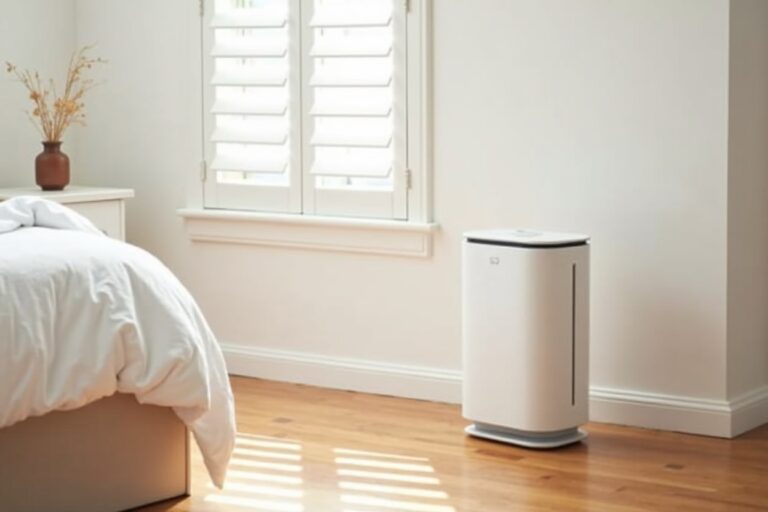
Noise is one of the areas where the Levoit 600S has a clear, documented advantage: 24 dB on sleep mode. To put that in context, 24 dB is quieter than a whisper in a library (typically around 30 dB) and similar to a very quiet bedroom with no fan running. It is genuinely inaudible to most people during sleep.
This matters more than it sounds. An air purifier that is noisy enough to disrupt sleep ends up turned off at night — which is precisely when uninterrupted filtration matters most. PM2.5 concentrations indoors often rise overnight as cooking residue, dust disturbance from foot traffic, and outdoor air infiltration accumulate without the ventilation that open windows provide during the day.
We do not have a verified sleep mode decibel rating for the Breville Protect Max. Breville does not publish this figure in the same way Levoit does. This is not necessarily a red flag — some manufacturers simply do not invest in marketing sleep mode specs — but it means we cannot make a direct like-for-like noise comparison between the two units.
What the absence of a published noise figure does tell you is practical: if bedroom use is your primary application and low noise is non-negotiable, the Levoit 600S at 24 dB sleep mode is the safer choice. You have a verified number. With the Breville, you would need to test it yourself in situ.
For living areas and daytime use, noise is rarely the deciding factor — and the Breville’s higher CADR means it reaches clean air targets faster, which often allows you to run it on a lower (quieter) fan speed and achieve the same result over a longer cycle.
Smart Features and Australian App Support
The Levoit 600S is a genuinely smart unit in a category where “smart” often means little more than a Wi-Fi on/off switch.
Its VeSync app integration gives you real-time PM2.5 sensor readings displayed on the unit and mirrored in the app. You can set fan speed schedules, enable auto mode (the unit responds to its built-in PM2.5 sensor and adjusts speed accordingly), and monitor filter life. Alexa compatibility is included. The app is available in Australia on iOS and Android with no VPN or region-switching required — a non-trivial point, since several competing brands ship apps that require an account region change to activate all features.
The PM2.5 display is the standout feature here. When you can see the air quality number drop from 35 micrograms per cubic metre to 8 in 20 minutes after cooking, you understand viscerally what the unit is doing. It also tells you when the unit is genuinely working hard versus coasting — useful for placing the unit optimally in the room.
The Breville Protect Max’s smart feature set is less documented in publicly available specs. It is a capable unit but appears positioned more as a premium appliance than a connected device. If Alexa integration, real-time air quality data, and schedule control from your phone are features you will actually use, the Levoit 600S is the stronger choice in this category.
One practical note on smart features: auto mode on the Levoit means the unit runs quietly when air quality is good and ramps up when it detects PM2.5 spikes — from cooking, opening windows during a high-pollen day, or the ash plume from a distant fire. This is a meaningful function in Australian conditions where PM2.5 events are common and often short-lived. You do not need to remember to turn it up; the sensor handles it.
Price and 5-Year Cost
At face value, the Levoit Core 600S is $399 and the Breville Protect Max is $468. A $69 difference. Over five years, however, the comparison is more nuanced because filter replacement costs add up.
For a like-for-like cost estimate, a few variables apply: how frequently you run the unit (hours per day), what your local air quality is like, and what replacement filters cost in Australia at time of purchase. Filter pricing fluctuates on Amazon AU, so the figures below are indicative rather than locked.
As a general principle for air purifiers in this CADR class:
- Filters typically need replacement every 6–12 months under moderate use in an average Australian metropolitan environment.
- During bushfire season or high-pollution periods, filter life can shorten considerably — a unit running on high speed continuously during a smoke event will consume a filter faster than in normal use.
- Both units use proprietary replacement filters, so you are committed to the manufacturer’s supply chain once you purchase.
The Levoit ecosystem has a well-established Australian filter supply via Amazon AU. Replacement filters for the Core 600S series are available and in stock at time of writing. The Breville Protect Max replacement filters are available through Australian retail channels including Amazon AU and Breville’s own Australian store.
The $69 upfront gap between the two units is unlikely to be a meaningful 5-year differentiator once filters are accounted for. The decision should rest on which unit’s performance profile matches your room size and use case — not on the initial price difference alone.
If budget is genuinely constrained and $69 is meaningful to you, the Levoit 600S at $399 is excellent value for its CADR and feature set. It is not a compromise product — it is a well-engineered unit at a lower price point. For most buyers the $69 difference is worth paying for the Breville’s higher throughput, but not for everyone.
Verdict
Both units are solid choices for Australian homes. The decision is not complicated if you map your use case to the right unit.
Buy the Breville Protect Max if: your target room is 55 m² or larger, particularly open-plan kitchen and living combinations. The 550 m³/h CADR is the strongest throughput in this price bracket and it is the unit we recommend to most buyers as the default.
Buy the Levoit Core 600S if: you want verified 24 dB sleep mode noise, real-time PM2.5 sensor data in an app, Alexa integration, or you are covering a bedroom or medium-sized room under 55 m² where the extra $69 is not justified by additional filtration capacity you will not use.
Best for bedrooms: Levoit Core 600S. The sleep mode noise spec is the deciding factor.
Best for open-plan living: Breville Protect Max. CADR wins.
Best for app users and smart home integration: Levoit Core 600S. VeSync + PM2.5 display + Alexa is a more complete smart feature set.
Best overall for most Australian homes: Breville Protect Max. Higher CADR, proven Australian brand support, and a $69 premium that most buyers are right to pay.
FAQ
Is the Levoit Core 600S available in Australia?
Yes. The Levoit Core 600S (ASIN B0C6LYVX32) is stocked on Amazon AU and ships domestically. The VeSync app that controls it works without any region workarounds on Australian App Store and Google Play accounts.
Which air purifier is better for bushfire smoke in Australian homes?
For bushfire smoke, CADR is the most important factor because smoke particle concentrations can spike rapidly and you want the room cleaned as fast as possible. The Breville Protect Max at 550 m³/h will clear a smoke-affected room faster than the Levoit Core 600S at 410 m³/h. Both units use filtration capable of capturing PM2.5 particles — the fine particulate that makes bushfire smoke dangerous. If you are in a bushfire-prone area and prioritising smoke response, the Breville’s throughput advantage is meaningful.
How loud is the Levoit Core 600S on sleep mode?
The Levoit Core 600S operates at 24 dB on its lowest (sleep) setting. That is quieter than most people’s baseline ambient bedroom noise — comparable to the sound of leaves rustling outside. The vast majority of users find it inaudible during sleep.
Can I run either unit 24 hours a day?
Both units are designed for continuous operation. Running an air purifier 24/7 on auto mode is actually the most effective approach — it maintains a consistent filtration baseline rather than allowing pollutant levels to build up during off periods. Running continuously will shorten filter life faster than intermittent use, so budget accordingly for annual filter replacement.
Does the Breville Protect Max work with Alexa or Google Home?
Based on publicly available product information, the Breville Protect Max does not have confirmed Alexa or Google Home integration. The Levoit Core 600S integrates with Alexa via the VeSync skill. If smart home voice control is a requirement, the Levoit is the appropriate choice.
What size room does the Levoit Core 600S cover?
The Levoit Core 600S covers approximately 68 m² at two air changes per hour (using a standard 2.7 m ceiling height). At a more aggressive 4–5 ACH — which some guidelines recommend for allergy and asthma management — the effective coverage area is closer to 35–40 m².
Which unit has cheaper replacement filters in Australia?
Filter pricing fluctuates. At time of writing, replacement filters for both units are available through Amazon AU. We recommend checking current pricing for both before making a final decision if filter running costs are a significant factor for you. Both units use proprietary filters — neither is compatible with generic third-party filters without risk of performance degradation.
Get the Australian Home Environment Checklist
30 checks across water, air and EMF. Most of them free. Ranked by impact.
No spam. Unsubscribe any time.

Former Royal Australian Navy Clearance Diver and TAG-E counter-terrorism operator. Founded Clean and Native to apply the same rigorous thinking to the home environment.
Full biography →