Best Water Filter Australia 2026: Compared & Ranked for Australian Tap Water
QUICK VERDICT
| Best overall under-sink RO | PWS RO-5U — WaterMark-certified 5-stage under-sink RO, 96% TDS removal, digital TDS monitor, Australian brand See Price → |
| Best countertop RO (renters) | AquaTru Classic — zero installation, NSF/ANSI 58 + P473 (PFAS), removes fluoride + chloramine See Price → |
| Best value under-sink RO | Waterdrop D6 — 1:1 waste ratio, $0.03/litre over 5 years, 600 GPD tankless See Price → |
| Best WaterMark-certified (AU) | EcoHero 5-Stage — WaterMark AS3497 certified, personally tested 95.7% TDS reduction (Palm Beach QLD) See Price → |
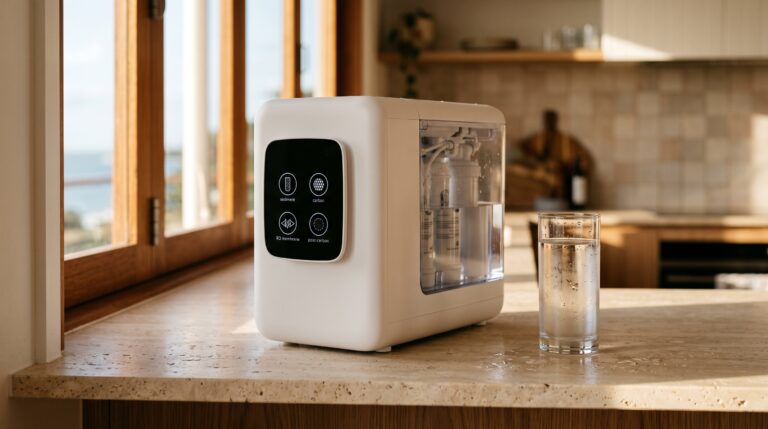
| Best countertop RO + hot water | Philips RO Water Station — no plumbing, filtered hot water up to 95°C in 3 seconds, UV-C sterilisation, 110+ contaminants See Price → |
| Best renter tap-mount | Tappwater EcoPro — clips on in 60 seconds, removes 93% PFAS + chloramine, ~$80 |
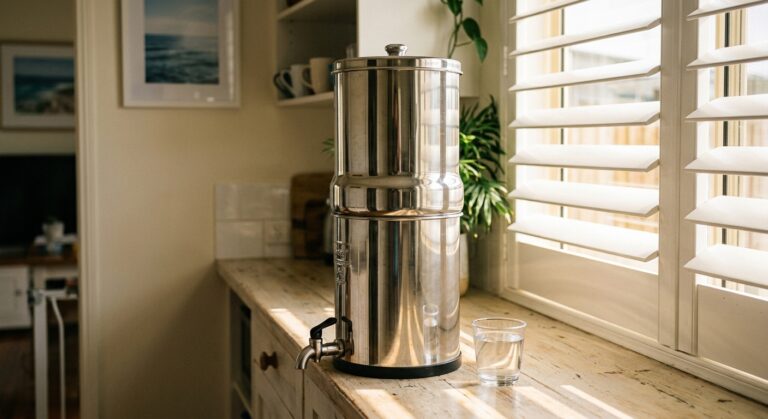
| Best off-grid / gravity | Berkey Royal — no power or plumbing, 99.9999% bacteria removal, needs PF-2 add-on for fluoride removal |
| Key AU fact | Brisbane, Sydney, Adelaide, Darwin use chloramine — Brita removes it at 1/40th the rate of catalytic carbon or RO |
| Only way to remove fluoride | RO (90–97%) or activated alumina — carbon filters cannot remove fluoride ions |
Australian tap water meets national safety standards. That much is true. What those standards don’t account for is everything technically “within limits” but worth removing: chloramine that standard carbon filters can’t touch, fluoride that only reverse osmosis actually eliminates, PFAS compounds linked to 700+ contamination sites nationally, and microplastics found in 94% of Australian tap water samples in 2024 research.
This guide covers every filter type available in Australia in 2026, what each actually removes (with numbers), and exactly which system fits your situation — renter, homeowner, family, or off-grid.
What’s Actually in Australian Tap Water in 2026
The Australian Drinking Water Guidelines (ADWG) set maximum contaminant limits, not zero-contaminant targets. Several things routinely present are worth filtering:
| Contaminant | Which Cities | Level in Supply | Best Removal Method |
|---|---|---|---|
| Chloramine | Brisbane, Sydney, Adelaide, Darwin | Up to 3 mg/L | Catalytic carbon block or RO |
| Free chlorine | Melbourne, Hobart, Canberra | 0.2–0.6 mg/L | Standard GAC or RO |
| Fluoride | All capitals except ACT partial | 0.6–1.0 mg/L | RO (90–97%) or activated alumina — carbon CANNOT remove fluoride |
| PFAS | 700+ contamination sites nationally (RAAF bases, airports, industrial) | Varies — often undetected | RO (NSF P473) or activated carbon at high contact time |
| Microplastics | All cities (94% of samples, 2024) | 0.7–7 particles/L | RO or quality gravity filter (0.1–0.2 µm) |
| TDS (dissolved solids) | Adelaide 300–500 mg/L, Perth 150–220 mg/L highest | 15–500 mg/L by city | RO only (reduces to <10 mg/L) |
The chloramine problem most Australians don’t know about
Standard activated carbon (GAC) — used in Brita, most tap filters, and basic under-sink filters — removes free chlorine effectively. It removes chloramine at 1/40th the rate. If you’re in Brisbane, Sydney, Adelaide, or Darwin, your Brita is doing almost nothing for the disinfectant in your water. You need either a catalytic carbon block filter or a reverse osmosis system.
The 5 Types of Water Filter: What Each Actually Removes
| Filter Type | Chloramine | Fluoride | PFAS | TDS | Renter OK? | Cost/L |
|---|---|---|---|---|---|---|
| Reverse osmosis (RO) | ✓ 99%+ | ✓ 90–97% | ✓ 93–98% | ✓ 95–99% | Countertop yes, under-sink no | $0.03–0.08 |
| Gravity filter (Berkey) | ✓ 99%+ | ⚠ Only with PF-2 add-on | ✓ 97%+ | ✗ No | ✓ Yes | $0.04–0.07 |
| Catalytic carbon tap-mount | ✓ 95%+ | ⚠ ~70% (some models) | ✓ 93% | ✗ No | ✓ Yes | $0.04–0.06 |
| Standard carbon (GAC/block) | ✗ <5% | ✗ No | ⚠ Variable | ✗ No | ✓ Yes | $0.01–0.03 |
| Pitcher (Brita standard) | ✗ Minimal | ✗ No | ✗ No | ✗ No | ✓ Yes | $0.08–0.15 |
Best Water Filter Australia 2026: Our Top Picks by Category
1. PWS RO-5U — Best Full Under-Sink System (Tap Included, Remineralised)

PWS RO-5U is the most complete under-sink filtration system available from an Australian brand. It ships with the system, all installation hardware, and a dedicated benchtop tap — removing the most common friction point with under-sink RO: sourcing and fitting a separate filtered water faucet. The 5-stage filtration removes 99% of contaminants including fluoride, PFAS, bacteria, and microplastics, before a post-filtration remineralisation stage adds alkaline minerals back into the filtered water. That final step is what separates this from standard RO output — you get pure water with a healthy mineral balance, not stripped-down zero-TDS water.
The 2:1 filtered-to-drain ratio is better than the 3:1 standard on most imported under-sink units. The 12-month filter cartridge lifespan and PWS’ twist-click cartridge design — no tools required — keeps ongoing maintenance straightforward. WaterMark AS3497 certified (licence 022780) and available now with 7–10 business day delivery.
The PWS RO-5U carries full WaterMark AS3497 certification (licence 022780), meaning licensed plumbers in every Australian council will install it without complication. The 8L pressurised holding tank delivers instant flow at the tap — no waiting for on-demand membrane processing. For households wanting the best-engineered, fully certified Australian under-sink RO with manufacturer-specified contaminant removal data, this is the pick.
PWS RO-5U — Pros and Cons
Pros
- Dedicated tap included in the box
- Post-filtration remineralisation as standard
- Tankless — no bacterial buildup risk
- Efficient 2:1 pure-to-drain ratio
- Australian brand + local support
Cons
- $999 — premium price point
- Requires under-sink installation
- Slower flow rate than Waterdrop D6
Buy if: you want a complete under-sink RO — tap included, remineralised output — and buying Australian-made matters. Check price →
2. AquaTru Classic — Best Countertop RO (Renters & Apartments)
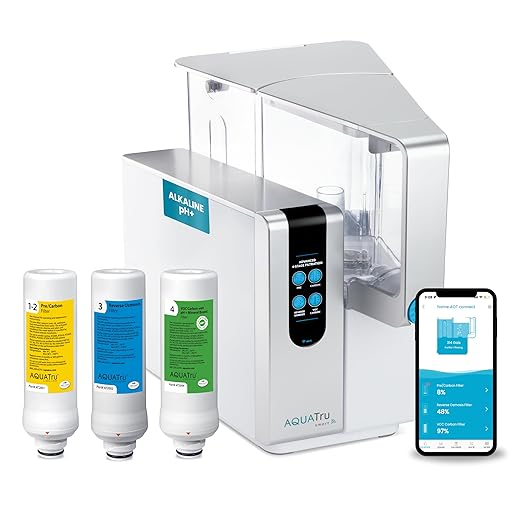
The AquaTru Classic is the most complete renter-friendly water filter available in Australia. It’s a genuine 4-stage reverse osmosis system — NSF/ANSI certified under Standards 42, 53, 58, and 401 — that removes 83+ contaminants including fluoride (98.5%), chloramine (99%), PFAS (certified to NSF P473), lead, arsenic, and dissolved solids. It sits on your benchtop, connects to your tap via a diverter valve, and requires zero plumbing modification. When you move, it moves with you.
The honest limitation: 150L per day maximum and a 2:1 water waste ratio. For 1–2 people using filtered water primarily for drinking and cooking, it’s sufficient. For families of 4+, the Waterdrop D6 (below) is more practical.
AquaTru Classic — Pros and Cons
Pros
- Zero installation — no plumber, no under-sink space needed
- NSF/ANSI 58 + P473 certified (independent PFAS + fluoride testing)
- Removes fluoride (98.5%), chloramine (99%), lead, arsenic, PFAS
- Fully portable — moves with you when you move
- 83+ contaminants removed across 4-stage RO
Cons
- 2:1 waste ratio (2 litres lost per litre filtered)
- 150L/day max — not ideal for families of 4+
- $549 upfront — highest countertop price on this list
- Smaller tank requires more frequent refilling
Buy if: you rent, live in an apartment, or need a filter that moves with you — especially if PFAS or fluoride removal is a priority and under-sink installation isn’t an option. Check price →
3. Waterdrop D6 — Best Under-Sink RO (Homeowners, Families)
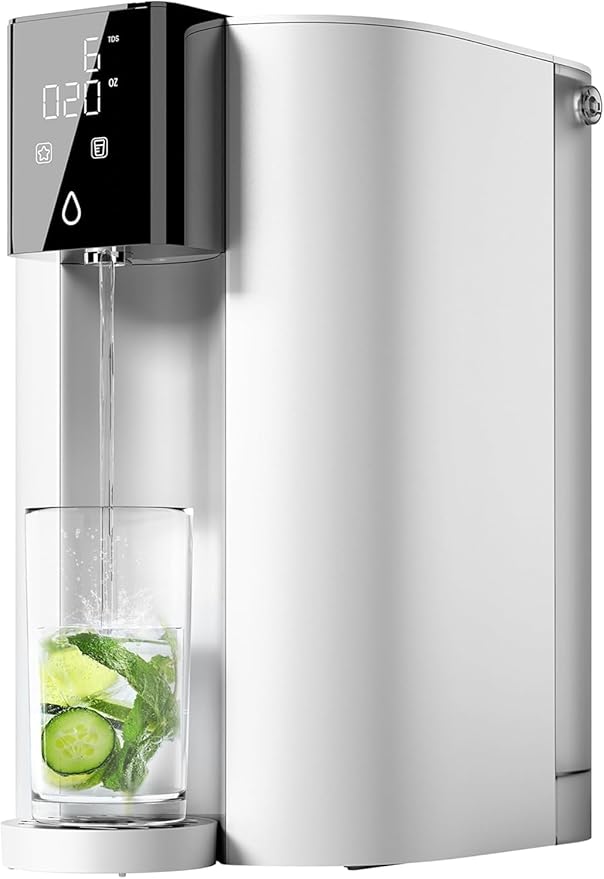
For permanent installation, the Waterdrop D6 delivers 2,270 litres per day, a 1:1 waste ratio (compared to the traditional 3:1 or worse), and 7-stage filtration that handles chloramine, fluoride (98.7%), PFAS, and TDS down to below 10 mg/L. Filter replacements run $180–220 per year — the lowest ongoing cost of any whole-filtration system in its class. At $0.03 per litre over 5 years, it’s significantly cheaper than bottled water ($0.50–2.00/L) or even the AquaTru.
The trade-off: requires tapping into under-sink plumbing. DIY-feasible for most handy homeowners; a plumber’s visit ($120–180) for everyone else. Not suitable for renters without landlord approval.
Waterdrop D6 — Pros and Cons
Pros
- Lowest cost per litre ($0.03) of any system on this list
- 1:1 pure-to-drain ratio — least wasteful under-sink RO
- 600 GPD output — suits families of 4–6
- Tankless design — no bacterial buildup risk
- NSF 58-certified 7-stage filtration
Cons
- Requires under-sink plumbing — renters need landlord approval
- Installation adds $120–180 if not DIY
- No WaterMark AS3497 certification
- Annual filter cost ~$180–220
Buy if: you own your home and want the best-value long-term under-sink RO — lowest cost per litre and best waste ratio of any system on this list. Check price →
4. EcoHero 5-Stage RO — Best WaterMark-Certified Under-Sink RO (Australian-Made)
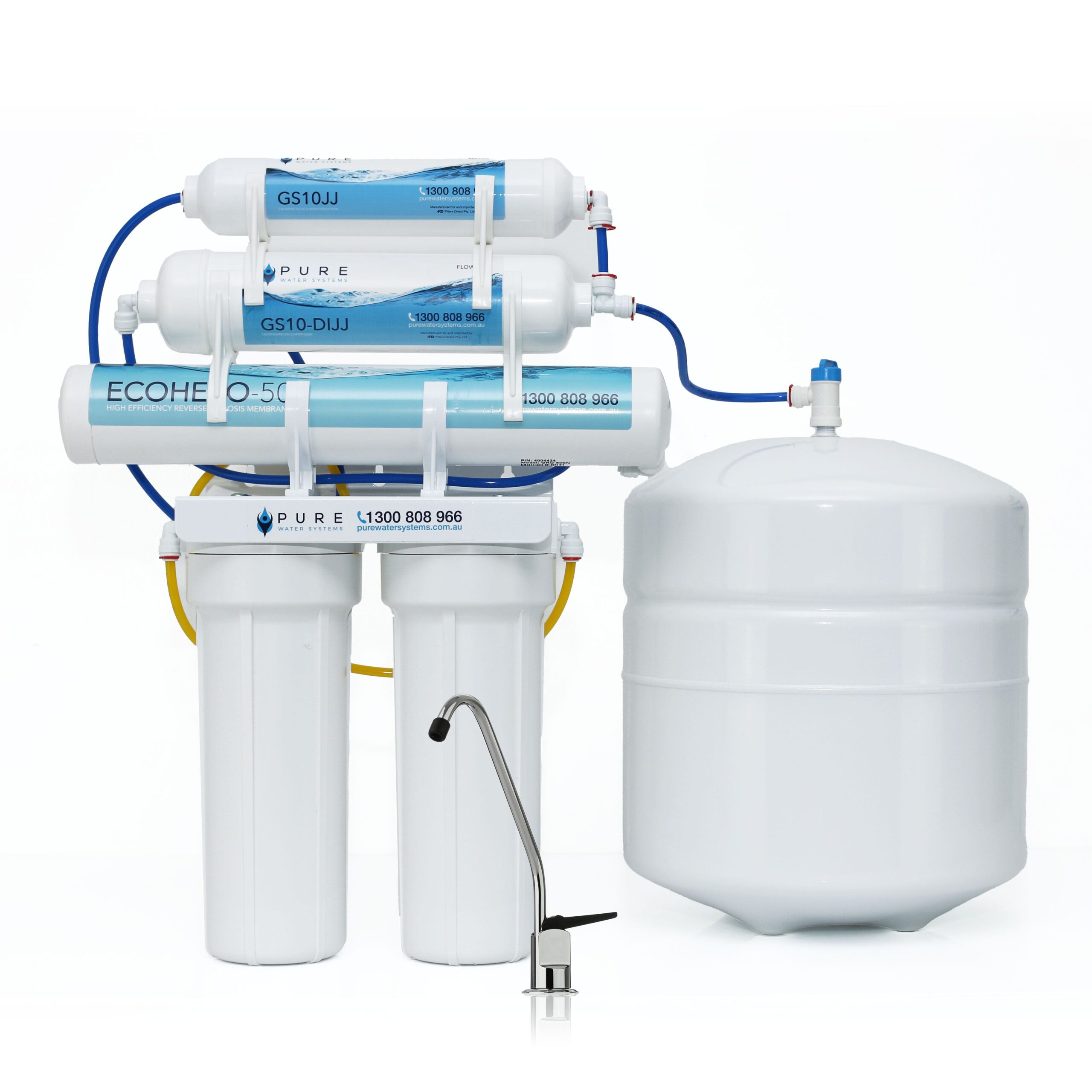
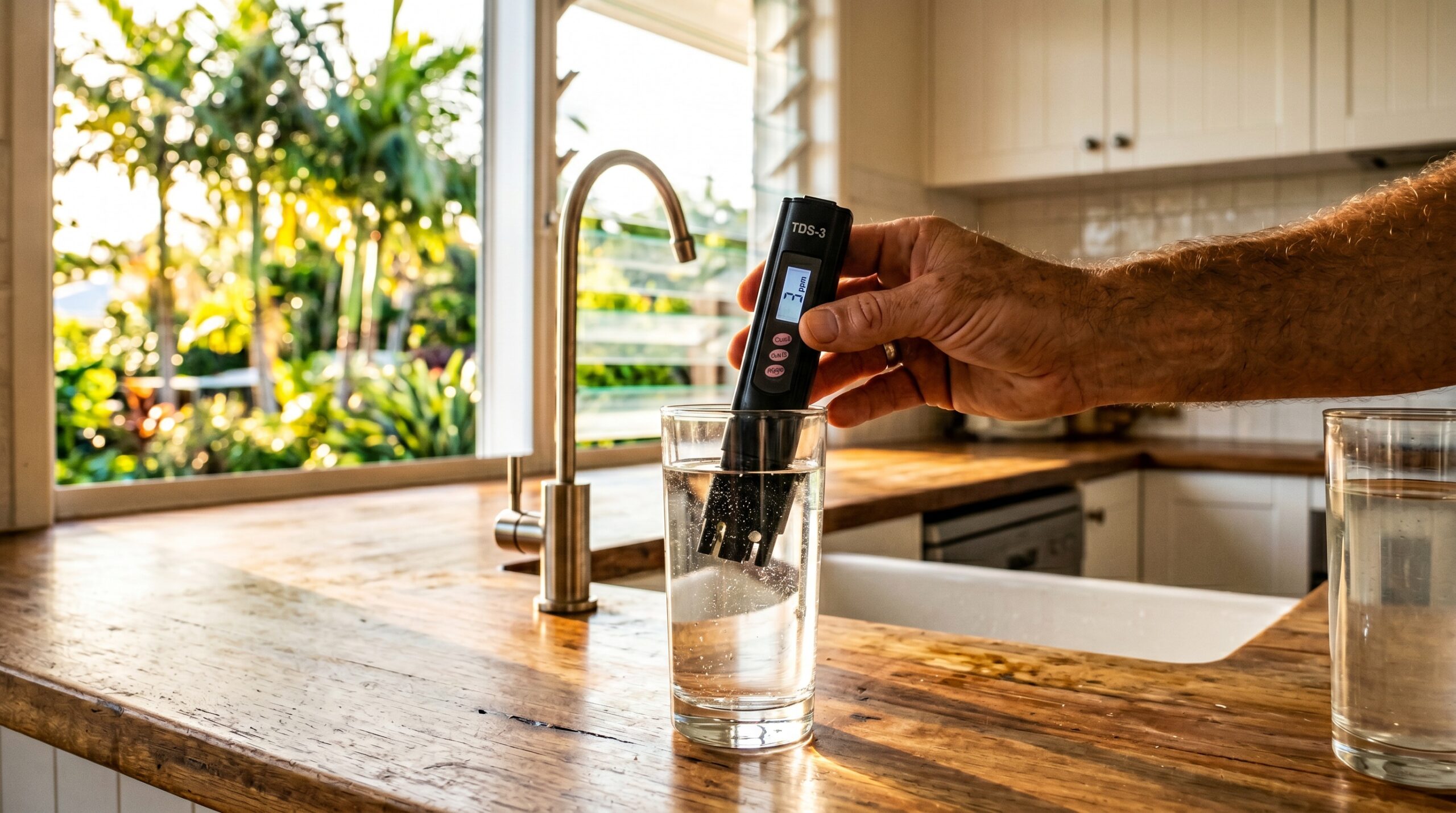
The EcoHero 5-Stage is the under-sink RO system running in my Palm Beach home. I’ve measured the results directly: mains tap water reads 69 ppm TDS; post-RO through the EcoHero 5-stage system it reads 3 ppm. That is a 95.7% TDS reduction and the benchmark I compare all other systems against.
What makes the EcoHero stand apart from imported RO systems is WaterMark AS3497 certification — a mandatory Australian/New Zealand plumbing standard that most Amazon-imported units don’t carry. This matters practically: licensed Australian plumbers will install a WaterMark-certified system without hesitation; some will refuse to install uncertified units (or void the warranty on work they do). The EcoHero-50 membrane is also rated at 50% water recovery — meaning 1 litre wasted per litre produced, compared to the traditional 3:1 ratio of most imported membranes.
- 5-stage filtration: PP sediment, carbon block, EcoHero-50 RO membrane (0.0001 micron), deioniser, GAC post-carbon
- Removes fluoride (~93%), lead (~98%), PFAS, arsenic (~88%), dissolved solids (~90%+)
- NSF 58 membrane, WaterMark AS3497 certified (lead-free compliant)
- 50% water recovery — significantly more efficient than standard imported membranes
- AU-based supplier (Pure Water Systems), local support, local shipping
The honest limitation: it costs more than Amazon-imported equivalents and isn’t available via Prime delivery. For homeowners who want an AU-certified system with a local support line, the premium is justified. For renters or anyone wanting the fastest delivery path, the Waterdrop D6 (above) is the more practical choice.
EcoHero 5-Stage RO — Pros and Cons
Pros
- Only WaterMark AS3497-certified under-sink RO on this list
- Personally tested: 69 → 3 ppm TDS (95.7% TDS reduction, Palm Beach QLD)
- 50% water recovery — more efficient than standard imported membranes
- Australian supplier, local warranty + support line
- Licensed plumbers will install without hesitation in any AU council
Cons
- Costs more than Amazon-imported equivalents
- No Prime delivery — AU shipping adds lead time
- 5-stage vs 7-stage on the Waterdrop D6
- PFAS removal not independently NSF P473-certified
Buy if: you’re a homeowner who needs WaterMark AS3497 certification for council compliance or licensed plumber installation — the only AU-certified under-sink RO on this list, personally tested in Palm Beach QLD. Check price →
5. Tappwater EcoPro — Best Tap-Mount (Renters, Budget)
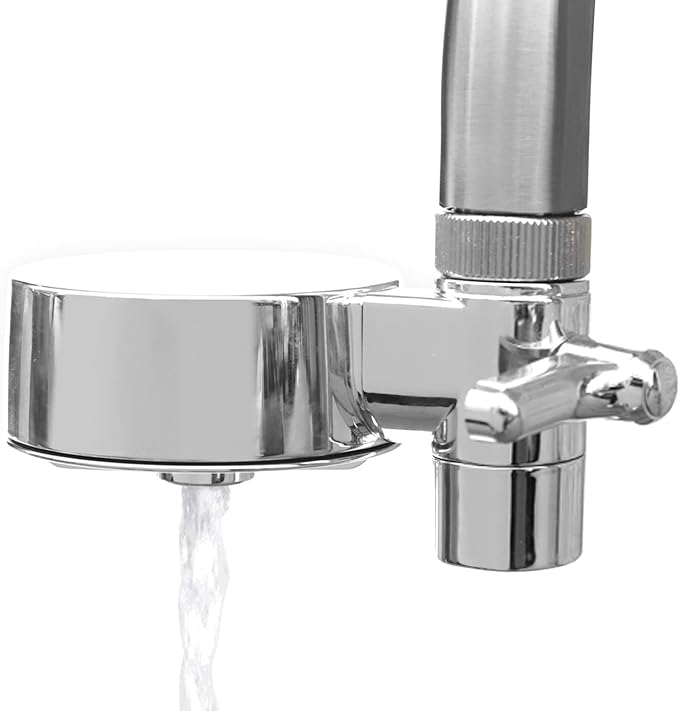
The Tappwater EcoPro is the best entry point for Australian renters who want meaningful filtration without spending $400–700. It clips directly onto your existing tap in 60 seconds (fits 95% of Australian tap fittings), removes 93% PFAS, ~95% chloramine via catalytic carbon, and handles chlorine, heavy metals, and microplastics. The fluoride removal is partial (~70%) — if fluoride removal is your primary concern, step up to the AquaTru.
Filter cartridges last 3 months or 1,000 litres; replacements cost ~$30. Total annual cost: ~$120–140, making it the most affordable meaningful filtration available.
Tappwater EcoPro — Pros and Cons
Pros
- Installs in 60 seconds — no tools, no landlord approval needed
- Removes 93% PFAS and ~95% chloramine via catalytic carbon
- Lowest upfront cost (~$80) of any meaningful filter on this list
- Fits 95% of Australian tap fittings
- No power, no plumbing — works anywhere
Cons
- Only ~70% fluoride removal — not a full RO alternative
- 3-month cartridge lifespan (4 replacements per year)
- Zero TDS or hardness reduction
- Flow rate noticeably slower than unfiltered tap
Buy if: you rent and want the lowest-cost way to address chloramine + PFAS — particularly in Brisbane, Sydney, Adelaide, or Darwin where chloramine is the primary concern. Check price →
6. Berkey Royal — Best Gravity Filter (Off-Grid, No Power)
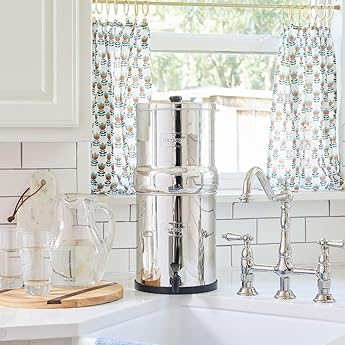
The Berkey Royal is the only filter on this list that requires no power, no plumbing, and no installation at all. Fill the top chamber, gravity does the work. The Black Berkey elements remove 99.9% of chloramine, PFAS, chlorine, bacteria, viruses, and heavy metals. Critical note: the standard Berkey does NOT remove fluoride. For fluoride removal, you must add the PF-2 fluoride filter elements — order them with the unit, not as an afterthought.
Ideal for: rentals, regional properties on bore water or tank water, households during water quality events, travel. The 12.3L capacity and ~4 litres/hour flow rate suits 2–4 people.
Berkey Royal — Pros and Cons
Pros
- No power, no plumbing, no installation required
- 99.9999% bacteria and 99.999% virus removal
- Works during power outages — emergency-ready
- Handles tank water, bore water, and surface water
- Very low ongoing cost (~$60/year in filter media)
Cons
- Standard unit does NOT remove fluoride (PF-2 add-on required)
- No TDS or hardness reduction
- ~4 litres/hour gravity flow — slow for large families
- Large benchtop footprint (38cm tall unit)
Buy if: you need filtration with zero power or plumbing dependency — off-grid properties, tank water, emergency preparedness, or regional households. Check price →
7. Philips RO Water Station — Best Countertop RO with Hot Water

The Philips RO Water Station is the only countertop reverse osmosis unit in Australia that also dispenses filtered hot water — and it does it at up to 95°C in 3 seconds. The AquaTru Classic (above) produces filtered water at ambient temperature only; the Philips RO Water Station lets you select 45°C, 85°C, or 95°C, effectively replacing both your tap filter and electric kettle on the benchtop. For anyone who drinks filtered water and also needs hot water for tea, pour-over coffee, or cooking, that is a meaningful consolidation.
The Aquaporin Inside technology uses biomimetic membranes — modelled on biological water channels in cell membranes — to achieve a 75% water recovery rate, significantly better than the 50% typical of standard RO membranes. At 110+ contaminants removed including fluoride, PFAS, bacteria, and microplastics, the filtration coverage is comprehensive. The UV-C LED sterilisation stage runs automatically to keep the 4L tank bacteria-free between dispenses — addressing the standard hygiene concern with tank-based systems. Alkaline mineralisation is also included, so the output isn’t stripped zero-TDS water.
The key limitation: no NSF P473 PFAS-specific certification. The AquaTru Classic carries independent NSF P473 certification for PFOA and PFOS removal; the Philips claims PFAS removal without that third-party validation. If PFAS is your primary concern — particularly in Darwin, near RAAF bases, or western Sydney — the AquaTru is the more defensible choice. For general benchtop RO with hot water dispensing, the Philips RO Water Station is unmatched in Australia at this price point.
Philips RO Water Station — Pros and Cons
Pros
- Only countertop RO with instant hot water (up to 95°C)
- No plumbing — renter-friendly benchtop unit
- UV-C LED sterilisation keeps tank water clean
- 75% water recovery (above RO average)
- TDS display + alkaline mineralisation
Cons
- No NSF P473 PFAS certification (unlike AquaTru)
- 4L tank requires refilling for high-use households
- 0.2 L/min flow rate is relatively slow
- Replacement filters only via The Good Guys
Buy if: you want countertop RO with instant hot water dispensing — replacing both your tap filter and kettle in one unit. Check price →
Also filtering your shower water? See our full Best Shower Filter Australia 2026 guide — including the only catalytic carbon option proven effective for chloramine cities.
Water Filter Recommendations by Australian City
| City | Disinfectant | Main Concerns | Minimum Recommendation | Comprehensive Pick |
|---|---|---|---|---|
| Sydney | Chloramine | Chloramine + PFAS (western suburbs) + fluoride | Tappwater EcoPro | AquaTru or Waterdrop D6 |
| Melbourne | Free chlorine | Fluoride + old pipe leaching (pre-1980 homes) | Any carbon filter (Brita works here) | AquaTru for fluoride removal |
| Brisbane | Chloramine | Chloramine + fluoride 1.0 mg/L (highest AU capital) | Tappwater EcoPro (catalytic carbon) | AquaTru, Waterdrop D6, or EcoHero 5-Stage (WaterMark-certified; ideal for SEQ homeowners) |
| Perth | Free chlorine | High TDS (150–220 mg/L) + hardness + PFAS near RAAF Pearce | Tappwater EcoPro | Waterdrop D6 (handles high TDS best) |
| Adelaide | Chloramine | Saltiest capital — TDS 300–500 mg/L, Murray River source | Tappwater EcoPro (minimal TDS reduction) | Waterdrop D6 — RO essential for TDS |
| Hobart | Free chlorine | Cleanest AU capital — TDS 15–25 mg/L; pipe leaching risk in pre-1970 homes | Brita acceptable here | AquaTru if in older home |
| Darwin | Chloramine | PFAS highest risk of any AU capital (RAAF Darwin, Robertson Barracks) | Tappwater EcoPro | AquaTru (NSF P473 PFAS certification) |
What You Don’t Need to Buy
Save your money on these
- Brita in Brisbane/Sydney/Adelaide/Darwin: Standard Brita uses GAC carbon — removes free chlorine (Melbourne is fine), removes chloramine at 1/40th the rate. In chloramine cities, you’re buying the shape of a filter without the function.
- Alkaline ionisers ($1,500–$4,000): Electrically adjusting pH has no evidence-based health benefit. Save the money and get an RO system with a mineraliser post-filter if water taste is the goal.
- Whole-house carbon filters for fluoride: Carbon cannot remove fluoride ions regardless of volume or contact time. This is fundamental electrochemistry, not a brand limitation.
- Benchtop distillers for daily use: Distillation removes fluoride effectively (~99%) but produces ~4L per 4-hour cycle. For a family, this is impractical. RO is faster and more convenient.
5-Year Total Cost Comparison
| Filter | Upfront | Annual Filters | 5-Year Total | Cost/Litre |
|---|---|---|---|---|
| Bottled water (2L/day) | $0 | $730–1,460 | $3,650–7,300 | $0.50–2.00 |
| Waterdrop D6 (under-sink RO) | $499 + install | $200 | ~$1,650 | $0.03 |
| EcoHero 5-Stage (under-sink RO) | ~$649 + install | $150 | ~$1,550 | $0.05 |
| PWS RO-5U (with tap) | $999 + install | $289 | ~$2,444 | $0.07 |
| AquaTru Classic (countertop RO) | $699 | $300 | ~$2,200 | $0.06 |
| Philips RO Water Station (countertop + hot water) | $799 | $179 | ~$1,694 | $0.05 |
| Tappwater EcoPro | ~$80 | $120 | ~$680 | $0.04 |
| Berkey Royal (no PF-2) | ~$450 | $60 | ~$750 | $0.04 |
How to Choose: The 3-Question Decision Tree
Question 1: Do you rent or own?
If you rent → AquaTru Classic (countertop RO) or Tappwater EcoPro (clip-on). Both require zero plumbing modification.
If you own → Waterdrop D6 (under-sink RO) for best long-term value. Or EcoHero 5-Stage if WaterMark AS3497 certification is required — the only AU/NZ-certified option with a local support line and personally tested results.
Question 2: Is fluoride removal a priority?
Yes → You need RO (AquaTru or Waterdrop D6). Tappwater EcoPro removes ~70%; the Berkey without PF-2 removes none.
No → Tappwater EcoPro is sufficient for chloramine + PFAS removal at lowest cost.
Question 3: What city are you in?
Brisbane/South-East Queensland → Chloramine + fluoride at 1.0 mg/L (highest of any AU capital). For SEQ homeowners wanting a WaterMark-certified under-sink system, the EcoHero 5-Stage is the tested local option (Palm Beach tested: 69 → 3 ppm TDS).
Adelaide or Perth → TDS is high — RO is strongly recommended (AquaTru or D6). Gravity filters don’t reduce TDS.
Melbourne or Hobart → Free chlorine, not chloramine. A standard carbon filter or Brita is acceptable as an entry point; RO if you want fluoride removal too.
Darwin → PFAS risk is highest of any AU capital. AquaTru’s NSF P473 PFAS certification matters here.
Top Picks
Considering the EcoHero 5-Stage for your home?
Most families spend $3,650–7,300 on bottled water over 5 years. The EcoHero 5-Stage brings that to ~$1,550 — while delivering water that tested at 3 ppm TDS from a Palm Beach mains feed of 69 ppm. It’s the only WaterMark AS3497-certified under-sink RO I’ve installed and run personally. The full review covers real test data, the exact install process, annual cartridge costs, and whether the Australian certification premium is worth it versus Amazon alternatives.
Read the full EcoHero 5-Stage review →Frequently Asked Questions
Does a Brita filter remove fluoride from Australian tap water?
No. Standard Brita pitcher filters use granular activated carbon (GAC), which removes chlorine and improves taste but cannot remove fluoride ions. Fluoride is a negatively charged ion that doesn’t bind to activated carbon. Only reverse osmosis (90–97% removal), activated alumina (80–95%), or distillation (~99%) reliably removes fluoride. If you’re in a fluoridated city and want it out of your water, you need an RO system — not a pitcher.
Does Brita work in Australian cities that use chloramine?
No — not meaningfully. Brita uses standard GAC, which removes free chlorine effectively but removes chloramine at approximately 1/40th the rate. In Brisbane, Sydney, Adelaide, and Darwin (all chloramine cities), Brita achieves minimal chloramine reduction. You need a catalytic carbon filter (like the Tappwater EcoPro) or an RO system for chloramine removal.
What is the cheapest water filter that actually works in Australia?
The Tappwater EcoPro (~$80 upfront, ~$120/year ongoing) is the lowest-cost filter that meaningfully addresses Australian water chemistry — specifically chloramine (95%) and PFAS (93%), which are the two main concerns for most capital city residents. If you’re in Melbourne or Hobart (free chlorine, not chloramine), a basic carbon filter including Brita works adequately for chlorine removal, though not fluoride.
Is reverse osmosis water safe to drink long-term?
Yes. The concern about RO removing beneficial minerals is real but overstated for most people with a normal diet. RO water has essentially zero TDS — it’s very “empty.” Modern RO systems often include a mineraliser post-filter stage that adds trace calcium and magnesium back. If yours doesn’t and you drink primarily RO water, ensure dietary mineral intake is adequate through food. The WHO notes no evidence of health harm from low-mineral water in studies to date.
Do I need a plumber to install an under-sink water filter?
For under-sink RO systems, the installation involves connecting to the cold water supply line, a drain line, and running a dedicated tap through the benchtop. Most DIY-capable homeowners complete this in 1–2 hours using included components. If you’re not comfortable with basic plumbing, a licensed plumber charges $120–180 for the job in most Australian cities. All countertop and tap-mount options require no plumbing at all.
Which Australian cities have the worst tap water quality?
Adelaide consistently ranks as the most challenging for filtration — TDS runs 300–500 mg/L (the highest of any Australian capital) due to its Murray River source, plus chloramine disinfection and fluoride at 0.9–1.0 mg/L. Perth is second, with TDS averaging 150–220 mg/L and hardness around 180 mg/L CaCO₃. Both cities benefit significantly from RO filtration. Darwin has the highest PFAS contamination risk of any Australian capital. Hobart is the cleanest — TDS 15–25 mg/L, free chlorine, soft water.
Can a water filter remove PFAS (forever chemicals) from Australian tap water?
Reverse osmosis removes 93–98% of PFAS compounds. The AquaTru Classic is specifically certified to NSF Standard P473, which tests for PFOA and PFOS removal. Activated carbon at high contact time (whole-house systems with sufficient carbon volume) also provides significant PFAS reduction. Standard tap filters and pitchers provide variable PFAS removal depending on the media — check for NSF P473 certification specifically if PFAS is your primary concern.
What’s the difference between chlorine and chloramine — and why does it matter for filter choice?
Chlorine is a single element (Cl₂) used as a disinfectant. Chloramine is chlorine combined with ammonia (monochloramine, NH₂Cl), used because it’s more stable in distribution systems. The problem for filter users: standard activated carbon (GAC) removes free chlorine very efficiently but removes chloramine at approximately 1/40th the rate — meaning a standard carbon filter may achieve less than 3% chloramine removal. Catalytic carbon, designed specifically to break the chloramine bond, achieves 95%+ removal. If your city uses chloramine (Brisbane, Sydney, Adelaide, Darwin), verify your filter uses catalytic carbon or an RO membrane.
Get the Australian Home Environment Checklist
30 checks across water, air and EMF. Most of them free. Ranked by impact.
No spam. Unsubscribe any time.

Former Royal Australian Navy Clearance Diver and TAG-E counter-terrorism operator. Founded Clean and Native to apply the same rigorous thinking to the home environment.
Full biography →