
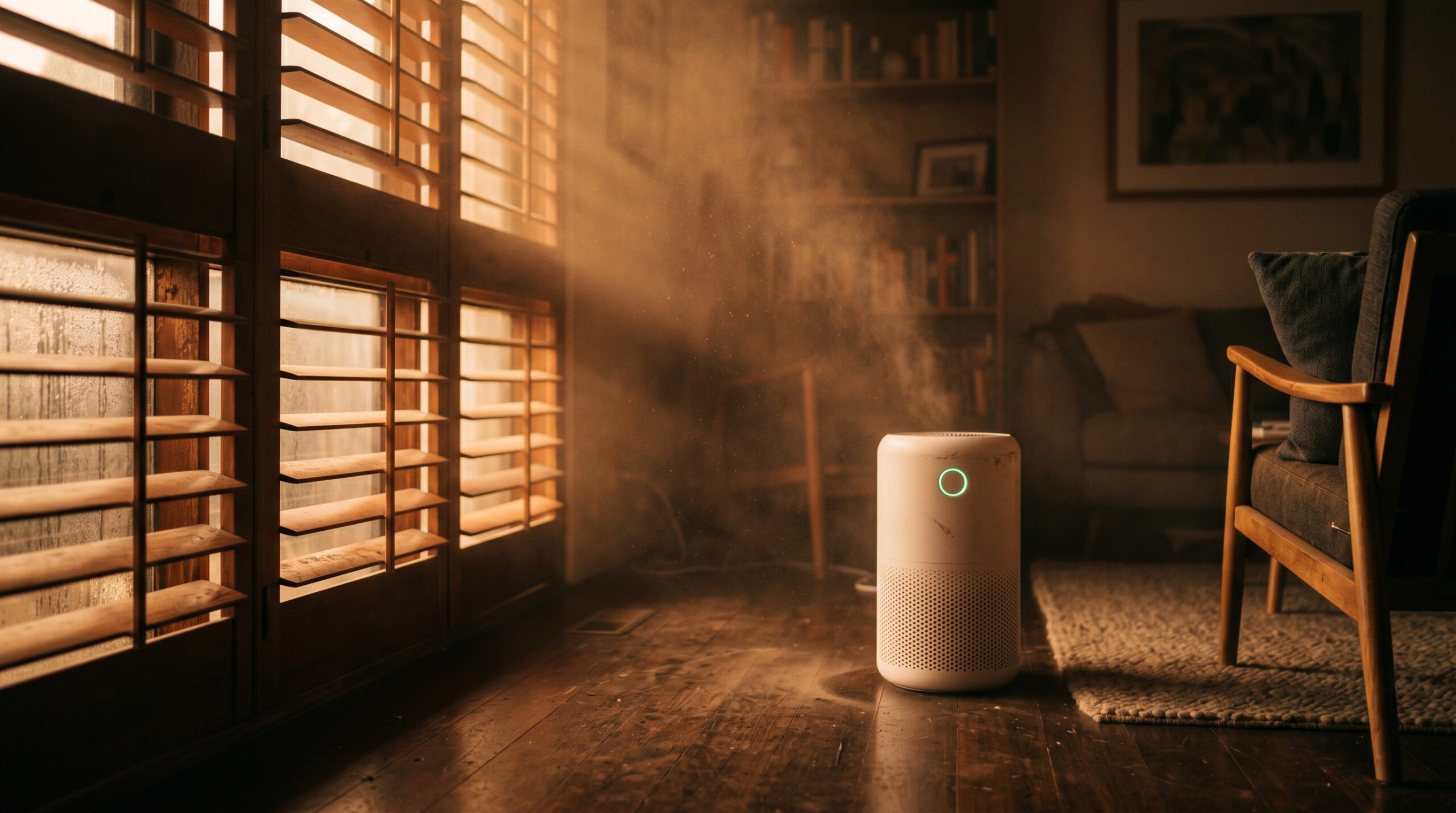
Bushfire Smoke Air Quality Alert: Protect Your Home Now
Drafted with AI assistance and checked against published specifications and certifications. First-hand measurements appear only where stated. How we make content
The Carlisle River fire in the Otways is currently pushing smoke across central Victoria and the Melbourne–Geelong corridor, triggering a bushfire smoke air quality alert that demands immediate indoor action. This guide tells you exactly what to do right now — seal, filter, monitor, and act — based on Victorian Government health guidance and verified AQI thresholds.
I have not personally tested the air purifiers discussed here (Breville Protect Max, Levoit Core 400S, Winix Zero Pro, Dyson Big Quiet, Austin Air HealthMate Plus); this assessment is based on published manufacturer specifications and independent standards (CADR, H13 HEPA, AS/NZS certification), not first-hand measurement. The only air product I measure first-hand is the Coway Airmega 150.
What Is Happening Right Now: The Carlisle River Fire and Melbourne’s Air
The Carlisle River fire in the Otways is an active incident being monitored by VicEmergency. Fires burning through the Otway Ranges push smoke northeast along established weather corridors, directly into Geelong, the Surf Coast, western Melbourne suburbs (Werribee, Hoppers Crossing, Point Cook), and on persistent north-westerly winds, all the way into inner Melbourne. This is not a hypothetical risk — it is the documented smoke transport pattern every Otways fire follows.
Melbourne uses free chlorine for water disinfection — not chloramine — which is worth noting if you are cross-checking our water filter content. But the air quality risk right now is the priority. EPA Victoria’s AirWatch network measures PM2.5 (fine particles below 2.5 micrometres) at monitoring stations including Geelong South, Footscray, and Alphington. Check EPA AirWatch in real time. If the Geelong South or Laverton stations are reading above AQI 100, the smoke has reached the metropolitan area.
According to the Victorian Government Department of Health, local government areas experiencing heavy smoke impacts should advise residents to shelter indoors, cancel outdoor events, and ensure community facilities (schools, aged care, health services) have operational air filtration. The guidance document — Supporting people when air quality is heavily impacted by bushfire smoke — explicitly names HEPA filtration as the primary indoor intervention.
The Health Risk You Cannot See: PM2.5 Explained in Plain Terms
Bushfire smoke is not the same as campfire smoke scaled up. It contains PM2.5 — fine particles at or below 2.5 micrometres in diameter, small enough to bypass your nose and throat entirely, penetrate deep into alveolar tissue, and enter your bloodstream. According to the National Environment Protection Measure (NEPM) for Ambient Air Quality, the 24-hour average standard for PM2.5 is 25 µg/m³. During significant bushfire events, outdoor concentrations routinely exceed 500 µg/m³. During the 2019-20 Black Summer fires, AQI readings above 2,000 were recorded across greater Sydney and parts of north-east Victoria — 80 times the NEPM standard.
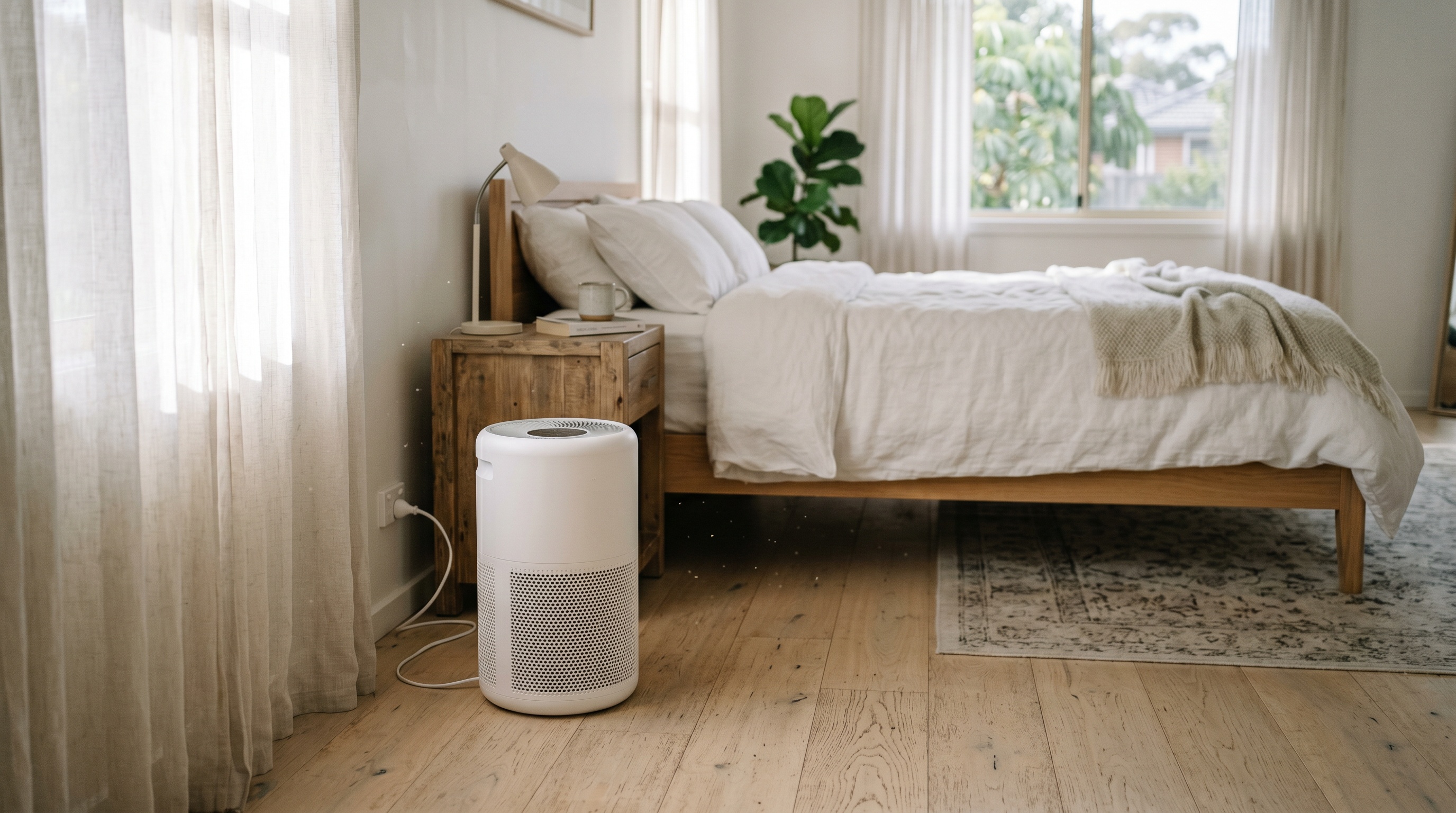
The populations at greatest risk, per Victorian Department of Health guidance, are: people with asthma or chronic obstructive pulmonary disease, children under five, adults over 65, pregnant women, and anyone with cardiovascular disease. For these groups, even moderate smoke exposure (AQI 100-150) carries measurable cardiovascular and respiratory risk. But “healthy adults” are not immune — sustained exposure above AQI 200 causes measurable decline in lung function in previously healthy individuals, per research published in the Medical Journal of Australia following the 2019-20 fires.
The critical indoor fact: buildings do not automatically protect you. A standard Australian home with average sealing infiltration allows outdoor air to exchange approximately once per hour. During a 12-hour smoke event at AQI 400, your indoor PM2.5 concentration will reach 60-80% of outdoor levels without active filtration. That is not shelter — it is slow exposure. The only intervention that changes this is mechanical filtration with a true HEPA filter running continuously.
Immediate Actions: What to Do Right Now During an Active Alert
I spent years as a Royal Australian Navy Clearance Diver working in contaminated water and air environments. The protocol is always the same: identify the hazard, contain exposure, apply the best available mitigation, monitor. Here is that protocol applied to bushfire smoke.
Step 1 — Close and Seal
Close all windows and external doors. This sounds obvious. Do it anyway, including rooms you are not using — PM2.5 migrates through internal doorways. Check obvious infiltration points: exhaust fans (bathroom, kitchen rangehood), evaporative cooling systems, open fireplaces. Evaporative coolers actively draw outdoor air inside — turn them off immediately during a smoke event and switch to a refrigerated split system if available. If you have visible gaps around door frames or window seals, a rolled towel against the base of external doors provides meaningful reduction.
Step 2 — Run Your HEPA Filter on Maximum
Turn your HEPA air purifier to its highest fan speed setting and leave it there. This is not the time for sleep mode or auto mode. Maximum speed delivers maximum Clean Air Delivery Rate (CADR). The CADR figure — measured in cubic metres per hour (m³/h) or cubic feet per minute (CFM) — tells you how much filtered air the unit delivers per unit of time. For a 25m² living area with a 2.4m ceiling (60m³ volume), you need a CADR of at least 120 m³/h to achieve two air changes per hour — the minimum for meaningful smoke reduction. Most HEPA units rated for “25m²” deliver this. At four air changes per hour (CADR 240+ m³/h for the same room), indoor PM2.5 drops by approximately 80% within 30-45 minutes, per research published in Environmental Science & Technology.
Step 3 — Monitor AQI and Indoor Air Quality
Open EPA Victoria’s AirWatch portal on your phone and check the nearest monitoring station every two hours during a smoke event. The monitoring stations most relevant to the Otways–Melbourne corridor are Geelong South, Laverton, and Footscray. Set a browser bookmark now, before you need it. If you have an indoor air quality monitor (IQAir AirVisual, Airthings Wave Plus, or similar with a PM2.5 sensor), place it in the room where your family spends the most time and watch the PM2.5 reading. If it rises above 35 µg/m³ despite filtration, add a second filter or increase the fan speed.
Step 4 — Protect Vulnerable Household Members
Children under five, elderly residents, and people with respiratory conditions should stay in the room with the HEPA filter running. If going outdoors is unavoidable, an AS/NZS 1716-certified P2 respirator is the minimum required standard — a surgical mask provides no meaningful PM2.5 protection. Keep outdoor time under 10 minutes and return indoors promptly.
Best HEPA Air Purifiers for Smoke Events — Australia
Choosing the Right HEPA Air Purifier for Smoke: What the Specs Actually Mean
Not all “HEPA” claims are equal. The standard that matters is H13 True HEPA, which captures 99.97% of particles at 0.3 micrometres (the most penetrating particle size — PM2.5 includes particles from 0.1 to 2.5 µm). A filter labelled “HEPA-type” or “HEPA-like” is not tested to H13 standard and may let a significant fraction of fine smoke particles through. Buy only units that explicitly state H13 True HEPA or publish filter test reports.
The CADR figure is the most important purchasing specification during a smoke event. It is measured in cubic metres per hour (m³/h) and tells you the volume of actually filtered air the unit delivers. To calculate the minimum CADR you need: multiply your room’s floor area by ceiling height (in metres) to get the room volume, then multiply by 4 (four air changes per hour is the target during a smoke event). A 40m² open-plan area with 2.7m ceilings is 108m³ — you need a CADR of at least 432 m³/h.
CADR Comparison — Mid-Range HEPA Air Purifiers, Australia 2026
The activated carbon stage matters during smoke events beyond just PM2.5 removal. Bushfire smoke contains volatile organic compounds (VOCs) — benzene, formaldehyde, acrolein, polycyclic aromatic hydrocarbons — that a HEPA filter alone cannot capture. These are gases, not particles. Only an activated carbon stage removes them. The Breville Protect Max carries 550g of activated carbon. The Levoit Core 400S has a thinner carbon layer (adequate for light use but less effective against heavy VOC loads from Otways fire smoke). The Austin Air HealthMate Plus leads the segment on carbon with 3.1kg of activated carbon and zeolite — purpose-built for sustained VOC exposure, though its 240 m³/h CADR limits it to single rooms up to 30m².
Room Sizing Reference — Active Smoke Event (4 ACH target)
| Room Size | Ceiling Height | Min. CADR Required | Suitable Unit |
|---|---|---|---|
| Bedroom (15m²) | 2.4m | 144 m³/h | Levoit Core 400S (420 m³/h) |
| Lounge (25m²) | 2.4m | 240 m³/h | Levoit Core 400S or Winix Zero Pro |
| Open plan (40m²) | 2.7m | 432 m³/h | Breville Protect Max (550 m³/h) |
| Large open plan (60m²) | 2.7m | 648 m³/h | Two units: Breville Protect Max + Levoit Core 400S |
Preparing Before the Next Smoke Event: What to Do When the Air Is Clean
The worst time to buy an air purifier is when the AQI hits 300 and every unit on Amazon AU has a two-week delivery window. If you are reading this during an active event and you do not have a filter, order one now and use the DIY method below in the interim. If the air is currently clear, this section is the most important thing you can do today.
The DIY Box Fan Filter — The Emergency Option
A box fan and a 20×20-inch MERV-13 furnace filter taped to the intake side creates a makeshift air purifier that removes approximately 50-70% of PM2.5. It is not a substitute for a true HEPA unit — H13 HEPA captures 99.97% of particles at 0.3µm versus MERV-13’s roughly 85% at 1µm — but it is dramatically better than nothing. Use packing tape to seal the edges of the filter to the fan frame. Run it in the room where vulnerable family members are sheltering. Replace the filter after each major smoke event — a grey, loaded filter provides reduced airflow and reduced filtration.
Filter Maintenance Schedule
A HEPA filter loaded with smoke particles restricts airflow and reduces CADR. Most manufacturers recommend annual filter replacement under normal use. During smoke season in Victoria and NSW (October through March), accelerate that schedule. If you run your filter continuously at maximum speed during a five-day smoke event, inspect the filter immediately afterwards. A visibly dark, discoloured HEPA filter is spending energy pushing air through a clogged medium rather than filtering it. Replace it. The cost of a replacement filter is trivial against the cost of the health outcome you are preventing.
Sealing Your Home Before Season
The most cost-effective investment before smoke season is not a more expensive air purifier — it is weatherstrip sealing. Gap-filling foam around external door frames, replacement of damaged window seals, and blocking unused fireplace flues reduces natural infiltration rates from 0.8-1.2 air changes per hour (typical older Victorian home) to 0.3-0.5 ACH. This halves the volume of smoke-laden outdoor air you need to filter. A $40 roll of door seal and a tube of low-VOC frame sealant purchased in September prevents a mid-summer crisis.
Evaporative coolers deserve specific attention for Melbourne and Geelong homes. An evaporative cooler running during a smoke event delivers contaminated outdoor air directly into your living space — it is the functional opposite of an air purifier. Switch to split-system air conditioning and recirculation mode during smoke events. If you only have evaporative cooling, turn it off, close the system’s louvre vents, and rely on ceiling fans or portable fans to circulate the air inside your sealed home.
What to Stock Before Smoke Season Starts
This is the pre-season checklist. Complete it before October in Victoria:
| Item | Purpose | Standard / Spec | Priority |
|---|---|---|---|
| HEPA air purifier (H13) | PM2.5 and VOC removal indoors | H13 HEPA + activated carbon stage | Essential |
| Replacement HEPA filter | Post-event replacement ready | OEM filter for your unit | Essential |
| P2 respirators (x4 per adult) | Outdoor protection unavoidable trips | AS/NZS 1716:2012 P2 | Essential |
| Door and window weatherstrip | Reduce smoke infiltration rate | Foam or rubber compression seal | High |
| Indoor PM2.5 monitor | Verify filtration is working | PM2.5 sensor (IQAir, Airthings) | Recommended |
| MERV-13 furnace filter + box fan | DIY backup if purifier fails | MERV-13 minimum | Backup |
AQI Monitoring: The Tools You Need and How to Use Them
AQI — Air Quality Index — is Victoria’s standardised scale for communicating PM2.5 and other pollutant concentrations to the public. EPA Victoria uses a 0-to-200+ scale where 0-33 is Good, 34-66 is Fair, 67-99 is Poor, 100-149 is Very Poor, 150-199 is Extremely Poor, and 200+ is Hazardous. Each step up the scale represents a meaningful increase in health risk. Do not conflate “Poor” (AQI 67-99) with acceptable during a smoke event for vulnerable household members — at this level, the Victorian Department of Health recommends those with asthma or heart conditions remain indoors.
Where to Monitor
EPA Victoria AirWatch is the primary source: epa.vic.gov.au/airwatch. It updates every hour from the permanent monitoring network. For the Otways fire corridor, the key stations are Geelong South (closest to the fire origin), Laverton (western Melbourne), and Footscray (inner west). If Geelong South is above AQI 100 and the wind is from the south-west, expect Melbourne CBD and northern suburbs to follow within two to four hours.
VicEmergency — emergency.vic.gov.au — is the source for fire location updates and smoke movement forecasts. Subscribe to push notifications for your local government area. During the Carlisle River fire, VicEmergency has been publishing smoke impact updates via their Facebook page as conditions change.
For real-time granular data including near-real-time PM2.5 from private sensors, PurpleAir has a growing network of sensors across Melbourne, Geelong, and regional Victoria. The PurpleAir map at map.purpleair.com shows sensor readings updated every two minutes. Note that PurpleAir sensors use a different calibration factor to EPA reference monitors — the platform now applies the EPA correction factor (US EPA LRAPA correction) by default in Australia, which brings readings within approximately 10-15% of EPA reference instruments.
What the Numbers Mean — Decision Thresholds
Here is the decision table. It is not complicated. It requires no medical degree. Print it and put it on your fridge before October.
| AQI | PM2.5 (µg/m³) | Risk Level | Recommended Action |
|---|---|---|---|
| 0–33 | 0–9 µg/m³ | Good | Normal activity |
| 34–66 | 9–25 µg/m³ | Fair | Monitor. Vulnerable groups limit outdoor activity |
| 67–99 | 25–37 µg/m³ | Poor | Limit outdoor exertion. Run HEPA filter indoors |
| 100–149 | 37–74 µg/m³ | Very Poor | Vulnerable groups indoors. HEPA on max. No outdoor exercise |
| 150–199 | 74–111 µg/m³ | Extremely Poor | All residents indoors. HEPA on max. Seal gaps. P2 mask for essential trips |
| 200+ | 111+ µg/m³ | Hazardous | Stay indoors. Two HEPA units if available. Seek medical advice for symptoms |
Victoria-Specific Context: Why Melbourne Is Particularly Exposed
Melbourne sits at the northern end of a geographic funnel. The Otways, Strzelecki Ranges, and Dandenong Ranges wrap around Port Phillip Bay from three directions. When fires burn in any of these ranges, Melbourne’s density and prevailing north-westerly winds during summer create a predictable smoke transport pathway. The western and northern suburbs — Werribee, Hoppers Crossing, Melton, Sunshine, Essendon, Broadmeadows — are consistently the first to be impacted when Otways fires run on south-westerly winds that rotate to north-westerly during fire weather.
Geelong, sitting 75km south-west of Melbourne, is typically impacted before the capital during Carlisle River or broader Otways fire events. Surf Coast suburbs including Torquay, Anglesea, and Lorne face dual risk — direct smoke from nearby fires and the second-hand plume moving north into the corridor. For residents of these areas: AQI readings can move from Good to Hazardous in under an hour when a fire makes a significant run. The time to have your HEPA filter running is when AQI reaches 50, not 200.
Melbourne uses free chlorine for tap water disinfection — standard activated carbon filters handle taste and odour adequately here, which is relevant context if you are also considering a water filter during a prolonged indoor shelter period. This is a different situation from Brisbane or Sydney (which use chloramine) — Melbourne residents have more filter options. But during an active smoke event, air quality is the immediate priority.
Last reviewed: May 2026 — Clean and Native
Frequently Asked Questions
EPA Victoria classifies AQI above 100 as “Very Poor” and this is the threshold at which the Victorian Department of Health recommends all vulnerable residents shelter indoors. During active fire events, VicEmergency issues formal smoke advisories when AQI is forecast to reach or exceed this level in affected local government areas.
Yes, significantly. A sealed home with windows and doors closed reduces PM2.5 infiltration by 50-80% compared to an open home, according to building science research on smoke infiltration rates. The effect is greatest in newer, well-sealed homes. In older Victorian weatherboard homes with gaps and deteriorated seals, closing windows still helps but adding weatherstripping provides additional meaningful reduction.
No. Evaporative coolers actively draw outdoor air into your home — they are the functional opposite of an air purifier during a smoke event. Turn off your evaporative cooler, close its louvre vents, and switch to a split-system air conditioner on recirculation mode. If you only have evaporative cooling, run ceiling fans or portable fans to circulate the sealed indoor air, and rely on your HEPA air purifier for filtration.
H13 True HEPA is the minimum standard you need for bushfire smoke. It captures 99.97% of particles at 0.3 micrometres — the hardest particle size to capture and the size most representative of fine smoke PM2.5. “HEPA-type” or “HEPA-style” filters are not independently tested to this standard and may allow a significant fraction of smoke particles through. Only buy units that state H13 True HEPA explicitly.
After any smoke event where you ran your purifier continuously for three or more days at maximum speed, inspect the filter visually. A visibly dark or discoloured filter has reduced airflow capacity and should be replaced. Under normal use, annual replacement is standard. During an active smoke season (October through March in Victoria), budget for one additional replacement filter per unit. Keep a spare on hand before season starts — stock sells out during smoke events.
The Breville Protect Max is the best single unit for most Melbourne households during smoke events. Its 550 m³/h CADR covers open-plan living areas up to 80m² at four air changes per hour, and its activated carbon stage removes the VOCs (benzene, formaldehyde, acrolein) that HEPA alone cannot filter. For bedrooms, the Levoit Core 400S at 420 CADR provides more than adequate coverage at a lower price point.
EPA Victoria’s AirWatch portal (epa.vic.gov.au/airwatch) is the authoritative source, updating hourly from the permanent monitoring network. The most relevant stations for Otways fire smoke are Geelong South, Laverton, and Footscray. For near-real-time granular data, the PurpleAir map (map.purpleair.com) covers Melbourne with private sensor density in most suburbs and updates every two minutes.
No. Surgical masks and cloth face coverings provide no meaningful protection against PM2.5 — the particles are far smaller than the gaps in the mask fabric. Only an AS/NZS 1716:2012 certified P2 respirator (equivalent to N95 in the US) provides documented protection against fine smoke particles when properly fitted. The seal between the respirator and your face is as important as the filter medium — facial hair breaks this seal.
Victorian Department of Health guidance recommends that people with severe respiratory or cardiovascular conditions consider temporarily relocating if smoke events are forecast to be prolonged (more than three to five days) and the home cannot be adequately sealed or filtered. For most children and elderly residents, sheltering in a well-filtered home with a running HEPA purifier is as protective as relocation and avoids the additional stress of travel. Consult a GP for individual medical advice during extended hazardous events.
Get the Australian Home Environment Checklist
30 checks across water, air and EMF. Most of them free. Ranked by impact.
No spam. Unsubscribe any time.

Former Royal Australian Navy Clearance Diver and TAG-E counter-terrorism operator. Founded Clean and Native to apply the same rigorous thinking to the home environment.
Full biography →