Winix vs Coway Air Purifier Australia 2026: Which One Is Actually Worth It?
Drafted with AI assistance and checked against published specifications and certifications. First-hand measurements appear only where stated. How we make content
For mid-range air purifiers in Australia, the Winix Zero Pro and Coway Airmega 150 are the two units that keep coming up — and for good reason. Both do the job. But which one you should buy comes down to one number: your room size.
✓ Buy the Winix Zero Pro if you…
- Have a living room, open-plan kitchen-lounge, or bedroom larger than 40m²
- Want a washable pre-filter to cut ongoing costs
- Run the purifier during the day and can tolerate 52 dBA on max
- Want a higher CADR buffer for bushfire smoke events in NSW, VIC, or QLD
- Prefer a unit with auto mode using a built-in air quality sensor
✓ Buy the Coway Airmega 150 if you…
- Are filtering a bedroom or small room under 40m²
- Need the quietest possible sleep mode (24 dBA)
- Want to spend $210 less upfront without sacrificing meaningful performance
- Live in a flat, apartment, or student accommodation
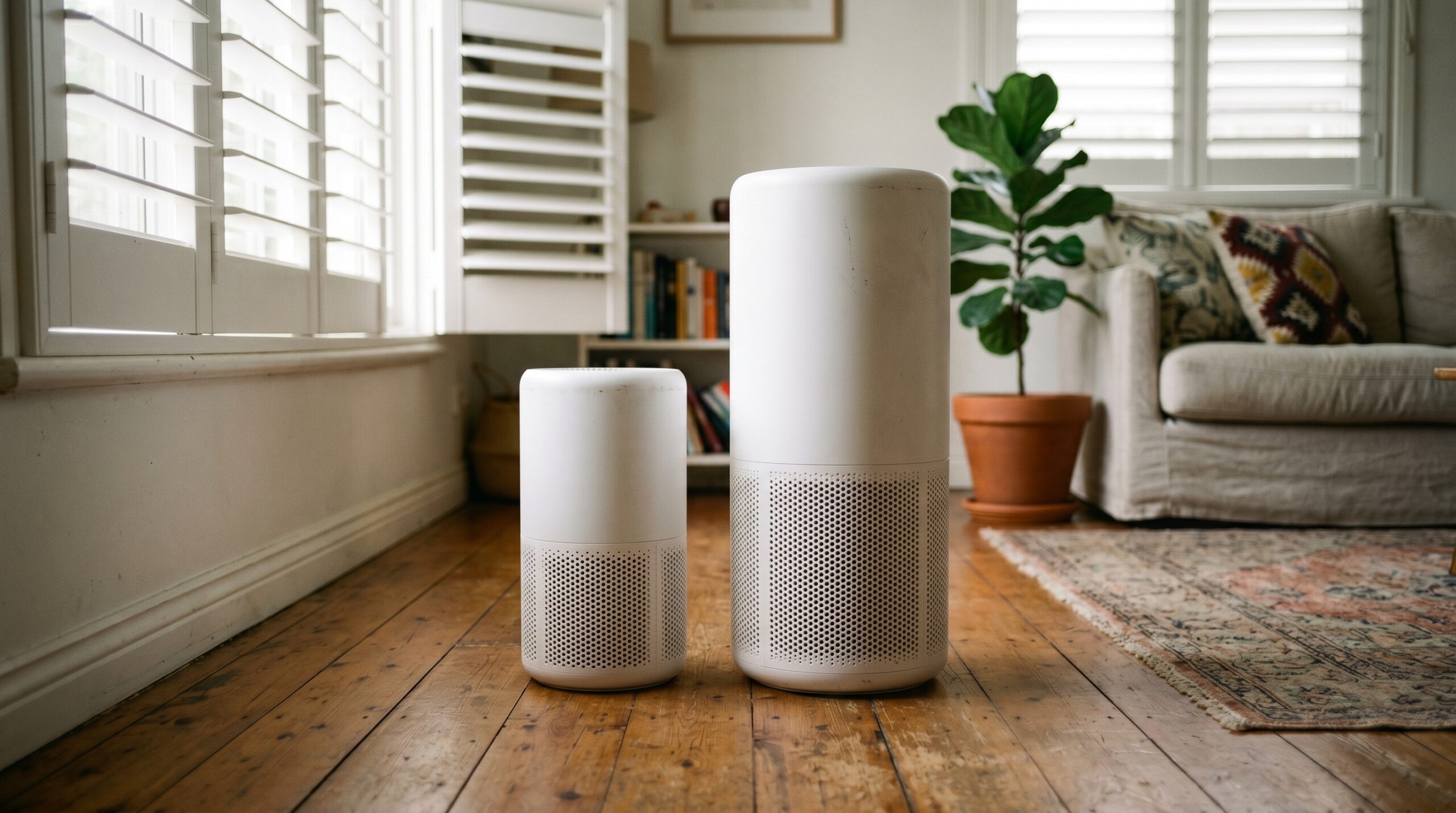
- Want a compact unit that does not dominate the room
Head-to-Head Specs: What the Numbers Actually Mean
Both units use a true H13 HEPA filter rated to capture 99.97% of particles at 0.3 micrometres. That is the same standard used in hospital operating theatres and pharmaceutical clean rooms. At that level, particle filtration is not where you choose between them. You choose on CADR, room coverage, and noise.
CADR stands for Clean Air Delivery Rate. It is the single most useful number in air purifier specs. Measured in cubic feet per minute (CFM), it tells you how much clean air the unit can actually deliver per minute across all three pollutant categories: dust, smoke, and pollen. The Winix Zero Pro’s 246 CFM CADR is 51% higher than the Coway 150’s 163 CFM. That gap is not marginal — it is the difference between appropriate coverage and undersizing a room.
Both units include an ioniser that can be disabled. This matters. Some buyers are concerned about ozone generation from ioniser technology — particularly those with asthma or chemical sensitivities. The best air purifiers for asthma in Australia are always run with ionisers off. Both Winix PlasmaWave and Coway Bipolar ionisers are independently switchable from the unit’s control panel, so you are not locked into either mode.
Room Size Deep-Dive: When CADR Actually Matters
The AHAM (Association of Home Appliance Manufacturers) recommends sizing a purifier to achieve at least 4.8 air changes per hour (ACH) for effective smoke and allergen control. At 2 ACH, you are running a unit that is marginal at best. At 1 ACH, you might as well open a window.
Here is what that means in practice for Australian home sizes:
| Room Size | Coway 150 ACH | Winix Zero Pro ACH | Verdict |
|---|---|---|---|
| 20m² bedroom (2.4m ceiling) | 5.8 ACH ✓ | 8.7 ACH ✓ | Either works — Coway saves $210 |
| 35m² master bedroom / large bedroom | 3.3 ACH ⚠ | 5.0 ACH ✓ | Winix preferred — Coway marginal |
| 50m² open-plan lounge | 2.3 ACH ✗ | 4.8 ACH ✓ | Winix only |
| 70m² combined kitchen-dining-lounge | 1.7 ACH ✗ | 3.4 ACH ⚠ | Winix adequate — consider Breville Protect Max for better coverage |
Most standard Australian bedrooms in new builds run 14-18m². For those, the Coway 150 is overkill in a good way — it cleans the air faster than you need, on lower fan speed, at lower noise. Buying the Winix Zero Pro for a 15m² bedroom is paying $210 extra for CADR you will never use.
The reverse is equally true. If you have a Queensland open-plan home with kitchen, dining, and lounge running 55-70m², the Coway 150 will not clean that space effectively. During bushfire smoke events — which hit Sydney, Melbourne, Brisbane, and Canberra households hardest between October and March — an underpowered unit is not a backup plan. It is a false sense of security.
One gap every competitor misses: warranty terms in Australia. Winix provides a 2-year warranty on units sold through Australian authorised retailers. Coway Australia offers a 2-year manufacturer warranty on the Airmega 150. Both are comparable, and both cover defects under Australian Consumer Law, which provides additional protections beyond any stated manufacturer warranty period regardless. Check your retailer’s returns policy — Amazon AU’s 30-day return window applies to both.
Noise Comparison: The Bedroom Use Case
Sleep mode noise is where the Coway 150 has a real, measurable edge. Twenty-four decibels on sleep mode is quieter than the ambient hum in most Australian bedrooms with ceiling fans running. The Winix Zero Pro at 26 dBA on sleep mode is not loud — but that 2 dBA difference is not trivial. Decibels are logarithmic: 26 dBA is approximately 60% louder in perceived volume than 24 dBA.
On maximum fan speed, the gap widens. The Coway 150 peaks at 46 dBA. The Winix Zero Pro reaches 52 dBA. At 52 dBA, you are at the level of a quiet conversation. Fine for a living room during the day. Not ideal if you are light-sensitive to sound and run the unit on auto mode overnight — because the auto mode will ramp up if it detects pollutants, and Brisbane households during spring pollen season will find that sensor triggering regularly.
Both units have a dedicated sleep mode that dims the indicator lights and locks to the lowest fan speed. If you are buying a purifier specifically for your bedroom, noise is not a secondary consideration. It is the primary one. The Coway 150’s 24 dBA sleep mode is one of the quietest in this price bracket in Australia.
If noise is your absolute priority and budget is flexible, the best air purifiers in Australia for 2026 include units that hit 20 dBA on sleep — but you will pay $400+ more for that performance.
Compare Both Units on Amazon AU
Coway Airmega 150 — Sage Green option →Filter and Running Costs: 5-Year Reality Check
Upfront price is only part of the story. Air purifiers have ongoing filter replacement costs that can exceed the purchase price over a typical 5-year ownership period. Here is the honest breakdown.
The Winix Zero Pro uses a 3-stage filter system: a washable pre-filter (no replacement cost), a combined H13 HEPA and activated carbon filter replacing annually at approximately $90 per set. The washable pre-filter is a genuine cost advantage over single-filter competitors — it captures large particles before they reach the HEPA layer and extends HEPA life.
The Coway 150 uses a 3-stage system as well: a mesh pre-filter that is washable and free to maintain, plus a combined True HEPA and activated carbon filter at approximately $70 per year. Slightly cheaper annual filters, but a smaller unit processing less air per cycle.
Both units draw modest power. The Winix Zero Pro runs at approximately 58W on max, dropping to under 5W on sleep. The Coway 150 runs at approximately 37W on max. On an average Australian electricity tariff of 35c/kWh, running either unit 12 hours per day adds roughly $7-12 per month to your power bill. Not nothing, but not a deciding factor.
5-Year Total Ownership Cost — Mid-Range Air Purifiers, Australia
Upfront price + 5 years of annual filter replacements (manufacturer-published filter costs, AUD).
Formula: upfront price + (annual filter cost × 5 years). Sources: Winix, Coway, Levoit, Dyson Australian product pages and Amazon AU listings. Bar fill #3A8A5A = Winix Zero Pro (reviewed); #1A3326 = peer products; max bar = Dyson BP04 at $1,749. Power costs not included — see prose above for electricity breakdown.
The Coway 150 is the cheapest 5-year proposition at $639 total — $310 less than the Winix over five years, and $1,110 less than the Dyson BP04. If you are in a room it can actually cover, that is a compelling gap. But spending $639 on a unit that delivers 1.7 ACH in a 70m² lounge is wasted money. Spend $949 on the Winix and get the coverage the room requires.
What Both Get Right — and Where Each Falls Short
Neither unit is without flaws. The honest version of this comparison acknowledges both.
What the Winix Zero Pro does well
The washable pre-filter is a genuine differentiator. Most competitors at this price point use disposable pre-filters that add $20-30 annually to running costs. The Winix pre-filter rinses clean under tap water and reinstalls in minutes. Over five years, that is $100-150 in avoided spend.
Auto mode on the Winix uses a real-time air quality sensor to adjust fan speed continuously. During Australian bushfire smoke events — when PM2.5 in Sydney, Melbourne, and Brisbane suburbs can spike above 500 micrograms per cubic metre — a purifier that detects and responds is meaningfully better than one you have to manually crank up.
CADR headroom matters during peak events. A unit running at 70% capacity during normal conditions has more reserve to push through a smoke episode. The Winix Zero Pro’s 246 CFM CADR gives you that buffer in a way the Coway 150 simply cannot match in a large room.
Where the Winix falls short
The Winix app has drawn consistent criticism. HouseFresh noted in testing of the Winix 5510 that the app functionality is inferior to Levoit and Xiaomi alternatives — no remote scheduling that actually works reliably, patchy connection on some Australian NBN router configurations, and an interface that feels outdated. For most buyers this is minor — the unit runs fine without the app. But if smart home integration is a priority, look at the Levoit Core 400S instead.
At 52 dBA on max, the Winix Zero Pro is noticeably louder than a typical bedroom purifier. If you run it in a bedroom on auto mode and your suburb cops pollen or smoke overnight, the fan will ramp up and you will know about it.
What the Coway Airmega 150 does well
The Coway 150 punches well above its price. Consumer Analysis, in benchmarking that covers 800+ hours of testing, ranked the Coway Mighty (the predecessor platform) as the number-two performing unit in its segment. Coway’s H13 HEPA layer is consistently verified at the advertised 99.97% particle capture rate at 0.3 micrometres.
The compact footprint — roughly 28cm square — means it fits on a bedside table, a study desk, or a shelf without dominating the space. For apartment living in Sydney, Melbourne, or Brisbane where rooms are smaller and floor space is at a premium, that matters.
The Coway 150 is also available in Sage Green, which is a detail that sounds trivial but is actually relevant for buyers who want the unit visible rather than hidden. The white and dark colourway options from competitors often look industrial. The Sage Green Coway looks intentional.
Where the Coway falls short
The 163 CFM CADR creates hard limits. There is no workaround for physics. If your room is 45m², the Coway 150 will deliver approximately 2.5 ACH — which is insufficient during a high-pollution event. You cannot compensate by running it longer. The air changes per hour figure is what it is at a given fan speed and room volume.
The activated carbon layer in the Coway 150 is thinner than the Winix equivalent. For households dealing with cooking odours, VOCs, or paint fumes in a larger space, carbon performance will be noticeably weaker. The Winix Zero Pro’s carbon stage is more substantial.
If you want to explore low-EMF air purifiers in Australia, neither the Winix nor the Coway has been independently verified for low-emission operation — a detail worth knowing for buyers who run a purifier overnight in the bedroom.
Final Verdict and Room Size Decision Tree
I am a former Royal Australian Navy Clearance Diver, and the way I approach gear selection is the same whether it is a dive kit or a home air purifier: fit for purpose, nothing more, nothing less. Both the Winix Zero Pro and the Coway Airmega 150 are well-built, honestly specified units from brands with track records in the Australian market. Neither is a poor choice in the right application.
The mistake most buyers make is buying based on price alone. Spending $289 on a unit that delivers 1.7 ACH in your living room is worse than spending $499 on a unit that delivers 4.8 ACH. The cheaper unit does not filter the room — it filters a fraction of it, slowly. That is not a bargain. It is a waste of $289.
Equally, spending $499 on a Winix Zero Pro for a 15m² apartment bedroom when the Coway 150 would achieve 5.8 ACH in that same room is paying $210 for nothing useful. Use the decision tree below and make the call based on your room, not your budget preference.
Both units are available now on Amazon AU with standard delivery Australia-wide.
Coway Airmega 150 is available in Dove White and Sage Green. Winix Zero Pro ships as standard. Check current pricing — both units fluctuate $20-40 around their RRP on Amazon AU.
Last reviewed: May 2026 — Clean and Native
Frequently Asked Questions
Only if your room exceeds 40m². In a standard Australian bedroom under 35m², the Coway 150 delivers more than enough CADR and is quieter and cheaper. In a living room or open-plan space, the Winix Zero Pro’s 246 CFM CADR is not optional — it is the minimum to achieve effective air changes per hour in that space.
Yes. The Coway Airmega 150 uses a True HEPA filter rated to capture 99.97% of airborne particles at 0.3 micrometres. This is the same H13 HEPA standard used in medical and laboratory environments. It is effective against PM2.5, pollen, mould spores, and most airborne allergens.
Yes. Both the Winix PlasmaWave and the Coway Bipolar ionisers are independently switchable from the control panel. If you have asthma, chemical sensitivities, or are simply cautious about ioniser-generated byproducts, turn it off. The H13 HEPA and activated carbon stages operate independently and are not affected by disabling the ion function.
For bedrooms in Sydney, Melbourne, Brisbane, and Canberra during smoke season (October to March), the Coway 150 is adequate for rooms under 35m². For larger living areas, the Winix Zero Pro’s 246 CFM CADR and air quality auto-sensor mode makes it significantly more effective at processing smoke-laden air quickly. During active smoke events, CADR headroom matters more than in normal conditions.
Both manufacturers recommend filter replacement every 12 months under normal use (12 hours per day). In high-pollution environments — near industrial areas, during extended smoke events, or in homes with pets — replacement every 9-10 months is more realistic. Both units have filter replacement indicators. Annual cost is approximately $90 for the Winix Zero Pro and $70 for the Coway 150.
Both Winix and Coway provide a 2-year manufacturer warranty on units purchased through authorised Australian retailers, including Amazon AU. This is in addition to Australian Consumer Law protections, which apply independently of any stated warranty period. Keep your purchase receipt — it is the simplest proof of purchase if a warranty claim is needed.
No. At 50m² with a standard 2.4m ceiling, the Coway 150 delivers approximately 2.3 air changes per hour — well below the 4.8 ACH minimum recommended by AHAM for effective air purification. You need a unit with at least 200 CFM CADR for that space. The Winix Zero Pro at 246 CFM CADR is the correct choice, or consider the Breville Protect Max at 550 CFM for a larger buffer.
Yes. The Coway Airmega 150 is available in two colour options on Amazon AU: Dove White (ASIN B09S353WKT) and Sage Green (ASIN B09S3C8PYC). Both share identical filtration specs and performance. The Sage Green version has become a popular choice for buyers who want the unit visible in a room rather than tucked in a corner.
Get the Australian Home Environment Checklist
30 checks across water, air and EMF. Most of them free. Ranked by impact.
No spam. Unsubscribe any time.

Former Royal Australian Navy Clearance Diver and TAG-E counter-terrorism operator. Founded Clean and Native to apply the same rigorous thinking to the home environment.
Full biography →