Newcastle Tap Water Quality 2026: What Hunter Water’s Data Actually Shows
Drafted with AI assistance and checked against published specifications and certifications. First-hand measurements appear only where stated. How we make content
Affiliate disclosure: Clean and Native earns a commission if you purchase through links on this page. This does not affect our editorial position — products are recommended based on performance data and certification only.
Newcastle tap water meets all Australian Drinking Water Guidelines and is safe to drink unfiltered. The supply is unusually soft (~77 mg/L), uses free chlorine (not chloramine), and has an active ongoing earthy/musty taste issue from MIB algal compounds in the Grahamstown Dam supply. The catches: MIB is harmless but unpleasant, and chlorine residual can affect taste and react with organics — both are easily removed with activated carbon.
| Option | What it removes | Verdict |
|---|---|---|
| No filter (tap only) | Nothing — compliant water | Safe, acceptable if taste doesn’t bother you |
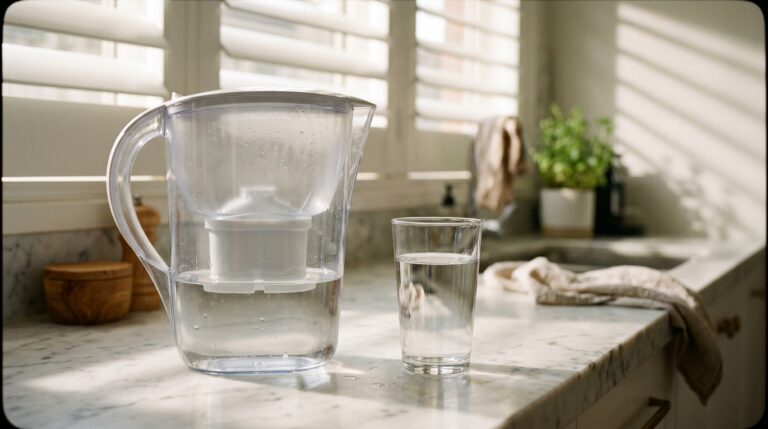
| Carbon filter (jug/benchtop) | MIB, chlorine, taste/odour | Recommended for most households |
| RO system (under-sink) | Everything + fluoride + TDS | Optional — overkill for Newcastle unless PFAS-cautious |
If your Newcastle tap water has tasted earthy or musty — and you have been in the Hunter long enough, it almost certainly has — that is not your imagination and it is not a sign the water is unsafe. It is MIB: Methyl-Isoborneol, produced by algae and filamentous bacteria in Grahamstown Dam. This guide covers what Hunter Water’s testing data actually shows, what MIB is and how to address it, the PFAS situation near Williamtown, and what filtration technology makes sense for Newcastle’s specific water profile.
Where Newcastle’s water comes from
Hunter Water supplies drinking water to more than 500,000 customers across Newcastle, Lake Macquarie, Maitland, Port Stephens, Cessnock, and Dungog. The supply comes from three primary sources that blend in the distribution system depending on seasonal availability and demand.
Grahamstown Dam near Raymond Terrace is the workhorse — it supplies up to 75% of Hunter Water’s daily demand. Water is pumped from the Williams River via the Seaham Weir through the Balickera Canal into the dam, then treated at Grahamstown Water Treatment Plant near Tomago. The plant has a treatment capacity of 257 megalitres per day. The Tomago Sandbeds — a rainfed aquifer under sand 20-50 metres thick near the coast — provide a secondary groundwater source via 21 Hunter Water bores. A third source is the Dungog water supply from Chichester and Lostock Dams, which serves parts of the region on different distribution zones.
Hunter Water operates under NSW’s drinking water quality framework, uses a NATA-accredited laboratory for routine testing, and publishes monthly water quality reports on its website. The supply is managed using a multi-barrier approach from catchment to tap.
Newcastle’s water quality data — what the testing shows
| Parameter | Newcastle level (Grahamstown) | ADWG guideline | Filtration relevance |
|---|---|---|---|
| Hardness | ~77 mg/L as CaCO3 (soft) | No health guideline | Good news. Minimal scale on appliances. No softener needed. |
| Fluoride | 1.0 mg/L | 1.5 mg/L (health) | At NSW target level. RO removes 93%+ if this is a concern. |
| Disinfection | Free chlorine, 0-1.5 mg/L | 5 mg/L (health) | Chlorine (not chloramine) — standard carbon filtration removes it effectively. |
| MIB (Methyl-Isoborneol) | Active issue — currently being managed | 10 ng/L (aesthetic) | Activated carbon removes MIB. This is the primary filtration case for Newcastle. |
| pH | 7.5-8.3 | 6.5-8.5 (aesthetic) | Within range. Slightly alkaline. No action required. |
| Calcium | ~23 mg/L | No guideline | Low — consistent with soft water from surface catchments. |
| PFAS | Below updated June 2025 ADWG limits | Updated June 2025 | NSW Gov confirmed compliance. Historical low-level detections near Williamtown (see PFAS section below). |
The MIB issue: why Newcastle water sometimes tastes like dirt
This is the most practically relevant water quality topic for Newcastle residents. Hunter Water has a currently active advisory on their website about Methyl-Isoborneol (MIB) in the Grahamstown water supply. MIB is produced by certain algae and filamentous bacteria that grow in the dam — it is the same compound responsible for the earthy, muddy flavour found in freshwater fish like catfish. The other compound sometimes associated with these flavours is geosmin.
The important distinction: human sensory perception detects MIB and geosmin at extraordinarily low concentrations — in the range of 5-15 ng/L (nanograms per litre). This is well below any health-relevant threshold. A concentration that is analytically trivial is organoleptically significant — you can smell and taste it at levels that have no physiological consequence whatsoever. Hunter Water’s advice to chill water in the refrigerator works partially because cold temperatures suppress volatile organic compound release, reducing perceived odour intensity.
What actually removes MIB: Activated carbon filtration — the mechanism in carbon block filters — adsorbs MIB and geosmin effectively. Both compounds have strong affinity for activated carbon media. A NSF-certified carbon block tap filter installed at the point of use will eliminate the earthy taste and odour from Newcastle tap water regardless of the MIB concentration in the supply. Chilling helps. Filtering works.
The MIB issue is seasonal and cyclical — it intensifies when algal growth in the dam increases, typically during warmer months and periods of lower water flow. Hunter Water treats the supply to reduce MIB before it reaches taps, but the compound can persist at taste-detectable levels through treatment. Hunter Water publishes its MIB management updates alongside monthly water quality reports.
The Williamtown RAAF base and PFAS: what the data shows
RAAF Base Williamtown is one of Australia’s most documented PFAS contamination sites — it sits approximately 8km east of Grahamstown Water Treatment Plant and about 10km from Grahamstown Dam. Given Williamtown’s documented contamination history, it is reasonable for Newcastle residents to ask whether the supply is affected.
Hunter Water’s official position, supported by independent data: PFAS from the Williamtown base cannot enter Grahamstown Dam due to the natural water flow direction — the hydrogeology separates the contamination plume from the dam catchment. This has been confirmed by mapping of PFAS detection locations between 2016 and 2025, which show the highest-frequency detections concentrated near the Williamtown base, the Balickera Canal, and the Tomago Aquifer — not in the dam itself.
Independent monitoring data from Friends of the Earth Australia (covering 2016-2025) confirms low-level detections in the distribution network — typically in the range of 2-7 ng/L PFOS and 2-8 ng/L PFHxS. These are well below the updated June 2025 ADWG guideline values for PFOS (8 ng/L). The NSW Government confirmed in 2025 that all Hunter Water supplies meet the updated, more stringent PFAS guidelines.
For residents in areas of the Newcastle distribution network that historically showed higher PFAS readings — areas nearer to Williamtown or the Tomago Aquifer supply zone — reverse osmosis remains the most effective household filtration option. RO achieves greater than 99% removal of longer-chain PFAS per the Australian Drinking Water Guidelines. For a full explanation of PFAS in Australian water supplies, see our comprehensive PFAS guide.
Newcastle’s soft water advantage
At approximately 77 mg/L as CaCO3, Newcastle’s water is classified as soft. This is genuinely unusual for a major Australian city — most coastal Queensland and Victorian cities sit in the moderate-to-hard range (100-180 mg/L). Soft water means minimal scale on kettle elements, shower screens, and hot water systems. Soap lathers easily. Appliance lifespans are not shortened by mineral buildup.
The mineral composition is straightforward: calcium at approximately 23 mg/L, magnesium at approximately 6 mg/L, sodium at approximately 27 mg/L, chloride at approximately 47 mg/L, sulphate at approximately 34 mg/L. These are low concentrations consistent with a surface water source from a relatively pristine mountain catchment (Williams River). The water is not particularly mineralised in any direction.
The practical implication for filtration decisions: a water softener is not needed and would not be beneficial. If you are comparing Newcastle water to other Australian cities, the hardness profile is significantly better than Adelaide, Geelong, most of Perth, and large parts of regional Queensland.
What filtration makes sense for Newcastle
Primary concern: MIB taste and chlorine odour
An NSF 42-certified activated carbon block tap filter removes MIB, geosmin, chlorine, and taste compounds effectively. Newcastle uses free chlorine (not chloramine), so standard carbon works without needing catalytic carbon.
Recommended: TAPP EcoPro — NSF 42 + 53 certified, installs on any standard tap
Comprehensive: PFAS, fluoride, TDS, and all contaminants
A 5-stage reverse osmosis system addresses every concern: MIB and taste, chlorine, fluoride (1.0 mg/L), PFAS (historically detectable near Williamtown), and dissolved minerals. Newcastle’s soft water means the output will be exceptionally clean.
Recommended: EcoHero 5-Stage RO — WaterMark + NSF 58 certified
See the EcoHero RO System →How Newcastle compares to other NSW cities
| City | Hardness | Disinfection | Key issue | Primary filter need |
|---|---|---|---|---|
| Newcastle | ~77 (soft) | Chlorine | MIB earthy taste (ongoing) | Carbon block for taste. RO for comprehensive. |
| Sydney (metro) | ~50-80 (soft) | Chloramine (most areas) | Chloramine taste, PFAS Blue Mountains | Catalytic carbon or RO. Standard carbon insufficient for chloramine. |
| Geelong | ~130 (moderate-hard) | Chlorine | PFAS (43% positive detections), scale | Standard carbon works for taste. RO for PFAS + hardness. |
| Palm Beach QLD | ~40-50 (very soft) | Chlorine | TDS 69 ppm, fluoride 0.7 mg/L | RO reduces to 3 ppm (95.7%). Carbon for taste only. |
Not sure which filter matches your specific concerns? Answer four questions about your main concern, setup, budget, and whether you are renting or own — see our water filter recommendation quiz for a personalised match. For a full breakdown of all Australian-market filter options across every price point and technology, see our best water filters Australia guide.
Frequently asked questions
Is Newcastle water hard or soft?
Newcastle water is soft at approximately 77 mg/L as CaCO3 from Grahamstown Dam’s surface catchment. Low mineral content means no scale issues and no need for a water softener.
Does Newcastle water have fluoride?
Yes. Hunter Water adds fluoride to the Newcastle supply at approximately 1.0 mg/L per NSW Health policy. Reverse osmosis removes 93%+ of fluoride if reduction is desired.
Can I drink Newcastle tap water straight from the tap?
Yes. Newcastle tap water meets all ADWG health standards. The earthy MIB taste is harmless. PFAS detections are well below current guidelines. For taste improvement, an activated carbon filter resolves the earthy character.
Is Newcastle tap water safe to drink?
Yes. Hunter Water supplies Newcastle drinking water and publishes monthly quality reports confirming compliance with the Australian Drinking Water Guidelines. The supply meets all health-based parameters. The earthy or musty taste some residents notice is caused by MIB (Methyl-Isoborneol), a naturally occurring algal compound that is harmless at any concentration found in the supply.
Why does Newcastle water taste earthy?
MIB and geosmin from algae in Grahamstown Dam. Detectable at very low concentrations. Activated carbon filtration removes both. Safe at any concentration present.
Does Newcastle water have PFAS contamination?
Historical monitoring (2016-2025) shows low-level PFAS detections in parts of the Hunter Water distribution network, typically 2-7 ng/L PFOS — well below the updated June 2025 ADWG guideline of 8 ng/L. The NSW Government confirmed in 2025 that all Hunter Water supplies meet the updated guidelines. The RAAF Williamtown base is a nearby PFAS contamination site, but Hunter Water states that water flow direction prevents contaminated groundwater from entering Grahamstown Dam.
Is Newcastle water hard or soft?
Newcastle water is soft — hardness approximately 77 mg/L as CaCO3 from the Grahamstown Dam surface catchment. This is low by Australian standards. Calcium is approximately 23 mg/L and magnesium approximately 6 mg/L. The practical result: minimal scale on appliances, no need for a water softener, and good soap lathering. Newcastle’s water hardness is significantly lower than Geelong (130 mg/L), Adelaide, and most of Perth.
Best filter for Newcastle?
Carbon block (TAPP EcoPro) for MIB taste and chlorine. RO (EcoHero 5-stage) for comprehensive — PFAS, fluoride, all dissolved contaminants.
Get the Australian Home Environment Checklist
30 checks across water, air and EMF. Most of them free. Ranked by impact.
No spam. Unsubscribe any time.

Former Royal Australian Navy Clearance Diver and TAG-E counter-terrorism operator. Founded Clean and Native to apply the same rigorous thinking to the home environment.
Full biography →