Perth Tap Water Quality 2026: What’s Actually In It?
Perth tap water is safe to drink and meets all Australian Drinking Water Guidelines (ADWG 2022) — but it is hard (~180 mg/L as CaCO&sub3;), has a moderate TDS (~170 mg/L on average), contains 0.7 mg/L fluoride, and is disinfected with free chlorine, which means standard activated carbon filters work well for taste improvement. As a former Royal Australian Navy Clearance Diver who has tested water from Perth to Palm Beach, the most common mistake I see Perth residents make is buying a filter marketed for chloramine cities — Perth uses free chlorine, which standard carbon removes effectively and cheaply.
Where you live in Perth matters enormously. Northern suburbs fed by Gnangara groundwater can see TDS of 300 to 584 mg/L and hardness over 200 mg/L — well into the “very hard” range. Southern suburbs served primarily by the DWER desalination network run 139 to 250 mg/L TDS with softer water. The table below is Perth-wide average data; your street-level quality may differ significantly.
Quick Verdict — Perth Tap Water Quality 2026
Safe to drink. Chlorinated with free chlorine. Hard water. No chloramine. Standard activated carbon filters work for taste improvement — no need for the catalytic carbon required in Brisbane or Sydney. For fluoride removal, you need reverse osmosis. For hard water effects on appliances, RO or a whole-house softener is the solution.
| Parameter | Perth Level | ADWG Limit | Filter Needed? |
|---|---|---|---|
| TDS (avg) | ~170 mg/L | 600 mg/L aesthetic | No (taste only) |
| Hardness | ~180 mg/L CaCO&sub3; | 200 mg/L aesthetic | RO for appliances |
| Fluoride | 0.7 mg/L | 1.5 mg/L max | RO to remove |
| Disinfectant | Free chlorine | 5 mg/L max | Carbon removes it |
| pH | ~7.5 to 8.0 | 6.5 to 8.5 | No filter needed |
✓ Who Should Filter Perth Water
- Anyone wanting to remove fluoride — requires reverse osmosis only
- Northern suburbs (Gnangara groundwater) experiencing TDS of 300+ mg/L and very hard water
- Households with kettles, coffee machines, or hot water systems scaling up from 180 mg/L hardness
- Kwinana, Rockingham, and Mandurah residents near industrial corridors — activated carbon plus RO recommended
- Anyone who notices chlorine taste or smell, especially in summer when dosing increases
✕ Who Does Not Need a Filter
- Anyone filtering for safety reasons — Perth tap water meets all ADWG health standards
- Buyers planning to use a chloramine-specific filter (catalytic carbon, Aquasana) — Perth uses free chlorine, which standard carbon removes at ~40 times the efficiency. Don’t overspend.
- Households concerned about PFAS in the mains supply — Water Corporation’s treated supply has not been flagged for PFAS exceedances. Groundwater bore users in Kwinana/Jandakot should test independently.
Where Perth’s Water Comes From — Three Sources, One Network
Perth’s drinking water supply is managed by the Department of Water and Environmental Regulation (DWER) and distributed by Water Corporation. Unlike Brisbane or Sydney, which rely primarily on reservoir catchments, Perth has had to fundamentally diversify its water supply in response to declining rainfall since the 1970s. The current supply mix is approximately: desalination (~40%), groundwater (~30%), and surface water catchments (~30%) — though this varies year to year with rainfall and consumption.
Desalination: Perth operates two major seawater reverse osmosis plants — the Southern Seawater Desalination Plant (Binningup) and the Perth Seawater Desalination Plant (Kwinana). Both operate at world-standard efficiency for a municipal RO plant. Desalinated water is remineralised before distribution to meet ADWG aesthetic guidelines — without remineralisation, pure RO permeate (TDS near 0) is corrosive to distribution pipes. The southern suburbs receive proportionally more desalinated water, which is why southern Perth typically runs softer and lower in TDS than the north.
Groundwater: The Gnangara Mound aquifer system underlies northern Perth and has supplied drinking water for over 100 years. Gnangara groundwater is naturally higher in TDS (300 to 584 mg/L in some areas) and hardness (often exceeding 200 mg/L as CaCO&sub3;) compared to desalinated supply. If you live in northern suburbs including Wanneroo, Joondalup, Clarkson, and surrounding areas, your water is likely blended from or dominated by Gnangara groundwater — this is why your kettle scales up faster than a friend’s in the southern suburbs.
Surface water catchments: The Integrated Water Supply Scheme draws from reservoirs including Mundaring Weir, Wellington Dam, and the Serpentine system. Catchment water is typically lower in TDS than groundwater and provides a high-quality input that blends with desalinated and groundwater sources in the distribution network.
Perth Water Quality Data — Parameter by Parameter
Here is what the independent data says about Perth tap water. All values are from Water Corporation’s published annual quality reports and DWER monitoring data unless otherwise stated.
TDS (Total Dissolved Solids) — ~170 mg/L Average, Much Higher in Northern Suburbs
Perth’s network-wide average TDS is approximately 170 mg/L — lower than Adelaide (~400 mg/L) and at the upper end of the “low” range. However, this average obscures significant suburb-level variation. Homes served by Gnangara groundwater can see TDS of 300 to 584 mg/L, which falls into the “moderate to high” range and affects both taste and appliance longevity. The ADWG aesthetic guideline for TDS is 600 mg/L — Perth as a whole sits comfortably below that threshold, but specific groundwater-fed areas in the north can approach or exceed taste thresholds for sensitive palates.
TDS is a measure of all dissolved minerals: calcium, magnesium, sodium, bicarbonates, and trace elements. A TDS of 170 mg/L is perfectly safe to drink. It does affect flavour, particularly in tea and coffee where mineral content significantly changes extraction profiles. If you taste a difference between Perth tap water and Melbourne’s exceptionally soft supply (~60 mg/L TDS), this is why.
Hardness — ~180 mg/L as CaCO&sub3; (Hard Category)
Perth’s tap water hardness averages approximately 180 mg/L as CaCO&sub3;, placing it in the “hard” category (120 to 180 mg/L is “moderately hard”; above 180 mg/L is “hard” per the ADWG aesthetic scale). For comparison: Melbourne is 18 to 30 mg/L (very soft), Brisbane is 80 to 120 mg/L (moderate), and Adelaide is 140 mg/L. Perth is genuinely hard water.
The practical consequences are real: kettles and element-based coffee machines scale up with calcium carbonate deposits. Hot water systems lose efficiency as heat exchangers coat with scale. Dishwashers require more detergent to achieve the same clean. Skin and hair can feel drier after showering because calcium and magnesium ions interact with soap and shampoo surfactants, reducing lather and leaving mineral residue. None of this is a health issue, but the economic cost of premature appliance failure is measurable. Whole-house softening or under-sink RO at the drinking tap are the two solutions.
Fluoride — 0.7 mg/L (Within NHMRC Optimal Range)
Water Corporation fluoridates Perth’s supply to a target of 0.7 mg/L, within the NHMRC’s optimal range of 0.6 to 1.1 mg/L for dental health benefits. The ADWG maximum health guideline is 1.5 mg/L. Perth’s fluoride level is one of the lower targets among Australian capital cities — Sydney targets 1.0 mg/L — and sits at the level where dental health benefits are documented without approaching guideline thresholds.
If you want to remove fluoride from drinking water, only two methods work reliably. Reverse osmosis achieves 90 to 97% fluoride reduction and is the most practical household solution. Activated alumina can achieve 80 to 95% reduction and is used in some point-of-use systems. Standard activated carbon, Brita filters, ceramic filters, and KDF media cannot meaningfully remove fluoride — the chemistry does not support it. Do not buy a filter claiming to “reduce” fluoride unless it explicitly states the percentage reduction and the mechanism is RO or activated alumina.
Disinfection — Free Chlorine (Standard Carbon Filters Work)
Perth uses free chlorine as its primary disinfectant — the same chemistry as bleach, added at low concentrations to maintain bacteriological safety across the distribution network. This is the critical distinction that many filter marketing materials exploit without explaining.
Brisbane, Sydney, Adelaide, Perth, and Darwin all use chlorine-based disinfection — but Brisbane, Sydney, Adelaide, and Darwin use chloramine (chlorine combined with ammonia), while Perth uses free chlorine. This matters because standard activated carbon (GAC) and block carbon filters remove free chlorine effectively but remove chloramine at only 1/40th the rate. A $50 benchtop carbon filter that works brilliantly in Perth would take months of contact time to remove chloramine in Brisbane. Perth residents do not need the catalytic carbon or compressed carbon block filters required in chloramine cities — a standard carbon block filter works correctly here.
Perth’s Hard Water — What 180 mg/L Actually Costs You
Hard water’s economic cost is often underestimated because it accumulates slowly. Calcium carbonate scale on electric kettle elements begins forming within months of use. The scale acts as a thermal insulator, forcing the element to draw more power to heat the same volume of water. Studies of scale accumulation in electric water heaters show a 12% reduction in efficiency per millimetre of scale thickness — meaning a moderately scaled element in a Perth kitchen uses measurably more electricity every time it runs.
For dishwashers and washing machines, hard water reduces detergent efficacy. The calcium and magnesium ions in hard water react with anionic surfactants (the cleaning agents in detergent) to form insoluble soap scum rather than foam. Manufacturers like Bosch and Miele publish separate detergent dosage guides for hard water regions — and Perth’s 180 mg/L puts it in the “hard” dosage bracket. Running a Perth dishwasher on the dosage specified for Melbourne’s 25 mg/L water produces underperforming wash results.
For the shower and skin, the hard water effect is real but variable. Calcium ions interfere with soap lathering and can leave a film on skin after rinsing. Some residents find Perth shower water acceptable; others — particularly those with sensitive or dry skin — notice a marked improvement with filtered or softened water. This is not a health issue; it is a comfort and cosmetic concern that some households consider worth addressing.
The solution depends on scope. For drinking and cooking water only: an under-sink or countertop reverse osmosis system removes calcium and magnesium alongside other dissolved solids, providing softened, low-TDS water at the tap. For whole-home protection of appliances, pipes, and shower experience: a whole-house water softener (ion exchange) replaces calcium and magnesium with sodium, eliminating scale throughout the home at a total installed cost of $1,500 to $3,000.
Perth by Region — Water Quality Varies More Than Most Cities
Perth’s divided supply network means suburb-level variation is more significant here than in most Australian cities. Use this as a starting guide and verify with Water Corporation’s annual report for your specific postcode.
| Area | Primary Source | Typical TDS | Hardness | Filter Priority |
|---|---|---|---|---|
| Northern suburbs (Wanneroo, Joondalup, Clarkson) | Gnangara groundwater | 300 to 584 mg/L | Very hard (200+ mg/L) | RO strongly recommended |
| Central Perth, inner suburbs | Blended network | ~170 mg/L | Hard (~180 mg/L) | Carbon for taste; RO for fluoride |
| Southern suburbs (Jandakot, Cockburn, Mandurah) | Desalination-dominant | 139 to 250 mg/L | Moderate to hard | Carbon for taste; RO for fluoride |
| Kwinana / Rockingham industrial corridor | Blended + Kwinana desal | ~200 mg/L | Hard | RO recommended; PFAS monitoring advised for bore users |
A note on Kwinana, Rockingham, and Mandurah: The Kwinana industrial corridor is home to some of Australia’s highest concentration of heavy industry — alumina refineries, chemical plants, and historically defence-related activity. PFAS (per- and polyfluoroalkyl substances) contamination from industrial and defence sites has been identified in specific groundwater areas across WA. Water Corporation’s treated mains supply is tested for PFAS and is not flagged for exceedances. However, residents who use private bores or who live near historically contaminated sites (such as the former Kwinana Airfield area) should have bore water independently tested before drinking. For mains water users in Kwinana and Rockingham, the primary concerns remain hardness and chlorine taste — the same as the broader Perth network.
Best Water Filters for Perth 2026
Perth’s free-chlorine disinfection means filter selection is simpler than in chloramine cities. Here are the three filter types that work correctly for Perth’s specific water chemistry, with the right products for each scenario. For a deeper comparison of specific filter models, see our full best water filter for Perth 2026 guide.
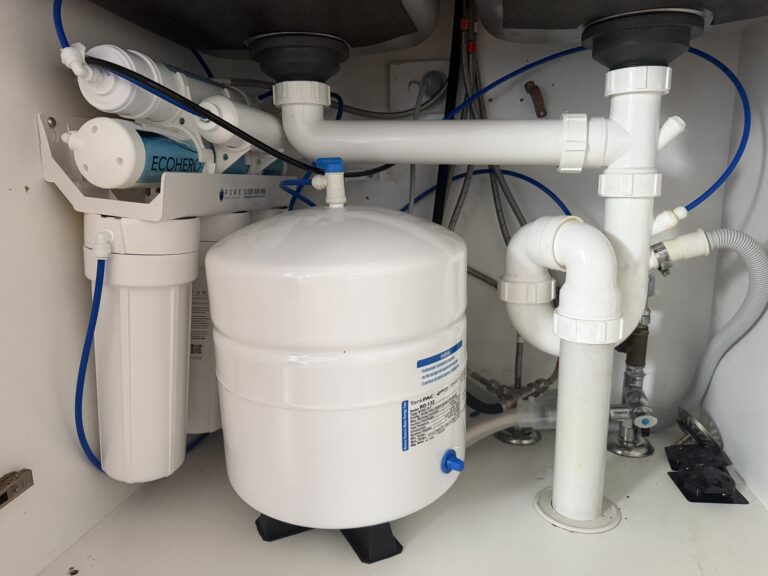
Best for Fluoride Removal + Hardness: EcoHero 5-Stage RO (Under-Sink)
Reverse osmosis is the only household filtration technology that reliably removes fluoride (90 to 97% reduction) AND hardness minerals in a single system. The EcoHero 5-Stage RO by Pure Water Systems is the unit I recommend for Perth households who want to address both concerns. It installs under the kitchen sink with a dedicated tap, uses no electricity (gravity-fed permeate collection), and includes a remineralisation stage that adds back a small quantity of calcium and magnesium for taste — important because pure RO water tastes flat. I use the EcoHero 5-Stage RO myself and have measured 3 ppm TDS output from 69 ppm input at my Palm Beach home — 95.7% reduction.
For Perth’s northern suburbs at 400+ mg/L TDS input, the RO membrane will require more frequent replacement (every 2 to 3 years rather than the 3 to 5 year rating at lower TDS) because of the higher mineral loading. Factor this into your running cost estimate when comparing options. Use our affiliate code CLEANANDNATIVE at Pure Water Systems for 10% off.
Best Countertop RO (No Plumbing Required): AquaTru Classic Smart
If you rent, can not modify your plumbing, or want RO performance without under-sink installation, the AquaTru Classic Smart is the correct alternative. It sits on the countertop, connects to your tap with a quick-connect adapter, and delivers RO-filtered water into a 3.8-litre reservoir. It uses a 4-stage filtration process: pre-filter, RO membrane, activated carbon polish, and alkaline remineralisation. The AquaTru’s RO membrane achieves greater than 90% fluoride reduction and substantial hardness reduction — adequate for Perth’s water chemistry.
The catch is waste water. All RO systems produce a reject stream of concentrated minerals — typically 2 to 4 litres of waste per litre of permeate produced, depending on feedwater TDS. At Perth’s 170 to 400+ mg/L TDS, the AquaTru will produce approximately 3 litres of brine per litre of drinking water. Direct this waste to the garden (the mineral concentration is not harmful to established plants) rather than down the drain.
Best Benchtop for Chlorine Taste (No Fluoride Removal): Tappwater EcoPro
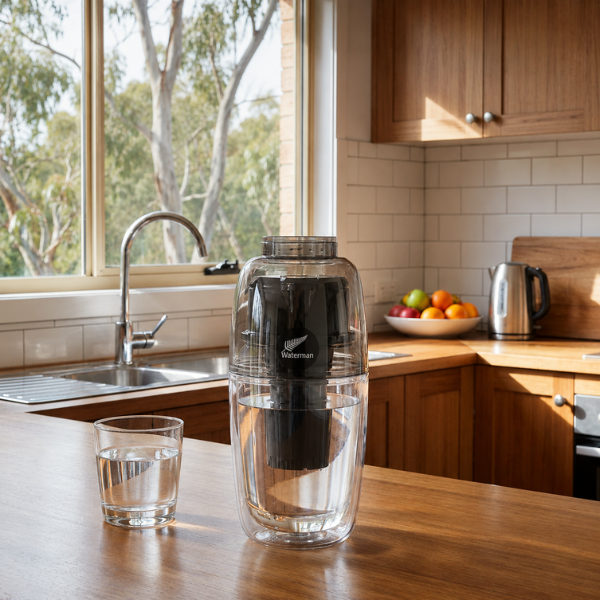
If your goal is solely to remove chlorine taste and odour without addressing fluoride or hardness, the Tappwater EcoPro benchtop filter is the right-sized solution. It uses an NSF 42 and NSF 53 certified compressed carbon block — the correct filter medium for Perth’s free-chlorine disinfection chemistry. It does not use ion exchange or RO, so it does not remove fluoride or soften water. But for the specific problem of “my tap water tastes of chlorine, especially in summer”, it is effective and low-cost to run at approximately $99 per filter replacement annually.
Final Verdict — Is Perth Water Safe to Drink?
Yes, Perth tap water is safe to drink. It meets all ADWG 2022 health guidelines. Water Corporation monitors the network with over 100,000 tests annually, and results are publicly available in the annual water quality report. The case for filtering Perth water is not a safety case — it is a quality, taste, and appliance-protection case.
The three legitimate reasons to filter Perth water are: (1) fluoride removal, which requires RO; (2) hard water effects on appliances, skin, and hair, which requires RO or whole-house softening; and (3) chlorine taste, which requires standard carbon. Anything sold beyond these three legitimate applications for Perth’s water chemistry — structured water, alkaline ionisers, magnetic softeners — lacks the evidence base to justify the cost. Measure first with a TDS meter, identify the specific problem, then buy the correct filter for that chemistry. See our full Australian water filtration guide for a broader framework.
Last reviewed: June 2026 — Clean and Native
Frequently Asked Questions
Is Perth tap water safe to drink?
Yes. Perth tap water meets all Australian Drinking Water Guidelines (ADWG 2022) health standards. Water Corporation conducts over 100,000 tests annually across the network. The case for filtering Perth water is about taste, hardness, and fluoride preference — not safety.
Does Perth water have chloramine or free chlorine?
Free chlorine. This is important when choosing a filter — standard activated carbon removes free chlorine effectively. Chloramine (used in Brisbane, Sydney, and Adelaide) requires catalytic carbon or RO. Perth residents do not need the more expensive chloramine-rated filters sold in those cities.
What is the TDS of Perth tap water?
Perth’s network average is approximately 170 mg/L TDS, but it varies significantly by suburb. Northern suburbs served by Gnangara groundwater can see 300 to 584 mg/L. Southern suburbs on desalinated supply typically run 139 to 250 mg/L. Check Water Corporation’s annual quality report for your specific postcode.
Is Perth water hard or soft?
Hard. Perth averages approximately 180 mg/L as CaCO&sub3; across the network — significantly harder than Melbourne (~25 mg/L) and Brisbane (~100 mg/L). Northern suburbs served by Gnangara groundwater often exceed 200 mg/L, placing them in the “very hard” category. Hard water is safe but causes scale buildup in kettles, coffee machines, and hot water systems.
Does Perth water have fluoride?
Yes. Water Corporation fluoridates to a target of 0.7 mg/L, within the NHMRC’s optimal range of 0.6 to 1.1 mg/L. The ADWG health guideline maximum is 1.5 mg/L. Perth’s fluoride level is one of the lower targets among Australian capitals. Only reverse osmosis or activated alumina can remove fluoride — standard carbon filters cannot.
What filter do I need for Perth tap water?
For chlorine taste: any standard activated carbon filter (benchtop or under-sink) works. For fluoride removal: reverse osmosis only — the EcoHero 5-Stage RO (under-sink) or AquaTru Classic Smart (countertop) are the right choices. For hard water effects on appliances and skin: RO at the drinking tap or whole-house ion exchange softening.
Does Perth water have PFAS?
Water Corporation’s treated mains supply is tested for PFAS and has not been flagged for health guideline exceedances. However, residents in Kwinana, Rockingham, and Jandakot who use private groundwater bores near industrial or historically defence-related sites should have bore water independently tested by a NATA-accredited laboratory before drinking it.
Why does Perth water taste different from other Australian cities?
Primarily hardness and mineral content. Perth’s ~180 mg/L hardness and ~170 mg/L TDS produce a more mineral-rich taste than Melbourne’s very soft supply (~25 mg/L hardness). The blend of desalinated, groundwater, and catchment sources also creates a distinctive mineral profile. Activated carbon filtration removes chlorine taste; RO removes the mineral character entirely.
Can I use a Brita filter in Perth?
Yes, for chlorine taste. Brita jug filters use activated carbon and ion exchange resin that removes free chlorine and reduces some hardness. They will not meaningfully reduce fluoride. If your primary concern is taste improvement from chlorine or reducing some hardness, a Brita works in Perth. For fluoride removal, you need an RO system.
Get the Australian Home Environment Checklist
30 checks across water, air and EMF. Most of them free. Ranked by impact.
No spam. Unsubscribe any time.

Former Royal Australian Navy Clearance Diver and TAG-E counter-terrorism operator. Founded Clean and Native to apply the same rigorous thinking to the home environment.
Full biography →