Does Reverse Osmosis Remove Minerals? What Australian Homes Need to Know
Drafted with AI assistance and checked against published specifications and certifications. First-hand measurements appear only where stated. How we make content
Yes, reverse osmosis removes minerals from water — including calcium, magnesium, and potassium. This is one of the most searched questions about RO filters, and the answer matters for how you choose and use your system. This guide covers what’s actually removed, whether it matters for health, and the specific remineralisation options available in Australia.
Yes, reverse osmosis removes 95–99% of all minerals including calcium, magnesium, and potassium — you need either a remineralisation cartridge, a mineralising jug, or simply don’t worry about it if you get minerals from food. Standard RO produces near-distilled water that lacks the trace minerals Australian tap water typically provides, but research shows dietary intake matters far more than water mineralisation for health outcomes. The catches: most entry-level RO systems don’t include remineralisation by default, and adding an alkaline filter post-membrane costs $80–$150 upfront plus cartridge replacements every 12 months.
| System type | Mineralisation option | Verdict |
|---|---|---|
| Under-sink RO with built-in remineralisation | Calcite/magnesium cartridge post-filter | Recommended for families |
| Countertop RO without remineralisation | Acceptable if diet is mineral-rich | Fine for adults, consider adding filter for kids |
| Entry-level RO (no mineral stage) | Aftermarket alkaline cartridge required | Upgrade or skip — pure RO long-term not ideal |
What Exactly Does Reverse Osmosis Remove?
The RO membrane is a semi-permeable barrier with pore sizes of approximately 0.0001 microns — small enough to block dissolved ions and molecules. In practice, a quality RO system with carbon pre-filtration removes:
The three products we own are measured first-hand by Jayce Love, former Royal Australian Navy Clearance Diver; every other product is assessed on published manufacturer specifications and independent certification using our documented methodology — no gifted units, no brand payments.
| Contaminant | Typical removal % | Relevance for Australia |
|---|---|---|
| Fluoride | 90–97% | Added to most metropolitan water supplies at 0.7 ppm |
| PFAS (PFOA, PFOS) | 90–99% | Present in many QLD, VIC, NSW water supplies near AFFF sites |
| Nitrates | 80–95% | Agricultural runoff in regional areas |
| Heavy metals (lead, arsenic, chromium) | 95–99% | Old plumbing, some SA/WA bore water |
| Calcium (hardness) | 90–98% | Hard water concern in Adelaide, Perth, Canberra |
| Magnesium | 90–98% | Component of water hardness |
| Sodium | 85–95% | Elevated in Perth/Adelaide coastal aquifer sources |
| Chloramine / chlorine | 95–99% (carbon pre-filter) | Disinfectant present in all Australian municipal water |
The key takeaway: RO is non-selective. The same membrane that removes PFAS and fluoride also removes calcium and magnesium. You can’t configure a standard RO system to remove contaminants while retaining beneficial minerals. They are all dissolved solids and the membrane treats them accordingly.
Does Mineral-Free Water Leach Minerals From Your Body?
This claim circulates widely in online discussions about RO water. The concern: low-mineral water may leach electrolytes from your blood and tissues, creating a net mineral deficit.
The evidence is weak. Your blood mineral concentration is regulated by the kidneys, not the mineral content of drinking water. Kidneys continuously adjust urinary mineral excretion to maintain homeostasis regardless of water TDS. The WHO reviewed this question specifically in their 2004 report on low-mineral water and found no evidence of adverse health effects from consuming demineralised water in populations that ate a normal diet.
The practical context: dietary mineral intake from food is orders of magnitude larger than intake from water. Even if you drink 2 litres of water per day, the calcium contribution from water (say 50mg/L in moderately hard water) represents about 5–10% of recommended daily intake. RO water at 5mg/L calcium reduces this contribution to roughly 0.5% of daily intake — negligible if your diet includes dairy, leafy greens, or nuts.
Exception: People on very restricted diets, those with high fluid intake (athletes), or those with known calcium/magnesium deficiency may have a more meaningful reliance on water minerals. For these groups, remineralisation is worth considering.
Australian Context: Where Mineral Content Actually Matters
In Australia, the mineral content of your water depends heavily on your location:
- Adelaide and Perth: Very hard water from limestone aquifer sources. High calcium and magnesium (TDS 200–500 ppm). RO output here is noticeably flatter-tasting. Remineralisation of RO water is more relevant here because residents are accustomed to hard water taste.
- Brisbane and SEQ: Moderately hard to soft water depending on storage. Wivenhoe/Somerset dam supply is soft (TDS 30–80 ppm). RO output in SEQ is already very close to remineralised water in mineral content.
- Sydney: Soft water from sandstone catchments. Warragamba Dam TDS typically 30–50 ppm. RO output minimally different from source in mineral terms.
- Melbourne: Very soft, acidic water from Silvan/Thomson reservoirs. TDS typically 20–40 ppm. RO water here is borderline acidic (pH 5–6 without remineralisation stage).
For Melbourne and Sydney households, the mineral content argument for remineralisation is minimal — source water already has low mineral content. For Adelaide and Perth households, remineralisation makes a meaningful difference to taste and may matter for households that previously relied on water as a calcium/magnesium source.
Remineralisation Options
Option 1: AquaTru Alkaline Upgrade (Calcium Carbonate Stage)
The AquaTru Classic and Carafe models accept an optional Stage 4 alkaline filter that adds calcium and magnesium back to the RO-filtered water. This is the cleanest solution for existing AquaTru owners: the fifth-stage alkaline filter raises pH to approximately 7.5–8.0 and adds 10–30 mg/L calcium and magnesium — enough to restore a more natural mineral balance and slightly improve taste.
The alkaline stage replaces the standard activated carbon polishing filter. No additional hardware required — it uses the same filter housing.
Option 2: AquaTru Classic with Alkaline Remineralisation Upgrade
The AquaTru Classic is a 4-stage countertop RO (NSF 58 + 401 certified) that removes fluoride (>96%), PFAS (>99%), chloramine, lead, and nitrates. An optional alkaline filter cartridge — the AquaTru Alkaline Filter — slots into the final stage and restores calcium, magnesium, and potassium while raising pH to approximately 8–9. No plumbing required. Available on Amazon AU with Prime delivery.
Option 3: Mineral Drops
Concentrated mineral solutions (typically magnesium chloride or calcium/magnesium trace mineral blends) added to RO water directly. These are inexpensive and allow you to control exact mineral additions. Limitations: requires manual addition every time you refill, and quality varies significantly between brands. Most do not include calcium carbonate specifically (which also raises pH).
Not a product we specifically endorse here, but worth knowing the option exists for existing RO users before purchasing a new system.
Aussie Trace Minerals — Australian ionic trace minerals for RO water
Sourced from the Southern Australian coast. Add a few drops to your RO water to restore magnesium, potassium, and over 70 trace minerals. The most practical option for existing RO owners.
Aussie Trace Minerals on Amazon AU →Option 4: Don’t Remineralise — and That’s Fine
For most Australians eating a normal diet, mineral-free RO water is not a health concern. The primary reason to get an RO system is to remove PFAS, fluoride, nitrates, heavy metals, and chloramine — and RO does this extremely well. If your diet is adequate in calcium and magnesium, the mineral content of your drinking water is a minor consideration.
Remineralisation is most valuable for taste (RO water at TDS <10 ppm tastes flat to many people) and for households in Adelaide/Perth that are accustomed to and may rely on harder water.
Does an RO System Without Remineralisation Produce Acidic Water?
Yes, typically. Standard RO water with TDS 5–30 ppm often has a pH of 5.5–6.5 — mildly acidic. This is because RO removes the buffering minerals (calcium, magnesium bicarbonates) that keep tap water at neutral pH 7–8. CO₂ from the atmosphere dissolves into the water, forming carbonic acid, which is not removed by the RO membrane.
Whether mildly acidic water (pH 6) is a health concern is contested. Most gastroenterologists consider stomach acid (pH 1.5–3.5) as rendering the slightly acidic pH of drinking water irrelevant to internal body pH. Where acidity does matter: corrosion of copper plumbing and potential effects on tooth enamel with high-volume consumption. A calcium carbonate remineralisation stage raises pH to 7–8 and eliminates both concerns.
What to Look For in an RO System for Australian Conditions
- NSF/ANSI 58 certification for PFAS removal: The AquaTru Classic has this. Many cheaper under-sink systems do not. PFAS contamination is widespread in Australian water supplies (QLD, VIC, ACT PFAS detections are well-documented) and NSF 58 is the only meaningful third-party certification for PFAS removal claims.
- Pre-filtration for chloramine: Australian water supplies use chloramine (not chlorine) as primary disinfectant in most capital cities. Standard carbon block filters are less effective at chloramine removal than catalytic carbon. Look for catalytic carbon or specific chloramine-removal carbon blocks.
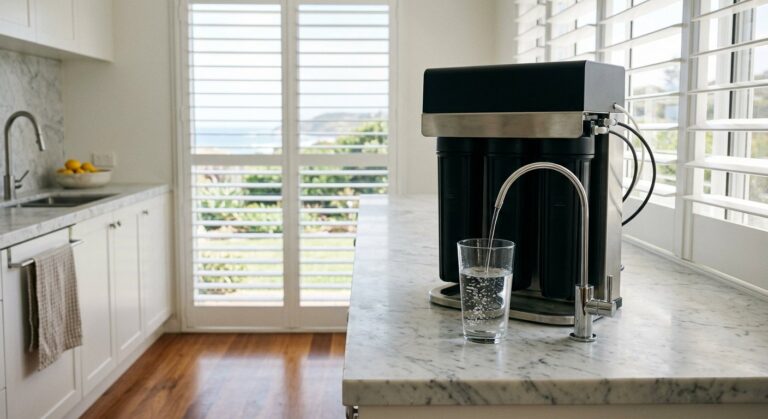
- Countertop vs under-sink: See our under-sink vs countertop RO comparison for the full analysis. Short version: countertop RO is easier to install (no plumbing) and produces higher-TDS purified water (typically 10–30 ppm); under-sink produces lower TDS but requires professional installation in most cases.
Recommended RO Systems for Australian Homes
AquaTru Classic — Best Countertop RO
NSF/ANSI 58 certified for PFAS. 4-stage filtration. Produces ~10–25 ppm TDS. Accepts alkaline stage 4 upgrade for remineralisation. No plumbing installation.
EcoHero 5-Stage Under-Sink RO — Australian RO with Remineralisation Stage
Australian-supplied 5-stage RO system including an alkaline remineralisation stage. Certified filtration, local support, and replacement filters available.
Frequently Asked Questions
Does reverse osmosis remove all minerals from water?
It removes the majority — typically 95–98% of dissolved minerals including calcium, magnesium, potassium, and sodium. A standard RO system will produce water with TDS of 5–30 ppm from typical Australian tap water at 50–500 ppm. Some trace minerals remain but at very low concentrations.
Is it safe to drink reverse osmosis water long-term?
Yes, for most people. The WHO and peer-reviewed literature do not support the claim that mineral-free water causes harm in people eating a normal diet. Your body regulates mineral concentrations through the kidneys, not through water intake. However, people with specific dietary deficiencies, high fluid intake, or who rely on water as a primary mineral source may benefit from a remineralisation stage.
How do I remineralise RO water at home in Australia?
Three practical options: (1) Install a remineralisation stage — the AquaTru alkaline filter upgrade is the simplest for AquaTru owners; (2) Choose a system with remineralisation built in, such as EcoHero under-sink RO with alkaline stage; (3) Add mineral drops to the water tank. Option 1 or 2 is recommended over drops for consistent results.
Does RO water have a pH below 7?
Yes, typically. RO water with low TDS often measures pH 5.5–6.5 due to dissolved CO₂ from the atmosphere. A calcium carbonate remineralisation stage raises this to pH 7–8. Whether mildly acidic drinking water is a health concern is debated; most evidence suggests it does not affect blood pH, which is tightly regulated by the kidneys and respiratory system.
Does reverse osmosis remove fluoride in Australian tap water?
Yes. RO systems certified to NSF/ANSI 58 remove 90–97% of fluoride. Australian metropolitan water supplies are fluoridated at 0.7 ppm. After RO filtration, fluoride concentration is typically below 0.07 ppm. Note: remineralisation stages (calcium carbonate) do not re-add fluoride.
What TDS reading should RO water be?
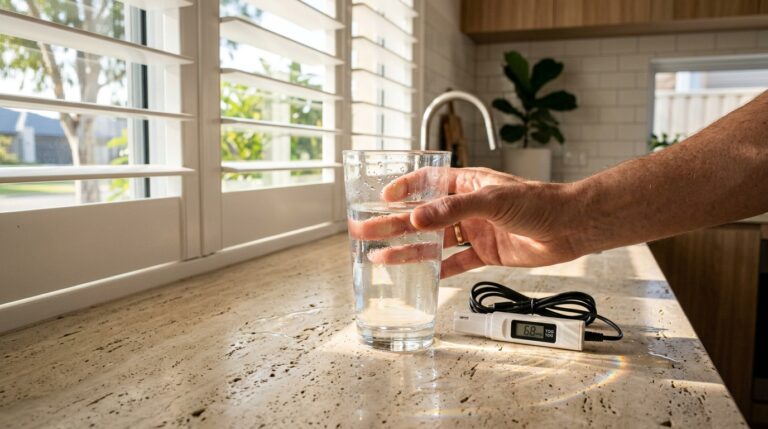
A quality RO system should produce water at 5–30 ppm TDS from typical Australian tap water. Higher than 50 ppm may indicate membrane degradation or a system not optimised for local TDS levels. Below 5 ppm is achievable with 4–5 stage systems including a carbon polishing stage. Note that TDS doesn’t tell you what’s in the water — it’s a proxy measure. Verify PFAS and fluoride removal through certification, not TDS measurement.
Which is better for Adelaide water — RO with or without remineralisation?
RO with remineralisation for most Adelaide households. Adelaide water from the River Murray source has TDS of 200–400 ppm with high calcium and magnesium. RO reduces this to 5–20 ppm — a dramatic change in taste. Most Adelaide residents find flat-tasting RO water unsatisfying. A remineralisation stage restores a more neutral taste profile while retaining the core benefit of fluoride, chloramine, and PFAS removal.
Does a Brita or gravity filter remove minerals like RO?
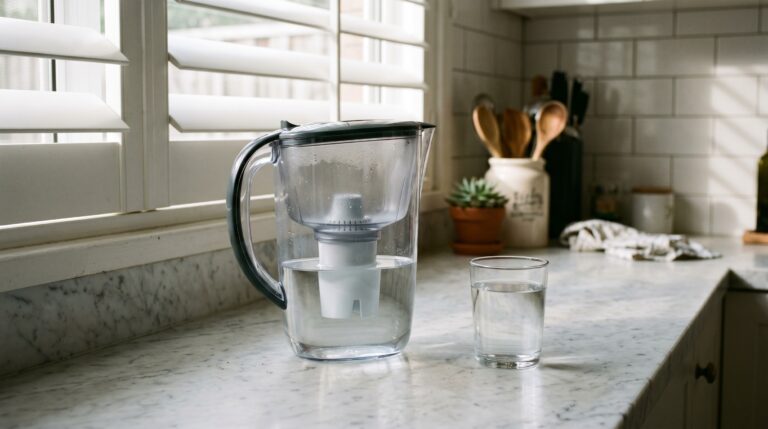
No. Carbon-block filters like Brita, TAPP EcoPro, and gravity filter systems do not significantly reduce TDS or remove minerals. They remove chlorine, chloramine, some heavy metals, and improve taste, but dissolved calcium, magnesium, fluoride, and nitrates pass through. PFAS removal is limited with standard activated carbon (catalytic carbon achieves moderate removal; RO membrane achieves >95%). See our countertop water filter comparison for details.
Get the Australian Home Environment Checklist
30 checks across water, air and EMF. Most of them free. Ranked by impact.
No spam. Unsubscribe any time.

Former Royal Australian Navy Clearance Diver and TAG-E counter-terrorism operator. Founded Clean and Native to apply the same rigorous thinking to the home environment.
Full biography →