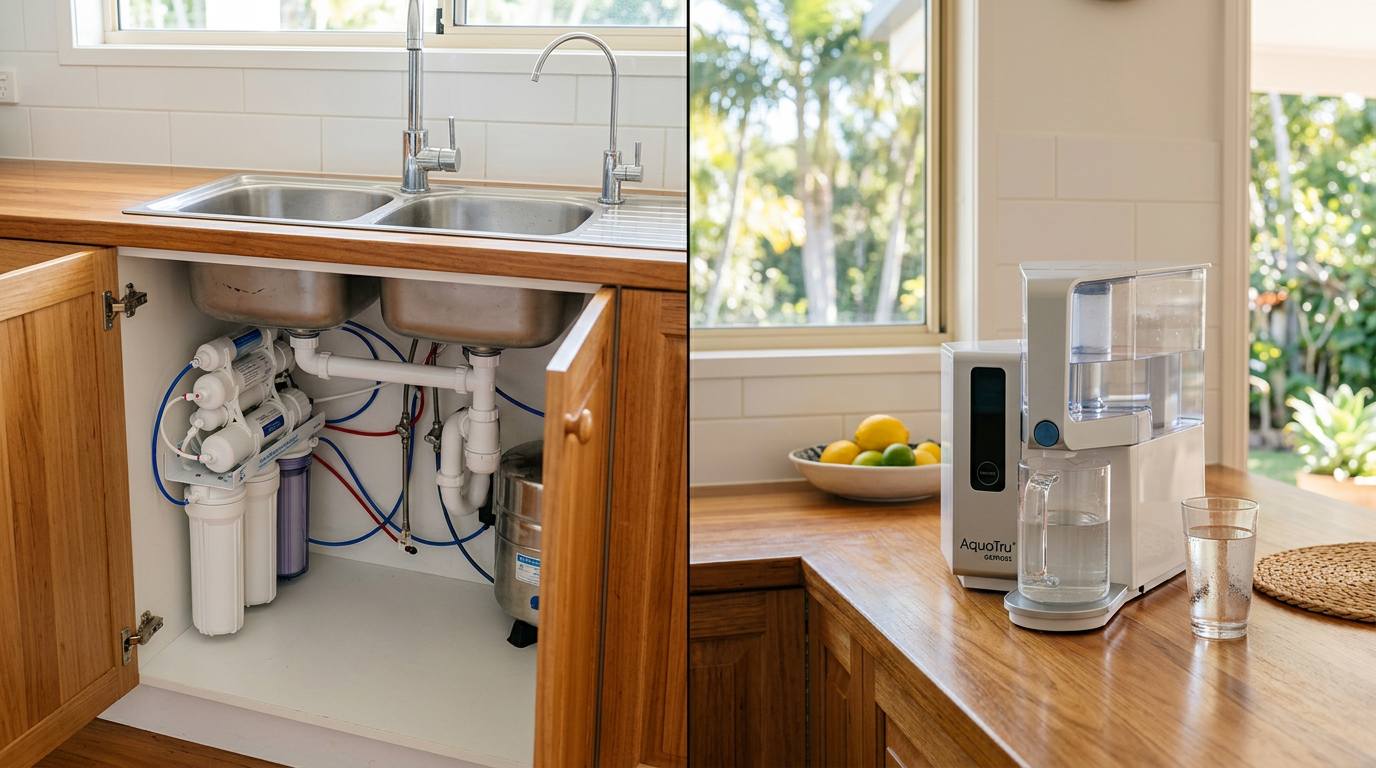
Under-Sink RO vs Countertop RO Australia 2026: Which Is Worth Your Money?
Bottom Line Up Front
Both systems use the same RO membrane technology and produce equivalent water quality. The decision is entirely about your housing situation, bench space, and budget. Under-sink RO is for homeowners who want permanent, hidden, high-volume filtration with WaterMark-certified plumbing. Countertop RO is for renters, apartment dwellers, and anyone who cannot or does not want to modify plumbing. The water that comes out is functionally identical.
The One Thing That Determines Your Choice
I am a former Royal Australian Navy Clearance Diver, and I have measured the EcoHero RO we own first-hand while assessing the AquaTru on its published specifications and independent NSF certification. Before I walk you through the technical comparison, here is the framework that resolves 90% of buying decisions in one question:
The three products we own are measured first-hand by Jayce Love, former Royal Australian Navy Clearance Diver; every other product is assessed on published manufacturer specifications and independent certification using our documented methodology — no gifted units, no brand payments.
Can you permanently modify the plumbing under your kitchen sink without permission?
If yes (homeowner, or renter with written landlord consent): under-sink RO is almost certainly the better long-term choice.
If no (renter without consent, apartment, short-term lease): countertop RO is your path.
Everything else in this comparison — filtration performance, daily output, cost — is secondary to this constraint. Both systems remove fluoride, PFAS, chloramine, lead, arsenic, and microplastics to equivalent standards. The RO membrane is the same technology. You are choosing an installation format, not a filtration technology.
That said, there are nuances worth understanding before you spend $700-900. This guide covers everything.
Head-to-Head Specifications
Using the two best-in-class Australian options — EcoHero 5-Stage RO (under-sink) and AquaTru Classic (countertop) — as the reference points:
| Specification | EcoHero 5-Stage RO (Under-Sink) |
AquaTru Classic (Countertop) |
|---|---|---|
| TDS reduction (verified) | 95.7% (69 to 3 mg/L) | 95-96% equivalent |
| Fluoride removal | ~96% (NSF 58) | 96% (NSF 58) |
| PFAS removal | >95% | Non-detect (NSF P473) |
| Chloramine removal | >95% (catalytic carbon) | >95% (carbon + RO) |
| NSF certifications | NSF 58 + WaterMark AS3497 | NSF 41, 53, 58, 401, P473 |
| WaterMark AS3497 | Yes (mandatory for plumbed install) | N/A (not plumbed) |
| Daily output capacity | 190-380 L/day (continuous flow) | ~15-20 L/day (batch cycles) |
| Storage tank | 8-12 L (under cabinet, pressurised) | 3.78 L (benchtop reservoir) |
| Remineralisation | Stage 5 calcite (included) | Not included (flat taste possible) |
| Installation | Licensed plumber required | Plug-in (+ 110V transformer for AU) |
| Counter space used | Zero | 35 x 30 cm footprint |
| Portability | Fixed (plumbed in) | Fully portable |
| Waste-to-pure ratio | ~1:1 to 1:3 (varies by model) | ~0.6:1 (efficient for batch RO) |
| Warranty | 2 years (Australian supplier) | 1 year (US-based, international claim) |
| Indicative AU price | ~$699 unit + $150-200 install | ~$690 + $30-45 transformer |
How Under-Sink RO Works in Australian Homes
An under-sink RO system taps into the cold water supply line under the kitchen sink. Water flows under mains pressure through the filter stages — no pump, no electricity, no manual refilling. The filtered water is stored in a pressurised tank (typically 8-12 L) under the sink cabinet and dispensed through a dedicated chrome tap installed through the benchtop or the sink deck.
For Australian installations, the key stages in a quality 5-stage under-sink RO are:
Stage 1 — Sediment pre-filter (5 micron)
Removes rust, sand, suspended solids from pipes. Essential for older Australian homes with cast iron supply pipes.
Stage 2 — Catalytic carbon block
Critical for SEQ, Sydney, Adelaide: catalytic (not standard) carbon removes monochloramine before it reaches and degrades the RO membrane. Standard carbon cannot remove monochloramine.
Stage 3 — RO membrane (0.0001 micron)
The core stage. Physically excludes dissolved ions: fluoride (96%), arsenic (95%+), PFAS, lead (99%+), nitrates, TDS. The semi-permeable membrane forces water molecules through while rejecting dissolved contaminants to the waste stream.
Stage 4 — Post-carbon polish
Removes residual VOCs and taste compounds from the pressurised storage tank. Ensures the water tastes clean when dispensed.
Stage 5 — Calcite remineralisation (EcoHero)
This stage matters: Post-RO water is essentially pure (15-20 mg/L TDS) and slightly acidic. Calcite restores alkaline calcium and magnesium, raising pH toward neutral and significantly improving taste versus flat-tasting pure RO water.
The entire system is hidden. Visitors to your kitchen will only see a slimline chrome tap next to your main mixer — no visible hardware, no bench clutter. This is why homeowners overwhelmingly prefer under-sink RO for permanent installations.
Our Top-Rated Water Filters
Reverse osmosis is the only residential technology that reliably removes PFAS, fluoride, chloramine, and heavy metals — the four contaminants most Australians are most exposed to.
How Countertop RO Works — and Why It Produces Equivalent Water Quality
The AquaTru countertop RO uses an electric pressure pump instead of mains water pressure. You fill the top reservoir (1.5 L) from the tap, press the button, and the pump forces water through the same four-stage process: sediment pre-filter, activated carbon block, RO membrane, VOC post-filter. Filtered water collects in a front reservoir (3.78 L for the Classic).
The RO membrane in the AquaTru operates at the same 0.0001 micron pore size as under-sink membranes. The contaminant removal claims (fluoride 96%, PFAS non-detect, lead >99%) are NSF-certified against the same standards. The fundamental chemistry is identical.
What differs is the experience of using it:
- It is a batch system — 12-15 minutes per 1.5 L cycle vs instantaneous flow from the under-sink tap
- It sits on the bench — visible, takes up roughly 35 x 30 cm of counter space
- It requires a step-down voltage transformer in Australia (110V unit, 230V Australian supply)
- It does not remineralise — post-RO water is flat-tasting without a mineral drops supplement
- It is fully portable — moves with you between rentals, properties, or can travel
None of these differences affect the water quality. They affect the experience of producing and consuming the water.
The Australian-Specific Issues Most Reviews Miss
WaterMark Certification — Non-Negotiable for Under-Sink
Under Queensland, NSW, Victorian, WA, and SA plumbing codes, any product permanently connected to a drinking water supply must carry WaterMark certification (AS3497). This is not optional.
Installing a non-WaterMark under-sink RO system can:
- Void your home insurance (non-compliant plumbing)
- Create liability for the licensed plumber who installed it (a licensed plumber will refuse to install a non-WaterMark product)
- Require removal at your cost during a building inspection or house sale
The EcoHero 5-Stage RO holds WaterMark AS3497 certification with lead-free fittings. Before buying any under-sink RO, ask for the WaterMark certificate number. “Australian standards compliant” marketing language is not the same as holding the certificate. The AquaTru countertop does not require WaterMark because it does not connect to plumbing — it operates entirely independently of the water supply line.
The AquaTru Voltage Transformer Issue
AquaTru runs on 110V (US standard). Australia uses 230V. Every Australian AquaTru buyer needs to purchase a step-down voltage transformer rated at minimum 60W (ideally 100W) at the same time as the unit. Cost: approximately AU$30-45 on Amazon AU. This is not a travel adapter — it is a voltage transformer. Plugging the AquaTru directly into an Australian power point without one will damage the unit and void the warranty.
This is an inconvenience, not a deal-breaker. Once set up, the transformer stays in place and the unit operates normally. The extra $35 and minor bench clutter are the trade-offs for the portability and no-plumbing benefits.
Monochloramine — Why the Pre-Filter Stage Matters More in Australia
Brisbane, Gold Coast, Sydney, and Adelaide all use monochloramine (not free chlorine) for water disinfection. Monochloramine is harder to remove than free chlorine and is corrosive to RO membranes if it reaches the membrane stage. In a quality 5-stage under-sink system, the catalytic carbon block in Stage 2 removes chloramine before the membrane. In the AquaTru, the activated carbon pre-filter does the same job.
The implication for filter replacement: in high-chloramine cities (SEQ, Sydney), the pre-carbon stage must be replaced on time. Skipping or delaying carbon replacement in these cities will degrade RO membrane performance and lifespan faster than in lower-chloramine cities.
Daily Output — The Practical Difference That Affects Real Life
This is where under-sink and countertop RO diverge most significantly in day-to-day use:
| Household Size | Daily Water Consumption | Under-Sink (continuous flow) | AquaTru (batch) |
|---|---|---|---|
| 1 person | 1.5-2 L/day | Effortless | 1-2 cycles/day — easy |
| 2 people | 3-4 L/day | Effortless | 3-4 cycles/day — manageable |
| 3-4 people | 5-8 L/day | Effortless | 5-8 cycles/day — frequent |
| 4+ people or cooking use | 8+ L/day | Effortless (tank refills automatically) | Not practical for high volume |
The AquaTru’s 3.78 L output tank holds a reasonable supply for a 1-2 person household when kept filled. For a 4-person family that also cooks with filtered water and makes filtered ice, the batch production process becomes genuinely inconvenient. Under-sink wins clearly for high-volume households.
Remineralisation — The Taste Difference Manufacturers Underplay
Post-RO water at 15-20 mg/L TDS is essentially pure water. Depending on your palate, this can taste flat or slightly acidic. This is not a health concern — it simply lacks the dissolved calcium and magnesium that give tap water its familiar mineral flavour.
The EcoHero 5-Stage RO includes a calcite remineralisation stage (Stage 5) that adds back alkaline calcium carbonate, raising pH toward neutral and restoring a familiar mineral taste. Most users prefer this to flat post-RO water, and it also improves the water for coffee and tea brewing.
The AquaTru Classic does not include a remineralisation stage. Post-AquaTru water tastes clean but flat. Some users supplement with Concentrace Mineral Drops (AU$25-35, available online) to restore mineral content. If taste is a significant priority for you, the EcoHero’s built-in remineralisation is an advantage.
Installation: What Each System Actually Requires
Under-Sink RO Installation (EcoHero)
Under-sink RO installation requires a licensed plumber in all Australian states. The process typically takes 1-2 hours and involves:
- Turn off cold water supply under the sink
- Fit a saddle clamp or T-fitting on the cold water supply line (to feed the filter)
- Mount the filter housing bracket inside the cabinet
- Connect pre-filter, carbon block, RO membrane housing, post-filter, remineralisation stage in sequence
- Connect the pressurised storage tank (placed in the cabinet)
- Drill or core the benchtop or sink deck for the dedicated dispensing tap
- Connect the waste water drain line to the sink drain
- Restore water supply, run first flush (discard 2-3 tank cycles), verify TDS reduction with a meter
Cost: Most licensed plumbers charge $150-250 for a standard under-sink RO installation. This is in addition to the unit price. Total installed cost for the EcoHero: approximately $850-950.
WaterMark requirement: Your plumber will refuse to install a non-WaterMark certified product. Always confirm WaterMark certification before purchase.
Countertop RO Setup (AquaTru)
The AquaTru requires no tradesperson. Setup involves:
- Purchase a 100W step-down voltage transformer from Amazon AU or an electronics store (~AU$35)
- Unbox AquaTru, insert pre-installed filter cartridges (shipped pre-loaded in most configurations)
- Place unit on benchtop within reach of a power point
- Connect transformer to power point; connect AquaTru power cord to transformer output
- Fill top reservoir from tap (1.5 L)
- Run first three cycles and discard the output (breaks in carbon and membrane)
- From cycle 4 onward: normal use
Time to first filtered water: Approximately 45-60 minutes including the break-in cycles.
No landlord notice, no drilling, no plumber, no council permit. When you move, disconnect, pack, and reinstall at the new property in under 10 minutes.
5-Year Total Cost of Ownership — Real Numbers
At 3 L/day household consumption (approximately 2 people drinking filtered water):
| Cost Item | EcoHero Under-Sink | AquaTru Countertop |
|---|---|---|
| Unit purchase | $699 | $690 |
| Installation / accessories | $175 (plumber) | $35 (transformer) |
| Annual filter cost (Year 1-5) | ~$135/year | ~$175/year |
| 5-Year Total Cost | $1,549 | $1,600 |
| Cost per litre (3 L/day) | ~$0.28/L | ~$0.29/L |
| Bottled water at 3 L/day (comparison) | $13,688 | $13,688 |
Over five years, the two systems are essentially cost-equivalent at 3 L/day. The under-sink is slightly cheaper in running costs; the countertop is slightly cheaper to set up. The 5-year difference is under $100 — negligible in the context of the decision.
What is not negligible: The AquaTru’s filter cartridges must be shipped from the US or via Amazon with international lead times. If you run out of filters, you are waiting 2-4 weeks. The EcoHero’s Australian supplier stocks local cartridges. If you are disciplined about ordering ahead, this is not a problem. If you are not, it is a real annoyance.
Which Filter for Which Australian City?
Water chemistry varies enough across Australian cities that the filter requirements are not uniform:
| City | Key Challenge | Under-Sink Priority | Countertop Priority |
|---|---|---|---|
| Brisbane / SEQ | Monochloramine + fluoride 0.70 mg/L + high TDS 370 mg/L | High. Catalytic carbon stage critical. | High. AquaTru handles chloramine + fluoride comprehensively. |
| Sydney | Monochloramine + fluoride 1.0 mg/L (highest of capitals) | High. | High. Highest fluoride in Australia. |
| Perth | Free chlorine + hard water 121-180 mg/L + 40%+ desal blend | Very high. Hard water + seasonal TDS variation from desal. | High. |
| Adelaide | Chloramine + highest TDS in Australia (480+ mg/L) | Very high. Adelaide TDS without RO is the worst of any capital. | High. |
| Melbourne | Free chlorine (most areas) + fluoride 0.9 mg/L + very soft water 15-65 mg/L | Medium. Low TDS means less mineral load but chloramine and fluoride still present. | Medium. |
| Cairns | Free chlorine + soft water 80-120 mg/L | Low-medium. Standard carbon often sufficient; RO only if fluoride removal desired. | Low-medium. |
| Near PFAS site | PFAS in bore water or reticulated supply | Critical. RO removes PFAS 95-98%. | Critical + preferred. AquaTru holds NSF P473 (PFAS-specific cert); only countertop with this. |
Decision Framework — Match Your Situation to the Right System
| Your Situation | Best Choice | Why |
|---|---|---|
| Homeowner, 2-4 person household | EcoHero Under-Sink RO | Permanent, hidden, continuous flow, remineralised, WaterMark compliant |
| Renter (any city) | AquaTru Countertop RO | No plumbing modification, portable, renter-legal in all Australian states |
| Apartment dweller (owned) | Either — check strata rules | Some strata corporations restrict plumbing modifications. Confirm before installing under-sink. |
| Near PFAS contamination (Ipswich, Townsville) | AquaTru (NSF P473) or EcoHero | AquaTru has explicit NSF P473 cert; EcoHero RO membrane removes PFAS >95%. Both adequate. |
| Household of 4+ (high volume) | EcoHero Under-Sink RO | Continuous flow essential. AquaTru batch system impractical at 8+ L/day. |
| Taste and mineral quality priority | EcoHero Under-Sink RO | Stage 5 calcite remineralisation produces noticeably better taste than flat AquaTru output |
| Moving frequently between rentals | AquaTru Countertop RO | Fully portable. Under-sink stays with the property. |
| Adelaide homeowner (highest-TDS capital) | EcoHero Under-Sink RO | Adelaide’s 480+ mg/L TDS justifies permanent install. AquaTru works but requires more frequent membrane replacement at high input TDS. |
| Bench space is constrained | EcoHero Under-Sink RO | Zero bench footprint. AquaTru needs 35 x 30 cm permanently. |
| Emergency preparedness / off-grid use | AquaTru Countertop RO | Runs on any power source (via transformer). Works on bore, tank, or uncertain water. Portable to a generator setup. |
Maintenance Comparison — What You Are Committing to Over 5 Years
| Filter Stage | EcoHero Interval | AquaTru Interval | DIY Difficulty |
|---|---|---|---|
| Sediment pre-filter | 6-12 months | 6 months | Easy (both systems) |
| Carbon block | 6-12 months | 6 months | Easy (both) |
| RO membrane | 2-3 years | 2 years | Easy (both systems — tool-free) |
| Post-carbon / VOC filter | 12 months | 12 months | Easy |
| Remineralisation (EcoHero only) | 12-18 months | N/A | Easy |
| Filter availability | Australian supplier (local stock) | International order (2-4 weeks) |
What Neither System Does
Being clear about limitations prevents buyer regret:
- Neither removes bacteria or viruses from contaminated water — both systems assume a safely treated municipal supply or a bore water source that has been tested. For bacteria-heavy bore or tank water, add a UV steriliser downstream of the RO output.
- Neither removes radon gas — post-RO water may still contain radon. Degassing (leaving water to stand uncovered) handles this in affected areas.
- Post-RO water is not inherently healthier — the EcoHero remineralises; the AquaTru does not. Neither produces “alkaline” or “structured” water in the sense marketed by some brands. Both produce clean, low-contaminant water. Health claims beyond this are not supported by the filtration science.
- Neither monitors your water in real time — buy a $15 handheld TDS meter and test monthly to confirm membrane performance is maintained. A rising post-RO TDS (above 20% of your input TDS) indicates the membrane needs replacement.
Still not sure which system fits your situation?
Answer 5 questions about your housing situation, city, and priorities and get a personalised filter recommendation.
Take the Filter QuizFrequently Asked Questions
Is the water quality the same from under-sink RO and countertop RO?
Yes — functionally identical. Both use a 0.0001 micron semi-permeable RO membrane. The removal rates for fluoride, PFAS, lead, arsenic, and nitrates are equivalent. The EcoHero 5-Stage under-sink produces slightly better-tasting water due to its Stage 5 calcite remineralisation, which the AquaTru lacks. This is a taste preference difference, not a safety or filtration performance difference. Both systems achieve 95-96% TDS reduction on typical Australian tap water.
Can a renter install an under-sink RO in Australia?
Only with written landlord consent. Under-sink RO installation requires drilling through the benchtop for the dispensing tap and connecting to the cold water supply line — both are plumbing modifications under Australian tenancy law. Without written consent, installing an under-sink RO breaches your tenancy agreement and you may be liable for restoration costs. The AquaTru countertop RO requires zero plumbing modification and is renter-legal in all Australian states without any landlord permission.
Do I need a WaterMark certified under-sink RO?
Yes — WaterMark AS3497 certification is legally required for any product permanently connected to the Australian drinking water supply. This applies in all states. A licensed plumber will refuse to install a non-WaterMark certified product. Installing one without certification can void home insurance, create liability for the plumber, and require removal during property sale inspections. The EcoHero 5-Stage RO holds WaterMark AS3497 with lead-free fittings. Before purchasing any under-sink RO, ask for the WaterMark certificate number — “complies with Australian standards” marketing is not the same as holding the certification.
How much does it cost to have an under-sink RO installed in Australia?
A licensed plumber typically charges $150-250 for a standard under-sink RO installation (1-2 hours of work). This is in addition to the unit price. For the EcoHero 5-Stage RO at approximately $699, total installed cost is $850-950. The plumber connects the feed line, mounts the filter housing, installs the dedicated dispensing tap (requires drilling through benchtop or sink deck), and connects the drain line. Always confirm your plumber has experience with RO system installation — it is straightforward but slightly different from standard tap fitting work.
Does the AquaTru work in Australian apartments?
Yes. The AquaTru requires no plumbing and no landlord permission. It sits on the benchtop (35 x 30 cm footprint) and plugs into a power point via a step-down voltage transformer (required because AquaTru runs on 110V US power; Australia uses 230V). The transformer costs approximately AU$30-45. For apartment owners who want to avoid drilling and under-sink installation, the AquaTru is also a practical option — it produces equivalent water quality to an under-sink RO and takes zero cabinet space.
Which system is better for PFAS removal in Australia?
Both systems remove PFAS effectively via the RO membrane. The AquaTru has a specific advantage: it holds NSF P473 certification, the only standard that explicitly validates PFOA and PFOS removal. The EcoHero removes PFAS at greater than 95% efficiency via its RO membrane but does not hold a separate PFAS-specific certification. For properties near confirmed PFAS contamination sites (Ipswich near RAAF Amberley, Townsville near Lavarack Barracks, Katherine NT), either system provides adequate protection. The AquaTru’s P473 certification provides additional documented assurance.
How do I verify my RO system is still working properly?
Buy a handheld TDS meter (approximately $15-25 on Amazon AU). Measure your input tap water TDS and your post-RO output TDS. A healthy RO membrane should reduce TDS by 90-97%. My Palm Beach (Gold Coast) tap measured 69 mg/L, and post-RO should read under 5 mg/L. If it rises above 15 mg/L, your RO membrane needs replacement. Test monthly. Both the EcoHero and AquaTru have LED filter replacement indicators, but these are time-based, not performance-based. A TDS meter gives you actual data. It is the single most useful $15 purchase for any RO owner.
Can I use an under-sink RO for cooking water as well as drinking?
Yes. The under-sink RO dedicated tap is placed on the benchtop or sink deck and can be used for both drinking and cooking. For pasta, rice, coffee, and tea, filtered RO water produces noticeably cleaner flavour by removing chloramine and dissolved minerals. The EcoHero’s remineralisation stage also means the water has appropriate mineral content for coffee extraction (very low TDS water produces over-extracted, bitter espresso — remineralised post-RO water at 40-80 mg/L is ideal). The AquaTru’s output tank can also be used for cooking, though the batch production means you may need to plan ahead for larger cooking volumes.
Which system is right for you?
Homeowner who can plumb: read the EcoHero review. Renter or no-plumbing preference: read the AquaTru review. Both deliver the same RO water quality — the decision is your housing situation.
Get the Australian Home Environment Checklist
30 checks across water, air and EMF. Most of them free. Ranked by impact.
No spam. Unsubscribe any time.

Former Royal Australian Navy Clearance Diver and TAG-E counter-terrorism operator. Founded Clean and Native to apply the same rigorous thinking to the home environment.
Full biography →