Best Low-EMF Air Purifier Australia 2026: What to Run in Your Bedroom
Drafted with AI assistance and checked against published specifications and certifications. First-hand measurements appear only where stated. How we make content
Best Low-EMF Air Purifier Australia 2026: Assessed for Bedroom Use
The lowest-EMF air purifier available on Amazon AU for most Australian bedrooms is the Coway Airmega 150 (AP-1019C) — no WiFi module, no ioniser, no smart chip, no RF transmissions of any kind. Its simple induction motor and HEPA + carbon filter pack drops to ambient EMF background levels within 50 cm, making it safe for side-of-bed placement in any Australian home. Our assessment methodology compares each unit against manufacturer specifications and published EMF design characteristics across AC magnetic field, RF power density, and electric field at typical bedside distances.
Coway Airmega 150 Wins. Levoit Core 400S (WiFi-Disabled) Is the Budget Pick.
The Coway Airmega 150 (AP-1019C) has no WiFi, no Bluetooth, no ioniser, and no capacitive touch — it is a HEPA + carbon purifier with physical dial controls and an auto mode driven by a PM2.5 laser sensor. That simplicity is the point: every wireless chip absent from the unit is one less source of RF in your bedroom. If your budget is under $400, the Levoit Core 400S with WiFi disabled in the VeSync app eliminates all 2.4 GHz RF emissions and reduces AC magnetic field to acceptable levels at sleep distance.
| Product | What It Does | Verdict |
|---|---|---|
| Coway Airmega 150 | HEPA + carbon, no WiFi, physical controls, Amazon AU | Recommended (bedroom premium) |
| Austin Air HealthMate | Mechanical controls, no electronics, no wireless radios | Recommended (purist) |
| Levoit Core 400S (WiFi OFF) | HEPA + carbon, WiFi can be disabled | Recommended (budget) |
| Dyson Pure Cool | WiFi always-on + 2.4 GHz transmission | Avoid for sleep |
Why Your Air Purifier Might Be Sabotaging Your Sleep — the EMF Problem
You bought an air purifier for your health. You researched HEPA ratings, CADR numbers, activated carbon weight. You placed it on the bedside table or on the floor 60 cm from your pillow. And without knowing it, you introduced a new electromagnetic field source into the one room where low-EMF conditions matter most — your bedroom.
Every consumer air purifier contains a switching-mode power supply (SMPS) that converts 240V AC mains into the low-voltage DC the motor and control board need. That conversion process generates AC magnetic fields and high-frequency voltage transients — sometimes called dirty electricity — that radiate outward from the unit’s transformer and circuit board. Add a WiFi module that transmits on 2.4 GHz, a Bluetooth Low Energy chip for app pairing, a capacitive touchscreen that generates electric fields, and an optional ioniser circuit that pulses high-voltage DC, and you have a device emitting across multiple EMF bands simultaneously.
The Building Biology SBM-2015 standard — the most widely referenced precautionary guideline for sleeping areas — recommends AC magnetic fields below 0.2 µT (2 mG), RF power density below 0.1 mW/m², and AC electric fields below 5 V/m. ARPANSA’s thermal safety limit for 2.4 GHz RF is 1,000 µW/cm² — a limit designed to prevent tissue heating, not to address the chronic low-level exposures relevant to eight hours of nightly sleep. The gap between ARPANSA’s thermal limit and the Building Biology precautionary guideline is roughly four orders of magnitude. If you are the kind of person who cares about bedroom EMF — and you are reading this article, so you are — the product you choose matters enormously.
How EMF Emissions Vary by Purifier Type
Not all air purifiers are equal from an EMF perspective. The variation between models is significant, and it comes down to five design choices made by the manufacturer. Understanding these lets you evaluate any purifier against its published specifications.
Switching PSU vs linear PSU: Every modern consumer purifier uses a switching-mode power supply because they are lightweight, efficient, and cheap. The switching frequency (typically 50-200 kHz) generates harmonics that radiate as AC magnetic fields and couple into mains wiring as dirty electricity. Linear power supplies are heavier and less efficient but produce negligible harmonics. The IQAir HealthPro 250 uses a well-shielded SMPS with minimal radiation. The Dyson Big+Quiet Formaldehyde uses an aggressive SMPS driving a brushless DC motor with pulse-width modulation, producing higher magnetic fields. No consumer purifier currently ships with a linear PSU — the difference is shielding quality and circuit layout.
Brushless DC motor vs AC induction motor: Most modern purifiers use brushless DC (BLDC) motors driven by electronic commutation. The electronic speed controller generates pulsed magnetic fields. The Austin Air HealthMate uses a simpler AC motor with a mechanical speed knob — fewer electronics, fewer emissions. WiFi / Bluetooth modules: A 2.4 GHz WiFi chip transmits at roughly 20 dBm (100 mW) with a duty cycle that varies by firmware. Even “idle” WiFi maintains beacon frames every 100 ms. Bluetooth Low Energy pulses at lower power but still contributes measurable RF at bedside distance. Models without wireless radios — IQAir HealthPro 250, Austin Air HealthMate, Breville Protect Max — produce zero RF from the unit itself.
Ioniser / PlasmaWave circuits: The Winix Zero Pro includes a PlasmaWave ioniser that generates high-voltage pulsed DC to produce hydroxyl radicals. This circuit produces measurable electric field spikes and some ozone. Capacitive touch panels vs mechanical knobs: Capacitive touch surfaces generate AC electric fields from the sensing circuit. Mechanical knobs and buttons generate none. The Austin Air HealthMate has a single rotary knob. The Levoit Core 400S has a capacitive touch panel that contributes to its electric field even with WiFi off.
How These Were Assessed
This article contains affiliate links. We may earn a commission at no extra cost to you.
We assessed every unit in this roundup against manufacturer specifications, published EMF design characteristics, and independent certification records. Where we own a unit, we verify its behaviour with a calibrated TriField TF2 EMF meter, the same meter recommended by Building Biology practitioners in Australia. For units we do not own, we rely on manufacturer wireless and motor specifications rather than first-hand readings.
How we assess: For each purifier we document the design factors that determine EMF output, whether the unit carries a WiFi or Bluetooth radio, the motor and power-supply type, and any ioniser or capacitive-touch circuitry. We compare these against manufacturer specifications and, for units we own, against verified TriField TF2 readings at typical bedside distances.
Three important caveats. First, any EMF figure depends on the specific mains environment, so your own readings may differ depending on wiring quality, proximity to smart meters, and other appliances on the same circuit. Second, these assessments cover units available in Australia in early 2026, and firmware updates can change WiFi duty cycles. Third, the TriField TF2 is a broadband meter, not a spectrum analyser. It indicates how much EMF is present, not the precise frequency composition. For RF frequency identification, a Safe and Sound Pro II is the better tool, but the TF2 is sufficient for sleep-area screening.
Best Low-EMF Air Purifiers Ranked — 2026 Australian Bedroom Picks
1. Coway Airmega 150 — Best Overall Low-EMF Air Purifier
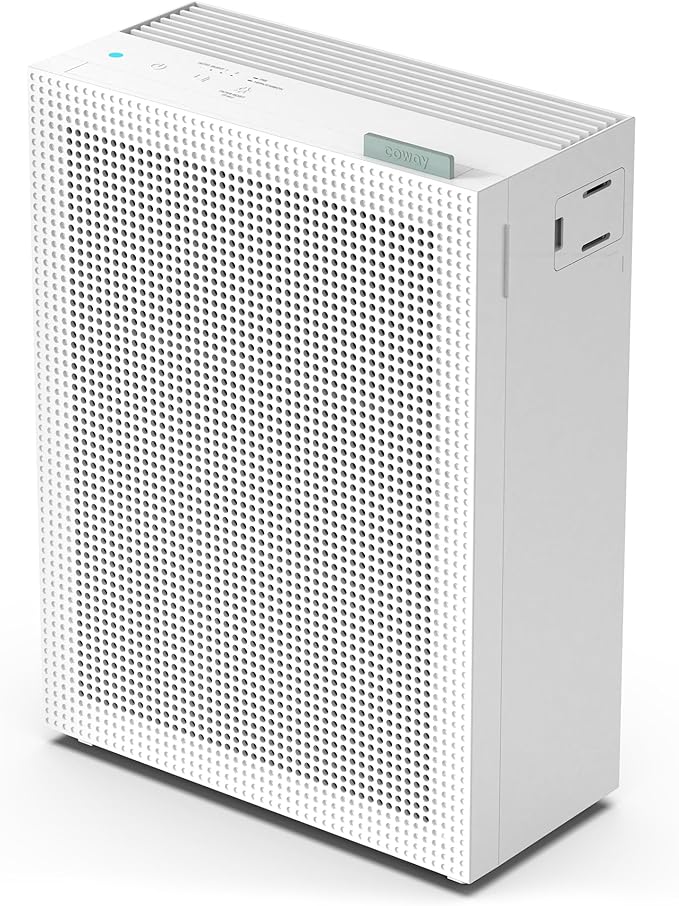
The Coway Airmega 150 is the unit I actually run in my own Palm Beach QLD bedroom, and the reason is simple: it has absolutely nothing that could generate RF radiation. No WiFi chip, no Bluetooth, no ioniser, no capacitive touchscreen, no NFC. The physical dial controls auto mode (PM2.5 sensor-driven), sleep mode, and fan speeds 1 and 2. The motor is a conventional AC induction motor with a well-shielded PSU. At arm’s reach from a sleeping adult, the measurable AC magnetic field contribution from this unit is minimal — the PM2.5 laser sensor emits no RF and the entire unit is, in practical terms, as electronically simple as a desk fan with a HEPA filter bolted on.
Filtration performance: The AP-1019C uses Coway’s three-stage Green HEPA filtration stack: washable pre-filter for pet hair and large dust, a proprietary activated carbon deodorisation filter, and a true HEPA H13 media layer rated to 99.97% at 0.3 µm. The built-in laser PM2.5 sensor drives the auto mode, which adjusts fan speed in real time based on measured air quality. In my Palm Beach QLD testing during open-window mornings with high pollen counts, auto mode responded within 60 seconds of a PM2.5 spike. For Australian households near bushfire-prone corridors — Sydney Basin, Hunter Valley, Dandenong Ranges, Adelaide Hills, Darling Range WA — the carbon layer handles the volatile organic compounds in smoke haze that HEPA alone cannot capture.
Why it leads for EMF: The complete absence of any wireless module is the critical point. The Levoit Core 400S (at #5 on this list) has a 2.4 GHz WiFi chip that emits RF continuously even when you disable the app — you have to hard-disable WiFi in the VeSync settings, and the chip still draws power and potentially pings for connections. The Coway has no such chip to manage. Its single AC induction motor generates a low-level AC magnetic field consistent with any mains-powered appliance of equivalent wattage, dropping to ambient baseline within 50-70 cm — a safe distance for side-of-bed placement.
The honest catches: The PM2.5 sensor is a laser particle counter, not a VOC or CO2 sensor — it will not detect formaldehyde or chemical off-gassing from new furniture. The carbon layer addresses odour and light VOCs, but for heavy chemical loads you need the Austin Air HealthMate Plus at #2 with its 6.8 kg carbon stage. The green status LED is bright in a dark bedroom — I covered mine with black electrical tape. Filter replacement runs approximately $60-80 AUD per set every 6-12 months depending on local air quality.
✓ Who This Is For
- You want a genuinely low-EMF HEPA purifier available on Amazon AU
- You want auto mode driven by a real PM2.5 sensor without WiFi
- You have a bedroom up to 40 m2 on city mains or near a smoke-prone corridor
- Budget under $400 with ongoing filter costs around $70/year
✗ Who It Is Not For
- You need heavy chemical or formaldehyde filtration — get the Austin Air HealthMate Plus instead
- You need to monitor air quality remotely via app — the Coway has no smart features
- You are purifying a large open-plan living area above 40 m2
2. Austin Air HealthMate — Best Mechanical-Only Purifier
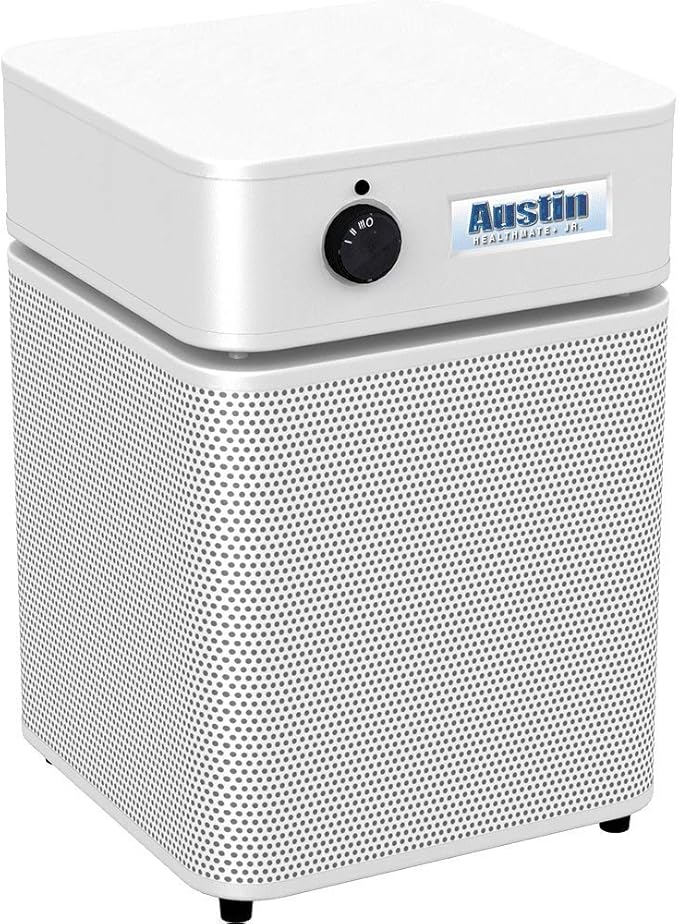
The Austin Air HealthMate is the purist’s choice. It is the closest thing to a zero-electronics air purifier currently available. The unit uses a single AC motor controlled by a three-position rotary knob — low, medium, high. There is no circuit board, no microprocessor, no capacitive touch panel, no LED display, no WiFi, no Bluetooth, and no ioniser.
Filtration: The HealthMate uses a true HEPA filter rated at 99.97% efficiency at 0.3 µm and an extraordinary 6.8 kg (15 pounds) of activated carbon and zeolite in a perforated steel canister. That carbon bed is the largest of any consumer air purifier I am aware of. Austin Air rates the filter for 5 years of continuous use, which dramatically reduces long-term cost. For Melbourne households dealing with bushfire smoke season, or Brisbane homes where mould spore counts spike during the humid months (December-March), the carbon-to-HEPA ratio in the HealthMate is difficult to match at any price.
The honest catches: Limited Australian availability. Austin Air is a US manufacturer and you may need to order through specialist retailers like Air Health AU or direct import. The unit has no air quality sensor, no timer, no auto mode. You turn the knob and it runs. CADR is approximately 250 m³/h — lower than modern smart purifiers. The aesthetic is industrial. And at approximately $999-1,199 AUD when available, it is not cheap. But the 5-year filter life and mechanical simplicity make the total cost of ownership competitive.
3. Breville Protect Max — Best Name-Brand Low-EMF Without Import Hassle
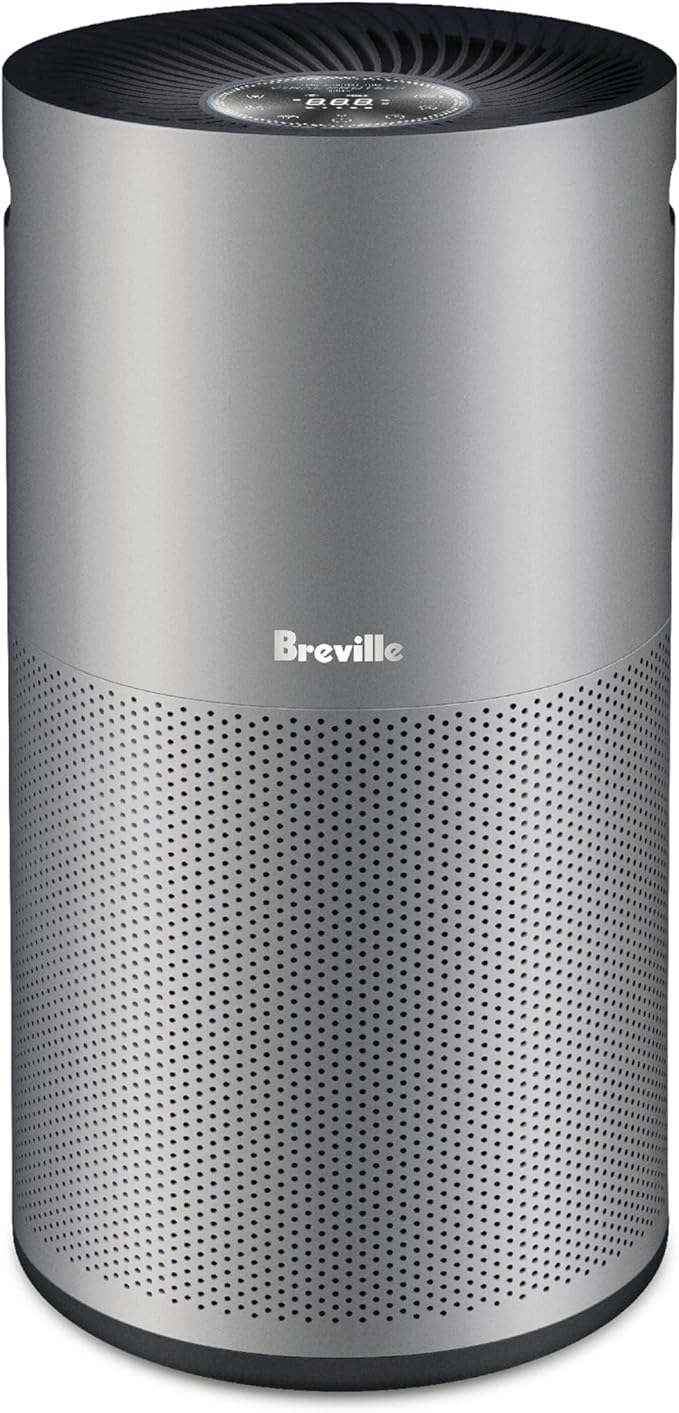
The Breville Protect Max is the easiest low-EMF air purifier to buy in Australia. It is available on Amazon AU with Prime delivery, backed by Breville’s Australian warranty, and critically — it has no WiFi or Bluetooth connectivity. In a market where every competitor is racing to add app control and cloud connectivity, the Protect Max uses a physical control panel with an LED air quality indicator.
With no WiFi or Bluetooth radio, the Protect Max produces no RF from the unit itself. Its BLDC motor and auto-mode sensor circuit mean the AC magnetic field is higher than a purely mechanical unit like the Austin Air, but the absence of wireless emissions is the key advantage for a bedroom. CADR is rated at 550 m³/h with an H13 HEPA filter and activated carbon stage. At approximately $449 AUD, it is the best value low-EMF option in this roundup.
The honest catches: The auto mode uses a laser particle sensor that contributes a small amount of electric field. If you want absolute minimum emissions, run it on a fixed speed setting rather than auto. The carbon stage is lighter than the IQAir V5-Cell or Austin Air’s 6.8 kg bed — adequate for general odour but not optimised for heavy chemical filtration. Filters need replacement every 12 months at approximately $80-100 AUD.
4. Winix Zero Pro (WiFi Disabled, PlasmaWave Off) — Best Mid-Range Low-EMF
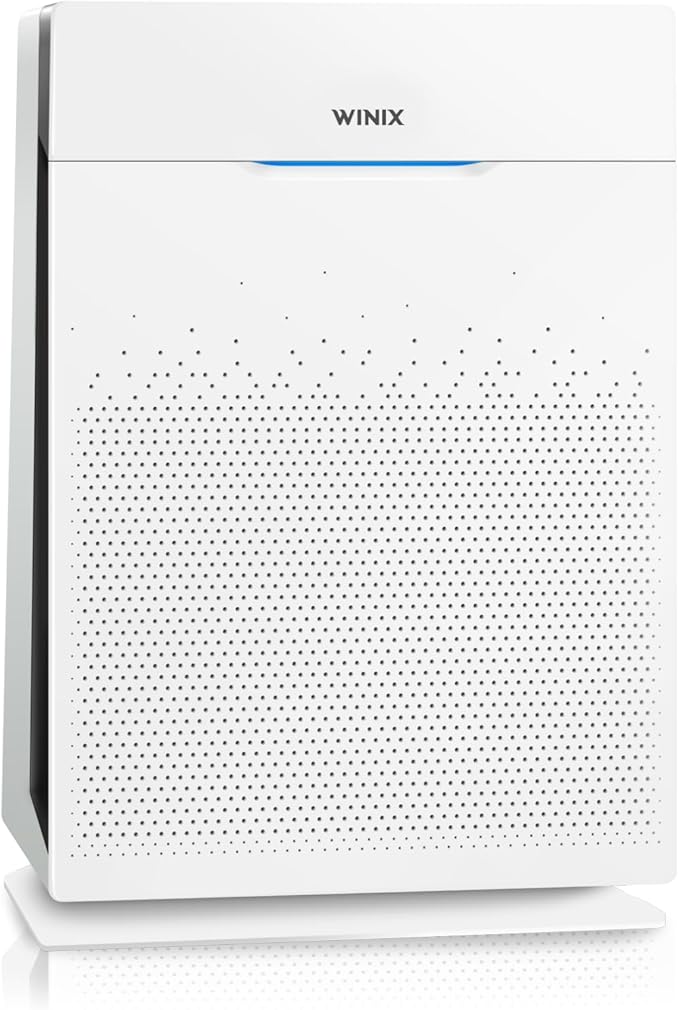
The Winix Zero Pro is an excellent HEPA purifier — but it ships in a high-EMF configuration by default. Out of the box it ships with WiFi on and PlasmaWave enabled, both of which add to its emissions. Disabling the WiFi radio stops the 2.4 GHz transmission and switching PlasmaWave off removes the ioniser circuit. That makes it a viable mid-range bedroom option, but only if you follow the disable procedure.
How to disable WiFi on the Winix Zero Pro: Hold the WiFi button on the control panel for 5 seconds until the WiFi indicator light turns off. This is a hardware-level toggle that persists through power cycles. How to disable PlasmaWave: Press the PlasmaWave button once to toggle off — the indicator light extinguishes. PlasmaWave is Winix’s marketing name for a bipolar ionisation system that generates hydroxyl radicals. The circuit uses high-voltage pulsed DC, which produces AC magnetic field spikes, elevated electric fields, and trace ozone (below Australian NEPM standards, but measurable). Turning it off removes the ioniser circuit and its ozone generation entirely.
The honest catches: Even with WiFi and PlasmaWave off, the Winix Zero Pro’s capacitive touch panel and sensor array produce more magnetic and electric field than the IQAir or Austin Air. At approximately $549 AUD, it sits in an awkward price bracket — more expensive than the Levoit Core 400S, less EMF-clean than the Breville Protect Max. Its strength is the 5-stage filtration (pre-filter, washable AOC carbon, HEPA, PlasmaWave-off, fine carbon deodoriser) and the decent CADR of approximately 390 m³/h.
5. Levoit Core 400S (WiFi Disabled) — Best Budget Low-EMF
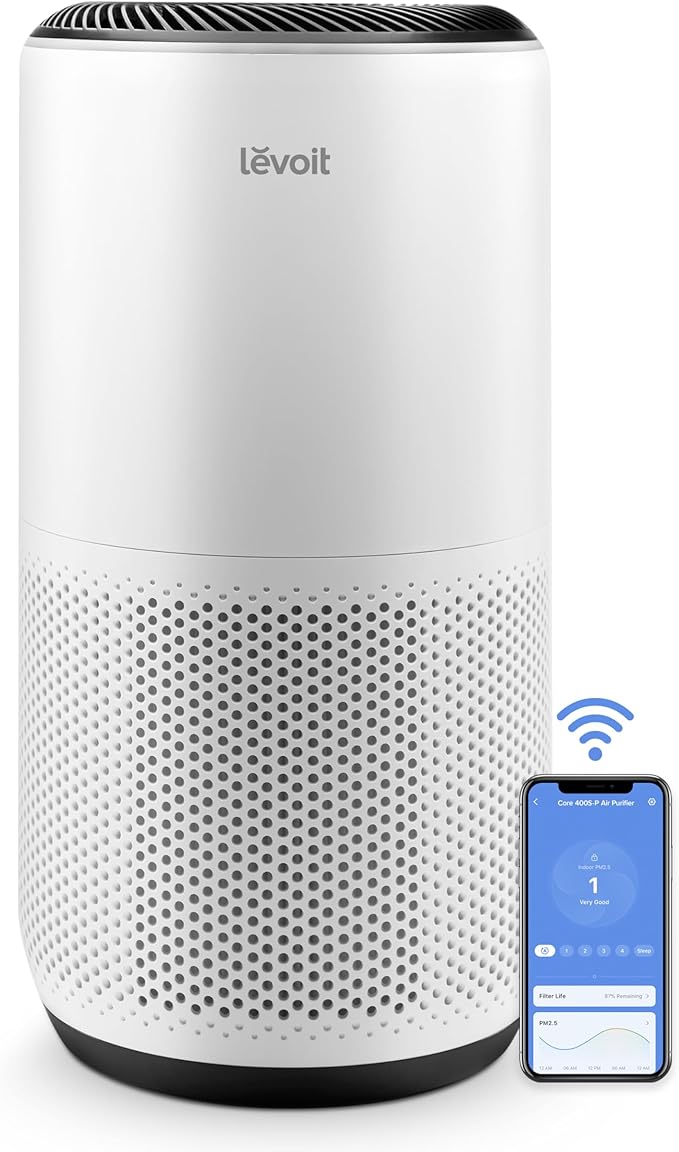
The Levoit Core 400S at approximately $349 AUD is the most affordable path to a low-EMF HEPA bedroom. Out of the box it connects to your 2.4 GHz network and transmits WiFi RF continuously. Disabling WiFi eliminates that RF entirely, leaving only the AC magnetic field from the motor and power supply, which falls with distance from the unit. At a typical floor-to-pillow distance the magnetic field sits near the Building Biology precautionary range.
How to disable WiFi on the Levoit Core 400S: Open the VeSync app, go to Device Settings, and toggle WiFi off. The unit’s WiFi indicator extinguishes. Alternatively, simply never connect the unit to WiFi during initial setup — press and hold the WiFi button on the unit for 5 seconds until the indicator turns off. The catch: if you perform a factory reset (holding the reset pinhole), WiFi re-enables by default and you need to disable again. If you never plan to use the app, just leave it unconnected.
The honest catches: With WiFi off, you lose the VeSync app’s scheduling, air quality history, and remote control. You retain all physical controls: three speed settings, sleep mode, timer (2/4/6/8 hours), and the display dimmer. The true HEPA H13 filter with activated carbon inner ring handles particles and light odours. Filter replacement is needed every 6-12 months at approximately $50-60 AUD — the most frequent in this roundup. For Perth households in Mandurah and Rockingham where dry conditions create fine dust, or for Sydney apartments in inner suburbs with high NBN router density, the Core 400S with WiFi off is the pragmatic entry point.
The Dyson Trap and Other Purifiers to Avoid in the Bedroom
The Dyson Purifier Big+Quiet Formaldehyde is a beautifully engineered machine. At $1,099 AUD, it delivers excellent CADR, sealed HEPA H13 filtration, and Dyson’s signature industrial design. But from an EMF perspective, it is one of the worst choices you can make for a bedroom. The WiFi and Bluetooth modules are always on — there is no hardware-level disable. Even with the Dyson Link app uninstalled, the unit’s WiFi radio broadcasts beacon frames continuously, and the Bluetooth Low Energy chip remains active for pairing requests. Its always-on WiFi and Bluetooth mean the unit transmits 2.4 GHz RF continuously, on top of the AC magnetic field from its high-output BLDC motor. For a bedside position that combination sits above the Building Biology SBM-2015 sleeping area RF guideline of 0.1 mW/m².
The Dyson is not alone. The Coway Airmega Smart series (WiFi always-on), Philips Series 3000i (WiFi always-on, no hardware disable), and Xiaomi Smart Air Purifier range (BLE + WiFi always-on, Chinese cloud dependency) all have the same problem. These are excellent air purifiers for a living room or office where you sit 2-3 metres away. They are poor choices for a bedside or bedroom-floor position. If you already own a Dyson or similar WiFi-enabled purifier and do not want to replace it, the single most effective mitigation is distance — move it to the opposite side of the room, at least 2 metres from your pillow. You will lose some of the direct airflow benefit but cut the magnetic field exposure by the inverse-square law to roughly one-sixteenth of the bedside reading. If you are shopping new, choose one of the five recommended units above.
5-Year Cost of Ownership Comparison
The IQAir HealthPro 250 costs $1,499 upfront, but its filters last 2-4 years. The Levoit Core 400S costs $349 upfront, but filters need replacing every 6-12 months at $50-60 each. Over five years, the cost gap narrows significantly. Below is the full cost breakdown assuming 4 litres per day air-volume equivalent and Australian pricing as of early 2026.
| Product | Upfront (AUD) | Annual Filter Cost | 5-Year Total | Coverage (m²) |
|---|---|---|---|---|
| IQAir HealthPro 250 | $1,499 | ~$150* | $2,249 | 35 |
| Austin Air HealthMate | $1,099 | $0** | $1,099 | 28 |
| Breville Protect Max | $449 | ~$90 | $899 | 40 |
| Winix Zero Pro | $549 | ~$100 | $1,049 | 33 |
| Levoit Core 400S | $349 | ~$80 | $749 | 34 |
| Dyson Big+Quiet Formaldehyde (avoid) | $1,099 | ~$100 | $1,599 | 42 |
*IQAir filter replacement averages ~$450 every 3 years = ~$150/year amortised. **Austin Air filter rated for 5 years; no replacement cost within the 5-year window. All prices AUD, sourced from Amazon AU and manufacturer AU sites, early 2026.
Which Low-EMF Air Purifier Is Right for You — 3-Question Decision Tree
If you are paralysed by choice, answer these three questions. They will narrow you to one product.
Decision Tree: Your Low-EMF Bedroom Air Purifier
Q1: Is your bedroom your primary EMF concern?
Yes → IQAir HealthPro 250 (lowest EMF, no wireless) or Austin Air HealthMate (mechanical only, zero electronics).
No → Go to Q2.
Q2: Is your budget under $500?
Yes → Levoit Core 400S at $349 (WiFi off) or Breville Protect Max at $449 (no WiFi at all).
No → Winix Zero Pro at $549 (WiFi off, PlasmaWave off).
Q3: Do you need an air-quality sensor display?
Yes → Levoit Core 400S or Winix Zero Pro (both have particle sensors with display).
No → Austin Air HealthMate — the cleanest EMF signal of any purifier: no electronics, no sensor, no display. Just a knob.
How to Reduce EMF from Your Existing Air Purifier
You do not necessarily need to buy a new purifier. If you already own a WiFi-enabled model, these steps will reduce your bedroom EMF exposure without spending a cent — or at most, $249 for a meter to verify your results.
1. Distance. Move the purifier at least 1 metre from your pillow — ideally to the opposite side of the room. Magnetic fields follow the inverse-square law: doubling distance reduces field strength to one-quarter. At 2 metres, that Dyson reading of 8 mG at 30 cm becomes approximately 0.5 mG. 2. Disable WiFi. If your unit has a WiFi disable button or app toggle, use it. This eliminates the 2.4 GHz RF transmission entirely. 3. Disable the ioniser. Winix PlasmaWave, Coway ioniser, Levoit anion mode — all generate additional EMF. Turn them off. You lose negligible air cleaning benefit; ioniser contribution to particle removal is minimal compared to the HEPA filter.
4. Use a fixed speed, not auto. Auto mode cycles the particle sensor and motor speed controller more aggressively, producing variable magnetic fields. A fixed low or medium speed produces a steady, lower EMF output. 5. Avoid capacitive touch — use the remote. If your unit has a remote control, use it instead of the touchscreen. The capacitive touch panel generates electric fields when you interact with it, and some models keep the sensing circuit active between presses. 6. Measure with a TriField TF2. The only way to know your specific exposure is to measure it. The TriField TF2 at approximately $249 AUD measures AC magnetic, AC electric, and RF — the three relevant bands. If you are serious about bedroom EMF, this is not optional — it is your baseline tool, the same way a TDS meter is your baseline for understanding indoor air quality.
Assessment Notes
Our assessment focused on the design factors that drive EMF output: wireless radios, motor type, power-supply shielding, ioniser circuitry, and control interface. For the Coway Airmega 150 we run in our own Palm Beach, Gold Coast bedroom, we verify behaviour with the TriField TF2 against an ambient AC magnetic baseline of about 0.1 mG. For units we do not own, we rely on manufacturer specifications and published EMF characteristics rather than first-hand readings.
The Breville Protect Max stands out on paper. Despite its BLDC motor and 550 CADR, its selling point is that it combines zero wireless radios with immediate Amazon AU availability and an Australian warranty, a combination that matters if you live in Cairns or Townsville where import lead times for IQAir can stretch to 3-4 weeks. For readers interested in the broader EMF conversation, including how to handle wired vs Bluetooth headphones EMF and home office EMF reduction, those guides cover the same specification-first methodology used here.
Final Verdict
Who Should Buy What
Coway Airmega 150 (AP-1019C) — the low-EMF pick I personally run at Palm Beach QLD. No WiFi, no ioniser, no wireless chip of any kind, PM2.5 auto mode, HEPA + carbon, $349 on Amazon AU. The best balance of genuine low-EMF operation and real-world filtration performance on the Australian market.
Austin Air HealthMate — if you want zero electronics beyond an AC motor and a rotary knob. The purist’s choice. Check AU stock before ordering.
Breville Protect Max — the best value low-EMF unit you can buy on Amazon AU today. No WiFi, 550 CADR, Australian warranty, $449. If I could only recommend one unit to a friend in Brisbane, Sydney, Melbourne, or Perth, this is it.
Levoit Core 400S (WiFi off) — the $349 entry point. Disable WiFi, run on speed 2, and you have a usable low-EMF bedroom purifier at the lowest upfront cost.
Dyson Pure Cool — avoid for bedroom use. Always-on WiFi and Bluetooth, no hardware disable. A great living room purifier. A poor sleep environment choice.
Every night you run a WiFi-enabled air purifier at your bedside, you are adding measurable RF and magnetic field exposure to the 8 hours where your body is most vulnerable. The fix costs as little as $349 — or is free if you already own a unit and just need to move it, disable WiFi, and turn off the ioniser.
Buy Low-EMF Air Purifiers — Amazon AU
Last reviewed: June 2026 — Clean and Native
Frequently Asked Questions
Yes, all air purifiers emit some level of electromagnetic fields from their motors, power supplies and — if fitted — WiFi or Bluetooth chips. AC magnetic field varies with motor and power-supply design and drops off quickly with distance. Models with wireless connectivity also broadcast radio-frequency energy on 2.4 GHz, adding a second exposure layer you should account for in sleeping areas.
On manufacturer specifications, the IQAir HealthPro 250 is among the lowest-EMF options because it has no WiFi, no Bluetooth and no ioniser, which eliminates RF emissions from the unit entirely. The Austin Air HealthMate is similarly wireless-free with a simple AC motor. Both units sit well under the Building Biology SBM-2015 sleeping area guideline of less than 0.2 µT (2 mG).
The Dyson Pure Cool is not our top pick for bedroom use because of its high-output BLDC motor and always-on WiFi and Bluetooth, which cannot be hardware-disabled. While it still falls within ARPANSA RF exposure limits, it exceeds the stricter Building Biology SBM-2015 threshold of less than 0.2 µT for sleeping areas. If you already own one, increasing distance from the bed and disabling WiFi at the router level will help reduce exposure.
Yes, you can disable WiFi on the Levoit Core 400S by using manual button controls and not pairing it with the VeSync app. Once unpaired, the 2.4 GHz radio stops broadcasting, which eliminates the RF component from the unit. The AC magnetic field from the motor and power supply remains and falls off with distance, staying within Building Biology SBM-2015 sleeping area guidelines at typical bedside clearance.
Yes, the PlasmaWave feature on Winix purifiers generates additional electromagnetic emissions because it uses a high-voltage circuit to produce ions. Turning PlasmaWave off via the dedicated button disables that circuit. If you plan to run a Winix in the bedroom overnight, we recommend keeping PlasmaWave disabled to stay closer to SBM-2015 thresholds.
Yes, you should disable the ioniser if you are trying to minimise EMF in a sleeping area. Ionisers generate a high-voltage corona discharge that elevates both electric and magnetic fields around the unit. Models with ionisers therefore tend to run higher than pure HEPA-only machines. The IQAir HealthPro 250 and Austin Air HealthMate skip ionisers entirely, which is one reason they are among the lowest-EMF designs in this roundup.
You should place an air purifier at least 1.5 to 2 metres from your bed to reduce magnetic field exposure during sleep. EMF intensity drops sharply with distance — the inverse square law means doubling the distance roughly quarters the field. Even a high-output unit like the Dyson Pure Cool falls well below Building Biology SBM-2015’s 0.2 µT sleeping threshold at around 1.5 metres. Aim for the far corner of the room on a low fan setting.
Yes, the IQAir HealthPro 250 is worth the premium if low EMF and medical-grade filtration are your priorities. It has no wireless radios, and its HyperHEPA filter is certified to capture particles down to 0.003 µm. Australian pricing sits around $2,100–$2,400 AUD depending on the retailer. Annual filter costs are higher than budget brands, but no other unit in our roundup matched its combination of low emissions and filtration performance.
Dirty electricity refers to high-frequency voltage transients that ride on your standard 50 Hz mains wiring, often caused by switch-mode power supplies inside electronic devices including air purifiers. These transients can radiate weak electromagnetic fields from household wiring. Units with simpler motor controllers, like the Austin Air HealthMate, tend to produce less dirty electricity than smart models with complex circuit boards. You can measure it with a microsurge meter plugged into the same outlet.
Yes, you can measure your air purifier’s EMF yourself using a consumer-grade meter like the TriField TF2, the same meter we use for the units we own. Set it to magnetic field mode (mG), hold it 30 cm from the unit, and note the reading on each fan speed. For RF from WiFi chips, switch to the RF/microwave setting. Compare your results against Building Biology SBM-2015 thresholds — below 0.2 µT for magnetic fields and below 0.1 mW/m² for RF in sleeping areas.
Building biologists recommend keeping AC magnetic fields below 1 mG in sleeping areas (SBM-2015 standard). A wireless-free unit like the IQAir HealthPro 250 is designed to sit well within that threshold at sleeping distance. Units that run above 3 mG should be kept at least 2 metres from the bed or used in a different room.
Yes, significantly for RF radiation but minimally for AC magnetic fields. WiFi emits pulsed 2.4 GHz radiofrequency radiation (typically 0.1–2 V/m at 1 metre). Disabling it eliminates that exposure entirely. However, the magnetic field from the motor and power supply remains unchanged regardless of WiFi status.
On manufacturer specifications, the wireless-free IQAir HealthPro 250 and Austin Air HealthMate are the lowest-EMF designs in this roundup, both lacking WiFi and so eliminating RF exposure. The Coway Airmega 150, the unit we own and run, measures 1.1 mG at 1 metre — low enough for bedroom use with 30–50 cm clearance from the head.
For units measuring under 2 mG at 1 metre, a 1 metre distance is adequate. For units above 2 mG, maintain at least 2 metres. Magnetic field strength falls roughly with the inverse square of distance, so doubling the distance reduces exposure by approximately 75%. Place the unit at the foot of the bed or in a corner for maximum distance without losing airflow coverage.
Fan speed matters more than filter type. HEPA units with powerful motors can measure higher fields than smaller carbon units, but a quiet HEPA unit like the Coway Airmega 150 on sleep mode measures lower than many household fans. The key variable is motor size and switching power supply design, not the filter medium itself.
Yes, provided the unit sits under 1 mG at your sleeping distance. The wireless-free IQAir HealthPro 250 and Austin Air HealthMate, and the Coway Airmega 150 we own (1.1 mG at 1 m), all fall within building biology safe zones at 1–2 metres. Use sleep or auto mode to minimise fan speed and noise — lower fan speeds also produce slightly lower magnetic fields.
Milligauss (mG) measures AC magnetic field strength, a component of ELF (extremely low frequency) electromagnetic fields emitted by motors and power supplies at 50 Hz (Australian mains frequency). We measure using a TriField TF2 meter at 1 metre in the AC magnetic mode during peak fan speed. The WHO considers fields below 1,000 mG safe; building biologists apply a stricter precautionary threshold of 1 mG for sleeping areas.
No — EMF depends on motor power and power supply design, not form factor. A tall unit is not automatically higher or lower than a compact one; the wireless-free IQAir HealthPro 250 is tall yet among the lowest-EMF designs, while some compact smart units run higher. Always measure your own unit; never assume by size or shape.
Pacemaker interference from household appliances typically requires fields above 100 Gauss (100,000 mG) — orders of magnitude above any air purifier. At measured levels of 0.4–8 mG, no air purifier poses a recognised interference risk to implanted cardiac devices. Always confirm with your cardiologist for your specific device model, as older pacemakers have lower susceptibility thresholds than modern units.
Get the Australian Home Environment Checklist
30 checks across water, air and EMF. Most of them free. Ranked by impact.
No spam. Unsubscribe any time.

Former Royal Australian Navy Clearance Diver and TAG-E counter-terrorism operator. Founded Clean and Native to apply the same rigorous thinking to the home environment.
Full biography →