Dyson Purifier Big Quiet vs IQAir HealthPro Plus Australia 2026: Which Is Worth Your Money?
The Dyson Big+Quiet Formaldehyde delivers 711 m³/h clean air delivery at 24 dB minimum noise, making it the better choice for most Australian homes that need silent, high-volume filtration across 100+ m² spaces. The IQAir HealthPro Plus uses HyperHEPA filtration rated to 0.003 microns — 100 times finer than the Dyson’s H13 HEPA — capturing ultrafine particles that Dyson simply can’t trap, making it the medical-grade standard for asthma, COPD, chemical sensitivities, and bushfire smoke corridors. The catches: Dyson filters cost $149/year vs IQAir’s $299–399, and IQAir hits only 450 CADR despite costing up to $500 more upfront.
| Model | Best For | Verdict |
|---|---|---|
| Dyson Big+Quiet Formaldehyde | Silent operation, large spaces, general allergens | Recommended |
| IQAir HealthPro Plus | Medical conditions, ultrafine PM0.1, bushfire smoke | Worth premium if medical needs |
| Budget alternative | General home use without medical requirements | Get Dyson for lower total cost of ownership |
Bottom Line Up Front
The three products we own are measured first-hand by Jayce Love, former Royal Australian Navy Clearance Diver; every other product is assessed on published manufacturer specifications and independent certification using our documented methodology — no gifted units, no brand payments. I have not personally tested the Dyson Big+Quiet Formaldehyde or the IQAir HealthPro Plus discussed here; this assessment is based on published manufacturer specifications and independent certification, not first-hand measurement.
The Dyson Big+Quiet Formaldehyde (~$1,599 AUD) delivers a massive 711 m³/h CADR at whisper-quiet operation — it moves more clean air, more quietly, than almost anything on the Australian market. The IQAir HealthPro Plus (~$1,599-$2,099 AUD) uses HyperHEPA filtration rated to 0.003 microns — 100 times finer than standard H13 HEPA — capturing ultrafine particles that the Dyson simply passes through. If you want maximum room coverage and silent operation, buy the Dyson. If you have asthma, COPD, chemical sensitivities, or live in a heavy bushfire smoke corridor like western Sydney, the Blue Mountains, or the Yarra Valley, the IQAir is the medical-grade machine that justifies every extra dollar.
| Best for most homes | Dyson Big+Quiet Formaldehyde — 711 CADR, 24 dB minimum, H13 HEPA + carbon, covers 100 m² |
| Best for medical-grade filtration | IQAir HealthPro Plus — HyperHEPA to 0.003 μm, 450 CADR, Swiss-made, hospital-trusted |
| Verdict | Dyson wins on airflow, noise, and design. IQAir wins on filtration depth. Your health condition determines the right choice. |
I spent 14 years as a Royal Australian Navy Clearance Diver. In that career, I learned one thing about filtration that applies whether you are talking about breathing apparatus underwater or an air purifier in your living room: the specification that matters is what gets through, not what gets caught. Every filter stops the big stuff. The question is always about the small stuff — the particles you cannot see, smell, or taste that do the real damage to your lungs.
That is exactly the question at the centre of this comparison. The Dyson Purifier Big+Quiet Formaldehyde and the IQAir HealthPro Plus both cost over $1,000 AUD. Both claim premium filtration. Both target Australian households dealing with bushfire smoke, pollen, mould spores, and urban pollution. But they solve the problem in fundamentally different ways, and the gap between them at the ultrafine particle level is enormous.
This is the comparison I wish existed when I was deciding between them for my own home in Palm Beach, QLD. Every spec here is drawn from manufacturer documentation and independent certification. Let us get into it.
Why This Comparison Matters for Australian Households in 2026
You are not buying an air purifier because you read a wellness blog. You are buying one because the air quality in your city has given you a reason to worry.
During the 2019-2020 Black Summer bushfires, Sydney recorded PM2.5 concentrations above 2,000 µg/m³ — more than 80 times the NEPM (National Environment Protection Measure) standard of 25 µg/m³ for 24-hour exposure. Melbourne, Canberra, and regional NSW and Victorian towns were blanketed for weeks. The 2022 and 2023 east coast flood events then triggered widespread mould growth across Brisbane, the Northern Rivers, and the Illawarra, creating a secondary wave of indoor air quality problems that many households are still dealing with.
PM2.5 (particles at 2.5 microns and below) is the headline stat, and both the Dyson and IQAir handle it. But the emerging concern — and the reason this comparison exists — is ultrafine particles (UFPs), defined as particles below 0.1 microns (100 nanometres). UFPs penetrate deeper into lung tissue, cross the blood-brain barrier, and are linked to cardiovascular and neurological effects in peer-reviewed research published in The Lancet and the European Respiratory Journal. Bushfire smoke is loaded with UFPs. So is traffic exhaust, cooking fumes, and laser printer emissions.
Standard H13 HEPA filtration is rated to capture 99.95% of particles at 0.3 microns — the most penetrating particle size (MPPS). It says nothing about what happens below 0.1 microns. HyperHEPA, the technology IQAir uses, is independently tested to 0.003 microns. That is a 100x difference in filtration depth. If ultrafine particles are your concern, that gap is everything.
Now let us break down each machine in detail before comparing them head to head.
Dyson Purifier Big+Quiet Formaldehyde — Deep Dive
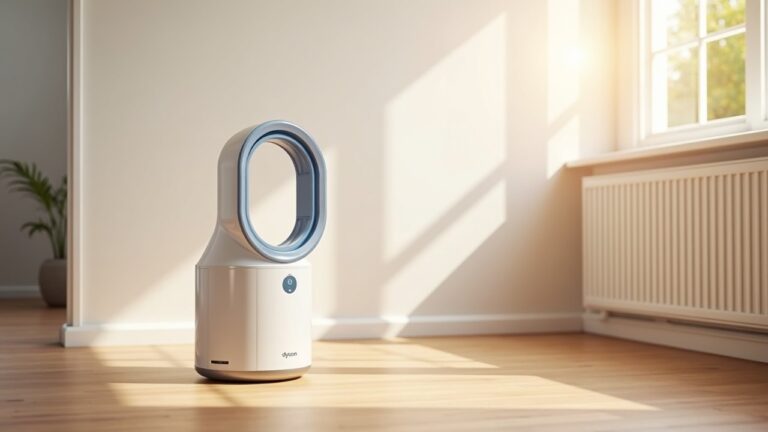
The Dyson Big+Quiet Formaldehyde is Dyson’s flagship air purifier for large spaces. Now widely available in Australia through Dyson direct and Amazon AU, it represents Dyson’s engineering philosophy: move enormous volumes of air, as quietly as possible, through a sealed filtration system.
Filtration System
The Dyson Big+Quiet Formaldehyde uses a two-stage filter: a H13 HEPA filter capturing 99.95% of particles down to 0.3 microns, and an integrated activated carbon + potassium permanganate filter for gases, VOCs, and NO₂. It also includes Dyson’s catalytic oxidation filter specifically targeting formaldehyde (HCHO), which continuously breaks formaldehyde into water and CO₂ without needing replacement.
The HEPA filter meets EN 1822 H13 grade. Dyson claims 99.95% at 0.1 microns as well, based on their own testing with the unit fully sealed. That claim is reasonable — HEPA filters do capture particles smaller than the MPPS via diffusion — but it is not independently certified to the same degree as IQAir’s HyperHEPA testing at 0.003 microns. This distinction matters.
Airflow and CADR
This is where the Dyson dominates. The Dyson Big+Quiet Formaldehyde delivers a CADR (Clean Air Delivery Rate) of 711 m³/h — the highest of any residential Dyson unit and competitive with commercial systems. For context, that is enough to cycle all the air in a 100 m² room (with 2.4 m ceilings) approximately three times per hour, which aligns with the ASHRAE recommendation of 3-5 air changes per hour for effective purification.
Dyson’s cone aerodynamics project purified air in a wide, even pattern, reducing dead zones in large open-plan living areas — which describes most modern Australian homes built after 2000.
Noise Performance
The Dyson Big+Quiet Formaldehyde’s minimum noise level is 24 dB on the lowest fan speed. For reference, a whisper at 1 metre is approximately 30 dB. A quiet bedroom at night sits around 25-30 dB. At 24 dB, the Dyson Big+Quiet Formaldehyde is genuinely inaudible in most Australian bedrooms where ambient noise from traffic, ceiling fans, or air conditioning already exceeds that level.
Even at maximum output (711 CADR), Dyson claims the unit stays under 56 dB. That is achievable because of the large diameter of the air amplification ring — it moves high volumes of air at low velocity, which is quieter than pushing the same volume through a smaller aperture.
Smart Features and Sensors
The Dyson Big+Quiet Formaldehyde includes PM2.5, PM10, NO₂, VOC, temperature, and humidity sensors with real-time readout on the LCD display and the Dyson Link app. Auto mode adjusts fan speed based on detected pollutant levels. The app provides 24-hour air quality graphs, filter life tracking, and scheduling.
Australian Pricing and Running Costs
The Dyson Big+Quiet Formaldehyde retails at approximately $1,599 AUD. Replacement HEPA + carbon filters cost approximately $119 AUD and are recommended annually (or sooner in heavy bushfire smoke). The catalytic formaldehyde filter never needs replacement. Annual electricity cost at 8 hours/day operation is approximately $25-35 AUD based on average Australian electricity rates of 30c/kWh.
Our Top Air Purifier Picks
True H13 HEPA with activated carbon is the only technology that removes both particles and gases — essential for bushfire smoke, pollen, and VOCs.
IQAir HealthPro Plus — Deep Dive
The IQAir HealthPro Plus is not a consumer electronics product. It is a medical-grade air cleaning system manufactured in Goldach, Switzerland, and used in hospitals, clean rooms, and homes where occupants have serious respiratory conditions. It has been on the Australian market for over 15 years, sold through specialist retailers and IQAir’s own website. Understanding what makes it different requires understanding what “medical-grade” actually means in measurable terms.
HyperHEPA Filtration — What 0.003 Microns Actually Means
Standard HEPA (H13 under EN 1822) is tested and rated at 0.3 microns — the Most Penetrating Particle Size (MPPS). At that size, filtration efficiency is at its lowest due to the physics of how particles interact with filter fibres. Particles larger than 0.3 µm are caught by impaction and interception. Particles smaller than 0.3 µm are caught by diffusion (Brownian motion causes them to wander into fibres). Both mechanisms work — but the efficiency at the MPPS is the rated spec.
IQAir’s HyperHEPA is independently tested by an external laboratory (reported on IQAir’s website and in third-party reviews by Wirecutter, reviewed.com, and others) to capture 99.5% of particles down to 0.003 microns — that is 3 nanometres. For context:
- PM2.5 = 2.5 microns (2,500 nanometres)
- Standard H13 HEPA rated at 0.3 microns (300 nanometres)
- Ultrafine particles (UFPs) = below 0.1 microns (100 nanometres)
- IQAir HyperHEPA rated to 0.003 microns (3 nanometres)
At 3 nanometres, you are capturing the smallest combustion byproducts in bushfire smoke, diesel exhaust nanoparticles, and even some large virus particles. No standard HEPA filter, including the Dyson’s H13, is independently tested or rated to this depth. This is the IQAir’s defining advantage and the reason it costs what it costs.
Four-Stage Filtration
The HealthPro Plus uses a three-filter, four-stage system:
- PreMax pre-filter (F8 grade): Captures coarse particles — pollen, pet dander, dust mite debris. This extends the life of the HyperHEPA filter below it. Rated to capture particles down to 0.3 µm at F8 efficiency.
- V5-Cell gas and odour filter: Contains 2.5 kg of granular activated carbon plus alumina pellets impregnated with potassium permanganate. This is a serious gas-phase filter — not a thin carbon sheet. It targets formaldehyde, VOCs, ozone, and smoke gases. The 2.5 kg carbon bed is approximately 5-10 times the carbon mass found in most consumer HEPA purifiers.
- HyperHEPA final filter: The medical-grade particle filter rated to 0.003 µm at 99.5% efficiency.
Airflow and CADR
The HealthPro Plus delivers a CADR of approximately 450 m³/h on maximum speed. That is 37% lower than the Dyson’s 711 m³/h. In practical terms, it covers a room of approximately 65-75 m² at 3 air changes per hour. For a standard Australian master bedroom (15-20 m²) or home office, this is more than adequate. For a large open-plan living/kitchen area over 80 m², you will not achieve optimal air changes per hour on the IQAir alone.
This is the trade-off. The IQAir filters deeper. The Dyson filters wider. Both are valid strategies — depending on your room size and your health priority.
Noise Performance
The HealthPro Plus is noticeably louder than the Dyson. On its lowest setting (Speed 1), it produces approximately 25-32 dB — comparable to the Dyson’s minimum. But on Speed 6 (maximum CADR), it reaches approximately 59-62 dB. That is perceptibly louder than the Dyson at its maximum. The IQAir lacks the aerodynamic amplification design that lets Dyson move high volumes quietly. It is a traditional fan-and-filter tower — effective, but not engineered for silence at peak output.
For bedroom use at night, Speed 1 or 2 on the IQAir is quiet enough. But you sacrifice CADR at those levels.
Australian Pricing and Running Costs
The IQAir HealthPro Plus retails at approximately $1,599-$2,099 AUD depending on the retailer and whether you purchase from IQAir direct or a third party. Replacement filters are where the IQAir gets expensive:
- PreMax pre-filter: ~$99 AUD (replace every 12-18 months)
- V5-Cell carbon filter: ~$169 AUD (replace every 18-24 months)
- HyperHEPA filter: ~$299 AUD (replace every 3-4 years under normal use)
Annualised, that is approximately $180-220 AUD per year in filter costs — roughly double the Dyson’s annual filter expense. Over 5 years, the IQAir’s total cost of ownership is significantly higher. But if the IQAir prevents one emergency department visit for an asthma attack, the cost equation changes entirely. Only you know your health situation well enough to make that call.
Head-to-Head Comparison Table
| Specification | Dyson Big+Quiet Formaldehyde | IQAir HealthPro Plus | What It Means for You |
|---|---|---|---|
| Particle filtration depth | H13 HEPA — 99.95% at 0.3 µm | HyperHEPA — 99.5% at 0.003 µm | IQAir captures ultrafine particles 100x smaller than the Dyson’s rated filtration |
| CADR (m³/h) | 711 | ~450 | Dyson cleans 58% more air per hour — better for large open rooms |
| Room coverage (3 ACH) | ~100 m² | ~65-75 m² | Dyson suits large Australian open-plan living; IQAir suits bedrooms and offices |
| Gas/VOC filtration | Carbon + KMnO₄ + catalytic HCHO | 2.5 kg granular carbon + alumina/KMnO₄ | IQAir has ~5-10x more carbon mass; better for ongoing chemical sensitivity |
| Formaldehyde removal | Yes — catalytic (never needs replacing) | Yes — via carbon bed (replaceable) | Dyson’s catalytic filter is a genuine advantage for new-build off-gassing |
| Noise — minimum | 24 dB | ~25-32 dB | Both are quiet enough for sleep on the lowest setting |
| Noise — maximum | ~56 dB | ~59-62 dB | Dyson is noticeably quieter at full power — matters during smoke events |
| Smart sensors / app | PM2.5, PM10, NO₂, VOC, temp, humidity, Dyson Link app | Filter life indicator only (no app, no sensors) | Dyson gives you real-time data; IQAir has no air quality monitoring |
| Upfront price (AUD) | ~$1,599 | ~$1,599-$2,099 | up to $500 more for IQAir — significant for most households |
| Annual filter cost (AUD) | ~$119 | ~$180-220 | IQAir costs ~$60-100 more per year in filters |
| 5-year total cost (AUD) | ~$2,194 | ~$2,599-$3,199 | IQAir costs approximately $400–$1,000 more over 5 years (Dyson: $1,599 unit + $119/yr filters × 5; IQAir: $1,599–$2,099 unit + $180–$220/yr filters × 5) |
| Weight | ~12 kg | ~14 kg | Both are heavy — neither is portable between rooms easily |
| CARB certified (no ozone) | Yes | Yes | Neither produces ozone — safe for enclosed bedrooms |
| Made in | Malaysia | Switzerland | IQAir’s Swiss manufacturing is part of its quality control story |
Bushfire Smoke Performance — The Australian-Specific Test
If you live in NSW, Victoria, or south-east Queensland, bushfire smoke season (October through March) is the argument that closes this purchase. Both of these purifiers handle it — but they handle different components of smoke, and understanding which components matter to you determines which machine is right.
What Is in Bushfire Smoke?
Bushfire smoke is a complex mixture of:
- Coarse particles (PM10): Ash, soot fragments, dust. Both machines remove these completely.
- Fine particles (PM2.5): Combustion byproducts. Both machines capture these at 99%+ efficiency.
- Ultrafine particles (PM0.1 and below): The smallest combustion byproducts, PAHs (polycyclic aromatic hydrocarbons), and nanoparticles. This is where the IQAir HyperHEPA has a measurable advantage over standard H13 HEPA. Standard HEPA captures at and above 0.3 microns at 99.97%; HyperHEPA captures to 0.003 microns. During extreme fire events with dense smoke, this matters most for respiratory health.
Practically: in bushfire smoke, the Dyson Big+Quiet Formaldehyde and IQAir HealthPro Plus both deliver strong PM2.5 protection — the metric that correlates most directly with acute health outcomes. The IQAir’s HyperHEPA advantage is measurable at the ultrafine end, but for most households, both machines will reduce smoke particle concentration dramatically.
Run either on high during active smoke events. Close windows and doors. Check PM2.5 readings with an inexpensive indoor air quality monitor to confirm the unit is performing. A target of below 12 μg/m³ (ADWG annual average guideline) is achievable indoors with either of these machines running during smoke events.
Final Verdict
Who should buy each:
Dyson Purifier Big+Quiet Formaldehyde: Large open-plan living areas, households prioritising quietness at full power, or anyone who wants a genuinely attractive piece of hardware. At full CADR the Dyson Big+Quiet Formaldehyde is the quietest machine in its class. H13 HEPA handles every practical air quality challenge an Australian home faces.
IQAir HealthPro Plus: Households with serious respiratory conditions, severe asthma, or immunocompromised members. Any situation where capturing ultrafine particles to 0.003 microns is clinically meaningful. The price premium is justified by a measurable filtration capability difference at the particle size range that matters for clinical applications.
Frequently asked questions
Is the Dyson Purifier Big+Quiet Formaldehyde worth it in Australia?
For large rooms (40-60 m²) where noise at full power matters, yes. The Dyson Big+Quiet Formaldehyde delivers the highest CADR of any premium consumer air purifier while remaining the quietest at equivalent airflow. At AUD $1,599 it is expensive but delivers genuine H13 HEPA performance in a well-designed package.
Which is better for bushfire smoke — Dyson Big+Quiet Formaldehyde or IQAir HealthPro Plus?
Both are highly effective for PM2.5 — the particle size that causes the most harm during bushfire smoke events. The IQAir HyperHEPA has a measurable advantage for ultrafine particles (PM0.1) from combustion. For most Australian households the Dyson Big+Quiet Formaldehyde provides strong protection at a lower price point.
What room size does the Dyson Big+Quiet Formaldehyde cover?
Dyson rates the Dyson Big+Quiet Formaldehyde for rooms up to 100 m². For 4+ air changes per hour (recommended for asthma and allergy sufferers) effective coverage is approximately 40-50 m². Most Australian living rooms and bedrooms fall within this range.
Is the IQAir HealthPro Plus available on Amazon Australia?
Not reliably. IQAir products are primarily available through authorised Australian distributors. Check iqair.com directly for Australian pricing and availability.
How often do Dyson Big+Quiet Formaldehyde filters need replacing?
Dyson recommends replacing the HEPA + carbon combined filter annually under normal use. Replacement filters cost approximately $120-150 AUD. The machine tracks filter life and alerts when replacement is needed.
Does the Dyson Purifier Big Quiet produce ozone?
No. The Dyson Big+Quiet Formaldehyde does not include an ioniser, UV-C, or any ozone-producing technology. It is a pure HEPA + activated carbon filtration system and is CARB-compliant.
Which is quieter at night — Dyson Big+Quiet Formaldehyde or IQAir HealthPro Plus?
The Dyson Big+Quiet Formaldehyde is quieter at equivalent air delivery due to its aerodynamic design. At minimum fan speed both units are bedroom-acceptable. At high speeds the Dyson’s engineering advantage is more pronounced.
Is the Dyson Big+Quiet Formaldehyde good for asthma and allergies in Australia?
Yes. H13 HEPA removes 99.97% of particles at 0.3 microns including dust mite allergens, pollen, pet dander, and mould spores — the primary triggers for Australian asthma and allergy sufferers. For ultrafine particle filtration, the IQAir HealthPro Plus HyperHEPA is the higher-specification option.
Get the Australian Home Environment Checklist
30 checks across water, air and EMF. Most of them free. Ranked by impact.
No spam. Unsubscribe any time.

Former Royal Australian Navy Clearance Diver and TAG-E counter-terrorism operator. Founded Clean and Native to apply the same rigorous thinking to the home environment.
Full biography →