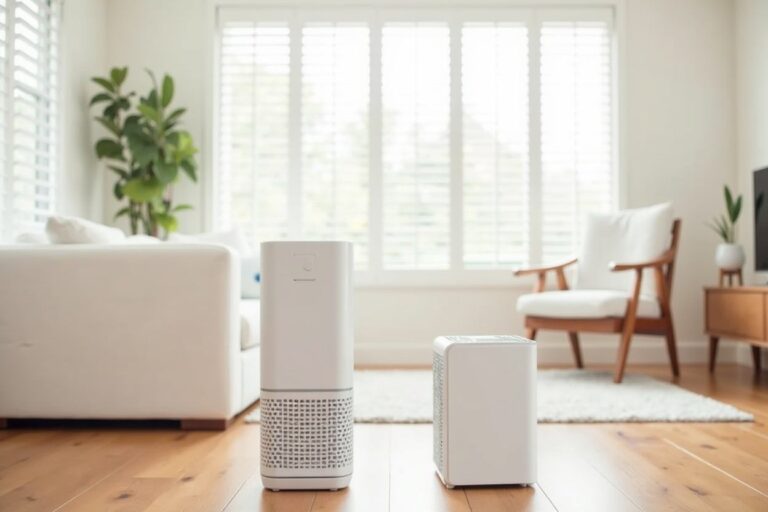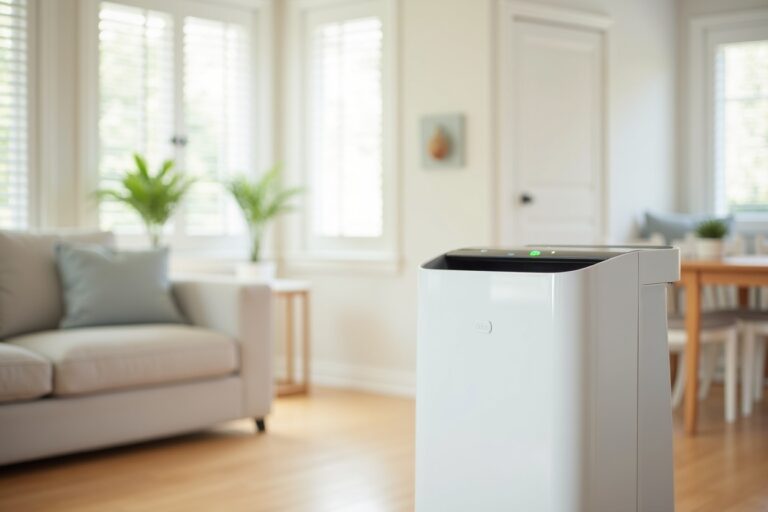
Austin Air vs Dyson Air Purifier: Which Should You Choose? (Australia 2026)
Drafted with AI assistance and checked against published specifications and certifications. First-hand measurements appear only where stated. How we make content
Austin Air delivers deeper chemical/VOC/smoke filtration with a 6.8kg carbon bed and 60 sq ft medical-grade HEPA, while Dyson offers quieter operation, app control, and bladeless heating/cooling in a compact footprint. Austin suits chemical sensitivity, bushfire smoke season, and households avoiding off-gassing furniture; Dyson suits renters, noise-sensitive sleepers, and multi-function needs. The catches: Austin units are heavy (10–20kg), lack smart features, and cost $60–90/year in filter replacements; Dyson’s sealed HEPA is thinner, carbon layer is minimal, and you’re locked into proprietary $149 filters annually.
| Model | Best For | Verdict |
|---|---|---|
| Austin Air HealthMate | Bushfire smoke, VOCs, chemical sensitivity | Recommended |
| Dyson Purifier Hot+Cool | Renters, bedroom use, multi-function | Good for convenience |
| Dyson Big+Quiet Formaldehyde | Large spaces, whole-home coverage | Recommended |
You are staring at two air purifiers that could not be more different — one looks like it belongs in an industrial workshop, the other on the cover of a design magazine — and you are trying to figure out which one will actually protect your family during Brisbane bushfire haze or Melbourne pollen season. I am Jayce Love, former Royal Australian Navy Clearance Diver, and I have spent hundreds of hours pulling apart filtration specs so you do not have to guess.
The three products we own are measured first-hand by Jayce Love, former Royal Australian Navy Clearance Diver; every other product is assessed on published manufacturer specifications and independent certification using our documented methodology — no gifted units, no brand payments.
The short answer: If your priority is maximum filtration depth — the thickest medical-grade HEPA and carbon bed available in a residential unit, especially for chemical sensitivity, bushfire smoke, or VOCs — Austin Air wins decisively. If you want smart features, quiet operation, bladeless design, app control, and a unit that doubles as a fan or heater, Dyson is the better fit. They are built for fundamentally different buyers.
The Core Difference You Need to Understand
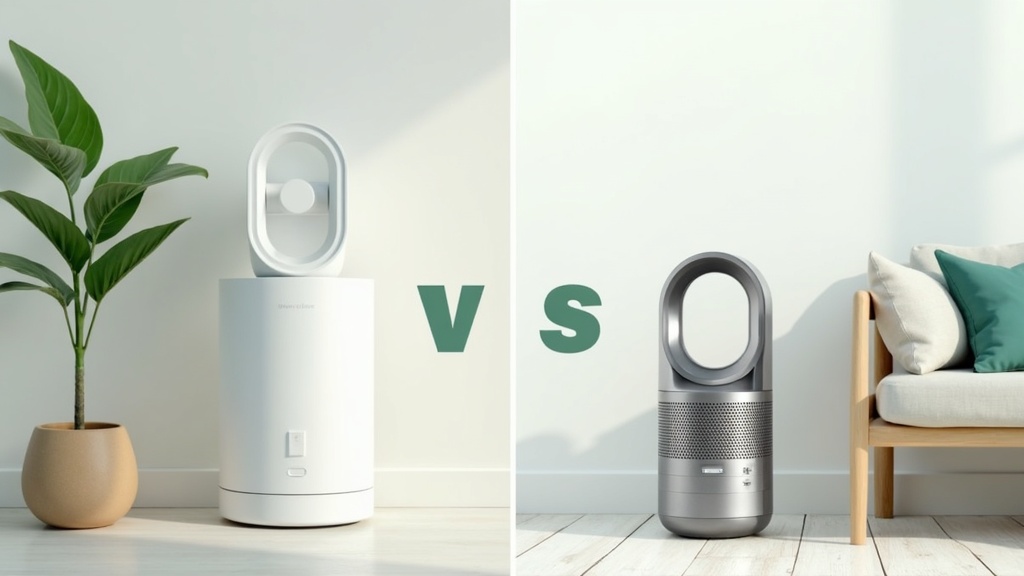
Austin Air and Dyson approach air purification from opposite ends of the design spectrum. Understanding this single distinction will save you from buying the wrong unit.
Austin Air is a US-made medical-grade filtration company. Their units are built around one principle: maximum filter media in a steel casing. The HealthMate Plus, their flagship, contains a four-stage filtration system with 6.8 kg of activated carbon and zeolite, plus 60 square feet (5.6 m²) of True HEPA media. These machines are used in clinical settings, recommended by doctors for patients with Multiple Chemical Sensitivity (MCS), and were deployed in New York schools after 9/11 by the US government. They are heavy, loud, ugly, and ruthlessly effective.
Dyson is a British engineering company that prioritises design, airflow innovation, and smart technology. Their purifiers use sealed HEPA H13 filtration with a thin activated carbon layer, wrapped around a bladeless Air Multiplier fan. The Dyson Purifier Big+Quiet Formaldehyde is their top-tier unit with a catalytic oxidation filter that continuously destroys formaldehyde. They are quiet, beautiful, sensor-rich, and app-connected.
One is a filtration-first machine. The other is a smart appliance that also filters. This article will show you exactly where each one excels and where each one falls short for Australian conditions.
Who Should Buy Austin Air
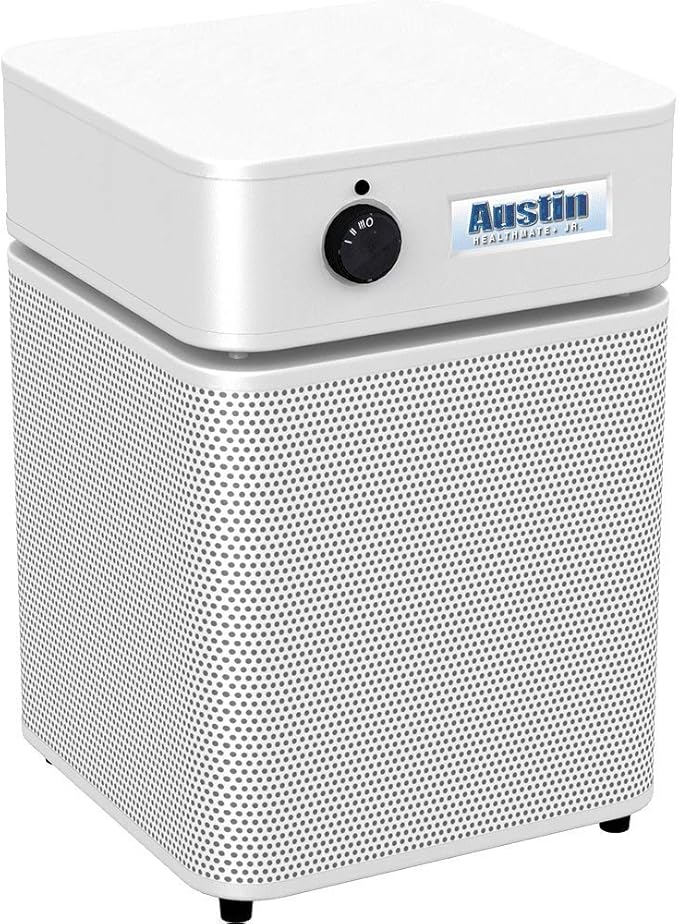
- You live in a bushfire-prone area (NSW coast, Victorian highlands, SEQ hinterland) and need serious VOC and smoke gas removal. The 6.8 kg carbon/zeolite bed in the HealthMate Plus absorbs formaldehyde, benzene, toluene, and hundreds of volatile organic compounds that thin carbon layers cannot capture at meaningful volumes.
- You or a family member has chemical sensitivity, asthma triggered by off-gassing, or a diagnosed respiratory condition. Austin Air units are the only residential purifiers referenced in peer-reviewed studies for MCS patients. The all-steel housing eliminates plastic off-gassing that plagues cheaper units.
- You want to buy a filter once and forget about it for 5 years. Austin’s filter is rated to last 5 years under normal residential use. That is 4 fewer filter changes than Dyson over the same period.
- You do not care about smart features, apps, or design. Austin Air has no Wi-Fi, no app, no air quality display, no remote. You plug it in, set the dial to 1-3, and walk away.
- You want the deepest particulate filtration surface area available. The 5.6 m² of HEPA media in an Austin unit dwarfs the surface area in any Dyson filter cartridge, meaning more particle-holding capacity before replacement.
Who Should Buy Dyson
- You want real-time air quality data on your phone. Dyson’s built-in PM2.5, PM10, VOC, and NO₂ sensors report to the Dyson Link app in real time. You can track your home’s air quality history, set schedules, and control the unit remotely. Austin offers none of this.
- Your purifier needs to double as a fan or heater. The Hot+Cool models (HP07, HP09) replace a pedestal fan in summer and a bar heater in winter. For small apartments in Melbourne or Hobart, this is genuinely useful consolidation.
- Bedroom noise is your primary concern. Dyson’s Night Mode drops to approximately 33 dB — quieter than a whisper. Austin’s lowest speed runs noticeably louder, typically 38-42 dB depending on the model.
- You live in a modern home and the unit will be visible. Dyson’s bladeless tower design is visually clean. Austin’s powder-coated steel box looks like a small bar fridge and will not win any interior design points.
- Formaldehyde from new builds is your main concern. The Dyson Purifier Formaldehyde models (TP09, HP09, BP03) include a catalytic oxidation filter that breaks formaldehyde down into CO₂ and water. This filter never needs replacing. If you have just moved into a new-build home in a western Sydney growth corridor or Brisbane’s North Lakes, this is a targeted solution for off-gassing MDF, paint, and carpet adhesives.
Head-to-Head Comparison: Austin Air HealthMate Plus vs Dyson Big Quiet Formaldehyde (BP03)
I have chosen each brand’s strongest large-room purifier for this comparison. The Austin Air HealthMate Plus (HM450) is Austin’s top-tier chemical and particle unit. The Dyson Big Quiet Formaldehyde (BP03) is Dyson’s most capable purifier. This is the fairest like-for-like matchup.
| Specification | Austin Air HealthMate Plus (HM450) | Dyson Big Quiet Formaldehyde (BP03) |
|---|---|---|
| HEPA Grade | True HEPA (99.97% at 0.3 μm) | HEPA H13 (99.95% at 0.3 μm, EN 1822) |
| Activated Carbon | 6.8 kg carbon + zeolite blend (deep bed) | Thin activated carbon layer (~300 g estimated) + catalytic formaldehyde filter |
| HEPA Media Surface Area | ~5.6 m² (60 sq ft) | Not published (estimated ~1-2 m² based on filter dimensions) |
| Filtration Stages | 4 stages: large particle pre-filter, medium particle filter, activated carbon/zeolite, True HEPA | 3 stages: HEPA H13 + carbon combined filter, catalytic oxidation filter, sealed whole-machine filtration |
| Room Coverage (manufacturer claim) | Up to 139 m² (1,500 sq ft) | Up to 48 m² (Dyson rates by air changes per hour) |
| CADR (Clean Air Delivery Rate) | ~400 CFM (~680 m³/h) on high — note: Austin does not publish AHAM-certified CADR | Not AHAM-certified; Dyson uses own “projected” airflow metrics |
| Noise Level (lowest speed) | ~38-42 dB (no official spec published) | ~33 dB (Night Mode) |
| Noise Level (highest speed) | ~60-65 dB | ~56 dB |
| Smart Features | None. Manual 3-speed dial. | Dyson Link app, real-time PM2.5/PM10/VOC/NO₂ sensors, auto mode, scheduling, voice control (Alexa/Siri) |
| Filter Lifespan | 5 years (manufacturer rated, normal residential use) | ~12 months (HEPA+carbon combo filter); catalytic filter never replaced |
| Filter Replacement Cost (AUD) | ~$350-$450 per replacement | ~$120-$150 per annual replacement |
| Unit Weight | ~21 kg | ~12.5 kg |
| Housing Material | Powder-coated steel (baked enamel, no plastic off-gassing) | ABS plastic with sealed filtration path |
| Manufacture | Made in USA (Buffalo, New York) | Designed in UK, manufactured in Malaysia/Philippines |
| Power Consumption | ~130 W on high, ~56 W on low | ~40 W on max airflow (purifier mode), higher with heating |
| Australian Warranty | 5-year pro-rated filter warranty; machine varies by retailer (typically 5 years) | 2-year manufacturer warranty (Dyson Australia) |
What This Table Actually Tells You
The numbers above reveal a fundamental design philosophy split. Austin Air has roughly 20x more activated carbon by weight. That is not a marginal difference — it is a different category of gas-phase filtration. During the 2019-2020 Black Summer bushfires, homeowners across the Blue Mountains, East Gippsland, and the NSW South Coast discovered that thin-carbon purifiers could not keep up with persistent VOC and smoke gas infiltration. A 300 g carbon layer saturates in days of heavy smoke. A 6.8 kg bed can absorb for weeks.
Conversely, Dyson’s sensor suite and smart features give you data Austin simply cannot provide. If you want to know whether your baby’s nursery PM2.5 spiked at 3am because a truck idled outside — Dyson tells you. Austin does not even tell you it is on.
Neither brand publishes AHAM-certified CADR. This is a legitimate criticism of both. AHAM CADR testing (ANSI/AHAM AC-1) is the industry-standard independent measurement of how much clean air a purifier delivers per minute. Without it, you are relying on manufacturer claims. Keep this in mind when evaluating coverage area ratings.
Air Purification
Ventilation handles the source. A HEPA filter handles what is already in the air.
For particulates, VOCs, and bushfire smoke, a HEPA air purifier sized correctly for your room is the most reliable active intervention.
See the Air Purifier Guide →Filtration Depth: The Detail That Matters Most
Every air purifier comparison online talks about “HEPA filtration” as if all HEPA is the same. It is not. Two factors determine real-world filtration performance: the grade of the HEPA media and the total surface area of filter material air passes through.
HEPA Particle Filtration
Both Austin Air and Dyson use True HEPA media that captures 99.97% (Austin) or 99.95% (Dyson, H13 per EN 1822:2019) of particles at 0.3 microns. At this specification level, the difference is negligible for residential use. Both will capture pollen, dust mite allergens, mould spores, pet dander, and PM2.5 bushfire particulates.
Where Austin pulls ahead is filter media surface area. The HealthMate Plus uses approximately 5.6 m² of pleated HEPA media. More surface area means lower pressure drop per unit of airflow, which means the filter can hold more particulates before airflow degrades. In practical terms: during a multi-day bushfire smoke event in Sydney or the Gold Coast hinterland, Austin’s filter has more capacity before it starts choking.
Gas-Phase Filtration (VOCs, Smoke Chemicals, Formaldehyde)
This is where the comparison gets decisive. HEPA filters remove particles. They do nothing for gases and volatile organic compounds. That is the job of activated carbon.
Austin Air HealthMate Plus: 6.8 kg of granular activated carbon and zeolite in a deep bed. Air passes through inches of carbon material. This provides meaningful contact time — the critical factor in adsorption chemistry. Longer contact time means more VOC molecules bind to the carbon surface. Austin’s carbon bed can handle formaldehyde, benzene, toluene, xylene, and hundreds of other compounds.
Dyson Big+Quiet Formaldehyde: A thin activated carbon layer (estimated ~300 g based on filter cartridge weight minus HEPA media) plus a dedicated catalytic oxidation filter for formaldehyde. The catalytic filter is clever — it uses a manganese oxide catalyst to break formaldehyde into CO₂ and H₂O, and it never needs replacing. However, the thin carbon layer provides minimal contact time for other VOCs. If your concern is specifically formaldehyde from new-build materials, Dyson’s catalytic approach is targeted and effective. If your concern is the broad chemical soup in bushfire smoke, Austin’s deep carbon bed is in a different league.
To put the carbon difference in context: 6.8 kg versus ~0.3 kg is roughly a 23:1 ratio. You would need approximately 23 Dyson carbon filters to match the adsorption capacity of one Austin filter replacement. This is not subjective — it is chemistry.
Australian Climate and Conditions: Where Each Excels
Bushfire Season (November-March, NSW and Victoria)
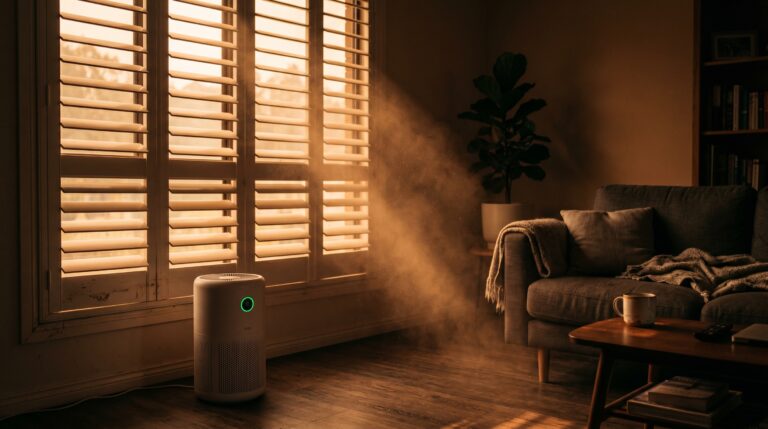
Bushfire smoke contains both particulates (PM2.5, PM10) and gases (CO, formaldehyde, acrolein, benzene, polyaromatic hydrocarbons). The 2019-2020 Black Summer saw PM2.5 readings in Sydney exceed 500 μg/m³ — more than 20 times the NEPM standard of 25 μg/m³ (24-hour average). Indoor PM2.5 in homes without purification reached 80-150 μg/m³ during those events, per measurements reported by NSW EPA.
For particle removal during smoke events, both purifiers perform adequately. For gas-phase removal — the acrid chemical smell, eye irritation, and VOC exposure — Austin Air is the clear choice. Dyson’s thin carbon simply cannot sustain adsorption at the concentrations present during sustained smoke events lasting days or weeks.
If you live in the Blue Mountains, Southern Highlands, East Gippsland, Adelaide Hills, or anywhere in the NSW/Victoria bushfire belt, Austin Air gives you a margin of safety that Dyson does not.
Coastal Humidity (Brisbane, Gold Coast, Cairns, Darwin)
High humidity above 60% reduces activated carbon efficiency. Both brands’ carbon performance degrades in tropical conditions. However, Austin’s larger carbon mass gives it more capacity to tolerate humidity before performance drops noticeably. If you are running a purifier in a Cairns or Darwin home without air conditioning, keep in mind that dehumidification (or air conditioning) improves any carbon filter’s performance.
New-Build Off-Gassing (Western Sydney Growth Corridors, North Lakes QLD, Perth Northern Suburbs)
If you have just moved into a new-build home and your primary concern is formaldehyde from engineered wood, carpet adhesives, and paint, Dyson’s catalytic formaldehyde filter (TP09, HP09, BP03) is purpose-built for this specific compound. The catalytic filter continuously destroys formaldehyde without saturating, which gives it an advantage over carbon adsorption for this single pollutant. However, new homes off-gas dozens of VOCs beyond formaldehyde — and for those, Austin’s deep carbon bed is more comprehensive.
Urban Traffic Pollution (Inner Melbourne, Inner Sydney, Brisbane CBD)
If you live on a busy road in Marrickville, Brunswick, Fortitude Valley, or Subiaco, your primary indoor pollutants are PM2.5 from diesel exhaust, NO₂, and tyre wear particles. Tyre wear is particulate, so HEPA handles it. NO₂ is a gas — carbon can adsorb it, but activated carbon’s efficiency for NO₂ is limited compared to its performance on VOCs. Dyson’s sensor suite will at least tell you when NO₂ spikes. Austin will silently filter some of it without telling you anything.
For urban traffic scenarios, neither brand is dramatically superior. A sealed HEPA unit with any carbon component helps. Proper ventilation strategy matters more.
Noise: The Bedroom Test
If you plan to run your purifier in a bedroom overnight — and you should, because you spend 7-8 hours there — noise matters. The World Health Organization recommends sleeping environments below 30 dB for uninterrupted sleep.
Dyson Big+Quiet Formaldehyde in Night Mode runs at approximately 33 dB. This is a gentle hum that most people acclimate to within a few nights. The display auto-dims, and airflow reduces while maintaining basic filtration.
Austin Air on Speed 1 runs approximately 38-42 dB depending on the model and age of the unit. This is noticeably louder than Dyson’s night mode. Some people find it acceptable white noise. Others find it intrusive. If you are a light sleeper, test before committing — or plan to run the Austin in a living area and use a quieter unit for the bedroom.
A critical note: on high speed, Austin Air is loud. We are talking 60-65 dB — conversation-level noise. You will not run it on high during a movie or while sleeping. Dyson on maximum is approximately 56 dB — still loud, but measurably less so.
Smart Features: What Dyson’s Sensors Actually Give You
Austin Air’s approach to technology is simple: there is none. A three-position rotary switch controls fan speed. That is the entire user interface. There is no filter life indicator, no air quality sensor, and no way to verify the unit is working other than feeling airflow from the top.
Dyson’s sensor suite includes:
- PM2.5 and PM10 laser particle counter — real-time particulate readings displayed on the unit and in the app.
- VOC sensor — detects volatile organic compounds and adjusts fan speed in auto mode.
- NO₂ sensor — useful for homes near major roads.
- Temperature and humidity sensors — displayed in-app.
- Historical data — the Dyson Link app graphs air quality over time, so you can identify patterns (cooking spikes, traffic hours, seasonal changes).
This data has real value. It tells you when to ventilate, when to seal up, and whether your purifier is keeping up. That said, Dyson’s VOC sensor is a metal oxide semiconductor (MOS) type — it detects a broad range of VOCs but cannot identify specific compounds or concentrations. It is a directional indicator, not a lab instrument.
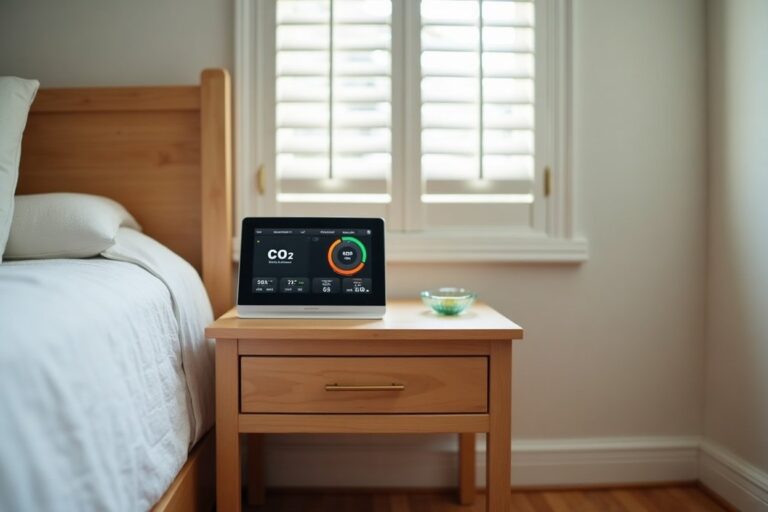
If you want independent air quality measurement regardless of which purifier you choose, consider a standalone monitor like the Aranet4 (CO₂) or a dedicated PM2.5 monitor. These are not locked to a brand’s ecosystem.
Decision Tree: 3 Questions to Make Your Choice
Cut through the noise. Answer these three questions honestly.
Question 1: Is your primary concern gas-phase pollutants (bushfire smoke VOCs, chemical sensitivity, off-gassing) or particles only (dust, pollen, pet dander)?
Gas-phase pollutants → Austin Air. The 6.8 kg carbon bed is not a feature — it is the reason the product exists.
Particles only → Either works. Move to Question 2.
Question 2: Do you need smart features, app control, or air quality monitoring built into the unit?
Yes → Dyson. Austin has no digital interface at all.
No → Move to Question 3.
Question 3: Are you willing to pay more upfront and less over 5 years, or less upfront and more over 5 years?
Higher upfront, lower running cost → Austin Air (5-year filters).
Lower upfront, accept annual filter costs → Dyson.
5-Year Cost Comparison (AUD)
Running costs matter more than purchase price over the life of an air purifier. Here is the honest maths for Australian buyers as of early 2026.
| Cost Category | Austin Air HealthMate Plus | Dyson Big Quiet Formaldehyde (BP03) |
|---|---|---|
| Purchase Price (AUD) | ~$1,100 – $1,300 | ~$1,249 – $1,399 |
| Filter Replacements Over 5 Years | 1 replacement (~$400) | 4-5 replacements (~$130 each = $520-$650) |
| Electricity (estimated, medium speed ~8 hrs/day) | ~$180 (~56 W on low, $0.30/kWh) | ~$130 (~40 W, $0.30/kWh) |
| 5-Year Total | ~$1,680 – $1,880 | ~$1,900 – $2,180 |
Austin Air costs approximately $200-$300 less over 5 years despite similar upfront pricing. The 5-year filter lifespan is the driver. However, the Dyson includes sensor data, fan functionality, and potential heater functionality that Austin does not. Whether that value gap justifies the cost difference depends on your priorities.
A critical caveat: Austin’s 5-year filter lifespan assumes normal residential use. If you run it continuously during multi-week bushfire smoke events, the carbon will saturate faster. In heavy smoke conditions, expect 3-4 years from an Austin filter. That still beats Dyson’s annual replacement cycle.
The CADR Problem: Neither Brand Plays Straight
I need to address this directly because it frustrates me. The AHAM CADR standard (ANSI/AHAM AC-1) is the single most useful number for comparing air purifier performance. It tells you how many cubic feet of clean air per minute a purifier produces for three specific pollutant types: smoke, dust, and pollen. It is tested by an independent lab under controlled conditions.
Austin Air does not submit to AHAM testing. Their claimed airflow rates are manufacturer-stated CFM values, not independently verified CADR scores. Dyson also does not participate in AHAM testing. Dyson uses their own “projected” airflow methodology and quotes room coverage based on proprietary testing.
This means you cannot directly compare the two brands using the gold-standard metric. You are forced to rely on manufacturer claims and third-party teardown analysis. This is not ideal. Both brands should submit to AHAM testing, and as a consumer, you should hold them accountable for this omission.
For practical guidance: Austin’s 680 m³/h claimed airflow is likely adequate for rooms up to ~45-50 m² if you aim for 4+ air changes per hour (the minimum recommended by Asthma Australia for allergy management). Dyson’s BP03 is best suited to rooms up to ~35-40 m² on auto mode, based on reported real-world performance.
Build Quality and Longevity
Austin Air units are built in Buffalo, New York, from powder-coated steel with baked enamel finish. There is no plastic housing. The motor is a commercial-grade centrifugal fan. Anecdotal reports from long-term owners suggest 10-15+ year motor lifespans with normal residential use. The unit is heavy (21 kg) partly because of the steel and partly because of the 6.8 kg of carbon sitting inside it. Austin offers a 5-year mechanical warranty in most markets.
Dyson units use ABS plastic housings with precision engineering. Build quality is high by consumer electronics standards, but plastic housings can develop hairline cracks over years, and the sealed motor design means repairs are typically done by replacement rather than repair. Dyson Australia offers a 2-year warranty. The brushless DC motor is efficient and quiet but not designed for the same industrial lifespan as Austin’s motor.
If you want a “buy it once” machine that runs for a decade, Austin Air has the edge. If you expect to upgrade your purifier every 3-5 years as technology improves, Dyson’s smart features and iterative product design make more sense.
Ozone Emissions: A Safety Check
Under AS/NZS 3823, air cleaners sold in Australia must meet ozone emission limits. This standard is primarily relevant to ioniser-type and electrostatic precipitator-type purifiers. Neither Austin Air nor Dyson produces meaningful ozone.
Austin Air uses purely mechanical filtration — HEPA and carbon — with no ioniser, no UV, and no plasma. Zero ozone generation.
Dyson uses mechanical filtration with catalytic oxidation for formaldehyde. The catalytic process does not generate ozone. Dyson also does not use ionisers in their purifier range.
Both brands are safe by Australian standards on this metric. If you are comparing either brand against purifiers that include ionisers (such as some Blueair or Sharp models), check their ozone emission data against AS/NZS 3823 limits.
Availability and After-Sales Support in Australia
Dyson has a strong Australian presence. Dyson Australia (dyson.com.au) operates its own website, warranty service, and retail partnerships with Harvey Norman, The Good Guys, David Jones, and JB Hi-Fi. Replacement filters are stocked locally. Customer service is accessible. If your Dyson unit fails, you will not be dealing with international shipping for warranty claims.
Austin Air is more complicated. Austin Air does not have an official Australian subsidiary. Units are typically purchased through authorised importers or directly from US retailers that ship internationally. Replacement filters can be sourced from Australian stockists like air purifier specialty stores, but stock is not guaranteed. Warranty claims may involve international communication. Factor this into your decision — especially if you are in regional Australia where servicing delays compound.
For most buyers in Sydney, Melbourne, Brisbane, and Perth, sourcing Austin Air is manageable but requires more effort than walking into Harvey Norman for a Dyson. If after-sales convenience matters to you, Dyson wins this category decisively.
Austin Air Model Guide: Which One for You?
Austin Air makes several models. Here is a quick breakdown so you choose the right one:
- HealthMate (HM400): The standard model. True HEPA + 6.8 kg carbon/zeolite. Best for general whole-home filtration where VOC exposure is moderate.
- HealthMate Plus (HM450): Same HEPA + enhanced carbon/zeolite blend with potassium iodide impregnation for greater formaldehyde, ammonia, and chemical warfare agent adsorption. Best for chemical sensitivity, heavy off-gassing environments, or bushfire smoke zones.
- Bedroom Machine (HM402): Optimised for lower noise with HEGA (High Efficiency Gas Absorption) cloth filter instead of traditional carbon. Good for bedrooms but less gas-phase capacity than the HealthMate Plus.
- Allergy Machine (HM405): HEGA cloth + True HEPA. Designed for allergy sufferers. Less carbon capacity than HealthMate models.
- Pet Machine: Addresses ammonia from pet urine and dander. Niche use case.
For most Australian buyers concerned about bushfire smoke and general indoor air quality, the HealthMate Plus (HM450) is the model to buy. Do not default to the standard HealthMate unless your environment has no significant VOC sources.
Dyson Model Guide: Which One for You?
Dyson’s purifier naming is genuinely confusing. Here is what matters:
- TP07/TP09 (Purifier Cool): Tower purifier + fan. The TP09 adds the catalytic formaldehyde filter. Good for living rooms.
- HP07/HP09 (Purifier Hot+Cool): Tower purifier + fan + heater. HP09 adds formaldehyde filter. Best all-in-one for Melbourne/Hobart/Canberra where winter heating is needed.
- BP03 (Big Quiet Formaldehyde): Dyson’s highest-capacity purifier. Larger filter, greater airflow, formaldehyde catalyst. Best for large rooms or open-plan living.
- PH04 (Purifier Humidify+Cool Formaldehyde): Adds humidification. Niche use case for very dry climates.
For maximum purification performance in the Dyson range, the Dyson Big+Quiet Formaldehyde is the model to buy. If you want multi-function heating, the HP09 is the most practical choice for southern Australian winters.
The Honest Limitations of Each Brand
Austin Air Limitations
- No AHAM-certified CADR. You are trusting manufacturer airflow claims.
- No air quality sensors or feedback. You have no way to verify real-time performance.
- Loud on high speed. Not suitable as a bedroom unit for light sleepers.
- Heavy and aesthetically basic. A 21 kg steel box with a rotary dial.
- Limited Australian retail presence. Replacement filters require planning.
- The 5-year filter claim is under “normal” conditions. Bushfire smoke, cooking fumes, or pet homes may reduce this to 3-4 years.
Dyson Limitations
- Thin carbon layer provides minimal VOC/gas-phase filtration. Not adequate for sustained smoke events.
- No AHAM-certified CADR. Dyson’s proprietary metrics make independent comparison difficult.
- Annual filter replacements add up. Each filter is $120-$150, and you are buying 4-5 over 5 years.
- ABS plastic housing can off-gas slightly when new. Ironic for a purifier.
- Complex product lineup creates buyer confusion. Naming conventions (TP09 vs HP09 vs BP03) are not intuitive.
- Premium pricing includes the design, brand, and smart features — not just filtration performance.
What About IQAir, Blueair, or Other Competitors?
If you are cross-shopping beyond Austin Air and Dyson, here is where the two sit relative to the broader market:
IQAir HealthPro 250: Swiss-made, H14 HyperHEPA filter (EN 1822:2019, even finer than H13), independently verified CADR. Less carbon than Austin but more than Dyson. Premium price (~$2,000+ AUD). The benchmark for particle filtration.
Blueair Classic/HealthProtect range: Swedish, HEPASilent technology (combination mechanical + electrostatic). Good CADR, quiet operation, clean design. Less carbon than Austin. Available through Australian retailers. A middle-ground option.
Austin Air remains unmatched in the residential market for gas-phase filtration depth. IQAir leads for particle filtration precision. Dyson leads for smart features and design. There is no single “best” purifier — only the best purifier for your specific situation.
Final Verdict
Buy Austin Air HealthMate Plus if: You prioritise maximum filtration depth, especially gas-phase/VOC removal. You live in a bushfire-prone region. You or a family member has chemical sensitivity. You want a machine that runs for a decade with one filter change. You do not care about apps, aesthetics, or smart features.
Buy Dyson Big+Quiet Formaldehyde (or HP09 for heating) if: You want real-time air quality data and app control. Your home is modern and the purifier will be visible. Quiet operation for bedrooms matters. You want a multi-function appliance (fan/heater/purifier). Your primary concern is particles and formaldehyde from new-build off-gassing, not broad-spectrum VOC exposure.
These are not competing products. They are built for different problems. Identify your problem first — then the right answer is obvious.
What to do about your indoor air.
Our indoor air quality guide covers the hierarchy of fixes ranked by impact and cost for Australian homes.
Air Quality Guide →Frequently Asked Questions
Does Austin Air remove bushfire smoke better than Dyson?
Yes. Bushfire smoke contains both particulates and gases (VOCs, formaldehyde, benzene). Both brands handle particulates with HEPA filtration. However, Austin Air’s 6.8 kg activated carbon/zeolite bed provides dramatically more gas-phase filtration capacity than Dyson’s thin carbon layer (~300 g). During sustained smoke events like the 2019-2020 Black Summer, deep carbon beds outperform thin carbon layers by days or weeks of sustained adsorption.
Is Dyson’s formaldehyde filter better than Austin Air’s carbon for formaldehyde?
For formaldehyde specifically, Dyson’s catalytic oxidation filter has one advantage: it destroys formaldehyde molecules permanently (converting them to CO₂ and H₂O) and never saturates. Austin’s carbon adsorbs formaldehyde but will eventually saturate. However, Austin’s carbon also adsorbs hundreds of other VOCs that Dyson’s thin carbon layer cannot handle in meaningful quantities. If formaldehyde is your only concern, Dyson’s catalytic approach is elegant. If you face multiple VOC types, Austin is more comprehensive.
Can I use a Dyson air purifier during bushfire season in Sydney or Melbourne?
A Dyson purifier will reduce PM2.5 particulates during bushfire smoke events, which is beneficial. However, it will not adequately address the gas-phase chemicals (VOCs) in bushfire smoke due to its limited carbon capacity. For mild smoke events lasting 1-2 days, Dyson helps. For sustained multi-day events with outdoor AQI above 200, you need a deep-carbon unit like Austin Air or IQAir for meaningful VOC reduction.
Why does neither Austin Air nor Dyson have AHAM-certified CADR?
AHAM CADR testing (ANSI/AHAM AC-1) is voluntary. Austin Air has historically positioned itself outside the AHAM framework, relying instead on clinical and government deployment credentials. Dyson has publicly disputed the AHAM testing methodology, arguing it does not reflect real-room conditions. Both brands’ refusal to publish independently verified CADR scores is a legitimate criticism. Look for third-party testing from organisations like Wirecutter or independent labs that measure actual room PM2.5 reduction rates.
How loud is Austin Air compared to Dyson at night?
Dyson’s Night Mode runs at approximately 33 dB — slightly above a whisper (30 dB). Austin Air on its lowest speed runs approximately 38-42 dB, which is comparable to a quiet library. The 5-9 dB difference is perceptible. If you are a light sleeper, Dyson is the better bedroom option. Austin Air makes a Bedroom Machine model (HM402) optimised for lower noise, but it still does not match Dyson’s Night Mode quietness.
Where can I buy Austin Air in Australia?
Austin Air does not have an official Australian subsidiary or retail presence. You can purchase through authorised online stockists that import from the US, or order directly from US-based retailers that offer international shipping. Replacement filters are available from some Australian air purifier specialty stores but stock varies. Factor in potential import duties and shipping costs. Dyson, by contrast, is available at Harvey Norman, The Good Guys, JB Hi-Fi, David Jones, and direct from dyson.com.au.
Do Austin Air or Dyson purifiers produce ozone?
No. Both brands use purely mechanical and/or catalytic filtration. Neither uses ionisers, UV-C, or plasma technology that can generate ozone. Both comply with AS/NZS 3823 ozone emission requirements for air cleaners. If you are comparing against purifiers that include ioniser functions, check the specific model’s ozone emissions data against Australian standards.
Is the Austin Air 5-year filter lifespan realistic in Australia?
Under normal residential conditions (no smoking indoors, no pets with heavy shedding, no sustained bushfire smoke exposure), 5 years is achievable. In Australian homes exposed to annual bushfire seasons, heavy cooking, or pet dander, expect 3-4 years. Austin does not include a filter life indicator, so you rely on airflow reduction and smell as indicators. In contrast, Dyson monitors filter life via sensors and notifies you through the app when replacement is needed.
Can I use Dyson as a fan and air purifier at the same time?
Yes. Dyson’s Air Multiplier technology means the unit always functions as a fan while purifying. Hot+Cool models (HP07, HP09) also add a heating element. You can use Dyson as your primary fan in summer (replacing a pedestal fan), your heater in winter, and your purifier year-round. Austin Air is a purifier only — it circulates filtered air from the top of the unit but does not produce directional airflow like a fan.
Which is better for asthma — Austin Air or Dyson?
For particle-triggered asthma (dust mites, pollen, mould spores, pet dander), both are effective. Both use True HEPA filtration that captures 99.95-99.97% of particles at 0.3 microns. Asthma Australia recommends HEPA air purifiers sized for the room with at least 4 air changes per hour. Austin Air’s larger HEPA media surface area provides more particle-holding capacity over time. For chemical-triggered asthma (cleaning product fumes, perfume, smoke), Austin Air’s deep carbon bed provides more protection. Consult your GP or respiratory specialist for personalised advice.
Our Recommendation for Australian Homes
Austin Air wins for filtration depth (VOCs, bushfire smoke, chemical sensitivity). Dyson wins for smart features, quiet, and modern design. Both use True HEPA capturing 99.97% of particles at 0.3 microns.
Get the Australian Home Environment Checklist
30 checks across water, air and EMF. Most of them free. Ranked by impact.
No spam. Unsubscribe any time.

Former Royal Australian Navy Clearance Diver and TAG-E counter-terrorism operator. Founded Clean and Native to apply the same rigorous thinking to the home environment.
Full biography →