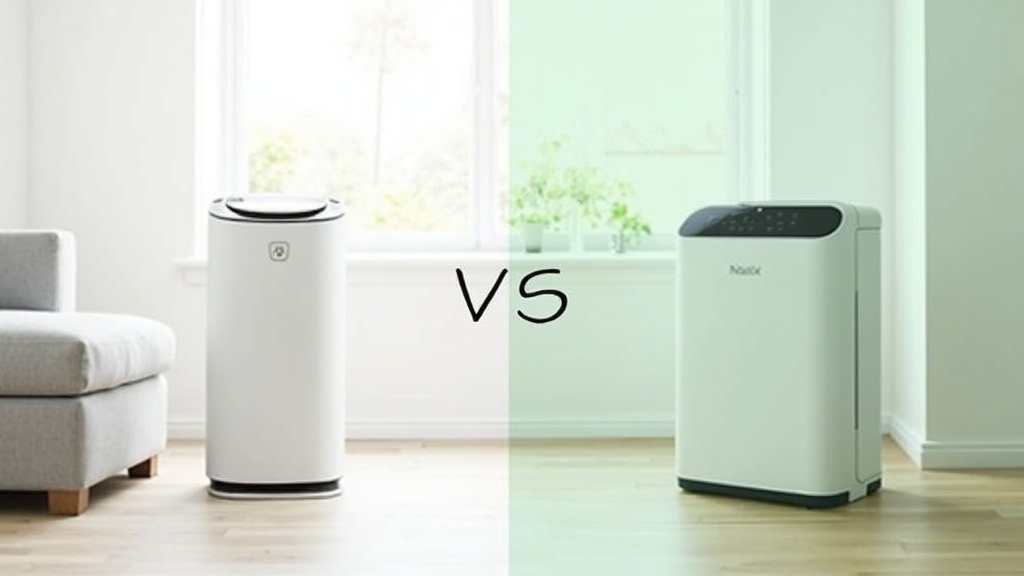
Portable Air Purifier vs Whole Home Air Filtration: Which Should You Choose? (Australia 2026)
Drafted with AI assistance and checked against published specifications and certifications. First-hand measurements appear only where stated. How we make content
A portable HEPA air purifier is the right first move for most Australian households because it costs 75–90% less upfront, delivers measurable particle reduction in a single room within minutes, requires no installer, and travels between rooms or rental properties. Whole-home filtration only makes economic sense when you already have a compatible ducted HVAC system, want passive coverage across every room simultaneously, and are prepared for higher ongoing filter costs and HVAC runtime penalties. The catches: portable units require manual placement in each priority room (bedrooms, living areas) and won’t protect spaces you forget to cover, whereas whole-home systems need professional retrofit if your ducted air-con wasn’t designed for MERV-13+ resistance.
| Approach | Upfront Cost (AU) | Verdict |
|---|---|---|
| Portable HEPA (e.g. Levoit Core 400S) | $350–$650 per unit, DIY setup | Recommended |
| Whole-home filtration retrofit | $2,500–$6,000+ installed, ongoing HVAC wear | Good for ducted-HVAC homes only |
| Hybrid (portable + MERV-8 ducted) | $500–$1,200 total, DIY filter swap | Best value for renters/mixed needs |
You are standing in your hallway, smelling bushfire smoke that has crept through every gap in your house, and wondering whether a $400 portable HEPA unit in the bedroom will fix the problem or whether you need to gut your ducted system and retrofit whole-home filtration. This is not an abstract question. During the 2019-2020 Black Summer fires, PM2.5 readings in western Sydney suburbs like Penrith exceeded 500 µg/m³ — more than 20 times the NEPM annual standard of 25 µg/m³ (lowered from 8 µg/m³ for PM2.5 as of July 2025). Your lungs do not care which approach you pick. They care about what actually reaches them.
The three products we own are measured first-hand by Jayce Love, former Royal Australian Navy Clearance Diver; every other product is assessed on published manufacturer specifications and independent certification using our documented methodology — no gifted units, no brand payments.
The short answer: A portable HEPA air purifier is the right first move for most Australian households. It costs 75-90% less upfront, delivers measurable particle reduction in a single room within minutes, requires no installer, and can travel with you between rooms or rental properties. Whole-home filtration only makes sense when you already have a compatible ducted HVAC system, you want passive coverage across every room simultaneously, and you are prepared for higher upfront cost and ongoing professional maintenance.
I am Jayce Love, a former Royal Australian Navy Clearance Diver based in Palm Beach, QLD. This article is built from manufacturer specifications, independent certification records, and where a product is one I genuinely own and use, from my own measurements, stated explicitly where that applies. This article gives you every number, every standard, and a clear decision framework so you can stop guessing.
What Each System Actually Does (And Does Not Do)
Before you spend a cent, you need to understand a fundamental distinction that most comparison articles blur: a portable air purifier and a whole-home system filter different volumes of air, at different rates, through different grades of media. Neither is inherently superior. They solve different geometry problems.
Portable HEPA Air Purifiers
A portable unit sits in a single room, draws air through an internal fan, passes it through layered filtration (typically a pre-filter, activated carbon bed, and HEPA media), and returns cleaned air to that room. The key metric is CADR — Clean Air Delivery Rate — measured in m³/h or CFM. A unit with a CADR of 300 m³/h can fully exchange the air in a 25 m² room (2.4 m ceiling = 60 m³) five times per hour. That is the benchmark for meaningful particle reduction.
The filtration grade matters. True HEPA (H13 per EN 1822:2019) captures 99.95% of particles at 0.3 microns — the most penetrating particle size. Some budget units sold in Australia use “HEPA-type” or H11 media, which captures only 95% at 0.3 microns. That 4.95% gap sounds small until you realise it means H11 passes roughly 100 times more particles than H13. Always check the EN 1822 classification.
Good portable units also include 0.5-2 kg of activated carbon for gas-phase filtration: VOCs, formaldehyde off-gassing from flat-pack furniture, cooking odours, and bushfire smoke gases (CO, acrolein, benzene). Carbon does not remove particles. HEPA does not remove gases. You need both.
Whole-Home Air Filtration Systems
Whole-home filtration integrates into your ducted HVAC system — the same ductwork that carries heated or cooled air around your house. There are three main configurations:
- Media filter upgrade: Replacing the standard MERV 8 (or lower) return-air filter with a MERV 13-16 pleated media filter or a 100 mm deep media cabinet filter. Cost: $300-$800 for the cabinet, $80-$200 per replacement filter annually.
- Electronic air cleaner (EAC): Electrostatic precipitator installed in the return-air duct. Charges particles and collects them on metal plates. No filter replacements, but requires regular cleaning and can produce trace ozone. Ozone output must comply with AS/NZS 3823 limits.
- Dedicated whole-home HEPA system: A separate fan unit with H13/H14 HEPA media, ducted in parallel to the HVAC. These are the gold standard for whole-home filtration but cost $3,000-$8,000 installed in Australia.
The critical limitation: whole-home filtration only works when the HVAC fan is running. If your system cycles off (as most do when the temperature set point is reached), filtration stops. Some systems offer a “fan only” or “continuous circulation” mode, but this adds 300-700 watts of continuous power draw — $200-$500 per year on your electricity bill at current Australian rates ($0.30-$0.35/kWh in QLD and NSW).
Who Should Buy a Portable Air Purifier
- Renters in any Australian city. You cannot modify ductwork you do not own. A portable HEPA unit requires nothing more than a power point. When you move from Newtown to Marrickville, the purifier comes with you.
- Households without ducted HVAC. Approximately 40% of Australian homes use split-system air conditioning. These have no ductwork to retrofit. Portable is your only powered filtration option.
- Anyone who needs targeted protection in one or two rooms. If you have one asthmatic child sleeping in one bedroom, a single portable HEPA unit with a CADR of 200+ m³/h in that bedroom will reduce their particle exposure during sleep hours (8+ hours) more effectively than a whole-home system running intermittently.
- Bushfire smoke response. During the November-March bushfire season in NSW, Victoria, and increasingly in South East Queensland, you need filtration you can deploy immediately. A portable unit runs within 60 seconds of unpacking. A whole-home retrofit takes days to weeks.
- Budget-constrained households. A quality H13 HEPA portable with adequate CADR for a bedroom costs $200-$500. Total annual running cost (filters + electricity) is $60-$150. This is 5-10x cheaper than whole-home installation plus ongoing costs.
Who Should Buy Whole-Home Air Filtration
- Homeowners with existing ducted reverse-cycle or gas ducted heating. If you already have the ductwork, retrofitting a MERV 13+ media cabinet filter is the most cost-effective way to cover every room simultaneously. Common ducted brands in Australia (Daikin, Mitsubishi Electric, Actron Air, Braemar) can typically accept aftermarket filter cabinets.
- Households where multiple family members have respiratory conditions. When everyone in the house needs cleaner air in every room — living areas, bedrooms, home office — running three or four portable units becomes more expensive and noisier than a single whole-home system.
- New builds or major renovations. If you are building or renovating and specifying ductwork anyway, designing for MERV 13+ filtration from the start adds minimal marginal cost. Talk to your HVAC contractor about static pressure calculations before specifying filter grade — this is where most DIY installs fail.
- Pet owners in large homes (200+ m² floor area). Multiple pets generating dander across open-plan living areas create a distributed particle load that benefits from continuous whole-home recirculation.
- Households near persistent pollution sources. If you live near a freeway (M1 in Brisbane and Gold Coast, Tullamarine Freeway in Melbourne, M5 in Sydney), a coal-fired power station, or an industrial precinct, your particle exposure is chronic, not episodic. Whole-home filtration addresses the baseline load across all rooms.
Head-to-Head Comparison: Portable vs Whole Home
| Criterion | Portable HEPA | Whole Home (Ducted) | What This Means for You |
|---|---|---|---|
| Filtration grade | H13 HEPA (99.95% at 0.3 µm per EN 1822:2019) | MERV 13-16 typical; dedicated systems can use H13/H14 | Portable HEPA generally delivers higher filtration efficiency per pass than standard ducted MERV 13 filters |
| Coverage area | Single room (15-50 m² depending on CADR) | Entire home via duct network | If you only need one room clean, portable wins. If every room matters, whole home wins. |
| Upfront cost (AUD) | $200-$900 per unit | $300-$800 (media cabinet) to $3,000-$8,000 (dedicated HEPA system), plus installation $200-$500 | Portable is 5-15x cheaper to deploy |
| Annual running cost (AUD) | $60-$150 (filters $40-$100 + electricity $20-$50 at $0.33/kWh) | $150-$600 (filters $80-$200 + fan electricity $100-$400) | Portable costs less to run, especially if you only operate it during sleep hours |
| Gas / VOC removal | 1-2 kg activated carbon bed (effective for formaldehyde, benzene, toluene) | Thin carbon pads (50-200 g) or no gas filtration on most systems | If VOCs are your concern, portable units with substantial carbon beds outperform whole-home carbon pads |
| Noise | 25-55 dB(A) depending on speed | Near-silent in living areas (ductwork dampens fan noise; 35-45 dB at return air grille) | Whole home is quieter in bedrooms. Portable units on low speed (25-35 dB) are comparable to ambient room noise. |
| Installation | None — plug in and turn on | Professional HVAC technician required for media cabinet or dedicated system | Portable is operational in 60 seconds. Whole home requires scheduling and trades. |
| Maintenance | Replace filters every 6-12 months (user-serviceable) | Replace media filters every 6-12 months; EACs require monthly plate cleaning; professional inspection annually recommended | Portable maintenance is simpler and cheaper. Whole-home EACs need diligent cleaning or efficiency drops rapidly. |
| Portability | Fully portable (5-12 kg typical) | Permanently installed | Renters, people who move frequently, or anyone wanting room-to-room flexibility should choose portable |
Air Purification
Ventilation handles the source. A HEPA filter handles what is already in the air.
For particulates, VOCs, and bushfire smoke, a HEPA air purifier sized correctly for your room is the most reliable active intervention.
See the Air Purifier Guide →The Filtration Science You Need to Understand
MERV vs HEPA: These Are Not the Same Scale
MERV (Minimum Efficiency Reporting Value) is an ASHRAE standard that rates filters on a 1-20 scale. HEPA grades (H10-H14) follow EN 1822:2019 and are tested differently. The two scales overlap but are not interchangeable. Here is how they compare on the particle sizes that matter most to your health:
| Filter Rating | Efficiency at 0.3 µm | Captures | Typical Application |
|---|---|---|---|
| MERV 8 | ~20% | Pollen, dust mites, carpet fibres | Standard ducted HVAC (most Australian homes) |
| MERV 11 | ~35-50% | Mould spores, pet dander, dust | Upgraded home HVAC |
| MERV 13 | ~75-85% | Bacteria, smoke particles, fine PM2.5 | Recommended minimum for health-focused ducted filtration |
| MERV 16 | ~95% | Most fine particulates, some virus carriers | High-end residential, commercial |
| H13 HEPA (EN 1822) | 99.95% | Virtually all airborne particles including virus-laden aerosols | Portable air purifiers, hospitals, cleanrooms |
| H14 HEPA (EN 1822) | 99.995% | Surgical-grade particle removal | Operating theatres, pharmaceutical manufacturing |
The practical takeaway: a portable H13 HEPA unit captures 99.95% of particles per pass through the filter. A whole-home MERV 13 filter captures roughly 80% per pass. Over multiple air exchanges, that MERV 13 gap narrows — but it never reaches HEPA-grade cleanness in a single pass. For acute events like bushfire smoke, the per-pass efficiency of H13 HEPA matters because you want particle levels to drop fast.
Why CADR Is the Number That Actually Matters
CADR — Clean Air Delivery Rate — tells you how many cubic metres of clean air a purifier produces per hour. It accounts for both the fan speed and the filter efficiency. A high CADR means faster cleaning. A purifier with a CADR of 300 m³/h in a 30 m² room with 2.4 m ceilings (72 m³ volume) delivers 4.2 air changes per hour (ACH). The target for effective filtration is 4-6 ACH.
Whole-home systems do not publish CADR because they rely on the HVAC fan’s airflow rate and the installed filter’s efficiency. A typical ducted system in a 150 m² Australian home circulates 1,000-1,500 m³/h. With a MERV 13 filter at ~80% efficiency, the effective CADR for the entire home is roughly 800-1,200 m³/h. Divide that across 360 m³ of total volume (150 m² × 2.4 m) and you get 2.2-3.3 ACH — adequate but lower than a properly sized portable in a single room.
This is the core trade-off: whole home gives you moderate filtration everywhere; portable gives you superior filtration where you choose to deploy it.
Gas-Phase Filtration: Where Portable Wins Decisively
HEPA removes particles. Carbon removes gases. Bushfire smoke is both — PM2.5 particulates plus volatile organic compounds (benzene, formaldehyde, acrolein, toluene). Cooking produces both — grease particles plus aldehydes and acrolein. New furniture off-gasses formaldehyde, which is a gas, not a particle.
Here is the problem with whole-home carbon filtration: the carbon pads inserted into ducted systems are typically 50-200 grams of carbon spread thinly across a large filter frame. The contact time between air and carbon is fractions of a second. This is inadequate for meaningful gas-phase adsorption.
A quality portable unit like the IQAir HealthPro 250 contains 2.5 kg of granular activated carbon. The Blueair HealthProtect 7470i contains approximately 1 kg. Even mid-range units pack 500-800 grams in a pelletised carbon bed with a meaningful contact time. This is the difference between filtering paint fumes and wafting past them. If VOCs, formaldehyde, or chemical sensitivity are your primary concern, portable wins on the chemistry alone.
The Static Pressure Problem: Why You Cannot Just Upgrade Your Ducted Filter
This section could save you a $3,000 HVAC repair bill. Every ducted HVAC system is designed around a specific static pressure budget — the resistance the fan can push air through before airflow drops to unacceptable levels. Filters with higher MERV ratings have denser media, which creates more resistance.
If your ducted system was designed for a MERV 8 filter and you install a MERV 16, the fan struggles. Airflow drops. Your air conditioner cannot deliver its rated cooling or heating capacity. Coils can freeze. The compressor works harder and fails sooner. You have spent money on a better filter and made your system worse.
The safe upgrade path for most Australian ducted systems:
- Check your system’s rated external static pressure (ESP). This is in the installation manual or on the data plate. Typical residential ESP is 100-250 Pa.
- Use a 100 mm deep pleated media cabinet filter (MERV 13-14) rather than a 25 mm panel filter. The deeper cabinet has more surface area, which reduces pressure drop at the same MERV rating.
- Have your HVAC technician measure the actual static pressure across the filter with a manometer. If the pressure drop exceeds the manufacturer’s limit, step down to MERV 11 or increase the filter cabinet size.
- Never install H13 HEPA media in a standard ducted system. The static pressure drop of H13 media (250-500 Pa) exceeds the total ESP budget of most residential HVAC units. This requires a dedicated HEPA bypass system with its own fan.
Portable HEPA units bypass this problem entirely. Their fans are purpose-designed for the pressure drop of their specific filter stack. You buy the unit, plug it in, and the engineering is already matched. This is why portable makes sense for most people who do not want to hire an HVAC engineer.
5-Year Cost Comparison: Three Realistic Scenarios
Numbers based on 2025-2026 Australian pricing. Electricity at $0.33/kWh (QLD/NSW average). All figures in AUD.
Scenario 1: Bedroom-Only Protection (Single Room)
| Cost Component | Portable HEPA (1 Unit) | Whole Home MERV 13 Retrofit |
|---|---|---|
| Upfront (unit + install) | $400 | $1,200 (cabinet + installation) |
| Annual filters | $80 | $120 |
| Annual electricity | $35 (30W × 10 hrs/day) | $290 (500W fan × 6 hrs/day continuous circ.) |
| 5-year total | $975 | $3,250 |
For bedroom-only protection, the portable unit costs less than a third of the whole-home retrofit over five years — and delivers higher per-pass filtration efficiency in that single room.
Scenario 2: Three-Room Coverage (2 Bedrooms + Living Area)
| Cost Component | 3 × Portable HEPA | Whole Home MERV 13 Retrofit |
|---|---|---|
| Upfront (unit + install) | $1,200 (3 × $400) | $1,200 |
| Annual filters | $240 (3 × $80) | $120 |
| Annual electricity | $105 (3 × $35) | $290 |
| 5-year total | $2,925 | $3,250 |
At three rooms, the costs converge. The portable setup still costs slightly less, but whole home delivers the convenience of passive coverage with no units to manage. If you already have ducted HVAC, this is the crossover point where whole home starts to make sense.
Scenario 3: Whole-Home HEPA-Grade Filtration
| Cost Component | 5 × Portable HEPA | Dedicated Whole-Home HEPA System |
|---|---|---|
| Upfront (unit + install) | $2,000 (5 × $400) | $5,500 (unit + professional install) |
| Annual filters | $400 (5 × $80) | $300 |
| Annual electricity | $175 (5 × $35) | $400 (dedicated fan 550W continuous) |
| 5-year total | $4,875 | $9,000 |
Even at five rooms, portable units cost roughly half the dedicated whole-home HEPA system. The whole-home system wins on convenience and aesthetics — no visible units, no cords, no filter changes in multiple rooms. You are paying a premium for integration and invisibility.
Decision Tree: 3 Questions to Your Answer
Question 1: Do you have ducted HVAC?
No → Portable HEPA is your only powered filtration option. Stop here. Choose a unit sized for your most important room.
Yes → Continue to Question 2.
Question 2: How many rooms need clean air?
1-2 rooms → Portable HEPA. Cheaper, higher per-pass efficiency, no HVAC modifications needed.
3+ rooms → Continue to Question 3.
Question 3: Is your primary concern particles or gases (VOCs, formaldehyde)?
Particles (dust, pollen, smoke PM2.5, pet dander) → Whole-home MERV 13+ retrofit. Cost-effective multi-room particle reduction through your existing ductwork.
Gases / VOCs → Portable units with substantial activated carbon beds (500 g+). Whole-home carbon pads are too thin for effective gas-phase adsorption. Use portable units in your most occupied rooms and consider source control (ventilation, material selection) as the primary strategy.
Australian-Specific Considerations
Bushfire Smoke: The Event That Changes Everything
The NEPM ambient PM2.5 standard was tightened to 15 µg/m³ (24-hour average) as of July 2025. During bad smoke events, outdoor PM2.5 in cities like Canberra (December 2019: peak 5,185 µg/m³ at Monash), Sydney (western suburbs), and Melbourne (east Gippsland-influenced episodes) can exceed this by 10-50 times.
Smoke infiltrates Australian homes quickly. A 2020 CSIRO study found that poorly sealed Australian homes (typical of pre-2005 construction) can reach 50-80% of outdoor PM2.5 concentrations within 1-2 hours. Newer homes built to NCC 2019+ energy efficiency standards are tighter but still allow infiltration through bathroom exhausts, range hoods, and gaps around doors.
During a smoke event, you do not have time to organise an HVAC technician. You need a portable HEPA unit you can deploy immediately in your bedroom — the room where you spend 7-9 hours breathing deeply. A unit with a CADR of 200+ m³/h will reduce PM2.5 in a sealed bedroom by 80-95% within 20 minutes. Close the door, close the windows, turn the purifier to high, and wait.
If you have whole-home filtration already installed, it works well during smoke events — as long as the fan is running continuously. Set your HVAC to “fan only” mode and ensure fresh air dampers are closed to prevent drawing smoky outdoor air into the system.
Humidity and Mould: The Subtropical Challenge
In Brisbane, Gold Coast, Cairns, Townsville, Darwin, and coastal NSW, relative humidity regularly exceeds 70% for months at a time. High humidity promotes mould growth on HEPA filters if the unit is stored without running. It also affects whole-home ductwork — condensation inside ducts provides the moisture mould spores need to colonise.
Practical implications:
- Portable units in humid climates: Run the unit regularly (even on low speed) to keep air moving through the filter. If you store the unit, remove the filter and store it in a sealed bag with silica gel packets.
- Whole-home systems in humid climates: Ensure ductwork is properly insulated to prevent condensation. Have ducts inspected for mould annually. Consider UV-C germicidal lamps in the return air plenum — these are effective against mould and bacteria on coil surfaces, though they do not replace particulate filtration.
- Neither system is a dehumidifier. If your indoor RH is consistently above 60%, address that separately with a dedicated dehumidifier or by running your air conditioner in “dry” mode. HEPA filtration catches mould spores (typically 2-20 µm — well within HEPA capture range) but does nothing about the moisture that allows mould to grow on surfaces.
Energy Costs: Where You Live Matters
Australian electricity prices vary significantly by state and retailer. As of early 2026:
| State/Territory | Typical Residential Rate (c/kWh) | Annual Cost: Portable HEPA 30W × 10 hrs/day | Annual Cost: Whole-Home Fan 500W × 6 hrs/day |
|---|---|---|---|
| QLD | 28-33 | $33-$36 | $307-$361 |
| NSW | 30-38 | $33-$42 | $329-$416 |
| VIC | 26-32 | $28-$35 | $285-$350 |
| SA | 35-45 | $38-$49 | $383-$493 |
| WA | 28-31 | $31-$34 | $307-$340 |
| TAS | 28-33 | $31-$36 | $307-$361 |
In South Australia, where electricity is the most expensive in the country, running a whole-home fan continuously could cost you close to $500 per year in electricity alone. A portable HEPA on low speed in SA costs under $50 per year. If you are in Adelaide and only need one or two rooms filtered, the portable option is dramatically cheaper to operate.
Common Mistakes Australians Make (And How to Avoid Them)
Mistake 1: Buying a MERV 16 Filter for a System Designed for MERV 8
As detailed above, this creates a static pressure problem that reduces airflow, stresses your compressor, and can freeze your evaporator coil. The correct approach is a 100 mm deep media cabinet filter rated MERV 13-14, installed by a qualified HVAC technician who measures static pressure before and after.
Mistake 2: Running an Ioniser Instead of a HEPA Filter
Ionisers (negative ion generators) charge particles so they stick to surfaces — your walls, furniture, and lungs. They do not remove particles from the air. They move them from the air to your couch. Some ionisers produce measurable ozone. Under AS/NZS 3823, ozone emissions from air cleaners must not exceed 0.05 ppm (0.1 mg/m³) during operation. Even below this limit, ozone irritates airways in sensitive individuals. Asthma Australia does not recommend ionisers for asthma management. Choose mechanical HEPA filtration instead.
Mistake 3: Oversizing or Undersizing Your Portable Unit
A unit with a CADR of 150 m³/h in a 40 m² open-plan living area delivers fewer than 2 ACH — not enough for meaningful particle reduction. Conversely, a unit with a CADR of 500 m³/h in a 12 m² bedroom is running at its lowest speed most of the time, which is fine but means you overspent on capacity you do not need.
The sizing rule: CADR (m³/h) ≥ room volume (m³) × 4. For a 20 m² bedroom with 2.4 m ceiling (48 m³), you need a CADR of at least 192 m³/h. For a 40 m² living area (96 m³), you need at least 384 m³/h.
Mistake 4: Assuming Whole-Home Filtration Means You Never Need Ventilation
Filtration removes particles and some gases from recirculated indoor air. It does not add oxygen, remove CO2, or address the fundamental need for fresh air exchange. The NCC (National Construction Code) requires minimum ventilation rates for habitable rooms. Filtration and ventilation are complementary, not substitutes.
During bushfire smoke events, you are trading off: closing windows to keep smoke out reduces ventilation but increases CO2. Run your air purifier with windows closed, but open windows briefly during low-smoke periods (check your state EPA air quality monitoring website) to refresh the air.
Mistake 5: Neglecting Filter Replacement
A clogged HEPA filter does not just reduce efficiency — it increases the pressure drop across the filter, forcing the fan to work harder, increasing noise and energy consumption. In high-pollution environments (near main roads, during bushfire season), filters may need replacement more frequently than the manufacturer’s stated interval. Monitor your unit’s filter life indicator or visually inspect the pre-filter monthly.
Hybrid Approach: The Best of Both Worlds
You do not have to choose one or the other. The most effective indoor air quality strategy for a ducted Australian home combines both:
- Upgrade your ducted HVAC filter to MERV 13 (in a properly sized media cabinet). This gives you baseline whole-home particle reduction whenever the system runs. Cost: $300-$800 one-off, $120/year filters.
- Add a portable H13 HEPA unit in the master bedroom. This gives you the highest-grade filtration in the room where you spend the most consecutive hours breathing. Cost: $300-$500 one-off, $80-$100/year filters.
- During bushfire smoke events, add a second portable to the living area. Deploy it from storage when smoke levels rise. Keep it clean and sealed between events.
This hybrid approach costs roughly $600-$1,300 upfront and $200-$220 per year in filters. It covers every room at MERV 13 level and gives you H13 HEPA where it matters most. This is what I run at my own house in Palm Beach.
What About UV-C, Plasma, and Photocatalytic Oxidation?
These technologies appear in both portable and whole-home systems marketed in Australia. Here is the evidence-based assessment:
UV-C germicidal irradiation: Effective against bacteria and viruses on surfaces (cooling coils, drain pans) when installed in HVAC systems with sufficient contact time and intensity. Not effective in portable units where air passes the UV lamp in fractions of a second. The exposure time is too short for meaningful microbial kill rates at residential airflow speeds.
Plasma / bipolar ionisation: Limited independent evidence for particle or pathogen reduction at residential scale. Some products produce measurable ozone. The Australian Competition and Consumer Commission (ACCC) has previously taken action against companies making unsubstantiated air purification claims. Stick to mechanical HEPA filtration with documented CADR.
Photocatalytic oxidation (PCO): Uses UV light on a titanium dioxide catalyst to oxidise VOCs. In theory, effective for gas-phase pollutants. In practice, many PCO units produce formaldehyde and other harmful byproducts from incomplete oxidation. Not recommended without independent laboratory testing specific to the product.
The consistent theme: HEPA + activated carbon is the proven, byproduct-free combination for particle and gas removal. Every other technology either lacks evidence at residential scale or introduces secondary pollutants. Stay with what works.
Final Verdict
For most Australian households in 2026, a portable HEPA air purifier is the smarter first investment. It is cheaper, simpler, more effective per room, better at gas-phase filtration, and does not require HVAC modifications or professional installation. It is the right choice for renters, split-system homes, single-room protection, and bushfire smoke response.
Whole-home filtration earns its place when you own a home with ducted HVAC, need coverage across three or more rooms, and are willing to invest in proper sizing, installation, and ongoing maintenance. A MERV 13 media cabinet retrofit is the cost-effective entry point. A dedicated whole-home HEPA system is the premium option for families with serious respiratory conditions.
The best approach for most homeowners is the hybrid: MERV 13 in your ductwork plus a portable H13 HEPA in your bedroom. Cover the whole house at a baseline level. Protect the room where you sleep at the highest level. Deploy additional portables during acute events.
Measure your room, calculate the CADR you need (room volume × 4), and buy accordingly. Every dollar you spend should be traceable to a measurable reduction in the particles and gases reaching your lungs.
What to do about your indoor air.
Our indoor air quality guide covers the hierarchy of fixes ranked by impact and cost for Australian homes.
Air Quality Guide →Frequently Asked Questions
Can a portable air purifier clean my whole house?
No. A portable unit is designed to clean a single room with the door closed. Air exchange between rooms is limited by doors and hallways. A unit with a CADR of 300 m³/h placed in the centre of an open-plan living/kitchen area (60-80 m² combined) will provide partial coverage, but airflow to adjacent rooms with closed doors is negligible. If you want whole-house coverage from portables, you need one unit per room, each sized to that room’s volume.
Is MERV 13 good enough for bushfire smoke?
MERV 13 captures approximately 75-85% of PM2.5 particles per pass. Over multiple air changes, cumulative particle reduction in a sealed home improves significantly. During moderate smoke events (outdoor PM2.5 50-150 µg/m³), MERV 13 running continuously can keep indoor levels below the NEPM 24-hour standard of 15 µg/m³. During severe events (outdoor PM2.5 500+ µg/m³), MERV 13 may not reduce indoor levels sufficiently on its own. Supplementing with a portable H13 HEPA in your bedroom is the most effective response during extreme smoke.
Do I need a whole-home system if I have a split-system air conditioner?
Split-system air conditioners (wall-mounted heads by Daikin, Mitsubishi, Fujitsu, etc.) have internal filters that capture coarse dust only — roughly equivalent to MERV 4-6. These are not designed for health-grade air filtration. You cannot retrofit MERV 13 or HEPA filtration into a split system. If your home uses split systems rather than ducted, a portable HEPA air purifier is your only powered filtration option.
How loud are portable air purifiers at night?
Most quality portable HEPA units produce 25-35 dB(A) on their lowest speed setting, which is comparable to a whisper or a quiet room fan. For reference, background noise in a suburban Australian bedroom at night is typically 25-30 dB(A). Some units marketed as “sleep mode” drop to 20-24 dB(A). At these levels, most people find the white noise effect helps rather than hinders sleep. Avoid units that exceed 40 dB(A) on low speed if bedroom use is your priority.
Will a whole-home system increase my electricity bill?
Yes. A whole-home system requires the HVAC fan to run — either during normal heating/cooling cycles or in continuous “fan only” mode. A typical residential ducted fan draws 300-700 watts. Running it 6 hours per day on fan-only mode at $0.33/kWh costs $217-$510 per year. If your system already runs frequently for heating and cooling (as in Brisbane’s humid summers or Melbourne’s cold winters), the marginal electricity cost for filtration is lower because the fan would be running anyway.
Can I install a whole-home HEPA filter myself?
A simple media cabinet filter (MERV 13-14) installed in the return air duct is technically a DIY job if you are comfortable cutting ductwork and sealing joints. However, you must verify that your HVAC system’s static pressure budget can accommodate the higher-resistance filter. This requires a manometer reading. Most homeowners should hire a licensed HVAC technician (ensure they hold an ARCTick licence if the work involves refrigerant circuits). A dedicated whole-home HEPA bypass system must be professionally installed — it involves additional ductwork, a separate fan unit, and electrical work.
How often should I replace the filters in a portable HEPA unit?
Manufacturer recommendations range from 6-12 months depending on the unit and usage. In practice, replacement frequency depends on your local particle load. Homes near major roads (within 200 m of M1, Princes Highway, Pacific Motorway), homes with pets, and homes in bushfire-prone areas will load filters faster. Check the pre-filter monthly — if it is visibly grey or matted with dust, the HEPA filter behind it is working harder. Some units have filter life indicators based on runtime hours; these are approximations. Replace the filter when airflow noticeably drops on the same speed setting, regardless of what the timer says.
Are there any Australian standards for air purifier performance?
AS/NZS 3823 covers the safety of electrical air cleaners, including ozone emission limits for ioniser-type devices (not to exceed 0.05 ppm). There is currently no mandatory Australian performance standard equivalent to the US AHAM CADR certification. Some manufacturers voluntarily test to AHAM AC-1 or the Chinese GB/T 18801 CADR standard. The NEPM (National Environment Protection Measure) sets ambient outdoor air quality standards but does not regulate indoor air quality or air purifier performance. When comparing units, look for independently tested CADR figures — ideally from AHAM, Intertek, TÜV, or equivalent accredited laboratory.
Does a portable air purifier remove mould?
A HEPA filter captures mould spores, which are typically 2-20 µm in diameter — well within the H13 capture range of 99.95% at 0.3 µm. However, removing airborne spores does not address active mould growth on surfaces. If you have visible mould on walls, ceilings, or in wet areas, you must fix the moisture source (leaking pipe, poor ventilation, rising damp) and remediate the mould physically. An air purifier is a secondary measure that reduces your inhalation exposure to circulating spores while you address the root cause.
Best Portable Air Purifiers for Australian Homes
For most households: start with a portable HEPA. The Breville Protect Max delivers 550 CADR — enough for a large bedroom or living room — at a fraction of the cost of whole-home installation.
Get the Australian Home Environment Checklist
30 checks across water, air and EMF. Most of them free. Ranked by impact.
No spam. Unsubscribe any time.

Former Royal Australian Navy Clearance Diver and TAG-E counter-terrorism operator. Founded Clean and Native to apply the same rigorous thinking to the home environment.
Full biography →