DefenderShield Phone Case vs Radiation-Free Headset: Which Should You Choose? (Australia 2026)
Drafted with AI assistance and checked against published specifications and certifications. First-hand measurements appear only where stated. How we make content
A radiation-free air-tube headset reduces RF exposure to the head more effectively than any phone case during calls, because distance is the single most powerful variable in RF exposure reduction. A DefenderShield case reduces body exposure when carrying your phone in a pocket or bag. They solve different problems — the headset protects during calls (when antenna output spikes), the case protects during carry. The catches: DefenderShield cases only shield one side (the shielded panel must face your body), and air-tube headsets require you to actually use them instead of holding the phone to your head.
| Solution | Primary Use Case | Verdict |
|---|---|---|
| Air-tube headset | Calls (head exposure) | Recommended as primary |
| DefenderShield case | Pocket/body carry | Recommended as secondary |
| Using neither | Daily phone use | Avoid if RF-conscious |
You carry your phone against your body for 10+ hours a day. You hold it against your skull for calls. You know ARPANSA’s safety limit of 1,000 μW/cm² at 2.4 GHz is a thermal-only standard that says nothing about long-term, low-level exposure. And you are trying to decide between two fundamentally different approaches to reducing your radiofrequency (RF) exposure: a shielded phone case or a wired headset that keeps the antenna away from your head entirely.
The three products we own are measured first-hand by Jayce Love, former Royal Australian Navy Clearance Diver; every other product is assessed on published manufacturer specifications and independent certification using our documented methodology — no gifted units, no brand payments.
The short answer: a radiation-free (air-tube) headset reduces RF to the head more effectively than any phone case during calls, because distance is the single most powerful variable in RF exposure reduction. A DefenderShield case reduces body exposure when carrying your phone. They solve different problems, and most Australians concerned about RF should use both.
The Core Problem: Your Phone Is an RF Transmitter Strapped to Your Body
Your smartphone transmits RF energy across multiple bands simultaneously — 4G LTE (700-2600 MHz), 5G sub-6 (3.6 GHz on Telstra/Optus), Wi-Fi (2.4/5 GHz), and Bluetooth (2.4 GHz). ARPANSA’s exposure standard, based on ICNIRP 2020 guidelines, sets limits at thermal thresholds: the point where tissue temperature rises measurably. It does not address non-thermal biological effects studied in research like the US National Toxicology Program’s $30 million, 10-year animal study that found “clear evidence” of heart tumours in male rats exposed to cell phone RF.
The Specific Absorption Rate (SAR) of your phone — measured in watts per kilogram (W/kg) — is tested at a specific distance from the body, typically 5-15 mm. When you press the phone directly against your skull or slide it into a front pocket with zero gap, actual absorption can exceed the tested SAR scenario. This is not a fringe concern. It is a physics problem.
Two product categories address this problem from opposite angles. Let’s break down each one before comparing them head to head.
What Is the DefenderShield Phone Case?
DefenderShield is a US-based manufacturer producing phone cases with multi-layered EMF shielding integrated into the front flap. The case uses a wallet-style design: you close the front cover so the shielding material sits between the phone’s antenna and your body when carried in a pocket or held against your head.
How It Works (Physics, Not Marketing)
The shielding layer contains conductive materials — typically a combination of copper, nickel, and non-woven metallic fabric — that reflect and absorb RF energy. DefenderShield claims FCC-certified lab testing showing up to 99% reduction of RF radiation (frequencies from 0 to 10 GHz) on the shielded side of the case. This is expressed as approximately 20 dB attenuation.
The critical detail: shielding only works on the side where the shielding material sits. The back of the case (where the phone’s antenna faces outward) is deliberately unshielded so the phone maintains its cellular connection. If the case shielded all sides, your phone would enter a high-power search mode and actually increase RF output — making things worse.
What DefenderShield Does Well
- Body-side RF reduction while carrying: When the flap is closed and the shielded side faces your thigh, hip, or chest, it reduces RF absorption in that tissue. This is relevant for anyone pocket-carrying for hours daily.
- Wallet function: Holds cards and serves as a phone stand. Practical enough that you will actually use it.
- No batteries or charging: Passive shielding. Nothing to maintain except the case itself.
- Call use (limited): If you hold the phone with the flap folded behind (shielded side facing your head), some RF reduction occurs. However, this is far less effective than creating distance with a headset.
What DefenderShield Does Not Do
- Does not reduce RF from the unshielded side: The phone still radiates freely away from the shielding layer. Anyone standing in front of you while your phone is in your breast pocket receives no benefit.
- Does not eliminate exposure: RF diffracts around edges. A flap-style case cannot create a sealed Faraday enclosure around the phone without killing the signal entirely.
- Does not help during speakerphone or video calls: If the phone is on a desk, the case is irrelevant to your exposure.
- May cause higher transmit power if improperly used: If you wrap the case around the phone (shielding the antenna side), the phone compensates by increasing power output to reach the tower. More power = more RF in every direction, including back through the incomplete shield.
What Is a Radiation-Free (Air-Tube) Headset?
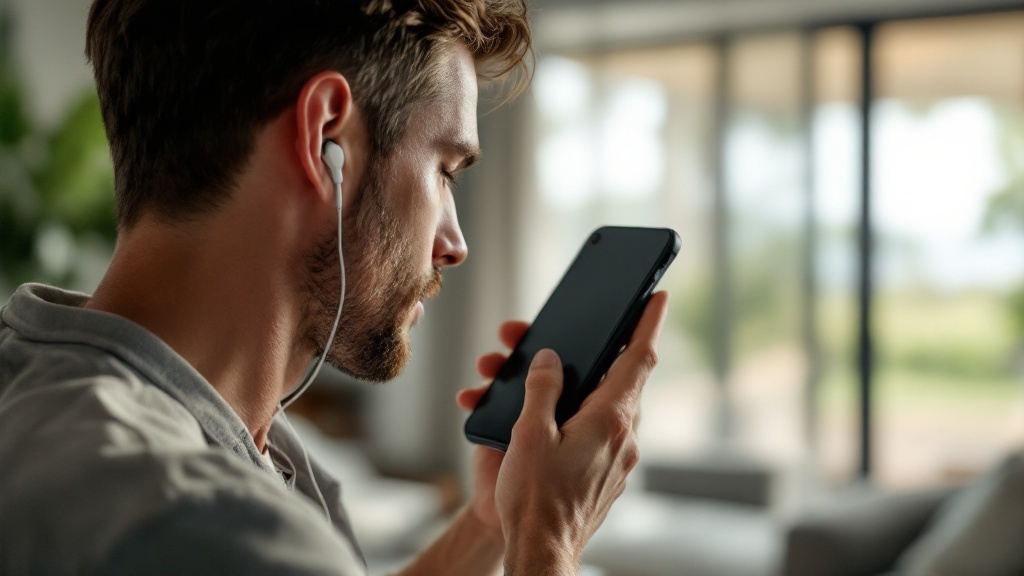
A “radiation-free” headset — more accurately called an air-tube headset — uses a hollow acoustic tube for the last 10-15 cm of the cable leading to each earpiece. Standard wired earbuds use a continuous wire all the way to the speaker driver in the ear canal. That wire can act as a secondary antenna, conducting RF energy from the phone directly into your ear canal and skull.
How It Works (Physics, Not Marketing)
An air-tube headset separates into two sections. The lower section (from the 3.5 mm jack to a midpoint transducer) carries the audio signal electrically through standard wire. At the transducer, electrical signal converts to acoustic (sound) vibration. The upper section — the hollow tube leading to each ear — carries only sound waves through air. No wire enters the ear canal. No RF conducts to the head.
The primary RF reduction comes from distance, not the tube itself. Moving the phone from 0 cm (against the skull) to 30-50 cm (at waist or chest level in a pocket while wearing the headset) reduces RF power density by the inverse square law. At 30 cm vs 0.5 cm from the head, you are looking at roughly a 3,600-fold reduction in RF power density at the head. The air tube then eliminates the residual wire-conducted RF that standard wired earbuds would still deliver.
What an Air-Tube Headset Does Well
- Massive reduction in RF to the head during calls: The combination of distance + no wire in the ear canal is the most effective single strategy for call-related RF reduction.
- Affordable: Quality air-tube headsets (DefenderShield, SYB, and others) range from $30 to $60 AUD. The DefenderShield branded air-tube headset sits at the premium end around $55-70 AUD.
- Compatible with any phone: 3.5 mm jack models work with older phones or via a Lightning/USB-C to 3.5 mm adapter.
- Zero learning curve: Plug in, put in ears, make call. No special orientation or carry habit required.
What an Air-Tube Headset Does Not Do
- Does not reduce body exposure from carrying the phone: Your pocket and hip still receive the same RF as without the headset. You have shifted exposure away from your head, not eliminated it from your body.
- Sound quality trade-off: Air tubes have lower fidelity than wired earbuds with direct speaker drivers. Bass response is weaker. This is adequate for calls and podcasts but noticeable for music.
- Durability: The air tube section is more fragile than standard wire. Kinking or crushing the tube degrades audio. Typical lifespan is 6-18 months with daily use.
- Requires a wired connection: If your phone lacks a headphone jack (most phones from 2018+), you need a dongle adapter, which adds bulk and a potential failure point.
Head-to-Head Comparison: DefenderShield Case vs Air-Tube Headset
This table compares the two products across the criteria that actually matter for RF exposure reduction in daily Australian use.
| Criterion | DefenderShield Phone Case | Air-Tube Headset | What This Means for You |
|---|---|---|---|
| RF reduction to head (during calls) | Partial — up to ~20 dB when flap is folded against head (manufacturer claim) | Very high — inverse square law distance reduction + zero wire-conducted RF | If call exposure is your primary concern, the headset wins decisively |
| RF reduction to body (while carrying) | Up to 99% on shielded side (FCC-lab tested, per manufacturer) | None — phone still in pocket transmitting normally | If you pocket-carry for hours, only the case helps |
| Price (AUD, shipped to Australia) | $80-130 depending on phone model | $30-70 (DefenderShield branded ~$55-70) | Headset is 40-60% cheaper upfront |
| Lifespan | 2-3 years (leather/synthetic wear, shielding material does not degrade) | 6-18 months (tube kinking, wire fatigue) | Case has lower long-term replacement cost |
| Ease of use | Must orient correctly — shielded side toward body. Requires closing the flap. | Plug in and use. No orientation required. | Headset has a lower error rate in daily use |
| Phone signal impact | Minimal — unshielded back allows normal tower communication | None — phone operates normally | Neither product should degrade call quality or data speeds |
| Bluetooth elimination | No — does not address Bluetooth headset/earbud RF | Yes — replaces Bluetooth earbuds entirely with wired + air-tube | If you currently use AirPods/Galaxy Buds, switching to air-tube eliminates 2.4 GHz Bluetooth in the ear canal |
| Verifiability (can you measure the difference?) | Yes — hold an RF meter on each side of the closed flap | Yes — measure RF at ear level with/without headset | Both claims are testable with a meter like the TriField TF2 or Safe and Sound Pro II |
EMF Measurement
You cannot reduce what you have not measured.
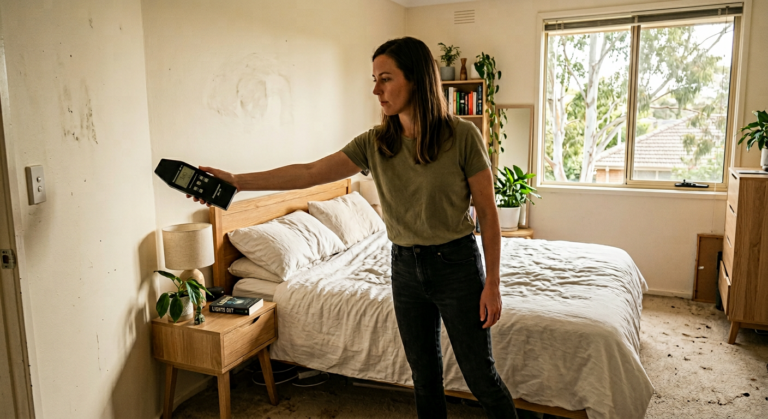
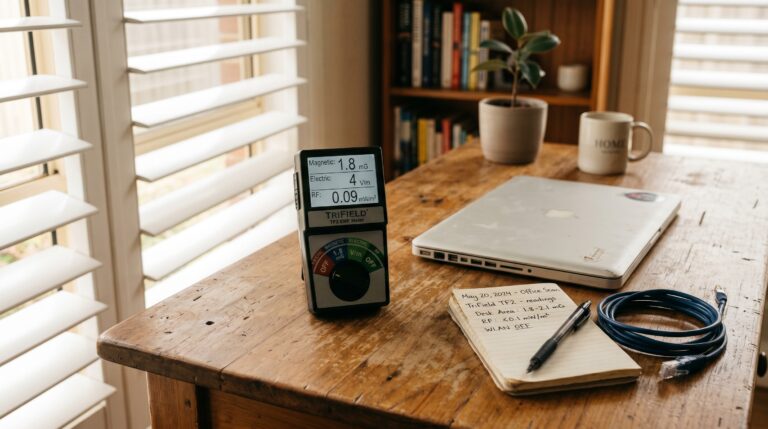
The TriField TF2 measures AC magnetic, AC electric, and RF/microwave fields in a single meter. It is what I use to audit rooms at the Palm Beach house.
See the TriField TF2 Review →The Physics That Settles This Debate: Inverse Square Law
RF power density drops with the square of the distance from the source. This is not a product claim. It is a fundamental law of electromagnetic radiation, and it is the reason ARPANSA, the WHO, and every competent RF engineer will tell you that distance is your first line of defence.
Here is what that looks like in practice for a phone transmitting at a SAR-relevant power level:
| Distance from Phone | Relative RF Power Density | Scenario |
|---|---|---|
| 0 cm (against skull) | Maximum (baseline) | Standard phone call, phone pressed to ear |
| 1 cm (thin case gap) | ~25% of contact level | Phone with case, held near head |
| 15 cm (speakerphone) | ~0.4% of contact level | Phone on desk, speakerphone mode |
| 30 cm (headset, phone in shirt pocket) | ~0.1% of contact level | Air-tube headset, phone at chest |
| 50 cm (headset, phone on desk) | ~0.04% of contact level | Air-tube headset, phone on desk or bag |
At 30 cm, you are receiving roughly one-thousandth of the RF power density compared to direct skull contact. No shielding material in a phone case can match that level of reduction while still allowing the phone to function. This is why, for call-related head exposure, an air-tube headset is the superior solution by a large margin.
The case, however, addresses a different geometry entirely: the phone sitting in your pocket, 0 cm from your thigh or hip, for hours between calls. In that scenario, you cannot create distance, so shielding the body-facing side is the practical alternative. Understanding which geometry applies to your daily pattern is the key to choosing correctly.
Who Should Buy the DefenderShield Phone Case
- ✓You pocket-carry your phone for 6+ hours daily. Tradies on building sites across Western Sydney, FIFO workers in the Pilbara, delivery drivers in Melbourne — anyone whose phone lives in a trouser or shirt pocket during work hours. The case puts a shielding layer between your phone and your body during those long-carry periods.
- ✓You want an everyday case anyway. If you need a wallet-style case with card slots, the DefenderShield doubles as functional daily protection. You are not adding another device to your routine — you are replacing your existing case.
- ✓You are buying for a child or teenager. Kids in Australian secondary schools often carry phones in blazer pockets or school bags pressed against their backs. A shielded case provides passive protection with zero compliance required from the child.
- ✓You take short calls held to the ear. If you make calls lasting under 2 minutes and don’t want to fiddle with a headset, the case with flap positioned between phone and skull offers partial reduction. Not as effective as a headset, but better than an unshielded case.
- ✓You already use a headset for calls and want to address carry exposure as the remaining gap. If you have the headset sorted, the case closes the other half of the equation.
Who Should Buy the Air-Tube Headset
- ✓You make phone calls totalling 30+ minutes per day. Real estate agents in Brisbane, consultants in Sydney, anyone in a role with frequent mobile calls. Your cumulative head exposure over weeks and months is the scenario where an air-tube headset makes the biggest measurable difference.
- ✓You currently use Bluetooth earbuds (AirPods, Galaxy Buds, etc.). Bluetooth Class 1 devices transmit at up to 100 mW directly inside your ear canal, both during calls and while streaming music or podcasts. Switching to a wired air-tube headset eliminates this entirely.
- ✓You are on a budget. If you can only justify one purchase, the headset addresses the highest-SAR scenario (phone against skull) at the lowest cost.
- ✓You want a measurable, verifiable reduction. Hold an RF meter like the TriField TF2 next to your ear during a call with the phone at your head, then again with the phone at waist level using the headset. The difference is dramatic and unambiguous. I have measured this myself at the Palm Beach house.
- ✓You are pregnant. Carrying a phone in a trouser pocket near the abdomen is a concern. An air-tube headset lets you keep the phone on a desk or in a bag during calls, creating meaningful distance from the abdomen as well as the head.
5-Year Cost Comparison
Running costs matter, especially when one product wears out faster than the other. Here is what each option costs over five years of daily use, based on Australian retail pricing in 2025-2026.
| Product | Upfront (AUD) | Annual Replacement (AUD) | 5-Year Total (AUD) |
|---|---|---|---|
| DefenderShield Phone Case | $100 | $50 (new case every 2 years + when upgrading phone) | $225-$300 |
| Air-Tube Headset (DefenderShield branded) | $60 | $50-60 (replacement every 12-18 months) | $240-$360 |
| Air-Tube Headset (budget brand, e.g., SYB) | $35 | $30-35 (replacement every 12 months) | $155-$210 |
| Both (Case + Budget Headset) | $135 | $80-95 | $380-$510 |
The 5-year cost of using both products together is less than the price of a single pair of AirPods Pro — which, by the way, are the very Bluetooth devices you should be replacing. The “both” option costs roughly $1.50-$2.00 per week. That is the cost of reducing your two primary RF exposure scenarios (carrying and calling) by meaningful, measurable margins.
The Shielding Trap: How Phone Cases Can Backfire
This is the section most comparison articles leave out, and it is the most important physics lesson in this entire piece.
A shielded phone case works correctly only when the shielding layer is between the phone and your body, with the unshielded side facing away from you (toward the cell tower). If you accidentally carry the phone with the shielded side facing outward — away from your body — you have done two things wrong simultaneously:
- The unshielded side now faces your body, providing zero attenuation where you need it most.
- The shielded side partially blocks the phone’s signal to the tower, causing the phone to increase its transmit power to maintain connection. Higher transmit power = more RF in all directions, including through the unshielded side into your body.
This is the same principle behind the canopy shielding trap I discuss in EMF bedroom articles. If the primary source is on the wrong side of the shield, you make things worse, not better. With a phone case, this means you must develop the habit of consistently orienting the case so the flap (shielding) faces your body.
An air-tube headset has no orientation problem. There is no wrong way to plug it in. This simplicity is a real advantage for anyone who does not want to think about EMF physics every time they pocket their phone.
Australian-Specific Considerations
5G Rollout and Frequency Bands
Telstra and Optus are aggressively rolling out 5G across Australian capital cities and regional centres. The sub-6 GHz band (3.6 GHz) is the primary mid-band deployment in Australia as of 2025-2026. Telstra’s mmWave (26 GHz) is limited to high-density locations like CBD areas in Sydney, Melbourne, and Brisbane.
DefenderShield’s shielding material is tested up to 10 GHz, which covers all current Australian 4G and sub-6 5G frequencies. It does not cover mmWave (26 GHz), but your phone’s mmWave antenna is only active in a handful of Australian locations and only when you have a mmWave-capable handset. For 99% of Australian usage, the case’s shielding range is adequate.
An air-tube headset is frequency-agnostic. Distance works regardless of whether the phone is transmitting at 700 MHz or 26 GHz. This is another structural advantage of the distance-based approach.
Regional and Rural Signal Conditions
If you live in areas with weaker mobile signal — outer suburbs of Perth, rural Queensland, remote parts of Tasmania — your phone transmits at higher power to reach the tower. This means higher RF exposure. In these conditions, both products become more valuable. The case provides more shielding benefit (because there is more RF to shield), and the headset creates more relative benefit (because the phone-to-head exposure is higher).
If you regularly travel between urban and regional areas — Brisbane to the Sunshine Coast, Sydney to the Blue Mountains, Melbourne to the Mornington Peninsula — your phone’s transmit power fluctuates significantly during the drive. A case with correct orientation provides passive protection during these transitions.
Heat Considerations
Australian summers push phone operating temperatures higher, particularly for tradies in direct sun across Darwin, Cairns, Townsville, and inland NSW/QLD. A wallet-style case adds thermal insulation, which can cause the phone to throttle its processor and cellular radio. Some users in hot conditions report their phone dropping to lower signal modes or overheating warnings more frequently with a thick wallet case. This is worth testing in your specific conditions before committing.
An air-tube headset adds zero thermal load to the phone. If you work outdoors in temperatures above 35°C regularly, this is another point in the headset’s favour.
Decision Tree: 3 Questions to Make Your Choice
Answer these three questions in order. They will give you a clear recommendation.
Question 1: Do you spend more total minutes per day on phone calls or carrying your phone in a pocket?
- More time on calls → Air-tube headset is your priority purchase.
- More time carrying → DefenderShield case is your priority purchase.
- Roughly equal → Proceed to Question 2.
Question 2: What is your budget right now?
- Under $70 AUD → Buy the air-tube headset first. It addresses the highest-SAR scenario (skull contact) at the lowest cost.
- $70-$140 AUD → Buy the DefenderShield case if carry time is your concern, or the headset + a USB-C adapter if calls are your concern.
- $140+ AUD → Buy both. Total cost for case + budget air-tube headset is approximately $135 AUD.
Question 3: Are you buying for yourself or for a child?
- For a child → Buy both. Children’s skulls are thinner (bone density is lower), and IEEE/WHO literature notes higher RF absorption per unit mass in paediatric head models. A child will not reliably use a headset for every call, so the case provides baseline protection during carry. The headset covers the calls they do make.
- For yourself → Follow Questions 1 and 2 above.
How to Verify the Claims Yourself
I do not ask you to trust manufacturer marketing. I ask you to measure. Here is the protocol I use at the Palm Beach house with the TriField TF2 (B078T2R64C on Amazon AU).
Testing a Shielded Phone Case
- Set the TriField TF2 to RF mode (mW/m² scale).
- Place your phone on a table. Initiate a call or enable a data-heavy activity (video streaming).
- Hold the TF2 sensor 1 cm from the phone’s back (unshielded side). Record the reading.
- Close the case flap. Hold the TF2 sensor 1 cm from the front of the closed flap (shielded side). Record the reading.
- Compare. A legitimate shielding case should show a reduction of 90%+ (roughly 10-20 dB) on the shielded side.
Testing an Air-Tube Headset vs Phone-to-Ear
- Set the TriField TF2 to RF mode.
- Hold the phone against your ear (or a mannequin head for consistency). Position the TF2 sensor at the opposite ear. Record the reading — this captures RF penetrating through the head.
- Now plug in the air-tube headset. Place the phone at waist level (30 cm from head). Position the TF2 at ear level. Record the reading.
- Compare. You should see a reduction of 95%+ in RF at the head position.
These are not laboratory protocols. They are practical, repeatable measurements any Australian can perform with a $500 meter. If a product’s claimed RF reduction does not show up on a calibrated meter, the product is not doing what it claims. Full stop.
What About Bluetooth “Low EMF” Headsets?
Some manufacturers sell Bluetooth headsets marketed as “low radiation” or “reduced EMF.” These are not the same as air-tube headsets, and the distinction matters.
A Bluetooth headset — even a “low power” Class 2 or Class 3 device — still transmits RF directly into your ear canal at 2.4 GHz. Class 2 Bluetooth transmits at up to 2.5 mW; Class 1 (used in many true wireless earbuds for range) transmits at up to 100 mW. The transmitter is literally inside your ear. Distance is zero. No amount of “low power” marketing changes the fact that you have a 2.4 GHz RF source at 0 cm from your tympanic membrane and temporal lobe.
An air-tube headset transmits zero RF at the ear. The comparison is not even close. If you are reading this article because you care about RF exposure to the head, Bluetooth earbuds are the wrong direction regardless of their power class.
Common Mistakes Australians Make with Both Products
Mistake 1: Using the case with the flap open during pocket carry
If the flap is flopping open, the shielding layer is not between the phone and your body. Many wallet-case users leave the flap open for quick screen access. This defeats the purpose entirely. If you catch yourself doing this, the case is not helping you.
Mistake 2: Using a headset but keeping the phone in a breast pocket
You have reduced head exposure brilliantly, but now the phone is transmitting against your chest at 0 cm. If you are concerned enough to buy an air-tube headset, extend that logic: keep the phone on a desk, in a bag, or at least in a hip pocket during calls. Every centimetre counts.
Mistake 3: Assuming the case works during wireless charging
Wireless charging requires the back of the phone to be exposed to the charging pad. The shielding layer in the front flap does nothing during wireless charging because the phone is typically lying flat on a surface, not pressed against your body. This is not a failure of the product — it is simply not the use case it was designed for.
Mistake 4: Replacing the air-tube headset with speakerphone and calling it solved
Speakerphone at 15-20 cm is better than phone-to-ear, but an air-tube headset at 30-50 cm is better still. Speakerphone also broadcasts your conversation to everyone around you — not ideal on a train from Parramatta to the CBD or in an open-plan office in South Brisbane.
Mistake 5: Buying either product without first measuring your actual exposure
You do not know your baseline RF exposure until you measure it. A TriField TF2 or Safe and Sound Pro II will show you exactly what your phone outputs during calls and idle, and let you verify that the product you bought actually reduces that number. Without measurement, you are guessing. The protocols above take 10 minutes.
Final Verdict
These two products are not competitors. They are complementary halves of a complete phone-RF reduction strategy.
If you are forced to choose one, buy the air-tube headset first. It addresses the highest-exposure scenario (phone pressed against skull during calls) with the most effective mechanism (distance), at the lowest cost ($35-60 AUD). You can verify its effectiveness with a $500 RF meter in under 5 minutes.
If you can afford both, buy both. The DefenderShield case handles the long hours of passive pocket carry that the headset cannot address. Together, they cover the two primary phone-RF exposure geometries — carry and call — for under $140 AUD total.
Neither product replaces the foundational habits that cost nothing: using speakerphone when possible, keeping the phone off your body when you can, and switching to airplane mode during sleep. Products supplement good practice. They do not replace it.
If you have not measured your home’s RF environment yet, start there. You cannot optimise what you have not quantified.
Start with a measurement, not a purchase.
Our measurement guide covers the room-by-room protocol used at the Palm Beach house.
EMF Measurement Guide →Frequently Asked Questions
Does the DefenderShield phone case block all radiation from my phone?
No. The case shields one side only — the side with the integrated shielding layer (the front flap). The back of the case is deliberately unshielded so the phone can communicate with cell towers. DefenderShield’s FCC-lab testing claims up to 99% RF reduction on the shielded side across frequencies from 0 to 10 GHz. RF still radiates from the unshielded side. If the phone were fully enclosed, it would lose signal and increase transmit power — making exposure worse.
Can an air-tube headset reduce RF exposure as effectively as not using a phone?
No. The phone still transmits RF, and your body still absorbs some of it depending on proximity. However, an air-tube headset with the phone at 30-50 cm from the head reduces RF power density at the skull by roughly 99.9% compared to phone-to-ear contact, based on inverse square law calculations. It is the closest you can get to head-level RF elimination while still using the phone for calls.
Do I need both a DefenderShield case and an air-tube headset?
It depends on your usage pattern. If you both make frequent calls and carry the phone in a pocket for hours daily, yes — each product addresses a different exposure scenario. If you primarily make calls and rarely pocket-carry (phone stays on a desk), the headset alone covers your primary concern. The decision tree earlier in this article will help you determine your priority.
Will a DefenderShield case weaken my phone signal or drain the battery?
When used correctly (shielded flap facing your body, unshielded back facing outward toward the cell tower), the case should not meaningfully degrade signal strength. The phone’s antenna radiates primarily from the back and edges. However, if the case is incorrectly oriented — shielded side facing the tower — the phone may increase transmit power to compensate, which drains the battery faster and increases RF output in all directions.
Are air-tube headsets compatible with iPhones that lack a headphone jack?
Yes, but you need a Lightning-to-3.5 mm or USB-C-to-3.5 mm adapter (depending on your iPhone model). iPhone 15 and newer use USB-C; iPhone 7 through 14 use Lightning. Apple and third-party adapters cost $10-25 AUD. The adapter adds a small amount of bulk but does not affect the air-tube’s RF reduction benefits.
Is there an Australian standard for phone case EMF shielding?
There is no specific Australian or AS/NZS standard for EMF shielding phone cases. ARPANSA sets RF exposure limits for humans (based on ICNIRP guidelines) but does not certify or regulate shielding products. DefenderShield’s testing is conducted in US FCC-accredited labs. You can verify claims yourself with an RF meter — the measurement protocol is outlined in this article.
How do air-tube headsets compare to regular wired earbuds for RF reduction?
Both wired earbuds and air-tube headsets create distance between the phone and your head, which is the primary benefit. The key difference: standard wired earbuds use a continuous metal wire that can act as a secondary antenna, conducting some RF energy from the phone directly into the ear canal. Air-tube headsets replace the final 10-15 cm of wire with a hollow tube carrying only sound waves. This eliminates wire-conducted RF at the ear. The improvement over standard wired earbuds is modest in absolute terms (the distance benefit is the big win), but the air tube removes the residual concern.
Can I measure the difference myself without expensive lab equipment?
This article contains affiliate links. We may earn a commission at no extra cost to you.
Yes. A TriField TF2 meter (available on Amazon AU) costs approximately $500 AUD and measures RF in mW/m². It is not a calibrated lab instrument, but it is accurate enough to show the relative difference between shielded/unshielded sides of a case, and between phone-to-ear vs headset-at-distance scenarios. I use this exact meter for all measurements at the Palm Beach house, including the router readings (3.058 mW/m² pre-canopy, 0.032 mW/m² post-canopy) cited across this site. Ten minutes with a TF2 will tell you more than any product’s marketing page.
Do DefenderShield products ship to Australia, and what is the warranty?
DefenderShield ships internationally from the US. Shipping to Australian addresses typically takes 10-20 business days. Customs duty may apply for orders over AUD $1,000 (unlikely for a single case and headset). DefenderShield offers a 1-year warranty on manufacturing defects. Note that return shipping to the US for warranty claims is at your expense, which is a practical consideration for Australian buyers. Some products are also available through Amazon AU with faster domestic shipping where stocked.
The Evidence-Based RF Protection Stack
For most Australians: buy the air-tube headset first ($35-60 AUD). It addresses the highest-exposure scenario with the most effective mechanism — distance. Add the phone case for passive carry coverage.
Get the Australian Home Environment Checklist
30 checks across water, air and EMF. Most of them free. Ranked by impact.
No spam. Unsubscribe any time.
Former Royal Australian Navy Clearance Diver and TAG-E counter-terrorism operator. Founded Clean and Native to apply the same rigorous thinking to the home environment.
Full biography →