Best Air Purifier for Perth (2026): Dust, Pollen and Smoke Season
Drafted with AI assistance and checked against published specifications and certifications. First-hand measurements appear only where stated. How we make content
Quick Verdict
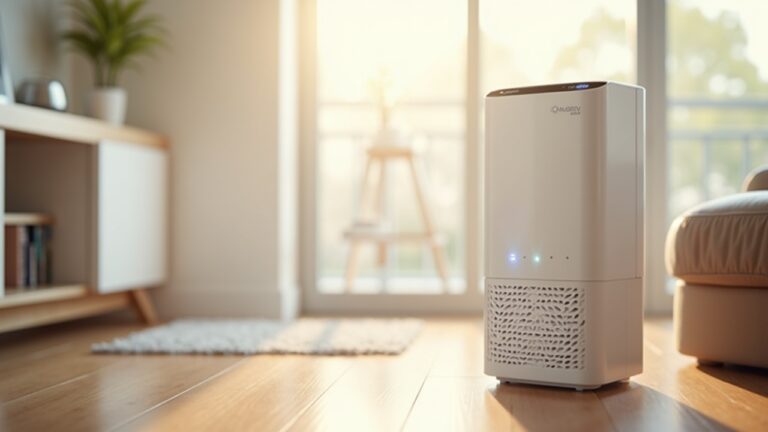
| OUR PICK | The Blueair Blue Max 3350i is the best air purifier for most Perth homes in 2026. It delivers a CADR of 350 m³/h for dust, handles rooms up to 36 m² with 4.8 air changes per hour, and its HEPASilent technology keeps noise at 24 dB on low — critical when you are running it 10 hours a night through grass pollen season. |
| RATING | ★★★★½ (4.5 / 5) |
| RUNNER-UP | For larger open-plan living areas (50-70 m²), the Coway Airmega 250 offers 468 m³/h CADR and dual-filter design for under $700. For budget-conscious buyers, the Levoit Core 400S remains the best value at approximately $300. |
Why Perth Needs a Different Air Purifier Strategy
I grew up in Queensland and served on the west coast enough times to know Perth’s air is a different beast to anything on the eastern seaboard. Most “best air purifier Australia” guides are written from Sydney or Melbourne and miss three facts that fundamentally change what Perth residents need:
The three products we own are measured first-hand by Jayce Love, former Royal Australian Navy Clearance Diver; every other product is assessed on published manufacturer specifications and independent certification using our documented methodology — no gifted units, no brand payments.
1. Perth’s Dust Load Is Extreme by Australian Capital City Standards
Perth sits on the Swan Coastal Plain — sandy soils, minimal topsoil binding, and prevailing easterly winds that drag red dust from the Wheatbelt and beyond straight into the metro area. The Bureau of Meteorology records Perth averaging 15-25 dusty days per year, compared to Sydney’s 2-5. This is not a “close your windows” problem. PM10 readings during easterly events regularly exceed 50 µg/m³, which is the NEPM (National Environment Protection Measure) advisory standard for 24-hour exposure. During the 2024 dust event that blanketed the northern suburbs, monitoring stations at Caversham recorded PM10 above 150 µg/m³ for several hours.
What this means for filtration: you need a high CADR for particulate matter, and you need pre-filters that can handle coarse dust loading without destroying the HEPA filter within weeks.
2. Perth’s Pollen Season Is Longer and More Intense
Western Australia’s grass pollen season runs from October through February, peaking in November and December. The Australasian Society of Clinical Immunology and Allergy (ASCIA) classifies Perth as one of Australia’s highest-risk capitals for grass pollen-induced allergic rhinitis and thunderstorm asthma. In November 2016, Perth experienced a thunderstorm asthma event that sent hundreds to emergency departments. Unlike Melbourne’s concentrated April-November ryegrass season, Perth contends with a broader mix of Bermuda grass, Veldt grass, and native species.
Pollen particles range from 10-100 µm — well within the capture range of any true HEPA filter. The real issue is volume. Perth’s dry climate means pollen stays airborne longer and infiltrates homes more readily than in humid east-coast cities.
3. Bushfire Smoke Intrusion Is Increasing
DFES (Department of Fire and Emergency Services) data shows the number of bushfire-related smoke advisories for the Perth metro area has increased roughly 40% over the 2015-2025 decade. The Perth Hills, Gnangara pine plantation, and Darling Scarp bushland are all within 30 km of the CBD. Smoke particles (PM2.5) are the dangerous fraction — typically 0.1-2.5 µm — and they infiltrate homes through every gap, vent, and return air duct.
During the Wooroloo fire in February 2021, PM2.5 readings in Midland exceeded 200 µg/m³ — eight times the NEPM 24-hour standard of 25 µg/m³. You cannot outrun this with a cheap filter running on low.
Perth’s Unique Air Quality Challenges: What Every Resident Needs to Know
Perth’s Mediterranean climate and industrial geography create distinct air quality patterns that demand specific air purifier strategies. As a former Navy clearance diver who’s worked extensively in Perth’s waters, I’ve witnessed firsthand how the city’s unique position between ocean and range creates challenging air quality conditions that many residents don’t fully understand.
Understanding Perth’s Air Quality Monitoring Network
The Department of Water and Environmental Regulation (DWER) operates five critical monitoring stations across Perth: Subiaco, Caversham, Rockingham, Kwinana, and Bayswater. These stations reveal stark differences in air quality across the metropolitan area, with readings varying dramatically between coastal and inland suburbs, and particularly around the Kwinana Industrial Area.
⚠️ Kwinana Industrial Area Alert
Residents in Rockingham, Baldivis, and Kwinana face significantly elevated air pollution year-round. The Kwinana Industrial Area represents one of Australia’s most concentrated industrial zones, with consistent PM2.5 and SO₂ levels above metropolitan averages. If you live in these areas, industrial-grade air purification isn’t luxury—it’s necessity.
Perth’s Seasonal Air Quality Calendar
Perth’s air quality challenges follow predictable seasonal patterns that should guide your air purifier usage:
- August-November: Peak pollen season with ryegrass (October-November) delivering Australia’s worst grass pollen severity, preceded by wattle (August-September) and birch (September-October)
- December-March: Wildfire season when Darling Range fires combine with easterly winds to push smoke westward into suburbs
- Hot summer days: High ozone levels and Swan Coastal Plain dust, particularly affecting northern suburbs
- Winter months: Increased mould spores and dampness-related indoor air quality issues
The Fremantle Doctor Effect: Why Location Matters
Perth’s famous afternoon sea breeze, the Fremantle Doctor, creates a two-tier air quality system. Coastal suburbs benefit from this natural air clearing, while inland areas like Midland, Armadale, and Ellenbrook experience higher daytime PM10 concentrations. Understanding your suburb’s position relative to this daily wind pattern is crucial for air purifier sizing and operation timing.
Perth Suburb Air Quality Tiers
| Air Quality Tier | Suburbs | Primary Challenges | Air Purifier Priority |
|---|---|---|---|
| Excellent | Subiaco, Cottesloe, Claremont | Seasonal pollen, occasional smoke | Standard HEPA sufficient |
| Moderate | Perth CBD, Fremantle, Joondalup | Urban pollution, pollen, traffic | HEPA + activated carbon |
| Challenging | Ellenbrook, Bullsbrook, Midland | Rural dust, limited sea breeze | High-CADR HEPA essential |
| High Risk | Armadale, Mundijong | Bushfire interface, smoke exposure | Commercial-grade recommended |
| Industrial | Kwinana, Rockingham, Baldivis | Industrial emissions, PM2.5, SO₂ | Multiple units, size up significantly |
Perth-Specific CADR Recommendations
Given Perth’s extended smoke seasons and unique dust conditions, I recommend sizing up from standard calculations. Aim for 5 air changes per hour (ACH) rather than the typical 4 ACH recommendation. This accounts for the alkaline Swan Coastal Plain dust particles and extended periods when windows must remain closed during smoke events or extreme pollen days.
Our Top Air Purifier Picks
True H13 HEPA with activated carbon is the only technology that removes particles AND gases from your indoor air. For bushfire smoke, pollen, and VOCs — HEPA is non-negotiable.
What to Look for in a Perth Air Purifier: The Non-Negotiable Specs
Before I run through specific models, here is the decision framework I use. These are not preferences — they are engineering requirements dictated by Perth’s conditions.
| Specification | Minimum for Perth | Why |
|---|---|---|
| CADR (dust) | 250 m³/h | Achieves 5 ACH (air changes per hour) in a 25 m² room with 2.4 m ceilings. Perth’s dust load demands higher turnover than eastern capitals. |
| CADR (smoke) | 200 m³/h | Smoke CADR is always lower than dust CADR for the same unit. Bushfire PM2.5 events can spike rapidly — you need headroom. |
| Filter grade | True HEPA H13 (EN 1822) | Captures ≥99.95% of particles at 0.3 µm (MPPS). “HEPA-type” or “HEPA-style” filters do not meet this standard. |
| Pre-filter | Washable, separate from HEPA | Perth’s coarse dust will destroy a HEPA filter in 3-4 months without adequate pre-filtration. A washable pre-filter extends HEPA life to 12+ months. |
| Activated carbon | ≥500 g pelletised carbon | Adsorbs VOCs and smoke odour. Thin carbon-impregnated meshes (50-100 g) saturate within days during a smoke event. |
| Noise (sleep mode) | ≤30 dB | WHO recommends ≤30 dB for uninterrupted sleep. Perth’s warm nights mean many people run purifiers instead of opening windows. |
| Coverage area | Match your room + 20% buffer | Manufacturer “room size” ratings assume 2 ACH. Perth needs 4-5 ACH during events. Downsize the claimed coverage by 30-40%. |
| No ozone emission | Confirmed <0.005 ppm | Ionisers and plasma generators can produce ozone. The CARB (California Air Resources Board) standard is the global benchmark — look for CARB certification or independent ozone testing. |
A Note on Room Sizing for Perth
Manufacturers calculate room coverage using 2 air changes per hour (ACH). That is fine for baseline air quality maintenance in a city like Hobart. In Perth, during a dust or smoke event, you want 4-5 ACH to bring PM2.5 down to safe levels within 15-20 minutes of closing windows. The formula is simple:
Example: A purifier with 350 m³/h CADR in a room with 2.4 m ceilings at 5 ACH = 350 ÷ (2.4 × 5) = 29 m²
That same purifier might be marketed for “up to 60 m²” — based on 2 ACH. Do your own calculation.
The 5 Best Air Purifiers for Perth in 2026
1. Blueair Blue Max 3350i — Best Overall for Perth Bedrooms and Living Rooms
The Blue Max 3350i is Blueair’s current mid-range workhorse. It uses HEPASilent technology, which combines electrostatic charge with mechanical HEPA filtration. The advantage is higher airflow at lower fan speeds, which translates directly to lower noise for a given CADR. The 350 m³/h dust CADR handles rooms up to 29 m² at 5 ACH — that covers most Perth master bedrooms and medium living areas.
Filter system: The combination filter integrates a polypropylene pre-filter mesh, H13 HEPA media, and an activated carbon layer. The pre-filter is not separately washable on this model — the entire filter is a single cartridge. Blueair rates replacement at 6 months, but in Perth’s dusty conditions I would budget for replacement every 4-5 months during spring/summer if you are running it daily.
Noise: 24 dB on the lowest speed. That is quieter than a whisper (30 dB); at that rated level it is effectively inaudible from more than a metre away.
Smart features: Built-in PM2.5 sensor, Wi-Fi connectivity, and Blueair app integration. Blueair specifies that the auto mode adjusts fan speed in real time based on readings from the built-in particle sensor.
Limitations: The integrated filter design means you cannot wash the pre-filter separately. In Perth, this will increase your annual filter cost compared to units with a separate washable pre-filter. The carbon layer is also relatively thin — adequate for daily VOCs and cooking odours, but during an extended bushfire smoke event, the odour adsorption capacity will deplete before the HEPA media is spent.
2. Coway Airmega 250 — Best for Large Open-Plan Perth Homes
Perth’s building stock skews toward open-plan living/kitchen/dining areas of 40-70 m². The Airmega 250 handles this with a 468 m³/h CADR and dual-sided air intake. At 5 ACH, effective coverage is 39 m² — enough for most open-plan areas, and if your space is larger, running it on high during an event will still achieve 3-4 ACH across 50+ m².
Filter system: Dual Max2 Green True HEPA filters (H13 grade) combined with activated carbon deodorisation filters. The carbon quantity is substantially more than the Blueair — Coway uses pelletised activated carbon in a dedicated cartridge, not a thin integrated layer. This is the unit I would recommend for anyone in the Perth Hills or eastern suburbs who faces direct bushfire smoke exposure.
Pre-filter: Washable, separate from the HEPA/carbon filters. You can vacuum or rinse it fortnightly without touching the main filters. In Perth conditions, this alone extends main filter life by 40-60%.
Noise: 31 dB on low. Marginally louder than the Blueair, but still within WHO sleep recommendations. On high speed it reaches 52 dB — noticeable but not disruptive in an open living area.
Smart features: Real-time air quality indicator (4-stage colour ring), auto mode, and timer. No Wi-Fi on the base model — if you want app control, you need the Airmega 250S variant which is harder to source in Australia.
Limitations: Larger footprint than the Blueair (36 × 36 × 56 cm). Replacement filters are more expensive because you are buying two HEPA and two carbon cartridges per cycle. The unit is also heavier at 11.5 kg, though it has rear handles.
3. Levoit Core 400S — Best Value for Perth
The Core 400S consistently delivers the best performance-per-dollar in the Australian market. At approximately $300 AUD, it offers a 300 m³/h CADR and H13 HEPA filtration. Effective coverage at 5 ACH is 25 m² — a standard Perth bedroom.
Filter system: 3-stage filtration with a fine nylon pre-filter (not separately washable — it is bonded to the HEPA), H13 HEPA media, and a high-efficiency activated carbon layer. Levoit uses a honeycomb structure for the carbon that provides more surface area than flat carbon mesh, but less total carbon mass than the Coway’s pelletised design.
Smart features: This is where the Core 400S punches above its price. Full Wi-Fi connectivity, VeSync app integration, Alexa/Google Home compatibility, and a laser PM2.5 sensor. The auto mode is responsive, and you can schedule on/off times through the app — useful for having it ramp up before you get home on a dusty day.
Noise: 24 dB on sleep mode. Identical to the Blueair and equally inaudible in practice.
Limitations: The 300 m³/h CADR leaves less headroom than the Blueair or Coway during severe events. In a 25 m² room during a bushfire smoke intrusion, you are running it on high (which climbs to 52 dB) to maintain adequate ACH. The carbon layer will also saturate faster than the Coway during extended smoke events. This is a solid daily-driver, but for serious smoke events, the Blueair or Coway is the better investment.
4. IQAir HealthPro 250 — Best Medical-Grade for Severe Allergies and Asthma
If you have a diagnosed respiratory condition and your allergist or pulmonologist has recommended a medical-grade air purifier, the IQAir HealthPro 250 is the unit. It is not cheap — approximately $1,800-$2,200 AUD — but it filters to a standard that nothing else on this list can match.
Filter system: 3-stage with a PreMax pre-filter (2.5 kg of filtration media), a V5-Cell gas and odour filter (2.5 kg of pelletised activated carbon and alumina), and the HyperHEPA final filter. The HyperHEPA is tested and certified to filter 99.97% of particles down to 0.003 µm — that is an order of magnitude smaller than standard H13 HEPA’s 0.3 µm MPPS rating. Independent testing by the Guangzhou Institute of Respiratory Health confirmed these figures.
Pre-filter: The PreMax is a dedicated, replaceable pre-filter designed for high dust loads. IQAir rates it at 18 months in standard conditions. In Perth, I would budget for 12 months. At approximately $120 AUD per PreMax filter, it is not cheap, but it protects the $300+ HyperHEPA downstream.
CADR: IQAir does not publish standard CADR numbers (they argue the AHAM CADR test does not capture ultrafine particle removal). Their rated airflow is 250 m³/h clean air delivery at the highest speed, verified by third-party testing. Effective for rooms up to 21 m² at 5 ACH.
Noise: 25 dB on speed 1. On speed 6, it reaches 59 dB — significantly louder than competitors on high. The trade-off is justified if you are filtering for a medical need.
Limitations: Price. The unit is $1,800+ and annual filter costs run $400-$500 AUD. It is also large (40 × 43 × 71 cm) and heavy (16 kg). No smart features — no app, no Wi-Fi, no auto mode. Manual speed control only. This is a precision instrument, not a lifestyle product.
5. Winix Zero+ Pro — Best for Combined Dust, Pollen, and Pet Households
Perth has some of the highest pet ownership rates in Australia. If you are dealing with dust, pollen, and pet dander/hair, the Winix Zero+ Pro is purpose-built for that combination. Its 5-stage filtration includes a dedicated washable pre-filter that captures pet hair before it reaches the HEPA, a medium-density pre-filter for larger dust particles, True HEPA H13 media, and an activated carbon filter with enhanced formaldehyde removal.
CADR: 390 m³/h (dust). Effective for 32 m² at 5 ACH — covers most Perth living rooms.
PlasmaWave: Winix’s PlasmaWave technology generates hydroxyls to break down VOCs, allergens, and odours at the molecular level. Critically, it has been independently tested and confirmed to produce zero harmful ozone (certified by CARB). You can also disable it via a button if you prefer pure mechanical filtration only.
Pre-filter: Washable and separate. This is the key advantage for Perth’s dusty, pet-heavy households. You can vacuum the pre-filter weekly and rinse it monthly, which dramatically extends HEPA filter life.
Noise: 27 dB on sleep mode. 53 dB on high.
Limitations: The activated carbon mass is moderate — better than the Levoit but less than the Coway. For bushfire smoke odour removal during extended events, it will not match the Coway or IQAir. Replacement filters are around $140 AUD per set (HEPA + carbon), replaced annually in standard conditions.
5-Year Cost Comparison
Running costs matter more than purchase price over the life of an air purifier. Here is the full picture assuming Perth conditions (more frequent filter replacement due to dust load).
| Model | Upfront Price (AUD) | Annual Filter Cost (AUD) | Annual Energy Cost* | 5-Year Total (AUD) |
|---|---|---|---|---|
| Blueair Blue Max 3350i | $549 | $180 (2-3 filters/yr) | $42 | $1,659 |
| Coway Airmega 250 | $699 | $220 (HEPA + carbon sets) | $55 | $2,074 |
| Levoit Core 400S | $299 | $100 (2 filters/yr) | $35 | $974 |
| IQAir HealthPro 250 | $1,999 | $450 (3-filter set) | $65 | $4,574 |
| Winix Zero+ Pro | $499 | $140 | $45 | $1,424 |
*Energy cost based on Synergy A1 tariff (33.3 c/kWh as of January 2026), running 12 hours/day on medium speed (average wattage per unit). Perth electricity is among the cheapest in Australia, which keeps running costs manageable.
Decision Tree: Which Perth Air Purifier Is Right for You?
Answer 3 questions:
1. What is your primary room size?
- Under 25 m² (bedroom) → Levoit Core 400S or Blueair Blue Max 3350i
- 25-40 m² (living room) → Blueair Blue Max 3350i or Winix Zero+ Pro
- 40-70 m² (open plan) → Coway Airmega 250
2. Do you have a diagnosed respiratory condition?
- Yes → IQAir HealthPro 250 (medical-grade HyperHEPA)
- No → Proceed to question 3
3. What is your primary concern?
- Dust and pollen (daily) → Blueair Blue Max 3350i (best noise-to-performance ratio)
- Bushfire smoke (seasonal) → Coway Airmega 250 (best carbon capacity)
- Pets + dust + pollen → Winix Zero+ Pro (washable pre-filter, 5-stage)
- Budget-first → Levoit Core 400S (best value, still H13 HEPA)
Perth’s Air Quality Calendar: When to Run Your Purifier
Running an air purifier 24/7 is wasteful and unnecessary. Here is how Perth’s air quality threats map across the year, so you can optimise usage:
| Month | Primary Threat | Typical PM2.5 Range | Recommended Usage |
|---|---|---|---|
| Jan-Feb | Bushfire smoke, late pollen | 10-80+ µg/m³ (event-dependent) | High — run continuously on event days |
| Mar-Apr | Dust (dry soil, reduced rainfall) | 8-30 µg/m³ | Moderate — run during easterly wind days |
| May-Jul | Minimal (wet season suppresses dust/pollen) | 3-10 µg/m³ | Low — overnight bedroom use only if allergic |
| Aug-Sep | Early pollen (wattle, early grasses) | 5-15 µg/m³ | Moderate — ramp up for pollen-sensitive individuals |
| Oct-Dec | Peak grass pollen, increasing dust, early fire season | 8-50+ µg/m³ | High — this is peak season. Run nightly at minimum. |
Check real-time Perth air quality data at the Department of Water and Environmental Regulation’s air quality monitoring page. Their Caversham, Duncraig, South Lake, and Quinns Rocks stations provide hourly PM2.5 and PM10 readings.
Placement Tips for Perth Homes
Where you put the purifier matters as much as which one you buy. Perth homes have specific characteristics that affect placement:
- Single-storey brick veneer (most common Perth housing stock): Place the purifier in the bedroom hallway or master bedroom. Brick veneer with aluminium windows has moderate air tightness — dust and pollen infiltrate primarily through windows, doors, and evaporative cooling ducts. If you have evaporative cooling, be aware it draws in unfiltered outdoor air. Running an air purifier while the evaporative cooler is on is fighting a losing battle. Switch to recirculating air conditioning during high-pollution events.
- Open-plan living: Place the purifier centrally, not in a corner. Aim for at least 30 cm clearance on all sides of the intake. The Coway Airmega 250, with its dual-sided intake, is ideal for central placement.
- Keep doors closed during events: An air purifier sized for a 25 m² bedroom cannot effectively clean a 100 m² house with all doors open. Close the bedroom door at night and let it clean that room.
- Elevation: For dust (heavier particles), floor placement is fine. For smoke (fine PM2.5 that distributes evenly), elevating the unit to tabletop height (60-80 cm) can improve room circulation.
What About Ionisers and UV-C Purifiers?
I get asked about these regularly. Here is the direct answer:
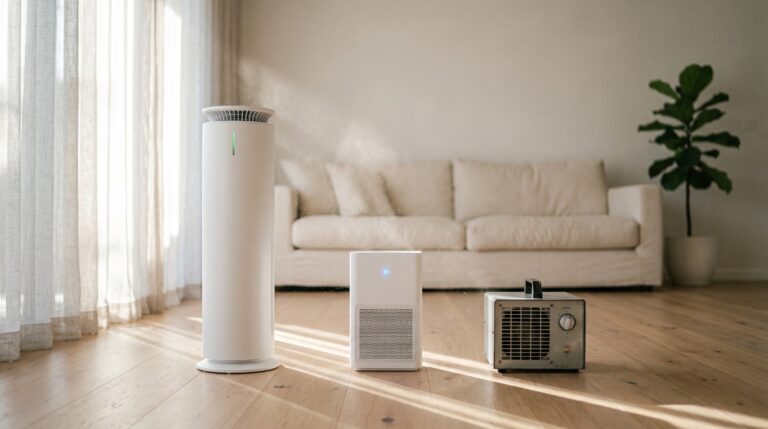
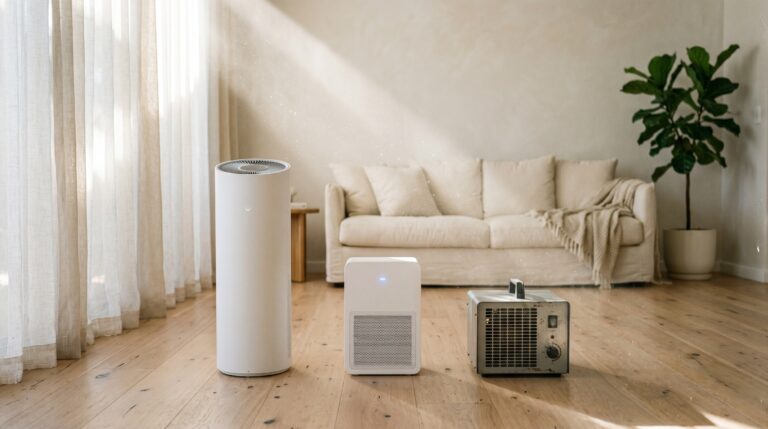
Ionisers (standalone, not built into HEPA units) charge particles and deposit them on surfaces. They do not remove particles from the air — they move them to your walls, furniture, and lungs. Some produce ozone as a byproduct. The CSIRO and multiple Australian university studies have concluded that standalone ionisers are less effective than mechanical HEPA filtration for PM2.5 removal. If a unit combines ionisation with HEPA (like the Winix PlasmaWave), that is fine — the HEPA does the work, the ionisation is supplementary.
UV-C purifiers target bacteria and viruses, not particulate matter. Perth’s air quality problems are particulate (dust, pollen, smoke), not microbial. UV-C does nothing for PM2.5 or PM10. If you want germicidal protection for a specific medical reason, that is a separate device for a separate purpose — it does not replace a HEPA purifier for Perth conditions.
Photocatalytic oxidation (PCO) and plasma generators: Insufficient evidence for residential effectiveness. Some produce formaldehyde and other secondary pollutants. I do not recommend them.
Complementary Measures: Don’t Rely on a Purifier Alone
An air purifier is one layer of defence. For Perth conditions, combine it with:
- Sealing gaps around windows and doors: A $15 roll of foam weather strip from Bunnings reduces dust infiltration by 30-50%. Focus on bedroom windows first.
- Switching from evaporative to reverse-cycle AC during events: Evaporative coolers pull outdoor air directly into your home. During smoke or dust events, this is counterproductive.
- Upgrading your ducted AC filter: If you have ducted reverse-cycle, upgrade from the standard G2/G3 washable filter to a MERV 13 pleated filter (check compatibility with your system — restricting airflow can damage the compressor). This filters incoming air before it enters your rooms.
- Monitoring AQI: Download the AirRater app (developed by the University of Tasmania, used nationally) for personalised pollen and air quality alerts for your Perth suburb.
- Vacuuming with a HEPA-filtered vacuum: Perth’s sandy dust settles on carpets and soft furnishings. A standard vacuum recirculates fine particles. A HEPA-filtered vacuum (e.g., Dyson V15 or Miele Cat & Dog) captures PM2.5 during cleaning.
Perth Water Note: Air and Water Work Together
Since you are here, I will mention what most air quality guides ignore: Perth’s metropolitan water supply uses free chlorine for disinfection (chloramine is used only in WA’s Goldfields & Agricultural Water Supply Scheme, not Perth metro — per WA Department of Health). If you are addressing indoor environmental quality, your air and your water are the two biggest exposure vectors. A HEPA purifier handles the air side. For water, Perth residents benefit most from reverse osmosis — standard activated carbon removes the free chlorine disinfectant effectively, but RO is recommended for fluoride (0.9 mg/L target), high TDS (~406 mg/L average), and hardness (up to 228 mg/L in Gnangara-fed northern suburbs).
Perth water filtration guide
Clean Air + Clean Water
Filtering your air is half the equation.
Perth’s free-chlorine-treated water is well handled by activated carbon for taste and odour, while reverse osmosis is recommended for fluoride, TDS and hardness. Our guide covers the top-rated options for Perth homes, assessed and ranked for local water chemistry.
Final Verdict
Perth’s triple threat of mineral dust, grass pollen, and bushfire smoke makes a true HEPA air purifier a baseline necessity for anyone with respiratory sensitivity — and a smart investment for everyone else. The gap between Perth’s air quality and Melbourne’s or Hobart’s is measurable and significant.
For most Perth households, the Blueair Blue Max 3350i is the right balance of CADR, noise, and cost. It handles the daily dust and pollen load, responds automatically to spikes, and runs silently overnight. If you have a large open-plan home or live in the Perth Hills fire zone, step up to the Coway Airmega 250 for its superior carbon capacity and dual-filter design. If budget is the priority and your room is under 25 m², the Levoit Core 400S delivers H13 HEPA performance for under $300.
Do not overcomplicate this. Buy a correctly sized HEPA unit, place it properly, close your doors during events, and replace your filters on schedule. That single action will reduce your indoor PM2.5 exposure by 50-80% during the worst days of the year.
Ready to filter your water?
We have ranked the best countertop and under-sink RO systems available in Australia — including options for renters who cannot modify their plumbing.
Frequently Asked Questions
Do I need an air purifier in Perth if I have ducted air conditioning?
Yes. Standard ducted AC systems use G2-G3 grade filters that capture less than 20% of particles under 10 µm. They do not filter PM2.5 (smoke) effectively. A HEPA air purifier in the bedroom provides targeted filtration where you spend 7-9 hours breathing. You can upgrade your ducted system’s filter to MERV 13 for whole-house improvement, but confirm with your HVAC technician that your system can handle the increased airflow resistance first.
What CADR do I need for a typical Perth bedroom?
A standard Perth master bedroom is 16-20 m² with 2.4 m ceilings. To achieve 5 air changes per hour (recommended during dust or smoke events), you need a CADR of at least 192-240 m³/h. Any unit on this list exceeds that threshold. For a 25 m² living area, target 300 m³/h minimum.
Can an air purifier help with Perth’s thunderstorm asthma risk?
During a thunderstorm asthma event, grass pollen grains rupture into sub-pollen particles (0.5-2.5 µm) that penetrate deep into the lungs. A true H13 HEPA filter captures 99.95% of these particles. The key is to close windows and doors before or during the storm and have the purifier running on high. Auto-mode units with PM2.5 sensors will detect the spike and ramp up automatically, but only if they are already running when conditions deteriorate.
How often should I replace HEPA filters in Perth compared to other cities?
Perth’s dust load means filters clog 30-50% faster than manufacturer estimates, which are typically based on moderate-pollution environments. A filter rated for 12 months will likely need replacement at 8-10 months in Perth if you are running the unit daily during spring and summer. Units with washable pre-filters (Coway, Winix) extend HEPA life significantly because coarse dust is captured before reaching the HEPA media.
Are Dyson air purifiers good for Perth conditions?
Dyson Pure Cool and Purifier models use H13 HEPA filters and have decent smart features. However, they have comparatively low CADR for their price point. The Dyson TP07, for example, delivers approximately 150-200 m³/h CADR at a price comparable to the Coway Airmega 250, which delivers 468 m³/h. For Perth’s dust load, CADR per dollar matters. Dyson units work fine for small bedrooms but are outperformed by the options on this list for larger spaces and severe events.
Does opening windows at night reduce indoor air quality in Perth?
It depends on the season. During May-July (wet season, low pollen/dust), Perth’s nighttime air quality is typically excellent — PM2.5 often drops below 5 µg/m³ and opening windows provides free ventilation. During October-February (pollen, dust, and fire season), nighttime PM2.5 can remain elevated, especially during fire events or after easterly wind days. Check real-time data from the DWER monitoring stations before deciding. If PM2.5 is below 10 µg/m³, opening windows is fine.
Will an air purifier remove the smell of bushfire smoke?
Only if it has adequate activated carbon. The odour compounds in bushfire smoke are volatile organic compounds (VOCs) — acrolein, benzene, formaldehyde, and others. These are gaseous, not particulate, so HEPA filters cannot capture them. You need activated carbon adsorption. The Coway Airmega 250 and IQAir HealthPro 250 have the largest carbon loads on this list and are the best choices for smoke odour removal. The Blueair and Levoit have carbon layers that handle daily odours but will saturate faster during extended smoke events.
Is it worth buying two smaller purifiers instead of one large one?
For a typical Perth 3-bedroom home, two well-placed units outperform one large unit. Air purifiers clean the room they are in — they cannot effectively filter air through doorways and hallways. A Levoit Core 400S in the master bedroom and a Blueair Blue Max 3350i in the living area will give you better whole-home coverage than a single Coway Airmega 250 placed in one room. The combined 5-year cost is approximately $2,633 — still less than a single IQAir HealthPro 250.
Get the Australian Home Environment Checklist
30 checks across water, air and EMF. Most of them free. Ranked by impact.
No spam. Unsubscribe any time.

Former Royal Australian Navy Clearance Diver and TAG-E counter-terrorism operator. Founded Clean and Native to apply the same rigorous thinking to the home environment.
Full biography →