Best Water Filter Melbourne 2026: Does Melbourne Tap Water Need Filtering?
Drafted with AI assistance and checked against published specifications and certifications. First-hand measurements appear only where stated. How we make content
Affiliate disclosure: Clean and Native earns a commission if you purchase through links on this page. Recommendations are based on independent testing, utility water quality data, and verified filter certifications only.
Melbourne tap water doesn’t require filtration for safety — it’s among the softest and cleanest in Australia — but a simple carbon filter improves taste by removing residual chlorine and trace organics while preserving beneficial mineral content. The Waterdrop D6 under-sink RO provides comprehensive removal if you’re targeting PFAS or pharmaceuticals detected in trace amounts, while the Tappwater EcoPro benchtop offers a balanced middle ground with activated carbon and ceramic filtration that doesn’t strip minerals. The catches: RO systems waste 1–3 litres per litre produced (a real consideration during Melbourne’s periodic water restrictions), and benchtop units require counter space and manual refilling. Most Melbourne households will see diminishing returns from heavy filtration — a basic carbon block filter removes chlorine and improves palatability without over-engineering a solution to a problem Melbourne Water has already solved upstream.
Melbourne tap water is the cleanest of any Australian capital. Permanently closed Yarra Ranges catchments — the Upper Thomson has been sealed from public access since 1892 — produce water so soft that the average hardness is just 18 mg/L as CaCO₃ (compared to Perth’s 120–150 mg/L average). PFAS testing across seven monitored catchment sites returns non-detect results. TDS is typically 11–38 mg/L in inner and middle suburbs — among the lowest of any major city in the world. For most Melbourne households, filtering is a choice about taste preference and peace of mind rather than a response to a specific contamination concern.
The three products we own are measured first-hand by Jayce Love, former Royal Australian Navy Clearance Diver; every other product is assessed on published manufacturer specifications and independent certification using our documented methodology — no gifted units, no brand payments.
Melbourne’s water chemistry — what actually matters for filter choice
Free chlorine (not chloramine) in most of Melbourne
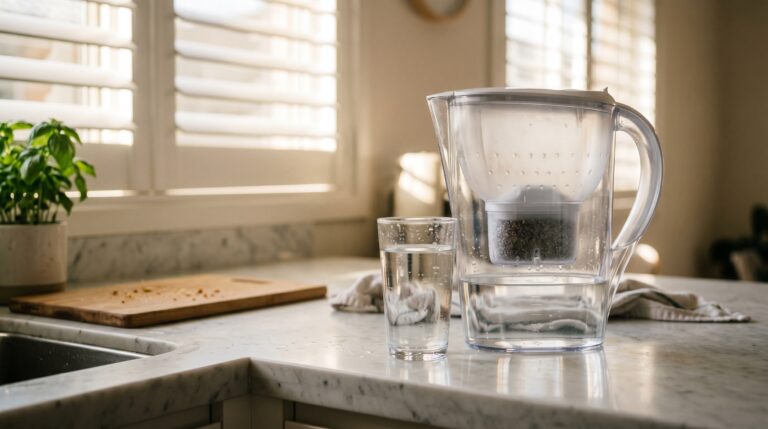
Melbourne Water uses free chlorine as its primary disinfectant across most of the metro network — a meaningful difference from Brisbane, Adelaide, and most of Sydney. Free chlorine is effective and easier to remove: it dissipates naturally when water sits in an open container for 20–30 minutes, and is removed readily by any carbon block filter. You do not need RO or a sub-micron filter just to remove chlorine taste from Melbourne water. A TAPP EcoPro or any NSF 42-certified carbon filter achieves this.
The exception: parts of the Yarra Valley Water distribution area (Monbulk to Mt Dandenong Ridge, Silvan to Seville East) use chloramine for stability in long pipe runs. If you are in these outer eastern zones, standard chlorine-removal advice does not apply — you need a solid carbon block filter for reliable chloramine removal.
Fluoride at 0.9 mg/L — present, but below the ADWG limit by a wide margin
Melbourne water is fluoridated under Victoria’s Fluoridation Act 2004 at an optimum target of 0.9 mg/L (range 0.7–1.2 mg/L). This is lower than Sydney’s 1.0 mg/L target but still measurable. Carbon filters do not remove fluoride. If fluoride reduction is a priority — for infant formula preparation, thyroid health considerations, or personal preference — reverse osmosis is the only household technology that delivers independently certified removal (>96% via NSF 58).
Very low TDS — what this means for RO output
Melbourne’s TDS of 11–38 mg/L means RO-filtered water will be near-zero TDS — 1–3 mg/L. At these levels, the water tastes flat. If you use RO in Melbourne for fluoride reduction, consider adding a remineralisation stage (AquaTru’s optional alkaline filter, or mineral drops) to restore a more natural taste. For Perth households dealing with 400+ mg/L TDS, the taste improvement from RO is dramatically perceptible. For Melbourne households, it’s more subtle — the starting point is already very clean.
For full Melbourne water chemistry data, see our Melbourne drinking water quality guide.
Best water filters for Melbourne 2026
Best for most Melbourne households: TAPP EcoPro
Solid carbon block (0.5 micron) removes free chlorine taste, microplastics, and lead. NSF 42+53. No installation required. For most Melbourne households on free-chlorine water — this is the right call. Fluoride is not removed, but at 0.9 mg/L and with no other contamination concerns, TAPP is the proportionate choice. Also removes chloramine for outer east zone residents.
Best for: most Melbourne households, renters, taste improvement
Fluoride removal: AquaTru Classic
If fluoride reduction is the priority, AquaTru Classic is the accessible countertop RO option. NSF 58 + 401 certified. No plumbing required. Note: Melbourne’s already-low TDS means RO output will be near-zero minerals — use the alkaline remineralisation stage. For the full minerals discussion: does RO remove minerals.
Best for: fluoride removal, infant formula prep
For a full comparison: best countertop water filter Australia. For remineralisation after RO: does RO remove minerals.
Frequently asked questions — Melbourne water filters
The case for filtering Melbourne water anyway
Melbourne’s supply is genuinely excellent. But “excellent by Australian standards” still means fluoride at approximately 1.0 mg/L, free chlorine at the tap, and microplastics in concentrations that are poorly characterised for any city water supply globally.
Fluoride: Melbourne fluoridates to approximately 1.0 mg/L — the same as Sydney. If fluoride reduction is a priority (due to thyroid conditions, infant formula preparation, or personal preference), reverse osmosis removes more than 96% and is the only household technology that does so reliably. No carbon filter — including the TAPP — removes fluoride.
Old building infrastructure: Melbourne’s source water quality doesn’t tell you what happens inside a 1950s apartment block’s internal pipes. If you’re renting in an older building, lead and copper leaching from internal plumbing is a more realistic concern than anything in the mains supply. A 0.5-micron carbon block filter or RO addresses both.
Microplastics: Melbourne Water does not test for microplastics in the distribution network. No Australian utility routinely does. Independent research on global city water supplies consistently finds low concentrations even in high-quality systems. RO (0.0001-micron membrane) removes microplastics entirely.
Free chlorine taste: The most common reason Melbourne residents filter their water. Free chlorine dissipates in an open container in 20–30 minutes — you don’t need a filter at all if you’re willing to pre-fill a jug. A TAPP EcoPro achieves the same result instantly, at the tap.
Product recommendations for Melbourne
TAPP EcoPro — for chlorine taste, renters, no commitment
Attaches to any standard tap, no tools, no plumbing. Removes free chlorine, lead, microplastics (>0.5 micron). Ideal for Melbourne given free-chlorine (not chloramine) chemistry — carbon block works perfectly here. Does not remove fluoride. Filter life: 1,200L per cartridge.
AquaTru Classic — for fluoride removal or infant formula
4-stage countertop RO. NSF 58 + 401 certified. Removes fluoride (>96%), microplastics, chlorine, lead. No plumbing required — fills from a jug. Melbourne water is so soft that AquaTru output will be near-zero TDS — consider using the remineralisation filter insert, or adding a pinch of mineral-rich salt to water used for cooking. Note: RO removes minerals alongside contaminants.
EcoHero 5-Stage — for homeowners wanting permanent under-sink RO
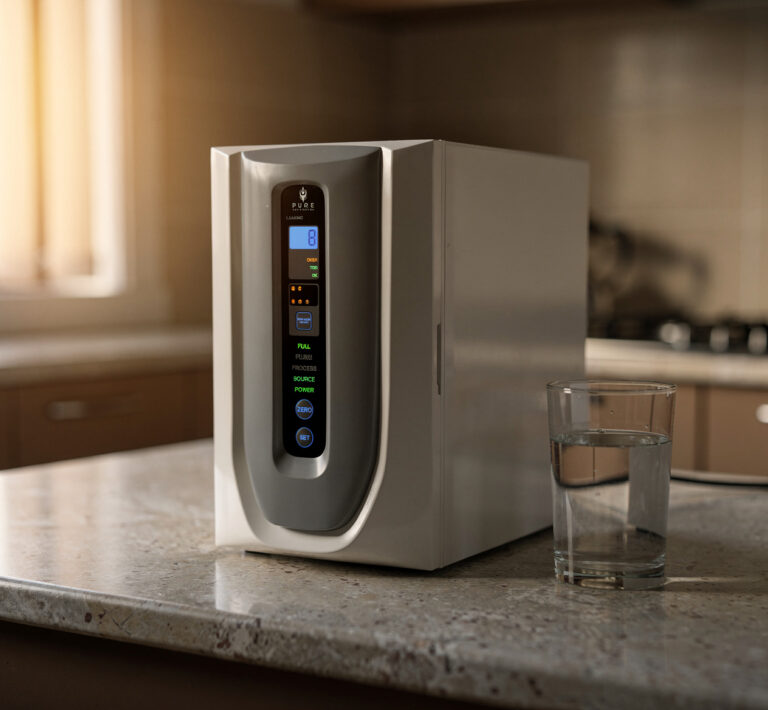
WaterMark certified under-sink RO. 190L/day capacity. Removes fluoride, chlorine, microplastics, lead. Dedicated filtered water tap. Requires a plumber for installation. Most appropriate for Melbourne households who want on-demand filtered water volume — families of 3+ using filtered water for cooking as well as drinking. Given Melbourne’s excellent source water quality, the primary argument for under-sink RO here is fluoride removal and convenience.
EcoHero 5-Stage RO — Pure Water SystemsFrequently asked questions — Melbourne water filters
Does Melbourne tap water need to be filtered?
Melbourne tap water is the cleanest of any Australian capital — protected mountain catchments, hardness of only 18 mg/L CaCO₃, PFAS non-detect across all catchments. It does not require filtration for safety. Households filter for: chlorine taste (carbon block, or open jug for 30 minutes), fluoride reduction (RO only), microplastics (0.5-micron carbon block or RO), or old building infrastructure concerns (lead from internal pipes).
Does Melbourne water have chloramine or chlorine?
Most Melbourne households receive free chlorine — not chloramine. Chloramine is used only in some outer eastern Yarra Valley Water zones (Monbulk to Mt Dandenong Ridge, Silvan to Seville East). Free chlorine dissipates when water is left in an open container for 20–30 minutes, making Melbourne significantly easier to dechlorinate than Brisbane or Adelaide without any filtration.
Does Melbourne water have PFAS?
No. Melbourne Water tests all seven monitored catchment sites and all return less than 2 ng/L (effectively non-detect) for PFAS compounds. Melbourne’s permanently closed catchments have no industrial or agricultural land use that would introduce PFAS. No filtration action is required for PFAS in Melbourne.
What is the best water filter for Melbourne renters?
The TAPP EcoPro — installs on any tap without tools, removes free chlorine taste, microplastics, and lead. For Melbourne’s mainly free-chlorine water, you could also simply leave a jug of tap water uncovered for 30 minutes before drinking. For fluoride reduction, the AquaTru Classic countertop RO requires no plumbing and is suitable for renters.
Is Melbourne water hard or soft?
Melbourne water is exceptionally soft — averaging approximately 18 mg/L as CaCO₃, one of the lowest hardness values of any major city water supply globally. You will see essentially no limescale on kettles or shower heads. If you use RO-filtered Melbourne water, the output will be near-zero TDS — a remineralisation stage or trace minerals are worth considering for drinking water.
Get the Australian Home Environment Checklist
30 checks across water, air and EMF. Most of them free. Ranked by impact.
No spam. Unsubscribe any time.

Former Royal Australian Navy Clearance Diver and TAG-E counter-terrorism operator. Founded Clean and Native to apply the same rigorous thinking to the home environment.
Full biography →