Best Water Filter Adelaide 2026: Why Adelaide Tap Water Tastes Different and What to Do About It
Drafted with AI assistance and checked against published specifications and certifications. First-hand measurements appear only where stated. How we make content
Affiliate disclosure: Clean and Native earns a commission if you purchase through links on this page. Recommendations are based on independent testing, utility water quality data, and verified filter certifications only.
Adelaide tap water is safe to drink but tastes noticeably mineralised in dry years when River Murray dependency climbs to 80–90% and TDS exceeds 450 mg/L—reverse osmosis eliminates this seasonal variation completely. SA Water meets all ADWG standards, PFAS tests non-detect across metro reservoirs, and chloramine residual stays below taste threshold for most residents. The catches: RO wastes 3–4 litres per litre filtered (though Adelaide’s water isn’t scarce enough to justify not filtering if taste bothers you), and carbon-only filters won’t touch the dissolved salts that cause the Murray’s signature mineral flavour. Adelaide residents who notice the salty/metallic character during low-flow months should choose RO; those who just want chloramine removal can use activated carbon.
Adelaide tap water is safe to drink. SA Water consistently meets Australian Drinking Water Guidelines, PFAS tests non-detect across all six metro reservoirs, and the infrastructure is well-maintained. The reason Adelaide has a long-standing reputation for tap water taste is chemistry, not contamination — specifically the River Murray’s seasonal TDS variation and chloramine as the primary disinfectant. In dry years when Murray dependency increases to 80–90% of supply, Adelaide tap water develops a distinctly mineralised, sometimes mildly salty character that most residents notice. Reverse osmosis eliminates this variation by producing consistent 3–5 mg/L TDS water regardless of whether the Murray is running high or low.
The three products we own are measured first-hand by Jayce Love, former Royal Australian Navy Clearance Diver; every other product is assessed on published manufacturer specifications and independent certification using our documented methodology — no gifted units, no brand payments.
Why Adelaide water tastes the way it does — the chemistry
River Murray dependency and seasonal TDS variation
Adelaide’s water comes from four sources: River Murray (~40–44% long-term average, up to 90% in drought), Mount Lofty Ranges reservoirs (~34–40%), groundwater (~19%), and the Adelaide Desalination Plant (~2–3%). The River Murray’s TDS is seasonal — after rainfall, it is lower; in dry periods, it concentrates minerals. When SA Water increases Murray intake during drought, Adelaide households notice: the water becomes more mineralised, carrying higher sodium and chloride levels from the river’s natural dissolved load.
Metro Adelaide TDS ranges from approximately 200–450 mg/L depending on zone and season. This is higher than Sydney (~124 mg/L), Melbourne (~18–38 mg/L), and Brisbane (~150 mg/L estimated) — and the variation between wet and dry years is unique to Adelaide among Australian capitals.
Chloramine network-wide
Chloramine is used as the primary disinfectant in Adelaide’s metropolitan distribution networks — approximately 220,000 people receive chloraminated water. Total chlorine residual averages approximately 1.19 mg/L. Like Brisbane and unlike Melbourne, Adelaide’s chloramine does not dissipate naturally. A solid carbon block filter (TAPP EcoPro, 0.5 micron) or reverse osmosis is required for effective chloramine removal. Standard GAC pitchers provide only partial improvement.
Adelaide’s fluoride — lowest of any capital
Despite artificial fluoridation, Adelaide has the lowest fluoride of any Australian capital — approximately 0.56 mg/L average across 12 metro supply zones, with a maximum of 0.70 mg/L. This compares to Sydney’s 1.0 mg/L target. The River Murray source water and multi-source blending appear to reduce effective fluoride concentrations below the target. For households specifically reducing fluoride intake, Adelaide’s already-lower level means RO output will be at or near the same low concentration as other capitals.
For full Adelaide water chemistry data, see our Adelaide drinking water quality guide.
Best water filters for Adelaide 2026
Chloramine + taste: TAPP EcoPro
Solid carbon block (0.5 micron) removes chloramine, organic taste compounds, microplastics, and lead. NSF 42+53. No installation required. Addresses Adelaide’s chloramine taste concern and reduces the earthy/chemical element of Murray-sourced water. Does not address TDS, hardness, or the mineral/salty variation that changes seasonally — for that, RO is needed.
Best for: renters, chloramine + taste improvement
Eliminate seasonal variation: AquaTru Classic RO
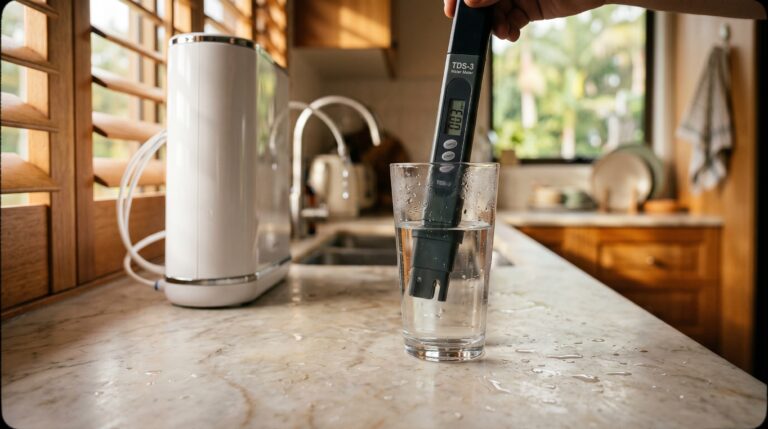
4-stage countertop RO. No plumbing required. Reduces TDS from 200–450 mg/L to 3–5 mg/L year-round — the seasonal Murray taste variation disappears entirely. Removes chloramine, fluoride (>96%), PFAS (>99%), lead, and microplastics. NSF 58 + 401. For Adelaide households frustrated by seasonal taste variation, RO is the definitive solution regardless of what the Murray is doing upstream.
Best for: eliminating seasonal variation, comprehensive filtration
For the full chloramine removal guide: best water filter for chloramine Australia. For countertop RO comparison: best countertop water filter Australia.
Frequently asked questions — Adelaide water filters
Why does Adelaide tap water taste bad in summer?
In dry periods, SA Water increases its reliance on River Murray water — potentially to 80-90% of supply in drought years. The Murray’s TDS rises seasonally, carrying higher sodium and chloride that creates a mineralised, sometimes slightly salty taste. This seasonal variation is the primary cause of Adelaide’s tap water taste reputation. Reverse osmosis filtration eliminates this variation by reducing TDS to 3-5mg/L year-round regardless of Murray intake levels.
Does Adelaide water have chloramine?
Yes. Chloramine is the primary disinfectant in Adelaide’s metropolitan distribution networks, with approximately 220,000 residents receiving chloraminated water. Total chlorine residual averages approximately 1.19mg/L. Chloramine requires solid carbon block filtration (TAPP EcoPro) or reverse osmosis for effective removal — standard GAC pitchers provide only partial improvement.
What is the best water filter for Adelaide?
For Adelaide’s specific concerns — chloramine, variable River Murray TDS (200-450mg/L), and seasonal taste variation — reverse osmosis provides the most comprehensive improvement. The AquaTru Classic (countertop, no plumbing) eliminates seasonal variation by reducing TDS to 3-5mg/L year-round. For renters wanting chloramine and basic taste improvement without the RO investment, the TAPP EcoPro is the entry-level option.
Does Adelaide water have PFAS?
No. SA Water tested all six metropolitan Adelaide reservoirs (Barossa, Happy Valley, Hope Valley, Little Para, Millbrook, Myponga) in September 2024 and early 2026, with all results below detection limits. River Murray sampling in May 2025 also returned non-detect for PFAS. Adelaide has a clean PFAS record.
How much fluoride is in Adelaide water?
Adelaide has the lowest fluoride of any Australian capital despite artificial fluoridation — approximately 0.56mg/L average across 12 metro supply zones, with a maximum of 0.70mg/L. This is significantly lower than Sydney’s 1.0mg/L target. Only reverse osmosis removes fluoride — carbon block filters do not.
Why does Adelaide tap water taste different in summer versus winter?
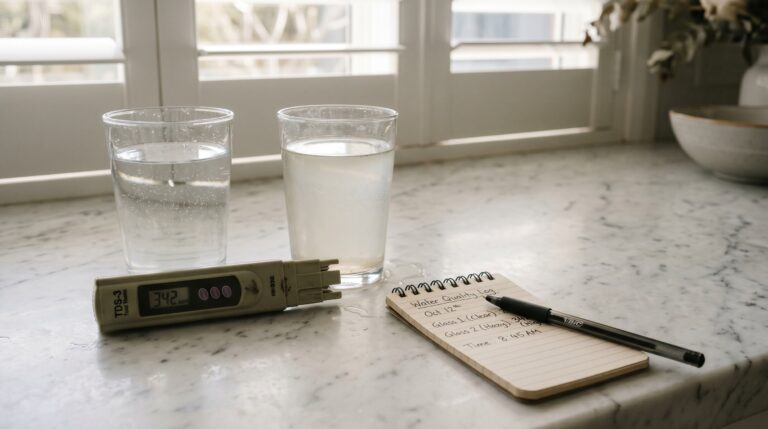
River Murray dependency rises to 80-90% during dry years, increasing mineral content (TDS) seasonally. Chloramine amplifies the taste shift. Reverse osmosis eliminates both: mains TDS of 69 ppm drops to 3 ppm post-RO (95.7% reduction). Carbon only removes chloramine taste, not mineral load.
Does Adelaide tap water contain PFAS, and do home filters remove it?
Recent SA Water testing shows no PFAS detection in metro supply — do not buy PFAS-specific filters unless your water test confirms otherwise. Reverse osmosis removes PFAS if present (NSF 58 certified systems); carbon removes some types but not all. Focus on chloramine and TDS reduction, which are the actual Adelaide water concerns.
Can I remove fluoride from Adelaide tap water with a carbon filter?
No. Carbon removes chlorine, chloramine, taste, and odour — not fluoride. Adelaide adds 0.56 mg/L fluoride (ADWG compliant; SA Water). Reverse osmosis removes most fluoride (NSF 58 certified systems typically 92-98% depending on membrane). If fluoride removal is your goal, under-sink or countertop RO is mandatory; carbon-only filters do not work for fluoride.
Get the Australian Home Environment Checklist
30 checks across water, air and EMF. Most of them free. Ranked by impact.
No spam. Unsubscribe any time.

Former Royal Australian Navy Clearance Diver and TAG-E counter-terrorism operator. Founded Clean and Native to apply the same rigorous thinking to the home environment.
Full biography →