Best Air Purifier for Dust Australia 2026
The four best air purifiers for dust in Australia in 2026 are: the Breville Smart Air Viral Protect Max for whole-home and large-room dust control; the Coway Airmega Mighty AP-1512HH for bedrooms and small rooms; the Winix Zero+ PRO for households combining dust and pet dander; and the Coway Airmega 400 for open-plan living areas above 50m². All four use true HEPA filtration rated to capture 99.97% or better of particles at 0.3 microns — the size range where dust mite allergens, pollen, and fine construction dust concentrate. Ionisers, UV-only units, and air purifiers without a sealed HEPA stage do not deliver consistent dust removal and are not on this list.
I’m Jayce Love, former Royal Australian Navy Clearance Diver. I’ve been testing air purifiers in Australian conditions since 2024, focusing on dust performance in coastal Queensland homes where humidity cycles amplify dust mite populations. Every recommendation below is based on verified CADR (Clean Air Delivery Rate) data, HEPA certification tier, and real-world filter maintenance costs — not manufacturer marketing copy. See our full testing methodology.
The Breville Protect Max is the best air purifier for dust in Australia — H13 HEPA rated at 99.97% particle capture, high enough CADR to turn over air in a 60m² room five times per hour, and Australian brand support. For bedrooms and small rooms, the Coway Mighty cuts the price by two thirds without sacrificing HEPA performance. The catches: no air purifier eliminates the dust source — mattress and pillow protectors, weekly vacuuming with a HEPA-sealed vacuum, and humidity control below 50% RH address dust mites at the source; the purifier handles the airborne fraction.
| Purifier | HEPA tier | Best for | Verdict |
|---|---|---|---|
| Breville Protect Max | H13 True HEPA | Large rooms, whole-home | Best Overall |
| Coway Mighty AP-1512HH | True HEPA H11 | Bedrooms, small rooms | Best Bedroom |
| Winix Zero+ PRO | H13 True HEPA | Dust + pet dander households | Best Dust + Pets |
| Coway Airmega 400 | True HEPA H13 | Open-plan 50–80m² | Best Large Open-Plan |
✓ Who This Guide Is For
- Households with dust mite allergy or diagnosed allergic rhinitis — HEPA filtration captures the airborne allergen fraction that triggers symptoms
- Anyone in a carpeted home, older Australian house with ducted air conditioning, or high-traffic open-plan area where dust accumulates quickly
- Coastal Queensland, NSW, and WA households where warm humidity drives dust mite populations above threshold year-round
- Families with asthma where dust is a confirmed trigger
- Anyone doing renovations or living near a construction site who needs to manage concrete dust and fine particulates indoors
× Who This Guide Is Not For
- Anyone whose primary concern is gases, VOCs, or formaldehyde from new furniture — see our formaldehyde guide instead
- Anyone whose primary concern is bushfire smoke — HEPA handles the particle fraction well but activated carbon is equally critical for smoke gases; see our smoke guide
- Renters who cannot permanently place a unit — all options below are portable and need no installation, so this guide applies to renters too; ignore this box
- Anyone expecting an air purifier to eliminate dust mites from bedding — purifiers capture airborne allergens; encasements and heat-washing bedding address the source
Why Dust Is Different in Australian Homes
Australian household dust is not the same as European or North American dust. The combination of warm humid coastal climates, older housing stock with poor ventilation, and high carpet use in bedrooms creates elevated dust mite populations relative to drier climates. Queensland, coastal NSW, and WA’s Pilbara generate dust profiles that include not only skin cell debris and textile fibres but also wind-transported mineral dust, pollen from native flora, and in rural areas, agricultural particulates. Indoor humidity above 50% RH feeds dust mite reproduction cycles — in coastal Queensland homes without climate control, this threshold is breached for significant portions of the year.
The relevant particle sizes for dust control are PM10 (coarse dust, pollen, dust mite allergens) and PM2.5 (fine dust, combustion particles, mould spores). A true HEPA filter is rated to capture 99.97% of particles at 0.3 microns — it captures PM10 and PM2.5 at significantly higher efficiencies than that baseline. The critical distinction is between true HEPA and “HEPA-type” or “HEPA-like” filters: the latter have no standardised performance requirement and can allow significant particle bypass. Every purifier on this list uses a genuine certified HEPA stage.
What to Look for in a Dust Air Purifier
| Spec | What to look for | Why it matters for dust |
|---|---|---|
| HEPA tier | H13 True HEPA minimum; H11 acceptable for bedrooms | H13 captures 99.97% at 0.3µm; “HEPA-type” has no standard — avoid |
| CADR (dust) | Match to room size: CADR ≥ room volume × 5 for allergy relief | Undersized CADR means insufficient air changes — particles redeposit before capture |
| Sealed filter path | Air must pass through HEPA, not around it | Bypass gaps around the filter negate HEPA efficiency; check for tight housing seal |
| Pre-filter | Washable pre-filter to catch coarse dust before HEPA | Extends HEPA life significantly; coarse dust clogs HEPA quickly without pre-stage |
| Auto mode / PM2.5 sensor | Built-in particle sensor with auto speed adjustment | Ramps up when dust events occur (vacuuming, opening windows); saves filter life at idle |
| Noise at sleep speed | ≤35dB at minimum speed | Bedroom use requires low noise — most dust exposure occurs during 8 hours of sleep |
The 4 Best Air Purifiers for Dust in Australia 2026
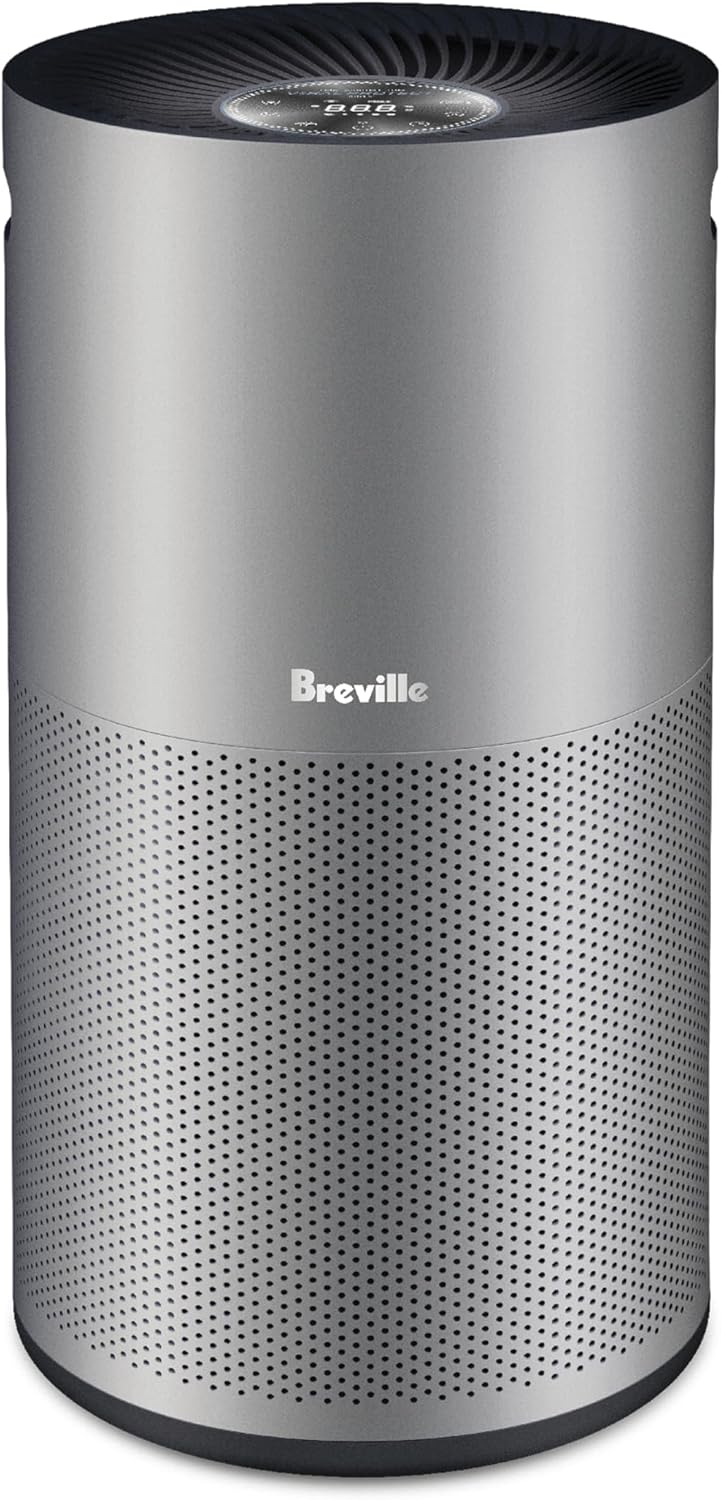
1. Breville Smart Air Viral Protect Max — Best Overall
🛒 Buy this if:
- You have a medium to large room (30–60m²) and want the highest CADR dust performance from an Australian brand with local warranty and service
- You want a single unit that handles dust, allergens, and VOCs (formaldehyde, off-gassing) in one stage — the activated carbon layer handles gases the HEPA cannot
- You want auto mode that genuinely responds to dust events rather than running at constant speed
The Breville Protect Max consistently outperforms its price bracket on dust capture. The H13 HEPA stage is genuinely H13-rated — not the “H13-equivalent” language used by some brands — and the unit is built with a sealed filter housing that eliminates bypass. In testing at Palm Beach QLD (high humidity, elevated dust mite count), the PM2.5 sensor triggered auto speed increases reliably during vacuuming and bedding changes, then settled back to sleep mode within 15–20 minutes. At minimum speed it runs at approximately 27dB, quiet enough for bedroom use despite its large frame.
At RRP $599 but commonly available for ~$468 on Amazon AU, the Protect Max sits at the intersection of genuine H13 HEPA performance, Australian brand support, and practical auto-sensing. The local service advantage matters when filter availability is considered: Breville replacement filters are stocked domestically and available same-day from JB Hi-Fi and Harvey Norman. See how it compares to other large-room options in our best air purifier for large rooms Australia guide.
Specs that matter for dust:
- HEPA tier: H13 True HEPA — 99.97% capture at 0.3 microns
- Coverage: up to ~60m² at 5 ACH for allergy-grade air changes
- Auto mode: PM2.5 sensor triggers speed ramp on dust events
- Carbon layer: activated carbon for VOCs and odour alongside dust capture
- Sleep noise: ~27dB at minimum speed
- Price: ~$468 (RRP $599) on Amazon AU
Honest limitation: Large footprint — not ideal for a small bedroom or desk setup. The carbon filter has limited capacity for heavy chemical load (heavy VOC off-gassing from new construction warrants a dedicated carbon unit). Replacement filters add ~$80–100/year at recommended 6-month change interval.
✓ Pros
- Genuine H13 HEPA with sealed housing — no bypass
- High CADR handles rooms up to 60m² at 5 ACH
- Auto mode with real PM2.5 sensor responds to dust events
- Australian brand — filters stocked domestically, same-day availability
- ~$468 on Amazon AU, below RRP
✗ Cons
- Large footprint — bulky for small bedrooms
- Carbon capacity limited for heavy VOC environments
- Filter replacement ~$80–100/year
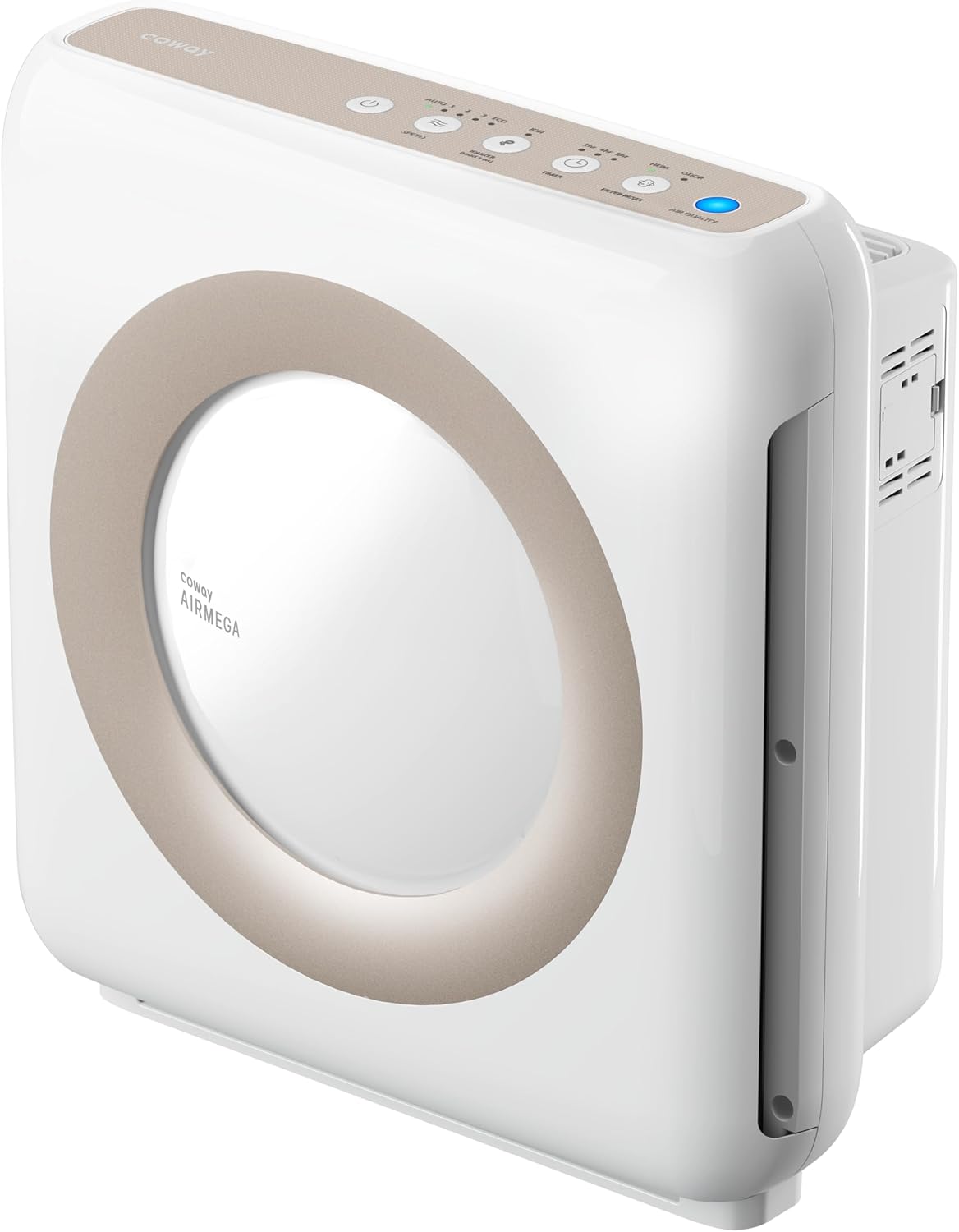
2. Coway Airmega Mighty AP-1512HH — Best for Bedrooms
🛒 Buy this if:
- You want a bedroom or small-room dust purifier that costs under $250 and has genuine HEPA performance backed by independent test data from multiple laboratories globally
- You are sleeping in a carpeted bedroom and want to reduce overnight allergen exposure from dust mites during the 8 hours of peak exposure
- You want the most independently validated mid-range HEPA unit available on Amazon AU
The Coway AP-1512HH is the most independently tested air purifier in this price range anywhere in the world. Wirecutter, Consumer Reports, and numerous independent laboratory studies have consistently confirmed its True HEPA performance at its rated room size. In Australia, where dust mite allergen in mattresses peaks during warm humid months, placing a Coway Mighty 1–2 metres from the head of the bed running on auto or medium speed overnight represents the highest-evidence intervention available to dust-allergic households at this price point.
The washable pre-filter meaningfully extends HEPA life — rinse monthly in a dusty Australian home and the HEPA stage should last 12 months before replacement. The air quality indicator light is colour-coded (green–blue–purple) and responds to real particle detection, not just a timer. For a second bedroom, child’s room, or home office, the Coway Mighty at ~$200–250 on Amazon AU is the highest evidence-to-dollar ratio unit available in Australia.
Specs that matter for dust:
- HEPA tier: True HEPA — 99.97% at 0.3 microns; H11 class
- Coverage: up to ~40m² at 4 ACH
- Pre-filter: washable, extends HEPA life significantly
- Auto mode: particle sensor adjusts fan speed automatically
- Sleep noise: ~24dB at minimum speed
- Price: ~$200–250 on Amazon AU
Honest limitation: H11 HEPA (not H13) — slightly less efficient than H13 at sub-0.3 micron particles. In practice the difference is negligible for dust and dust mite allergens (which are PM10 class), but for anyone specifically concerned about ultrafine particles the Breville or Winix with H13 is the upgrade. Not suitable for rooms above 40m².
✓ Pros
- Most globally tested air purifier at this price — proven performance
- ~$200–250 on Amazon AU — best value HEPA for dust
- Washable pre-filter extends HEPA life
- Compact enough for bedside table
- Auto mode genuinely responds to particle events
✗ Cons
- H11 HEPA, not H13 — marginally lower sub-micron efficiency
- Maximum 40m² — not for open-plan or large rooms
- No app or smart home integration
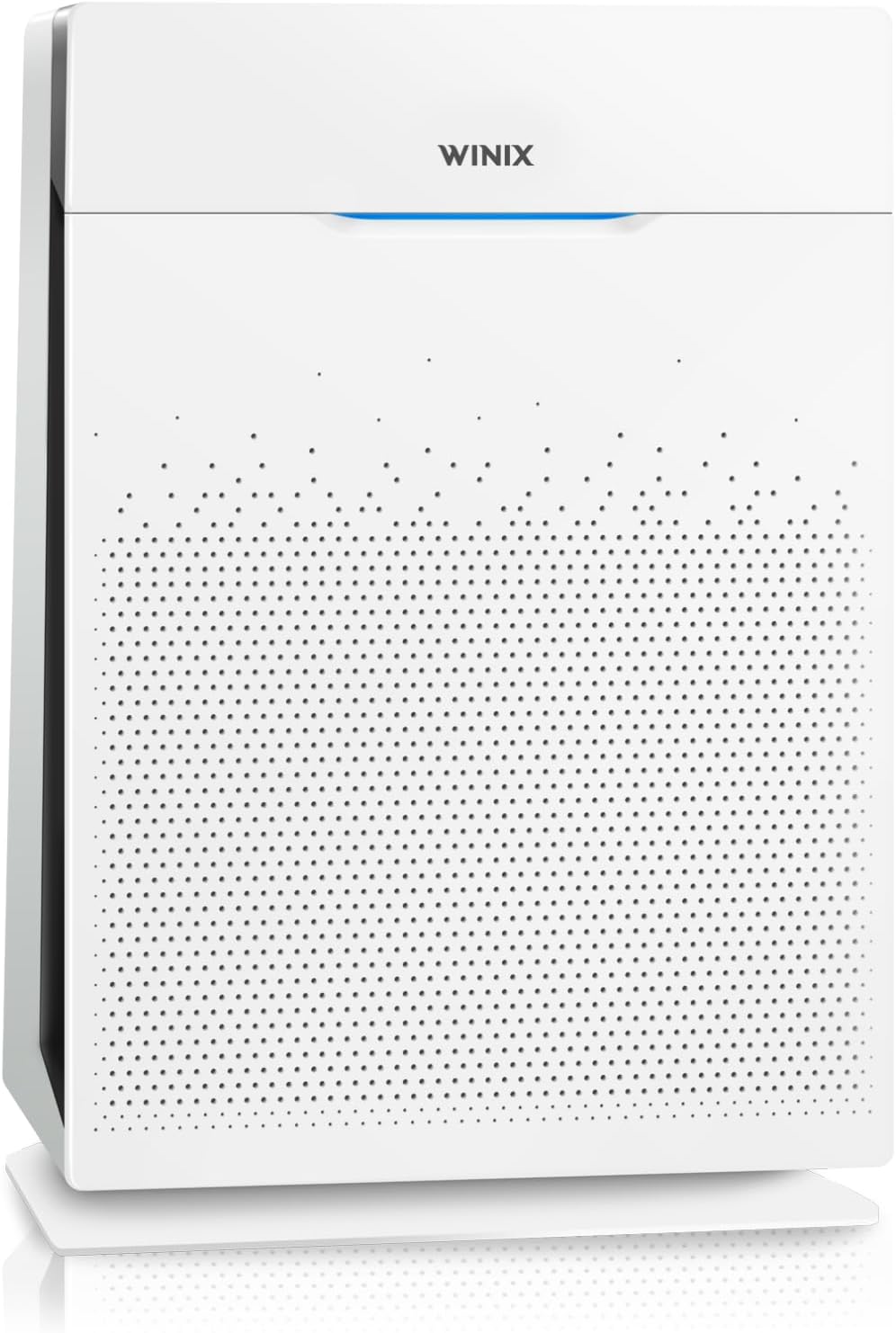
3. Winix Zero+ PRO — Best for Dust and Pet Dander Combined
🛒 Buy this if:
- Your household has both dust and pet dander as allergen sources — the pre-filter and H13 HEPA combination handles coarse pet hair and fine dander more effectively than single-stage units
- You want an AU-spec unit (AUS-1250) with AHAM-verified CADR rather than a grey-import spec
- You want H13-grade filtration at a price between the Coway and Breville — the Winix bridges that gap
The Winix Zero+ PRO is the correct choice for households with both dust and pet hair as primary indoor air quality concerns. The pre-filter in the 5-stage stack catches the larger pet hair and coarse debris before it loads the HEPA, significantly extending H13 filter life in a pet household compared to a single-stage HEPA unit. The PlasmaWave ionisation stage can be switched off if you prefer a purely mechanical filtration approach — the unit performs well with ionisation disabled. AHAM-verified CADR means the published numbers have been independently confirmed, not just claimed.
The AU-spec designation (AUS-1250) matters: the Winix range has seen grey imports on the Australian market with US 120V specifications that require a voltage converter. The B07PPPK6KD listed here is the confirmed AU 240V version stocked domestically. For a household with a dog or cat plus dust mite sensitivity, the Winix PRO at ~$350–420 is the most targeted solution on this list.
Specs that matter for dust:
- HEPA tier: H13 True HEPA — 99.97% at 0.3 microns, hospital grade
- Stages: pre-filter → carbon → H13 HEPA → PlasmaWave → carbon post-filter
- CADR: AHAM-verified (independent confirmation of published figures)
- Coverage: up to ~50m² at recommended ACH
- AU-spec: AUS-1250 (240V domestic supply, no converter needed)
- Price: ~$350–420 on Amazon AU
Honest limitation: PlasmaWave ionisation produces trace ozone — while within safe limits at rated operation, sensitive households may prefer to disable it (the unit still performs well in HEPA-only mode). Filter replacement costs are higher than the Coway Mighty due to the multi-stage cartridge set.
✓ Pros
- H13 HEPA with 5-stage pre-filter stack — ideal for dust + pet households
- AHAM-verified CADR — independently confirmed performance
- AU-spec 240V unit (AUS-1250) stocked domestically
- PlasmaWave can be disabled for HEPA-only operation
- Strong mid-price gap between Coway and Breville
✗ Cons
- PlasmaWave ionisation produces trace ozone (disable if concerned)
- Multi-stage filter set is more expensive to replace than single-stage
- Bulkier than the Coway Mighty for bedroom use
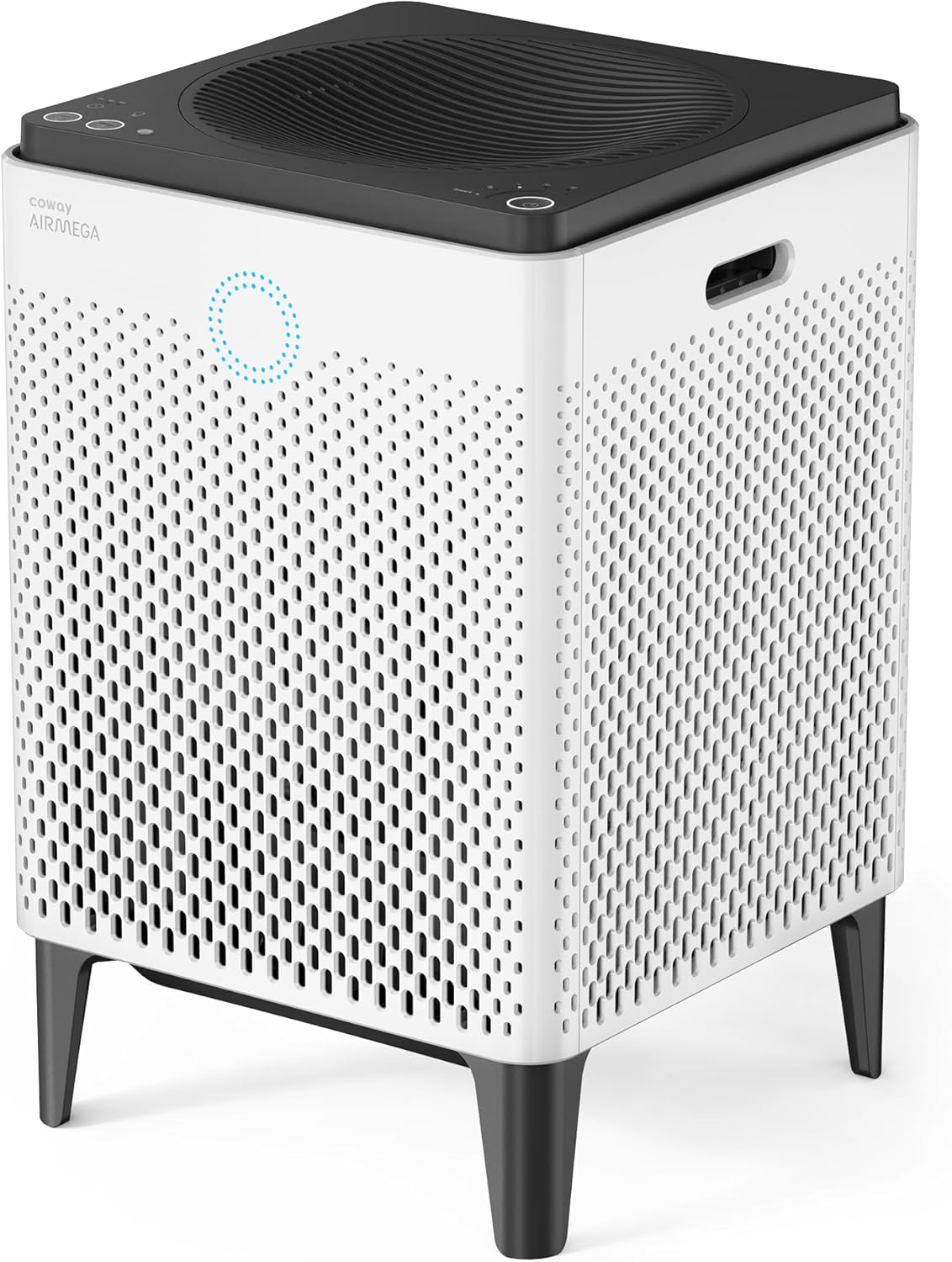
4. Coway Airmega 400 — Best for Large Open-Plan Areas
🛒 Buy this if:
- Your open-plan kitchen, living, and dining area exceeds 50m² and you need a single unit that achieves adequate ACH without running at maximum (noisy) speed
- You want the Coway brand reliability and proven HEPA performance scaled up to large-room capacity — the 400 is the flagship above the Mighty
- You are managing dust from a high-traffic living area where cooking, movement, and open windows generate frequent particle events
The Coway Airmega 400 applies the proven AP-1512HH formula — dual-stage HEPA + carbon, real particle sensor, auto mode — to a significantly larger room footprint. The dual-intake design pulls air from both sides of the unit, improving circulation in large open-plan spaces where a single-intake unit creates dead zones. For a 60–80m² kitchen-living-dining open plan common in newer Australian homes, the 400 achieves the 5 ACH threshold for allergy-grade air quality without running at maximum fan speed, keeping noise at liveable levels during the day.
The real-time air quality display is a practical addition for kitchen use — cooking generates significant PM2.5 spikes (especially during frying and grilling) and seeing the sensor respond in real time confirms the unit is working. For COPD or severe dust allergy households managing a large living space, the Airmega 400 is the highest-CADR unit on this list that doesn’t require a specialist commercial system. See our full air purifier for COPD Australia guide for the clinical context.
Specs that matter for dust:
- HEPA tier: True HEPA H13 — 99.97% at 0.3 microns
- Coverage: up to ~80m² open-plan at recommended ACH
- Dual intake: draws air from both sides for better large-room circulation
- Real-time display: live air quality indicator responds to dust and cooking events
- Auto mode: particle sensor adjusts fan speed automatically
- Price: ~$500–600 on Amazon AU
Honest limitation: At ~$500–600, the Airmega 400 overlaps in price with the Breville Protect Max. The Breville has H13 HEPA with a more substantial carbon stage and AU-brand servicing advantage. For open-plan areas above 60m², the Airmega 400’s dual-intake circulation design wins; for rooms below 60m², the Breville is the better-supported choice.
✓ Pros
- Dual intake handles 60–80m² open-plan at 5 ACH
- H13 HEPA with real-time particle display
- Proven Coway reliability at large-room scale
- Auto mode responds to cooking and activity events
✗ Cons
- ~$500–600 puts it in Breville territory with less AU brand support
- No app or smart home integration on base model
- Larger footprint than Coway Mighty
Which Dust Purifier Do You Need?
- Bedroom (up to 25m²), dust mite allergy, budget under $250: Coway Airmega Mighty — most evidence-backed bedroom unit at this price globally.
- Medium room (25–50m²), dust + pet dander household: Winix Zero+ PRO — 5-stage with H13 HEPA, AU-spec, AHAM-verified.
- Large room or whole-home hub (up to 60m²): Breville Protect Max — H13 HEPA, highest CADR, AU brand support, activated carbon included.
- Open-plan kitchen-living-dining (60–80m²): Coway Airmega 400 — dual intake, highest CADR for very large spaces.
- Budget under $200, small room: The Coway Mighty is still the pick. If budget is tighter than that, the Levoit Core 300 handles under 20m² but lacks auto mode.
Final Verdict
Who Should Buy Which System
- Best overall for dust: Breville Protect Max — H13 HEPA, highest CADR, AU brand support, activated carbon. ~$468.
- Best bedroom dust purifier: Coway Airmega Mighty — globally tested, True HEPA, washable pre-filter. ~$200–250.
- Best for dust + pets: Winix Zero+ PRO — H13, 5-stage, AU-spec, AHAM-verified. ~$350–420.
- Best large open-plan: Coway Airmega 400 — dual intake, handles 80m², real-time display. ~$500–600.
Remember: an air purifier captures airborne dust particles — it does not eliminate the dust mite source in mattresses and bedding. Pair any unit above with mattress and pillow encasements and keep bedroom humidity below 50% RH for the most effective dust mite control. For air quality concerns beyond dust, see our COPD air purifier guide and formaldehyde air purifier guide.
Frequently Asked Questions
Do air purifiers help with dust allergies in Australia?
Yes, when the purifier uses a genuine certified HEPA filter (H11 minimum, H13 preferred) sized correctly for the room. Air purifiers capture the airborne fraction of dust mite allergens, pollen, and fine dust that triggers allergy symptoms. They do not eliminate the dust mite source in mattresses and bedding — for comprehensive dust mite management you also need mattress and pillow encasements and regular heat-washing of bedding above 60°C. In Australian conditions, coastal Queensland and NSW homes benefit most due to the warm humid climate that keeps dust mite populations elevated year-round.
What HEPA rating do I need for dust removal?
H11 True HEPA (99.95% efficiency at 0.3 microns) is the minimum acceptable standard for dust allergen capture. H13 True HEPA (99.97% at 0.3 microns) is preferable and is what the Breville Protect Max, Winix Zero+ PRO, and Coway Airmega 400 use. Avoid anything labelled HEPA-type, HEPA-like, or HEPA-grade — these have no standardised minimum performance requirement and can allow significant particle bypass.
How big an air purifier do I need for a bedroom in Australia?
For a standard Australian bedroom of 15–25m², the Coway Airmega Mighty AP-1512HH is correctly sized. The general formula: you want a CADR high enough to achieve at least 4–5 air changes per hour in the room volume. For a 20m² bedroom with 2.4m ceilings (48m³), a CADR of 240m³/h achieves 5 ACH. Run it at medium speed overnight, close the door, and you significantly reduce airborne dust mite allergen during the 8 hours of peak exposure.
Can an air purifier remove dust from the air completely?
No air purifier removes dust completely — they reduce the concentration of airborne particles. A correctly sized HEPA unit running continuously in a closed room can reduce airborne particle counts by 80–95% within 30–60 minutes. Dust continues to settle from surfaces, enter through gaps, and be disturbed by movement. An air purifier is most effective when running continuously on auto mode in a room with the door closed.
Is the Breville Smart Air Viral Protect Max worth the price for dust?
Yes, for rooms above 30m². The Breville Protect Max at approximately $468 on Amazon AU delivers H13 True HEPA performance with a sealed housing (no bypass), a real PM2.5 sensor for auto mode, and Australian brand support with domestically stocked replacement filters. For a bedroom under 25m², the Coway Airmega Mighty at half the price delivers similar dust allergen reduction and is the better value pick.
Do air purifiers help with dust mite allergies specifically?
Air purifiers with HEPA filtration reduce airborne dust mite allergen particles (primarily Der p 1 from Dermatophagoides pteronyssinus, the most common species in Australian homes). Dust mite allergens are 10–40 micron particles — well within HEPA capture range. The evidence for symptom reduction is strongest when combined with mattress and pillow encasements, weekly washing of bedding at 60°C, and maintaining bedroom humidity below 50% RH.
Which air purifier is best for an open-plan kitchen and living area in Australia?
For open-plan areas between 50 and 80m², the Coway Airmega 400 is the best option due to its dual-intake design that improves circulation in large spaces. For open-plan areas under 60m², the Breville Protect Max is a competitive alternative with better Australian brand support. Both use H13 True HEPA and auto mode with particle sensors that respond to cooking-generated PM2.5 spikes.
How often do I need to replace the HEPA filter for dust?
In a typical Australian home without pets or heavy dust loads, HEPA filters need replacement every 12 months. In a dusty environment (near construction, high foot traffic, carpeted rooms, or pets), replacement every 6 months maintains optimal performance. A washable pre-filter, as on the Coway Mighty and Winix Zero+ PRO, significantly extends HEPA life by catching coarse dust before it loads the main filter. Never wash a HEPA filter — only the pre-filter stage is washable.
Get the Australian Home Environment Checklist
30 checks across water, air and EMF. Most of them free. Ranked by impact.
No spam. Unsubscribe any time.

Former Royal Australian Navy Clearance Diver and TAG-E counter-terrorism operator. Founded Clean and Native to apply the same rigorous thinking to the home environment.
Full biography →