Best Air Purifier for Dust Australia 2026: 5 Picks and What Actually Helps
Drafted with AI assistance and checked against published specifications and certifications. First-hand measurements appear only where stated. How we make content
How this assessment was made. I run a Coway Airmega 150 in my own home in Palm Beach, QLD; the pre-filter photos on this page are of my unit after a month of use with a dog in the house. I haven’t tested the other purifiers. Their figures come from the manufacturers and, for the Winix, AHAM-verified numbers reported by HouseFresh. The allergen advice comes from ASCIA, Australia’s clinical immunology and allergy body. Prices, sellers and ratings were checked on Amazon Australia on 29 Oct 2026. Clean and Native may earn a commission on some links.
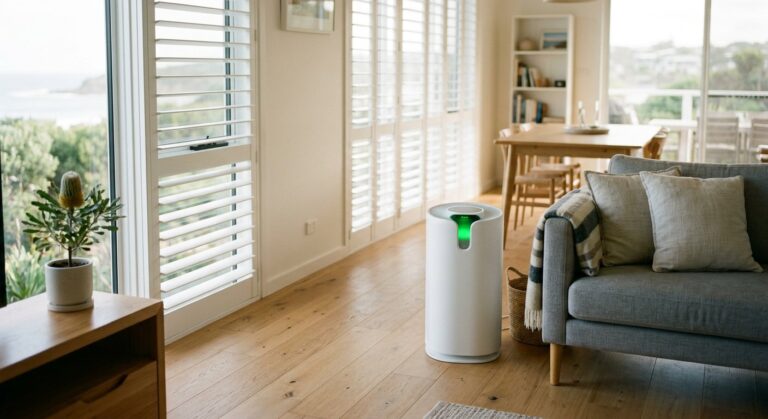
The best air purifier for dust in Australia for most homes is the Winix 5500-2: an AHAM-verified dust CADR of 243 cfm covers a living room of about 32 m², for $265.00at Amazon AU · as of 19 Nov 2026, 8:29 pm AEST Details. For a bedroom, I use the Coway Airmega 150 (dust CADR 161 cfm, about $299). For allergy households that want no ions at all, the Philips PureProtect 3200 (about $395). For open-plan areas, the Levoit Core 600S-P (about $459).
Before you buy, know what a purifier can and can’t do with dust. It catches the fine dust that floats: outdoor dust drifting in, cooking and traffic particles, the haze after you shake out a rug. It does very little about the dust already lying on the carpet and the bed, which is where dust mite allergen lives. As a former Navy Clearance Diver, I was trained to deal with the source of a problem before the symptoms. This guide covers both: the purifier, and the five cheaper steps that do more for dust mite allergy than any machine.
Buy a HEPA purifier sized for the room, run it all the time, and turn it up when you vacuum or make the bed. Then deal with the bedding and the carpet.
| Pick | Why | Price |
|---|---|---|
| Winix 5500-2 | Living rooms to ~32 m²; dust CADR 243 cfm | $265.00at Amazon AU · as of 19 Nov 2026, 8:29 pm AEST Details |
| Coway Airmega 150 | Bedrooms to ~21 m²; the one I own | Currently unavailable on Amazon AUas of 19 Nov 2026, 11:29 pm AEST Details |
| Philips PureProtect 3200 | Allergy households; no ions or ozone | $495.00at Amazon AU · as of 19 Nov 2026, 8:29 pm AEST Details |
| Levoit Core 600S-P | Open-plan areas to ~57 m² | $429.00at Amazon AU · as of 19 Nov 2026, 11:29 pm AEST Details |
| Levoit Core 300 | Budget, small bedrooms | $129.00at Amazon AU · as of 19 Nov 2026, 8:29 pm AEST Details |
✓ A dust purifier is worth it if
- Someone in the house has dust mite allergy or asthma
- You live near a busy road, a building site or unsealed roads
- Your home gets visible dust on surfaces within a day or two
- You have pets that shed (the pre-filter catches the hair)
× Spend your money elsewhere first if
- You haven’t covered mattresses and pillows or hot-washed the bedding yet
- The dust is from sanding, cutting or grinding indoors: use on-tool extraction and a P2 mask
- The problem is a smell or gas (VOCs need carbon, not HEPA)
- Your home is damp: mould and mites both need humidity control first
What household dust actually is
Household dust is a mix: skin flakes, fabric fibres, pet hair and dander, pollen, soil tracked in on shoes, fine particles from outside and from cooking, and the droppings of dust mites that feed on the skin flakes. It comes in two broad sizes, and the size decides what a purifier can do about it.
Fine dust (PM2.5 and smaller PM10) floats for hours. It drifts in from roads and building sites, comes off the stove when you fry, and hangs in the light after you shake a rug. This is what an air purifier is good at, because the air carries it to the filter.
Coarse dust and mite allergen is heavier. More than 80% of dust mite allergen is carried on particles bigger than 10 microns, and the main carrier, mite droppings, is about 20 to 25 microns across. According to the Thermo Fisher allergen reference, these particles are undetectable in the air of an undisturbed room and become airborne only for a short time when something disturbs them: making the bed, vacuuming, sitting on the couch. The rest of the time they are on the mattress, the pillow and the carpet, where no purifier can reach.
What a purifier can and can’t do
| Dust problem | Will a HEPA purifier help? | What does the heavy lifting |
|---|---|---|
| Fine dust from roads, traffic, building sites | Yes, well | Purifier running continuously, windows shut on bad days |
| Dust in the air after vacuuming or making the bed | Yes, if it’s on high at the time | Purifier on high for 20 to 30 minutes |
| Dust mite allergen in the mattress and pillows | Hardly | Mite-resistant covers, hot-washed bedding (ASCIA) |
| Dust settled on floors and shelves | No | HEPA vacuum and damp cloth |
| Pet hair and dander | Partly (pre-filter catches hair) | Grooming, vacuuming, purifier in the main living area |
| Silica dust from cutting or sanding | Not enough | On-tool extraction, wet cutting, P2 respirator |
A True HEPA filter, as the US EPA puts it, can theoretically remove at least 99.97% of particles at 0.3 microns, the hardest size to catch, and particles larger or smaller than that are trapped even more efficiently. So any genuine HEPA purifier will catch dust that reaches it. The question is never whether the filter catches dust, but how much air the purifier moves past it, and that is CADR.
One month of dust: my pre-filter
This is the pre-filter from my Coway Airmega 150 after one month in my home in Palm Beach, with a dog in the house. The grey layer is the coarse dust, lint and dog hair the pre-filter stops before it reaches the HEPA filter behind it. Most of that was floating in the room at some point.
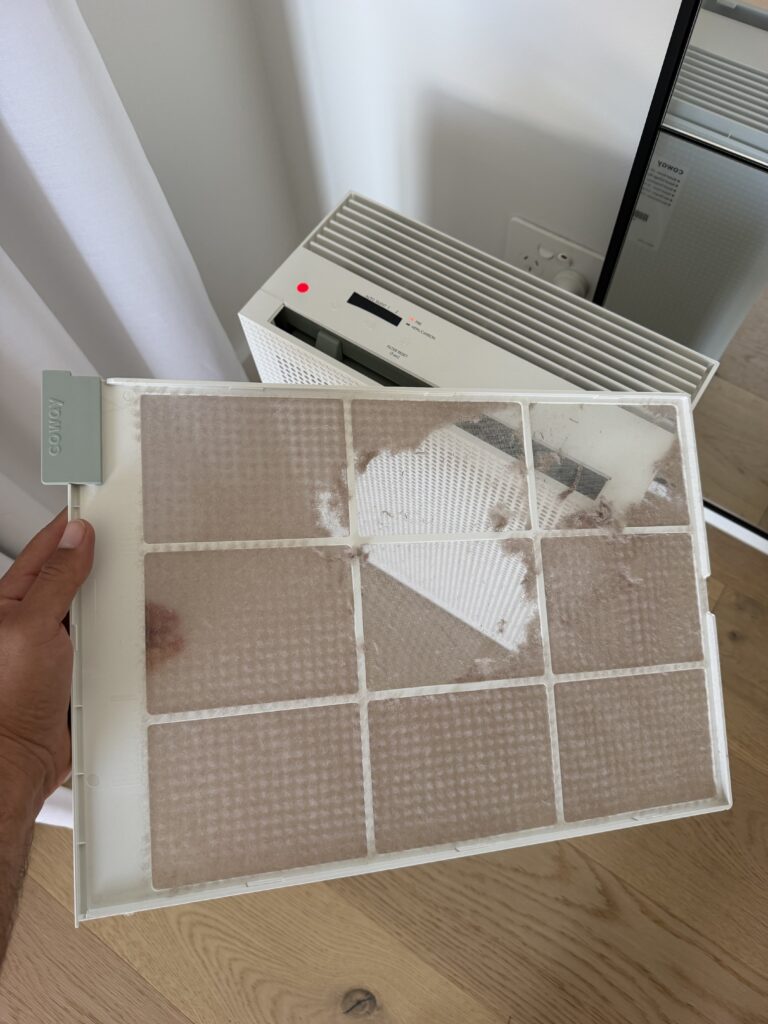
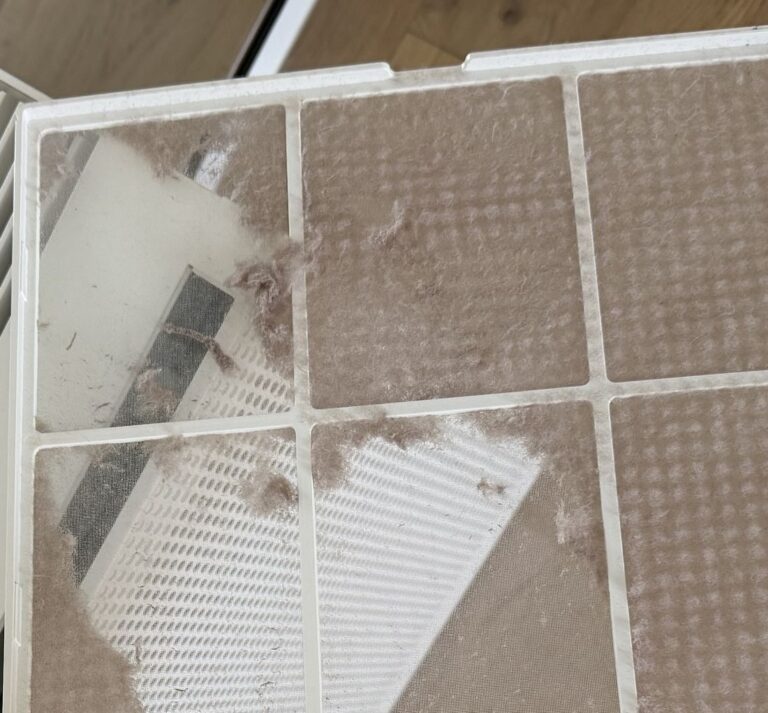
Two lessons from it. First, the pre-filter does a lot of the dust work, so a purifier whose pre-filter you can vacuum or rinse saves you money on HEPA replacements. Second, a loaded pre-filter cuts airflow. In a dusty house, clean it every couple of weeks rather than waiting for the reminder light. My Coway Airmega 150 review has the full filter story.
What to look for
| Spec | What to look for | Why it matters for dust |
|---|---|---|
| Filter | True HEPA, named and tested | “HEPA-type” or “HEPA-like” has no defined standard |
| CADR | A dust or smoke CADR from AHAM, or a stated test | It tells you how much clean air per minute; an “up to 80 m²” claim doesn’t |
| Pre-filter | Washable or vacuumable | Catches coarse dust and hair, protects the HEPA |
| Sensor and Auto | Particle sensor with Auto mode | Ramps up when you vacuum or make the bed |
| No ions or ozone | Ioniser off, or none fitted | The US EPA warns against air cleaners that intentionally produce ozone |
| Running cost | Filter price and life | A cheap purifier with dear filters isn’t cheap |
Ignore room sizes on the box. Brands calculate them on different bases: the Amazon AU listings for the Levoit Core 300 and Core 600S-P claim up to 80 and 294 m², for purifiers that suit rooms of about 15 and 57 m² on the US EPA’s rule. Use CADR instead.
Sizing table
| Room | Floor area | Smoke CADR needed | Picks that fit |
|---|---|---|---|
| Small bedroom or study | 10 to 12 m² | ~70 to 85 cfm | Levoit Core 300, Coway Airmega 150 |
| Main bedroom | 15 to 20 m² | ~110 to 145 cfm | Coway Airmega 150 |
| Living room | 25 to 32 m² | ~180 to 230 cfm | Winix 5500-2, Philips 3200 |
| Open-plan living | 40 to 57 m² | ~290 to 410 cfm | Levoit Core 600S-P |
Needed CADR is my calculation from the US EPA two-thirds rule (smoke CADR in cubic feet per minute of at least two-thirds of the floor area in square feet; 1 m² = 10.76 square feet; the rule assumes a standard 2.4 m ceiling). For dust allergy, go one size up so the purifier can do the job on a quieter setting. For your own room, use our CADR calculator.
The best air purifiers for dust
1. Winix 5500-2: best for most homes
 Best for most homes243 cfmdust CADR (AHAM, via HouseFresh)
Pre-filter + washable carbon + True HEPA + PlasmaWave (switch it off) | ~32 m² on the EPA 2/3 rule | Sold by Amazon AU
Check the Winix 5500-2 Price on Amazon →Amazon AU price: $265.00 · as of 19 Nov 2026, 8:29 pm AEST DetailsThe 5500-2 has the best-documented dust performance per dollar here. HouseFresh reports AHAM-verified CADRs of 232 cfm for smoke, 243 for dust and 246 for pollen, and Winix says it is AHAM Verifide. On the EPA rule that covers a living room of about 32 m². It has a fine-mesh pre-filter, a washable carbon filter and a True HEPA filter, and a particle sensor for Auto mode. PlasmaWave, Winix’s ionising stage, can be switched off, and I’d keep it off. Note that this is the US 5500-2; Winix’s Australian distributor sells a different Winix Zero model with its own spec sheet.
✓ Pros
- AHAM-verified dust CADR (243 cfm)
- Living-room size for about $279
- Huge rating base
× Cons
- PlasmaWave needs switching off
- Bulky for a bedroom
- US model, not the AU-distributed Zero
Buy this if…
you want one purifier for a dusty living room of up to about 32 m².
2. Coway Airmega 150: best for bedrooms
 Bedrooms | I own this161 cfmdust CADR (Coway)
Pre-filter + carbon + HEPA | ~21 m² on the EPA 2/3 rule | No ioniser listed | 35 W | Sensitive Choice approved
Check the Airmega 150 Price on Amazon →This is the purifier in my house, and the dusty pre-filter above is from it. Coway publishes CADRs of 153 cfm for smoke, 161 for dust and 220 for pollen, which suits a bedroom of up to about 21 m² on the EPA rule. Bedrooms are where dust mite allergy bites, because you spend eight hours there with your face in the pillow, and the 150 is quiet enough to run all night: I measured 32.1 dBA on Silent at one metre. It draws 35 W, lists no ioniser, and is approved under the National Asthma Council’s Sensitive Choice program.
✓ Pros
- The unit I run at home
- Quiet enough to sleep beside
- Sensitive Choice approved; no ioniser listed
× Cons
- Bedroom-sized only (~21 m²)
- Pre-filter needs regular vacuuming in a dusty home
- Deodorisation filter every 6 months
Buy this if…
the purifier is for the bedroom of someone with dust mite allergy, in a room up to about 21 m².
3. Philips PureProtect 3200: best for allergy households
 Allergy householdsECARFallergy-friendly certification (Philips)
HEPA NanoProtect + carbon | CADR 520 m³/h (GB/T, not AHAM) | No ions or ozone (Philips) | 15 to 47.5 dB(A) | 36 W
Check the Philips 3200 Price on Amazon →Amazon AU price: $495.00 · as of 19 Nov 2026, 8:29 pm AEST DetailsPhilips says the 3200 emits “no ions, chemicals or ozone”, and it carries ECARF allergy-friendly certification from the European Centre for Allergy Research Foundation. Its CADR of 520 m³/h is measured to the Chinese GB/T standard, which can’t be compared directly with AHAM figures, so I would size it for a living room or a large bedroom rather than trust the 135 m² on the listing. It is also the quietest purifier here on paper, 15 dB(A) at its lowest setting.
✓ Pros
- No ions or ozone (Philips)
- ECARF allergy-friendly certified
- Very quiet minimum
× Cons
- CADR on a GB/T basis, not AHAM
- Small rating base
- Dearer than the Winix
Buy this if…
someone in the house has allergies or asthma and you want nothing in the purifier that emits ions.
4. Levoit Core 600S-P: best for open-plan areas
 Open-plan areas410 cfmCADR (Levoit Core 600S manual)
Pre-filter + HEPA + carbon | If it has a Plasma button, keep it off | Core 600S AU figures: 410 cfm, 26 to 55 dB
Check the Core 600S-P Price on Amazon →Amazon AU price: $429.00 · as of 19 Nov 2026, 11:29 pm AEST DetailsOpen-plan kitchen, dining and living areas need a lot of air moved. Levoit’s Australian manual for the Core 600S gives a CADR of 697 m³/h (410 cfm), about 57 m² on the EPA rule, and 26 to 55 dB; Levoit doesn’t publish separate figures for the 600S-P sold here, so treat them as a close guide. Its size means it can run on a middle setting in a 40 m² room and still keep up when you vacuum. In the US, the 600S-P name belongs to Levoit’s PlasmaPro model, whose manual describes a switchable plasma stage that releases ions (and a 67 W rating). The Amazon AU listing (model LAP-C601S-WCA) doesn’t mention plasma; if yours has a Plasma button, keep it off. The HEPA filter does the dust work.
✓ Pros
- Covers ~57 m² on the EPA rule
- Large rating base
- Pre-filter, HEPA and carbon in one cylinder
× Cons
- Loud on high (55 dB)
- Takes floor space
- Plasma (ion) stage to switch off
Buy this if…
your dust problem is a big open-plan living area.
5. Levoit Core 300: budget pick for small rooms
 Budgetsold by Levoit’s AU distributor
Pre-filter + carbon + HEPA | CADR 187 m³/h (Levoit AU listing, test not stated) | ~15 m² on the EPA 2/3 rule | No ioniser
Check the Levoit Core 300 Price on Amazon →Amazon AU price: $129.00 · as of 19 Nov 2026, 8:29 pm AEST DetailsFor a small bedroom or study on a budget, the Core 300 has a pre-filter, carbon and HEPA, no ioniser, and a CADR of 187 m³/h on Levoit’s Australian listing, which doesn’t name the test. That is about 15 m² on the EPA rule; size it for a room of 12 m² or less so it isn’t running flat out. It is sold by VeSync, Levoit’s distributor.
✓ Pros
- About $169
- No ioniser
- Quiet Sleep mode (24 dB, Levoit)
× Cons
- CADR test method not stated
- Small rooms only
- No particle sensor
Buy this if…
you need a purifier for a small bedroom and the budget is under $200.
Check all seven rooms, not just this one
38 checks, 29 free, ranked by impact. Sent as a 32-page PDF.
We'll email you the audit and a short series of practical guides. Unsubscribe in one click, any time. Privacy.
Sent. Taking you to your download...
Comparison table
| Spec | Winix 5500-2 | Airmega 150 | Philips 3200 | Core 600S-P | Core 300 |
|---|---|---|---|---|---|
| Dust CADR | 243 cfm (AHAM) | 161 cfm | Not split* | Not split | Not split |
| Smoke / overall CADR | 232 cfm | 153 cfm | 520 m³/h GB/T | 410 cfm | 187 m³/h |
| Room (EPA 2/3 rule) | ~32 m² | ~21 m² | Living or bedroom* | ~57 m² | ~15 m² |
| Ions | PlasmaWave, switchable | None listed | None (Philips) | Plasma, switchable | None |
| Particle sensor | Yes | Yes | Yes | Yes | No |
| Ratings (Amazon AU) | 27,688, 4.6 | 304, 4.7 | 43, 4.7 | 6,121, 4.6 | 740, 4.6 |
| Price (29 Oct 2026) | ~$279 | ~$299 | ~$395 | ~$459 | ~$169 |
*The Philips GB/T CADR can’t be put through the EPA’s AHAM-based rule directly. Figures are the manufacturers’ own except the Winix, which is AHAM-verified as reported by HouseFresh.
Five steps that beat any purifier for dust mites
ASCIA, the Australasian Society of Clinical Immunology and Allergy, publishes the allergen minimisation advice Australian allergists hand out. None of its house dust mite steps involve an air purifier. These are the ones that matter, in order of what I’d do first:
1. Cover the bed. “Cover mattress, pillows, and quilts with dust mite resistant covers,” and wash the covers at least every two months (ASCIA).
2. Hot-wash the bedding weekly. ASCIA says to wash sheets and pillowcases weekly in water hotter than 60°C. If you can’t, use a wash product containing tea tree or eucalyptus oil, or dry the bedding outdoors and then tumble dry on hot for at least ten minutes.
3. Vacuum carpets and sofas weekly, ideally with a HEPA vacuum, then get out of the room. ASCIA advises weekly vacuuming, says HEPA vacuums may remove more allergen, and notes that all vacuuming increases airborne mite allergen, and suggests a mask or having someone else vacuum, then waiting 20 minutes before going back in. This is the moment your purifier earns its keep: run it on high while you vacuum and for half an hour after. See the best HEPA vacuums.
4. Keep the house dry. Dust mites thrive in warm, humid homes, which is most of coastal Queensland for half the year. ASCIA advises a dry, well-ventilated house and avoiding water-cooled air conditioners and unflued gas heaters, which add moisture. If your home is damp, a dehumidifier does more for mites than a purifier.
5. Think about hard floors. ASCIA notes that carpets can hold large amounts of mite allergen that vacuuming can’t fully remove, and suggests hard floors where practical and affordable.
What we left out
Breville Smart Air Viral Protect Max, the old top pick on this page: Breville states a CADR of up to 530 m³/h without naming the test, and it isn’t on the Sensitive Choice list. Coway Airmega Mighty (AP-1512HH): a proven purifier, but at about $399 online it costs $120 more than the Winix for a similar room size. Coway Airmega 400: excellent for large rooms, but about $999 online, so the Levoit Core 600S-P is better value for open-plan dust. Ionisers and ozone generators: they make particles stick to walls and furniture rather than capturing them, and the US EPA warns against air cleaners that intentionally produce ozone; see ozone and ioniser purifiers vs HEPA.
Which should you buy?
A dusty living room up to about 32 m²: Winix 5500-2. A bedroom for someone with dust mite allergy: Coway Airmega 150, plus mattress and pillow covers. Allergy or asthma, and you want no ions at all: Philips PureProtect 3200. A big open-plan area: Levoit Core 600S-P. A small bedroom under $200: Levoit Core 300. For pet hair, see the best air purifiers for pets; for mould, the best air purifiers for mould; for every HEPA option, the best HEPA air purifiers.
On a tighter budget? See the best air purifiers under $200, sized on real CADR for Australian bedrooms.
Final verdict
For most Australian homes, the Winix 5500-2 is the best air purifier for dust: an AHAM-verified dust CADR of 243 cfm for about $279. For a bedroom, the Coway Airmega 150 is the one I run, and its pre-filter after a month shows exactly how much dust a purifier pulls out of a room. But if dust mite allergy is the reason you are buying, start with the bed: covers and a 60°C wash will do more than the purifier, and the purifier will do the rest.
Prices change. Check Amazon AU before buying.
Frequently asked questions
What is the best air purifier for dust in Australia?
For most homes, the Winix 5500-2: an AHAM-verified dust CADR of 243 cfm suits a living room of about 32 m², for $265.00at Amazon AU · as of 19 Nov 2026, 8:29 pm AEST Details. For a bedroom, the Coway Airmega 150 (dust CADR 161 cfm, about $299).
Do air purifiers actually reduce dust?
Yes, for dust in the air. A True HEPA filter catches at least 99.97% of particles at 0.3 microns and larger particles even more efficiently. It can’t remove dust that has already settled on floors, furniture and bedding.
Do air purifiers help with dust mite allergy?
Only partly. Most dust mite allergen is on particles bigger than 10 microns that stay in bedding and carpet and become airborne only briefly when disturbed. ASCIA’s advice centres on mite-resistant covers, hot-washing bedding and vacuuming; a purifier helps most when it runs on high while you vacuum or make the bed.
What size air purifier do I need for dust?
Use the US EPA rule: a smoke CADR in cubic feet per minute of at least two-thirds of the room’s floor area in square feet. A 15 m² bedroom needs about 110 cfm; a 30 m² living room about 215 cfm. For allergies, go one size up.
Should I run my air purifier when I vacuum?
Yes. ASCIA notes that vacuuming increases airborne dust mite allergen. Run the purifier on high while you vacuum and for 20 to 30 minutes after, and stay out of the room for 20 minutes if you’re the allergic one.
How often should I clean the pre-filter in a dusty house?
Every two weeks or so in a dusty home or with pets, rather than waiting for the reminder. A loaded pre-filter cuts airflow. Never wash a HEPA filter unless the manufacturer says it is washable.
Is HEPA-type the same as True HEPA?
No. True HEPA is defined by its efficiency at 0.3 microns. “HEPA-type” and “HEPA-like” have no agreed standard, so look for a named True HEPA filter and a published CADR.
Will an air purifier help with renovation or silica dust?
It will reduce some of the fine dust left in the air, but it isn’t protection. For cutting, sanding or grinding, use on-tool dust extraction or wet methods and a properly fitted P2 respirator.
- ASCIA: allergen minimisation (house dust mite; content updated April 2024)
- Thermo Fisher allergen encyclopedia: house dust mite (d1), particle size and airborne behaviour
- US EPA: what is a HEPA filter?
- US EPA: how to create a cleaner air room (2/3 CADR rule)
- AHAM Verifide: air cleaner CADR and the 2/3 rule
- US EPA: ozone generators that are sold as air cleaners
- US EPA: guide to air cleaners in the home
- Coway: Airmega 150 CADR (153 smoke, 161 dust, 220 pollen)
- HouseFresh: Winix 5500-2 review (AHAM CADR, PlasmaWave behaviour)
- Winix America: 5500-2 product spotlight (True HEPA, AHAM Verifide)
- Philips: PureProtect 3200 (AC3220) specifications
- Levoit Core 600S (LAP-C601S-WAUR) user manual, Australian model (copy)
- Levoit: PlasmaPro 600S-P user manual (US model LAP-C601S-WUSR, switchable plasma)
- Levoit Core 300: Amazon AU listing (CADR 187 m³/h)
- Breville: Smart Air Viral Protect Max specifications
- National Asthma Council Australia: the Sensitive Choice program
- Sensitive Choice: approved Coway air purifiers

Former Royal Australian Navy Clearance Diver and TAG-E counter-terrorism operator. Founded Clean and Native to apply the same rigorous thinking to the home environment.
Full biography →The 7-Room Home Audit
Air is where most homes have their biggest free fix. The audit walks every room: 38 checks across air, water and EMF, ranked by impact against Australian guidelines.
- The rangehood habit that cuts gas cooking fumes
- Two-minute tests for exhaust fans, mould and stale bedrooms
- When a purifier helps, and the bedroom one I own
We'll email you the audit and a short series of practical guides. Unsubscribe in one click, any time. Privacy.
Sent. Taking you to your download...