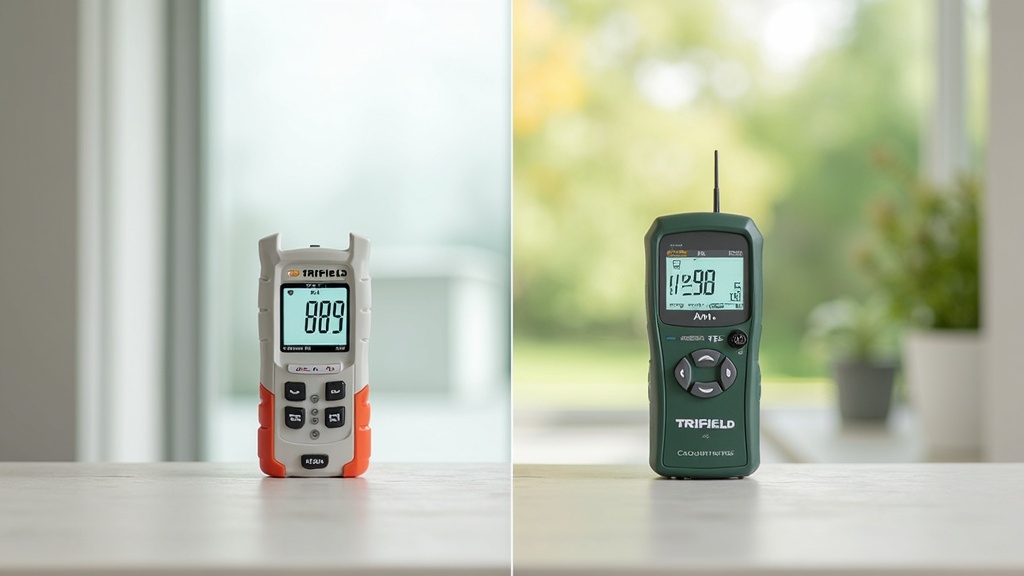
Trifield TF2 EMF Meter vs Acoustimeter AM-10: Which Should You Choose? (Australia 2026)
26 min read
You have two meters sitting in your shopping cart. One costs roughly $250, the other roughly $650. Both claim to measure the RF radiation filling your bedroom from the smart meter on the other side of the wall, the 5G small cell down the street, and the Wi-Fi router your family refuses to turn off at night. You need to know which one is worth your money — and more importantly, which one will give you data accurate enough to act on.
As a former Royal Australian Navy Clearance Diver, I approach EMF the same way I approached dive planning: measure first, trust the data, then decide. I have used both the TriField TF2 and the Acoustimeter AM-10 at my Palm Beach QLD house. This article gives you the unfiltered comparison — specifications, real-world readings, cost analysis, and the decision framework that tells you exactly which meter to buy based on your situation.
Short answer: The TriField TF2 is the better first meter for most Australian households because it measures three field types (RF, AC magnetic, AC electric) in one device for under $250. The Acoustimeter AM-10 is the better dedicated RF meter — more sensitive, wider frequency range, and real-time audio feedback — but it only measures RF and costs nearly three times as much. Your choice depends on whether you need a broad EMF survey tool or a specialist RF instrument.
Quick Verdict: TriField TF2 vs Acoustimeter AM-10
| Use Case | Winner | Why |
|---|---|---|
| First EMF meter for an Australian home | TriField TF2 | Measures RF + AC magnetic + AC electric in one unit for ~$250. Covers the three field types building biologists assess in every room. |
| Dedicated RF assessment (smart meters, 5G, towers) | Acoustimeter AM-10 | Wider RF frequency range (200 MHz–8 GHz), higher sensitivity floor (0.02 V/m), peak and average simultaneous display, real-time audio demodulation. |
| Budget under $300 | TriField TF2 | The AM-10 is typically $600–$700 AUD. If you cannot afford it, the TF2 still gives actionable RF data for Wi-Fi, routers, and most common household sources. |
| Verifying shielding canopy or paint effectiveness | Acoustimeter AM-10 | Peak hold and higher sensitivity let you confirm that pulsed signals (smart meters pulse every few seconds) are actually being attenuated, not just averaged away. |
| Assessing bedroom wiring and appliance magnetic fields | TriField TF2 | The AM-10 has zero magnetic or electric field measurement. Only the TF2 covers these. Building biology sleeping area guideline is <0.2 µT magnetic and <5 V/m electric. |
| Identifying specific RF source by sound | Acoustimeter AM-10 | Built-in speaker demodulates RF so you can hear the difference between Wi-Fi, DECT phone, smart meter, and 4G/5G. The TF2 has no audio output for RF. |
| Professional building biology surveys | Both (together) | Professionals typically carry a broadband RF meter (AM-10 or better) plus a separate magnetic/electric meter. The TF2 serves as the low-frequency companion to the AM-10. |
Why This Comparison Matters for Australian Homes
Australia has a specific EMF landscape that differs from the US and Europe. ARPANSA sets the RF exposure limit at 1,000 µW/cm² (10 W/m²) for the 2.4 GHz band — a thermal safety limit designed to prevent tissue heating. Building biology guidelines, used by the Institute of Building Biology + Sustainability (IBN) in Germany and adopted by Australian building biologists, recommend sleeping area RF levels below 0.1 mW/m² — that is 100,000 times lower than the ARPANSA limit.
The gap between those two numbers is where most Australian households sit. Your smart meter, your neighbour’s Wi-Fi, and the NBN fixed wireless tower down the road are all legal under ARPANSA. But they may still produce readings well above building biology guidelines in your bedroom. The only way to know is to measure.
Both the TriField TF2 and the Acoustimeter AM-10 can detect common Australian RF sources: Wi-Fi routers (2.4 GHz and 5 GHz), smart meters (typically 900 MHz in Australia via mesh networks operated by Ausgrid, Energex, and others), 4G/5G towers, and DECT cordless phones. But they differ significantly in how much detail they provide and what else they can measure.
Who Should Buy the TriField TF2
- You want one meter that covers RF, magnetic, and electric fields. The TF2 is a true three-in-one. You can survey your bedroom for wiring errors (AC magnetic), body voltage issues (AC electric), and wireless radiation (RF) without buying three separate instruments.
- Your budget is under $300 AUD. The TF2 retails for approximately $230–$260 AUD on Amazon Australia. That is a fraction of the AM-10’s price and gives you actionable data across all three field types.
- You are starting your first EMF assessment and need a baseline. When I first measured my Palm Beach house, the TF2 told me my router was producing 3.058 mW/m² at the bed head — over 30 times the building biology sleeping area guideline. That single reading justified the purchase and every action I took afterward.
- You need to check AC magnetic fields from meter boxes, wiring, and appliances. Many older Queensland homes have the electrical meter box on a bedroom wall. The TF2’s magnetic field mode (measuring in milliGauss, convertible to µT) is the only way to quantify this without hiring a building biologist. The AM-10 cannot do this at all.
- You want a simple, single-dial interface you can learn in five minutes. The TF2 has one rotary knob, a backlit LCD, and a clear needle-style display. No menus. No software. Pick it up, turn the dial, start walking around your house.
Who Should Buy the Acoustimeter AM-10
- Your primary concern is RF from smart meters, 5G towers, or nearby mobile base stations. The AM-10’s frequency range of 200 MHz to 8 GHz covers virtually all Australian telecommunications bands, including the 3.6 GHz band being deployed by Telstra, Optus, and TPG for mid-band 5G. It displays both peak and average power density simultaneously — critical for pulsed signals like smart meters that spike briefly then go quiet.
- You need to identify the type of RF source by sound. The AM-10’s built-in speaker and 3.5 mm audio output let you hear the modulation pattern of each signal. A Wi-Fi router sounds different from a DECT phone, which sounds different from a 4G tower. This audio feedback is the fastest way to locate and identify sources, especially when multiple signals overlap.
- You are verifying the effectiveness of RF shielding paint, window film, or a bed canopy. After I installed shielding at the Palm Beach house, the TF2 showed a drop from 3.058 mW/m² to 0.032 mW/m² — a 98.95% reduction. The TF2 confirmed the result. But the AM-10 would have shown me whether brief smart meter pulses were still penetrating during the gaps between Wi-Fi transmissions, because it holds and displays peak values separately.
- You want the sensitivity to measure very low RF levels and confirm a “clean” sleeping environment. The AM-10’s sensitivity floor of approximately 0.02 V/m (roughly 0.001 mW/m²) is well below the building biology “no concern” threshold of 0.1 mW/m². The TF2’s RF sensitivity floor is higher, meaning very low-level signals may not register.
- You are a building biologist, consultant, or someone planning to conduct assessments for others. The AM-10 is an industry-standard instrument used by building biology practitioners across Australia, the UK, and Europe. Its calibration, sensitivity, and dual-display format meet professional assessment requirements.
Head-to-Head Specification Comparison
Numbers tell the story. Here is every specification that matters, side by side.
| Specification | TriField TF2 | Acoustimeter AM-10 | What This Means for You |
|---|---|---|---|
| Fields Measured | RF, AC Magnetic, AC Electric | RF only | The TF2 covers all three field types a building biologist assesses. The AM-10 requires separate meters for magnetic and electric fields. |
| RF Frequency Range | 20 MHz — 6 GHz | 200 MHz — 8 GHz | The AM-10 extends to 8 GHz, covering more 5G mid-band frequencies. Both cover Wi-Fi 2.4/5 GHz and Australian smart meter bands (~900 MHz). |
| RF Sensitivity Floor | ~0.05 mW/m² (manufacturer states 0.001 mW/cm²) | ~0.001 mW/m² (0.02 V/m) | The AM-10 is roughly 50 times more sensitive. It can confirm you are below building biology “no concern” levels. The TF2 may bottom out before reaching that threshold. |
| RF Display | Single reading (weighted average), LCD with bar graph | Dual LED bar graphs: Peak and Average simultaneously | Pulsed signals (smart meters, 4G/5G) have high peaks and low averages. The AM-10 shows both. The TF2 shows a weighted value that may understate peak exposure. |
| RF Audio Output | None | Built-in speaker + 3.5 mm jack (demodulated audio) | The AM-10 lets you hear the signal. You can distinguish Wi-Fi from a DECT phone from a smart meter by its sound signature. The TF2 is silent on RF mode. |
| AC Magnetic Range | 0.1 — 100.0 mG (0.01 — 10.0 µT) | N/A — not measured | Building biology sleeping guideline: <0.2 µT (2 mG). Only the TF2 measures this. Relevant for meter box walls, bedside wiring, and powerlines. |
| AC Electric Range | 1 — 1,000 V/m | N/A — not measured | Building biology sleeping guideline: <5 V/m. Only the TF2 measures this. Relevant for unshielded lamp cords, extension leads near the bed, and in-wall wiring. |
| RF Measurement Units | mW/m² (selectable) | V/m and µW/m² (dual scale on LED bars) | Both provide power density readings. The AM-10’s V/m scale is commonly used in building biology reports and European standards. |
| Power Source | 2 × AA batteries (included) | Internal rechargeable battery (USB charge) or 2 × AA | Both can run on AA batteries. The AM-10’s rechargeable option is more convenient for extended surveys. |
| Country of Manufacture | USA (Alpha Lab Inc., Salt Lake City) | UK (EMFields Solutions Ltd) | Both are designed and manufactured by specialist EMF instrumentation companies with decades of experience. |
| Typical Australian Price (2025/26) | $230 — $260 AUD | $600 — $700 AUD | The AM-10 costs roughly 2.5–3× the TF2. The price difference funds either shielding materials or a second specialist meter. |
| Data Logging | No | No (3.5 mm audio out can feed a recorder) | Neither meter logs data natively. For long-term RF logging, you would need a spectrum analyser (e.g., Safe and Sound Pro II or higher-tier equipment). |
EMF Measurement
You cannot reduce what you have not measured.
The TriField TF2 measures AC magnetic, AC electric, and RF/microwave fields in a single meter. It is what I use to audit rooms at the Palm Beach house.
RF Measurement: Where the Real Differences Show Up
Both meters detect RF radiation. But the way they detect, display, and quantify it differs enough to change what you can actually do with the data.
Peak vs Average — Why It Matters for Australian Smart Meters
Australian smart meters (deployed across Victoria by Jemena, AusNet, CitiPower, Powercor, and United Energy, and rolling out in Queensland via Energex and Ergon) use mesh radio technology, typically in the 900 MHz band. These meters transmit in short, sharp pulses — a few milliseconds of high-power RF followed by seconds or minutes of silence.
The TF2 displays a weighted measurement that responds to these pulses, and it does have a “peak hold” function you can enable. But its response time and display resolution mean very brief spikes can be partially smoothed. You will see the meter jump when a smart meter pulses, but the exact peak power density may be understated.
The AM-10 was specifically designed for pulsed RF. Its peak LED bar has a fast response time, capturing brief spikes and holding them on the display long enough for you to read the value. Simultaneously, the average bar shows the time-averaged exposure. This dual display tells you two things at once: how strong the peaks are (relevant to some biological research) and what the average exposure is over time.
If you live within 3–5 metres of your smart meter — common in apartments in Melbourne, Sydney, Brisbane, and the Gold Coast where meter banks serve multiple units — the AM-10 gives you a more complete picture of what is happening at your bedroom wall.
Frequency Range: Does the Upper Limit Matter?
The TF2 covers 20 MHz to 6 GHz. The AM-10 covers 200 MHz to 8 GHz. In practice, the difference at the top end (6 GHz vs 8 GHz) matters for one scenario: proximity to 5G mid-band infrastructure operating in the 3.4–3.8 GHz band (both meters cover this) and future C-band deployments approaching 6 GHz.
Neither meter covers millimetre wave (mmWave) 5G in the 26 GHz band, which the ACMA has allocated for future Australian 5G use but which has seen minimal deployment as of early 2026. For mmWave, you would need a specialist instrument such as the Safe and Sound Pro II (which covers up to 8 GHz) or a dedicated mmWave detector.
At the low end, the TF2 starts at 20 MHz, capturing some RF signals the AM-10 (starting at 200 MHz) would miss — though very few common Australian household sources operate between 20 and 200 MHz. FM radio (88–108 MHz) is the main one, and it is rarely a concern indoors.
For the vast majority of Australian homes, both meters cover the frequencies that matter: Wi-Fi (2.4 GHz and 5 GHz), smart meters (~900 MHz), mobile towers (700 MHz, 850 MHz, 1800 MHz, 2100 MHz, 2600 MHz, 3500 MHz), DECT cordless phones (1.88–1.90 GHz), and Bluetooth (2.4 GHz). The AM-10’s extra headroom to 8 GHz is a future-proofing advantage, not a present-day necessity for most.
Audio Demodulation: The AM-10’s Killer Feature
The single most useful feature the Acoustimeter has over the TF2 is its built-in speaker. When you turn on the AM-10, it demodulates the RF signal into audible sound. Each type of RF source has a distinct acoustic signature.
Wi-Fi sounds like a rapid, irregular clicking or buzzing. A DECT cordless phone produces a steady, rhythmic pulse (about 100 pulses per second). A smart meter generates short bursts with long gaps. A 4G tower produces a continuous, dense buzzing.
Why does this matter? Because when you walk around your house with the AM-10, you do not just see a number go up — you hear what is causing it. If you are standing in your bedroom and the meter spikes, the audio tells you whether it is your own Wi-Fi router in the next room, your neighbour’s DECT phone, or the smart meter on the external wall. This identification step determines what action you take: turn off your own device, request a meter relocation, or apply shielding.
The TF2 has no audio output in RF mode. It has a sound function in magnetic field mode (useful for finding wiring faults), but for RF, you are reading numbers only. You can still identify sources by walking toward them and watching the reading climb, but it is slower and less definitive when multiple sources overlap.
AC Magnetic and AC Electric Fields: The TF2’s Exclusive Territory
This section is straightforward: the Acoustimeter AM-10 does not measure AC magnetic or AC electric fields. At all. If these fields matter to you — and they should — the TF2 is either your primary meter or a necessary companion to the AM-10.
AC Magnetic Fields in Australian Homes
AC magnetic fields at 50 Hz (Australia’s mains frequency) are produced by current flowing through wiring, appliances, and external powerlines. The building biology sleeping area guideline is below 0.2 µT (2 milliGauss). ARPANSA’s reference level for public exposure at 50 Hz is 200 µT — 1,000 times higher.
Common Australian sources that exceed building biology guidelines:
- Meter boxes on bedroom walls — especially common in Queensland and NSW homes built from the 1970s to 1990s. I have measured 1.5–3.0 µT at the bed head in homes where the meter box is on the other side of the wall.
- Net current wiring errors — where active and neutral currents do not follow the same path, creating a magnetic field that extends several metres from the wall. These are common in older homes that have been rewired piecemeal.
- Underfloor heating — in Melbourne and Hobart homes, electric underfloor heating can produce magnetic fields well above 0.2 µT at floor level.
- Bedside clock radios, phone chargers, and power boards — within 30 cm, these can exceed 0.2 µT.
The TF2 measures AC magnetic fields from 0.1 mG to 100 mG (0.01 µT to 10 µT), which comfortably covers the range from building biology guidelines up to levels that would concern any assessor. Without this capability, you are blind to an entire category of exposure in your sleeping environment.
AC Electric Fields in Australian Homes
AC electric fields at 50 Hz are produced by voltage in wiring, even when no current is flowing (i.e., even when appliances are switched off but the circuit is live). The building biology sleeping area guideline is below 5 V/m.
The TF2 measures AC electric fields from 1 V/m to 1,000 V/m. Common sources that exceed 5 V/m at the sleeping position:
- Unshielded lamp cords running behind or under the bed
- Extension leads and power boards near the bed head
- In-wall wiring directly behind the pillow — especially in homes with plasterboard walls and no shielded cable
- Electric blankets (even when switched off but still plugged in)
A common, free fix is to switch off the bedroom circuit at the switchboard before sleep. The TF2 lets you verify that this action actually reduces the electric field at your pillow to below 5 V/m. No AM-10 measurement will tell you this.
Decision Tree: 3 Questions to Your Answer
Do not overcomplicate this. Answer three questions and you will know which meter to buy.
Question 1: Is your primary concern RF/wireless radiation specifically, or do you need to assess all field types in your home?
→ All field types (RF + magnetic + electric): Buy the TriField TF2.
→ RF only: Proceed to Question 2.
Question 2: Is your budget above or below $500 AUD?
→ Below $500: Buy the TriField TF2. Its RF mode is adequate for identifying high-exposure areas and verifying the impact of source removal.
→ Above $500: Proceed to Question 3.
Question 3: Do you need to verify that your sleeping area is below the building biology RF guideline of 0.1 mW/m², or are you primarily trying to identify and remove the strongest sources?
→ Identify and remove strongest sources: The TF2 handles this. You will see clear spikes from routers, smart meters, and DECT phones.
→ Verify low-level compliance / validate shielding / professional assessments: Buy the Acoustimeter AM-10. Its sensitivity floor and peak detection are necessary for this work.
5-Year Cost Comparison
Neither meter has consumable parts or mandatory recalibration intervals for home use (professional building biologists may choose annual recalibration, which costs $100–$200 AUD per instrument). Battery costs are negligible. The primary cost is the purchase price.
| Item | Upfront (AUD) | Annual Running Cost (AUD) | 5-Year Total (AUD) |
|---|---|---|---|
| TriField TF2 (all three field types) | $250 | ~$5 (batteries) | $275 |
| Acoustimeter AM-10 (RF only) | $650 | ~$5 (batteries) | $675 |
| AM-10 + TF2 together (professional-level coverage) | $900 | ~$10 (batteries) | $950 |
| Alternative: Safe and Sound Pro II (RF, wider range) | $550 | ~$5 (batteries) | $575 |
For context: a single one-hour EMF assessment from a building biologist in Sydney, Melbourne, or Brisbane typically costs $250–$450 AUD. The TF2 pays for itself if it prevents even one professional visit or confirms that the professional’s recommendations actually worked.
Real-World Testing: What I Measured at Palm Beach QLD
I live in Palm Beach on the Gold Coast. The house has a Wi-Fi router (Telstra Smart Modem 3), a smart meter on the side of the house, and neighbours on both sides with their own Wi-Fi networks. The nearest Telstra macro tower is approximately 600 metres south. There is an NBN fixed wireless tower about 1.2 km to the west.
TriField TF2 Readings (Pre-Mitigation)
| Location | Field Type | Reading | Building Biology Guideline | Assessment |
|---|---|---|---|---|
| Bed head (master bedroom) | RF | 3.058 mW/m² | <0.1 mW/m² | 30× over guideline |
| Bed head (master bedroom) | AC Magnetic | 0.12 µT | <0.2 µT | Within guideline |
| Bed head (master bedroom) | AC Electric | 18 V/m | <5 V/m | 3.6× over guideline |
Post-Mitigation Readings
After installing a shielding canopy and switching the bedroom circuit off at the switchboard:
| Location | Field Type | Reading | Reduction |
|---|---|---|---|
| Bed head (inside canopy) | RF | 0.032 mW/m² | 98.95% reduction (now below 0.1 mW/m² guideline) |
| Bed head (circuit off at switchboard) | AC Electric | 1.2 V/m | 93.3% reduction (now below 5 V/m guideline) |
These readings were taken with the TriField TF2. The TF2 confirmed the shielding canopy was effective for RF and confirmed the circuit switch-off was effective for electric fields. An Acoustimeter would have provided more granular RF data — particularly on whether smart meter pulses were being fully attenuated during the canopy test — but the TF2 gave enough resolution to verify a 98.95% reduction and confirm the result was below the building biology guideline of 0.1 mW/m².
Critical note on the shielding canopy: I removed all internal RF sources from the bedroom first (phone on aeroplane mode, no Wi-Fi devices inside the room). A shielding canopy reflects RF. If you leave a phone or tablet inside the canopy with Wi-Fi active, the canopy traps and amplifies the signal. Always remove internal sources first, then shield against external residual. The correct sequence is: measure → reduce sources → shield external residual.
The Highest-Impact Actions Cost Almost Nothing
Before you spend $250 or $650 on a meter, know this: the two highest-impact bedroom actions are nearly free.
- Router timer from Bunnings — approximately $15. Set it to turn off your Wi-Fi router from 10 PM to 6 AM. This eliminates the single largest RF source in most Australian homes during the hours you are sleeping. If your household uses the NBN via a modem/router combo, the timer turns off both the router’s Wi-Fi and its connection to the NBN box.
- Phone on aeroplane mode — free. Your phone transmits cellular, Wi-Fi, and Bluetooth signals. On your bedside table, it may be the strongest RF source within 1 metre of your head. Aeroplane mode stops all transmission instantly. You can still use the alarm function.
These two actions alone will reduce RF exposure in most bedrooms by 80–95%. A meter confirms the result and identifies any remaining sources (neighbour’s Wi-Fi, smart meter, external towers) that may require shielding.
Alternative to Consider: Safe and Sound Pro II
If you are reading this comparison, you may also be considering the Safe and Sound Pro II. It sits between the TF2 and AM-10 in both price (approximately $500–$550 AUD) and capability.
| Feature | TriField TF2 | Acoustimeter AM-10 | Safe and Sound Pro II |
|---|---|---|---|
| Fields measured | RF + Magnetic + Electric | RF only | RF only |
| RF range | 20 MHz — 6 GHz | 200 MHz — 8 GHz | 200 MHz — 8 GHz |
| Peak + Average | Weighted (peak hold available) | Simultaneous dual display | Simultaneous dual display |
| Audio output | No (RF mode) | Yes (speaker + 3.5 mm) | Yes (speaker + 3.5 mm) |
| Australian price (approx.) | $230–$260 | $600–$700 | $500–$550 |
The Safe and Sound Pro II offers many of the AM-10’s RF advantages (peak/average display, audio demodulation, similar frequency range) at a lower price point. It is manufactured by Safe Living Technologies in Canada and is well-regarded by building biologists. However, like the AM-10, it measures RF only — you still need the TF2 or equivalent for magnetic and electric fields.
If your budget stretches to $750–$800 total and RF is your primary concern, the combination of a Safe and Sound Pro II (for RF) and a TriField TF2 (for magnetic and electric fields) gives you professional-level coverage across all three field types.
Common Mistakes When Buying an EMF Meter in Australia
I see the same errors repeated in forums, Facebook groups, and email questions. Here are the ones that cost people money or lead to bad data.
Mistake 1: Buying a Cheap RF Detector from eBay or Temu
Sub-$50 “EMF detectors” sold on eBay, Temu, and AliExpress typically have no calibration certificate, unknown frequency response, and sensors that respond unpredictably to different signal types. They may show a number on the screen, but that number has no verified relationship to actual field strength. You cannot make decisions about shielding, canopy purchases, or source removal based on data from an uncalibrated instrument.
Both the TF2 (manufactured by Alpha Lab Inc.) and the AM-10 (manufactured by EMFields Solutions Ltd.) are factory-calibrated to known standards. Their measurements can be compared against building biology guidelines with reasonable confidence.
Mistake 2: Measuring RF and Ignoring Magnetic and Electric Fields
RF gets the most attention in online discussion. But if your meter box is on your bedroom wall, your AC magnetic field exposure at night may be a larger concern than your RF exposure — and the AM-10 will never tell you about it. The TF2 covers all three. If you buy the AM-10 alone, you have a blind spot.
Mistake 3: Shielding Before Measuring
I have seen Australians spend $400–$1,200 on shielding canopies, paint, or window film before taking a single measurement. Without baseline data, you cannot verify the shielding worked. Without identifying internal sources first, you risk the shielding trap: a canopy reflecting internal RF (from a phone or tablet left active inside) and increasing your exposure. The correct sequence is always measure → reduce sources → shield external residual → measure again to verify.
Mistake 4: Expecting a Consumer Meter to Replace a Spectrum Analyser
Neither the TF2 nor the AM-10 is a spectrum analyser. They cannot tell you the exact frequency of a signal, separate overlapping signals by frequency, or provide a spectral display. They give you broadband power density across their entire frequency range. For most home assessments, this is sufficient. If you need frequency-specific data — for example, to distinguish between 900 MHz smart meter emissions and 850 MHz Telstra signals — you need a spectrum analyser, which starts at around $2,000 AUD.
What About the ARPANSA Limits?
ARPANSA’s Radiation Protection Standard for Maximum Exposure Levels to Radiofrequency Fields (Radiation Protection Series No. 3) sets general public exposure limits that vary by frequency. At 2.4 GHz (Wi-Fi), the limit is 1,000 µW/cm², which converts to 10,000 mW/m² or 10 W/m².
For context, the highest reading I have measured at the Palm Beach house was 3.058 mW/m² from the Wi-Fi router — that is 0.03% of the ARPANSA limit. Building biology guidelines recommend sleeping below 0.1 mW/m² — that is 0.001% of the ARPANSA limit.
The ARPANSA limit is a thermal safety limit designed to prevent measurable tissue heating. It does not address non-thermal biological effects, which are the subject of ongoing scientific debate. Building biology guidelines apply the precautionary principle and set thresholds orders of magnitude lower. Both the TF2 and the AM-10 are designed to measure at building biology levels, not ARPANSA levels — ARPANSA-level RF would pin both meters at maximum.
This is not a commentary on whether ARPANSA limits are adequate. It is a factual statement that both meters are calibrated and ranged for the exposure levels you will actually encounter in your home, which are far below ARPANSA limits but may be above building biology guidelines.
Measurement Protocol: How to Use Either Meter
Whether you buy the TF2 or the AM-10, follow this room-by-room protocol for your first assessment.
Step 1: Remove Known Sources Temporarily
Turn off Wi-Fi on your router, put all phones on aeroplane mode, and switch off DECT cordless phones. This establishes your ambient baseline — the RF that comes from outside your home (towers, neighbours, smart meters). Measure at the bed head, centre of the bed, and foot of the bed. Record the readings.
Step 2: Re-enable Sources One at a Time
Turn on the Wi-Fi router first. Walk back to the bedroom and measure again. The difference between Step 1 and Step 2 is your router’s contribution to bedroom RF. Then turn on the DECT phone. Measure again. Then take phones off aeroplane mode. Each step isolates one source’s contribution.
Step 3: Measure Magnetic Fields (TF2 Only)
Switch the TF2 to AC magnetic mode. Walk slowly along every wall of the bedroom, holding the meter about 10 cm from the wall surface. Pay attention to areas behind which wiring runs, the meter box, or the switchboard. Move to the bed and measure at pillow height. Record readings at each location.
Step 4: Measure Electric Fields (TF2 Only)
Switch to AC electric mode. Stand barefoot (or in socks) on the floor near the bed. Hold the meter at pillow height. The reading indicates the electric field at your sleeping position. Then switch off the bedroom circuit at the switchboard and measure again. The difference tells you how much of the electric field is from your own wiring vs external sources.
Step 5: Record Everything
Write down every reading with the location, date, time, and what sources were active. This record becomes your baseline for all future measurements and lets you quantify the effect of any changes you make.
Our full measurement guide walks through this protocol room by room with photos and example readings from the Palm Beach house.
Final Verdict
Buy the TriField TF2 if you want one meter that covers all three field types, you are conducting your first home EMF assessment, and your budget is under $300 AUD. It is the single best starting instrument for an Australian household. It will identify whether your router, wiring, meter box, or smart meter is the dominant source of exposure in your sleeping area, and it will verify whether simple actions (router timer, circuit switch-off, phone aeroplane mode) have worked. At $250, it pays for itself immediately.
Buy the Acoustimeter AM-10 if your primary concern is RF specifically, you need high-sensitivity measurement to confirm you are below building biology guidelines, you are validating shielding effectiveness against pulsed signals like smart meters, or you are conducting assessments professionally. It is the better RF instrument by a clear margin — but it measures RF only. You will still need a magnetic/electric field meter alongside it.
Buy both if you want professional-level coverage and your budget allows $900 AUD. The AM-10 handles RF with superior sensitivity, peak detection, and audio demodulation. The TF2 handles AC magnetic and AC electric fields. Together, they cover every field type a building biologist assesses.
For most readers of this site, the TriField TF2 is the right first purchase. It is what I used to take the readings that prompted every mitigation step at the Palm Beach house. Once you have data from the TF2, you will know whether a specialist RF meter like the AM-10 is your next step — or whether a $15 router timer and aeroplane mode solved 90% of the problem.
Check TriField TF2 Price on Amazon AustraliaMeasures RF + magnetic + electric fields
Check Safe and Sound Pro II Price on Amazon AustraliaDedicated RF meter with audio demodulation
Start with a measurement, not a purchase.
Our measurement guide covers the room-by-room protocol used at the Palm Beach house.
30 checks across water, air and EMF. Most of them free. Ranked by impact. No spam. Unsubscribe any time. Former Royal Australian Navy Clearance Diver and TAG-E counter-terrorism operator. Founded Clean and Native to apply the same rigorous thinking to the home environment.Get the Australian Home Environment Checklist