How to Measure EMF in Your Home (Australia): An 8-Step Protocol With Real Readings
Drafted with AI assistance and checked against published specifications and certifications. First-hand measurements appear only where stated. How we make content
How this assessment was made. Every reading on this page is mine, taken with my own TriField TF2 in my house in Palm Beach, QLD, between March and June 2026, and read off the meter’s display in the photos shown. I spent my working life as a Navy Clearance Diver, where you measure before you act and you trust the instrument, not the story, so this guide is built the same way: a repeatable procedure, real numbers, and the limits of the gear stated plainly. I do not own the Safe and Sound Pro II; it is described from its maker’s manual. Measurement advice comes from ARPANSA and the meter manuals, cited below. Prices checked 3 Nov 2026. Drafted with AI assistance and checked against the sources: how we make content.
Short answer: to measure EMF in your home you measure three different things, because each has its own source, unit and meter setting: RF from wireless devices (mW/m² or µW/m²), AC magnetic fields from electrical current (mG or µT) and AC electric fields from voltage in wiring (V/m). A three-mode meter such as the TriField TF2 (about $289) reads all three. Start at the bed, measure at the pillow, write every reading down, switch sources off one at a time to find what is causing each number, then compare the results against the right yardstick. ARPANSA also hires out magnetic field meters for $100 for five days if you only want to check mains fields once.
Buy a TriField TF2 if you want to audit the whole house yourself. Hire one if you only need a weekend. If your real question is how low the wireless signal is at your pillow, hire a Safe and Sound Pro II, which reads far lower than the TF2.
| Option | Best for | Price |
|---|---|---|
| TriField TF2 | Whole-house audit: RF, magnetic and electric in one meter | $299.00at Amazon AU · as of 19 Nov 2026, 11:43 pm AEST Details |
| TriField TF2 hire (SaferEMF) | One-off check, 3 days | $99 + deposit (3 Nov 2026) |
| Safe and Sound Pro II hire (SaferEMF) | Low-level bedroom RF | $99 + $400 deposit (3 Nov 2026) |
| ARPANSA meter hire | Mains magnetic fields only, 5 days | $100 (3 Nov 2026) |
✓ This guide is for you if
- You want to know what EMF levels are actually in your home, not guess
- You have, or are about to buy or hire, an EMF meter
- You want to check a bedroom, a router position or a meter box wall
- You want to understand readings before spending money on fixes
× It will not
- Tell you a reading is safe or harmful: it shows you where it sits on each yardstick
- Replace a licensed electrician for anything involving wiring
- Turn a consumer meter into a certified survey
- Recommend shielding products: ARPANSA does not recommend phone protective devices, and distance does most of the work
The three things you are measuring
| Field | Comes from | Unit | TF2 setting |
|---|---|---|---|
| RF (radiofrequency) | Wi-Fi routers, phones, smart meters, Bluetooth, baby monitors, mobile base stations | mW/m² or µW/m² (1 mW/m² = 1,000 µW/m²) | RF, 20 MHz to 6 GHz |
| AC magnetic field | Current flowing: appliances with motors or heating elements, wiring under load, meter boxes, powerlines | mG or µT (1 µT = 10 mG) | Magnetic, 0.1 to 100 mG |
| AC electric field | Voltage in wiring and cords, even with nothing switched on | V/m | Electric, 1 to 1,000 V/m |
Two facts from ARPANSA explain most surprises. Magnetic fields depend on current, not voltage, so a high-voltage line does not necessarily read high unless it carries a large current, and appliances with high current, such as those with motors, tend to read higher. And readings vary with design, so one brand of kettle or fridge may differ from another. Measure your own, rather than trusting a table.
What to measure with
| Option | Measures | Strength | Limit | Cost |
|---|---|---|---|---|
| TriField TF2 (I own this) | RF, AC magnetic, AC electric | One meter for the whole house; manual gives accuracy at 50 Hz | Lowest RF step is 1 µW/m²; RF stops at 6 GHz; 3-second peak hold only | $299.00at Amazon AU · as of 19 Nov 2026, 11:43 pm AEST Details; $289 SaferEMF |
| Safe and Sound Pro II | RF only, 200 MHz to 8 GHz | Reads down to 0.1 µW/m² on its linear range; MAX hold | No magnetic or electric fields; ±6 dB | $499 SaferEMF; $99 hire |
| ARPANSA meter hire | Mains (ELF) magnetic fields | The regulator’s own meters (Sypris 4080 or EMDEX Snap) | No RF, no electric field | $100 for 5 days |
| NATA-accredited consultant | RF survey | Accredited measurement, the route ARPANSA suggests for RF | Cost; you book and wait | Quote |
 I own this
Magnetic 0.1 to 100 mG, 3-axis, 40 Hz to 100 kHz | Electric 1 to 1,000 V/m | RF 20 MHz to 6 GHz, 0.001 to 19.999 mW/m² | peak captures bursts every 12 ms and holds 3 s | 9 V battery, 20+ hours (12+ with backlight)
Check the TriField TF2 price on Amazon →Amazon AU price: $299.00 · as of 19 Nov 2026, 11:43 pm AEST DetailsSaferEMF on the Gold Coast sells the TF2 for the same $289 and hires it for $99 for three days plus a refundable deposit (checked 31 Oct 2026). Full test results are in my TriField TF2 review.
 Bedroom RF$499SaferEMF; hire $99
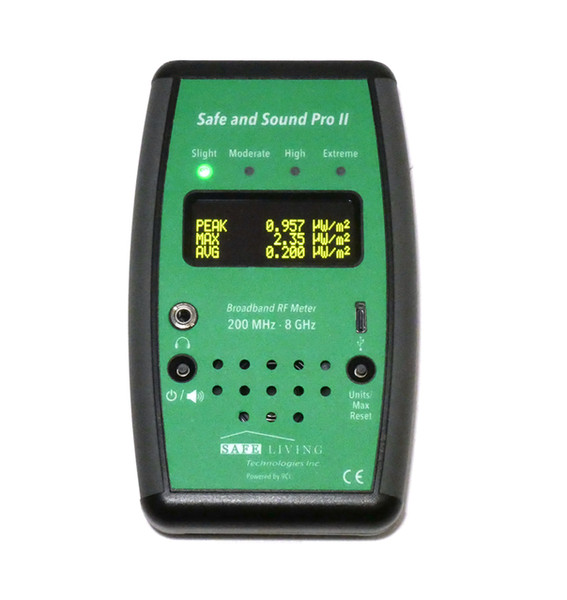
RF only, 200 MHz to 8 GHz | linear from 0.1 to 1,000,000 µW/m² (SLT manual) | ±6 dB from 400 MHz to 7.2 GHz | PEAK, MAX and AVG | $499 at SaferEMF, $569.95 online | I have not used one
Buy or hire the Pro II at SaferEMF →Why it matters: the building biology “no concern” band for RF where you sleep is under 0.1 µW/m², and the TF2’s smallest step is 1 µW/m². A TF2 can tell you a bedroom is above that line; it cannot confirm one is below it. Our Safe and Sound Pro II review (from the maker’s specifications) and best EMF meter guide cover the trade-off.
Before you start
- Pick a time, and repeat it. ARPANSA notes household electricity demand “typically peaks during the evening at about 7.00 pm”, so magnetic readings change through the day. Measure at least once in the evening.
- Use the right height. ARPANSA’s magnetic field method is the middle of the room at about one metre from the floor, plus where people spend time, such as the bed.
- Keep the meter still. ARPANSA warns that shaking or vibrating a meter can give false readings.
- Do not jam it against devices. Readings taken a few centimetres from portable electronics may be false (ARPANSA). Note the distance for every reading.
- Mind your body. The TF2 manual says your body shields electric fields, a hand over the top lowers the reading and a hand behind it raises it. For RF, the Pro II manual says to hold the meter at least 30 cm from your body. Hold it the same way every time.
- Write down what is on. Router, phones, appliances, heating or air conditioning. A reading without that context cannot be repeated.
The 8-step home EMF measurement protocol
This is the order I use. It starts where you spend the most continuous hours and works outward, and each step comes with what I measured at home so you can see what real numbers look like.
1. Take a baseline in each room
Middle of the room, about 1 m off the floor, on all three settings. ARPANSA gives typical household magnetic fields away from appliances as about 0.1 to 2 mG. The TF2 manual says most homes read under 5 mG magnetic, under 20 V/m electric and under 5 mW/m² RF. Anything well above those is worth tracing.
2. Measure the bed at the pillow
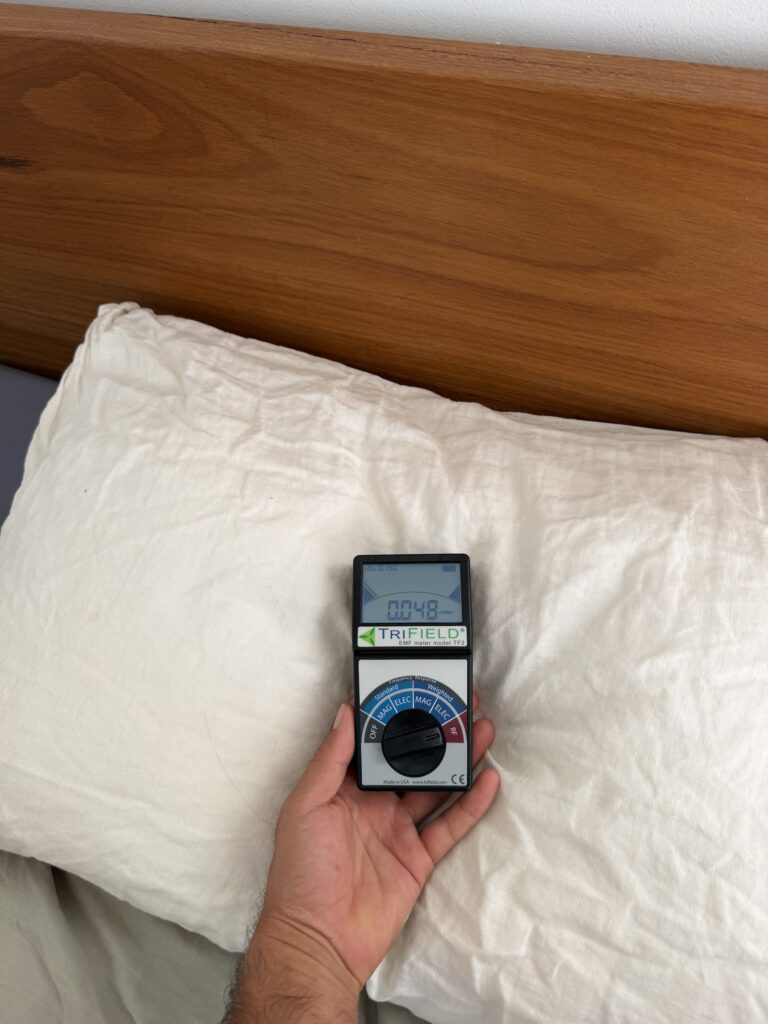
Lay the meter where your head goes and read RF, then magnetic, then electric. At my pillow the RF read 0.048 mW/m² with a peak of 0.150, and the electric field at the pillow surface read 2 V/m.
3. Check the bedhead and the wall behind it
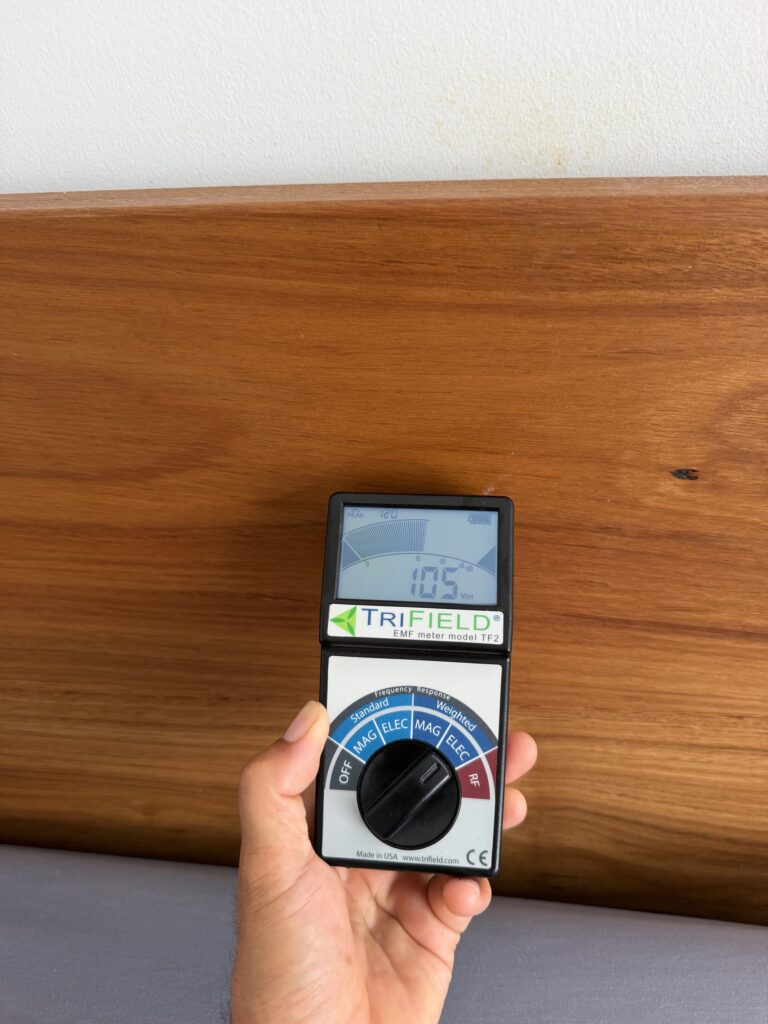
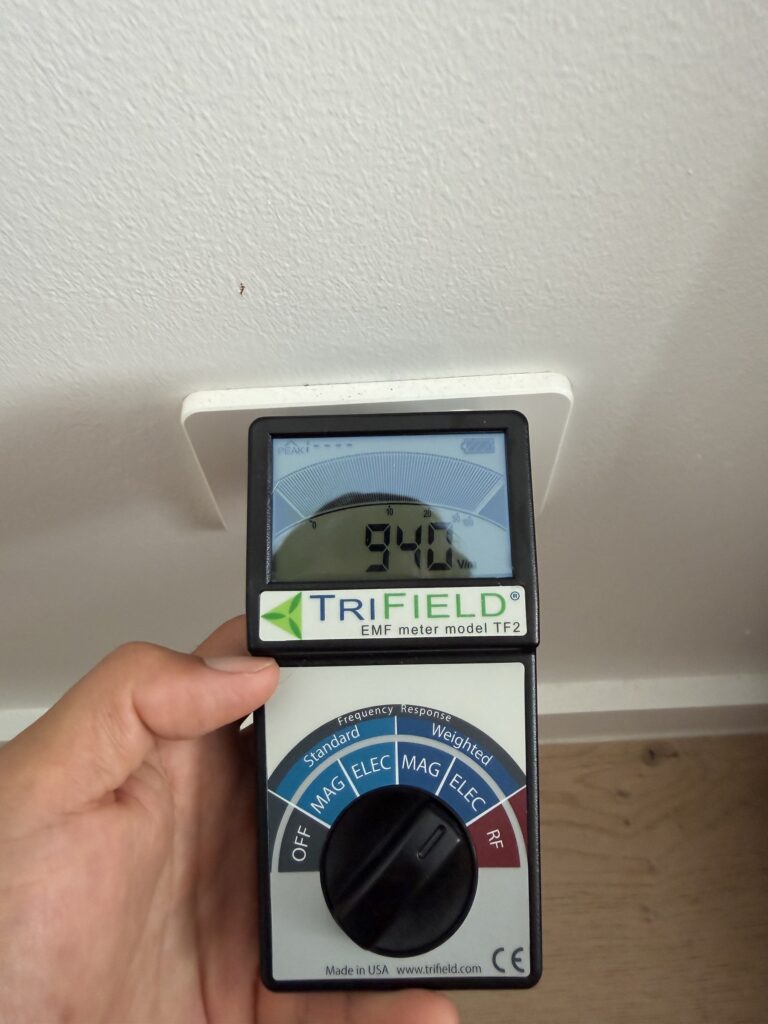
Wiring often runs behind beds. Move the meter slowly along the bedhead and wall. My timber bedhead read 50 to 105 V/m electric. Elsewhere in the house, two internal walls read 8.2 and 11.7 mG magnetic. A wall shared with a meter box deserves a separate reading: ARPANSA says moving a bed away from a meter box, typically more than one metre, lowers exposure.
4. Walk away from the router and log the drop
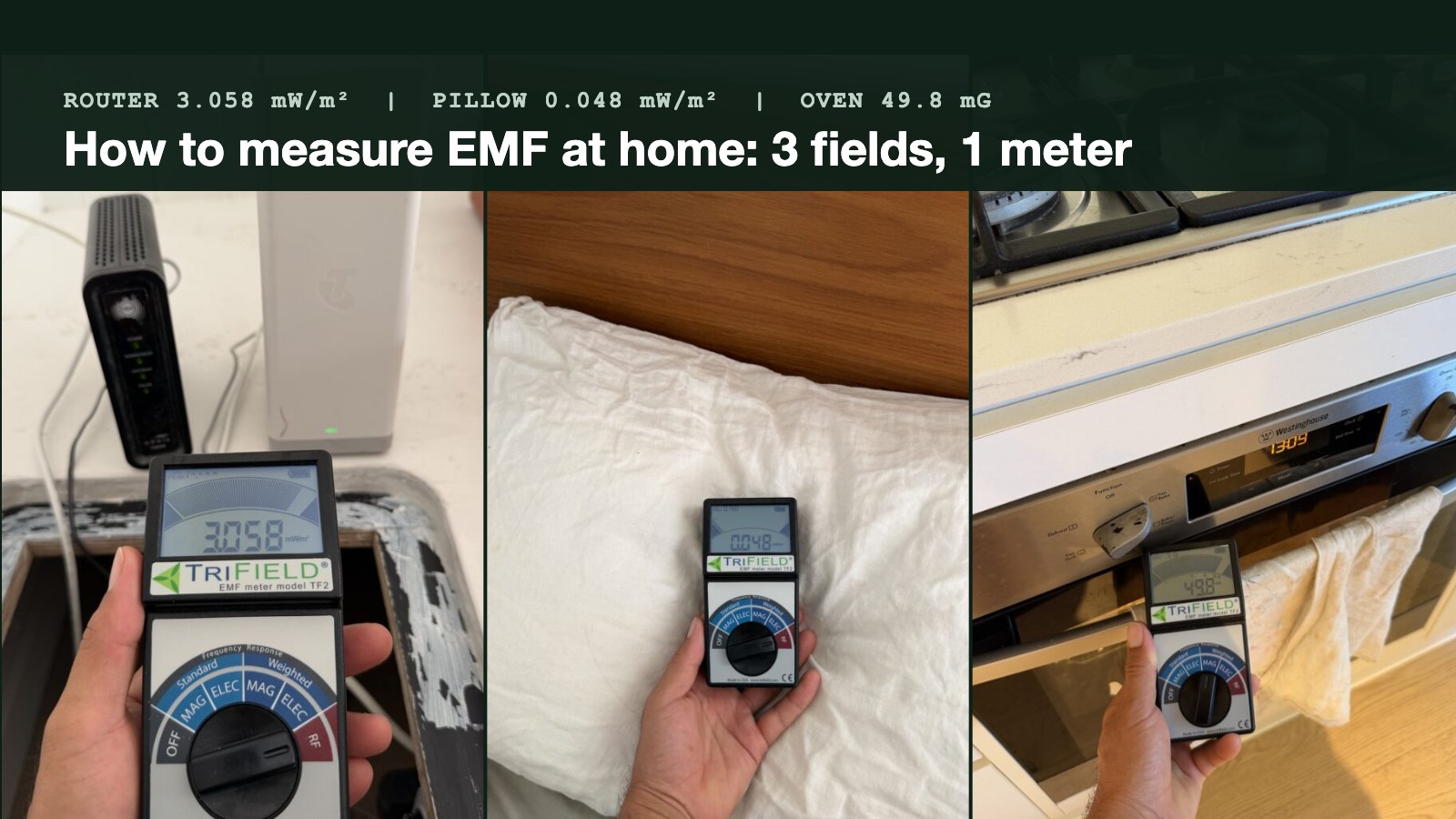
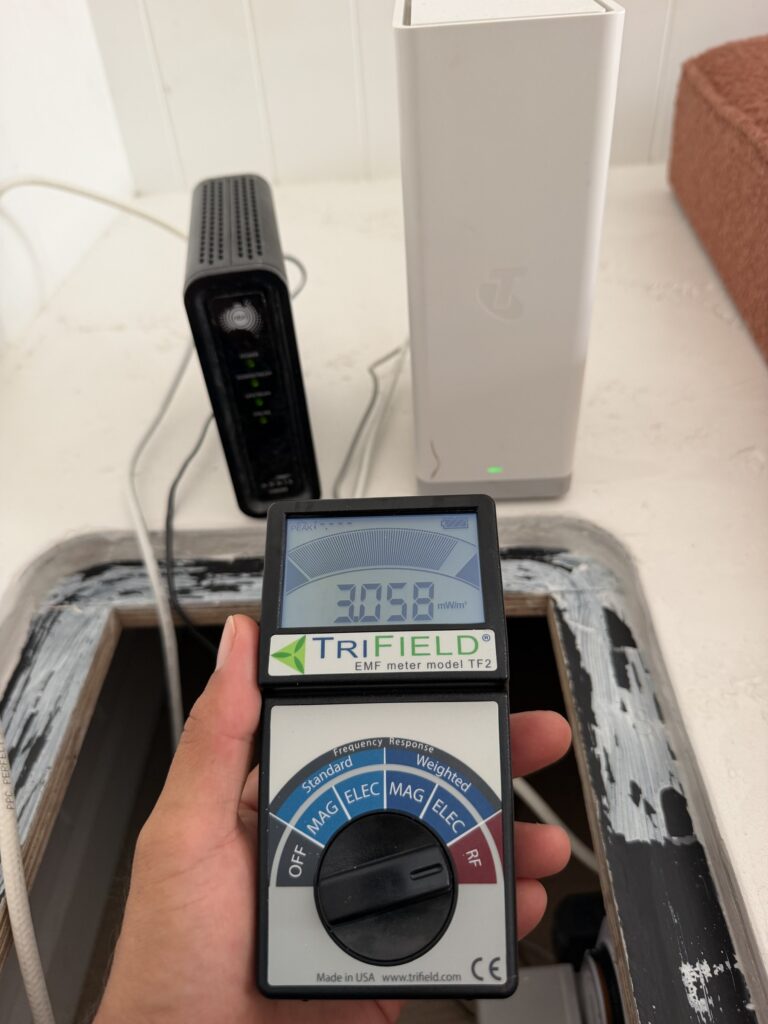
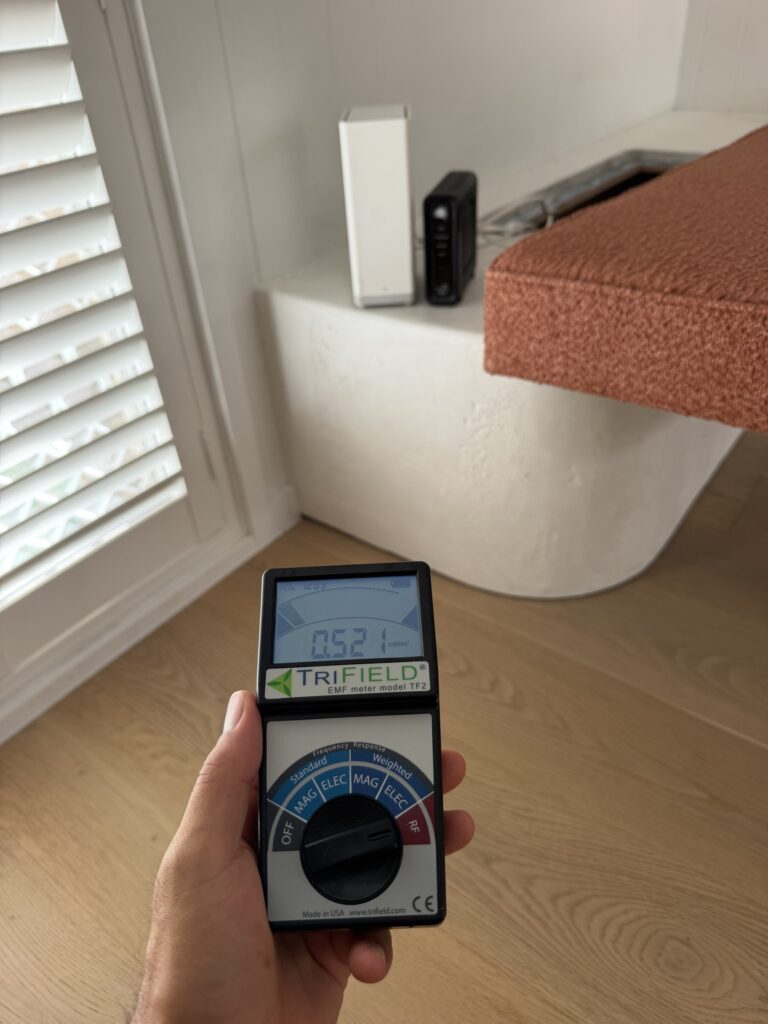
Start beside the router, then step back in stages and write each number down. Mine read 3.058 to 4.380 mW/m² at close range, 0.521 two to three metres away in the same room, 0.257 further back, 0.124 in the hallway and 0.032 on the living room couch. That run of numbers is the single most useful thing a meter shows you: distance does most of the work.
5. Watch the peak for smart meters and other bursty sources
Wi-Fi, phones and smart meters transmit in bursts. The TF2 captures bursts every 12 ms and holds the highest for 3 seconds. Its manual notes smart meters may send a packet only about once a minute, so stand at the closest indoor point to the meter, watch the peak reading for a minute or two, and record the highest value you see.
6. Measure appliances at the distance you use them
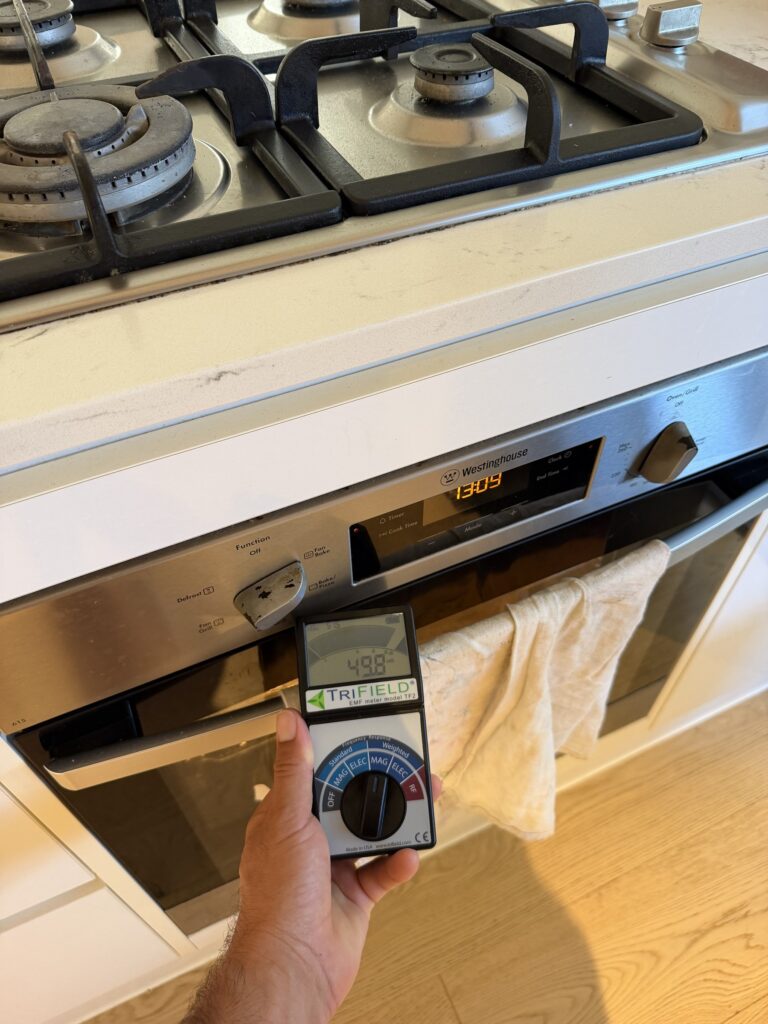
Measure where your body actually is, not with the meter on the appliance. At my gas oven door, in the cooking position, the magnetic field read 49.8 mG. For comparison, ARPANSA lists electric stoves at 2 to 30 mG and hair dryers at 10 to 70 mG at normal user distance.
7. Isolate sources one at a time
For any high reading, keep the meter in the same spot and the same grip, then switch one thing off at a time: the router, a phone into aeroplane mode, a lamp unplugged. The reading that drops tells you the source. Leave anything inside walls or the switchboard to a licensed electrician.
8. Repeat, and re-measure after every change
Take the key readings again in the evening and on another day. After any change, measure the same spot the same way. My router now runs on a timer, off from 9 pm to 6 am; see the router timer guide. For a bedroom-only version of this protocol, use the EMF bedroom audit.
Record sheet
Copy this layout into a notebook or spreadsheet. The first rows are from my house; my early photos did not log the time or what was switched on, which is exactly the gap this sheet closes.
| Date and time | Spot | Distance | What was on | RF (mW/m²) | Magnetic (mG) | Electric (V/m) |
|---|---|---|---|---|---|---|
| 2026 | Pillow | On the pillow | Not logged | 0.048 (peak 0.150) | 2 | |
| 2026 | Router | Close range | Router on | 3.058 | ||
| 2026 | Oven door | Cooking position | Not logged | 49.8 | ||
Check all seven rooms, not just this one
38 checks, 29 free, ranked by impact. Sent as a 32-page PDF.
We'll email you the audit and a short series of practical guides. Unsubscribe in one click, any time. Privacy.
Sent. Taking you to your download...
What the numbers mean: three yardsticks
A reading on its own means nothing. Three yardsticks are used in Australia, and for RF they differ by a factor of up to 100 million, so know which one you are comparing against.
1. Regulatory limits. ARPANSA’s RF standard (RPS S-1) follows the international ICNIRP limits. For the general public from 2 to 300 GHz, which covers Wi-Fi and Australia’s 3.5 GHz 5G, the reference level is 10 W/m², or 10,000 mW/m², averaged over 30 minutes; lower limits apply below 2 GHz. For 50 Hz mains, ARPANSA points to the international guideline of 200 µT (2,000 mG) for magnetic fields, and ICNIRP’s 2010 guidelines give 5,000 V/m for electric fields. These limits are set to prevent known effects such as heating and nerve stimulation, with a safety margin.
2. Typical levels. ARPANSA’s typical household magnetic field away from appliances is about 0.1 to 2 mG. The TF2 manual’s typical home: under 5 mG, under 20 V/m and under 5 mW/m².
3. Building biology guidelines. The German building biology standard (SBM-2008) sets precautionary bands for sleeping areas only. They are not health limits, and the RF values refer to peak readings.
| Field | ARPANSA / ICNIRP limit (public) | SBM-2008 sleeping: no concern | Slight | Severe | Extreme |
|---|---|---|---|---|---|
| RF (µW/m²) | 10,000,000 (2 to 300 GHz, 30-min average) | under 0.1 | 0.1 to 10 | 10 to 1,000 | over 1,000 |
| AC magnetic (mG) | 2,000 (200 µT) | under 0.2 | 0.2 to 1 | 1 to 5 | over 5 |
| AC electric (V/m) | 5,000 | under 0.3* | 0.3 to 1.5* | 1.5 to 10* | over 10* |
*The SBM electric bands are for a potential-free meter. A handheld TF2 is not one, so TF2 electric readings cannot be placed in those bands directly.
My pillow RF of 0.048 mW/m² is 48 µW/m²: about 0.0005% of the ARPANSA level, and in the SBM “severe” band. The 49.8 mG at my oven door is about 2.5% of the 2,000 mG guideline. Both readings of those numbers are true; a meter just tells you which facts you are dealing with.
EMF unit converter and band checker
Meters report in different units, and mixing up mW/m² and µW/m² is the most common error online: it is a factor of 1,000. Enter a reading to convert it and see where it sits.
Bands are the SBM-2008 sleeping-area bands. Limits are ARPANSA/ICNIRP public reference levels; the RF figure assumes 2 to 300 GHz and is a 30-minute average, so an instant reading shows scale, not compliance. V/m to µW/m² uses the far-field relation S = E²/377.
Mistakes that ruin readings
- Mixing units. 0.048 mW/m² is 48 µW/m², not 0.048 µW/m². Check the unit on the display every time.
- Comparing an instant reading with a 30-minute limit. ARPANSA’s RF limit is time-averaged; a TF2 reading is instantaneous. Use the comparison for scale only.
- Using one meter for everything. RF-only meters miss mains fields entirely, and ARPANSA notes gauss meters do not read Wi-Fi or mobile phones.
- Reading below the meter’s floor. A TF2 cannot show RF below 1 µW/m², and it stops at 6 GHz, so it does not cover mmWave 5G.
- Changing your grip. Electric field readings move with your hand and body (TF2 manual). Same grip, same distance, every time.
- Measuring once. Load changes through the day; ARPANSA notes the evening peak. Repeat.
- Trusting a reading taken against the device. Record the distance, and measure where your body actually is.
What to do with your results
Start with what costs nothing and is easy to verify with a second reading:
- Distance first. ARPANSA’s advice on phones is that “the most effective way to reduce the exposure is to increase the distance between your mobile phone and your head or body.” Charge the phone away from the bed.
- Time the router. Mine is off 9 pm to 6 am. Re-measure at the pillow with it off.
- Move the router or the bed, using your own drop-off readings from step 4 as the guide. See router safe distance.
- Move the bed off a meter box wall, typically more than a metre, per ARPANSA.
- Wire what does not move. Ethernet for a TV or desktop removes its Wi-Fi traffic.
- Anything electrical in walls or the switchboard is a job for a licensed electrician.
Be sceptical of products sold to block EMF. For phones, ARPANSA “does not recommend the use of any protective devices other than approved hands-free accessories”. If you do try a product, the meter is how you check whether it changed anything.
When to get a professional
Get help if readings stay high and you cannot find the source, if you need documented measurements for a purchase or a dispute, or if the source is in the wiring. Options in Australia:
- ARPANSA meter hire for mains magnetic fields: $100 per meter for five days, with return express post. ARPANSA does not hire RF meters.
- A NATA-accredited consultant for RF surveys, which is where ARPANSA points people for RF measurement.
- A building biologist if you want an assessment against the building biology bands. Ask what meters they use and whether their electric field readings are potential-free.
- A licensed electrician for wiring faults or changes.
Prices change. SaferEMF prices checked 31 Oct 2026; Amazon AU 3 Nov 2026.
Frequently asked questions
How do I measure EMF in my home?
Use a meter that reads RF, AC magnetic and AC electric fields, such as the TriField TF2. Start at the pillow, then the bedhead and wall, then the router at several distances, appliances where you use them, and the closest point to the smart meter. Record every reading with the time, distance and what was switched on, then switch sources off one at a time to find the cause.
What is the best meter to measure EMF at home in Australia?
The TriField TF2 (about $289) for a whole-house check, because it reads all three field types. For very low RF levels in a bedroom, the Safe and Sound Pro II reads far lower; SaferEMF on the Gold Coast hires it for $99 for three days.
Can I measure EMF with my phone?
Not reliably. Phone EMF apps rely on the phone’s built-in magnetometer, the compass sensor designed for the Earth’s static magnetic field, and a phone has no sensor for RF power density. Use a dedicated meter.
What is a normal EMF reading in a house?
ARPANSA gives typical household magnetic fields away from appliances as about 0.1 to 2 mG. The TriField TF2 manual says most homes read under 5 mG magnetic, under 20 V/m electric and under 5 mW/m² RF. My pillow read 0.048 mW/m² RF.
What EMF level is safe?
ARPANSA’s RF standard sets 10 W/m² from 2 to 300 GHz (30-minute average). For 50 Hz fields, ARPANSA points to the international guideline of 200 µT (2,000 mG), and ICNIRP’s 2010 guidelines give 5,000 V/m for electric fields. Building biology sleeping-area guidelines are far lower, for example under 0.1 µW/m² RF for no concern. They are precautionary, not health limits.
How do I measure a smart meter’s EMF?
Use the RF setting at the closest indoor point to the meter and watch the peak reading for a minute or two, because the TriField TF2 manual notes smart meters may transmit only about once a minute. Record the highest peak you see.
Can I hire an EMF meter in Australia?
Yes. ARPANSA hires magnetic field meters for $100 for five days, but not RF meters. SaferEMF on the Gold Coast hires the TriField TF2 and the Safe and Sound Pro II for $99 for three days plus a deposit.
Does a TriField TF2 measure 5G?
It measures RF from 20 MHz to 6 GHz, which covers 2.4 and 5 GHz Wi-Fi, 4G and Australia’s 3.5 GHz 5G. It does not cover mmWave 5G at 24 GHz and above.
- AlphaLab: TriField TF2 owner’s manual (ranges, peak capture, typical home levels, electric field handling)
- Safe Living Technologies: Safe and Sound Pro II operation manual (range, measuring technique)
- ARPANSA: measuring magnetic fields (method, typical household and appliance levels)
- ARPANSA: hire of radiation meters ($100, 5 days; no RF meter hire)
- ARPANSA: electricity and health (200 µT guideline, meter box distance, childhood leukaemia evidence)
- ARPANSA: Standard for Limiting Exposure to Radiofrequency Fields, 100 kHz to 300 GHz (RPS S-1)
- ARPANSA: mobile phone base stations (health effects below the standard)
- ARPANSA: reducing exposure to mobile phones (distance advice and protective devices)
- ICNIRP 2010: guidelines for limiting exposure to time-varying electric and magnetic fields (1 Hz to 100 kHz)
- Baubiologie Maes / IBN: Building Biology Evaluation Guidelines for Sleeping Areas, SBM-2008
- IARC Monograph 80: static and extremely low-frequency electric and magnetic fields
- IARC Monograph 102: radiofrequency electromagnetic fields

Former Royal Australian Navy Clearance Diver and TAG-E counter-terrorism operator. Founded Clean and Native to apply the same rigorous thinking to the home environment.
Full biography →The 7-Room Home Audit
Distance and off-time do most of the work, and they are free. The audit maps every room: 38 checks across EMF, air and water, ranked by impact.
- Our own TF2 readings from router to pillow
- What to check behind the bedhead wall
- ARPANSA limits and precautionary bands, side by side
We'll email you the audit and a short series of practical guides. Unsubscribe in one click, any time. Privacy.
Sent. Taking you to your download...