
EMF & YOUR HOME
Are The Devices In Your Home Affecting Your Health?
Most Australians have never measured the EMF levels in their home. Here’s what the science actually says — and the simple steps that make the biggest difference.
Independently tested. Jayce Love measures every recommended product personally — calibrated instruments, no gifted units, no brand payments. See our testing process →
Disclosure: This page contains affiliate links. If you buy through our links, we may earn a small commission at no extra cost to you. Every product has been personally tested by Jayce Love. See our testing methodology →
First — What Exactly Is EMF?
EMF stands for electromagnetic field. It’s the invisible energy that surrounds anything that uses or carries electricity — your phone, your WiFi router, your microwave, the power lines on your street.
EMF has always existed. The sun produces it. The Earth produces it. What’s changed is the sheer number of man-made sources inside our homes, and how much time we spend close to them.
The question most people are asking isn’t “does EMF exist?” — it’s “are the levels in my home something I should be concerned about?” That’s a reasonable question. The honest answer: it depends on your sources, and your distance from them.
The Two Types You Need To Know About
Not all EMF is the same. There are two main categories that matter in a home context.
Extremely Low Frequency (ELF)
Produced by anything carrying mains electricity — power lines, home wiring, and all plug-in appliances. ELF fields drop rapidly with distance and are always present in homes with powered circuits.
Radio Frequency (RF)
Produced by wireless devices — WiFi routers, mobile phones, Bluetooth, smart meters and baby monitors. RF penetrates walls and accumulates from multiple sources. It’s the type that has increased most dramatically in the last 20 years.
What Does The Science Actually Say?
This is where it gets nuanced — and where a lot of misinformation exists on both sides.
The research doesn’t show that normal household EMF exposure causes acute harm. But researchers are genuinely interested in what long-term, chronic, low-level exposure might mean — particularly for children, who are heavier users of wireless devices and whose bodies are still developing.
“The precautionary principle makes sense when the cost of action is low. Putting your router in a less-trafficked area of the house costs nothing.”
— Clean and Native, applying the ALARA principle (As Low As Reasonably Achievable)The World Health Organisation classifies RF-EMF as “possibly carcinogenic to humans” — meaning the evidence doesn’t clear it, and more research is ongoing.
The takeaway: there’s no evidence of harm from normal use, but reducing unnecessary exposure — especially during sleep — is a sensible, low-cost decision.
The Single Most Important Thing To Understand
Distance is your biggest lever.
EMF follows the inverse square law — double your distance from a source, and you reduce exposure by 75%. The practical changes that matter most are almost always about where things are placed, not whether you own them at all.
Your WiFi router at 3 metres produces approximately 1% of the RF exposure it produces at 0.3 metres. Moving it out of the bedroom whilst keeping whole-home coverage is a zero-cost improvement.
Sleeping with your phone on the nightstand (0.2 m away) versus charging it in another room eliminates the highest-duration RF exposure of the day — 8 hours of near-zero versus 8 hours of close-proximity.
Queensland Energex smart meters pulse RF at 900 MHz in short bursts. A 1.5-metre setback from the exterior wall reduces exposure to a level consistent with building biology sleeping area guidelines.
3 Practical Steps — Start Here
You don’t need to overhaul your home or get rid of your devices. These three changes cover about 80% of the opportunity.
Move your router out of the bedroom
Your router is a continuous RF emitter — 24 hours a day. Positioning it in a hallway or living area instead of the bedroom eliminates your highest-duration exposure window. No hardware required. Combined with the timer below, this is the single highest-return change most households can make.
Put your router on a $20 timer
A 24-hour mechanical timer (Jackson 24hr Mechanical Timer, ~$20 on Amazon AU) cuts RF exposure during your entire 8-hour sleep window without impacting daytime access. RF field strength drops by over 90% at 30cm from the source — a timer eliminates close-proximity overnight RF completely.
Measure before you act
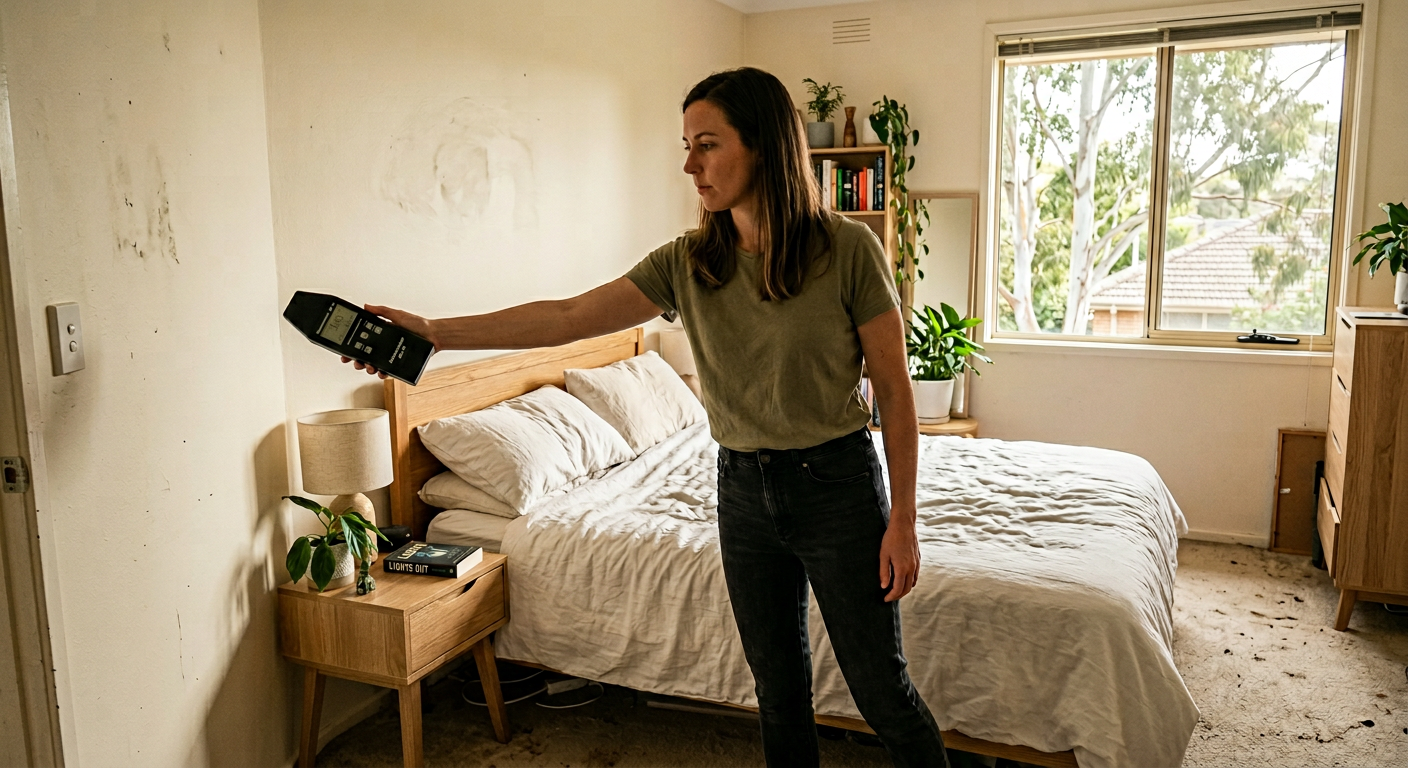
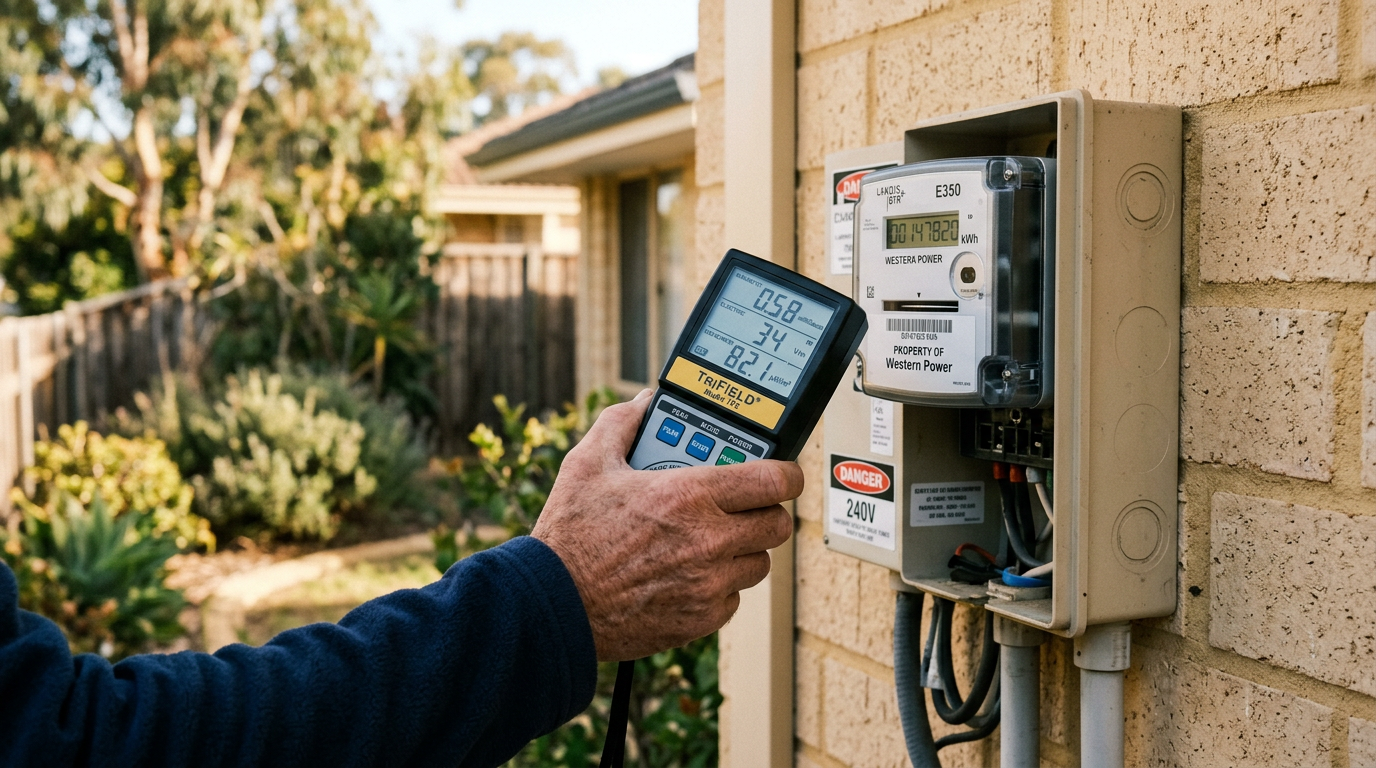
The TriField TF2 is the only tri-mode meter (RF + ELF magnetic + ELF electric) that gives a complete picture of your home. A 30-minute bedroom audit confirms whether your specific environment warrants further action — and verifies when changes have worked. Guessing leads to spending money on the wrong problem.
AUSTRALIAN REGULATORY CONTEXT
ARPANSA (the Australian Radiation Protection and Nuclear Safety Agency) follows ICNIRP guidelines. The public exposure limit for RF radiation is 1,000 µW/cm². Most homes measure well below this — but proximity to routers and smart devices creates localised hotspots that can be 100× higher at short range.
In Queensland, Energex smart meters pulse RF signals to the grid network. Sydney and Melbourne NBN fibre cabinets generate low-level ELF fields. Measuring your specific environment with a calibrated meter is the only way to know your actual exposure — see how we measure.
Explore by Topic
Key guides, reviews, and practical protocols — curated by what matters most.
Understand EMF
Measure Your Home
Reduce Your Exposure
Earthing & Grounding
FREE DOWNLOAD
Get the Australian Home Environment Checklist
30 checks across water, air and EMF. Most of them free. Ranked by impact.
NO SPAM. UNSUBSCRIBE ANY TIME.