Do Mobile Phones Cause Cancer? EMF Risks 2026
Based on the largest Australian cohort study to date — ARPANSA’s analysis of 489,769 women — there is no demonstrated association between mobile phone use and brain cancer incidence, and national brain cancer rates have remained statistically stable from 1982 to 2012 despite near-universal phone adoption. The International Agency for Research on Cancer (IARC) classifies radiofrequency EMF as “possibly carcinogenic” (Group 2B) — the same category as pickled vegetables and talcum powder — meaning limited evidence exists and a causal link has not been established.
That does not mean RF exposure is irrelevant to your household. It means you need to separate what the evidence actually shows from fear-based marketing, understand Australia-specific safety thresholds set by ARPANSA, and take practical steps that reduce exposure where the science supports doing so — without spending money on products that do nothing.
QUICK VERDICT: Do Mobile Phones Cause Cancer? EMF Risks 2026
No established causal link between mobile phone RF and cancer exists in the current evidence base. Australian brain cancer incidence has not risen despite 30+ years of mobile phone use. Practical exposure reduction is still worthwhile — it costs nothing and aligns with ARPANSA’s precautionary guidance.
| EMF Source | What the Evidence Shows | Verdict |
|---|---|---|
| Mobile phone RF (850–2600 MHz) | IARC Group 2B — limited evidence, no causal link in Australian cohort data | Low concern — reduce with simple habits |
| WiFi routers (2.4/5 GHz) | Power output ~0.1W vs phone’s 0.25–2W; exposure falls with inverse-square law | Negligible at 2+ metres |
| Smart meters (900 MHz) | Burst transmissions average <1% duty cycle; peak vs average readings differ 100–1,000x | Measure before assuming risk |
What ARPANSA Actually Says About Mobile Phone Radiation
ARPANSA — the Australian Radiation Protection and Nuclear Safety Agency — is the federal body responsible for setting RF exposure limits in Australia. Their current standard, RPS 3, adopts the International Commission on Non-Ionizing Radiation Protection (ICNIRP) guidelines. At 2.4 GHz (the frequency your WiFi router uses), the public exposure limit is 1,000 µW/cm². For the 900 MHz band used by Australian smart meters and some phone networks, the limit is even higher at approximately 4,500 µW/cm².
These are thermal safety limits. They are designed to prevent tissue heating — the only RF health effect currently established by mainstream science. They are not precautionary limits. Building Biology guidelines (SBM-2015), by contrast, recommend sleeping-area RF exposure below 0.1 mW/m² (0.01 µW/cm²) — roughly 100,000 times lower than the ARPANSA threshold. That gap is the source of most public confusion.
ARPANSA’s own position statement on mobile phones acknowledges the IARC Group 2B classification and recommends “reducing exposure where practical” as a precautionary measure. They specifically suggest using hands-free devices, texting instead of calling, and keeping the phone away from the body. This is not because they believe phones cause cancer — it is standard precautionary policy applied when evidence is incomplete. The same logic applies to any agent with a Group 2B classification.
The critical point: ARPANSA does not classify mobile phone radiation as a known or probable carcinogen. They classify it exactly where IARC does — as “possibly carcinogenic” based on limited evidence. Their practical recommendation is to reduce unnecessary exposure, not to avoid phones or buy shielding products. If you hear someone claim Australian authorities have declared phones dangerous, they are misrepresenting the position.
The Australian Evidence: 489,769 Women and 30 Years of Data
The most significant Australian study on this topic is ARPANSA’s own prospective cohort analysis, published in 2018. Researchers tracked 489,769 Australian women aged 45 and older through the Sax Institute’s 45 and Up Study. They compared brain cancer incidence between mobile phone users and non-users over the study period. The result: no statistically significant association between mobile phone use and brain cancer.
This was not a small survey or a self-reported questionnaire with weak methodology. It was a large-scale prospective cohort study — the gold standard in epidemiology after randomised controlled trials (which would be unethical to conduct for this question). The sample size of nearly half a million participants gives the study substantial statistical power to detect even small increases in risk.
Backing this up, Chapman et al. published a landmark analysis in Cancer Epidemiology in 2016, examining Australian brain cancer incidence data from 1982 to 2012 — a 30-year window that covers the entire mobile phone era, from early analogue brick phones through to universal smartphone adoption. Their finding: brain cancer incidence remained stable across all age groups except those aged 70 and over, where a small increase was observed. That increase in the 70+ group began before widespread mobile phone use and is consistent with improved diagnostic imaging (more cancers being detected, not more cancers occurring).
Here is why these two studies matter more than any individual lab study on rats: they examine actual cancer rates in actual human populations over actual decades of phone use. If mobile phones caused brain cancer at any meaningful rate, you would expect to see a dose-response signal in these data. Australian mobile phone subscriptions went from essentially zero in the early 1990s to over 30 million active services by 2012 (ABS data). Brain cancer rates did not follow. Not even slightly.
This does not prove phones are perfectly safe — proving a negative is impossible. It means that if RF from phones causes brain cancer, the effect is so small that it cannot be detected even in populations of half a million tracked over decades. Compare this to smoking, where the lung cancer signal was visible in population data within 15–20 years of widespread adoption. We are now 30+ years into mass mobile phone use in Australia with no comparable signal.
Understanding IARC Group 2B — What “Possibly Carcinogenic” Actually Means
The IARC classification system is where most of the fear originates — and where most of the misunderstanding lives. In 2011, IARC classified radiofrequency electromagnetic fields as Group 2B: “possibly carcinogenic to humans.” Media headlines screamed. Sales of EMF shielding products spiked. And almost nobody read the actual classification criteria.
IARC uses five categories. Group 1 is “carcinogenic” — this includes tobacco smoke, asbestos, processed meat, and ionising radiation. Group 2A is “probably carcinogenic” — red meat, very hot beverages (above 65°C), and night shift work. Group 2B is “possibly carcinogenic” — RF electromagnetic fields, pickled vegetables, talcum powder (perineal use), and the fuel additive methyleugenol. Group 3 is “not classifiable” and Group 4 is “probably not carcinogenic.” In practice, only one substance has ever received a Group 4 classification (caprolactam, a nylon precursor).
Group 2B means there is limited evidence of carcinogenicity in humans and less than sufficient evidence in experimental animals. “Limited evidence” in IARC terminology means a positive association has been observed but chance, bias, or confounding cannot be ruled out. This is not the same as “we think it causes cancer but can’t prove it.” It is closer to “we’ve seen something in a few studies, but the overall evidence doesn’t support a causal conclusion.”
The studies that drove the 2B classification were primarily the Interphone study (2010) and Hardell group studies from Sweden. Both reported possible associations between heavy mobile phone use (30+ minutes per day for 10+ years) and glioma. However, both had significant methodological limitations — recall bias in the Interphone study was particularly problematic, as people with brain tumours may over-report phone use on the affected side of the head. The large prospective studies conducted since then, including the ARPANSA cohort, have not confirmed these associations.
The practical interpretation: Group 2B means “we should keep studying this.” It does not mean “this causes cancer.” If you stopped eating every Group 2B substance and avoiding every Group 2B exposure, you would need to give up pickled vegetables, talcum powder, and a long list of common chemicals. The classification warrants awareness, not panic.
Beyond Phones: WiFi, Smart Meters, and Power Lines in Australian Homes
Mobile phones get the headlines, but they are only one RF source in your home. If you are concerned about EMF exposure, you need the full picture — and you need actual measurements, not assumptions. I use a TriField TF2 at the Palm Beach house to audit every room. Without a meter, you are guessing. Here is what the main sources look like in a typical Australian home.
WiFi Routers (2.4 GHz and 5 GHz)
Your NBN-supplied router transmits at roughly 0.1 watts on each band. A mobile phone during a call can transmit at 0.25 to 2 watts depending on signal strength (weaker signal = higher transmission power to reach the tower). At one metre from a typical router, RF power density is well under 1 µW/cm². At two metres it drops by 75% (inverse-square law). At three metres it is negligible by any standard, including Building Biology SBM-2015.
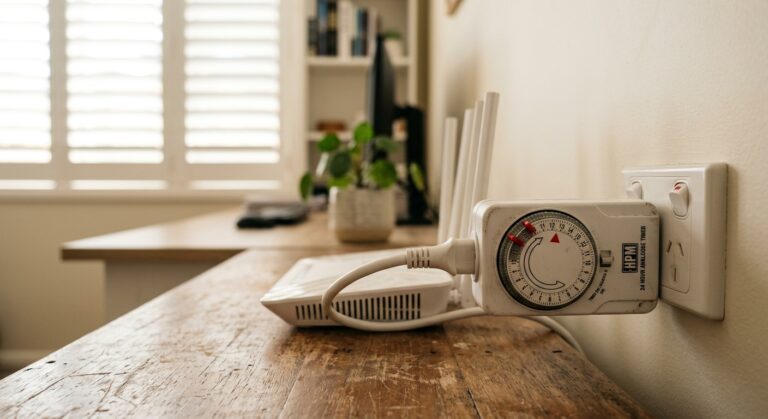
The practical risk from WiFi in a living area is extremely low. The concern arises when routers are placed in bedrooms, on bedside tables, or in children’s rooms — not because WiFi is dangerous at living-area distances, but because unnecessary exposure during 8 hours of sleep is trivially easy to eliminate. Move the router to a central hallway. If you cannot, put it on a mechanical timer so it switches off during sleep hours.
Smart Meters (900 MHz)
Australian smart meters operate at approximately 900 MHz and transmit usage data in short bursts — typically lasting 30–200 milliseconds, several times per hour. The key distinction that most articles miss: peak readings during a burst can be 100 to 1,000 times higher than the time-averaged reading. An RF meter in peak-hold mode might show 50 µW/cm² during a burst, while the same meter in averaging mode shows 0.05 µW/cm². Both readings are correct. They measure different things.
If your bedroom wall shares a wall with the smart meter box (common in apartments and townhouses in Melbourne, Brisbane, and Sydney), you may be getting burst exposures at levels above Building Biology sleeping-area guidelines, even though time-averaged exposure is trivial. The solution is not to demand meter removal — it is to measure the actual levels on your side of the wall with an RF meter, and if they exceed your comfort threshold, move the bed or add distance. One metre of distance from the meter reduces exposure by approximately 90%.
Power Lines and Household Wiring (ELF Magnetic and Electric Fields)
Extremely low frequency (ELF) magnetic fields from power lines and household wiring are a separate category from RF. IARC also classifies ELF magnetic fields as Group 2B, based on epidemiological studies showing a weak association between childhood leukaemia and chronic exposure above 0.3–0.4 µT. ARPANSA’s exposure reference level for the public is 200 µT — hundreds of times higher than the levels where the epidemiological association was observed.
Building Biology SBM-2015 recommends sleeping-area magnetic fields below 0.2 µT and AC electric fields below 5 V/m. In most Australian homes I have measured, bedroom magnetic fields from wiring are below 0.1 µT unless you have a meter box on the other side of the wall, an electric underfloor heating system, or high-current appliances running nearby. Electric fields from unshielded wiring in the walls can be 20–100 V/m in bedrooms, reduced to near zero with a demand switch installed by a licensed electrician on the bedroom circuit (cost: approximately $100–150).
EMF Meters & Protection
See full EMF guide →SAR Ratings Explained: What Your Phone’s Number Actually Tells You
Every mobile phone sold in Australia must comply with ARPANSA’s RF exposure standard, which limits the Specific Absorption Rate (SAR) to 2.0 W/kg averaged over 10 grams of tissue. SAR measures the rate at which your body absorbs RF energy from the phone. Every phone model has a SAR value listed in its documentation — typically between 0.2 and 1.6 W/kg for head-position testing.
Here is what most people get wrong about SAR: a lower SAR phone is not necessarily “safer” in any meaningful way. SAR is tested at maximum transmission power with the phone pressed directly against the head. In real-world use, your phone adjusts its transmission power constantly based on signal strength. A phone with a SAR of 1.4 W/kg in an area with strong reception might actually expose you to less RF than a phone with a SAR of 0.5 W/kg in a poor-reception area, because the second phone is transmitting at higher power to maintain connection.
The practical implication is counterintuitive: signal strength matters more than SAR rating. If you live in a suburb with poor reception — common in western Sydney, parts of Logan in Brisbane, or outer Perth suburbs like Bullsbrook — your phone works harder and emits more RF. Improving your reception (using WiFi calling, positioning near a window, or using a signal booster) reduces your actual exposure more than choosing a low-SAR phone model.
That said, if two phones are otherwise equal and you are choosing between them, the lower SAR model produces less peak exposure. It is a tiebreaker, not a primary decision factor. Do not pay a premium for a “low-SAR” phone or buy a phone case marketed as “SAR-reducing” — most of those products either do nothing measurable or degrade signal quality, which forces the phone to transmit at higher power and increases your actual exposure.
Practical Steps That Actually Reduce Your Exposure
If you have read this far, you understand that the cancer evidence is weak and the Australian data does not support alarm. But ARPANSA recommends precautionary reduction, and the steps that work are either free or very cheap. Here is the protocol I follow at home, in order of impact.
1. Phone on Airplane Mode During Sleep (Free)
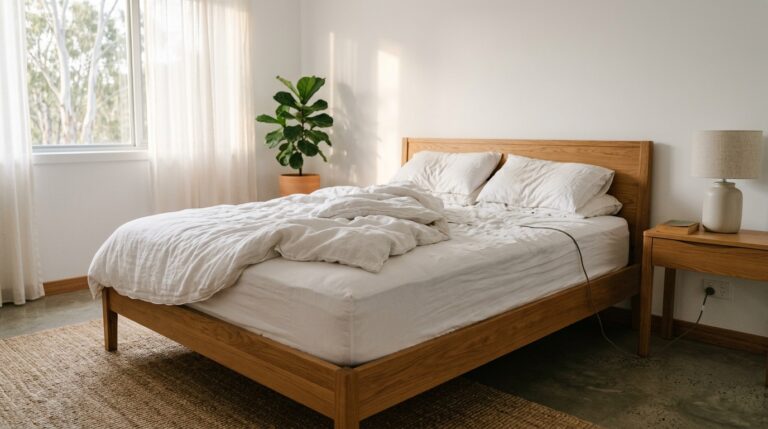
This is the single highest-impact action. Your phone transmits RF constantly in standby — polling the network, checking for push notifications, updating location. At night, on your bedside table, that is 7–8 hours of continuous low-level exposure at close range. Airplane mode eliminates it. Set your alarm before switching — airplane mode does not disable the alarm clock. If you need to be reachable for emergencies, move the phone to the far side of the room. Distance is your most effective tool: doubling the distance quarters the exposure.
2. Mechanical Timer on WiFi Router (~$20)
The Jackson 24hr Mechanical Timer plugs into the wall, and you plug the router into it. Set it to cut power from 10 pm to 6 am. Eight hours of zero WiFi RF in your home every night with no ongoing effort. This eliminates the second-largest RF source in most households during the hours that matter most for sleep quality and cellular repair.
3. Speaker Mode or Air-Tube Headset for Calls
Holding a phone against your head during calls delivers the highest SAR exposure your phone produces. Speaker mode puts 30–50 cm between the antenna and your skull, reducing exposure by roughly 90%. Air-tube headsets go further — unlike standard wired earbuds, which conduct some RF along the wire, air-tube headsets use a hollow tube for the last section to the ear, so no RF reaches the ear canal. The DefenderShield air-tube headset available from SaferEMF AU is the model I use.
4. Demand Switch on Bedroom Circuit (~$100–150)
A demand switch (or cut-off relay) is installed by a licensed electrician on the circuit breaker feeding your bedroom. When all devices on that circuit are off, the switch automatically disconnects power, eliminating AC electric fields from the wiring in your walls. In an unshielded Australian home, bedroom wall wiring can produce 20–100 V/m of AC electric field — well above the Building Biology SBM-2015 guideline of less than 5 V/m. A demand switch drops this to near zero during sleep.
5. Measure Before You Shield
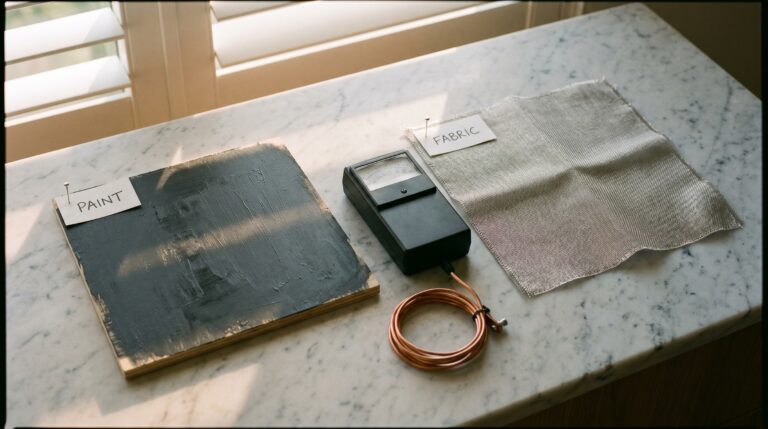
This is the most important rule in EMF reduction, and the one most people violate. If your primary EMF source is inside the room — a phone, a router, a baby monitor — a Faraday canopy or shielding paint will reflect that energy around the enclosed space and increase your exposure. The correct sequence is always: measure, then remove internal sources, then shield external residual only. A TriField TF2 or Safe and Sound Pro II gives you the data to make decisions instead of guesses.
What the Science Does Not Support: Products and Claims to Avoid
The EMF protection market is full of products that exploit fear and scientific illiteracy. As a former Navy Clearance Diver, I was trained to evaluate equipment on measured performance, not marketing claims. Apply the same standard here.
Anti-Radiation Phone Stickers and “Harmonisers”
Products claiming to “neutralise,” “harmonise,” or “restructure” phone radiation have no measurable effect on RF emissions. None. Zero. The physics does not support the mechanism they claim. A sticker on the back of your phone does not alter the electromagnetic field the antenna produces. If it actually blocked RF, your phone would lose signal and increase transmission power to compensate — making exposure worse. The ACCC has taken action against misleading EMF product claims in Australia. Do not waste your money.
Shielding Phone Cases (Most Models)
Cases that claim to “block 99% of radiation” typically place shielding material between the phone and your body. This can redirect the RF away from you — but it also degrades the signal to the tower, which forces the phone to transmit at higher power. The net effect on your total exposure is unclear at best and potentially negative. The far cheaper and more effective approach is speaker mode or an air-tube headset.
Whole-Home “EMF Neutralisers”
Plug-in devices claiming to protect your entire home from EMF by “counteracting” or “cancelling” electromagnetic radiation violate basic physics. RF cancellation (destructive interference) requires precisely matched amplitude and opposite phase at every point in space — this is physically impossible with a single plug-in device. These products are, without exception, non-functional. Spend the same money on a TriField TF2 and get actual data instead.
Children and Mobile Phone RF: What Australian Parents Need to Know
Children’s heads are smaller, their skull bones are thinner, and their brain tissue has higher water content — all of which mean RF energy penetrates deeper into a child’s brain relative to an adult’s for the same phone and same SAR output. Modelling studies (including work by Gandhi et al., 2012) estimate that a child’s brain may absorb 2–10 times more RF energy than an adult’s depending on age and phone position.
Despite this, no epidemiological study has demonstrated a causal link between children’s mobile phone use and brain cancer. The MOBI-Kids study (an international case-control study including Australian participants) found no consistent association between mobile phone use and brain tumours in young people aged 10–24. The CEFALO study (European) reached similar conclusions for children aged 7–19.
ARPANSA’s precautionary advice is stronger for children: they recommend parents encourage children to limit call time, use hands-free options, and text rather than call. This is reasonable. Children will have decades more cumulative exposure than today’s adults, and the evidence base for very long-term (40–50 year) exposure simply does not exist yet. Precaution in the absence of long-term data is sensible, not alarmist.
Practical steps for Australian parents: keep phones and tablets in airplane mode when children are using them for offline games or videos. Use WiFi-connected tablets rather than cellular-connected phones for streaming (WiFi transmits at much lower power). Keep devices off the bed and out of the bedroom at night. These steps cost nothing and are consistent with ARPANSA’s published guidance for children.
How to Measure EMF in Your Own Home
Everything above is academic unless you know what your actual exposure levels are. Here is the measurement protocol I use at the Palm Beach house, simplified for any Australian household.
What You Need
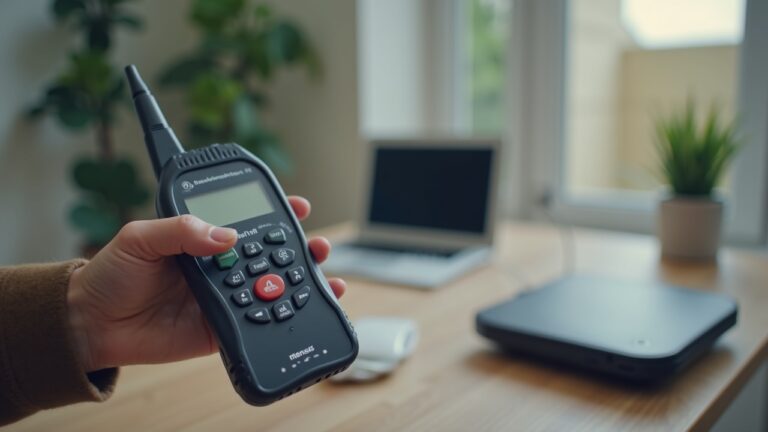
A TriField TF2 measures all three field types: AC magnetic (from wiring and appliances), AC electric (from live wiring in walls), and RF (from phones, WiFi, smart meters, and cell towers). It is the only meter most households need. If you want higher sensitivity for RF specifically — particularly for identifying smart meter bursts or cell tower exposure — the Safe and Sound Pro II from SaferEMF AU is the specialist tool.
Measurement Protocol
Measure in the bedroom first — this is where you spend 7–8 hours per night in a low-metabolic state where cellular repair occurs. Take readings in three modes: AC magnetic, AC electric, and RF. Record the reading at your pillow position with all devices in their normal state. Then turn off the WiFi router, put your phone in airplane mode, and re-measure. The difference tells you how much of your exposure comes from your own devices versus external sources (cell towers, neighbours’ WiFi, smart meters).
Compare your readings to Building Biology SBM-2015 sleeping-area guidelines: RF below 0.1 mW/m², AC magnetic below 0.2 µT, AC electric below 5 V/m. If your readings exceed these guidelines and the source is internal, remove it. If the source is external (cell tower, neighbour’s WiFi), then and only then consider shielding — and measure again after shielding to confirm it reduced exposure rather than trapping it.
| Field Type | SBM-2015 Sleeping Guideline | ARPANSA Limit | Typical Australian Bedroom |
|---|---|---|---|
| RF power density | <0.1 mW/m² (0.01 µW/cm²) | 1,000 µW/cm² at 2.4 GHz | 0.01–5 µW/cm² (varies hugely) |
| AC magnetic field | <0.2 µT | 200 µT | 0.02–0.15 µT (most homes) |
| AC electric field | <5 V/m | 5,000 V/m | 20–100 V/m (unshielded wiring) |
Notice the pattern: most Australian bedrooms are well within ARPANSA limits for all three field types. But many exceed Building Biology sleeping guidelines for AC electric fields (from wiring) and RF (from WiFi routers and phones left on overnight). These are the exposures you can eliminate for free or close to it. The data from your own meter tells you exactly which ones to address.
Final Verdict: Evidence, Not Fear
The question “do mobile phones cause cancer?” has a clear current answer: no established causal link exists, and Australian population data over 30 years shows no detectable increase in brain cancer rates despite universal phone adoption. IARC’s Group 2B classification warrants continued research, not panic. ARPANSA’s precautionary guidance is sensible and costs nothing to follow.
The smart approach is not to ignore EMF or to fear it. It is to measure your actual exposure, eliminate the easy wins (airplane mode at night, router timer, speaker mode for calls), and avoid spending money on products that violate basic physics. Every dollar spent on an “EMF harmoniser” sticker is a dollar not spent on a TriField TF2 that gives you actual, actionable data about your home.
If you are in an apartment in inner Sydney, Brisbane, or Melbourne with a smart meter on your bedroom wall and a router in the same room, your sleeping-area RF exposure might actually exceed Building Biology guidelines. That is worth knowing and worth fixing. But fixing it costs $20 for a timer and the 30 seconds it takes to switch your phone to airplane mode. Start there.
complete guide to EMF in Australian homes best EMF meter for Australian homes how to measure EMF in your homeLast reviewed: July 2026 — Clean and Native
Start with measurement. The TriField TF2 is the only meter you need.
Measures AC magnetic, AC electric, and RF in one device. I use it for every room audit at the Palm Beach house. Without real readings, every EMF decision is a guess.
Frequently Asked Questions
No. ARPANSA states there is no established health effect from RF exposure below the ICNIRP safety limits. They recommend precautionary exposure reduction as standard policy, not because they have found evidence of harm. Their 2018 cohort study of 489,769 Australian women found no association between phone use and brain cancer.
Group 2B means “possibly carcinogenic to humans” based on limited evidence where chance, bias, or confounding cannot be ruled out. It is the same classification given to pickled vegetables and talcum powder. It indicates a need for further research, not an established cancer risk.
No. According to Chapman et al. (Cancer Epidemiology, 2016), Australian brain cancer incidence was stable from 1982 to 2012 across all age groups except those aged 70+, where the increase predates mobile phone adoption and is consistent with improved diagnostic imaging.
Children’s thinner skulls and higher brain water content mean RF penetrates deeper relative to adults. No epidemiological study has established a causal link to cancer in children, but ARPANSA recommends stronger precaution for children due to their longer lifetime exposure ahead. Airplane mode for offline use is the simplest step.
No. Stickers and “harmoniser” devices have no measurable effect on RF emissions. If they actually blocked RF, they would degrade signal quality and force the phone to transmit at higher power, potentially increasing your exposure. The ACCC has taken action against misleading EMF product claims in Australia.
Use speaker mode or an air-tube headset for calls, switch to airplane mode during sleep, and keep the phone away from your body when possible. These free steps reduce exposure by 90% or more, which is more effective than any commercial EMF product.
Australian smart meters at 900 MHz transmit in short bursts (30–200 milliseconds). Peak readings during a burst can be 100 to 1,000 times higher than time-averaged readings. Actual exposure depends on distance from the meter and wall construction. Measure with an RF meter before drawing conclusions.
SAR is a useful tiebreaker between otherwise equivalent phones but is not a primary decision factor. SAR is tested at maximum transmission power, which rarely occurs in real-world use. Your signal strength has more effect on actual RF exposure than the phone’s SAR number — poor reception forces higher transmission power regardless of SAR rating.
Yes. If the primary EMF source is inside the shielded area (a phone, router, or baby monitor), shielding reflects that energy around the enclosed space and increases exposure. The correct sequence is always: measure, remove internal sources, then shield only against external residual. Never shield before measuring.
The TriField TF2 measures AC magnetic, AC electric, and RF fields in one device and costs under $250. It is the only meter most Australian households need. For specialist RF measurement (smart meters, cell towers), the Safe and Sound Pro II from SaferEMF AU provides higher sensitivity and frequency range.
Get the Australian Home Environment Checklist
30 checks across water, air and EMF. Most of them free. Ranked by impact.
No spam. Unsubscribe any time.

Former Royal Australian Navy Clearance Diver and TAG-E counter-terrorism operator. Founded Clean and Native to apply the same rigorous thinking to the home environment.
Full biography →