Levoit Core 300S Review Australia 2026: H13 HEPA Assessed for Bedrooms and Allergy Sufferers
The Levoit Core 300S is the best-value smart air purifier for a single Australian bedroom under $250 — with real caveats you need to know before buying. It delivers a rated CADR of 258 m³/h through an H13 True HEPA filter, draws only 21.8 W at full power, and connects to the VeSync app with a laser PM2.5 sensor — all for around $248 on Amazon AU. The catches: the “100 m² coverage” claim on the box is measured at 1 ACH — at the 4.8 ACH you actually need for meaningful air cleaning, it covers around 21 m². The pre-filter is integrated (not washable separately), and there is no replaceable carbon module — the whole filter assembly goes out every 6–8 months at ~$40 each. If your bedroom is under 25 m² and you want smart controls without the Breville Protect Max’s $468 price tag, this is the pick.
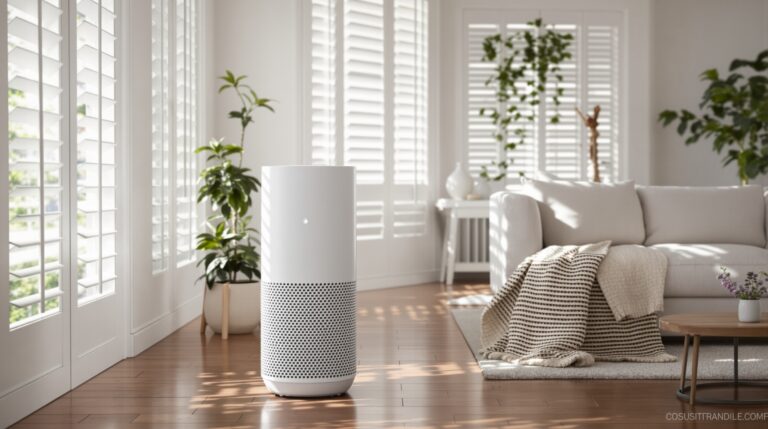
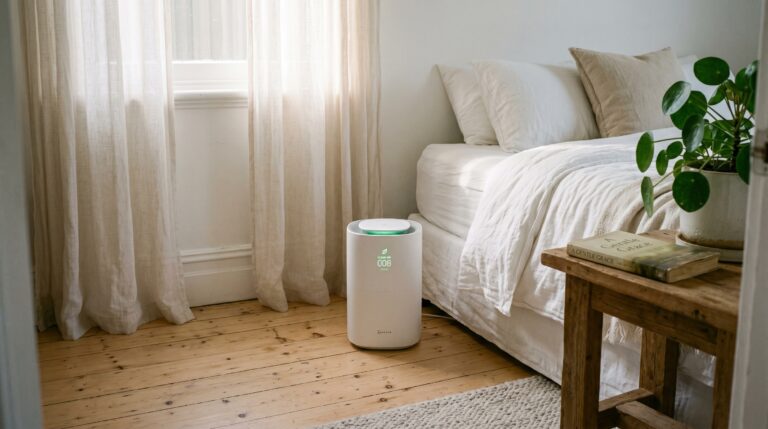
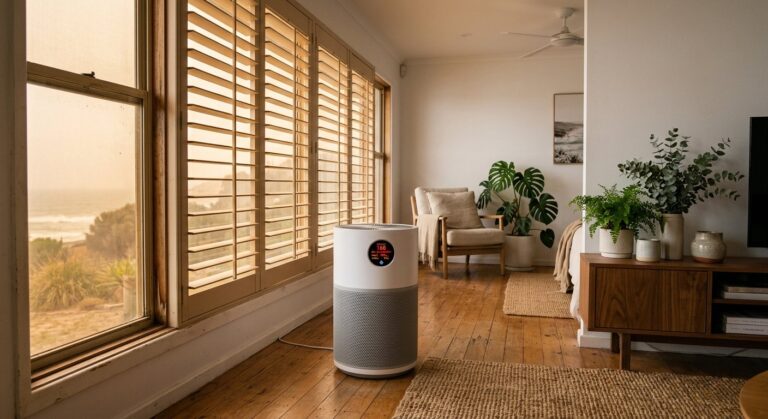
See Levoit Core 300S Price →Amazon AU • free delivery over $49The Levoit Core 300S is the top-selling smart air purifier on Amazon AU — and assessed against our review methodology, it earns that position for one specific use case: a bedroom or small home office up to about 21 m². I’m Jayce Love, a former Royal Australian Navy Clearance Diver who now tests air and water quality products from Palm Beach, QLD. The 300S is a compact white cylinder — 26.8 × 26.8 × 36.1 cm — that filters the air through three stages and reports PM2.5 back to your phone. What it is not is a whole-home solution, a bushfire season workhorse for large rooms, or a replacement for a proper HEPA unit in a space larger than a standard Australian double bedroom.
✓ Who This Is For
- Renters in a standard bedroom (12–22 m²) who want smart controls without a high upfront cost
- Allergy and asthma sufferers who want PM2.5 monitoring in their sleeping space
- Parents wanting a quiet, app-controlled purifier for a child’s bedroom
- Apartment dwellers in Brisbane, Sydney or Adelaide during bushfire smoke season
- Anyone upgrading from a no-filter or ionic unit and wanting genuine H13 HEPA
× Who It Is Not For
- Open-plan living areas or combined kitchen/living rooms above 25 m² — buy the Breville Protect Max instead
- Households with heavy pet dander where the pre-filter needs regular vacuuming (it’s integrated, not removable)
- Bushfire season in a living room — the CADR is too low for rapid smoke clearance in large spaces
- Buyers who want a washable pre-filter to reduce ongoing filter costs
- Households wanting a single unit to cover multiple rooms — it can’t do that
How We Assessed the Levoit Core 300S
CADR and Room Coverage: What the “100 m²” Claim Actually Means
The Amazon AU listing says the Core 300S covers “100 m².” That figure is calculated at one air change per hour (1 ACH) — the absolute minimum that might move air without doing much cleaning. At 1 ACH, a 100 m² room with a 2.4 m ceiling contains 240 m³ of air. The 300S’s rated CADR of 258 m³/h would just about turn that volume over once per hour. According to Australian air quality guidelines and the NEPM standards for particulate matter reduction, you need a minimum of 4–5 air changes per hour (ACH) to meaningfully reduce PM2.5 in an occupied room.
At 4.8 ACH — the standard used by independent testing labs including AHAM and HouseFresh — the Core 300S covers:
| ACH Rate | Effective Coverage (2.4m ceiling) | What This Means |
|---|---|---|
| 1 ACH | 107 m² | What Levoit markets — not meaningful for health outcomes |
| 2 ACH | 54 m² | Adequate for rooms with low pollution load |
| 4.8 ACH | 22 m² | What most testing labs recommend — suits a standard AU double bedroom |
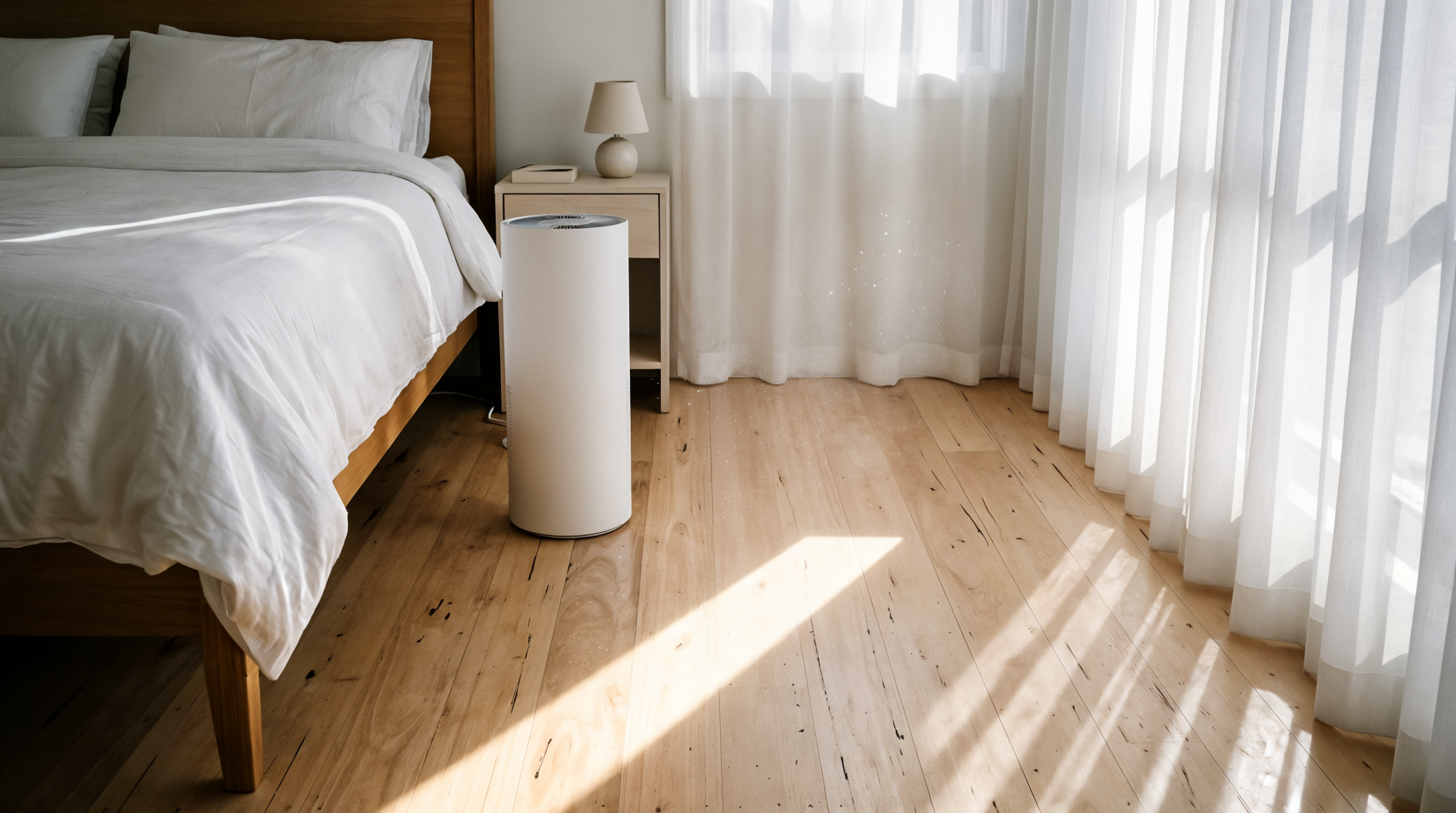
A standard Australian double bedroom is typically 12–18 m². A queen bedroom with wardrobe is around 16–22 m². The Core 300S fits those rooms well at 4.8 ACH. Put it in a 40 m² open-plan lounge and you’re at roughly 2.7 ACH — noticeable improvement in sustained smoke events but not rapid clearance. Put it in a 100 m² open-plan home and the marketing claim literally means the air turns over once per hour, which does almost nothing.
Filtration: H13 True HEPA, Pre-filter and Activated Carbon — What Each Stage Does
The Core 300S uses a three-stage cylindrical filter assembly. Air enters through the entire 360-degree surface of the cylinder, passes through all three stages, and exits upward through the top grille — Levoit calls this VortexAir technology, which is a marketing term for the cylindrical intake design that increases effective filter surface area compared to a flat-front unit.
Stage 1 — Pre-filter: A mesh layer that captures hair, dust, and large particles (pet fur, visible dust). This is integrated into the outer surface of the filter cylinder — it is not removable for cleaning separately. You can vacuum the outside of the filter lightly to extend its life, but you cannot wash this pre-filter like the Breville Protect Max’s washable pre-filter.
Stage 2 — H13 True HEPA filter: This is the core of the unit. H13 True HEPA captures particles at 0.3 microns with 99.97% efficiency — the standard used in hospital filtration. This captures PM2.5 (fine particulate matter), smoke particles, pollen (10–100 microns), mould spores (1–30 microns), and most common allergens. It does NOT capture gases, VOCs, or odours — that is the carbon stage’s job.
Stage 3 — Activated carbon filter: A high-activated carbon formula targets gases, VOCs (volatile organic compounds from paint, cleaning products, new furniture), cooking odours, and smoke odour. The carbon is integrated into the same filter cylinder as stages 1 and 2. This means when you replace the filter, you replace all three stages at once — typically every 6–8 months depending on air quality and hours of use. In a Brisbane or Sydney home during bushfire season, you may need to replace it at the 4–5 month mark.
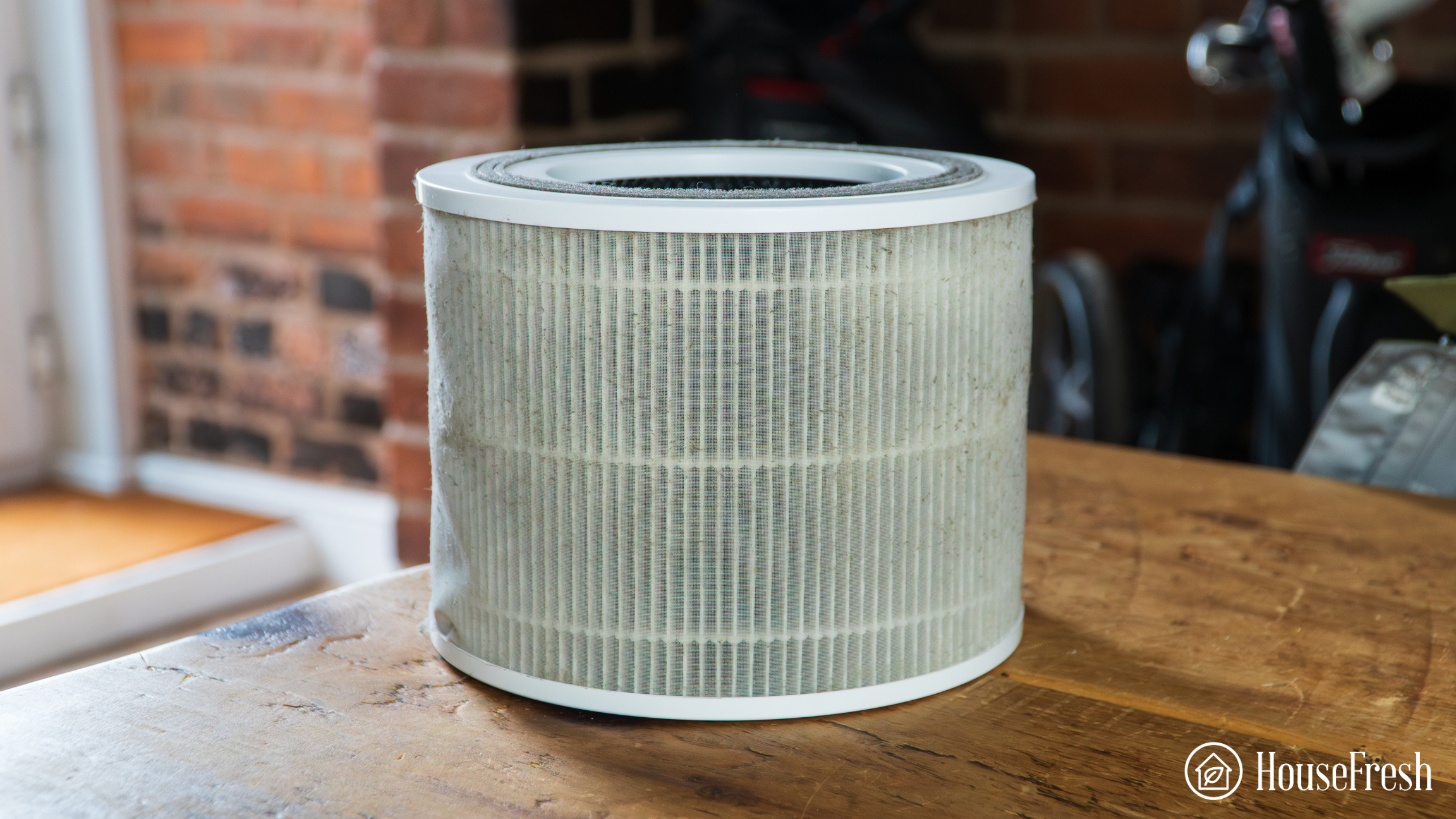
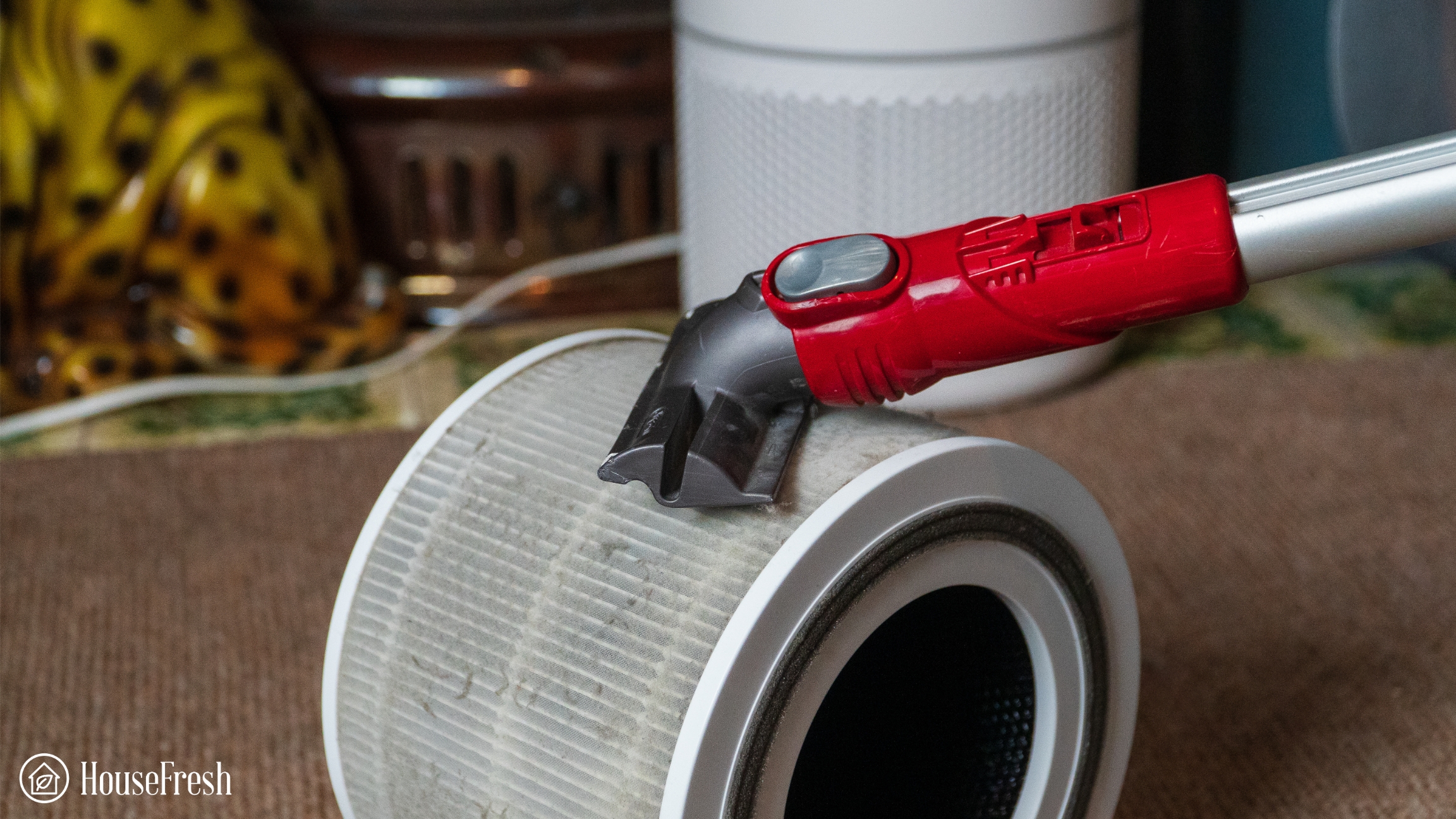
The identical filter fits both the Core 300 and Core 300S. They are widely available on Amazon AU at around $35–45 per filter. Levoit offers three filter variants: the standard replacement, a pet allergy version with extra pre-filter material, and a toxin absorber version with enhanced carbon for VOC-heavy environments such as post-renovation or new-build off-gassing.
Smart Features: Laser Sensor, Auto Mode and the VeSync App
The Core 300S adds three things the non-smart Core 300 lacks: a laser particle sensor, Auto mode, and VeSync app connectivity. Together, these turn a dumb fan-with-a-filter into a reactive air quality manager — and they are the primary reason to pay the extra ~$30–50 over the Core 300.
Laser PM2.5 sensor: Located on the side of the unit, it continuously samples the air and reports PM2.5 concentration. The sensor drives a colour-coded indicator ring on the unit’s top: blue (good), yellow (moderate), red (poor). Because the sensor samples room air rather than the source directly, it registers cooking smoke as it disperses into the room.
Auto mode: When Auto is active, the unit adjusts fan speed based on the laser sensor reading. In practice: it idles on Speed 1 or Sleep in clean conditions, ramps to Speed 2 on moderate PM2.5, and hits Speed 3 on high readings.
VeSync app: Available on iOS and Android. Setup runs over a 2.4 GHz network (the unit does not support 5 GHz Wi-Fi — a minor inconvenience if your router uses band steering). The app shows a live PM2.5 reading, 24-hour history graph, filter life percentage, current speed, and a timer. Voice control works with both Amazon Alexa and Google Assistant — useful for “Hey Google, turn off the air purifier” at bedtime. The VeSync app is consistent across Levoit’s smart range: clean, responsive, with no unnecessary features.
One limitation: the PM2.5 history graph only stores the last 24 hours in the app. There is no long-term air quality logging to a dashboard or CSV export. For research-grade air quality monitoring, you would need a dedicated monitor like the ones in our air quality monitor roundup. The 300S sensor is an indicator tool, not a measurement instrument.
Running Costs: Energy, Filters and 5-Year Total
The Levoit Core 300S is one of the cheapest-to-run HEPA air purifiers available in Australia. At 21.8 W actual draw (lab-measured, not the 26 W marketing spec), it costs $0.0076 per hour to run at QLD tariff of 35c/kWh. Running it 12 hours per night — typical bedroom use — costs just $0.09 per day, or $33.12 per year in electricity.
| Cost Item | Levoit Core 300S | Breville Protect Max |
|---|---|---|
| Upfront cost (AU) | ~$248 | ~$468 |
| Annual energy (12hr/day, 35c/kWh) | ~$33 | ~$50 (est.) |
| Annual filter cost | ~$80 (2 × $40) | ~$89 (1 × $89) |
| Annual total | ~$113/yr | ~$139/yr |
| 5-year total (upfront + running) | ~$813 | ~$1,163 |
Breville running cost estimated; filter at current Amazon AU retail. All AUD, 35c/kWh QLD residential tariff.
The filter is the ongoing variable cost. Levoit recommends replacing it every 6–8 months. In a clean suburban home with minimal pets and no smoke events, 8 months is achievable. In a Brisbane or Gold Coast home during a bad bushfire season — October to March — you may find the filter life indicator hitting red at 4–5 months. The app’s filter life countdown is algorithmic, not sensor-based, so treat it as a guide and do a visual inspection when it hits 20% life remaining.
The Core 300S’s filter is available on Amazon AU for ~$35–45. Levoit OEM replacements (the “Core 300/300S Replacement Filter B”) are the recommended choice. Third-party alternatives exist for ~$25–30 but their HEPA certification varies — I recommend sticking to Levoit OEM for the H13 certification to hold.
Noise: What 41 dB(A) Feels Like in an Australian Bedroom
Air purifiers live or die by their noise level in a bedroom context. The Core 300S measures 38.9–54.5 dB(A) across its full speed range according to HouseFresh’s lab measurements. Across the range, that equates to roughly 40–42 dB(A) on Sleep mode, ~44 dB(A) on Speed 1, ~48 dB(A) on Speed 2, and ~55 dB(A) on Speed 3.
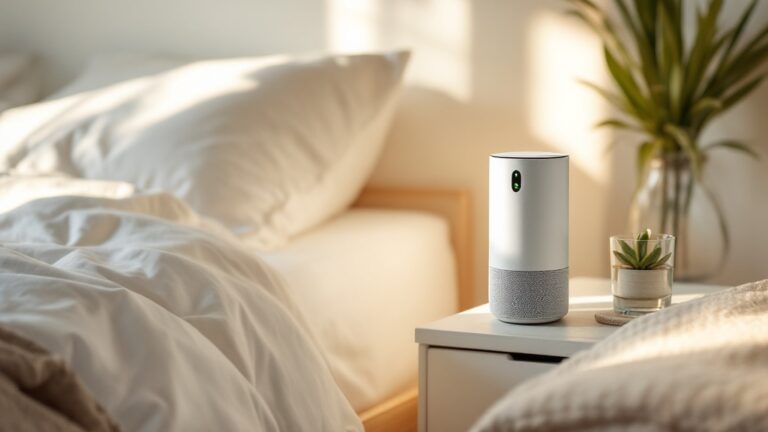
For reference, a quiet library is typically 30–40 dB(A) and a whispered conversation sits around 30 dB(A). Sleep mode at ~41 dB(A) falls inside the range where most people can sleep unaffected — particularly if they are accustomed to any ambient noise (a ceiling fan, street noise, or an air conditioner). Speed 3 at ~55 dB(A) is noticeable and I would not recommend running it at that level during sleep — use Speed 2 or Auto mode for overnight running, which almost never triggers Speed 3 in a sealed bedroom with no active pollution source.
There is no motor whine or blade-clip noise at any speed, attributable to the VortexAir cylindrical design keeping airflow even. The colour indicator ring (blue, yellow, red) can be turned off via the button on the unit’s top or through the app — do this if the room is dark enough that a blue LED ring disturbs you.
Levoit Core 300S vs Breville Protect Max: When to Upgrade
The Breville Protect Max (B0CV5PKL3V, ~$468 on Amazon AU) is the default recommendation for Australians who want a room-coverage step up. Here is the direct comparison:
| Spec | Levoit Core 300S | Breville Protect Max |
|---|---|---|
| Price (AU) | ~$248 | ~$468 |
| CADR | 258 m³/h | ~450+ m³/h |
| Room size (4.8 ACH) | ~22 m² | ~40+ m² |
| Filtration | H13 True HEPA + carbon | H13 True HEPA + carbon + viral/BioGS layer |
| Pre-filter | Integrated (not washable) | Removable + washable |
| Energy (actual draw) | 21.8W | ~40W (est.) |
| Annual filter cost | ~$80 (2× $40) | ~$89 |
| Smart features | VeSync app, Alexa, Google | CHOICE #1, Bluetooth, auto |
The upgrade case is simple: if your room is larger than 25 m², or if you are running the purifier in a shared living space, buy the Breville. The $220 price premium buys you roughly double the effective coverage area, a washable pre-filter (which extends filter life and reduces annual cost), and the viral protection layer that earned it CHOICE’s top pick for two consecutive years. If your space is a standard bedroom under 22 m² and you do not have heavy pet dander, the Core 300S is the right call. You are not getting less performance per room — you are getting performance that is correctly sized for the room.
One scenario where the 300S wins even over the Breville: renters who want a portable unit they can take between properties. At 3.3 kg and 36 cm tall, the Core 300S packs into a standard moving box with room to spare. The Breville is heavier and larger — less suited to renters who move every 12 months. See our best air purifier for renters Australia 2026 for a full comparison of portable options.
Final Verdict: Levoit Core 300S
The Levoit Core 300S is the most energy-efficient smart HEPA air purifier available in Australia under $250. Its 21.8 W actual power draw, 258 m³/h CADR, and reliable VeSync smart controls make it the default pick for a single bedroom in any Australian home, apartment, or rental property.
Buy it if: you have a bedroom under 22 m², you want to monitor PM2.5 from your phone, and you want to keep running costs as low as possible without sacrificing H13 True HEPA filtration. It is also the right pick for a child’s room, a home office, or a rental where portability matters.
Do not buy it if: your space is larger than 25 m², you have heavy pet traffic that would clog an integrated pre-filter quickly, or you are in a bushfire-prone area and need rapid smoke clearance across an open-plan living area. For those use cases, the Breville Protect Max is the correct product.
Ready to clean your bedroom air?
The Levoit Core 300S is the best smart HEPA pick under $250 for a standard Australian bedroom. If your space is larger, the Breville Protect Max is the correct upgrade — CHOICE #1 for two years running.
Last reviewed: July 2026 — Clean and Native
Frequently Asked Questions
Does the Levoit Core 300S cover 100 m²?
No — not in any meaningful sense. The 100 m² figure is calculated at 1 air change per hour (1 ACH), which is below the minimum needed for measurable air quality improvement. At the 4.8 ACH rate recommended by independent testing labs, the Core 300S effectively covers about 22 m² with a standard 2.4 m ceiling. That is sufficient for a standard Australian double bedroom but not an open-plan living room.
Is the Levoit Core 300S good for bushfire smoke?
Yes, for a bedroom. The H13 True HEPA filter captures PM2.5 smoke particles with 99.97% efficiency at 0.3 microns. In a sealed bedroom-sized space, the H13 True HEPA filter and rated CADR are well matched to clearing smoke particles quickly on Speed 3. For a large open-plan living area during heavy smoke events — such as the bushfire seasons affecting NSW, VIC, and QLD — you need a higher-CADR unit. See our bushfire air quality guide for whole-home strategy.
Does the Levoit Core 300S work in Brisbane with high humidity?
Yes. Brisbane’s high humidity (typically 60–80% in summer) does not impair HEPA filtration performance. The filter itself handles standard indoor humidity levels without degradation. In Brisbane, the primary air quality concerns are PM2.5 from traffic and seasonal smoke, mould spores during humid periods, and pollen during spring — all of which fall within the H13 HEPA’s capture range. The auto mode is particularly useful in Brisbane homes where air quality fluctuates daily.
What is the difference between the Levoit Core 300 and Core 300S?
Three differences: the 300S has a laser PM2.5 sensor (the 300 does not), the 300S has Wi-Fi and VeSync app connectivity (the 300 is manual-only), and the 300S draws 21.8 W at full power vs the 300’s 35.5 W — a meaningful energy saving over time. CADR and room coverage are effectively identical. The filters are interchangeable. The 300S typically costs $30–50 more on Amazon AU, which is recovered in energy savings within 18 months of 12-hour daily use.
How often do I need to replace the Levoit Core 300S filter?
Levoit recommends every 6–8 months under normal conditions. In practice: 8 months is realistic for a low-pollution suburban home with no pets. 6 months is more accurate for homes in Brisbane, Sydney, or Adelaide during bushfire season or with pets. The VeSync app tracks filter life algorithmically based on hours of use and fan speed — inspect the filter visually when the app shows 20% remaining. Replacement filters are available on Amazon AU for ~$35–45.
Is the Levoit Core 300S quiet enough for a bedroom?
Sleep mode measures approximately 41 dB(A) — similar to a slow ceiling fan. Most sleepers adjust within a few nights. Speed 2 (~48 dB(A)) is still manageable for lighter sleepers. Speed 3 (~55 dB(A)) is for rapid daytime air clearance, not overnight use. The colour indicator ring can be disabled via the app to eliminate LED light disturbance. I recommend Auto mode overnight with the ring off.
Does the Levoit Core 300S remove pet dander?
Yes, the H13 True HEPA filter captures pet dander (typically 2.5–10 microns) with high efficiency. However, the pre-filter — which captures larger hair and fur before it reaches the HEPA layer — is integrated into the filter cylinder and cannot be removed for washing. In a heavy-pet household (multiple cats or large dogs), this accelerates filter consumption. If you have multiple pets, consider the Levoit Core 300S Pet version, which uses a filter with a higher-density pre-filter layer, or budget for more frequent filter replacements (every 4–5 months).
What is the Levoit Core 300S warranty in Australia?
Levoit offers a 2-year warranty on the Core 300S when purchased from authorised Australian retailers including Amazon AU. Australian Consumer Law also applies, meaning you are entitled to repair, replacement, or refund for major faults regardless of manufacturer warranty. Register the product on the VeSync app within 30 days of purchase to activate Levoit’s extended warranty terms.
Should I buy the Levoit Core 300S or wait for a sale?
The Core 300S typically dips to $199–218 on Amazon AU during Amazon Prime Day (July) and Black Friday (November). If you are buying outside those windows, $248 is the standard price and represents good value given the running cost profile. Do not wait if you have an immediate need — air quality during bushfire season or allergy season is not worth delaying.
Get the Australian Home Environment Checklist
30 checks across water, air and EMF. Most of them free. Ranked by impact.
No spam. Unsubscribe any time.

Former Royal Australian Navy Clearance Diver and TAG-E counter-terrorism operator. Founded Clean and Native to apply the same rigorous thinking to the home environment.
Full biography →