Best Water Filter Australia 2026: Tested & Ranked for Australian Tap Water
21 min read
What “Safe” Means for
Australian Tap Water
Every Australian state publishes drinking water quality data and declares it meets guidelines. What those guidelines actually measure — and what they don’t — is a different question entirely.
The ADWG sets limits. The question is what those limits were designed to protect against — and what falls outside them.
The Australian Drinking Water Guidelines (ADWG), published by NHMRC and NRMMC, define acceptable concentrations for hundreds of chemical, microbiological, and radiological substances in treated water. When a utility publishes annual water quality data showing compliance, it is measuring against ADWG thresholds.
Those thresholds are derived from a calculation: take the no-observed-adverse-effect level from toxicology studies, apply a safety factor, and set a guideline value. The framework is systematic and the intent is protective. But several things fall outside its scope — including contaminants added intentionally (chloramines, fluoride) and emerging contaminants where long-term data lags deployment (PFAS, microplastics).
Understanding the ADWG’s architecture — what it measures, what safety factors it applies, and where its limits come from — is the starting point for any rational decision about home filtration.
The ADWG framework: what it covers and where it stops
The ADWG is a risk-based framework. For each regulated substance, a guideline value represents the concentration at which daily consumption over a lifetime is considered unlikely to cause adverse health effects in the general population. Safety factors of 10–1,000 are applied depending on data quality and the severity of the health endpoint.
This framework covers acute contaminants reliably. Where it becomes less comprehensive is with: substances added intentionally (fluoride, chloramines — where the guideline is also the target, not just an upper limit), emerging contaminants with limited long-term human data (PFAS, some pesticide metabolites), and cumulative or synergistic effects between multiple low-level contaminants simultaneously present.
The ADWG is also advisory rather than legally enforceable in most jurisdictions. State water utilities operate under their own licences and standards, which reference but are not identical to ADWG values.
NHMRC / NRMMC
2022 (updated)
250+ guideline values
Advisory only
10x — 1,000x NOAEL
PFOA: 0.56 µg/L (interim)
No guideline value yet
0.6 — 1.0 mg/L
What each filter type actually removes
Not all filters remove the same contaminants. The table below maps filter technology to removal effectiveness for the substances most relevant to Australian tap water.
| Contaminant | Reverse Osmosis | Activated Carbon (NSF 42/53) | Gravity (Ceramic + Carbon) | UV + Carbon | Pitcher (Standard) |
|---|---|---|---|---|---|
| Chlorine (free) | 99%+ | 95%+ | 90%+ | 95%+ | 70–85% |
| Chloramines | 99%+ | Catalytic carbon only | Partial | Catalytic carbon only | Minimal |
| Fluoride | 94–97% | Negligible | Negligible | Negligible | Negligible |
| PFAS (PFOA/PFOS) | 95%+ | NSF 58 certified only | Partial | Partial | Unreliable |
| Lead | 97%+ | NSF 53 certified | Partial (ceramic) | NSF 53 certified | Some |
| Nitrates | 85–95% | Negligible | Negligible | Negligible | Negligible |
| Bacteria / Cysts | 99.9%+ (with membrane) | Not reliably | Ceramic: 99.99% | UV: 99.9%+ (log 3) | No |
| Microplastics | Yes (>0.001µm) | Partial (>0.5µm) | Partial (ceramic) | Partial | Unreliable |
| Heavy metals (Hg, As, Cd) | 95%+ | NSF 53 only (some) | Partial | Partial | Unreliable |
| Disinfection byproducts (THMs) | 96%+ | NSF 53 certified | Activated carbon | Carbon stage | Some |
Removal rates are approximate and depend on influent concentration, filter condition, and flow rate. NSF/ANSI certification provides verified removal data for specific contaminants. Always verify certifications match the contaminant you are targeting.
The three contaminants most relevant to Australian households
Most Australian tap water is microbiologically safe. The filtration question in Australia is primarily about chemical contaminants — three of which are relevant to almost every household.
Chloramines: the disinfectant that standard carbon can’t remove
Sydney, Melbourne, Perth and most major Australian cities switched from chlorine to chloramines (chlorine + ammonia) as the primary disinfectant. Chloramines are more stable, travel further through distribution networks, and produce fewer trihalomethane byproducts. They also require catalytic activated carbon (not standard carbon) for removal — and they are corrosive to rubber seals and lead solder in older plumbing.
Fluoride: added at the source, invisible without testing
Fluoride is added to drinking water in all Australian states except Queensland (council-by-council) and parts of South Australia. The target concentration is 0.6–1.0mg/L. Critically, no standard carbon filter removes fluoride — only reverse osmosis (94–97% removal), bone char, or activated alumina. If fluoride removal is your goal, filter selection is binary: RO removes it, almost everything else does not.
PFAS: in some supplies, no current standard carbon solution
PFAS (per- and polyfluoroalkyl substances) contamination has been detected in drinking water supplies near defence bases, fire training facilities, and industrial sites across Australia. ADWG interim guideline values were set in 2022. For households in affected areas, the only reliably effective filtration options are reverse osmosis or NSF 58-certified filters specifically tested for PFAS removal. Standard activated carbon does not reliably remove PFAS.
Disinfection byproducts: the reaction products of treatment itself
When chlorine or chloramines react with naturally occurring organic matter in source water, they form disinfection byproducts (DBPs) including trihalomethanes (THMs) and haloacetic acids (HAAs). These are regulated under the ADWG. Total THMs guideline: 0.25mg/L. DBPs are volatile — they are present in shower steam and bath water as well as drinking water. NSF 53-certified activated carbon filters remove the majority of THMs from drinking water.
“If the water meets ADWG guidelines,
why does it still contain fluoride, chloramines, and PFAS?”
Because compliance and absence are not the same thing. Meeting an ADWG guideline value means the measured concentration is below a calculated risk threshold — not that the substance is absent. Fluoride and chloramines are present by design. PFAS may be present in trace amounts that comply with interim limits while long-term effects at low doses remain an active research question.
The ADWG framework is the best available regulatory tool and is grounded in toxicology. Understanding its assumptions helps you make a more informed personal decision about whether additional filtration is warranted in your specific context.
What this means when choosing a filter
Compliant does not mean unfiltered is optimal. The right filter depends on what you are actually targeting.
The most common filtration mistake in Australia is buying a carbon filter to remove chloramines when the filter uses standard (not catalytic) carbon — and then wondering why the water still tastes the same. Or buying a gravity filter expecting fluoride removal, which standard gravity filters cannot deliver.
The decision tree is simple once you know your water. Identify the contaminants present in your specific supply (your utility publishes this annually). Match filter certification to your target contaminants. Verify NSF/ANSI certification numbers — not brand marketing claims.
For most Australian households, reverse osmosis is the most comprehensive single-filter solution: it removes chloramines, fluoride, PFAS, nitrates, heavy metals, DBPs, and microplastics in a single stage. The trade-off is installation complexity, waste water (typically 3:1 ratio), and removal of beneficial minerals.
-
Know your disinfectant first
Chlorine vs chloramine determines which carbon type you need. Check your utility’s annual report or call them directly. -
Fluoride removal requires RO or specific media
Standard carbon, ceramic, and UV systems do not remove fluoride. Only reverse osmosis, bone char, or activated alumina are effective. -
NSF certification number beats brand claims
Verify the specific NSF/ANSI standard (42, 53, 58, 177) and the contaminant list covered. The certification number is searchable on the NSF database. -
Filter maintenance determines real-world performance
An overdue cartridge can leach captured contaminants back into the water. Replacement schedules are conservative for a reason.
The articles below apply this framework to specific filter choices.
Each review below is based on actual filter testing, NSF certification verification, and Australian tap water contaminant data. No sponsored placements. Affiliate links are disclosed and the editorial conclusions are independent.
Water filtration guides.
Tested, not trusted.
Every article below cross-references NSF certification data, ADWG guidelines, and Australian state water quality reports. Filter recommendations are based on contaminant removal rates, not price or commission rates.
This article contains affiliate links. We may earn a commission at no extra cost to you.
Australian tap water meets national safety standards — that much is true. What those standards don’t account for is everything that’s technically “within limits” but still worth filtering out. Chloramine. Fluoride. Trace PFAS compounds that no utility has a clean answer for. Microplastics. Agricultural runoff in regional supply zones. If you’ve been thinking seriously about a water filter, 2026 is a good time to act — and this guide will tell you exactly which system is worth buying.
OUR TOP PICKS
Three filters. Three budgets. All certified.
We’ve tested the claims. These are the three systems that actually deliver what they promise — from a 0 pitcher to a full under-sink RO setup.
Affiliate links — we may earn a commission at no extra cost to you.
Why Australian Tap Water Needs Filtering in 2026
Australian water authorities do a reasonable job of delivering safe water. But “safe” is defined by the Australian Drinking Water Guidelines (ADWG), which set maximum contaminant limits rather than zero-contaminant targets. Several things routinely present in Australian tap water are worth removing:
- Chloramine: Most Australian capital cities now use chloramine (chlorine + ammonia) rather than free chlorine for disinfection. It’s harder to remove than chlorine and requires catalytic activated carbon — not the standard carbon in basic filters.
- Fluoride: Added at 0.6–1.0mg/L in NSW, VIC, QLD, SA and WA. Reverse osmosis and specific gravity filters (with fluoride add-ons) are the only technologies that reliably remove it.
- PFAS: Over 700 contamination sites identified across Australia by the PFAS National Environmental Management Plan. Not all are drinking water sources, but PFAS has been detected in supplies near defence bases, airports and industrial zones.
- Microplastics: A 2024 study found microplastics in 94% of Australian tap water samples tested. Most quality filters — including RO and gravity systems — capture these effectively.
The question isn’t whether to filter. It’s which technology fits your situation. See what’s in your state’s tap water for a breakdown by city.
The 5 Types of Water Filter: Which Suits You?
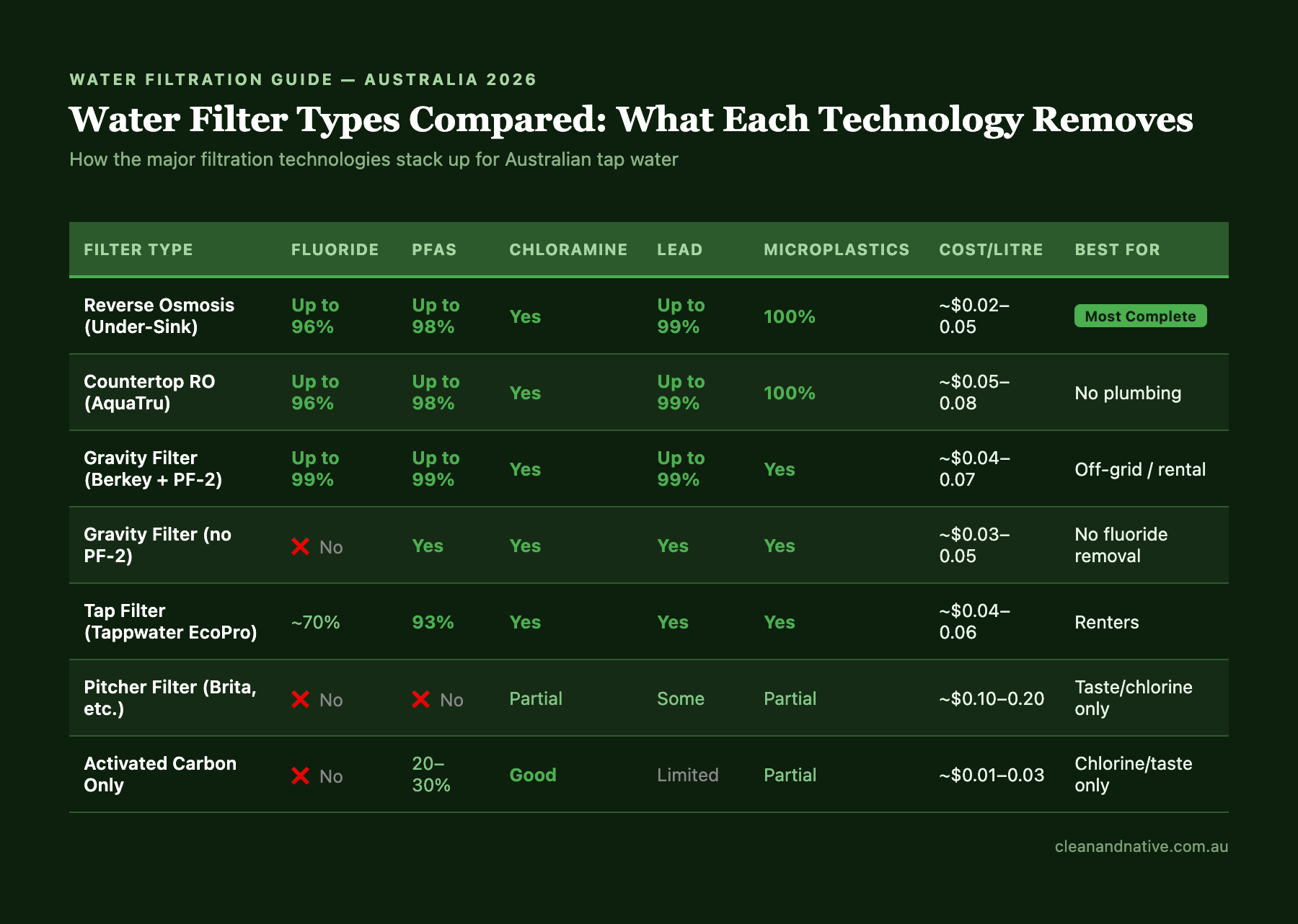
Reverse osmosis (RO): The most comprehensive filtration available for residential use. Removes fluoride (up to 96%), PFAS (up to 98%), lead (up to 99%), arsenic, nitrates, microplastics, and dissolved solids. Requires installation under a sink or on a countertop. Produces some waste water.
Gravity filters (Berkey-style): No plumbing required. Fill the top chamber, gravity does the work. Removes a wide range of contaminants but does NOT remove fluoride unless you add dedicated fluoride filter elements. Excellent for off-grid, rental or travel use.
Tap-mount filters (Tappwater, Brita On-Tap): Install directly on your existing tap. Good for chlorine, taste and some contaminants. Best models (like Tappwater EcoPro) now remove up to 93% PFAS and 70% fluoride. No storage tank, no plumbing beyond the tap fitting.
Under-sink filters (non-RO): Activated carbon block filters installed under the sink with a dedicated tap. Remove chlorine, chloramines, VOCs, some heavy metals. Good flow rate, minimal installation. Don’t remove fluoride or dissolved salts.
Pitcher/jug filters: Brita and similar jugs use granular activated carbon. Improve taste and remove some chlorine. Do not remove fluoride, PFAS, chloramine (reliably) or dissolved contaminants. Budget entry point but limited capability.
Best Water Filters in Australia 2026: Our Top Picks
We evaluated filters on five criteria: verified removal rates (NSF certification or independent lab testing), Australian availability, value for the capability delivered, ease of use, and filter replacement cost over three years.
| Filter | Type | Removes Fluoride | Removes PFAS | Removes Chloramine | Cost/Litre | Best For |
|---|---|---|---|---|---|---|
| AquaTru Countertop RO | Countertop RO | Up to 96% | Up to 97% | Yes | ~$0.06 | No-plumbing RO |
| Berkey Royal + PF-2 | Gravity filter | Up to 99% | Up to 99% | Yes | ~$0.05 | Off-grid / rental |
| Clearly Filtered Pitcher | Pitcher | Up to 99.5% | Up to 99.9% | Yes | ~$0.13 | Simple / portable |
| Waterdrop D6 (Under-Sink RO) | Under-sink RO | Up to 96% | Up to 98% | Yes | ~$0.03 | Permanent install |
| Tappwater EcoPro | Tap-mount | ~70% | 93% | Yes | ~$0.05 | Renter-friendly |
Best Under-Sink Water Filter Australia 2026
For permanent installation, under-sink reverse osmosis gives you the most comprehensive filtration at the lowest cost per litre. The Waterdrop D6 is our top pick: it’s tankless (no storage tank under the sink taking up space), uses a 3:1 drain ratio (much better than the traditional 5:1), and filters directly on demand. Installation takes under an hour with basic plumbing knowledge or a short plumber visit.
If you want Australian-certified equipment, the Shield Water Filter 7-Stage RO is WaterMark certified, designed specifically for Australian water chemistry, and removes PFAS, fluoride, heavy metals and microplastics through seven dedicated stages including a hydrogen alkaline post-filter.
For the full breakdown of RO options, read our reverse osmosis filter guide.
Best Countertop Water Filter Australia (No Installation)
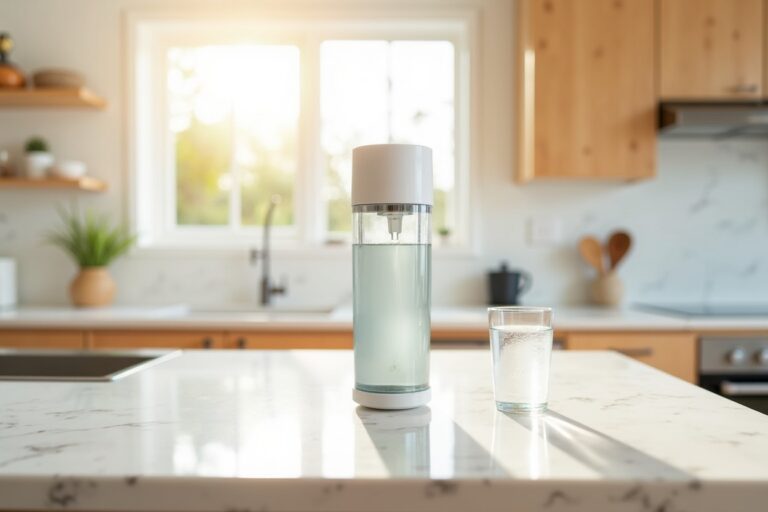
The AquaTru Countertop RO is the standout option here. It sits on your benchtop, plugs into a standard power point, and uses a 4-stage reverse osmosis system to remove 83 contaminants — including PFAS, fluoride, lead, arsenic and chloramine. NSF/ANSI certified under Standards 42, 53, 58 and 401. No plumber. No drilling. Fills a 1.9L tank that dispenses on demand.
The main tradeoff: it’s slower than a plumbed RO (produces about 4L/hour), and you need to remember to refill it. For a family of two to four using it primarily for drinking and cooking, it’s entirely adequate.
The Clearly Filtered Water Pitcher is the best pitcher option if you want something even simpler — no power, no installation, NSF certified to remove over 270 contaminants including PFAS and fluoride. Filter life is 100 gallons (~380 litres).
Best Water Filter for Renters Australia 2026
Renters need filtration without modifying the property. Three solid options:
Tappwater EcoPro screws directly onto your existing tap (60-second install, fits 95% of Australian taps), removes 93% PFAS, 70% fluoride, 98% chlorine, and over 100 other contaminants. When you move out, you unscrew it and take it with you.
AquaTru Countertop RO sits on the bench — no installation at all. Most comprehensive filtration available without any plumbing changes.
Berkey Royal (without PF-2) is gravity-fed, requires no plumbing and no electricity. Note: without the optional PF-2 fluoride add-on filters, a standard Berkey does not remove fluoride. If fluoride removal matters to you, budget for the PF-2 filters as well.
For a deeper dive on options specific to rental situations, see our breakdown of PFAS contamination in Australian drinking water.
Ready to filter your water?
We have ranked the best countertop and under-sink RO systems available in Australia — including options for renters who cannot modify their plumbing.
Frequently Asked Questions
Does a Brita filter remove fluoride from Australian tap water?
No. Standard Brita pitcher filters use granular activated carbon, which improves taste and removes some chlorine but does not remove fluoride or PFAS. If fluoride removal is your goal, you need a reverse osmosis system, a Berkey with PF-2 fluoride filters, or a Clearly Filtered pitcher (which uses a more advanced filtration media than Brita).
What is the most important thing to filter out of Australian tap water?
It depends on where you live. For most capital city residents, the priorities are chloramine (used instead of chlorine in most Australian cities), PFAS (especially if you’re near a contamination site — check the PFAS site register), and fluoride if you prefer to limit your intake. A reverse osmosis system addresses all three comprehensively.
How much does a good water filter cost in Australia?
Expect to pay $350–700 AUD for a quality countertop or gravity filter, and $500–1,200 AUD for an under-sink RO system including installation. Annual filter replacement costs run $80–200 depending on the system. Cost per litre of filtered water works out to $0.03–0.10 — significantly less than bottled water ($0.50–2.00 per litre).
Is reverse osmosis water safe to drink long-term?
Yes, with one consideration: RO removes beneficial minerals along with contaminants. The water is perfectly safe to drink, but if your diet is already low in calcium and magnesium, you may want to consider a remineralisation filter stage (many modern RO systems include this) or ensure you’re getting adequate minerals through food. Most people drinking a varied whole-foods diet don’t need to worry about this.
Do I need a plumber to install an under-sink water filter?
For a basic under-sink carbon filter with a separate tap, most handy homeowners can install it in under an hour using the included components. For under-sink RO systems, the process is more involved — you’re connecting to the cold water supply, the drain line, and a dedicated tap — and it’s worth paying a plumber ($150–300) if you’re not confident with basic plumbing. Countertop options like the AquaTru need zero plumbing.
Get the Australian Home Environment Checklist
30 checks across water, air and EMF. Most of them free. Ranked by impact.
No spam. Unsubscribe any time.
Former Royal Australian Navy Clearance Diver and TAG-E counter-terrorism operator. Founded Clean and Native to apply the same rigorous thinking to the home environment.
Full biography →