Does Brisbane Tap Water Have Fluoride? What You Need to Know
Yes – Brisbane tap water contains fluoride at a target concentration of 0.70 mg/L, as mandated by Queensland’s Water Fluoridation Act 2008. This places Brisbane at the lower end of Australian capital city fluoride levels – Sydney’s tap water has significantly more fluoride at 1.0 mg/L. This article covers the exact data from Seqwater, the health research on both sides, which populations should consider reducing their exposure, and the only filter technologies that actually remove fluoride.
Yes, Brisbane tap water contains fluoride at 0.70 mg/L — mandated under Queensland’s Water Fluoridation Act 2008 and well below the 1.5 mg/L health guideline. Most adults can drink it without concern, but infants on formula, pregnant women, and people with thyroid conditions should consider a reverse osmosis system (activated carbon/Brita filters do not remove fluoride). The catches: Brisbane uses monochloramine disinfection (not chlorine), so you need a filter rated for chloramine removal if that’s also a concern, and RO wastes 3–4 litres per litre produced.
| Population | Fluoride Concern | Verdict |
|---|---|---|
| Infants on formula | Overexposure risk (fluorosis) | RO filter recommended |
| Pregnant women / thyroid patients | Emerging research warrants caution | Consider RO, consult GP |
| General adult population | 0.7 mg/L well below 1.5 mg/L limit | Tap water safe as-is |
Brisbane Fluoride – Key Facts
Current level: 0.70 mg/L (target) – measured range 0.6-0.8 mg/L
Mandated by: Water Fluoridation Act 2008 (Qld) + Water Fluoridation Regulation 2020
ADWG health limit: 1.5 mg/L – Brisbane is less than half the limit
Disinfection: Monochloramine (not chlorine) – relevant for filter selection
Removes fluoride: Reverse osmosis only. Activated carbon (Brita, standard jugs) does not.
Who should consider filtering: Infants on formula, pregnant women, people with thyroid conditions
Current Fluoride Levels in Brisbane Tap Water (2026 Data)
Brisbane’s water supply is managed by Seqwater, which operates the bulk treatment network across South East Queensland. Treated water reaches residents through Urban Utilities (Greater Brisbane) and Unitywater (Moreton Bay, Sunshine Coast, Noosa). Fluoride is added at the treatment plant stage – not in the distribution network – to achieve a target of 0.70 mg/L.
The measured range in Seqwater’s 2024-25 annual drinking water quality report is 0.6-0.8 mg/L, consistent with the Water Fluoridation Regulation 2020 target of 0.7 mg/L. Urban Utilities tests fluoride at multiple points throughout the distribution network; independent monitoring by Queensland Health confirms compliance.
| City | Water Authority | Fluoride (mg/L) | Disinfection | Notes |
|---|---|---|---|---|
| Brisbane (QLD) | Seqwater / Urban Utilities | 0.70 | Chloramine | Mandated. Lower than Sydney, Melbourne. |
| Sydney (NSW) | Sydney Water | 1.0 | Chloramine | Highest of any AU capital. |
| Melbourne (VIC) | Melbourne Water | 0.90 | Chlorine | Second highest. Free chlorine – easier to filter. |
| Perth (WA) | Water Corporation | 0.70 | Chloramine | Same level as Brisbane. |
| Canberra (ACT) | Icon Water | 0.80 | Chlorine | Zero PFAS detections. Best overall AU capital. |
| Adelaide (SA) | SA Water | 0.56 | Chloramine | Lowest mainland. Murray River TDS 480 mg/L. |
| Darwin (NT) | Power and Water | 0.70 | Chloramine | Fluoridated. PFAS concern near RAAF Tindal. |
| Hobart (TAS) | TasWater | 0.0 | Chlorine | Not fluoridated. Lowest risk AU capital. TDS 42 mg/L. |
Where Does Brisbane’s Water Come From? The Seqwater Network
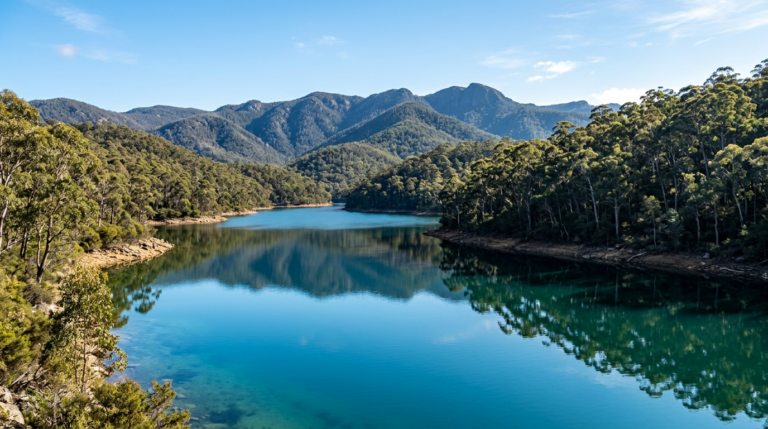
Understanding the source helps contextualise the fluoride discussion. Brisbane’s water comes from a grid of interconnected dams and water treatment plants managed by Seqwater:
- Wivenhoe Dam (Lake Wivenhoe) – the primary storage reservoir for SEQ, with a capacity of 1,165 GL. Water is treated at Mount Crosby Water Treatment Plant before entering distribution.
- Somerset Dam – feeds into Wivenhoe and supplements the grid during high-demand periods.
- North Pine Dam – supplies north Brisbane through the North Pine Water Treatment Plant.
- Hinze Dam (Gold Coast) – serves the Gold Coast corridor through Molendinar WTP.
- Enoggera, Esk, and Baroon Pocket dams – supplementary storages feeding into the broader SEQ grid.
All treatment plants in the Seqwater network add fluoride to the target of 0.70 mg/L. The source water is soft and low in natural fluoride – the fluoride in your tap comes entirely from the addition at treatment, not from the dam water itself.
TDS across the SEQ grid averages around 370 mg/L – moderate by national standards but significantly higher than Melbourne’s 55 mg/L from its mountain catchments. The higher TDS reflects the different geology of SEQ’s water catchments.
How Fluoride Is Added to Brisbane Water
The fluoride added to Brisbane’s water supply is hexafluorosilicic acid (H2SiF6), also called fluorosilicic acid or hydrofluorosilicic acid. This is the most commonly used fluoridation agent in Australian water treatment – it is a by-product of phosphate fertiliser manufacturing, making it the most cost-effective fluoride source available at treatment scale.
At the pH of treated drinking water (7.0-8.5), hexafluorosilicic acid dissociates completely to fluoride ions (F-) and silicic acid (Si(OH)4). The fluoride ion in treated Brisbane water is chemically identical to the fluoride ion from naturally fluoride-rich groundwater – the source compound matters only at the point of addition, not at the tap.
The compound used sometimes features in anti-fluoridation arguments (characterised as “industrial waste”). The chemistry doesn’t support the concern: complete dissociation at drinking water pH means what reaches your tap is fluoride ions and water, not hexafluorosilicic acid.
Our Top-Rated Water Filters
Reverse osmosis is the only residential technology that reliably removes PFAS, fluoride, chloramine, and heavy metals — the four contaminants most Australians are most exposed to.
The Health Evidence: What the Research Actually Says
The fluoride debate polarises quickly into “completely safe, benefits proven” versus “toxic, must be stopped.” The actual literature sits in a more nuanced middle ground that’s worth understanding.
The Case for Fluoridation at 0.70 mg/L
- Dental decay reduction: The evidence for fluoride’s effectiveness in reducing dental caries is strong and multi-generational. Studies across Australia, the UK, Ireland, and New Zealand consistently show lower rates of tooth decay in fluoridated communities, with the benefit most pronounced in lower socioeconomic groups with less access to dental care. The NHMRC’s systematic evidence review (2017) concluded that fluoridation at 0.6-1.1 mg/L produces a 26-44% reduction in tooth decay in children.
- Safety at current levels: The NHMRC’s 2017 review found no consistent evidence of harm to the general population at concentrations used in Australia. This includes no evidence of effects on kidney function, bone density, neurological development, or cancer risk at the 0.7 mg/L level used in Brisbane.
- Dental fluorosis: The only consistently documented adverse effect at 0.7 mg/L is mild dental fluorosis – white spots or streaking on tooth enamel. The NHMRC estimated 3-19% of Australians in fluoridated areas have mild or very mild dental fluorosis, which is considered cosmetically minimal at these levels.
Legitimate Research Concerns
- Neurodevelopment / IQ studies: A 2017 meta-analysis published in Environment International (Grandjean and Landrigan) reviewed fluoride as a developmental neurotoxicant. A more specific study by Bashash et al. (2017) in Environmental Health Perspectives found associations between maternal urinary fluoride levels and lower IQ scores in children in a Mexican cohort – however, the fluoride exposures in that study were at levels higher than Brisbane’s 0.70 mg/L. The research is ongoing; Health Canada and the US National Toxicology Program have both commissioned recent reviews. The NHMRC’s position is that available evidence does not establish causation at Australian water fluoridation levels.
- Thyroid function: A 2018 study in Environment International (Peckham et al.) found higher rates of hypothyroidism in fluoridated areas of the UK compared to non-fluoridated areas. The association was significant but the study design (ecological, not individual-level) limits causal interpretation. For people with diagnosed or suspected hypothyroidism, reducing fluoride intake as a precautionary measure is reasonable and some integrative medicine practitioners recommend it.
- Cumulative exposure: The NHMRC’s review and NHMRC’s fluoride intake guidelines focus on water consumption but fluoride also enters intake through toothpaste (not meant to be swallowed, but relevant for young children), some foods (tea has naturally high fluoride), dental treatments, and some medications. For infants on formula made with fluoridated tap water, cumulative daily fluoride intake relative to body weight can be higher than for breastfed infants – this is the strongest practical case for filtering infant formula water.
The bottom line on health: For healthy adults, Brisbane’s 0.70 mg/L fluoride level is within NHMRC and WHO safety parameters and is unlikely to cause harm. For infants on formula, pregnant women, and people with thyroid conditions, the precautionary case for fluoride reduction is evidence-informed – not fringe. The mechanism to do so is a reverse osmosis filter, which reduces fluoride by 85-95%.
Who Should Consider Reducing Fluoride Intake in Brisbane?
| Population | Fluoride concern | Evidence level | Recommendation |
|---|---|---|---|
| Infants (0-12 months) on formula | Higher fluoride per kg body weight than breastfed | Moderate | Consider RO or low-fluoride water for formula. Discuss with GP. |
| Pregnant women | Crosses placenta; Bashash et al. (2017) IQ association study | Emerging | Precautionary RO filter is reasonable. Discuss with GP/obstetrician. |
| Diagnosed hypothyroidism / Hashimoto’s | Fluoride-thyroid association in Peckham (2018) | Emerging (ecological study) | Many endocrinologists recommend RO water as precaution. |
| Healthy adults | No consistent harm at 0.70 mg/L per NHMRC 2017 | Low | No urgent need to filter. Personal choice. |
| Children (dental fluorosis risk) | Mild fluorosis possible if cumulative intake high | Moderate | Monitor total fluoride intake (toothpaste + water + diet). Don’t supplement additionally. |
Brisbane’s Second Water Problem: Chloramine
The fluoride discussion often overshadows Brisbane’s more immediately impactful water quality issue: disinfection with monochloramine rather than free chlorine.
Brisbane, Gold Coast, and the broader Seqwater network use monochloramine as their primary disinfectant residual. This matters for filter selection because standard activated carbon filters – the technology in Brita jugs, most gravity filters, and many under-sink systems – do not remove chloramine. Only catalytic activated carbon or a reverse osmosis membrane addresses chloramine.
The practical consequence: if you buy a fluoride-reduction filter for Brisbane that uses standard carbon block technology (not catalytic carbon or RO), you may be reducing fluoride while leaving chloramine – which has stronger evidence for skin irritation, eczema aggravation, and disinfection byproduct formation than fluoride – completely unaddressed.
The good news: reverse osmosis removes both fluoride and chloramine through the membrane rejection mechanism. An RO filter addresses both concerns simultaneously.
Regional Queensland: Fluoride Levels Outside Brisbane
Queensland’s fluoridation coverage applies to all town water supplies serving populations above 1,000 people under the Water Fluoridation Act 2008 – but local governments gained the ability to opt out in 2012. Coverage is therefore not uniform across the state.
| QLD Area | Fluoridated? | Disinfection | Notes |
|---|---|---|---|
| Brisbane / Gold Coast / Sunshine Coast (SEQ) | Yes – 0.70 mg/L | Chloramine | Seqwater network. Mandatory. |
| Townsville | Yes – 0.70 mg/L | Chlorine | Townsville City Council. Free chlorine – standard carbon works. |
| Cairns | Yes – 0.70 mg/L | Chlorine | Cairns Regional Council. Free chlorine. |
| Toowoomba | Yes – 0.70 mg/L | Chlorine | Toowoomba Regional. Free chlorine. |
| Some rural/remote councils | Varies | Varies | Opt-out permitted since 2012. Check your local council. |
Which Filters Actually Remove Fluoride from Brisbane Water?
This is where most competing articles are vague or wrong. The answer is simple: very few filter technologies remove fluoride, and activated carbon is not one of them.
| Filter Technology | Removes Fluoride? | Removes Chloramine? | Notes |
|---|---|---|---|
| Standard activated carbon (Brita, most jugs) | No | No | Most popular filter type – useless for both Brisbane-specific concerns. |
| Catalytic activated carbon | No | Yes | Addresses chloramine. Does not address fluoride. |
| Reverse Osmosis (RO) | Yes (85-95%) | Yes | Best solution for Brisbane. Addresses both fluoride and chloramine. |
| Activated alumina | Yes (80-95%) | No | Effective for fluoride. Does not address chloramine. pH sensitive. |
| Bone char carbon | Yes (90-95%) | Partial | High fluoride removal. Not vegan/vegetarian. Less common in AU market. |
| Gravity filter + fluoride cartridge (e.g. Berkey PF-2) | Yes (>97%) | Partial | Requires specific fluoride element (not standard Berkey). Good for renters. |
| UV filter | No | No | UV is for bacteria/pathogens only. Irrelevant for fluoride or chloramine. |
Best Filters for Fluoride Removal in Brisbane (Recommended Options)
1. Under-Sink Reverse Osmosis – Best Overall for Brisbane
For Brisbane households, a reverse osmosis under-sink system is the most comprehensive solution. It removes fluoride (85-95%), chloramine (via membrane), PFAS, heavy metals, and reduces TDS – addressing all of Brisbane’s water quality concerns in a single system. Water is stored in a pressure tank and delivered through a dedicated tap, leaving your main tap unaffected.
Key considerations for Brisbane RO installation: the system requires WaterMark AS3497 certification for permanent plumbing, and installation by a licensed plumber. The SEQ water pressure (typically 300-500 kPa) is suitable for RO operation without a booster pump in most cases.
Best Under-Sink RO Filters for Brisbane →2. AquaTru Countertop RO – No Plumber Required
The AquaTru is a countertop reverse osmosis system that requires no plumbing – it fills from a reservoir you fill manually. It achieves the same fluoride removal as plumbed RO (85-95%) and is NSF/ANSI 58 certified. For Brisbane renters who cannot modify plumbing, or households wanting fluoride reduction without a licensed plumber, the AquaTru is the most effective option available. Note the Australian power adapter requirement (the standard AquaTru runs on 110V; an Australian-compatible version is available).
AquaTru Australia Review →3. Berkey with PF-2 Fluoride Elements – Best Gravity Option
Berkey gravity filters paired with PF-2 fluoride and arsenic reduction elements provide over 97% fluoride removal without electricity or plumbing. This makes Berkey the top option for renters, rural properties, or as a secondary filter. Critical note: the standard Black Berkey elements alone do not remove fluoride – you must add the PF-2 elements specifically. They connect to the lower tank and are separate from the main filtration elements.
The PF-2 elements use an activated alumina media. Each set filters approximately 3,785 litres and should be replaced every 6 months for a typical household. The Berkey system’s chloramine removal is partial – the Black Berkey elements have some catalytic carbon components but are not the most efficient chloramine solution for Brisbane’s concentration levels. For comprehensive Brisbane coverage, pair Berkey with PF-2 elements, and accept limited chloramine reduction as a trade-off versus full RO.
Berkey vs Doulton Australia Comparison →Find the right filter for your Brisbane home
Our Queensland water filter guide covers RO and gravity options matched to SEQ water chemistry – including chloramine removal, fluoride reduction, and PFAS risk near Amberley.
Best Water Filters for Brisbane → Under-Sink vs Countertop RO →Frequently Asked Questions
Does Brisbane tap water have fluoride?
Yes. Brisbane’s water supply, managed by Seqwater and distributed by Urban Utilities and Unitywater, contains fluoride at a target of 0.70 mg/L as required by the Water Fluoridation Act 2008 (Qld). The measured range is 0.6-0.8 mg/L. This is lower than Sydney (1.0 mg/L) and Melbourne (0.9 mg/L) but higher than Adelaide (0.56 mg/L). Hobart is the only Australian capital with no added fluoride (0.0 mg/L).
Is Brisbane’s fluoride level safe?
According to the NHMRC’s 2017 systematic evidence review, there is no consistent evidence of harm to the general population at the concentrations used in Australia (0.6-1.1 mg/L). Brisbane’s 0.70 mg/L is well within the ADWG health limit of 1.5 mg/L and the WHO guideline of 1.5 mg/L. For healthy adults, no action is required. The precautionary case for filtering is stronger for infants on formula, pregnant women, and people with thyroid conditions – see specific guidance above.
Does boiling Brisbane tap water remove fluoride?
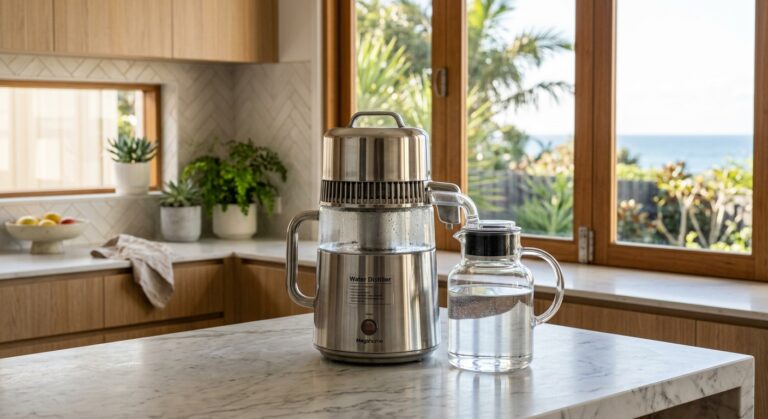
No. Boiling does not remove fluoride – it actually slightly concentrates it because water evaporates during boiling while fluoride (a stable inorganic ion) remains. Boiling removes free chlorine and is effective against biological contamination, but has no effect on fluoride, chloramine, PFAS, or heavy metals. Only reverse osmosis or specific adsorption media (activated alumina, bone char) remove fluoride.
Does a Brita filter remove fluoride from Brisbane water?
No. Brita jugs and equivalent standard activated carbon filters do not remove fluoride. The fluoride ion (F-) is smaller than the pores in activated carbon media – it passes straight through. For fluoride removal, you need reverse osmosis, activated alumina, or bone char carbon. Additionally, standard Brita-style filters do not remove chloramine, which is Brisbane’s primary disinfectant – making them largely ineffective for addressing Brisbane’s two main water chemistry concerns.
Is Brisbane fluoride level safe for babies and formula feeding?
The Australian Dental Association advises that fluoridated water is safe for formula preparation, and Brisbane’s 0.70 mg/L is within range. However, the NHMRC acknowledges that infants fed exclusively on formula made with fluoridated water consume more fluoride per kg body weight than breastfed infants, and some paediatric practitioners recommend using filtered or low-fluoride water for newborn formula as a precaution. This is a decision to make with your GP or paediatrician – it is a reasonable precautionary choice, not a fringe position.
What is the best filter to remove fluoride in Brisbane?
Reverse osmosis is the most effective and comprehensive option for Brisbane. An RO system removes fluoride (85-95%), chloramine (Brisbane’s disinfectant), PFAS, heavy metals, and reduces TDS simultaneously. For renters or those without plumbing access, the AquaTru countertop RO achieves the same fluoride removal without installation. Gravity filters (Berkey with PF-2 elements) are a good no-plumbing alternative, removing over 97% of fluoride, though with less effective chloramine removal than RO.
Why does Brisbane use chloramine instead of chlorine?
Seqwater switched to monochloramine as the primary disinfectant residual because it lasts longer in distribution networks (reducing the need for rechlorination booster points) and produces fewer trihalomethane (THM) disinfection byproducts than free chlorine. The downside is that chloramine requires different filter technology to remove – standard activated carbon doesn’t work. Only catalytic activated carbon or reverse osmosis membranes address chloramine.
Does fluoride affect thyroid function?
The research is emerging but not conclusive. A 2018 study (Peckham et al., Environment International) found higher rates of hypothyroidism in fluoridated UK areas versus non-fluoridated areas. The association was statistically significant but the ecological study design limits causal interpretation. For people with diagnosed hypothyroidism or Hashimoto’s thyroiditis, many integrative medicine and functional medicine practitioners recommend reducing fluoride intake as a precaution. This is considered a reasonable evidence-informed choice, not medically established as necessary. Using an RO filter for drinking and cooking water is the practical implementation.
How does Brisbane fluoride compare to other Queensland cities?
Brisbane (SEQ network): 0.70 mg/L, chloramine disinfection. Townsville: 0.70 mg/L, free chlorine. Cairns: 0.70 mg/L, free chlorine. Toowoomba: 0.70 mg/L, free chlorine. The fluoride level is consistent across Queensland’s major cities, all targeting 0.70 mg/L under the Water Fluoridation Act. The key difference is disinfection method: Brisbane/SEQ uses chloramine while North Queensland cities use free chlorine – making standard carbon filters effective in Townsville and Cairns but not in Brisbane.
Get the Australian Home Environment Checklist
30 checks across water, air and EMF. Most of them free. Ranked by impact.
No spam. Unsubscribe any time.

Former Royal Australian Navy Clearance Diver and TAG-E counter-terrorism operator. Founded Clean and Native to apply the same rigorous thinking to the home environment.
Full biography →