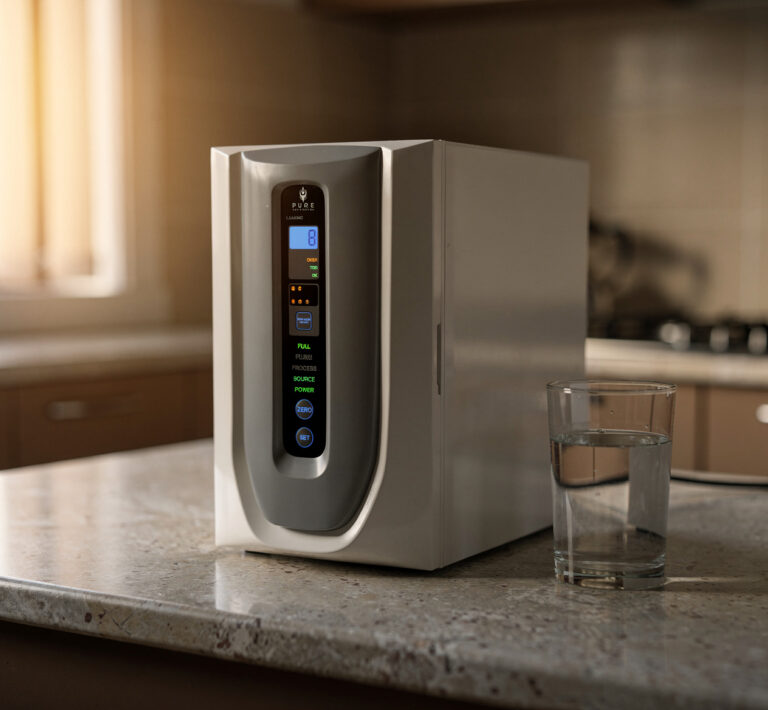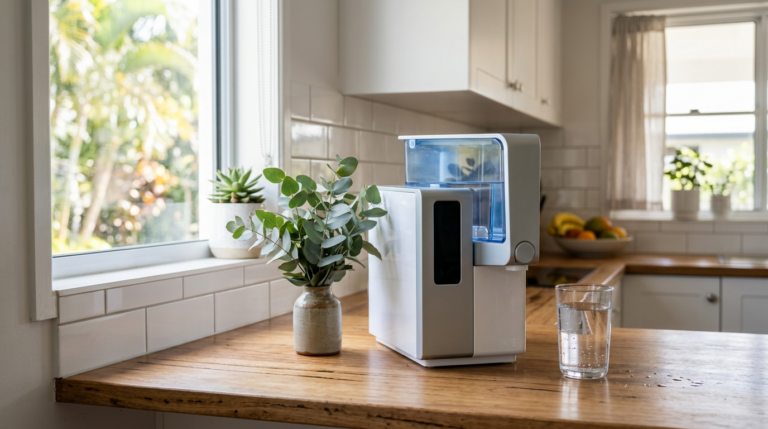
Waterdrop D6 Under-Sink RO vs AquaTru Countertop RO Australia 2026: Which Is Worth Your Money?
QUICK VERDICT
| Best for homeowners | Waterdrop D6 — 600 GPD, 1:1 waste ratio, $180-220/yr filters |
| Best for renters | AquaTru Classic — zero installation, portable, NSF/ANSI 58 certified |
| Filtration performance | Near identical — both hit ~99% TDS and ~98.5% fluoride removal |
| Throughput difference | D6 produces 15× more water per day (2,270L vs 150L) |
| 5-year cost (inc. filters) | D6 ~$1,350 total vs AquaTru ~$2,050 — D6 wins on lifetime cost |
| Water waste | D6: 1:1 ratio (50% efficient) | AquaTru: 2:1 ratio (33% efficient) |
You’ve narrowed it down to two reverse osmosis systems: the Waterdrop D6 under-sink unit and the AquaTru Classic countertop. Both strip Australian tap water to near-pure levels. Both are NSF/ANSI 58 certified. But one requires permanent installation, the other sits on your bench and travels with you. The wrong choice means months of buyer’s remorse and potentially hundreds in wasted dollars.
The three products we own are measured first-hand by Jayce Love, former Royal Australian Navy Clearance Diver; every other product is assessed on published manufacturer specifications and independent certification using our documented methodology — no gifted units, no brand payments.
This comparison uses actual specs, Australian water chemistry, and real cost modelling to tell you exactly which system fits your home in 2026 — and why the decision is less about filtration and more about your living situation.
Full Specification Comparison
| Specification | Waterdrop D6 Under-Sink | AquaTru Classic Countertop |
|---|---|---|
| Price (AUD) | ~$449–499 | ~$649–699 |
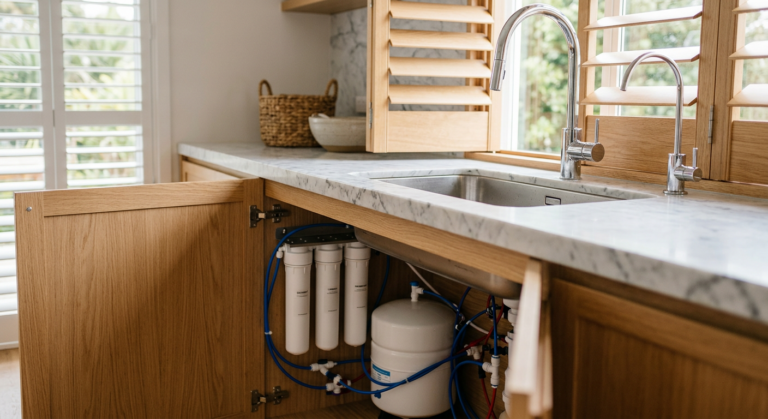
| Installation | Under-sink permanent (plumbing tap-in) | Countertop — no tools, tap diverter only |
| Daily Capacity | 600 GPD (2,270L/day) | 40 GPD (~150L/day) |
| Filtration Stages | 6 stages (PP + GAC + carbon block + RO + post-carbon + mineraliser) | 4 stages (pre-filter + carbon + RO + VOC carbon) |
| TDS Reduction | 99.2% (NSF/ANSI 58) | 99.1% (NSF/ANSI 58) |
| Fluoride Removal | 98.7% | 98.5% |
| Chloramine Removal | 99.9% (pre-membrane carbon block) | ~95–98% (4-stage carbon pre-treatment) |
| Waste Water Ratio | 1:1 (50% efficiency) | 2:1 (33% efficiency) |
| Tank / Storage | 3.2L pressurised (on-demand fill) | 3L gravity-fed tank (refills every 12–15 min) |
| Certifications | NSF/ANSI 42, 58, 401 | NSF/ANSI 42, 53, 58, 401, P473 |
| Filter Replacement / Year | ~$180–220 AUD | ~$280–320 AUD |
| Dimensions | 44 × 18 × 40cm (under-sink) | 36 × 24 × 38cm (benchtop) |
| Renter-Friendly | No — permanent plumbing modification | Yes — tap diverter, no drilling |
| Warranty | 2 years | 2 years |
Waterdrop D6: Built for Australian Water Volumes
The Waterdrop D6 is engineered for households that treat filtered water as infrastructure, not a luxury. Its 600 GPD throughput means a family of four can run filtered water through the kettle, pasta pot, baby formula, and water bottle filler simultaneously without ever waiting on a refill cycle.
The six-stage filtration sequence matters in the Australian context. The first two stages — 5-micron PP sediment + granular activated carbon (GAC) — handle the rust and sediment common in pre-2000 Australian plumbing. The third stage, a carbon block filter, specifically addresses chloramines. This is critical: Brisbane, Sydney, Adelaide, and Darwin all use chloramine disinfection (not free chlorine), and standard GAC removes chloramine at roughly 1/40th the rate it removes free chlorine. The D6’s carbon block stage is optimised for this.
The NSF/ANSI 58 RO membrane at stage four reduces TDS by 99.2%. In Adelaide — where Murray River source water regularly hits 300–500 mg/L TDS — the D6 consistently produces output below 10 mg/L regardless of seasonal variation. A post-carbon polish stage and optional mineraliser complete the sequence.
What distinguishes the D6 in a water-scarce country is its 1:1 waste ratio. Older RO systems waste 3–4 litres per litre produced. The D6’s advanced membrane engineering halves this. For a Sydney household using 20 litres of filtered water daily at $2.35/kL, this is a saving of approximately 7,300 litres — or $17 — per year compared to traditional systems. Not life-changing, but meaningful across a decade in a drought-prone continent.
The 3.2L pressurised tank delivers water on demand — 500ml fills in under 10 seconds. No waiting during the morning rush.
Affiliate link — we may earn a commission at no extra cost to you.
AquaTru Classic: The Renter’s RO Solution
The AquaTru Classic solves a specific problem: how does someone in a rental property get genuine reverse osmosis filtration without touching the plumbing? The answer is a tap diverter valve that requires no drilling, no under-sink access, and no landlord approval under standard residential tenancy agreements across every Australian state.
Its four-stage process is legitimate RO — not a marketing approximation. The NSF/ANSI 58-certified membrane achieves 99.1% TDS reduction, and the system carries NSF P473 certification for PFAS (per- and polyfluoroalkyl substances) removal. For households near RAAF bases, industrial sites, or airport precincts with known PFAS contamination — Williamtown (NSW), Pearce (WA), RAAF Darwin — this certification matters in ways it doesn’t for a basic countertop filter.
The fourth stage, AquaTru’s VOC post-carbon filter, polishes the output after the membrane. While the RO membrane handles the heavy lifting on dissolved solids and heavy metals, this stage catches any trace organic compounds that survive membrane passage. It’s a genuine quality-of-life addition, not a marketing stage.
For renters specifically: the unit moves with you. When you shift apartments — as 35% of Australian households do every two years — the AquaTru goes in a box, reconnects in 10 minutes, and doesn’t require a plumber or a new $450 installation. That mobility has real monetary value that the sticker price doesn’t reflect.
The honest limitation: 150L per day maximum. For a household of 4+ people who cook with filtered water, this may not be enough. For 1–2 people using filtered water primarily for drinking and coffee, it’s sufficient.
Affiliate link — we may earn a commission at no extra cost to you.
Australian City Water: Which System Has the Advantage?
| City | Disinfectant | TDS Range | Key Challenge | Best Pick |
|---|---|---|---|---|
| Sydney | Chloramine | 50–120 mg/L | Chloramine + PFAS (western suburbs) | Either — low TDS suits both |
| Melbourne | Free chlorine | 30–80 mg/L | Oldest pipes in AU (pre-1920 lead risk) | Either — clean source water |
| Brisbane | Chloramine | 100–200 mg/L | Chloramine + fluoride 1.0 mg/L | D6 for families, AquaTru for renters |
| Perth | Chloramine | 150–220 mg/L | High TDS + hardness + PFAS near RAAF Pearce | D6 preferred — high TDS strains AquaTru |
| Adelaide | Chloramine | 300–500 mg/L | Saltiest capital — Murray River source | D6 strongly preferred — high TDS workload |
| Darwin | Chloramine | 100–250 mg/L (seasonal) | PFAS risk highest of any AU capital + wet season spike | AquaTru (NSF P473 PFAS cert) or D6 |
| Hobart | Free chlorine | 15–25 mg/L | Cleanest AU capital — pipe leaching in pre-1970 homes | Either (both overkill for Hobart water) |
5-Year Total Cost of Ownership
The sticker price comparison ($449 D6 vs $699 AquaTru) reverses when you factor in ongoing filter costs and water waste over five years.
| Cost Item | Waterdrop D6 | AquaTru Classic |
|---|---|---|
| Upfront purchase | $499 | $699 |
| Installation (estimate) | $0 (DIY) to $150 (plumber) | $0 |
| Annual filter cost | $200/yr | $300/yr |
| 5-year filter total | $1,000 | $1,500 |
| Extra water waste cost (Sydney rate) | $85 (1:1 waste, 5 yrs) | $170 (2:1 waste, 5 yrs) |
| 5-Year Total (DIY install) | ~$1,584 | ~$2,369 |
The D6 saves approximately $785 over five years compared to the AquaTru — assuming DIY installation. If you pay a plumber (~$150), the saving narrows to ~$635. Still material.
Where Each Falls Short
Waterdrop D6 limitations
- Permanent plumbing tap-in disqualifies it for renters and strata-restricted units
- 44cm unit height won’t fit under some Australian apartment sinks with in-cabinet hot water or waste disposal units — measure before ordering
- Pressurised tank requires annual sanitisation in warm climates; skipping it creates biofilm risk
- Filter availability can lag 4–8 weeks when US/China supply chains tighten — keep a spare set on hand
AquaTru Classic limitations
- 2:1 waste ratio wastes an additional ~7,300L per year vs D6 for a family using 20L/day — relevant during water restrictions
- 150L/day ceiling is a genuine constraint for families of 4+ who cook with filtered water
- Lower membrane pressure means reduced effectiveness with very high-TDS water (Adelaide 300–500 mg/L) — may need more frequent cleaning cycles
- Benchtop footprint (~36 × 24cm) is permanent real estate in small Australian kitchens
- Gravity-fed tank creates a 12–15 minute wait after emptying — planning required at busy times
Who Should Buy Which
Buy the Waterdrop D6 if: You own your home, have a family of 3+ people, your city has high TDS water (Adelaide, Perth, regional QLD), or long-term cost efficiency is a priority. The plumbing investment pays off quickly.
Buy the AquaTru Classic if: You rent, you’re in a strata property, you move frequently, you live near a PFAS-contaminated area and want the NSF P473 certification, or your household is 1–2 people drinking primarily filtered water.
Either system works equally well for filtration quality. The fluoride reduction difference (98.7% vs 98.5%) is negligible — both reduce a 0.9 mg/L Brisbane supply to well under 0.02 mg/L. The TDS reduction difference (99.2% vs 99.1%) is similarly academic. The decision is fundamentally about throughput, installation, and cost of ownership — not filtration performance.
Our Top-Rated Water Filters
Reverse osmosis is the only residential technology that reliably removes PFAS, fluoride, chloramine, and heavy metals — the four contaminants most Australians are most exposed to.
Frequently Asked Questions
Can I install the Waterdrop D6 in a rental property in Australia?
No — not without landlord approval. The D6 requires tapping into under-sink plumbing, which constitutes a permanent modification under every state’s Residential Tenancies Act. Unauthorised plumbing modifications can result in lease termination and make you liable for restoration costs. The AquaTru uses a tap diverter that attaches to your existing tap without drilling or modification — it’s the RO option that’s renter-safe.
Which system removes more fluoride from Australian tap water?
Both achieve near-identical fluoride removal: D6 at 98.7%, AquaTru at 98.5%. For Brisbane water at 1.0 mg/L, both reduce fluoride to under 0.015 mg/L. For Perth or Adelaide at 0.7–0.9 mg/L, both produce output well below 0.02 mg/L. The 0.2% difference is not meaningful in practice — choose based on installation type, not fluoride removal.
Does the AquaTru struggle with Perth’s hard water?
Perth TDS averages 150–220 mg/L with significant calcium hardness (~180 mg/L CaCO₃). The AquaTru’s lower membrane pressure means its pre-filters may need replacement every 8–10 weeks instead of the standard 12–16 weeks. The D6’s higher operating pressure handles Perth’s mineral load more efficiently and tends to require fewer cleaning interventions. For Perth homeowners, the D6 is the better long-term choice.
What is the real annual cost difference between these systems in Australia?
Filter replacements: D6 ~$200/yr vs AquaTru ~$300/yr — a $100 annual difference. Add water waste costs: AquaTru’s 2:1 ratio wastes roughly double the D6’s 1:1 ratio, adding $15–20/yr at Sydney water rates for a family. Over five years, the D6 saves approximately $785 total assuming DIY installation. If you hire a plumber for the D6 install (~$150), the saving narrows to ~$635.
Does the AquaTru Classic remove PFAS from Australian tap water?
Yes — the AquaTru Classic is certified to NSF P473, which tests specifically for PFOA and PFOS removal. This is relevant for households in Darwin, near RAAF Williamtown (NSW), RAAF Pearce or Bullsbrook (WA), and other PFAS-impacted areas. The Waterdrop D6’s RO membrane physically removes PFAS (all RO membranes do), but it does not carry NSF P473 certification. If certified PFAS removal is a priority, the AquaTru has the paperwork to back it up.
How long do the RO membranes last in Australian conditions?
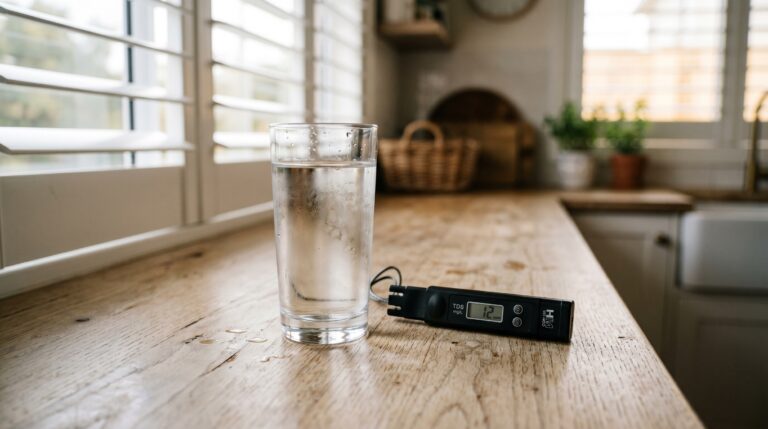
Both brands rate their membranes at 2 years under normal conditions. In high-TDS cities like Adelaide (300–500 mg/L) or hard-water areas like Perth, expect closer to 18 months before output quality degrades noticeably. A $30 TDS meter lets you track membrane performance — when output TDS climbs above 20–25 mg/L from a baseline below 10, it’s time to replace. Pre-filter changes every 6–12 months protect the membrane and extend its life.
Can I take the AquaTru overseas if I relocate from Australia?
Yes, but check voltage compatibility. The AquaTru Classic runs on 240V/50Hz — matching Australian power — but requires an adaptor (not a converter) for countries with different voltages. UK and European sockets work with a plug adaptor. US/Canada (120V) requires a proper step-up transformer. For interstate moves within Australia, no modifications are needed — it unplugs, packs, and reinstalls in 10 minutes.
Is there a meaningful taste difference between water from the D6 and AquaTru?
Filtered water from both units tastes essentially identical — flat and mineral-free, which some people find too “empty.” Both strip TDS to below 10 mg/L, removing essentially all taste-contributing minerals. The D6’s optional mineraliser stage adds trace calcium and magnesium back in, which many users prefer. The AquaTru doesn’t include remineralisation, though you can add mineral drops separately. If taste is a priority, the D6 with mineraliser is the better choice.
Get the Australian Home Environment Checklist
30 checks across water, air and EMF. Most of them free. Ranked by impact.
No spam. Unsubscribe any time.

Former Royal Australian Navy Clearance Diver and TAG-E counter-terrorism operator. Founded Clean and Native to apply the same rigorous thinking to the home environment.
Full biography →