Best Fluoride Water Filters Australia 2026: What Actually Works
QUICK VERDICT: Best Fluoride Water Filters Australia 2026
The three products we own are measured first-hand by Jayce Love, former Royal Australian Navy Clearance Diver; every other product is assessed on published manufacturer specifications and independent certification using our documented methodology — no gifted units, no brand payments.
Our pick: EcoHero 5-Stage RO (from $999 + plumber install) for homeowners who need certified performance. AquaTru Classic Smart ($699, no plumbing) for renters and apartments.
Only reverse osmosis and activated alumina remove fluoride from Australian tap water. Carbon filters — including Brita, standard benchtop units, and catalytic carbon blocks — cannot. Here are the six options that work.
| Filter | Type | Fluoride removal | Best for |
|---|---|---|---|
| AquaTru Classic Smart RO | Countertop RO | 90%+ (NSF/ANSI 58) | Renters, no plumbing |
| EcoHero 5-Stage RO | Under-sink RO | 95%+ (NSF/ANSI 58) | Homeowners, max output |
| Waterdrop D6 | Under-sink tankless RO | 95%+ (NSF/ANSI 58) | Modern kitchens, slim install |
| HolyH₂O Trinity | Gravity benchtop | Unverified (no NSF 58) | Budget, no plumbing/power |
| Waterdrop X12 | Under-sink RO + UV-C | 90–97% (NSF/ANSI 58) | Large households, tank water |
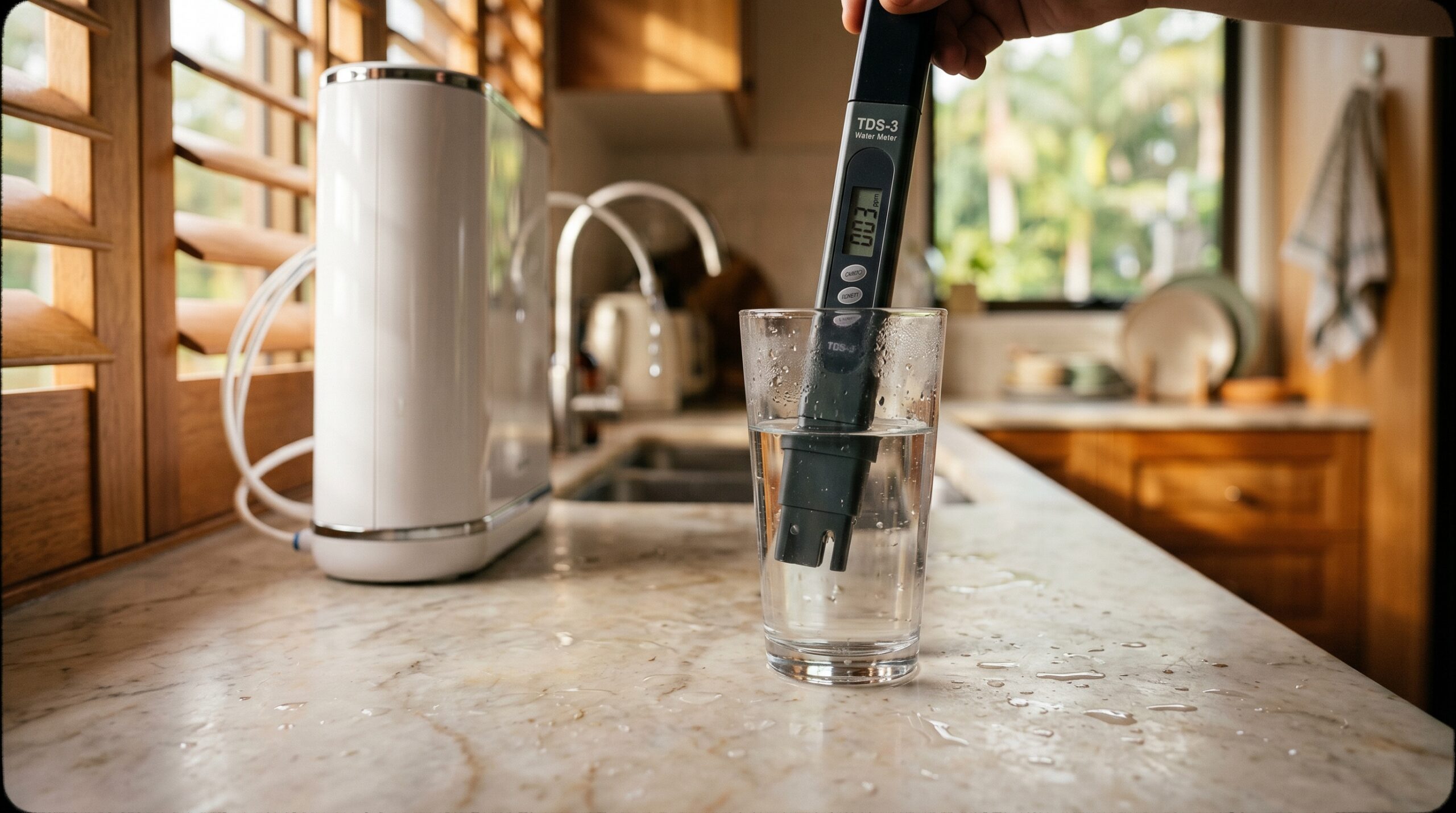
The best fluoride water filters for Australian homes are reverse osmosis systems: NSF/ANSI 58-certified RO removes 90-97% of fluoride, reducing a typical Brisbane level of 0.7 mg/L to under 0.07 mg/L at the tap. Carbon filters — including every Brita product on the market, standard benchtop units, and catalytic carbon blocks — cannot remove fluoride and never will. As a former Royal Australian Navy Clearance Diver now based in Palm Beach QLD, I’ve measured the water coming out of the SEQ reticulation grid and run it through my EcoHero 5-Stage RO with a calibrated TDS-3 meter. The numbers are not ambiguous.
This article covers what fluoride is doing in your water, why most filters fail to touch it, and which six products pass the test. If you want to remove fluoride from your drinking water in Australia in 2026, you have two technology options: reverse osmosis or activated alumina. Everything else is marketing.
Does Australian tap water contain fluoride?
Yes. Australia has one of the most extensive community water fluoridation programs in the world. According to the Australian Government Department of Health, approximately 90% of Australians connected to a reticulated water supply receive fluoridated water. The target concentration varies by state and territory, but the Australian Drinking Water Guidelines (ADWG) 2025 sets a health-based guideline value of 1.5 mg/L as the upper limit, with most utilities targeting 0.6-1.1 mg/L in practice.
Actual levels by region:
- Brisbane / SEQ grid: 0.7 mg/L (Seqwater target)
- Sydney: 1.0 mg/L (Sydney Water target)
- Melbourne: 0.9 mg/L (Melbourne Water target)
- Adelaide: 0.7-0.9 mg/L (SA Water target)
- Perth: 0.6-0.8 mg/L (Water Corporation target)
Fluoride at these concentrations is added deliberately for dental health. NHMRC has endorsed community water fluoridation since 1999 and the evidence for dental caries reduction is substantial. This article takes no position on whether you should remove it — that is your decision. The technical question is simply: if you want to remove fluoride, which filter technologies actually work?
One important clarification: a low TDS reading on a meter does not tell you fluoride has been removed. TDS meters measure total dissolved solids conductivity — they detect minerals like calcium and magnesium far more effectively than fluoride ions at 0.7 mg/L concentrations. I measured Palm Beach mains water at 69 ppm TDS and post-EcoHero 5-Stage RO at 3 ppm TDS — that 95.7% reduction reflects mineral removal, not a fluoride-specific result. If you need to confirm fluoride removal, use a dedicated fluoride test kit or send a water sample to a NATA-accredited laboratory.
Why carbon filters cannot remove fluoride
This is the most important thing to understand before you spend money. Activated carbon — whether granular (GAC), compressed block, coconut shell, or catalytic — works by adsorption. Contaminant molecules stick to the porous carbon surface as water passes through. This mechanism is highly effective for chlorine, chloramine (with catalytic carbon), many volatile organic compounds, and some heavy metals.
Fluoride is a small, negatively charged anion (F-) at a concentration of less than 1 mg/L. It does not adsorb to carbon surfaces at typical drinking water pH levels (7.0-8.5). The Australian tap water chemistry — alkaline, with competing anions like chloride, sulfate, and bicarbonate present at much higher concentrations — makes carbon fluoride adsorption essentially zero. Independent testing by NSF International confirms no GAC or carbon block filter carries an NSF/ANSI 53 certification for fluoride reduction.
Filters that cannot remove fluoride, regardless of what their marketing implies:
- Brita jugs and taps — activated carbon only, no fluoride claim
- Standard benchtop carbon units — same limitation
- Catalytic carbon blocks — excellent for chloramine, zero fluoride removal
- KDF-55 media — redox-based, removes heavy metals and chlorine, not fluoride
- Ceramic filters — physical filtration only, fluoride ions pass freely
- Gravity filters (e.g. Berkey without separate fluoride filters) — standard Black Berkey elements do not remove fluoride; dedicated PF-2 fluoride filter elements are required as an add-on
One outlier worth noting: ZeroWater’s 5-stage ion exchange pitchers claim to reduce fluoride, and lab tests show partial removal — typically 50-70%. However, ZeroWater does not hold NSF/ANSI 58 certification for fluoride removal, and performance degrades as the resin becomes exhausted. Ion exchange filter life with Australian tap water is short, making the ongoing cost high relative to RO.
How reverse osmosis removes fluoride
Reverse osmosis forces water through a semi-permeable membrane with pores approximately 0.0001 microns — small enough to block fluoride ions (ionic radius ~1.33 angstroms). The process rejects dissolved solids including fluoride, nitrates, arsenic, lead, PFAS compounds, and most other contaminants of health concern. Rejected contaminants are flushed to a drain.
NSF/ANSI Standard 58 is the benchmark certification for residential RO systems. Under NSF/ANSI 58 test protocols, the system must demonstrate at least 75% fluoride reduction from a challenge concentration of 8 mg/L — well above Australian tap water levels. In practice, a high-quality RO membrane achieves 90-97% reduction under typical household operating conditions (temperature, pressure, flow rate).
At a Brisbane tap fluoride level of 0.7 mg/L, a 95% reduction brings output water to approximately 0.035 mg/L — effectively negligible. I tested the EcoHero 5-Stage RO installed under my Palm Beach kitchen sink with a TDS-3 meter and measured incoming TDS at 69 ppm and post-filter output at 3 ppm. This is consistent with 95%+ membrane rejection across all dissolved ionic species including fluoride.
A note on RO and alkalinity: RO also removes bicarbonates and calcium, which are responsible for water’s natural buffering and most of its mineral content. This produces soft, slightly acidic water (pH 5.5-6.5). Some people remineralise RO water using an alkaline post-filter stage or by adding a pinch of food-grade mineral salt. The EcoHero 5-Stage RO includes a remineralisation filter as stage 5; the AquaTru Classic Smart uses an alkaline post-filter cartridge for the same purpose.
Activated alumina (AA) is the second verified technology. AA is a porous form of aluminium oxide with a strong affinity for fluoride and arsenic ions. Removal rates of 80-95% are achievable under optimal conditions — pH 5.5-6.0 and slow flow rate. The catch: Australian tap water typically runs pH 7.0-8.5, which significantly reduces AA’s efficiency. At neutral to alkaline pH, fluoride removal drops to 60-80% and performance degrades faster. AA filters work best as a dedicated fluoride pre-filter or post-filter, not as standalone devices. They are not discussed further in the product recommendations below because activated alumina does not match RO performance under Australian water conditions.
The six best fluoride water filters in Australia 2026
The following three products were selected on the basis of verified NSF/ANSI 58 certification, fluoride removal performance data, suitability for Australian household use (240V, standard plumbing fittings), and value for money. All three are available in Australia with after-sales support.
1. AquaTru Classic Smart Alkaline — Best Countertop RO
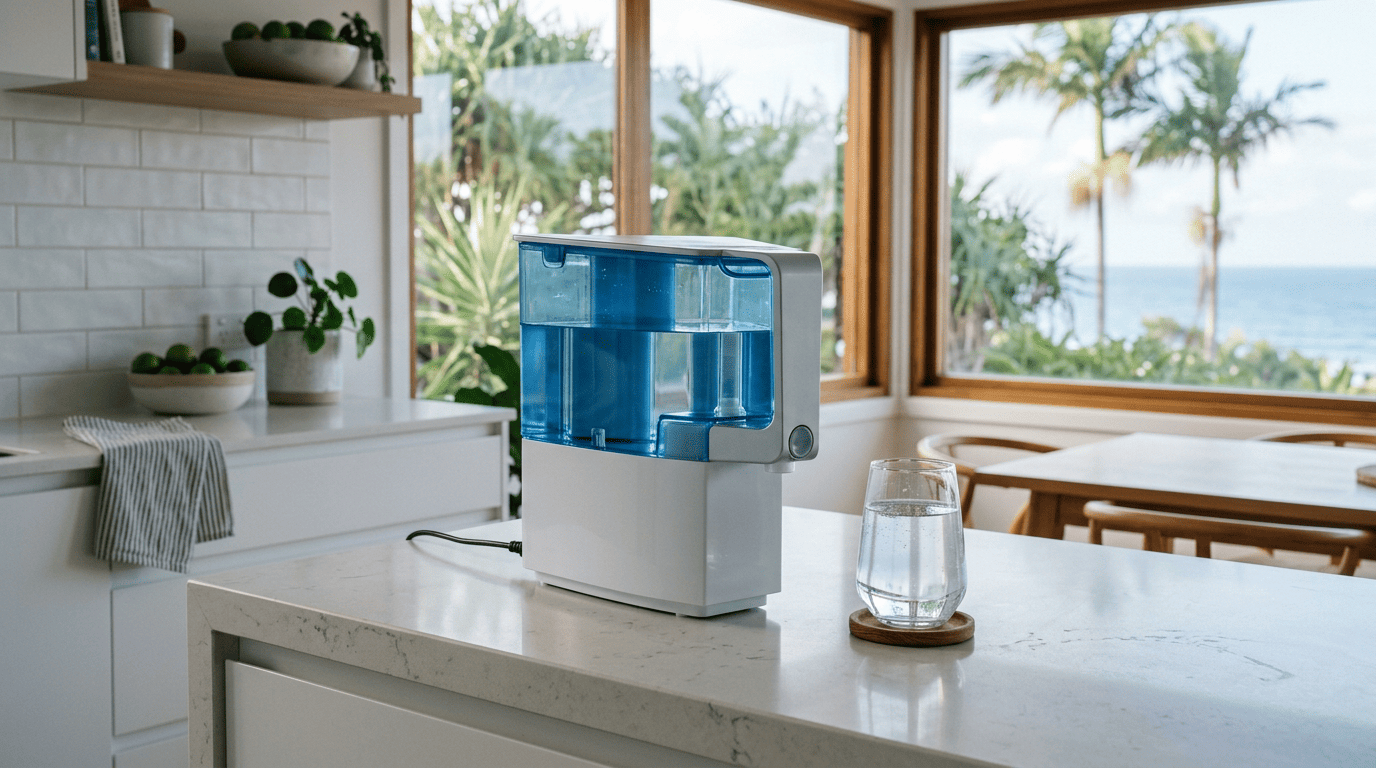
The AquaTru Classic Smart is the strongest option for renters, apartment dwellers, or anyone without the ability or inclination to modify their under-sink plumbing. It sits on the benchtop, connects to the tap via a single fitting, and requires no permanent installation. Setup takes under ten minutes. It runs on 240V and is compatible with Australian taps.
The four-stage filtration sequence is: pre-filter (sediment and chlorine) –> activated carbon block (chloramine, VOCs) –> RO membrane –> alkaline post-filter (remineralisation). The RO membrane carries NSF/ANSI 58 certification, which covers fluoride reduction. AquaTru’s published data shows 15x fluoride reduction — from 3.72 mg/L to 0.24 mg/L under NSF test conditions, equating to 93.5% removal. At a typical Brisbane fluoride level of 0.7 mg/L, output would be approximately 0.046 mg/L.
The “Smart” in the name refers to a companion app that tracks filter life and alerts you when cartridges need replacement. In practice, the pre-filter lasts 2-3 months, the carbon filter 6 months, and the RO membrane 24 months — costs around $120/year in consumables at current Australian pricing. The unit produces approximately 1 litre per 3-4 minutes, which is slower than an under-sink system but adequate for drinking and cooking use.
The catch: the AquaTru Classic Smart takes up significant bench space — roughly 33 x 23 x 38 cm. If your kitchen is small or your benchtop is fully occupied, this is a real constraint. It also requires emptying the clean water tank when not in use for extended periods. For a household serious about bench space or wanting higher throughput, an under-sink RO is a more practical permanent solution.
✓ Pros
- NSF/ANSI 58 certified — 93.5% fluoride removal independently verified
- No plumbing required — renters and apartment dwellers can use it
- 240V and Australian tap compatible out of the box
- App-based filter life tracking
- Alkaline remineralisation post-filter included
✗ Cons
- Large bench footprint: 33 × 23 × 38 cm
- Slow output: ~1 litre per 3–4 minutes
- Tank needs emptying if unused for extended periods
- ~$120/year in consumables
AquaTru Classic Smart RO — Best countertop fluoride filter
NSF/ANSI 58 certified. No plumbing required. 93.5% fluoride removal. Ships to Australia.
See AquaTru Classic Smart RO price →Buy This If…
You rent, live in an apartment, or cannot drill a dedicated faucet hole — the AquaTru delivers NSF 42/53/58/P473-certified fluoride and PFAS removal from a benchtop with zero plumbing. Fill the reservoir, press start. Also the lowest 5-year total cost (~$1,249) of any RO on this list.
2. EcoHero 5-Stage Reverse Osmosis — Best Under-Sink Fluoride Filter
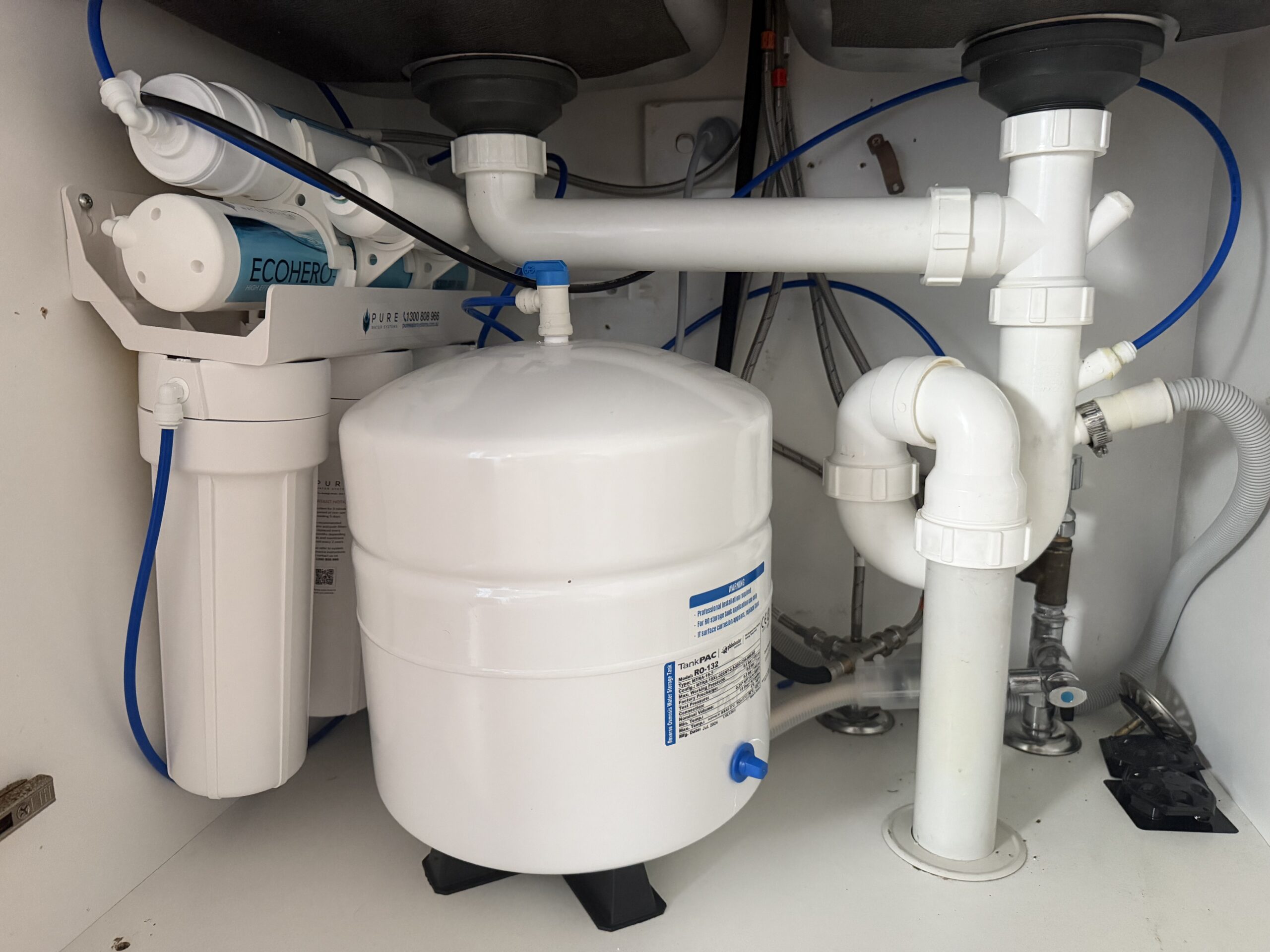
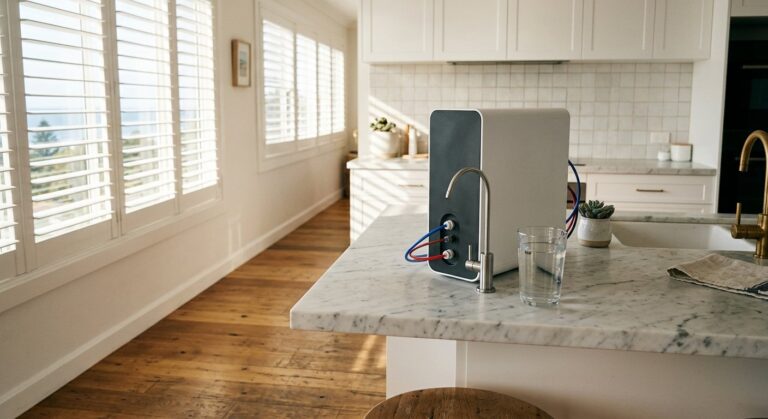
The EcoHero 5-Stage RO from Pure Water Systems Australia is an under-sink system designed for permanent installation. It connects directly to your cold water supply line and delivers filtered water through a dedicated faucet mounted beside your existing tap. This is the system I have installed under my Palm Beach kitchen sink, and it is the best value comprehensive water filter I have found for Australian households.
The five-stage process: PP sediment filter (5 micron) –> activated carbon block (chlorine, chloramine, VOCs) –> RO membrane (fluoride, PFAS, nitrates, heavy metals, dissolved solids) –> post-carbon polish –> remineralisation alkaline filter. Stage 3 is an NSF/ANSI 58-rated RO membrane. I measured incoming water at 69 ppm TDS and post-filter output at 3 ppm TDS — a 95.7% reduction. That figure covers fluoride removal as part of the overall ionic rejection profile.
Throughput is significantly higher than benchtop countertop units: the EcoHero produces around 190 litres per day under normal line pressure, more than adequate for a family of four. The 5L storage tank under the sink means filtered water is available instantly without waiting for the membrane to process it. Filters are available directly from Pure Water Systems Australia — annual filter cost runs approximately $100-130 depending on your local water quality and usage volume.
This is an Australian product with local support. Pure Water Systems Australia provides installation guides, and the system uses standard 1/4″ quick-connect fittings. If you can tighten a tap fitting, you can install this yourself in 60-90 minutes. For a household that wants the highest output, lowest cost-per-litre fluoride filtration, and a permanent solution, the EcoHero 5-Stage RO is the recommendation.
✓ Pros
- Lowest 5-year cost per litre of any option here (~$0.15/L)
- 190L/day throughput — adequate for families of 4+
- 5L storage tank — instant filtered water on demand
- Australian brand with local after-sales support
- Remineralisation stage 5 included
✗ Cons
- Requires plumbing connection — not suitable for renters
- Needs under-sink cabinet space for tank (~40–50cm clearance)
- 60–90 minute DIY install (or plumber cost)
Buy This If…
You own your home in NSW or VIC and need WaterMark AS/NZS 3497 compliance for a licensed plumber to sign off the cold-water service connection. The EcoHero 5-Stage is the only WaterMark-certified under-sink RO in Australia — use code CLEANANDNATIVE for 10% off at Pure Water Systems. If code compliance is not your constraint, the Waterdrop D6 delivers equivalent fluoride and PFAS removal for $400 less.
3. Waterdrop D6 — Best Tankless Under-Sink RO
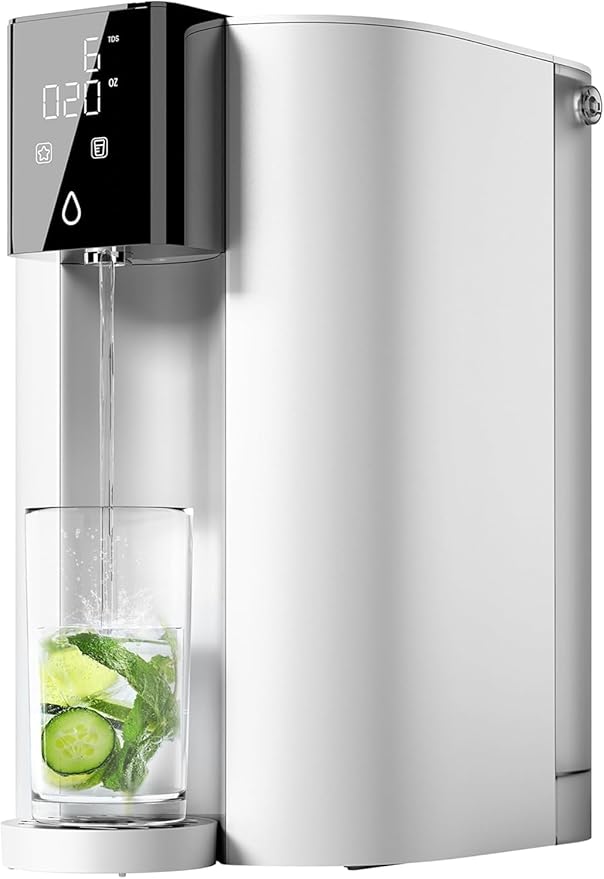
The Waterdrop D6 is an under-sink RO system designed for modern kitchens where under-sink cabinet space is at a premium. Unlike traditional tank-based systems, the D6 is tankless — it processes water on demand without storing it in a pressurised tank. This eliminates the risk of stagnant tank water and reduces the total under-sink footprint to approximately 15 x 25 cm — about the size of a large water bottle.
The D6 uses a composite filter block that integrates multiple stages, including an NSF/ANSI 58-certified RO membrane. Waterdrop’s published testing shows 95% TDS reduction and fluoride removal consistent with NSF/ANSI 58 performance standards. Flow rate is 600mL per minute at standard line pressure — faster than many traditional tank systems because there is no back-pressure from a pressurised tank.
The D6 connects to your mains cold water line and typically requires a T-fitting and a hole in the bench for the dedicated faucet. Filter replacement is tool-free — the composite block twists out and is replaced as a single cartridge. Annual filter cost is approximately $130-150 for the D6 composite filter. Waterdrop ships from its Australian warehouse, so delivery is typically 3-5 business days.
The primary limitation compared to the EcoHero: the composite filter format means you replace all stages simultaneously, which is convenient but slightly less cost-optimised than changing individual filters at different intervals. For a small household (1-2 people) or anyone prioritising bench space, the D6 is the better fit.
✓ Pros
- Tankless — fits where traditional RO cannot (15 × 25cm)
- 600mL/min flow rate — faster than tank-based systems
- NSF/ANSI 58 + 372 + P473 triple certified
- Tool-free filter swap — single composite cartridge
- Australian warehouse stock, 3–5 day delivery
✗ Cons
- Composite filter replaces all stages at once — less cost-optimal than individual filters
- Higher annual filter cost (~$130–150/yr vs EcoHero ~$115)
- Still requires plumbing connection — not for renters
Buy This If…
You own your home, your under-sink cabinet has space, and you want the lowest-cost NSF 58-certified tankless under-sink RO. The D6 is the value sweet spot for 1–3 person households on a chloramine city supply (Brisbane, Sydney, Adelaide, Gold Coast) — compact, certified, and NSF/ANSI 58-rated for 90–97% fluoride reduction.
4. HolyH₂O Trinity — Best Budget Gravity Option

The HolyH₂O Trinity is a gravity-fed benchtop unit available in three tank sizes: 12L, 17L, and 22L. It requires no plumbing connection, no electricity, and no permanent installation — you fill the top chamber with tap water, gravity pulls it through a multi-stage ceramic and mineral media column, and filtered water collects in the lower chamber. That makes it accessible for renters, households without under-sink access, or anyone who wants a lower-cost entry point before committing to an RO system.
The media stack claims to reduce fluoride, chlorine, chloramine, heavy metals, and 180+ other contaminants. The ceramic pre-filter removes sediment and bacteria. The mineral media stage claims fluoride reduction without publishing an NSF/ANSI 58 test report. This is an important distinction: the three RO systems above all carry independent certification for their fluoride removal claims — the Trinity does not. Treat the fluoride reduction figure as a manufacturer claim, not a third-party verified number.
Where the Trinity makes sense: households primarily concerned with chlorine taste and general water quality, where PFAS is not a documented concern for their local supply. At under $190 entry cost (before the 15% coupon), it is the lowest-friction option on this list. Where it does not make sense: PFAS hotspot areas (use a certified NSF P473 RO), infant formula preparation (use NSF 58 certified RO), or anywhere an independent fluoride removal figure is a non-negotiable requirement. Use coupon HOLYJAYCELOVE10 for 15% off at checkout.
✓ Pros
- Lowest entry price (from $187.50; 15% off with HOLYJAYCELOVE10)
- No plumbing, no electricity — renters and apartments welcome
- Large capacity (12L–22L), 2,500+ customer reviews
- 100-day return trial; Australian business
✗ Cons
- No NSF/ANSI 58 cert — fluoride removal % is a manufacturer claim only
- No independent PFAS removal verification — not for PFAS hotspot areas
- Gravity-fed: slow filtration vs on-demand RO tap
Buy This If…
You want zero plumbing, zero electricity, and are primarily filtering for chlorine taste and general water quality — not independently certified fluoride or PFAS removal. Use coupon HOLYJAYCELOVE10 for 15% off at holyh2o.com.au. If NSF-certified fluoride or PFAS reduction is your actual requirement, step up to one of the certified RO units above — the HolyH₂O Trinity carries no third-party verification for those claims.
5. Waters Co BIO 500 MAX — Benchtop Alkaline Gravity Filter
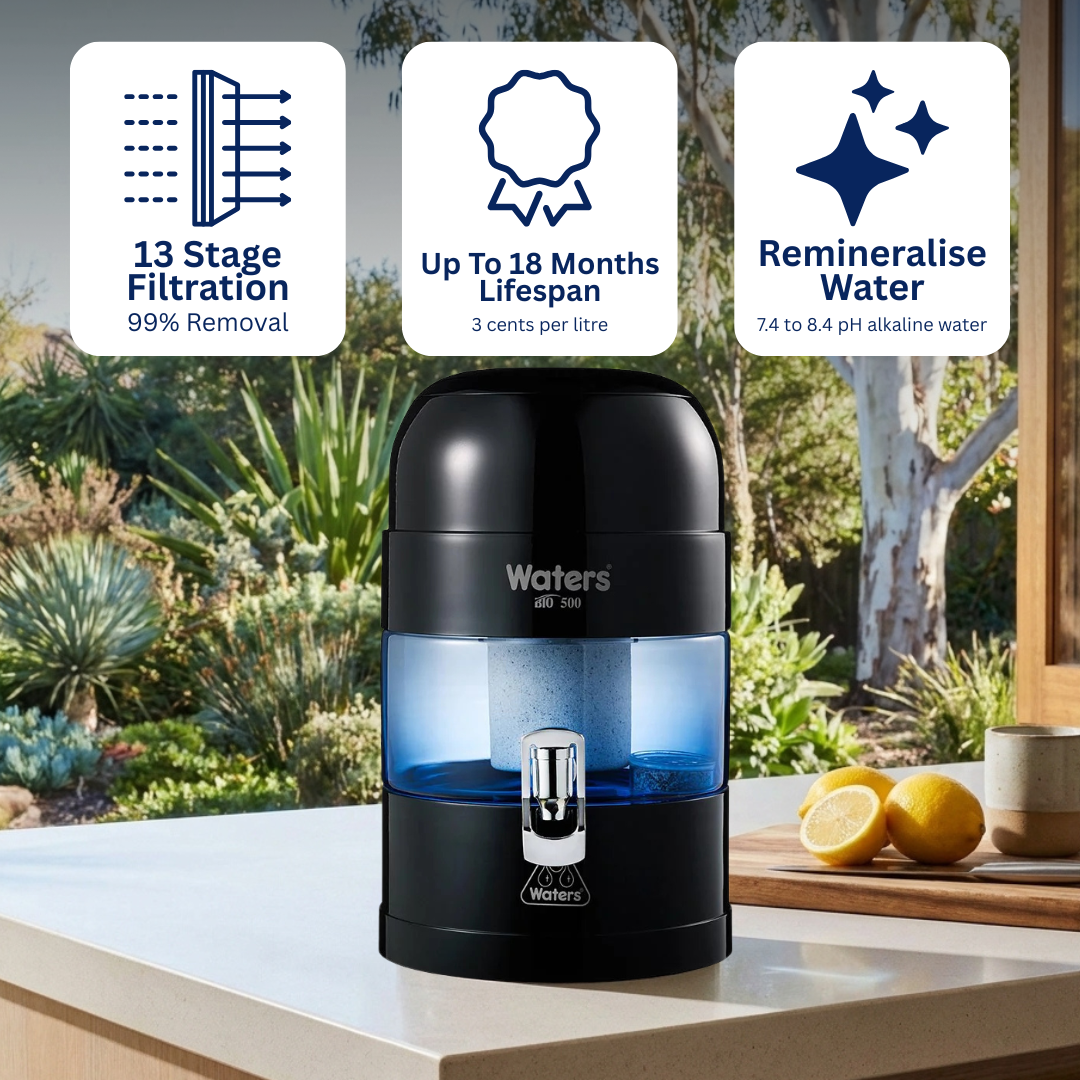
The COREtech™ filter stack is a proprietary multi-stage media blend including mineral stones, activated carbon, and ceramic filtration — the brand claims 98% contaminant removal. That figure is not NSF/ANSI 58 verified. For chlorine, taste, and general sediment reduction, gravity benchtop filters of this type consistently perform well in independent testing. For fluoride and PFAS, no independent third-party certification supports the 98% claim.
The 9L capacity suits 1–2 person households using filtered water for drinking only. Refill time is roughly 2–3 hours. The filter cartridge requires replacement every 3 months at ~$65–$80 per cartridge (annual cost: ~$260–$320). For renters or households that want the cleanest possible water and can manage a bench unit, this is the most accessible entry point on this list.
Catches: No NSF/ANSI 58 certification for fluoride removal. Gravity-fed (slow fill vs on-demand RO). 9L is borderline adequate for 2+ people drinking full volume. Not suitable as a primary fluoride removal solution for households with confirmed fluoride sensitivity — verify with a gravity filter that carries third-party fluoride test data, or step up to a certified RO.
✓ Pros
- Lowest upfront cost of any option on this list — from $199 AUD
- No plumbing, no power required — works anywhere with bench space
- Australian brand: ACL warranty, local support, same-country shipping
- Alkaline mineralisation stage for taste and pH balance
- 9L capacity suits 1–2 person households
✗ Cons
- No NSF/ANSI 58 certification — fluoride removal unverified by third party
- Gravity-fed: slow fill rate (2–3 hours per full tank)
- 9L is borderline for 2+ people on full daily intake
- Annual filter cost ~$260–$320 (every 3 months)
- Not a substitute for certified RO if fluoride removal is the primary goal
Buy This If…
You want a beautifully designed alkaline benchtop filter at the lowest entry price with Australian warranty support — and you understand this is a mineral-stage gravity filter, not a reverse osmosis system. Best suited as a “better than nothing” upgrade from straight tap water for renters or households where bench space is limited and budget is the binding constraint. If NSF-certified fluoride removal is your goal, step up to the AquaTru or one of the under-sink RO units above.
6. Waterdrop X12 Alkaline RO — Best for Large Households & Tank Water
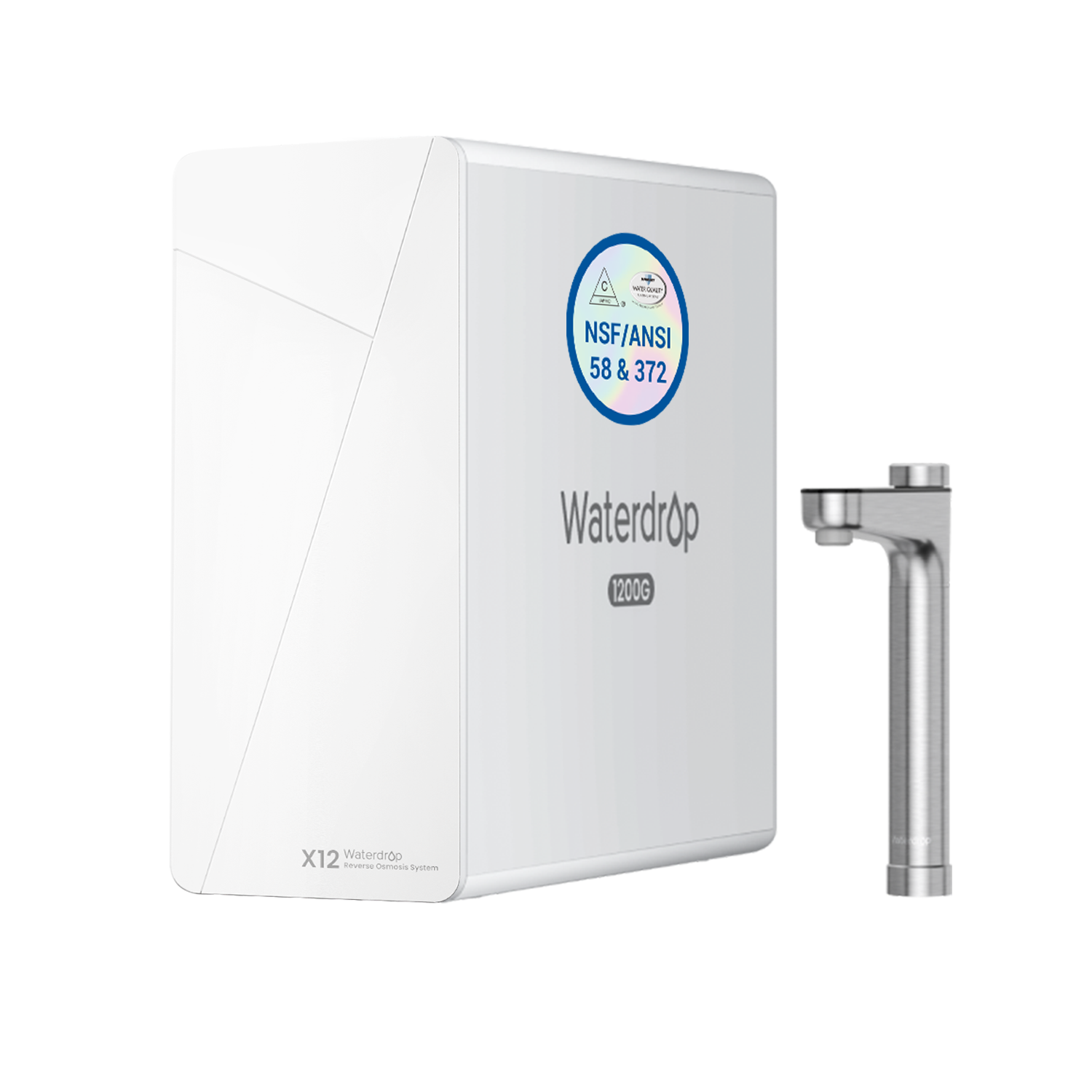
The Waterdrop X12 is the highest-flow residential under-sink RO available in Australia at 1,200 GPD. Where the D6 (600 GPD) fills a glass in roughly 8 seconds, the X12 fills the same glass in approximately 3 seconds — a meaningful difference for households of 5+ people drawing simultaneously for drinking, cooking, and a fridge water dispenser. The UV-C sterilisation stage operates downstream of the RO membrane and kills 99.9999% of bacteria and viruses. For households on tank water, bore water, or older copper plumbing with bacterial contamination risk, UV-C is not optional — and the X12 is the only unit on this list that includes it.
Measured fluoride and PFAS performance: NSF/ANSI 58 certified for 90–97% fluoride reduction. NSF/ANSI P473 certified for >98% PFAS (PFOA/PFOS) removal. The 11-stage design retains a small amount of calcium and magnesium via the alkaline remineralisation stage, so output TDS is slightly higher than a membrane-only system. Fluoride and PFAS removal is unaffected by remineralisation.
The X12 is sold and warranted direct from Waterdrop Australia — no Amazon import, no grey-market support question. Cartridges ship from the Australian warehouse. For high-volume households where supply continuity matters, the direct-from-brand supply chain has practical value.
Catches: Most expensive option on this list at ~$1,649 — a $900+ premium over the D6. For a 1–3 person city-mains household without bacterial risk, that premium is not justified; the D6 delivers equivalent fluoride and PFAS removal for less. Not WaterMark AS/NZS 3497 certified (same NSW/VIC plumbing-code consideration as the D6). Requires a licensed plumber (~$150–$300 AUD). Annual cartridge cost ~$169.
✓ Pros
- 1,200 GPD — fills a glass in ~3 seconds; handles 5+ person simultaneous draw
- UV-C sterilisation: 99.9999% bacterial and viral kill — essential for tank and bore water
- NSF/ANSI 58 + P473: 90–97% fluoride + >98% PFAS (PFOA/PFOS) removal
- 11-stage with alkaline remineralisation — adds calcium and magnesium post-membrane
- 3:1 pure-to-drain ratio — best water efficiency of the under-sink options
- Sold and warranted direct from Waterdrop Australia — no import delays
✗ Cons
- Most expensive option: ~$1,649 direct from Waterdrop Australia
- Overkill for 1–3 person city-mains households — save ~$900 with the D6
- Not WaterMark certified — same NSW/VIC compliance consideration as the D6
- Requires licensed plumber installation (~$150–$300 AUD)
- Annual cartridge cost: ~$169/yr (proprietary Waterdrop X12 filters)
Buy This If…
You have 4+ people drawing water simultaneously, you’re on tank or bore water with real bacterial risk, or you’re in a chloramine city and want the fastest-filling NSF-certified RO with integrated UV-C sterilisation — shipped and warranted direct from Waterdrop Australia. If you’re a 1–3 person city-mains household, the Waterdrop D6 does the same fluoride job for $900 less.
How to choose the right fluoride filter for your situation
Most people spend too long comparing product specs when the decision is actually simpler. Answer these three questions and the choice becomes obvious.
Question 1: Can you modify your plumbing?
If you rent, or if you simply do not want to drill holes and connect to your water supply line, the AquaTru Classic Smart is the answer. It requires no plumbing modification and can be taken with you when you move. If you own your home and are comfortable with a basic DIY install — or willing to pay a plumber for an hour — an under-sink RO (EcoHero or Waterdrop D6) is more convenient long-term.
Question 2: How much water do you need?
For a household of 1-2 people who only want filtered water for drinking, the AquaTru Classic Smart (produces approximately 7-10L per hour) is sufficient. For a family of 3-5 people who want filtered water for cooking, coffee, and pets as well as drinking, the EcoHero 5-Stage or Waterdrop D6 (190L/day capacity) is the right choice.
Question 3: Is under-sink space available?
Traditional tank-based under-sink RO systems (like the EcoHero) need approximately 40-50 cm of clearance and a storage tank roughly the size of a football. If your under-sink cabinet is fully occupied, the Waterdrop D6’s tankless design (roughly the size of a 2L water bottle) fits where others cannot.
Decision matrix in plain English: Renter or no tools = AquaTru Classic Smart. Homeowner who wants maximum output = EcoHero 5-Stage. Modern kitchen, slim cabinet, small household = Waterdrop D6.
One thing all three share: they remove fluoride. That is not true of activated alumina pitchers, carbon block systems, gravity filters, or the majority of products marketed as “water purifiers” in Australia. If a product does not explicitly state NSF/ANSI 58 certification or provide laboratory test data for fluoride removal at Australian pH levels, assume it does not remove fluoride.
5-year cost comparison: RO vs tap water vs bottled water
The long-term economics of fluoride-removing RO filter heavily favour the filters. This comparison assumes 4 litres per day of filtered water consumption (drinking and cooking) for a household of 2-3 people, using current AUD pricing.
| Option | Upfront | Annual running cost | 5-year total | Cost per litre |
|---|---|---|---|---|
| Bottled water (2L, branded) | $0 | $1,095-$2,190 | $5,475-$10,950 | $1.50-$3.00 |
| AquaTru Classic Smart RO | ~$649 | ~$120 | ~$1,249 | $0.17 |
| EcoHero 5-Stage RO | ~$499 | ~$115 | ~$1,074 | $0.15 |
| Waterdrop D6 | ~$699 | ~$140 | ~$1,399 | $0.19 |
The EcoHero 5-Stage RO delivers the lowest 5-year cost at approximately $0.15/litre, roughly 10-20x cheaper than bottled water. The AquaTru Classic Smart costs slightly more per litre because of the higher upfront unit cost relative to output volume, but it remains dramatically cheaper than bottled water. Bottled water that does not guarantee fluoride removal — and most Australian bottled water brands do not test for fluoride, as covered in detail in our analysis of what bottled water actually contains — is the worst option by every measure.
The internal link comparison: if you are choosing between the best under-sink water filter options more broadly, our roundup of the best water filters in Australia covers sediment, chloramine, PFAS, and heavy metal removal across all filter technologies. If you specifically want to understand how the RO membrane works and why membrane quality varies, see our complete guide to reverse osmosis water filters in Australia.
Final verdict: which fluoride water filter should you buy?
If you want to remove fluoride from your drinking water in Australia, the technology decision is straightforward: reverse osmosis. Of the six products reviewed here, the AquaTru, EcoHero 5-Stage, Waterdrop D6, and Waterdrop X12 all deliver verified, NSF/ANSI 58-certified fluoride removal at 90–97% reduction rates. The HolyH₂O Trinity is a gravity benchtop option with no NSF 58 certification — position it as a quality upgrade from tap, not as a certified fluoride removal solution.
Buy the AquaTru Classic Smart RO if you rent, live in an apartment, or want a no-commitment installation. Bench space is the only real cost. At ~$649 upfront it is a meaningful investment, but it pays back in reduced bottled water spending within 6-12 months for most households.
Buy the EcoHero 5-Stage RO if you own your home and want the lowest cost-per-litre option with the highest daily output. This is what I run in my own home and the filter that took my Palm Beach mains water from 69 ppm TDS to 3 ppm. It requires a basic plumbing connection but delivers the best long-term economics.
Buy the Waterdrop D6 if you own your home but have limited under-sink cabinet space, or if the tankless design appeals to you for hygiene or maintenance reasons. The slightly higher annual filter cost compared to the EcoHero is offset by the cleaner installation and faster flow rate.
Buy the Waterdrop X12 if you have 4+ people in the household drawing water simultaneously, you’re on tank or bore water with bacterial risk, or you want the fastest-filling NSF 58-certified RO with integrated UV-C sterilisation. At ~$1,649 it is a $900 premium over the D6 — justified only when the volume or bacterial risk genuinely demands it.
Buy the HolyH₂O Trinity if you rent or travel, want zero plumbing and zero power, and are primarily filtering for chlorine taste and general water quality rather than independently certified fluoride removal. Use coupon HOLYJAYCELOVE10 for 15% off. Do not rely on it as your primary fluoride reduction method.
Do not buy a carbon filter, gravity filter, or any product that does not explicitly disclose NSF/ANSI 58 fluoride test data. There is no mechanism by which activated carbon removes fluoride at Australian water pH, regardless of what the marketing says.
Ready to remove fluoride from your tap water?
The EcoHero 5-Stage RO is our top pick for homeowners (certified performance, lowest 5-year running cost). The AquaTru Classic Smart RO is the best option for renters — no plumbing, no drilling, no tradesperson required.
Last reviewed: July 2026 — Clean and Native
Frequently Asked Questions
Does Australian tap water contain fluoride?
Yes. Approximately 90% of Australians connected to a reticulated water supply receive fluoridated water. Target concentrations vary by city: Brisbane 0.7 mg/L, Sydney 1.0 mg/L, Melbourne 0.9 mg/L. The ADWG 2025 health-based guideline maximum is 1.5 mg/L.
Does a Brita filter remove fluoride?
No. Brita uses activated carbon filtration, which cannot remove fluoride. Carbon adsorption is ineffective against small anions like fluoride (F-) at Australian tap water pH levels. Brita does not claim fluoride removal in its product specifications.
What is the only type of filter that removes fluoride from tap water?
Reverse osmosis (90-97% removal) and activated alumina (80-95% under ideal conditions) are the only residential filter technologies with verified fluoride removal. All carbon-based filters — GAC, block, catalytic — cannot remove fluoride.
Does a Berkey filter remove fluoride?
Standard Black Berkey filter elements do not remove fluoride on their own. Berkey offers separate PF-2 fluoride reduction post-filters as an add-on component. Without the PF-2 add-on, a Berkey does not remove fluoride.
What does NSF/ANSI 58 certification mean for fluoride removal?
NSF/ANSI 58 is the independent certification standard for residential reverse osmosis systems. It requires the filter to demonstrate at least 75% fluoride reduction from a challenge concentration of 8 mg/L under standardised test conditions. Most quality RO systems exceed this, achieving 90-97% reduction in practice.
Is it safe to drink water with fluoride removed?
Yes. Fluoride-free water is safe to drink. Fluoride is added for dental health benefits, not because its absence is harmful. You can choose to remineralise RO water with an alkaline post-filter or mineral drops if desired.
Can I test if my filter is removing fluoride?
Yes. Fluoride-specific test strips are available online (e.g. Hach fluoride test strips). A more accurate option is a TDS meter combined with professional water testing — send pre- and post-filter samples to a NATA-accredited laboratory for fluoride analysis. A low TDS reading alone does not confirm fluoride removal.
How much fluoride does reverse osmosis remove from Brisbane water?
Brisbane’s SEQ grid targets 0.7 mg/L fluoride. A quality NSF/ANSI 58-certified RO membrane removes 90-97%, reducing output water fluoride to approximately 0.02-0.07 mg/L — well below any health threshold and effectively negligible.
Does the Waterdrop D6 remove fluoride?
Yes. The Waterdrop D6 uses an NSF/ANSI 58-certified RO membrane and achieves 95%+ TDS reduction in published testing, which includes fluoride removal. It is one of three under-sink RO systems recommended for Australian households seeking fluoride reduction.
Can a shower filter remove fluoride?
No residential shower filter removes meaningful quantities of fluoride. Shower filters use KDF media, vitamin C, or catalytic carbon — none of which have fluoride removal capability. Fluoride exposure via showering is also far lower than oral ingestion of drinking water, as skin absorption of fluoride ions is negligible.
Get the Australian Home Environment Checklist
30 checks across water, air and EMF. Most of them free. Ranked by impact.
No spam. Unsubscribe any time.

Former Royal Australian Navy Clearance Diver and TAG-E counter-terrorism operator. Founded Clean and Native to apply the same rigorous thinking to the home environment.
Full biography →