Best Water Filter Sydney 2026: What Sydney Tap Water Actually Needs
Affiliate disclosure: Clean and Native earns a commission if you purchase through links on this page. Recommendations are based on independent testing, utility water quality data, and verified filter certifications only.
QUICK VERDICT — SYDNEY BY SITUATION
The three products we own are measured first-hand by Jayce Love, former Royal Australian Navy Clearance Diver; every other product is assessed on published manufacturer specifications and independent certification using our documented methodology — no gifted units, no brand payments.
Match your situation to the right filter for Sydney water chemistry
| Renter, improve taste & remove chloramine | TAPP EcoPro — clips on any tap, 0.5 micron carbon block, no plumbing |
| Remove fluoride (1.0 mg/L — highest of any capital) | RO only — AquaTru Classic (no plumbing) or EcoHero under-sink |
| Blue Mountains household (post-2024 PFAS concern) | AquaTru Classic RO — removes PFAS >99% alongside fluoride and chloramine |
| Infant formula preparation | AquaTru Classic — reduces fluoride to <0.04 mg/L, removes lead >97%, chloramine >99% |
| Homeowner wanting permanent under-sink install | Waterdrop Core — WaterMark certified, tankless, on-demand RO |
Sydney tap water is safe to drink — it meets all Australian Drinking Water Guidelines and is drawn from some of the best-protected catchments in the world. Warragamba Dam and the Upper Nepean system are classified closed catchments; Sydney Water reports near-zero industrial contamination in source water. But “safe” doesn’t mean unfiltered is the optimal choice for every household. Three features of Sydney’s water chemistry make filter selection more nuanced than most guides acknowledge.
Sydney’s three water chemistry facts that drive filter choice
1. Chloramine — not free chlorine — at most treatment plants
Sydney Water uses chloramination at its major treatment facilities: Prospect, Potts Hill, Warragamba, Woronora. Five smaller plants (Cascade, Illawarra, Nepean, North Richmond, Orchard Hills) use free chlorine. If you are in inner Sydney, western Sydney, or southern Sydney, you are almost certainly on chloramine. This matters because chloramine does not dissipate by leaving water in a jug — it requires active filtration. Granular activated carbon (GAC) pitchers like standard Brita models remove chloramine poorly at normal flow rates. A solid carbon block filter (0.5 micron contact time) or RO is required for reliable removal.
2. Fluoride at 1.0 mg/L — the highest target of any Australian capital
Sydney Water doses fluoride to a target of 1.0 mg/L. NSW regulations require over 95% of samples to fall within 0.90–1.50 mg/L. This is significantly higher than Brisbane (0.6–0.8 mg/L), Perth (~0.75 mg/L), and Adelaide (~0.56 mg/L). Carbon block filters do not remove fluoride regardless of pore size. Only reverse osmosis (Donnan exclusion mechanism) reliably removes fluoride — at greater than 96% in NSF 58-certified systems, reducing Sydney tap water from ~1.0 mg/L to less than 0.04 mg/L.
3. Blue Mountains PFAS — resolved, but worth understanding
In June 2024, Sydney Water detected elevated PFAS in treated water from Cascade WFP (Katoomba, Blackheath, and surrounding Blue Mountains suburbs): PFOS 16.4 ng/L, PFHxS 14.2 ng/L. A $3.4 million GAC and ion exchange treatment upgrade was installed by December 2024. Post-upgrade testing confirms all nine Sydney WFPs now meet ADWG PFAS limits. The main Sydney network was unaffected. If you are in the Blue Mountains, Sydney Water’s PFAS monitoring page provides current monthly results — checking this directly is advisable. AquaTru RO removes PFAS at greater than 99% as additional assurance.
For the full Sydney water chemistry data — fluoride levels, hardness, pH, TDS, and PFAS monitoring — see our Sydney drinking water quality guide.
Which filter technology works for Sydney water
| Technology | Chloramine | Fluoride | PFAS | Verdict for Sydney |
|---|---|---|---|---|
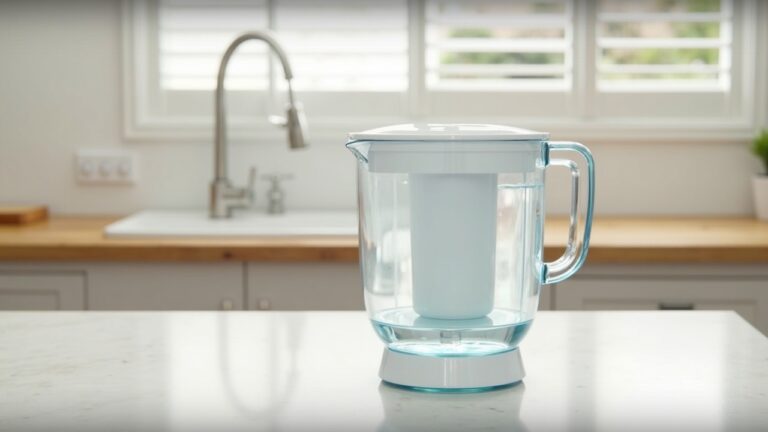
| Standard GAC pitcher (Brita) | Partial | No | No | Inadequate for Sydney |
| Carbon block tap filter (TAPP EcoPro) | Yes | No | Partial | Good for renters — covers chloramine and taste |
| Reverse osmosis (AquaTru / Waterdrop) | Yes | >96% | >99% | Best comprehensive solution for Sydney |
Best water filters for Sydney 2026
Homeowners: Waterdrop Core under-sink RO
WaterMark certified for permanent installation in Australian homes. Tankless design — no storage tank under the sink. 190L/day production. Dedicated filtered tap included. Removes fluoride, PFAS, chloramine, lead, and microplastics. Compact footprint — fits under any standard Australian kitchen sink.
Best for: homeowners wanting permanent on-demand RO
Waterdrop Core on Amazon AUFor a full comparison of under-sink RO systems see our best under-sink water filter Australia guide. For countertop RO: best countertop water filter Australia. For the fluoride removal science: does reverse osmosis remove fluoride.
Frequently asked questions — Sydney water filters
Why can’t a standard Brita jug handle Sydney tap water properly?
Sydney uses chloramine as its primary disinfectant, not free chlorine. Standard carbon jugs like Brita are designed to reduce chlorine but lack the contact time and catalytic carbon needed to break down chloramine. You will still taste and consume chloramine with a basic jug filter.
Is reverse osmosis overkill for Sydney water?
No. RO is the gold standard for Sydney because it removes chloramine, PFAS, fluoride, and heavy metals in one system. Given PFAS concerns in parts of Western Sydney and the seasonal blending of desalinated water, RO gives you the most thorough filtration available for a household setup.
Should I worry about PFAS in my Sydney tap water?
If you live in Western Sydney, particularly near defence bases or industrial sites, PFAS contamination is a legitimate concern. Sydney Water treats to regulatory limits, but those limits are still debated by independent researchers. An RO system or a filter with activated carbon rated for PFAS removal is the practical solution.
Does Sydney’s soft water affect which filter I should choose?
Sydney water is naturally soft, so you do not need a water softener or scale inhibitor built into your filter. This also means you can skip systems marketed for hard water protection. Focus your budget on filtration performance for chloramine, PFAS, and fluoride instead.
What type of filter removes both chloramine and fluoride from Sydney water?
A reverse osmosis system handles both. Catalytic carbon alone can reduce chloramine but will not touch fluoride. If you want both contaminants removed without RO, you would need a catalytic carbon stage plus a separate fluoride reduction media, which adds cost and complexity.
Do I need a different filter when Sydney blends in desalinated water during droughts?
You do not need a separate system, but it reinforces the case for RO. Desalinated water can carry different trace mineral profiles and treatment byproducts compared to dam water. A quality RO system normalises your water regardless of the source blend Sydney Water is using at any given time.
Get the Australian Home Environment Checklist
30 checks across water, air and EMF. Most of them free. Ranked by impact.
No spam. Unsubscribe any time.

Former Royal Australian Navy Clearance Diver and TAG-E counter-terrorism operator. Founded Clean and Native to apply the same rigorous thinking to the home environment.
Full biography →