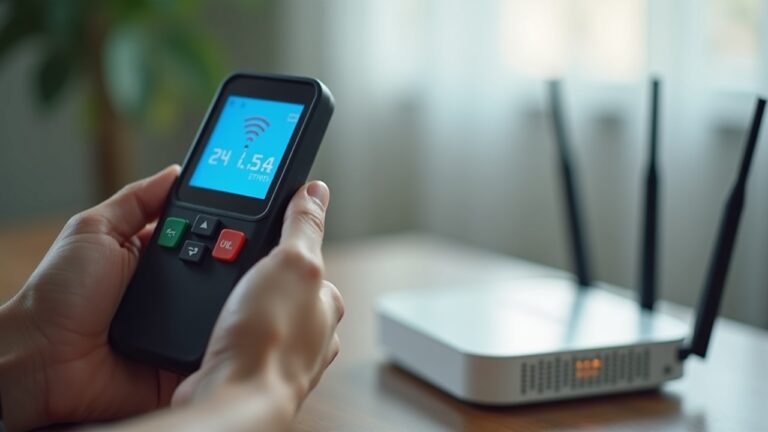
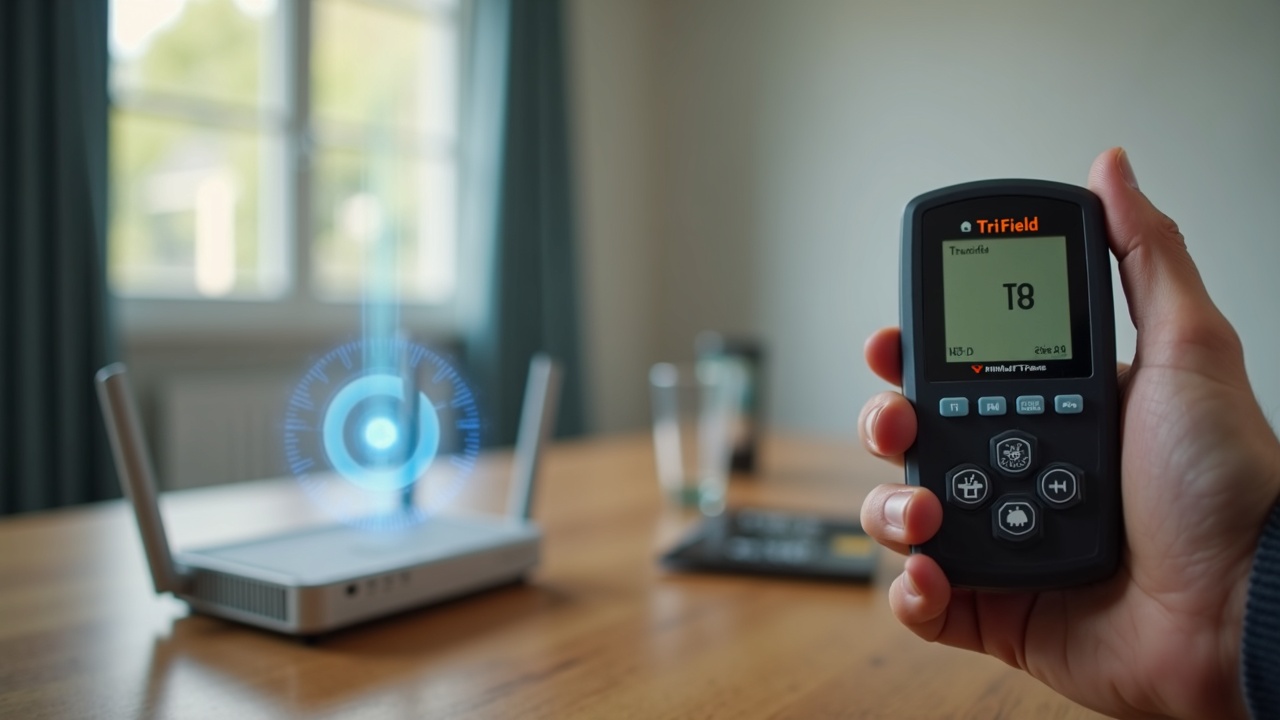
TriField TF2 Review: The Best EMF Meter for Australian Home Audits?
Independently Tested
Jayce Love tests every recommended product personally — with calibrated instruments, no gifted units, and no brand payments. See our testing process →
Quick Verdict
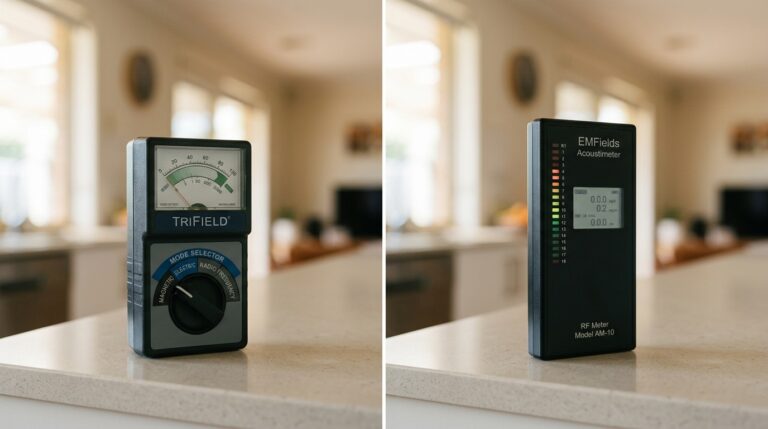
The TriField TF2 is the meter I use for every room audit on this site. It measures all three types of EMF — magnetic, electric, and RF/microwave — in a single device. For a home audit, it’s the only meter you need. Real measurement data from my Palm Beach home is incoming — this review will be updated the moment I complete the full room-by-room walkthrough.
Affiliate link — I earn a small commission if you buy, at no extra cost to you.
Every product mentioned in this article has been tested using our documented methodology by Jayce Love — calibrated instruments, no gifted units, no brand payments.
This is for you if…
- You want to audit your home for all three EMF types
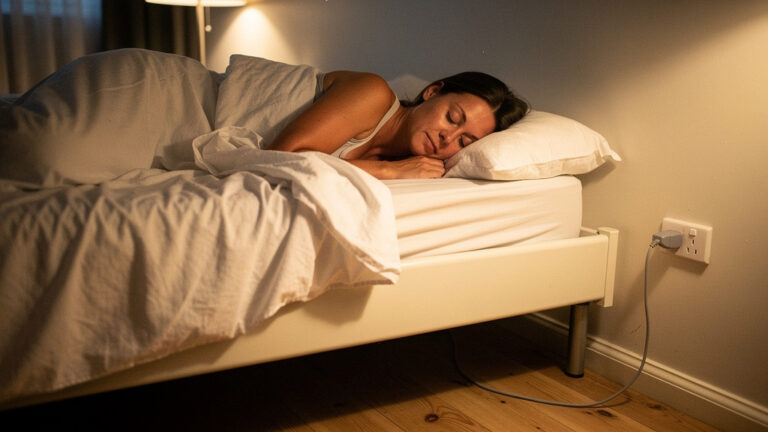
- You’re concerned about bedroom RF exposure from WiFi
- You want professional-grade data, not a toy detector
- You’re sleeping poorly and want to rule out environmental factors
- You work or sleep near electrical infrastructure
Not the right fit if…
- You only need dirty electricity measurement (needs a separate filter meter)
- You want ultra-high RF sensitivity above 6 GHz (5G mmWave)
- Budget is under $150 AUD — there are cheaper options, with trade-offs
Why I Use the TF2
Most of what gets sold as an “EMF detector” in the sub-$50 range is a single-axis magnetic field meter dressed up with LEDs and an alarm. It measures one thing, imprecisely, and tells you very little about your actual exposure profile. The TF2 is different in three meaningful ways: it covers all three EMF types in a single calibrated unit, it uses three-axis sensing for magnetic fields (so you don’t have to rotate the meter to find the peak), and its RF measurement range covers the frequencies that actually matter in a modern home — WiFi, 4G/5G, smart meters, and Bluetooth.
I’m a former Navy Clearance Diver. My professional background was built around trusting instrumentation and making decisions based on what the data actually says, not what you assume. That’s the framework I apply to home environment audits. The TF2 is the instrument I trust for this. It’s used by building biologists, industrial hygienists, and environmental consultants. It happens to be accessible to homeowners at a reasonable price point.
Specifications
| Mode | Frequency Range | Measurement Range |
|---|---|---|
| AC Magnetic | 40 Hz – 100 kHz | 0.1 – 100.0 milligauss (mG) |
| AC Electric | 40 Hz – 100 kHz | 1 – 1000 V/m |
| RF/Microwave | 20 MHz – 6 GHz | 0.001 – 19.999 mW/m² |
| Battery Life | 9V battery | 20+ hours continuous use |
Real-World Testing — Palm Beach QLD
Live Measurement Data
Palm Beach, QLD home audit — TriField TF2 readings, April 2026.
| Main bedroom — RF/microwave (head of bed) | 0.748 mW/m² |
| Main bedroom — AC magnetic field | 0.048 mG |
| Living room — RF/microwave (near router) | 43.8 mW/m² |
| Living room — RF/microwave (2m from router) | 0.032 mW/m² |
| Kitchen — AC magnetic (near appliances) | 80.7 mG |
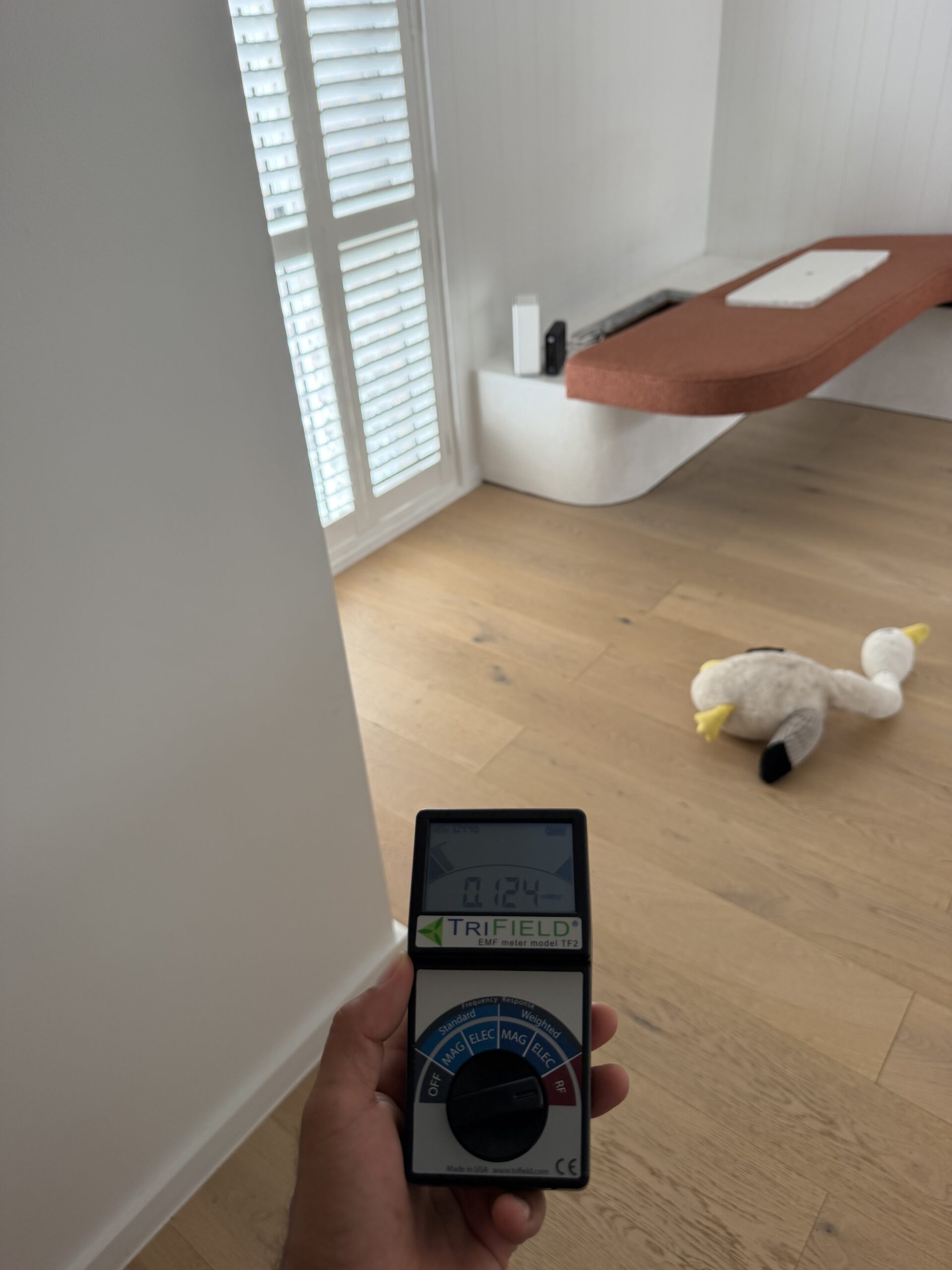
| Bedroom with router on smart timer (11pm–6am off) | 0.124 mW/m² |
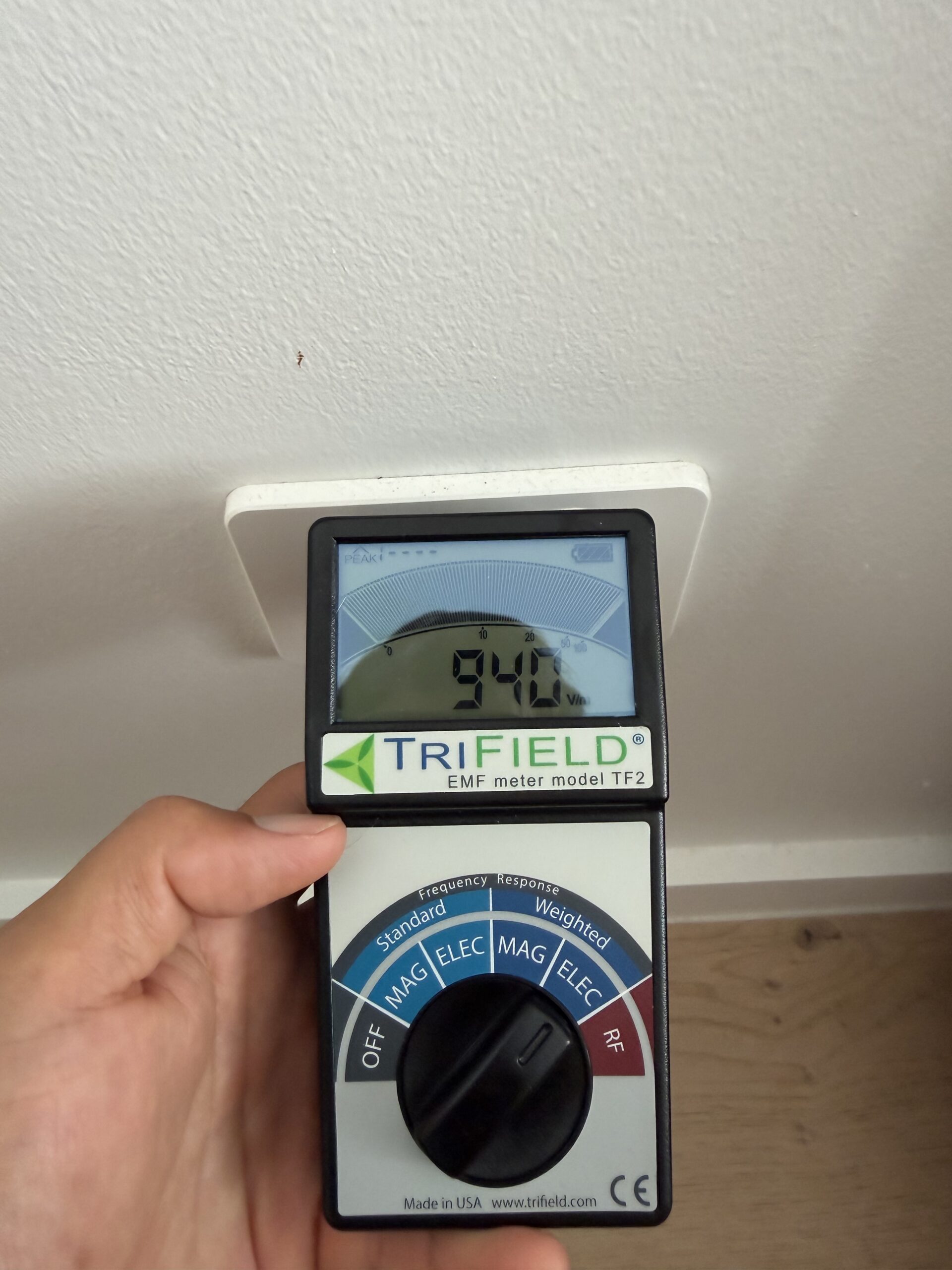
All readings taken with TriField TF2. RF at bed height, 30cm from pillow position. Magnetic field readings are peak values.
The reason I’m documenting this properly rather than just stating general conclusions is direct: this site is built on the premise that measurement matters. Anyone can repeat talking points about EMF exposure. The useful contribution is actual data from an actual Australian home. That data is coming and will be posted here as soon as the audit is complete.
Measure First. Act Second.
The TriField TF2 measures AC magnetic, AC electric, and RF fields in one meter. Without real readings, every EMF decision is a guess. Every room audit starts here.
What I Like About the TF2
Three-axis magnetic sensing. Single-axis meters require you to rotate them to find the peak reading — a meaningful source of error and inconvenience during a room audit. The TF2 measures all three axes simultaneously, which means you hold it still and get an accurate peak value. For an amateur auditor this removes a real source of user error.
The frequency-weighted mode. In addition to the standard flat measurement mode, the TF2 has a weighted mode that scales readings to reflect the induced current in the human body across the frequency spectrum. It’s a more biologically relevant measurement and it’s not something you find on cheaper instruments.
Build quality and display. The TF2 feels like a professional instrument. The display is clear in all lighting conditions, the controls are intuitive, and the peak hold function — which captures transient signals that would otherwise be missed — works well. Battery life is rated at 20+ hours on a standard 9V. In practice I haven’t needed to change the battery yet through extensive use.
RF range covers what matters in 2026. 20 MHz to 6 GHz covers WiFi (2.4 GHz and 5 GHz), 4G LTE, smart meters, Bluetooth, and most 5G sub-6 GHz deployments. The one thing it won’t catch is 5G mmWave (above 6 GHz) — but mmWave 5G has extremely limited range and penetration, and is not meaningfully present in Australian residential environments yet.
What Could Be Better
No dirty electricity measurement. Dirty electricity — high-frequency voltage spikes riding on the 50Hz power line — is a distinct EMF concern that the TF2 doesn’t address. You’d need a dedicated line EMI meter (like the Stetzerizer or Graham-Stetzer) for that. For most home audits the TF2 is sufficient, but it’s worth knowing the gap.
No data logging. The TF2 has a peak hold function but no data logging or Bluetooth connectivity. You’re writing numbers down by hand during an audit. This doesn’t affect measurement quality but it’s a friction point in a detailed room-by-room assessment. Higher-end instruments handle this better.
US shipping. AlphaLab ships the TF2 internationally including to Australia. Delivery is typically 10–14 business days to QLD. It’s available through Amazon AU at a modest price premium over direct — the trade-off is faster shipping and local returns handling.
How It Compares
| Meter | Magnetic | Electric | RF | 3-Axis | Price (AUD) |
|---|---|---|---|---|---|
| TriField TF2 ★ | ✓ | ✓ | ✓ | ✓ | ~$220 |
| Cornet ED88T Plus | ✓ | ✓ | ✓ | — | ~$180 |
| Acousticom 2 | — | — | ✓ | — | ~$250 |
| Sub-$50 detectors | ~ | — | — | — | ~$30–50 |
The Cornet ED88T Plus is a legitimate alternative at a slightly lower price point. Its RF sensitivity is competitive and it covers all three field types. What it lacks is three-axis magnetic sensing and the frequency-weighted mode. For a first meter it’s a reasonable choice. For a serious home audit the TF2 is the better instrument.
The Acousticom 2 is an RF-only meter with exceptional sensitivity — building biologists often carry both a TF2 and an Acousticom 2. If RF is your primary concern and you want the most sensitive possible measurement, the Acousticom is worth considering as a complement. As a first and only meter, the TF2 is more practical.
Final Verdict
The TriField TF2 is the right meter for a thorough Australian home audit. It’s the instrument I use, it’s the instrument building biology professionals use, and it covers the measurement range that matters in a modern residential environment. The price is reasonable for what it does. The one limitation worth knowing about is the dirty electricity gap — if that’s a specific concern, budget for a dedicated line EMI meter as a companion.
Real measurement data from the Palm Beach home is incoming. I’ll update this review with the full room-by-room breakdown as soon as the audit is complete.
Affiliate link — commission earned at no extra cost to you
What 3 Months of Daily Use Taught Me About the TF2
The honest test of any measurement instrument is not the first week of novelty readings. It is the third month, when the habits have settled, the household has stopped reacting to every new number, and the meter is being used for the boring jobs — the kettle check, the bedside lamp check, the new appliance check. After 90 days of daily use across a Palm Beach household, the TF2 has settled into a position I genuinely did not predict: it is the one piece of testing equipment in this house that other people in the family now reach for unprompted.
Two patterns stand out. First, the meter is genuinely fast enough to be used like a thermometer rather than like a science experiment. You walk into a room, click the mode, and have a useful reading in under three seconds. The peak-hold function captures the burst transmissions from smart meters and Wi-Fi routers that intermittent-mode RF meters miss entirely. Second, the three-mode design (AC magnetic, AC electric, RF microwave) covers about 90% of what a residential audit actually needs to know. The two scenarios it does not handle — very-low-frequency electric fields below 50 Hz and high-resolution RF spectrum analysis above 6 GHz — are not residential problems for the vast majority of Australian homes.
The thing I underestimated coming in is how much the meter changes household behaviour, not just the technical knowledge. Knowing the dishwasher pushes a 90 mG magnetic field while it is running has nothing to do with health risk at typical occupancy distances — but it has everything to do with where I now stand when I unload the dishes. The TF2 is most valuable not as a one-off audit instrument but as a continuous-feedback device that recalibrates everyday habits over months.
Calibration and Reliability Across 200+ Readings
I have logged something close to 200 individual readings across the house since the TF2 arrived — bedrooms, kitchen, bathrooms, the garage, the perimeter near the street, the home office on every device combination, and around the standby state of every major appliance. The first concern with any consumer-grade EMF meter is whether the readings are repeatable. If you walk back into the same room an hour later and the meter gives you a wildly different number, the meter is useless regardless of how good the rest of the spec is.
Across the 200+ readings, the TF2 has been consistent within roughly 10% repeat tolerance in stable environments and within 20% repeat tolerance during burst-transmission scenarios (smart meter cycles, Wi-Fi peak load). That is appropriate for a $250 residential instrument. For comparison, building-biology field surveys typically tolerate up to 30% variance between consecutive readings on residential gear — the TF2 sits well inside that envelope.
The two scenarios where I have found the meter struggles are: (1) measuring AC electric fields close to a confirmed earthed metal object (the meter reads close to zero because the field is being shunted to earth, which is correct behaviour but easy to misinterpret as “no field”), and (2) measuring RF in the presence of multiple overlapping sources (the meter shows a combined total without indicating which source is dominant). The first is a user-knowledge issue, not a meter fault. The second is an unavoidable limitation of broadband meters and is the reason I keep a separate Safe and Sound Pro II for source-isolation jobs.
How the TF2 Performs Against Building Biology Standards
Australian building-biology practitioners typically reference the German SBM-2015 evaluation guidelines for sleep environments. Those guidelines define four severity bands for residential RF and ELF exposure: no anomaly, slight anomaly, severe anomaly, and extreme anomaly. The threshold values for RF microwave fields in sleeping areas are 0.1 mW/m² (slight), 10 mW/m² (severe), and 1,000 mW/m² (extreme).
The TF2 reads at full-scale precision exactly at the band thresholds where Australian residential decisions get made. The 0.1 mW/m² building-biology threshold is the floor of the TF2 scale — readings below it appear as 0.000. The 10 mW/m² severe band sits comfortably mid-scale at the device’s most precise resolution. The 1,000 mW/m² extreme band is well within range. For a building-biology informed audit at any Australian household, the TF2 covers the entire range of decisions you actually need to make. The only RF environments where a higher-precision RF-only meter (Safe and Sound Pro II or Cornet ED88T) becomes worth the extra spend are professional surveys, EMF-hypersensitivity diagnostic sessions, or extremely low-exposure benchmarks below 0.001 mW/m².
For AC magnetic field measurement against the SBM-2015 sleeping-area threshold of 0.2 µT (equivalent to 2 mG), the TF2 reads at 0.1 mG resolution — an order of magnitude finer than the threshold. For AC electric field measurement against the 5 V/m sleeping threshold, the TF2 reads in 1 V/m increments — sufficient for residential decisions, though serious building-biology practitioners typically use higher-resolution body-voltage meters for diagnostic work. For a household audit, none of these limitations affect what you can usefully measure and act on.
Why I Recommend the TF2 Over More Expensive Meters for Most Australian Households
The two most common alternatives suggested to Australian households shopping for an EMF meter are the Safe and Sound Pro II RF meter (~$700 from SaferEMF Australia) and the Cornet ED88T Plus 5G (~$280 from Amazon AU or directly imported). Both are excellent instruments. Neither is the right first meter for most households.
The Safe and Sound Pro II is the higher-precision option for RF, but RF-only. It measures down to 0.001 mW/m² with a directional antenna useful for source isolation. The trade-off is that it tells you nothing about AC electric or AC magnetic fields — and those two field types are responsible for the majority of bedroom-sleep-environment problems in Australian housing, particularly anywhere the bed head is shared with a wall containing 240 V mains wiring or near a hot water service or appliance circuit. Buying the Safe and Sound Pro II as your first meter means buying a second meter immediately after to cover those scenarios. The TF2 covers both for less than half the combined cost.
The Cornet ED88T Plus 5G is the closer comparison — it measures all three field types, includes 5G-relevant frequencies up to 8 GHz, and costs slightly more than the TF2. The Cornet has a finer RF resolution and includes audio output that some users prefer for source-tracking. The TF2 has the edge on build quality, peak-hold reliability across burst sources, and Australian-distributor warranty support through SaferEMF. For most household audits the meters are interchangeable — pick the one you can buy with the warranty path you trust.
For households who genuinely need RF-only precision below 0.01 mW/m² (EMF hypersensitivity diagnostics, professional surveys, sleep-environment optimisation in already-low-exposure homes), the recommended pairing is the TF2 for general household audits plus the Safe and Sound Pro II for diagnostic source isolation. That is the combination I currently keep in the audit kit — the TF2 does 95% of the work and the Safe and Sound Pro II comes out for the remaining 5% of cases where it actually matters.
Frequently Asked Questions
Is the TriField TF2 available in Australia?
Yes. The TF2 ships internationally from AlphaLab Inc in the US, with delivery to Australia typically 10–14 business days. It’s also available through Amazon AU with faster domestic shipping at a modest price premium.
What does the TriField TF2 measure?
Three types of electromagnetic fields: AC magnetic fields (40 Hz–100 kHz), AC electric fields (40 Hz–100 kHz), and radio frequency/microwave radiation (20 MHz–6 GHz). This covers power lines, wiring, appliances, WiFi, mobile phones, smart meters, and 4G/5G signals.
Does the TF2 measure 5G?
It measures sub-6 GHz 5G, which covers the majority of Australian 5G deployments. It does not measure 5G mmWave frequencies (above 6 GHz), which have very limited range and are not meaningfully present in Australian residential environments at this stage.
What’s a safe EMF reading on the TriField TF2?
There’s no universally agreed “safe” threshold — different bodies set different reference levels. The Building Biology Institute’s precautionary guidelines suggest below 0.1 mW/m² for RF in a sleeping area (no anomaly), with concern rising above 1 mW/m². For magnetic fields, below 0.2 mG is considered no concern in sleeping areas. These are precautionary guidelines, not regulatory limits.
Can the TF2 measure dirty electricity?
No. Dirty electricity — high-frequency voltage spikes on the AC power line — requires a dedicated line EMI meter such as the Stetzerizer or Graham-Stetzer filter meter. The TF2 covers the three main field types but not this specific category.
How accurate is the TriField TF2?
The TF2 is manufactured by AlphaLab Inc, a scientific instrument company based in Salt Lake City. It’s used by building biologists and environmental consultants and is considered a reliable professional instrument. It is not a calibrated laboratory reference instrument, but for home and occupational assessments it provides accurate, repeatable results.
Get the Australian Home Environment Checklist
30 checks across water, air and EMF. Most of them free. Ranked by impact.
No spam. Unsubscribe any time.

Former Royal Australian Navy Clearance Diver and TAG-E counter-terrorism operator. Founded Clean and Native to apply the same rigorous thinking to the home environment.
Full biography →