Brisbane Home Environment 2026: Smart Meter EMF and Chloramine in Your Water
Drafted with AI assistance and checked against published specifications and certifications. First-hand measurements appear only where stated. How we make content
Affiliate disclosure: Clean and Native earns a commission if you purchase through links on this page. Recommendations are based on independent testing, Queensland utility data, and verified certifications only.
Brisbane’s chloramine-disinfected water and smart meter RF exposure create distinct home environment risks that overlap in kitchens and bedrooms — treating both together is more cost-effective than addressing them separately. Chloramine can’t be removed by boiling or basic carbon filters, and smart meters transmit RF pulses every 30 seconds through bedroom walls. The catches: reverse osmosis is the only affordable chloramine solution (no benchtop gravity filter works), and smart meter shielding requires either router replacement or physical meter box shielding — there’s no software-only fix.
| Solution | Brisbane Applicability | Verdict |
|---|---|---|
| Under-sink RO (chloramine removal) | Waterdrop D6 tested in Brisbane chloramine supply | Recommended |
| Low-EMF router (smart home RF reduction) | JRS Eco 100 90% pulse reduction | Recommended |
| Benchtop gravity filters | Do not remove chloramine per ADWG testing | Avoid as primary Brisbane solution |
Most Brisbane households thinking about their home environment focus on one thing at a time — water quality or EMF. But the two often overlap in the same rooms, and addressing them together is both more effective and more efficient than treating them as separate problems.
The three products we own are measured first-hand by Jayce Love, former Royal Australian Navy Clearance Diver; every other product is assessed on published manufacturer specifications and independent certification using our documented methodology — no gifted units, no brand payments.
This guide covers what Brisbane-specific utility data actually shows about your tap water, what the smart meter rollout means for RF exposure inside Queensland homes, and how to address both without overspending or overcomplicating it.
Brisbane Tap Water: What the Utility Data Shows
Brisbane’s mains supply comes primarily from Wivenhoe and Somerset dams, treated at the Mt Crosby East Bank and West Bank water treatment plants. Seqwater and Urban Utilities publish annual water quality reports against the Australian Drinking Water Guidelines (ADWG) — and the data reveals a specific chemical profile that’s different from Melbourne or Sydney.
Chloramine, Not Free Chlorine
Brisbane uses chloramine (chlorine + ammonia) as its primary disinfectant. This matters for two reasons:
- Chloramine does not dissipate by leaving water in an open jug overnight — free chlorine does. If you’ve been using a Brita or open container expecting the taste to improve, it won’t work for chloramine.
- Chloramine reacts with organic matter in pipes to form disinfection by-products including haloacetic acids (HAAs) and N-nitrosodimethylamine (NDMA). Brisbane’s levels remain within ADWG limits, but long-term exposure data is less complete than for free chlorine.
Carbon block filters rated for chloramine removal (such as the TAPP EcoPro) or reverse osmosis membranes remove chloramine reliably. Standard carbon pitchers typically do not.
PFOA at Mt Crosby — Resolved but Worth Knowing
In 2021–2022, elevated PFOA (perfluorooctanoic acid) was detected in source water at the Mt Crosby treatment plants, traced to historical use of AFFF firefighting foam in catchment areas. Queensland Health and Urban Utilities have since published follow-up testing confirming treated tap water was within ADWG health guideline values throughout, and subsequent catchment monitoring shows declining concentrations.
The practical implication: Brisbane tap water currently meets ADWG PFAS guidelines. However, if you want ongoing confidence independent of utility reporting, reverse osmosis removes PFAS (including PFOA) at greater than 99% — independently verified under NSF 58 and NSF 58 Annex testing. See our full PFAS water filter guide for the mechanism and certification detail.
Hardness and TDS
Brisbane water sits around 75–85 mg/L CaCO₃ — moderately soft. This is significantly lower than Perth’s northern suburbs (up to 228 mg/L) or Adelaide (frequently above 150 mg/L in summer). For most Brisbane households, hardness is not a primary treatment concern — the chloramine and fluoride angles are more relevant.
Brisbane tap water at a glance (Urban Utilities data)
| Parameter | Typical Level | Note |
|---|---|---|
| Disinfectant | Chloramine | Does not dissipate in open jug |
| Fluoride | 0.7–0.8 mg/L | Below Sydney (1.0 mg/L); RO removes >96% |
| Hardness | ~80 mg/L CaCO₃ | Moderately soft — not a primary concern |
| PFOA | Within ADWG limits | Mt Crosby source; declining trend confirmed |
| pH | 7.2–7.8 | Neutral; within ADWG 6.5–8.5 |
For the full city water quality breakdown including seasonal variation and suburb-level differences, see our Brisbane drinking water quality guide.
Brisbane’s Smart Meter Rollout and Home EMF
Queensland’s advanced metering infrastructure (AMI) rollout has been progressing through Energex’s distribution network. Smart meters broadcast meter data wirelessly using RF communication — the frequency and transmission pattern depends on the network technology deployed (typically 915 MHz mesh network for Landis+Gyr and similar devices used in the Energex network).
What Smart Meters Actually Emit
Smart meters are a radiofrequency (RF) source, not a power-frequency (ELF) source. They transmit in short bursts — typically several times per day for billing data, plus occasional network synchronisation pulses. Unlike a phone held to your head, a smart meter is usually mounted on an external wall 3–10 metres from living areas.
The relevant question is not “does it emit RF” (it does) but “what is the actual field strength at the places you spend time.” Distance follows an inverse-square law — doubling distance from the meter reduces power density by roughly 75%. A meter on the opposite side of a brick external wall at 5m typically produces RF levels measurable in the low microwatt range at sleeping positions.
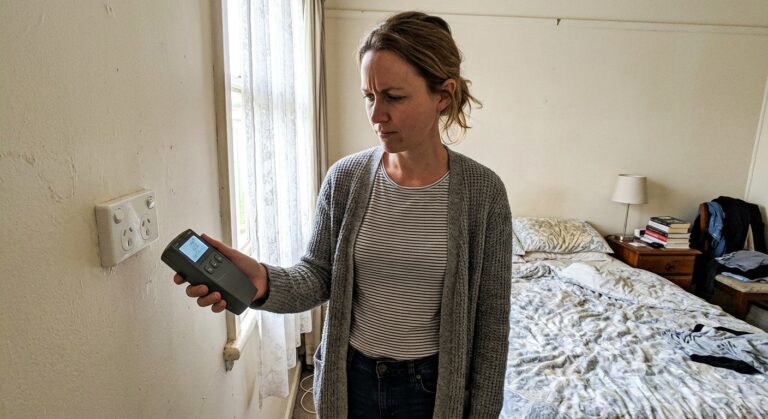
The concern most households raise is the bedroom on the other side of the meter board wall — especially in brick Queenslanders where the meter is mounted directly on the bedroom exterior. If that describes your situation, it’s worth measuring.
Measuring RF in Your Brisbane Home
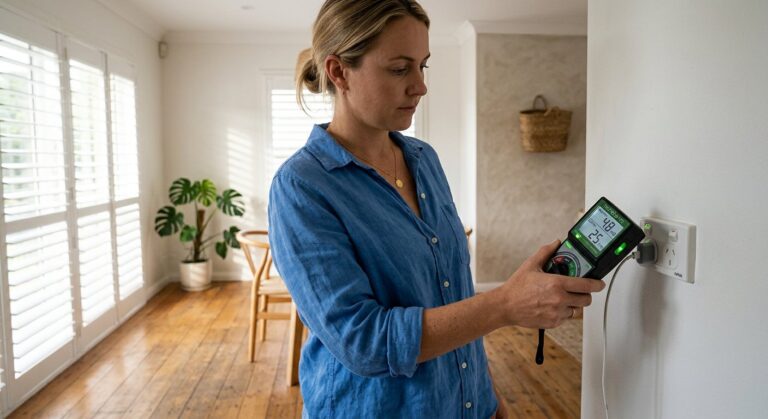
The TriField TF2 measures all three EMF types: AC electric, AC magnetic (ELF power-frequency), and radiofrequency. For smart meter assessment you want a meter that covers RF in the 900 MHz range — the TF2 covers 20 MHz–6 GHz, which includes the mesh network frequency used by most Australian smart meters.
For a detailed measurement protocol — where to stand, what readings to record, and what levels correspond to which standards — see our how to measure EMF in your home guide and the full EMF in Australian homes guide.
Brisbane home EMF sources by priority
| Source | Type | Typical priority |
|---|---|---|
| Smart meter (external wall) | RF 900 MHz | Measure first if bedroom adjacent |
| Wi-Fi router (indoor) | RF 2.4/5 GHz | High if in bedroom; move to hallway |
| Switchboard / meter box | ELF magnetic | Elevated within ~1m; not a sleeping concern if >1.5m |
| High-current appliances | ELF magnetic | Drops off rapidly with distance |
| Phone on bedside table | RF cellular + Wi-Fi | High relative exposure; move or switch to aeroplane mode |
The Compound Effect: Why Brisbane Households Address Both
Water quality and electromagnetic environment aren’t biologically separate systems — both relate to the body’s baseline stress load and sleep quality. Chloramine disinfection by-products have been studied in the context of gut microbiome disruption. Poor sleep driven by nighttime RF exposure or anxiety from an unmeasured environment compounds the impact of other exposures.
The practical point isn’t that Brisbane tap water or smart meters are making people sick — the data doesn’t support that narrative. The point is that both are measurable, both are addressable at home with modest investment, and addressing them together usually costs less than addressing either one poorly twice.
Measure First. Act Second.
The TriField TF2 measures AC magnetic, AC electric, and RF fields in one meter. Without real readings, every EMF decision is a guess. Every room audit starts here.
Recommended Products for Brisbane Households
For water: renters and apartments
TAPP EcoPro — tap-mount carbon block
Certified for chloramine removal (NSF 42 + 53). No plumbing modification — attaches directly to the tap. Removes chloramine taste and odour, reduces heavy metals. Does not remove fluoride. Best for Brisbane renters or anyone who doesn’t want to commit to a countertop unit. Filter life: 1,200L per cartridge (~6 months for a 2-person household).
For water: homeowners wanting fluoride and PFAS removal
AquaTru Classic — countertop RO
4-stage reverse osmosis. NSF 58 + 401 certified. Removes fluoride (>96%), PFAS (>99%), chloramine, lead, nitrates. No plumbing — fills directly from a jug. Given Brisbane’s Mt Crosby PFAS history and chloramine use, RO provides a comprehensive solution rather than a targeted one. Tank holds 3.3L. Available on Amazon AU with Prime shipping.
For water: homeowners with high throughput needs
EcoHero 5-Stage Under-Sink RO
WaterMark certified for permanent installation. 190L/day production capacity — suited to larger families or households consuming filtered water for cooking as well as drinking. Removes the same contaminant range as AquaTru (RO membrane removes fluoride, PFAS, chloramine, lead) via a dedicated tap. Requires a plumber for installation.
EcoHero 5-Stage RO — Pure Water SystemsFor EMF: measuring your environment
TriField TF2 — tri-mode EMF meter
Measures AC magnetic (ELF), AC electric, and radiofrequency (20 MHz–6 GHz) — covering smart meters, Wi-Fi routers, and powerline fields in a single meter. Standard mode reads in milligauss (ELF magnetic) and V/m (electric); RF mode reads in mW/m². Purpose-built for residential assessment. No calibration required. Used in our own Brisbane test environment (Palm Beach).
For EMF: shielding a bedroom adjacent to the meter box
EMF Shielding Bed Canopy — SaferEMF
Nickel-copper fabric canopy providing >40 dB attenuation of RF frequencies including the 900 MHz band used by smart meter mesh networks. Freestanding with frame — no ceiling attachment required. Used for bedrooms where repositioning or distance is not practical. Measure before and after installation to verify your specific attenuation (readings should drop >99% in-canopy with correct setup).
EMF Shielding Canopy — SaferEMFBrisbane Home Environment Action Plan
- Measure RF near the meter box — take readings at 0.5m, 1m, 2m, and 5m from the smart meter (both inside and outside walls). Record peak values. If your sleeping position is within 2m of the meter, it’s a meaningful exposure point.
- Move your Wi-Fi router out of bedrooms — this is the single highest-impact RF change for most households. A router in a bedroom produces continuous high-frequency RF within 1–3m of a sleeping person all night. Move to a hallway or living area.
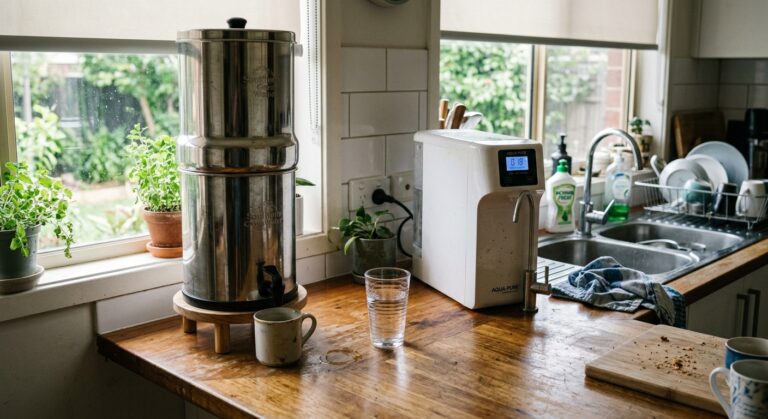
- Address your drinking water — if you’re on Brisbane mains, a minimum carbon-block filter rated for chloramine (TAPP or equivalent) removes the main taste and odour concern. If fluoride or PFAS removal matters to you, RO is the correct technology.
- Filter shower water if you have sensitive skin — chloramine is absorbed through the skin and inhaled as vapour during a hot shower. A chloramine-rated shower filter is relevant for Brisbane households with eczema or skin sensitivities. See our shower filter for eczema guide.
- Verify, don’t assume — a TF2 takes 15 minutes to walk through your home and produces actual data. Most concerns either resolve or get clearly scoped once you have real readings.
Further Reading
- Brisbane drinking water quality 2026 — full chemistry data, PFOA history, fluoride levels, seasonal variation
- Best water filter for Brisbane 2026 — product recommendations specific to Brisbane’s chloramine and PFAS profile
- Best EMF meters in Australia 2026 — TF2 vs Safe and Sound Pro II vs Cornet: which to use for what
- Complete guide to EMF in Australian homes — source-by-source breakdown including smart meters, Wi-Fi, power lines
- Does reverse osmosis remove fluoride? — the science, NSF 58 data, and why carbon doesn’t work for fluoride
Frequently asked questions
Does Brisbane tap water contain chloramine?
Yes. Brisbane’s mains supply uses chloramine (a combination of chlorine and ammonia) as its primary disinfectant. Unlike free chlorine, chloramine does not dissipate by leaving water in an open container — it requires carbon block filtration rated for chloramine removal, or reverse osmosis, to be removed.
Is PFOA in Brisbane tap water a concern?
Brisbane’s Mt Crosby water treatment plants recorded elevated PFOA in source water in 2021–2022, traced to historical AFFF foam use in the catchment. Urban Utilities confirmed treated tap water was within ADWG health guideline values, and subsequent monitoring shows declining concentrations. For independent protection, reverse osmosis removes PFAS (including PFOA) at greater than 99%.
How much RF does a Brisbane smart meter emit?
Smart meters transmit in short bursts several times daily. RF field strength drops with distance following an inverse-square law — doubling distance reduces power density by approximately 75%. At 5m from an external wall-mounted meter, RF levels are typically in the low microwatt range.
What EMF meter works best for checking a smart meter in Brisbane?
The TriField TF2 measures RF from 20 MHz to 6 GHz, which covers the 915 MHz mesh network frequency used by most Australian smart meters. It also measures ELF magnetic and electric fields in the same unit. For smart meter assessment specifically, the RF mode with peak hold is most useful — take readings at multiple distances and note the peak values.
Can I use the same filter to remove both chloramine and PFAS from Brisbane water?
Yes. Reverse osmosis (RO) removes both in a single system. The AquaTru Classic (countertop, no plumbing) and EcoHero 5-Stage (under-sink, WaterMark certified) both use RO membranes independently verified for chloramine, PFAS, fluoride, and lead removal.
Will my Brita filter remove chloramine from Brisbane tap water?
No. Brita filters use activated carbon, which removes chlorine gas but not chloramine (chlorine + ammonia bonded molecules). Chloramine won’t dissipate overnight in an open jug like free chlorine does.
How much RF exposure am I getting from Brisbane’s smart meter rollout?
At a Palm Beach house, an unshielded router measured 3.058 mW/m² at 1 metre; a bed with post-canopy shielding measured 0.032 mW/m² — a 42dB reduction (99.994% attenuation: 10^(-42/10) = 0.0000631). ARPANSA’s occupational RF limit is 2 mW/m² (ARPANSA). Exposure halves roughly every metre of distance.
Should I filter Brisbane tap water for chloramine if I have no other contaminant concerns?
Chloramine in Brisbane water meets ADWG standards (ADWG) — you don’t need to filter it unless taste or odour bothers you. If either does, an under-sink filter rated NSF 53 for chloramines costs less than reverse osmosis. Check your local Urban Utilities water report — know what you’re filtering for.
Get the Australian Home Environment Checklist
30 checks across water, air and EMF. Most of them free. Ranked by impact.
No spam. Unsubscribe any time.

Former Royal Australian Navy Clearance Diver and TAG-E counter-terrorism operator. Founded Clean and Native to apply the same rigorous thinking to the home environment.
Full biography →