The Truth About Bottled Water in Australia 2026
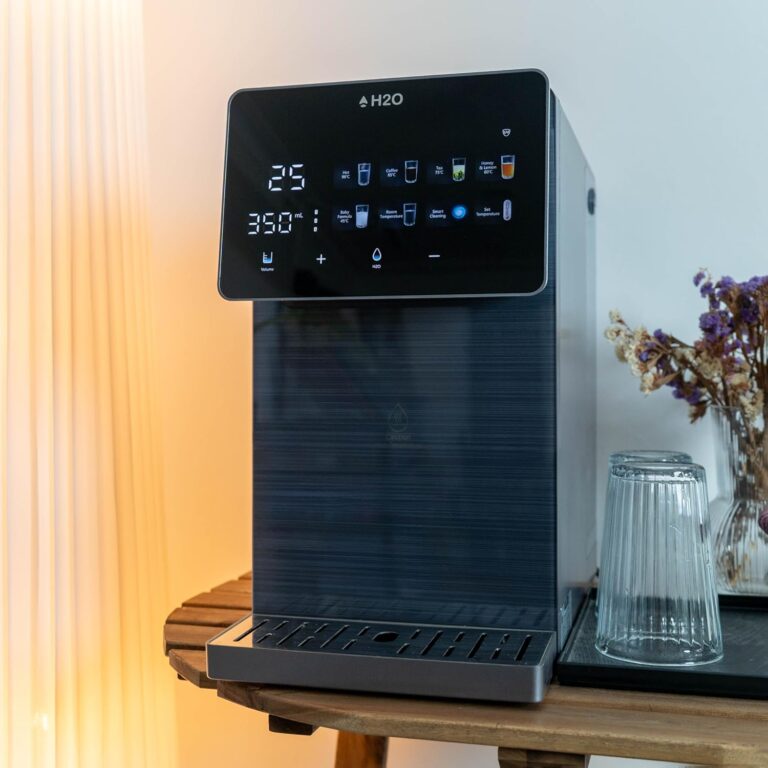
Most bottled water sold in Australia is filtered municipal tap water resold at a 2,000% markup in single-use plastic — the same source that flows from your kitchen tap. A quality benchtop or under-sink RO system delivers cleaner water (typically 3–10 ppm TDS versus 18–120 ppm for bottled) at roughly 4 cents per litre instead of $3. The catches: upfront filter cost ($200–$600), and you need to replace cartridges every 6–12 months depending on usage and water quality.
| Option | Annual Cost (2L/day) | Verdict |
|---|---|---|
| Benchtop/Under-Sink RO | ~$30 + $200 upfront | Recommended |
| Bottled Water (supermarket) | ~$2,190 | Avoid as primary |
| Unfiltered Tap (metro AU) | ~$1.50 | Safe, but chlorine/fluoride present |
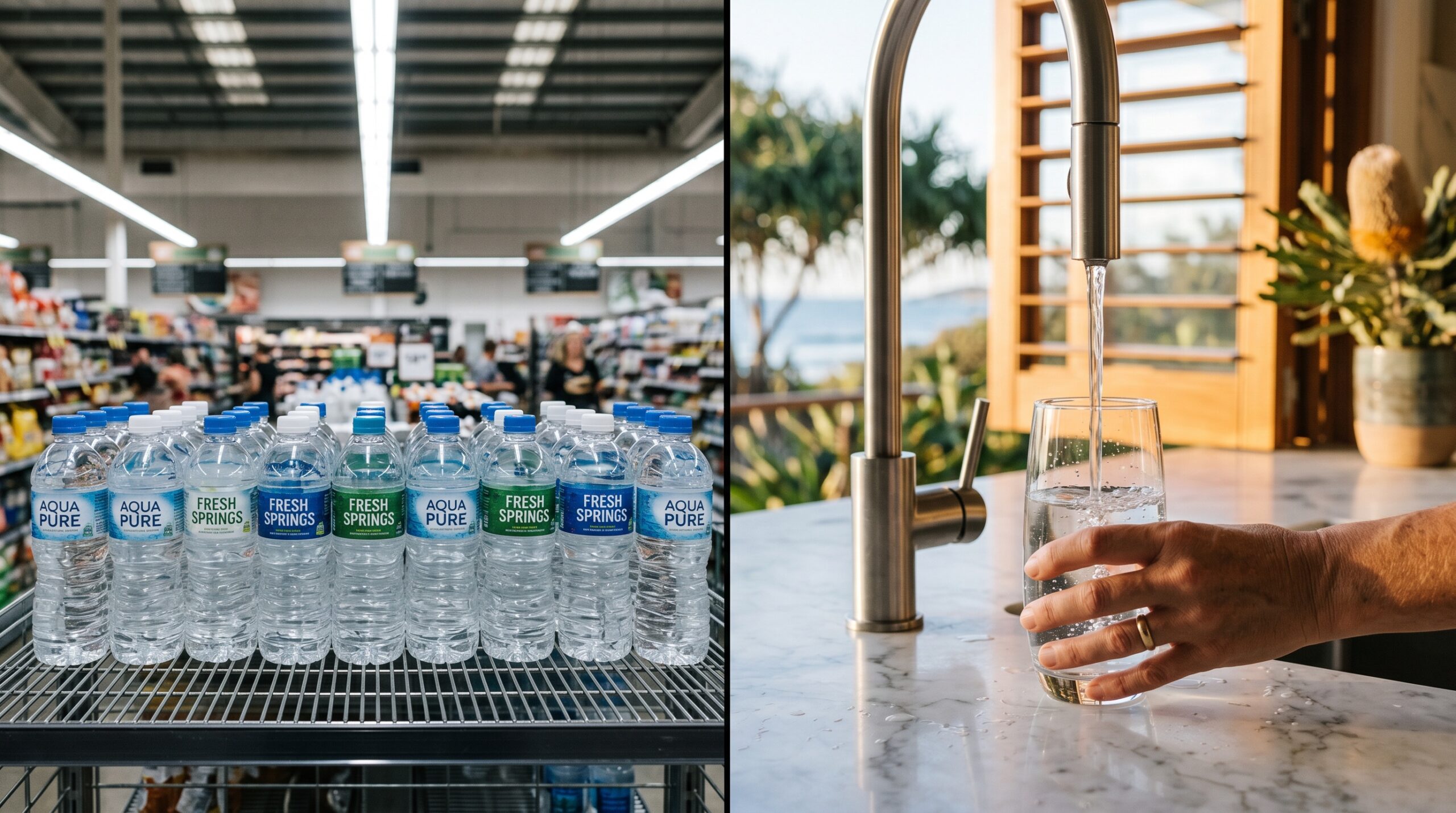
Most bottled water sold in Australia is filtered municipal tap water — the same supply that flows from your kitchen tap, run through a commercial filter, then sold back to you at a 2,000% markup inside a single-use plastic bottle. That is not an exaggeration. It is the documented supply chain for some of Australia’s biggest-selling brands.
The three products we own are measured first-hand by Jayce Love, former Royal Australian Navy Clearance Diver; every other product is assessed on published manufacturer specifications and independent certification using our documented methodology — no gifted units, no brand payments.
I am Jayce Love, a former Royal Australian Navy Clearance Diver based in Palm Beach, QLD. My Palm Beach mains TDS reading sits at 69 ppm. After running that same water through my EcoHero 5-Stage reverse osmosis system, it drops to 3 ppm. Bottled water, by contrast, carries no requirement to disclose what is actually in it, and its mineral content varies widely from brand to brand. For most Australians, a quality benchtop filter delivers cleaner water than the bottle in your fridge, at roughly four cents per litre instead of three dollars.
Australians Spend $700 Million a Year on Bottled Water — Here Is Where That Money Goes
According to Australian Beverages Council data, Australians spend approximately $700 million annually on bottled water. That figure has grown every year for the past decade, even as tap water quality in most capital cities meets or exceeds the Australian Drinking Water Guidelines (ADWG) set by the NHMRC and NRMMC.
Put that spend in perspective. A household buying two 600mL bottles per day at $3 each spends $2,190 per year. The same household filtering its own tap water with a certified benchtop unit like the Tappwater EcoPro spends roughly $90 per year on replacement cartridges after the initial purchase — a saving of over $2,000 annually. That is not a marginal difference. That is a car payment.
The bottled water industry’s growth is driven by a perception gap: people believe bottled water is safer, purer, or more rigorously tested than tap water. The regulatory reality tells a different story, and it is worth understanding exactly what you are paying for.
FSANZ Food Standards Code 2.6.2 vs the ADWG — What Actually Gets Tested
This is the fact that changes the conversation. Your tap water and your bottled water are regulated by two entirely different frameworks, and the one covering tap water is stricter.
Australian Drinking Water Guidelines (ADWG), published by the NHMRC and updated most recently in 2025, set guideline values for over 200 parameters including heavy metals (lead: 0.01 mg/L), disinfection by-products (THMs: 0.25 mg/L), pesticides, PFAS (PFOS + PFHxS: 0.07 μg/L), and microbiological indicators. Municipal water suppliers in every state are required to monitor against these guidelines and report publicly. SEQ Water, Melbourne Water, Sydney Water, Water Corporation WA — all publish annual water quality reports you can read online.
FSANZ Food Standards Code 2.6.2, which governs packaged water (including bottled water), sets far fewer specific contaminant limits. It requires bottled water to be “suitable for human consumption” and meet microbiological criteria, but it does not mandate testing for the full ADWG parameter list. There is no requirement for bottled water brands to test for PFAS, microplastics, or disinfection by-products, and no requirement to publish results publicly.
To be direct: your tap water supplier is required by state health regulations to test for more contaminants, more frequently, and publish the results. Your bottled water brand is not. You are paying more for less transparency.
This does not mean tap water is perfect. Depending on your city, it contains chloramine (Brisbane, Sydney, Adelaide, Darwin) or free chlorine (Melbourne, Hobart, Canberra) as a disinfectant, plus fluoride at 0.6 to 1.0 mg/L in most jurisdictions. If you want those removed, you need a filter — but at least you know what you are filtering because the data is published. With bottled water, you are trusting a brand with no public data obligation.
Where Australian Bottled Water Actually Comes From
The marketing imagery on bottled water labels — mountain springs, pristine creeks, untouched wilderness — rarely matches the supply chain. Two of Australia’s top-selling brands illustrate this clearly.
Mount Franklin, owned by Coca-Cola Amatil (now Coca-Cola Europacific Partners), sources from multiple locations around Australia. Several of these sources are municipal water supplies. The brand itself has acknowledged sourcing from town water in various states. The water is filtered and treated before bottling, but the starting material is the same water flowing through your pipes.
Pump, also a Coca-Cola brand, is explicitly labelled as “purified water” — which in industry terms means filtered municipal supply. It undergoes reverse osmosis and UV treatment at a bottling plant, but the input is tap water. You are buying filtered tap water in a plastic bottle for 60 to 100 times the cost of filtering it yourself at home.
Some brands do source from genuine spring or bore water — brands like Antipodes (Whakatane, New Zealand), Voss, and certain smaller Australian spring water producers. But even these are not required to test against the full ADWG parameter list under FSANZ 2.6.2.
Bottled water varies widely in dissolved solids from brand to brand — purified and RO products can read low, while mineral spring waters run considerably higher. My Palm Beach tap water sits at 69 ppm, and some bottled brands carry higher TDS than unfiltered tap water. TDS alone does not indicate safety — minerals contribute to TDS — but it demonstrates that “bottled” does not automatically mean “purer”.
The Microplastic Problem in Bottled Water
MICROPLASTICS IN BOTTLED WATER
What the Research Shows
259 bottles · 11 brands · 9 countries
Visible-scale particles only
Raman spectroscopy · sub-1 micrometre detection
Australian Heat Leaching Risk
Low leaching
Moderate leaching
High leaching
CSIRO research: Australian logistics routinely expose pallets to 35°C+ temperatures
Sources: Frontiers in Chemistry (2018) · Columbia University/PNAS (2024) · CSIRO · FSANZ · NHMRC ADWG
Every PET plastic bottle is a potential source of microplastic contamination into the water it contains. This is not speculation — it is published science.
A 2018 study published in Frontiers in Chemistry analysed 259 individual bottles from 11 brands across nine countries and found microplastic contamination in 93% of samples. According to the study’s authors, the average was 325 microplastic particles per litre. A 2024 Columbia University study using Raman spectroscopy identified an average of 240,000 nanoplastic particles per litre in bottled water — orders of magnitude higher than previously estimated because earlier studies could not detect particles below 1 micrometre.
Heat exposure during transport and storage accelerates leaching. According to CSIRO research, Australian conditions — where bottled water pallets routinely sit in warehouses and truck trailers at temperatures exceeding 35°C — increase the rate of chemical migration from PET plastic into water. If you have ever left a water bottle in your car during a Queensland summer, the taste change you notice is not imaginary. It is measurable chemical leaching.
Australia’s FSANZ framework does not currently set limits for microplastic content in bottled water. There is no testing requirement and no maximum permissible level. The NHMRC has acknowledged microplastics as an emerging contaminant of concern but has not yet established guideline values in the ADWG.
We cover this topic in depth in Part 2 of this series: Microplastics in Australian Bottled Water — What the Science Says. If this is your primary concern, that article details the specific studies, the particle sizes involved, and which filtration methods actually remove them.
373 Million Plastic Bottles to Landfill Every Year
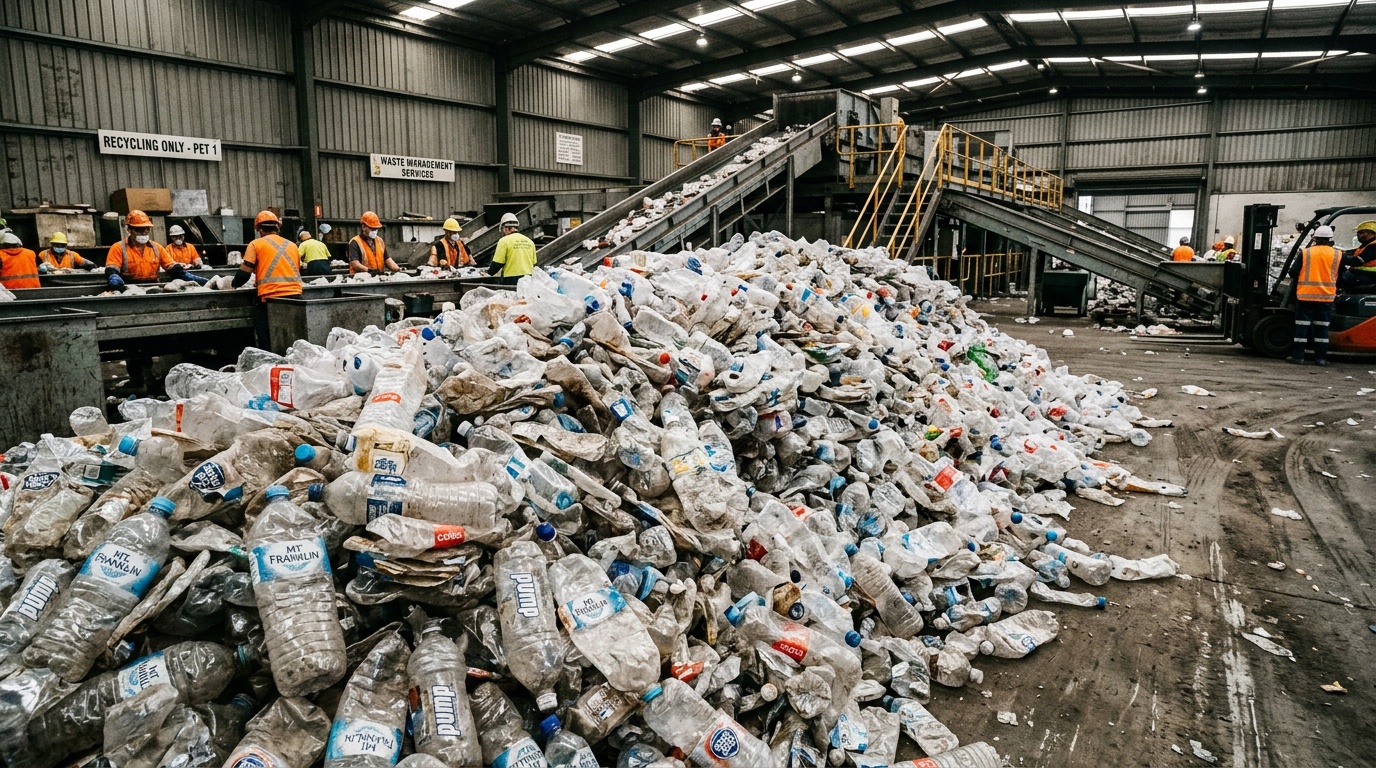
According to ABS 2024 waste data, Australians send approximately 373 million single-use plastic water bottles to landfill annually. That figure accounts only for bottles that enter the waste stream — not those that end up in waterways, oceans, or roadsides.
Container deposit schemes (10c refunds) have improved recycling rates in states like NSW, QLD, and SA. But even with these schemes, the national recycling rate for PET beverage containers hovers around 56% according to the Australian Packaging Covenant Organisation (APCO). Nearly half of all bottles sold still end up as waste.
Each 600mL bottle requires roughly 200mL of oil equivalent to manufacture and transport, according to the Pacific Institute. That means the water inside the bottle required less energy to treat at the municipal plant than the bottle itself required to produce. You are not buying water. You are buying a plastic container with a small amount of water inside it.
Switching one household from a two-bottle-per-day habit to a benchtop filter eliminates roughly 730 plastic bottles per year. Across a neighbourhood of 200 homes, that is 146,000 bottles. The maths scales quickly, and it starts with your kitchen tap.
The Filtered Tap Alternative — Tappwater EcoPro at $0.04 per Litre
If the goal is clean, good-tasting drinking water without the cost, waste, and regulatory ambiguity of bottled water, a certified benchtop filter is the most practical solution for most Australian households.
The Tappwater EcoPro is a compressed carbon block filter that attaches directly to your kitchen tap. No plumbing modification required. It is NSF/ANSI 53 certified for reduction of lead, chlorine, VOCs, and particulates. Each cartridge filters approximately 1,200 litres before replacement, and at a cartridge cost of roughly $45, that works out to about $0.04 per litre.
Important city-specific note: If you live in a chloramine city — Brisbane, Sydney, Adelaide, or Darwin — you need a compressed carbon block or catalytic carbon filter for effective disinfectant removal. Standard granular activated carbon (GAC) removes chloramine at roughly 1/40th the rate it removes free chlorine, according to published adsorption data. The EcoPro uses compressed carbon block, which is effective for chloramine reduction. If you are in Melbourne, Hobart, or Canberra (free chlorine cities), standard carbon filters also work fine.
If your primary concern is fluoride or PFAS removal, carbon block filters — including the EcoPro — cannot remove fluoride. Full stop. For fluoride, you need reverse osmosis (90-97% removal per NSF/ANSI 58 testing) or activated alumina (80-95%). The AquaTru Classic countertop RO is a leading no-plumbing RO option, certified to NSF/ANSI 58 for fluoride and PFAS reduction.
Replace Bottled Water for $0.04/Litre
Five-Year Cost Comparison: Bottled Water vs Filtered Tap
Numbers close arguments. Here is what each option actually costs over five years, assuming a household consumption of 4 litres per day (1,460 litres per year).
| Option | Upfront Cost | Annual Running Cost | 5-Year Total | Cost per Litre |
|---|---|---|---|---|
| Bottled water (600mL @ $3) | $0 | ~$7,300 | ~$36,500 | $5.00 |
| Bottled water (1.5L @ $2.50) | $0 | ~$2,433 | ~$12,167 | $1.67 |
| Tappwater EcoPro | ~$99 | ~$55 (cartridges) | ~$374 | $0.04 |
| AquaTru Classic RO | ~$549 | ~$120 (filters) | ~$1,149 | $0.16 |
Even the most expensive home filter option — a countertop RO system — costs less over five years than buying large-format bottled water. The Tappwater EcoPro at $374 over five years saves you over $12,000 compared to 1.5L bottles and over $36,000 compared to 600mL bottles. That is not a rounding error. That is a holiday.
For the full comparison including under-sink RO systems and gravity filters, see our best water filter to replace bottled water in Australia.
Final Verdict
Bottled water in Australia is less regulated than tap water, frequently sourced from the same municipal supply, sold at a 2,000% markup, contaminated with microplastics from its own packaging, and generates 373 million landfill bottles per year. There is no credible health argument for choosing bottled over properly filtered tap water. Not one.
If your concern is chlorine taste and general contaminants, the Tappwater EcoPro at ~$0.04 per litre is the practical no-plumbing solution. If your concern extends to fluoride, PFAS, or heavy metals, you need a reverse osmosis system certified to NSF/ANSI 58 — the AquaTru Classic or an under-sink RO.
Either way, stop buying bottled water. The data does not support it.
Ready to ditch bottled water?
The Tappwater EcoPro is the simplest way to stop buying bottled water today — NSF/ANSI 53 certified, attaches to your tap in 60 seconds, and filters at $0.04 per litre. No plumbing. No plastic bottles.
Last reviewed: April 2026 — Clean and Native
Frequently Asked Questions
Is Australian bottled water safer than tap water?
No. Australian tap water is regulated under the ADWG, which tests over 200 contaminant parameters. Bottled water falls under FSANZ Food Standards Code 2.6.2, which has fewer mandatory testing requirements and no public reporting obligation. Tap water has stricter oversight.
Where does Mount Franklin water come from?
Mount Franklin, owned by Coca-Cola Europacific Partners, sources from multiple locations across Australia, including municipal tap water supplies. Despite the mountain branding, several supply points are town water that is filtered and treated before bottling.
Does bottled water contain microplastics?
Yes. A 2018 study in Frontiers in Chemistry found microplastic contamination in 93% of bottled water samples tested globally. A 2024 Columbia University study detected an average of 240,000 nanoplastic particles per litre. We cover this in detail in our microplastics in bottled water article.
Can a benchtop filter remove chloramine from Brisbane tap water?
Only if it uses compressed carbon block or catalytic carbon. Brisbane uses chloramine, not free chlorine. Standard granular activated carbon (GAC) filters — including Brita jugs — remove chloramine at roughly 1/40th the rate they remove free chlorine. The Tappwater EcoPro uses compressed carbon block and is effective for chloramine reduction.
Does the Tappwater EcoPro remove fluoride?
No. No carbon filter removes fluoride. Fluoride removal requires reverse osmosis (90-97% removal per NSF/ANSI 58 testing) or activated alumina (80-95%). If fluoride is your primary concern, you need an RO system such as the AquaTru Classic.
How much do Australians spend on bottled water each year?
According to Australian Beverages Council data, approximately $700 million per year nationally. A single household buying two 600mL bottles per day spends roughly $2,190 annually.
How many plastic bottles go to Australian landfill each year?
According to ABS 2024 waste data, approximately 373 million single-use plastic water bottles reach Australian landfill annually. The national PET recycling rate is approximately 56% according to the Australian Packaging Covenant Organisation.
What is the cheapest way to replace bottled water at home?
A benchtop carbon block filter like the Tappwater EcoPro costs approximately $99 upfront and $55 per year in cartridges, working out to about $0.04 per litre. Over five years, that is $374 total versus $12,000 to $36,500 for the equivalent in bottled water.
Get the Australian Home Environment Checklist
30 checks across water, air and EMF. Most of them free. Ranked by impact.
No spam. Unsubscribe any time.

Former Royal Australian Navy Clearance Diver and TAG-E counter-terrorism operator. Founded Clean and Native to apply the same rigorous thinking to the home environment.
Full biography →