Best Home Water Filter Australia 2026 and How to Choose One
Drafted with AI assistance and checked against published specifications and certifications. First-hand measurements appear only where stated. How we make content
How this assessment was made. This guide picks the best home water filter for each problem. Each filter is matched to a problem (taste, fluoride, PFAS, lead). They are ranked on how well each one replaces bottled water for a household: what the technology removes, then capacity and installation in an Australian home, then the evidence behind its claims, then running cost. I have used two of these systems: the Pure Water Systems EcoHero 5-stage reverse osmosis unit under my Palm Beach kitchen sink from mid-2025, and a Waterdrop C1S countertop unit bought in November 2026. My only measurements are TDS readings on a handheld meter that is not calibrated; I have not laboratory-tested any filter. Prices and listings were checked on 18 and 19 November 2026.
The best home water filter is the one that removes what is actually in your water. For chlorine taste and odour, a carbon filter does the job. For fluoride, PFAS and most dissolved solids, reverse osmosis is the technology to buy[1][7]: I used a Pure Water Systems EcoHero under my Palm Beach kitchen sink from mid-2025, and the Waterdrop C1S countertop unit gives renters a reverse osmosis membrane with no plumbing.
If you are buying a water filter to replace bottled water, the choice comes down to five checks: what your utility reports, what you want removed, which technology removes it, whether a certification backs the claim, and what the filters cost a year. The chooser and the running cost calculator below do the arithmetic.
Match the filter to the problem. Reverse osmosis covers the most ground; a carbon filter is the cheap answer for taste; a certified jug is the budget answer for lead and fluoride.
| Pick | Best for | Why | Price |
|---|---|---|---|
| EcoHero 5-stage RO | Homeowners; fluoride, PFAS, lead | Under-sink reverse osmosis; WaterMark listed; I have used one | Pure Water Systems |
| Waterdrop C1S | Renters; no plumbing | Countertop reverse osmosis; I own one | $379.22at Amazon AU · as of 19 Nov 2026, 11:43 pm AEST Details |
| Waterdrop X8 | Tankless under-sink RO | IAPMO certified to NSF/ANSI 42, 58 and 372 | $611.29at Amazon AU · as of 19 Nov 2026, 11:43 pm AEST Details |
| ZeroWater 7-cup jug | Certified on a budget | IAPMO certified to NSF/ANSI 53, incl. lead, fluoride, total PFAS | $54.24at Amazon AU · as of 19 Nov 2026, 8:43 pm AEST Details |
| Brita Flow Cask | Taste, in a big benchtop tank | Carbon; maker-tested claims, not certified | $59.49at Amazon AU · as of 19 Nov 2026, 5:43 pm AEST Details |
Filter chooser: two questions
Pick your situation and your main goal. The suggestion links to the full write-up below.
Filter chooser | two questions
Do you own or rent?
What do you most want out of your water?
Start with
EcoHero 5-stage under-sink RO
Reverse osmosis removes most fluoride; Pure Water Systems’ certified table lists 93.6% for this system. It is the system I used under my own sink.
See the pick ↓✓ A home filter makes sense if
- You buy bottled water for taste or peace of mind
- You want fluoride, PFAS or dissolved solids reduced
- You live in an older home and want lead reduced at the drinking tap
- You are tired of carrying and recycling bottles
× Do not overspend if
- You only dislike the chlorine taste: a carbon filter is enough
- You were sold a whole house filter for drinking water
- You expect a TDS meter to tell you lead or PFAS is gone
- You will not change cartridges on time
How to choose a water filter in 5 steps
1. Read your water quality report first
Assess before you buy. It holds at the kitchen sink as much as anywhere. Your utility publishes drinking water quality results, and many now publish PFAS testing too, such as Seqwater and Sydney Water[8][9]. The report tells you whether your supply is chlorinated or chloraminated, whether it is fluoridated, and how hard it is. Bore and tank water has no utility report, so test it through a NATA-accredited laboratory before choosing anything. Our guide to testing your water before you buy a filter covers how, and is Australian tap water safe to drink explains what the guidelines mean.
2. Decide what you want removed
Write down one main goal. Chlorine taste and odour is a common goal, and the cheapest to solve. Fluoride is another common one: Australian guidelines set a health value of 1.5 mg/L, and fluoridated supplies typically target 0.7 to 1 mg/L[5], so removing it is a preference, not a safety fix. PFAS has guideline values in nanograms per litre, set lower in June 2025[6]. Each goal points to a different technology.
3. Match the technology to the goal
This is where most people overspend or underspend. The American Dental Association puts it plainly: “Most carbon filters do not remove fluoride”, while “almost all reverse osmosis systems and distillation units remove most of the fluoride”[1]. In the 2020 Duke University and NC State study of filters in real homes, every under-sink reverse osmosis filter removed PFAS almost completely, while carbon jugs, fridge and tap filters were inconsistent[7]. The table in the next section sets it out by filter type.
4. Check the certification covers your contaminant
NSF/ANSI 42 covers aesthetic impurities such as chlorine taste and odour; NSF/ANSI 53 covers contaminants “with a health effect”; NSF/ANSI 58 covers reverse osmosis systems; NSF/ANSI 401 covers “emerging contaminants”[2]. A certificate covers specific claims, so read what it lists: a filter certified to NSF/ANSI 58 for dissolved solids is not certified for PFAS. For anything plumbed in, Australia adds WaterMark: water filters and replacement cartridges are on the WaterMark Schedule and must perform to AS 3497[4], and a licensed plumber may not install a listed product that is not certified[3]. Jugs, benchtop dispensers and countertop units you fill by hand do not connect to the plumbing, so no plumber is involved.
5. Compare the running cost, not the sticker price
A cheap jug with a four-week cartridge can cost more a year than a countertop reverse osmosis unit with a yearly filter. The running cost calculator below compares the picks per litre at your daily use, against what you pay for bottled water.
What each filter type removes
| Filter type | Chlorine taste | Fluoride | PFAS | Plumber |
|---|---|---|---|---|
| Carbon jug or benchtop | Yes | Generally no (ADA) | Inconsistent (Duke 2020); check for a certified claim | No |
| Certified jug (ZeroWater) | Yes | Certified (NSF/ANSI 53) | Certified, total PFAS (NSF/ANSI 53) | No |
| Countertop reverse osmosis | Yes | Most (ADA, RO) | RO category; check the claim | No |
| Under-sink reverse osmosis | Yes | Most (ADA, RO) | Near-complete in testing (Duke 2020) | Yes, WaterMark |
| Whole house carbon | Yes, at every tap | Generally no | Widely variable (Duke 2020) | Yes, WaterMark |
| Water softener | No | No significant change (ADA) | Not a PFAS treatment | Yes |
The ADA also notes that some filters containing activated alumina can remove significant amounts of fluoride, and that water softening does not significantly change fluoride levels[1]. A whole house filter has its place for chlorine at the shower and sediment; our whole house filter guide covers it. For drinking water, filter at the kitchen tap. For how a membrane works, see what is reverse osmosis.
The best home water filters in Australia
Ranked on how well each one replaces bottled water for a household: what the technology removes, then capacity and installation in an Australian home, then the evidence behind its claims, then running cost. Every Amazon pick was in stock on Amazon Australia on 19 November 2026.
1. Pure Water Systems EcoHero 5-stage RO: best home water filter for owners
 Measured at home69 → 3 ppmTDS, Palm Beach tap
5-stage RO | WaterMark: AS/NZS 3497 compliant (register); lead free (Pure Water Systems) | 93.6% fluoride and 98.6% lead in its certified reduction table (Pure Water Systems) | Faucet sold separately | Plumber required
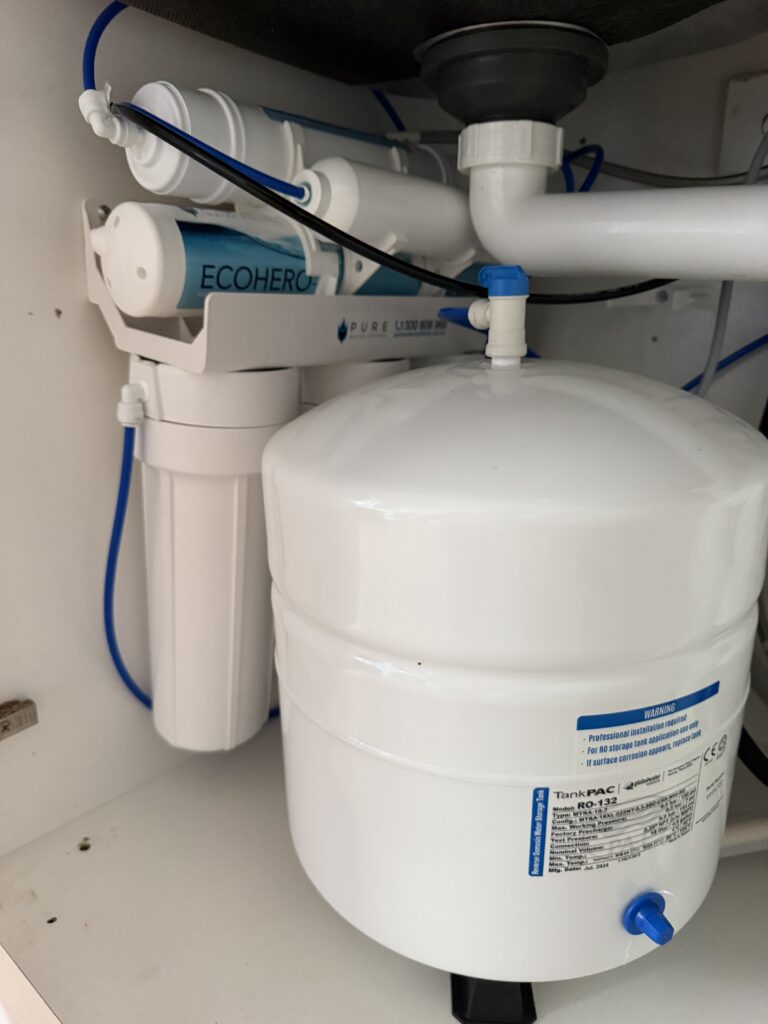
Check price and stock at Pure Water Systems →This is the system I used under my Palm Beach kitchen sink from mid-2025. My Gold Coast tap water read 69 ppm TDS before and 3 ppm after, the average of three tests on a handheld meter that is not calibrated. That reading says the membrane is working; it does not identify fluoride, lead or PFAS.
It is on the WaterMark register as AS/NZS 3497 compliant[10], and Pure Water Systems lists it as lead free under WaterMark licence 040326[11], which is what your plumber needs. Pure Water Systems’ certified reduction table gives 93.6% for fluoride and 98.6% for lead. It shows a “Certified PFAS Reduction” badge but publishes no PFAS figure or certifier for this system; its PFAS footnote refers to an HTO+ cartridge that is not in this system’s cartridge list and says NSF certification is still in progress. So I rate it on reverse osmosis technology, not on its PFAS paperwork[7][11]. My first service cost $490 all-in with a technician. Check price and stock with Pure Water Systems before you book a plumber. Full detail in my EcoHero review.
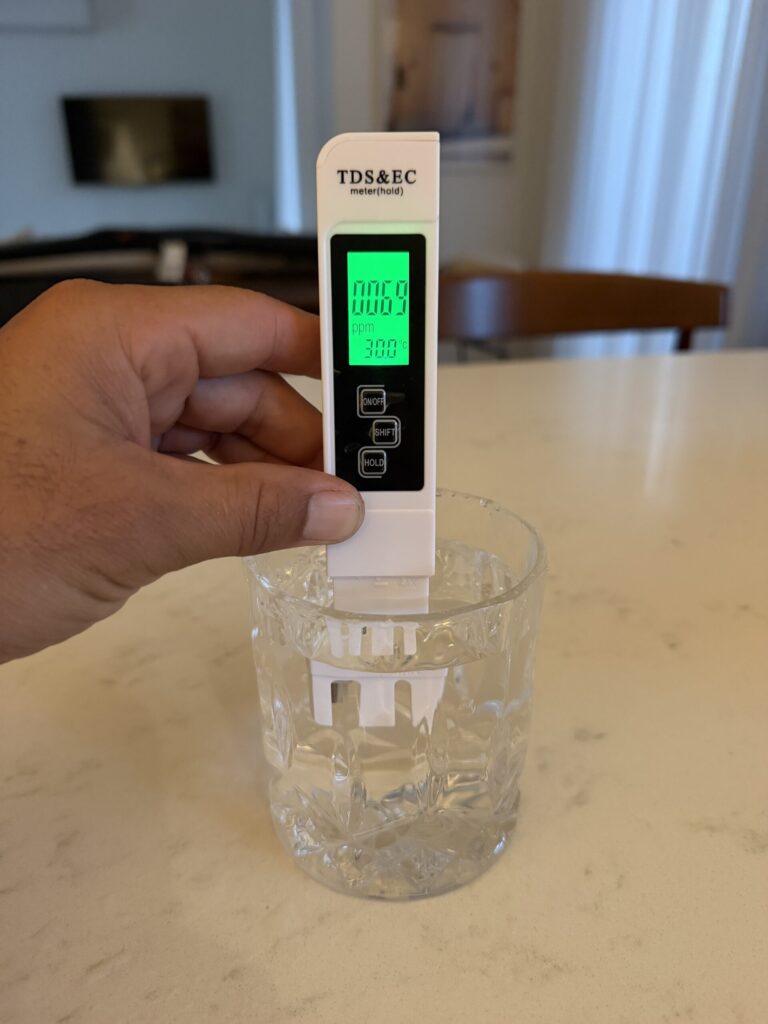
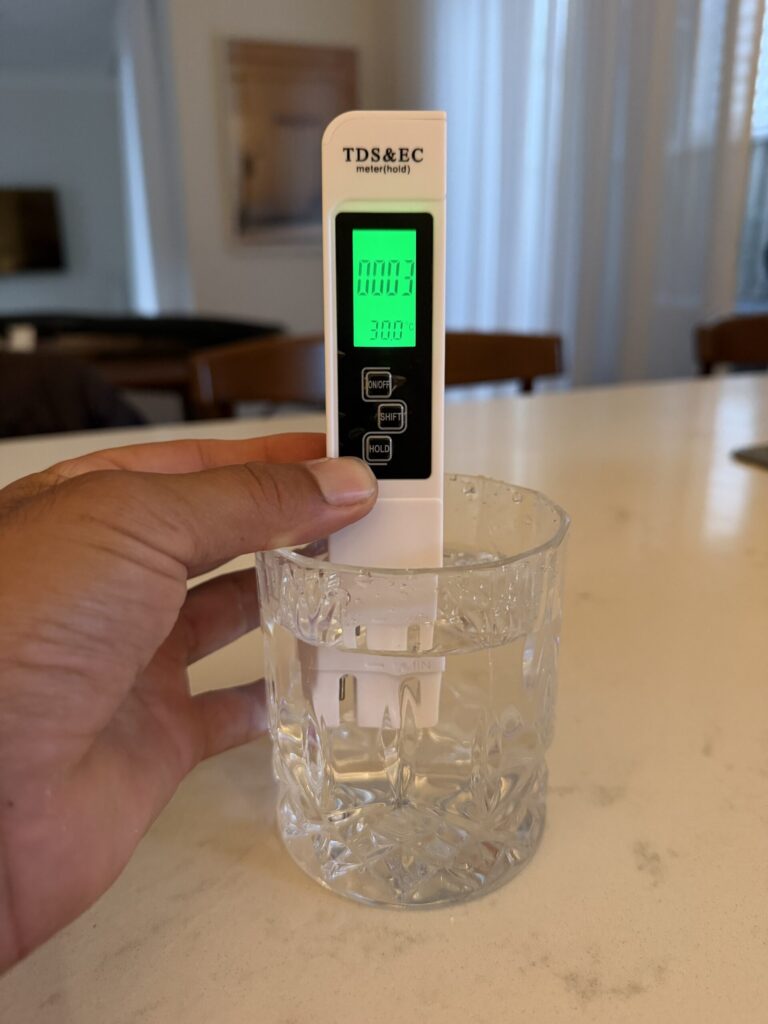
Palm Beach QLD: my kitchen tap at 69 ppm TDS (left) and the same water after the EcoHero at 3 ppm (right). TDS counts all dissolved ions; it does not identify lead, fluoride or PFAS.
✓ Pros
- Reverse osmosis: covers fluoride, lead and PFAS in one system
- WaterMark listed; local support
- Filtered water on tap, no refilling
× Cons
- Faucet and a licensed plumber on top of the price
- No PFAS figure or certifier published
- Servicing cost me $490 with a technician
Buy this if
you own your home and want one system that covers fluoride, lead, PFAS and dissolved solids at the kitchen tap.
Not for you if
you rent, or you only want better-tasting water.
2. Waterdrop C1S: best for renters
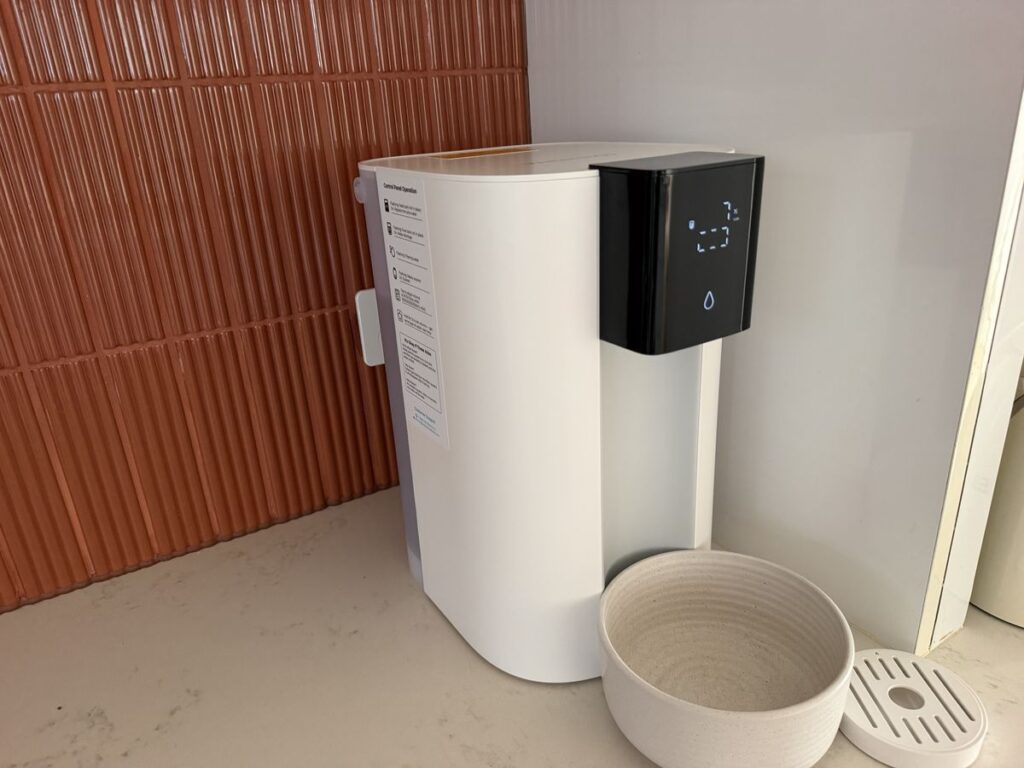 Measured at home69 → 7 ppmTDS, handheld meter
Countertop RO | Fill by hand; no plumbing | Live TDS display | NSF/ANSI 372 (materials) | 3:1 pure to drain (Waterdrop) | C1RF filter $119.99, about every 12 months (Waterdrop AU)
Check the Waterdrop C1S on Amazon AU →Amazon AU price: $379.22 · as of 19 Nov 2026, 11:43 pm AEST DetailsIf you cannot touch the plumbing, a countertop reverse osmosis unit gives you a membrane without a plumber: fill the tank by hand and it dispenses filtered water at the push of a button. I bought one in November 2026. It took about 20 minutes to set up, and my handheld meter read 69 ppm at the tap and 7 ppm after (the unit’s own display read 3 ppm). Its C1RF filter costs $119.99 and lasts about 12 months[16], the cheapest per litre of anything here. Be clear on the paperwork: it is certified to NSF/ANSI 372, which covers lead-free materials, not contaminant reduction; its reduction claims come from testing Waterdrop commissioned[17]. Full detail in my C1S review.
✓ Pros
- Reverse osmosis membrane with no plumbing
- Cheapest filters per litre here
- Moves house with you
× Cons
- Certification covers materials only
- Takes bench space; tank filled by hand
- Room temperature water
Buy this if
you rent and want reverse osmosis water to replace bottled water.
Not for you if
you want filtered water on tap without refilling a tank.
3. Waterdrop X8: best tankless under-sink RO
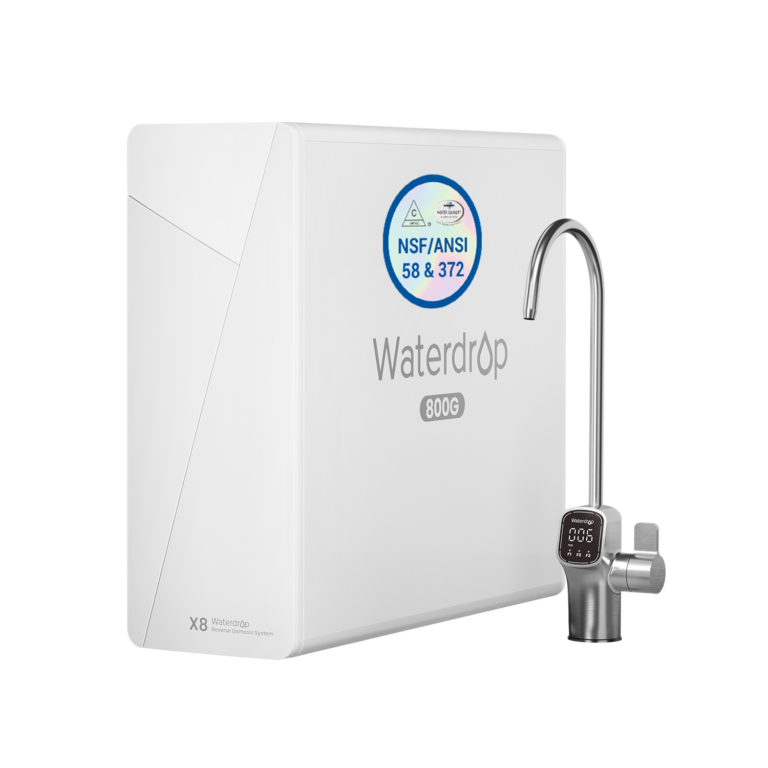 Pure to drain2:1Waterdrop figure
800 GPD tankless RO | IAPMO R&T certified to NSF/ANSI 42, 58 and 372 (Waterdrop) | Needs a power point | Filters: F2 6 months, F1G 12 months, RO 24 months
Check the Waterdrop X8 on Amazon AU →Amazon AU price: $611.29 · as of 19 Nov 2026, 11:43 pm AEST DetailsA tankless reverse osmosis unit with a 2:1 pure-to-drain ratio. Waterdrop says it is certified by IAPMO R&T to NSF/ANSI 42, 58 and 372; the certified reduction centres on dissolved solids, and its PFAS figures come from SGS testing Waterdrop commissioned[14]. It needs a power point under the sink, and Waterdrop lists no WaterMark for the system, so ask your plumber before you buy. Waterdrop Australia sells it at $899, or 30% off with code WDX8[15]; Amazon AU was cheaper when checked. At Waterdrop AU prices, filters run about $289 a year after the first. The X8 vs EcoHero comparison covers the trade-offs.
✓ Pros
- Reverse osmosis membrane
- Tankless and compact; 2:1 ratio
- Certified to NSF/ANSI 42, 58 and 372
× Cons
- No WaterMark listing found
- Needs power under the sink
- Highest filter cost of the Waterdrop pair
Buy this if
you own your home, want under-sink reverse osmosis through Amazon and your plumber has approved the unit.
Not for you if
you need a WaterMark-listed system or have no power point under the sink.
4. ZeroWater 7-cup jug: best certified budget filter
 CertifiedNSF/ANSI 53IAPMO
IAPMO certified to NSF/ANSI 53: lead, fluoride, total PFAS (99.7% average) and more | TDS meter included | Filter life depends on tap TDS | Imported product on Amazon AU
Check the ZeroWater price on Amazon AU →Amazon AU price: $54.24 · as of 19 Nov 2026, 8:43 pm AEST DetailsThe cheapest independently certified option I found on Amazon Australia. Culligan lists IAPMO certification to NSF/ANSI 53 for lead, fluoride, total PFAS and several metals[12]. The catch is filter life: ZeroWater says a filter lasts up to about 40 gallons (about 150 litres) with normal use, less in harder water, and you change it when the included meter reads 006[13]. That suits one or two people drinking from a jug, not a family cooking with it, which is why it sits out of the calculator. It is imported, so check filter availability before you commit. More jugs are compared in the water filter jug guide.
✓ Pros
- Independently certified for lead, fluoride and total PFAS
- Low upfront cost; no installation
- Meter tells you when to change
× Cons
- Short filter life; shorter with harder water
- Imported; check filter stock
- Jug capacity only
Buy this if
you rent or are on a budget and want certified claims for your drinking water.
Not for you if
you cook for a family with filtered water every day; the filter changes add up.
5. Brita Flow Cask: best for taste in a big tank
 Filtered capacity5.2 LBenchtop tap
MAXTRA PRO carbon cartridge | Maker claims: chlorine, lead, copper, limescale, PFAS >99%, tested according to NSF/ANSI 53 (Brita) | No fluoride claim | Cartridge $17, every 4 weeks or 150 L (Brita AU)
Check the Brita Flow Cask on Amazon AU →Amazon AU price: $59.49 · as of 19 Nov 2026, 5:43 pm AEST DetailsIf taste is the reason you buy bottled water, this is a cheap, simple fix. Brita Australia says the MAXTRA PRO cartridge reduces chlorine, lead, copper and limescale, and “total PFAS >99%”, tested according to NSF/ANSI 53[18]. I found no certification listing for those claims, so treat them as the maker’s testing. Brita says its cartridges are not designed to remove fluoride[19], and the cartridge is rated for four weeks or 150 litres, sold locally at $17.
✓ Pros
- Cheap to buy; 5.2 L of filtered water on tap
- Local cartridges
× Cons
- Claims tested by the maker, not certified
- Four-week cartridge
- No fluoride reduction
Buy this if
you want better-tasting water from an easy benchtop dispenser.
Not for you if
you want fluoride reduced or certified claims.
Comparison table
| Spec | EcoHero RO | Waterdrop C1S | Waterdrop X8 | ZeroWater | Brita Flow Cask |
|---|---|---|---|---|---|
| Type | Under-sink RO | Countertop RO | Tankless under-sink RO | Jug | Benchtop dispenser |
| Fluoride | 93.6% (maker’s certified table) | Most, as RO (ADA) | Most, as RO (ADA) | Certified | No |
| Lead | 98.6% (maker’s certified table) | No certified figure | No certified figure | Certified | Maker claim |
| Certification | AS/NZS 3497 (WaterMark) | NSF/ANSI 372 | NSF/ANSI 42, 58, 372 | NSF/ANSI 53 | None found |
| Plumber | Yes | No | Yes, plus power | No | No |
| Filters a year* | $490 (my first service) | $119.99 | about $289 | Depends on TDS | $221 at 4 L a day |
| Price | Pure Water Systems | $379.22at Amazon AU · as of 19 Nov 2026, 11:43 pm AEST Details | $611.29at Amazon AU · as of 19 Nov 2026, 11:43 pm AEST Details | $54.24at Amazon AU · as of 19 Nov 2026, 8:43 pm AEST Details | $59.49at Amazon AU · as of 19 Nov 2026, 5:43 pm AEST Details |
*After year one, at the replacement intervals each maker gives (EcoHero: my first technician service, if repeated yearly); sources in the calculator below.
Check all seven rooms, not just this one
38 checks, 29 free, ranked by impact. Sent as a 32-page PDF.
We'll email you the audit and a short series of practical guides. Unsubscribe in one click, any time. Privacy.
Sent. Taking you to your download...
Replacing bottled water: the running cost
Bottled water prices vary from bulk packs to single bottles, so enter what you pay per litre and the calculator puts it beside the filters. The filter figures are filters only, after the first year.
Filters vs bottled water | running cost after year one
How many litres of drinking and cooking water does your household use a day?
| System | Filters a year | Per litre | Basis (checked 18 Nov 2026) |
|---|---|---|---|
| Waterdrop C1S countertop RO | $119.99 | 8.2 c/L | C1RF filter $119.99 (Waterdrop AU), about every 12 months |
| Brita Flow Cask (carbon) | $221.00 | 15.1 c/L | MAXTRA PRO $17 (Brita AU), every 4 weeks or 150 L |
| Waterdrop X8 under-sink RO | $289.47 | 19.8 c/L | 2 x F2 $69.99, F1G $44.99, half an X8-F3 $209 a year (Waterdrop AU) |
| EcoHero 5-stage under-sink RO | $490.00 | 33.6 c/L | My first service, $490 with a technician (Pure Water Systems), if repeated yearly |
At 4 L a day, filters cost from 8.2 c/L to 33.6 c/L after year one. Enter what you pay per litre for bottled water to compare.
Not included: purchase price, installation, electricity, and the water a reverse osmosis unit sends to drain (Waterdrop gives 2:1 for the X8 and 3:1 for the C1S[14][17]). The EcoHero figure is a full technician service, not cartridges alone. The ZeroWater is left out because its filter life depends on your water’s TDS and I could not confirm a local filter price.
One practical note. A filter only replaces bottled water if you change the cartridges on schedule: a spent filter gives no warning, so put the dates in your calendar the day you install it. A TDS meter is a useful check that a membrane is working, but it cannot see lead, fluoride or PFAS[20]; see what TDS in water means.
What we left out
AquaTru Classic. Strong certifications, but on Amazon AU it is a US import that runs from a 120 V wall plug, so I will not recommend it for a 240 V Australian kitchen; see Waterdrop C1S vs AquaTru. Whole house filters as a drinking water solution, for the reasons above. Gravity filters such as Berkey have test reports but no certification I could find; see the Big Berkey review. Fridge and tap-mounted filters sit in the inconsistent carbon group unless certified for your contaminant. Any filter that does not ship to Australia, however good its reviews overseas.
Which should you buy?
- Homeowner, wants fluoride, lead and PFAS covered: EcoHero 5-stage RO.
- Renter, wants reverse osmosis: Waterdrop C1S.
- Tankless under-sink RO through Amazon: Waterdrop X8.
- Budget, wants certified claims: ZeroWater jug.
- Taste only: Brita Flow Cask.
For every filter type in one place, see the best water filters in Australia; for reverse osmosis in depth, the best reverse osmosis systems; for fluoride specifically, the best fluoride water filters.
Final verdict
The best home water filter in Australia is reverse osmosis if you want fluoride, PFAS and dissolved solids out, and a carbon filter if you only want better taste. Owners should look at the Pure Water Systems EcoHero, the system I used under my own sink; renters at the Waterdrop C1S. Either one, with cartridges changed on time, replaces bottled water for drinking and cooking at home.
Prices change; Amazon prices shown on this page update automatically. Check the retailer before you buy.
Prefer filtered water from your main kitchen spout? See the best filtered water taps: 3-way mixer taps and certified tap-mount filters.
Frequently asked questions
What is the best home water filter in Australia?
It depends on what you want removed. For chlorine taste, a carbon filter is enough. For fluoride, PFAS and most dissolved solids, reverse osmosis is the technology to buy: I used the Pure Water Systems EcoHero under my Palm Beach sink, and the Waterdrop C1S countertop unit suits renters.
How do I choose a water filter?
Read your utility’s water quality report, decide what you want removed, match the technology to it, check the certification covers that contaminant, then compare running costs. A WaterMark listing matters for anything a plumber connects.
Can a home water filter replace bottled water?
For drinking and cooking at home, yes, if the filter matches your goal and you change the cartridges on time. Use the calculator on this page with your own bottled water price to compare the running cost.
Does a carbon filter remove fluoride?
Generally no. The American Dental Association says most carbon filters do not remove fluoride, while almost all reverse osmosis and distillation units remove most of it. Some filters with activated alumina can also remove a significant amount.
Do I need a plumber to install a water filter?
Only for filters connected to the plumbing. Water filters are on the WaterMark Schedule, so the National Construction Code requires a plumbed-in filter to be WaterMark certified, and your state plumbing regulator requires a licensed plumber to connect it. Jugs, benchtop dispensers and countertop units you fill by hand need no plumber.
What do NSF/ANSI 42, 53 and 58 mean on a water filter?
NSF/ANSI 42 covers aesthetic impurities such as chlorine taste and odour. NSF/ANSI 53 covers contaminants with a health effect, such as lead. NSF/ANSI 58 covers reverse osmosis systems. Check the certification names the contaminant you care about.
How much water does a reverse osmosis filter waste?
It varies by system. Waterdrop gives 2:1 pure to drain for the X8 and 3:1 for the C1S. Check the ratio before you buy; it varies widely between systems.
Can I test my tap water at home?
A TDS meter shows total dissolved solids and whether a reverse osmosis membrane is working. It cannot identify lead, fluoride or PFAS. For those, use your utility’s published results or a NATA-accredited laboratory.
- American Dental Association: Fluoridation Facts (2025), home water treatment and fluoride
- NSF: standards for water treatment systems (NSF/ANSI 42, 53, 58, 401)
- ABCB WaterMark: buying plumbing products
- QBCC: guide to water filters and replacement cartridges (WaterMark, AS 3497)
- NHMRC: Australian Drinking Water Guidelines, fluoride fact sheet
- NHMRC: PFAS in Australian drinking water, guideline values (25 June 2025)
- Duke University: not all home drinking water filters completely remove toxic PFAS (2020)
- Seqwater: PFAS and drinking water
- Sydney Water: PFAS and drinking water
- ABCB WaterMark product register: Pure Water Systems 5 Stage Undersink RO, AS/NZS 3497 compliant
- Pure Water Systems: EcoHero 5 Stage Reverse Osmosis, under sink (system only)
- Culligan: 7-cup ZeroWater pitcher, IAPMO certification to NSF/ANSI 53
- ZeroWater: how long will my filter last?
- Waterdrop: X8 reverse osmosis system specifications and certification
- Waterdrop Australia: X8 price and code, X8 replacement filter prices and lifespans
- Waterdrop Australia: C1RF replacement filter for the C1S, price and lifespan
- Waterdrop: C1S countertop RO specifications
- Brita Australia: MAXTRA PRO Pure Performance cartridge
- Brita Australia: FAQ, filters and cartridges (fluoride)
- Cooperative Extension: what a TDS test does and does not tell you
Checked 18 and 19 November 2026. Links to Amazon Australia, Pure Water Systems and Waterdrop Australia are affiliate links; the other sources are not.

Former Royal Australian Navy Clearance Diver and TAG-E counter-terrorism operator. Founded Clean and Native to apply the same rigorous thinking to the home environment.
Full biography →The 7-Room Home Audit
Your tap water is one room. The audit covers all seven: 38 checks across water, air and EMF, 29 of them free, ranked by impact against Australian guidelines.
- Morning tap flush: the free lead fix most homes skip
- How to read your utility's water quality report
- Renting or owning: the two reverse osmosis filters I use at home
We'll email you the audit and a short series of practical guides. Unsubscribe in one click, any time. Privacy.
Sent. Taking you to your download...