Best Whole House Water Filter Australia 2026: Compared, Ranked, City-by-City
The best whole house water filter for Australian homes in 2026 is the PWS Twin UV Whole House System ($2,499) — a three-stage point-of-entry unit with sediment pre-filter, catalytic carbon block, and UV disinfection. It is the only system that simultaneously addresses chloramine (used in Brisbane, Sydney, Adelaide, Gold Coast, and Darwin), fine particulate sediment, and biological contamination from a single mains entry point. For households without rainwater or bore risk, the PWS Twin Big White Town Water Package ($999) covers the same chemical and sediment stages without UV at less than half the price. Both ship from Brisbane with Australian-based support and use catalytic carbon block media — the only media type that reliably reduces chloramine at flow-through rates.
| System | Stages | Best For | Price |
|---|---|---|---|
| PWS Twin UV | Sediment + Cat. Carbon + UV | Best Overall | $2,499 |
| PWS Twin Town 20″ | Sediment + Cat. Carbon | Best Value | $999 |
| SHIELD WaterMark Big Blue | Sediment + Carbon (GAC) | Budget / Free-Chlorine Cities | ~$499 |
| Aquasana EQ-1000-AST-UV | SCM + Carbon + UV | Hard Water + Filtration | ~$2,500 |
The best whole house water filter for Australian homes in 2026 is the PWS Twin UV Whole House System — a three-stage point-of-entry unit combining sediment filtration, catalytic carbon block, and UV disinfection to address every contaminant class in Australian mains water. For most Brisbane, Sydney, Adelaide, and Gold Coast households, a whole house filter is the only practical way to remove chloramine, PFAS compounds, and biological risk from every tap simultaneously.
✓ Who This Is For
- Homeowners in Brisbane, Sydney, Adelaide, or Gold Coast who are on mains supply with chloramine
- Anyone whose household uses more than 4 litres of filtered water per day — point-of-use filters cannot keep up
- Households in areas with confirmed PFAS contamination (western Sydney, parts of south-east QLD)
- People who want filtered water at every tap — kitchen, bathroom, laundry, garden — not just one outlet
- Those on rainwater tanks or private bores where sediment and bacteria risk are real
- Homeowners planning a kitchen renovation who can bundle installation cost
✗ Who It Is Not For
- Renters who cannot modify plumbing — see benchtop filter alternatives
- Households whose only concern is fluoride — whole house filters do NOT remove fluoride, only RO does
- Perth or Adelaide households who think a whole house filter will soften their water — it will not. Hardness minerals require a separate water softener
- Apartment residents with no access to the main water line
- Anyone whose sole concern is drinking water — an under-sink RO unit at ~$300-700 costs far less and removes more contaminants from one tap
What Is a Whole House Water Filter?
A whole house water filter — also called a point-of-entry (POE) filter — connects to your main water supply line before it branches to individual taps. Every litre of water entering your home passes through the filter system first. That means filtered water at the kitchen tap, shower, bathroom basin, laundry, and garden hose simultaneously. I’m a former Royal Australian Navy Clearance Diver, and the systematic, whole-system approach to contamination control is exactly how I think about household water: eliminate the threat at the entry point, not one tap at a time.
The technology inside a whole house filter varies by system, but most Australian installations use two or three stages: a sediment pre-filter to catch sand, rust, and particulates; a carbon or catalytic carbon stage for chemical contaminants; and optionally a UV stage for biological inactivation. What a whole house filter does NOT do is remove dissolved minerals — calcium and magnesium (the hardness compounds) pass straight through carbon and sediment media. If you’re in Perth or Adelaide with 140-200 mg/L hardness, you need a dedicated water softener in addition to filtration. Do not confuse the two.
Australian Water Chemistry — Your City Determines Your System
This is the fact that every generic “best water filter” article gets wrong, and it’s the most important filter-selection decision you’ll make. Australian mains water is not uniform. The disinfection method used by your water utility determines which filter technology will actually work — and buying the wrong type means you’re filtering nothing despite having paid for a system.
Brisbane, Sydney, Adelaide, Gold Coast, and Darwin all use chloramine as their primary disinfectant. Chloramine is a compound of chlorine and ammonia that is far more stable and persistent than free chlorine. Standard granular activated carbon (GAC) — the media inside budget Brita-style jugs and most cheap whole house systems — removes chloramine at approximately 1/40th the rate it removes free chlorine. That is not a rounding error; it means a standard GAC cartridge that would last 12 months removing free chlorine lasts about three weeks removing chloramine before breakthrough. Melbourne, Hobart, Canberra, Townsville, Cairns, and Toowoomba use free chlorine — standard carbon works fine there. The systems recommended in this article are specified accordingly.
| City / Region | Disinfection | Hardness (mg/L CaCO₃) | TDS (approx.) | PFAS concern | Recommended carbon type |
|---|---|---|---|---|---|
| Brisbane / SEQ | Chloramine | 80-120 | 80-115 mg/L | Moderate | Catalytic carbon block or compressed block |
| Sydney | Chloramine | ~50-80 | ~100 mg/L | HIGH (31 compounds, UNSW 2024) | Catalytic carbon + PFAS Protect cartridge |
| Adelaide | Chloramine | 140 | ~400 mg/L | Moderate | Catalytic carbon block — also consider softener |
| Perth | Chloramine | ~180 | ~170 mg/L | Moderate (industrial corridor) | Catalytic carbon block — softener strongly advised |
| Melbourne | Free chlorine | ~25 | ~60 mg/L | Low | Standard GAC or carbon block adequate |
| Hobart / Canberra | Free chlorine | Low | Low | Low | Standard GAC or carbon block adequate |
| Darwin | Chloramine | Moderate | Variable | Low-moderate | Catalytic carbon block |
Sydney deserves a specific call-out. UNSW researchers published findings in 2024 detecting 31 separate PFAS compounds in Sydney Water supply — and Sydney Water itself has been actively monitoring PFAS in its distribution network since 2022. This is not alarmism; it is a documented contamination reality that demands PFAS-specific filtration. Standard carbon blocks remove some PFAS compounds but are not rated or certified for it. The 3M PFAS lawsuit and the broader PFAS contamination picture across Australia make this one of the most significant water quality decisions Australian homeowners have faced in a generation.
The Four Products — Deep Dive
1. PWS Twin UV Whole House System — Best Overall

🛒 Buy this if:
- You are on bore water, rainwater tank, or any non-mains supply and need bacterial protection across every tap — showers, bathrooms, laundry — not just the kitchen
- You want a complete whole-house system that handles bacteria, sediment, and chemical contaminants in a single mains-entry installation
- You want the bundle value: the current package includes a free Luxe under-sink system (RRP $779) for kitchen drinking water
✓ Pros
- NSF 42/53 certified — independently verified contaminant removal
- Three-stage protection: sediment + catalytic carbon + UV kills 99.9999% bacteria including E. coli
- Australian-owned supplier with local installation support and WaterMark eligibility
- Digital UV ballast counter tracks lamp life — no guessing on replacement timing
✗ Cons
- Highest upfront cost at $2,499 — budget buyers should consider the Twin Town Water package
- Licensed plumber installation required for warranty coverage (add ~$300-400)
- No PFAS-specific cartridge certification on this model — the PFAS Protect option is on the Town Water package
This is the system I would install in my own home. Three stages is the minimum configuration that addresses all three major contaminant classes in Australian mains water: particulates (sediment), chemical disinfection byproducts and organics (catalytic carbon block), and biological hazards (UV). The key word in stage two is catalytic. The Diamond Flow carbon block uses catalytic carbon media — not standard granular activated carbon — which is the only carbon type that can remove chloramine at practical flow rates. If you’re in Brisbane, Sydney, Adelaide, Gold Coast, or Darwin and the carbon stage is not catalytic or a tightly compressed block, the system is not doing its job on your most significant chemical contaminant.
Flow rate
75 litres per minute from the UV stage. For context, a typical Australian home uses peak flow rates of 20-40 L/min across simultaneous fixtures. This system will not cause pressure drop in normal use. That matters — undersized whole house filters create a noticeable pressure reduction that makes the system easy to bypass or ignore.
UV stage specifics
The UV ballast includes a digital counter — not just a light indicator — that tracks cumulative exposure hours so you know precisely when the UV lamp needs replacement (typically 9,000-12,000 hours, or roughly 12-18 months of continuous operation). UV inactivation at 99.9999% (6-log) meets the WHO and ADWG drinking water guidelines for biological risk reduction. No chemicals are added; no taste impact.
PFAS limitation
The PWS Twin UV does not include a specific PFAS-rated cartridge. Catalytic carbon does adsorb some long-chain PFAS compounds, but the system is not NSF P473 certified for PFAS removal. If you are in western Sydney, Logan, or Ipswich and you have a specific PFAS concern, pair this with a point-of-use RO unit at the kitchen tap — or specify the PFAS Protect cartridge upgrade when ordering (see Product 2 below). The trade-off at this price point is complete chemical-biological protection versus specific PFAS certification.
Installation
Professional plumbing installation is required. Pure Water Systems supplies with detailed instructions; most licensed plumbers complete the job in two to three hours. Budget $250-350 for labour in metro areas.
Our #1 Whole House Pick
Read our full PWS whole house filter review →2. PWS Twin Big White Town Water Package 20″ — Best Value

🛒 Buy this if:
- You are on mains water in Brisbane, SEQ, Adelaide, or Perth and need whole-house catalytic carbon to effectively remove chloramine from showers and every tap
- You want a high-flow 20-inch housing system that handles peak household demand without pressure drop
- You don’t need UV (you’re on treated mains water) but want the most capable chemical filtration from an Australian brand under $1,000
✓ Pros
- Best value whole-house system from an Australian supplier at $999
- PFAS Protect cartridge option removes 98% of 5 PFAS compounds — directly relevant after the 3M lawsuit
- Handles Brisbane, Sydney, Adelaide and Perth chloramine treatment with the catalytic carbon stage
- Upgrade path available — can pair with a UV stage if biological protection is later required
✗ Cons
- No UV stage — biological contamination (E. coli, Giardia) not addressed on this model
- PFAS protection only available with the PFAS Protect cartridge upgrade — standard GAC option is insufficient for PFAS
- No independent NSF certification number — Australian supplier standard
The most important configuration decision with this system is the second-stage cartridge. If you select the standard GAC option and you live in a chloramine city, you are largely wasting your money on the chemical filtration stage — GAC will not keep up with chloramine at whole-house flow rates. Specify the PFAS Protect cartridge upgrade instead. The Fibredyne 1-micron compressed block cartridge addresses chloramine more effectively than loose GAC, and adds documented 98% removal rates across five key PFAS compounds. For a Sydney household living anywhere near areas flagged in the UNSW 2024 PFAS monitoring data, this upgrade pays for itself in peace of mind alone.
The PFAS Protect cartridge — what it actually means
The 98% removal figure across five PFAS compounds comes from the cartridge manufacturer’s testing data. This is not NSF P473 third-party certification — that distinction matters. NSF P473 requires independent laboratory verification. The Fibredyne cartridge’s performance data is supplier-tested. It is still significantly better than a standard GAC cartridge, which has no PFAS rating at all. For a comprehensive view of PFAS-rated filtration options, see the PFAS water filter guide.
Who should choose this over the PWS Twin UV
If you are on a fully treated mains supply with no known bacterial contamination risk, no rainwater input, and your primary concerns are chloramine removal and PFAS, the Twin Town at $999 with the PFAS Protect cartridge is the rational choice. You save $1,500 versus the UV system. UV is justified if you have any biological risk — tank water mixing, ageing distribution infrastructure, or a property in an area that has had boil-water advisories.
Flow rate and pressure
The 20″ Big White housings are the largest standard size available. They deliver high flow rates with minimal pressure drop — appropriate for a three-to-four bathroom household. The larger housing also extends cartridge life, reducing your annual filter replacement cost compared with smaller 10″ systems.
3. SHIELD WaterMark Big Blue Dual Stage — Best Budget Option

🛒 Buy this if:
- You are on mains free-chlorine water (Melbourne, Hobart, regional VIC) and want the most affordable WaterMark-certified whole-house system available in Australia
- You are managing high sediment on tank or bore water as a pre-treatment stage before an existing UV system
- Budget is your primary constraint and you accept the trade-offs: no UV, standard carbon only, not for chloramine areas
✓ Pros
- Australian WaterMark certified — independently tested for local plumbing code compliance
- Lowest upfront cost (~$499) for a standards-compliant whole-house system
- 20″x4.5″ Big Blue housings deliver high flow rate — no pressure drop on high-demand households
✗ Cons
- Basic 2-stage filtration only — no PFAS protection, no UV, no chloramine-specific cartridge
- Standard carbon block does not adequately address chloramine in Brisbane or Sydney — check cartridge spec carefully
- Limited ongoing cartridge ecosystem compared to dedicated water filter suppliers
The SHIELD Big Blue’s key credential is WaterMark certification. In Australia, WaterMark (administered by the Australian Building Codes Board under AS 4020) is the plumbing product standard that confirms the system is safe to install in contact with drinking water supplies — it does not certify contaminant removal performance. What it does mean is that your licensed plumber can legally install this system in a permanent connection to your mains supply in all states and territories. Many cheap imported systems on marketplaces do not carry this certification and are technically non-compliant for permanent installation.
The chloramine limitation — read this if you’re in Brisbane or Sydney
The SHIELD Big Blue ships with standard carbon media. Standard GAC and standard carbon block both fail at chloramine removal at practical whole-house flow rates. If you are in a chloramine city and you buy this system without upgrading the second-stage cartridge to a catalytic carbon option, you will achieve sediment removal and modest taste improvement — but you will not be removing chloramine. In a free-chlorine city like Melbourne or Hobart, the system performs adequately at this price point.
Build quality at $499
The 20″x4.5″ Big Blue housing is a well-proven format used by plumbers across Australia for decades. At $499, the SHIELD system is a genuine housing that accepts standard industry cartridges — which means if you want to upgrade the media later, you source replacement cartridges from any Australian filter supplier. This is the right framework for a budget buyer who wants a certified Australian-compliant installation and is prepared to specify their own cartridge media.
4. Aquasana EQ-1000-AST-UV — Best for Hard Water + Filtration

🛒 Buy this if:
- You are on hard mains water (Perth ~180 mg/L, Adelaide ~140 mg/L) and want a multi-stage system combining UV, filtration, and salt-free scale inhibition in one installation
- You want NSF 42/53/61 certified performance and a 10-year system warranty with the Aquasana brand backing
- You are comfortable with US-brand support and slightly longer cartridge lead times compared to Australian-stocked brands
✓ Pros
- Combines scale conditioning (TAC) + carbon + KDF + UV in a single system
- 1,000,000 gallon capacity rating — approximately 20 years for an average Australian household
- NSF 42/53/61 certified. No salt and no electricity needed for the conditioning stage
✗ Cons
- Premium price (~$2,200-2,800 AUD) with complex installation requirements
- TAC conditioning prevents scale deposits but does NOT remove hardness minerals — water chemistry stays the same
- Carbon media saturates with PFAS over time — not a permanent PFAS removal solution
- US-focused brand with limited local installer networks in Australia
Perth households face the hardest tap water in Australia at approximately 180 mg/L CaCO3. Adelaide sits at 140 mg/L. Both are cities where limescale builds up inside hot water systems, showerheads, and appliances at a rate that shortens their service life and inflates energy bills. The Aquasana EQ-1000 addresses this through Scale Control Media — a template-assisted crystallisation technology that converts dissolved calcium and magnesium into microscopic crystals that do not adhere to pipe surfaces. This is not softening in the traditional ion-exchange sense; the minerals remain in the water but in a form that cannot deposit as scale. Critically, no salt or regeneration cycle is required.
KDF media and chloramine
KDF-55 media, which is present in the Aquasana EQ-1000, is effective for free chlorine removal via redox reaction. It is not effective for chloramine. Perth and Adelaide are both chloramine cities. The Aquasana system also includes activated carbon stages, and the combination performs adequately at the flow rates the system is designed for — but this is an important nuance. If chloramine removal is your primary concern in Perth or Adelaide, the PWS Twin UV or PWS Twin Town with catalytic carbon is a more targeted solution. Where the Aquasana wins is the scale conditioning combined with filtration and UV in a single installation — no separate softener required, no salt bags, no drain line for regeneration.
NSF certification depth
NSF 42/53 covers aesthetic and health-related contaminant reduction (chlorine, taste, odour, lead, VOCs). NSF 61 certifies that the system materials themselves do not leach contaminants into your drinking water. Three NSF certifications at the $2,200-2,800 price point represents genuine third-party verification — more comprehensive than the SHIELD system’s WaterMark (which covers installation compliance, not contaminant reduction) and comparable to the PWS Twin UV’s NSF 42/53 certification.
The 1,000,000-gallon rating
At 4 litres per day household consumption (ADWG household modelling), 1,000,000 US gallons equates to approximately 26 years of drinking water use. For whole-house use including showering, laundry, and garden — a realistic 500-800 litres per day — the service life is closer to five to eight years before the primary filter media requires replacement. Annual filter service is still required for the pre-filter and post-filter stages.
How to Compare: The Four Specs That Actually Matter
Whole house filter marketing is full of numbers designed to impress rather than inform. Here are the four specifications that actually determine whether a system will work in your Australian home — and what each one means in plain terms.
1. Carbon media type — catalytic vs standard GAC
This is the single most important specification for Australian buyers in chloramine cities. Catalytic carbon is manufactured by activating carbon at high temperature in an oxidising environment, creating additional active sites on the carbon surface. These sites catalyse the decomposition of chloramine into harmless nitrogen and chloride compounds. Standard GAC does not have these sites — it adsorbs free chlorine effectively but is largely ineffective against chloramine at practical whole-house flow rates. If you are in Brisbane, Sydney, Adelaide, Gold Coast, or Darwin and the product page does not specifically say “catalytic carbon” or “compressed carbon block” — it is probably standard GAC and will not solve your primary problem.
2. Housing size — 10″ vs 20″ and standard vs Big Blue
Larger housings mean longer cartridge life and less pressure drop. A 10″ standard housing is fine for a single bathroom unit or benchtop filter. For a whole house application serving three or more bathrooms, 20″ Big Blue (4.5″ diameter) housings are the correct format. They accept more media volume, deliver higher flow rates, and the cartridges last two to three times longer than their 10″ equivalents. All four systems in this roundup use 20″ housings — anything smaller is a compromise on flow rate.
3. UV rating — if biological risk is present
UV systems are rated by dose in millijoules per square centimetre (mJ/cm2). A UV dose of 40 mJ/cm2 achieves 99.99% (4-log) inactivation of most pathogens. 6-log (99.9999%) requires a higher dose or longer contact time. The PWS Twin UV achieves 6-log at 75 L/min — a meaningful specification for households on mixed mains/tank supply or in areas with ageing distribution infrastructure. UV does not remove chemical contaminants; it works only on biological targets and only if the pre-filter has already reduced turbidity (cloudiness) to allow UV light penetration.
4. Certification — WaterMark vs NSF vs supplier testing
WaterMark (AS 4020 / AS 3497) is an Australian building code compliance certification confirming the product is safe for permanent installation and does not leach contaminants. It is a materials-and-installation standard, not a filtration-performance standard. NSF/ANSI 42 and 53 are American standards for aesthetic and health-related contaminant reduction — these certify that the filter does what it claims in terms of contaminant removal. NSF 61 certifies material safety. The strongest whole house filter combination is WaterMark plus NSF 42/53 — the system is both legally compliant for Australian installation and independently certified for filtration performance. Supplier-tested performance data (no NSF or WaterMark) should be treated as directional, not verified.
5-Year Total Ownership Cost
The purchase price of a whole house filter is not the real cost. Installation, annual cartridge replacement, and UV lamp replacement all add up over a five-year horizon. Compared against the cost of buying bottled water for a four-person household — at a conservative $2/litre, 4 litres per day — the economics become very clear.
5-Year Total Ownership Cost — Whole House Water Filters vs Bottled Water (Australia)
Hardware + professional installation + annual filter replacements over 5 years. Bottled water: 4L/day at $2/L for a typical household.
The five-year cost comparison makes the argument for the mid-tier systems clearly: the PWS Twin Town at $1,899 total five-year cost delivers PFAS protection and chloramine removal at less than a third of the cost of bottled water. Even the $3,699 five-year cost of the PWS Twin UV — which includes UV disinfection and NSF 42/53 certification — is half what a four-person household spends on bottled water over the same period. The cost-per-litre on the PWS Twin UV system works out to approximately $0.05/litre at typical household water consumption. Bottled water at $2/litre is 40 times that cost, for water that has no stricter safety regulation than tap water under Australian food standards.
Installation in Australia — What to Expect
Whole house filter installation is licensed plumbing work in all Australian states and territories. Do not attempt DIY installation of a system that connects permanently to your mains supply — it is illegal without a licensed plumber, it will void your home insurance for water-related damage, and it risks contaminating your supply if connections are not made correctly.
What the installation involves
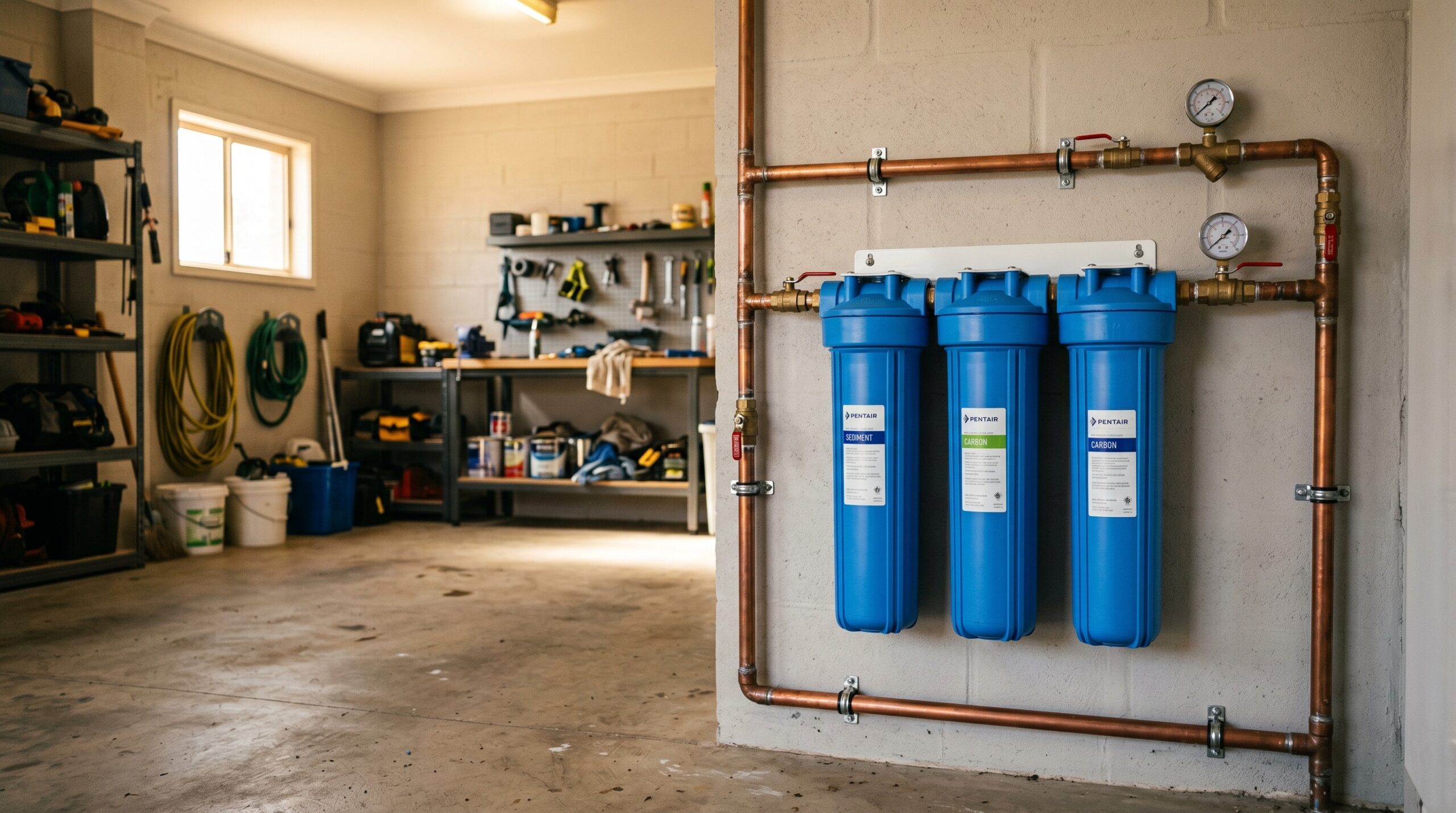
A standard twin or three-stage whole house filter installs on the cold water main line before it branches to your hot water system. The plumber cuts into the main, installs isolation valves either side of the filter housing array (mandatory for future cartridge changes), mounts the housings to a wall or frame, and makes the pipe connections. Total time for an experienced plumber: two to three hours. The isolation valves allow you to shut off flow to the filter housings for cartridge replacement without cutting off water to the house.
Where to install it
The optimal location is in a utility room, garage, or on an external wall near where the mains supply enters the home. UV systems require a 240V power outlet nearby for the ballast unit. The filter housings need enough clearance below them to allow cartridge removal — typically 300-400mm of clearance beneath the housing base. In Palm Beach and similar coastal Queensland homes, an external wall installation in the garage or meter box area works well. The housings should be protected from direct UV sunlight (not UV from the filter — sunlight), as prolonged sun exposure degrades the plastic housing over time.
Cost of installation in Australian metro areas
Licensed plumbing labour for a whole house filter installation typically runs $250-350 in metro Brisbane, Sydney, Melbourne, and Perth. Regional and rural areas may be higher. If your home requires additional work — isolation valves where none exist, re-routing a main line, or installation in an awkward location — budget $400-500. Always get a fixed quote before the plumber starts. The total installed cost of the PWS Twin UV system at $2,499 hardware plus $300 installation is $2,799 — still less than half of what a four-person household spends on bottled water in five years.
Cartridge replacement
With proper isolation valves installed, cartridge replacement is a 15-minute job you can do yourself. Shut the isolation valves, release pressure via the pressure-relief button on the housing cap, unscrew the housing using the housing wrench (supplied with most systems), remove the spent cartridge, insert the new cartridge, re-seat the housing, and slowly open the isolation valves. No plumber required for routine maintenance. Annual cartridge replacement costs run $80-180 per year depending on the system and cartridge specification — see the cost chart above for system-specific figures.
How It Compares — Whole House vs Under-Sink
A question that comes up regularly is whether a whole house filter makes a point-of-use unit at the kitchen tap unnecessary. The answer depends entirely on what you’re trying to achieve.
A whole house filter treats all water at the point of entry — every tap, shower, appliance, and garden outlet. It is extremely effective at protecting your hot water system from sediment damage, reducing chloramine exposure in the shower (which is a genuine absorption pathway — chloramine is volatile and absorbed through both skin and inhalation), and extending the life of plumbing fixtures. What it does not do is remove fluoride or achieve the sub-micron filtration that reverse osmosis provides. If drinking water purity is the primary goal — and you want fluoride removal, certified PFAS removal to NSF P473, or TDS reduction — an under-sink RO unit at the kitchen tap remains the most effective point-of-use solution. The ideal configuration for a Brisbane or Sydney household with both concerns is a whole house catalytic carbon system at the entry point plus an under-sink RO unit at the kitchen tap. The whole house system protects the plumbing and reduces the contaminant load entering the RO pre-filter, extending RO membrane life. The RO unit finishes the job for drinking and cooking water. Total cost of that dual approach: approximately $1,500-3,500 depending on the systems chosen — and it is the highest-performing drinking water configuration available for an Australian home without a commercial-grade treatment plant.
Last reviewed: June 2026 — Clean and Native
Final Verdict
The right whole house filter for your Australian home depends on three variables: your city, your budget, and whether biological risk is present in your supply.
For Brisbane, Sydney, Adelaide, Gold Coast, and Darwin households on mains supply with a budget above $2,000, the PWS Twin UV Whole House System is the correct answer. Three stages, catalytic carbon that actually addresses chloramine, UV disinfection rated to 99.9999%, NSF 42/53 certified, and Australian supplier support.
If biological risk is low and your primary concerns are chloramine and PFAS — which is the correct set of concerns for most inner-city Brisbane and Sydney households — the PWS Twin Town Water Package at $999 with the PFAS Protect cartridge upgrade is exceptional value. It addresses the two most significant documented chemical risks in Australian mains water for $1,500 less than the UV system.
Melbourne, Hobart, and Canberra households on free chlorine supply with a budget under $500 who need an Australian-certified installation can rely on the SHIELD Big Blue with standard carbon media. It does the job it is sold to do in a free-chlorine city.
Perth and Adelaide households with hard water at 140-200 mg/L who want filtration and scale management without a salt softener have a genuine use case for the Aquasana EQ-1000 UV. No other system in this roundup addresses scale and filtration simultaneously in a single installation.
One thing all four systems share: none of them remove fluoride. If fluoride removal is a requirement, the whole house filter is not the tool — a point-of-use reverse osmosis unit at the kitchen tap removes 90-97% of fluoride and is the right answer for that specific concern. The two technologies are complementary, not competing.
Frequently Asked Questions
Only if the carbon stage uses catalytic carbon or a tightly compressed carbon block. Standard granular activated carbon (GAC) removes chloramine at approximately 1/40th the rate it removes free chlorine — which means it breaks through very quickly and provides minimal ongoing protection. Brisbane, Sydney, Adelaide, Gold Coast, and Darwin are all chloramine cities. If you are buying a whole house filter for any of those cities, confirm the carbon media type before purchasing. The PWS systems in this roundup use catalytic carbon block specifically for this reason.
Standard whole house carbon filters are not certified or rated for PFAS removal. Some carbon media will adsorb longer-chain PFAS compounds (PFOS, PFOA) to some extent, but this is not quantified or verified under NSF P473 for most whole house systems. The PWS Twin Town Water Package with the PFAS Protect cartridge upgrade uses 1-micron Fibredyne compressed block media rated by the manufacturer to remove 98% of five specific PFAS compounds. For certified PFAS removal, an NSF P473-certified under-sink reverse osmosis unit at the kitchen tap remains the most verified approach. See the PFAS filter guide for the full picture.
No. Carbon filtration, sediment filtration, and UV disinfection do not remove fluoride. Fluoride passes through all carbon and sediment media. The only technologies that remove fluoride are reverse osmosis (90-97% removal) and activated alumina (80-95% removal). If fluoride removal is a requirement, an under-sink RO unit at the kitchen tap is the correct solution — it handles drinking and cooking water, which is where dietary fluoride exposure is concentrated.
Not for drinking water purity. A whole house filter treats all water at the point of entry — showers, laundry, garden hose, and kitchen tap simultaneously. This is valuable for protecting plumbing, reducing shower chloramine absorption, and extending appliance life. But it does not achieve the sub-micron removal, fluoride rejection, or TDS reduction that reverse osmosis provides. The optimal configuration for a Brisbane or Sydney household is a whole house catalytic carbon system at the entry point plus an under-sink RO unit at the kitchen tap. The whole house system protects the plumbing and pre-filters the RO input; the RO finishes the job for drinking water.
Cartridge life depends on water quality and household water consumption. For a typical Australian three-to-four person household on mains supply, sediment pre-filter cartridges last three to six months; carbon block or catalytic carbon cartridges last six to twelve months; UV lamps last 9,000-12,000 operating hours (approximately twelve to eighteen months of continuous use). In areas with high sediment — rural properties, homes downstream of ageing infrastructure, or post-flood events — pre-filter life can drop to four to six weeks. Annual filter budgets run $80-180 per year depending on the system. Check the pressure gauge on your system; a noticeable pressure drop across the housings is the clearest signal that cartridges need replacement.
Licensed plumbing installation of a two- or three-stage whole house filter costs $250-350 in metro Brisbane, Sydney, Melbourne, and Perth. Regional and rural areas may be higher. This assumes the mains entry point is accessible and isolation valves can be fitted without pipe re-routing. If additional pipework is required, budget $400-500. Always insist on isolation valves either side of the filter housing array — they allow you to replace cartridges yourself without shutting off water to the house, which pays for itself many times over across the life of the system.
No. Carbon filtration and sediment filtration do not remove calcium and magnesium — the dissolved minerals responsible for water hardness and limescale. Perth tap water at approximately 180 mg/L CaCO3 and Adelaide at 140 mg/L are actually hard, and a whole house carbon filter will not change those readings. For scale prevention, you need either a salt-based ion exchange water softener or a salt-free scale conditioning system such as the SCM technology in the Aquasana EQ-1000. See the water softener guide for whole-home scale management options. A whole house filter and a water softener are complementary systems that address different problems.
Not legally for a permanent mains connection in Australia. Plumbing work that connects to the mains water supply requires a licensed plumber in all states and territories under the National Construction Code and state plumbing regulations. DIY installation is illegal, will void home insurance claims related to water damage, and risks contamination if connections are made incorrectly. Budget $250-350 for a qualified plumber — it is a simple two-to-three hour job for an experienced tradesperson. Cartridge replacement after installation, however, is a 15-minute job any homeowner can do themselves with the housing wrench supplied with the system.
Get the Australian Home Environment Checklist
30 checks across water, air and EMF. Most of them free. Ranked by impact.
No spam. Unsubscribe any time.

Former Royal Australian Navy Clearance Diver and TAG-E counter-terrorism operator. Founded Clean and Native to apply the same rigorous thinking to the home environment.
Full biography →