Best Air Purifier for Pets Australia 2026: Dog Hair, Cat Dander and Odour
The Breville Protect Max (LAP500) is the single best air purifier for Australian pet owners in 2026, with a rated 99.97% HEPA capture rate for cat dander (Fel d 1) and dog allergen (Can f 1), activated carbon for pet odours, and a coverage spec that actually matches typical Australian living rooms. The catches: it cannot eliminate embedded dander from carpets or soft furnishings (you still need to vacuum weekly), and the replacement filters cost AU$119 every 12 months in heavy-pet households. Pet owners in open-plan homes above 50m² will need the Levoit Core 400S instead; those with severe allergies and budget for overkill should consider the Winix Zero Pro, but the Breville balances performance, running cost, and local stock availability better than any competitor in this comparison.
See Breville Protect Max Price →If you share your home with a dog, cat, or both, you already know the reality: pet dander is a sub-micron protein particle that embeds itself in soft furnishings, circulates through your ducted air conditioning, and triggers allergic rhinitis in roughly 1 in 5 Australians according to the Australasian Society of Clinical Immunology and Allergy (ASCIA). A true HEPA air purifier captures 99.97% of airborne particles at 0.3 micrometres — and that includes the Fel d 1 cat allergen (typically 1-5 µm) and Can f 1 dog allergen (5-10 µm) that cause the sneezing, itchy eyes, and disrupted sleep you are dealing with right now.
Every product in this article is assessed against manufacturer specifications and independent certifications using our documented methodology. No gifted units, no brand payments.
I am Jayce Love, former Royal Australian Navy Clearance Diver, now based in Palm Beach QLD. This article covers the three air purifiers that actually solve the pet hair, dander, and odour problem in Australian conditions, with honest tradeoffs and the specific model that suits your situation.
✓ Who This Guide Is For
- Dog and cat owners dealing with daily hair, dander, and odour in enclosed Australian homes
- Pet allergy sufferers who need CADR-rated particle removal — not marketing claims
- Households in bushfire-prone areas needing PM2.5 protection during smoke events
- Renters who cannot modify HVAC and need a portable plug-and-play solution
✗ Who This Guide Is Not For
- Bird and reptile owners — ionisation on some units can harm avian respiratory systems (see FAQ)
- Whole-home filtration needs — these units cover one room, not an entire house
- Buyers whose only concern is VOCs from renovation — a carbon-only unit suits that better
Why Pet Owners Need a Specific Type of Air Purifier
Not every air purifier handles pet-related pollutants well. The problem is threefold: visible hair and fur, invisible dander allergens, and volatile organic compounds from pet odour. A cheap ioniser from Kmart addresses none of these effectively. A basic HEPA unit without activated carbon handles dander but leaves the smell untouched. You need a unit that tackles all three layers simultaneously.
Pet dander is the real threat, not fur. The fur you see tumbling across your timber floor is mostly a cosmetic nuisance. The allergenic proteins — Fel d 1 from cats and Can f 1 from dogs — attach to microscopic skin flakes between 1 and 10 micrometres. These particles stay airborne for hours, penetrate deep into your lungs, and according to ASCIA, are the primary trigger for pet-related allergic rhinitis and asthma exacerbations. A true HEPA H13 filter captures these particles with 99.97% efficiency at the most penetrating particle size of 0.3 µm. Anything marketed as “HEPA-style” or “HEPA-type” without a specific grade is not tested to this standard and should be avoided.
Pet odour is a chemical problem, not a particle problem. The smell of a wet dog, a litter tray, or a Staffie who rolled in something at the dog park — these are volatile organic compounds (VOCs) and ammonia. HEPA filters cannot capture gases. You need a substantial activated carbon bed — not a thin carbon-impregnated mesh, but a pelletised or granular carbon layer measured in grams. The Breville Protect Max uses a separate carbon filter weighing over 400 grams. The Levoit Core 400S integrates carbon into its composite filter. Both measurably reduce pet odour. Units with a token carbon dusting (under 100 grams) will disappoint you within a week.
Pre-filters save you money. Pet hair clogs HEPA filters fast. Every quality pet-household purifier has a washable pre-filter that catches visible hair and large particles before they reach the expensive HEPA media. Without a pre-filter, you will replace your HEPA filter two to three times more often — turning a $79 annual filter cost into $200+. This is the single most overlooked spec for pet owners.
The Australian Pet Owner’s Specific Challenges
Australia’s climate creates unique conditions that amplify pet allergen exposure. If you live in Brisbane, Sydney, Perth, or anywhere along the coastal strip, your home deals with high humidity (often above 60% RH) for months at a time. Humidity does not eliminate dander — it makes particles heavier and causes them to settle on surfaces faster, but disturbing those surfaces (walking on carpet, sitting on the couch, your dog jumping on the bed) re-aerosolises them in concentrated bursts. Your purifier needs to respond quickly to these spikes.
Ducted air conditioning — the default in most QLD and NSW homes built after 2000 — recirculates air through every room. If your cat sleeps in the spare bedroom, the dander ends up in your master bedroom via the return air duct. Closing vents does not solve this because the return air grille pulls from common areas. A dedicated bedroom purifier is the only reliable intervention short of a whole-house HEPA retrofit (which costs $3,000-5,000 installed).
Bushfire smoke compounds the problem. During NSW and Victorian bushfire season (October-March), PM2.5 levels in suburbs like Penrith in western Sydney, or the Yarra Valley in outer Melbourne, regularly exceed NEPM standards of 25 µg/m³ — sometimes hitting 200+ µg/m³ for days. Running your purifier on high during smoke events simultaneously handles the smoke particulate and the pet dander. Two problems, one machine. If you do not own a HEPA purifier, every bushfire smoke event delivers PM2.5 directly into your bedroom while your dog or cat is shedding beside you.
Pollen season in south-east QLD peaks September through November, and cat dander particles readily bind to pollen grains, creating a combined allergen load that hits harder than either alone. ASCIA notes that sensitisation to multiple allergens is the norm, not the exception — roughly 80% of people allergic to pets are also allergic to dust mites or pollen. Your purifier handles all of these simultaneously.
Detailed Reviews: The 3 Best Air Purifiers for Pets in Australia 2026
Breville Protect Max — Best Overall for Pet Owners

The Breville Protect Max is the top-selling premium HEPA air purifier on Amazon AU. It uses a three-stage filtration system: washable pre-filter mesh, true HEPA H13 media rated to 99.97% at 0.3 µm, and a separate activated carbon filter with over 400 grams of pelletised carbon. That carbon mass matters — it is what separates genuine odour reduction from marketing theatre.
CADR of 468 m³/h means this unit can cycle the air in a 40 m² open-plan living area roughly 4.8 times per hour. The AHAM-verified CADR standard recommends a minimum of 4 air changes per hour for allergen reduction. Most competing units at this price point deliver 3-3.5 changes in the same room.
Sleep mode runs at 24 dB — quieter than a whisper, quieter than ambient noise in a suburban bedroom at night. At this level, it does not wake light sleepers, does not disturb pets, and still provides meaningful air turnover in a standard 15-20 m² bedroom.
The app connectivity via Wi-Fi gives you real-time PM2.5 and VOC readings. This is not gimmicky — it is genuine closed-loop feedback that lets you verify the unit is actually working.
What I liked: Genuine three-stage filtration with substantial carbon. Washable pre-filter saves money with heavy-shedding breeds.
What could be better: Replacement HEPA + carbon filter kit runs approximately $89-99 and needs replacing every 6-12 months depending on pet load. In a two-dog household, expect closer to 6 months. The unit is also physically large — it will not disappear in a small apartment.
Verdict: If you have medium to large dogs, cats, or multiple pets, and you want the best dander and odour performance available in Australia, this is the unit. At roughly $549, it costs less than a single year of antihistamines and specialist visits for a pet-allergic household member.
Levoit Core 400S — Best Value for Pet Households

The Levoit Core 400S is the most popular HEPA air purifier sold in Australia under $300, and for good reason. It delivers a CADR of 350 m³/h through a cylindrical 360-degree intake design with a three-in-one composite filter: pre-filter mesh, H13 HEPA, and an activated carbon inner layer. The 360-degree intake is a genuine advantage in pet households because dander circulates at all heights — fur from a cat perched on a bookshelf or a dog lying on the floor both get drawn in without needing to aim the unit.
At approximately $269-299 on Amazon AU, the Core 400S covers rooms up to 33 m² with the recommended 4+ air changes per hour. That handles most Australian bedrooms, home offices, and medium living areas. For a larger open-plan kitchen-living-dining area (40-50 m²), you will get 3 air changes — still effective, but not as aggressive as the Breville. If your primary concern is the bedroom where your cat sleeps on the pillow, the Core 400S is more than sufficient.
The VeSync app provides PM2.5 monitoring and scheduling. The sleep mode noise level sits at 24 dB — identical to the Breville and essentially inaudible in a furnished room.
The tradeoff is carbon capacity. The composite filter integrates the carbon layer into the HEPA structure rather than using a separate pelletised carbon bed. This means less total carbon mass — roughly 150-200 grams versus the Breville’s 400+. For mild pet odour (one small dog, litter tray in another room), this is adequate. For heavy odour (multiple large dogs, indoor litter trays, humid QLD homes where smells amplify), the Breville’s dedicated carbon filter is noticeably superior.
What I liked: Outstanding value. actually quiet. 360-degree intake captures dander from all directions. Replacement filters cost approximately $55-65 and last 6-8 months in a single-pet household.
What could be better: Carbon layer is thinner than the Breville, so heavy odour situations are not its strength. No separate pre-filter — pet hair hits the composite filter directly, potentially shortening filter life in heavy-shedding households. Consider vacuuming the outer pre-filter mesh weekly.
Verdict: If you have one or two pets and a budget under $300, the Levoit Core 400S is the smart buy. It removes dander as effectively as units costing twice as much — the only compromise is odour handling at the extremes.
Winix Zero Pro — Best for Bedrooms with Cats

The Winix Zero Pro occupies the middle ground between the Breville and Levoit in both price and performance, but it has a specific advantage for cat owners: its PlasmaWave ionisation feature (which can be toggled off) combined with a true HEPA H13 filter and a separate carbon filter creates a particularly effective setup for the fine, persistent Fel d 1 allergen that makes cat dander so problematic.
CADR of 390 m³/h covers rooms up to 35 m² with the target 4 air changes per hour. The separate activated carbon filter — not integrated into the HEPA media — provides better odour absorption than the Levoit’s composite design. For cat owners dealing with litter tray ammonia (especially in apartments where the tray might be in a bathroom adjacent to the bedroom), this dedicated carbon layer makes a measurable difference.
The unit runs at 27 dB on its lowest setting — slightly louder than the Breville and Levoit at 24 dB, but still below the threshold of perception for most sleepers.
Winix is a South Korean brand with strong hospital and commercial credentials in Asia-Pacific markets. The Zero Pro is ECARF certified (European Centre for Allergy Research Foundation) as suitable for allergy sufferers. While this is not an Australian standard, it is an independent third-party certification that specifically tests allergen reduction — more relevant for pet owners than a generic electrical safety tick.
What I liked: Separate carbon filter for genuine odour control. ECARF allergy certification. Solid build quality. PlasmaWave can be turned off if you prefer zero ozone (though Winix claims it produces less than 0.001 ppm, well below CARB’s 0.050 ppm limit).
What could be better: Replacement filters are pricier than Levoit — approximately $79-89 for the combined HEPA + carbon set.
Verdict: If you are a cat owner with a bedroom focus, or if you deal with litter tray odour in a small apartment, the Winix Zero Pro’s combination of dedicated carbon and ECARF certification makes it the right choice.
5-Year Cost Comparison: Which Purifier Saves You Most?
Upfront price tells you half the story. Filter replacement costs over 5 years often exceed the purchase price of the unit itself. Here is the real cost of ownership for a household running the purifier 12+ hours daily with pets:
Note: Filter replacement frequency assumes a multi-pet household running the unit 12+ hours daily. Single-pet homes can expect 20-30% longer filter life. Pre-filter maintenance (weekly vacuum of the outer mesh) extends HEPA filter life significantly regardless of which unit you choose.
The Levoit Core 400S is the clear 5-year cost winner at $0.45 per day — less than a takeaway coffee. The Breville costs more because its superior carbon capacity demands more frequent carbon filter replacement, but that cost buys you actually better odour control. Think of it as: $0.45/day for dander control, or $0.73/day for dander plus serious odour control. Both are a fraction of the $5-15/day cost of daily antihistamines plus GP visits for a pet-allergic family member.
Decision Tree: Which Purifier Suits Your Pet Household?
Three questions. That is all it takes to choose the right unit.
Question 1: What is your primary concern?
- Dander and allergies only (no major odour issue): Levoit Core 400S. Best value, HEPA H13 handles dander as effectively as the premium options.
- Dander plus significant pet odour (wet dogs, litter trays, multiple pets): Go to Question 2.
Question 2: How large is the main room you need covered?
- Under 35 m² (bedroom, home office, apartment living area): Winix Zero Pro. Dedicated carbon filter, ECARF certified, handles the space with headroom.
- Over 35 m² (open-plan living, large family room): Breville Protect Max. Higher CADR and carbon mass needed for larger volumes.
Question 3: Is budget the deciding factor?
- Under $300: Levoit Core 400S. No contest at this price point.
- $300-450: Winix Zero Pro.
- $450+: Breville Protect Max.
What to Avoid: Air Purifier Types That Fail for Pets
The market is full of products that sound effective but measurably fail in pet households. Knowing what to avoid saves you money and frustration.
Ionisers without HEPA filters. Pure ionisers (no filter media) charge airborne particles and cause them to stick to surfaces — your walls, your TV screen, your lungs. They do not remove particles from the air. They redistribute them. Some ionisers produce measurable ozone as a byproduct, which according to the California Air Resources Board (CARB) can irritate airways at concentrations above 0.050 ppm. Pets, especially birds and small animals, are more sensitive to ozone than humans. Avoid standalone ionisers entirely.
“HEPA-type” or “HEPA-style” filters. These terms are not regulated in Australia. They can mean anything from 85% to 95% particle capture — far below the 99.97% standard of true HEPA H13. For pet dander in the 1-10 µm range, even a 95%-efficient filter lets through 50 times more allergen particles than a true HEPA H13. That difference is the difference between symptom relief and continued sneezing.
UV-C “sanitiser” units. UV-C light destroys bacteria and viruses on direct exposure, but it does nothing for dander particles or pet odour. These units are marketed for pet owners with misleading claims about “cleaning the air.” UV-C is irrelevant to the pet allergen problem. Do not pay a premium for it.
Ozone generators. Illegal to sell as air purifiers in some US states and restricted under CARB standards. In Australia, there is no specific TGA restriction, but ozone generators are dangerous to pets — particularly birds, which can die at concentrations that barely register to human senses. If a product mentions “ozone output” as a feature, walk away.
How to Maximise Your Air Purifier’s Effectiveness with Pets
Buying the right purifier is step one. Placement and maintenance determine whether you get 50% or 100% of its potential performance. These rules are based on aerosol physics, not opinion.
Place the unit where your pet spends the most time. If your dog sleeps in the living room, that is where the purifier goes. If your cat sleeps on your bed, the purifier goes in the bedroom. Dander concentration is highest within 2-3 metres of the animal. Placing the purifier in a hallway “to cover the whole house” is the single most common mistake — it covers nothing effectively because the hallway has the lowest allergen concentration in the home.
Run it 24/7 on auto mode, not intermittently. Dander is continuously produced while your pet is present. Running the purifier only at night means you spend the evening accumulating allergens that the unit then takes hours to clear. Auto mode handles this efficiently — low power consumption when the air is clean (8-15 watts on the Levoit), ramping up only when particles spike. Annual electricity cost at 24/7 operation is roughly $20-35 depending on your state tariff.
Maintain the pre-filter weekly. Remove the pre-filter, take it outside, and vacuum it with a brush attachment. This takes 90 seconds and prevents pet hair from reaching the HEPA media.
Keep doors open or leave a 15 cm gap under internal doors. Your purifier needs return airflow. A sealed room with the purifier running creates a pressure differential that reduces effective CADR by 10-20%. If privacy is needed (bedroom at night), ensure the door has adequate undercut clearance.
Combine with surface cleaning. The purifier handles airborne particles. Settled dander on carpets, couches, and bedding requires vacuuming (HEPA-bagged vacuum, weekly minimum) and washing (pet bedding at 60°C weekly). These two strategies are complementary — neither alone is sufficient. The purifier catches what the vacuum misses, and the vacuum removes what has settled between purifier cycles.
How These Compare to the Dyson and Other Premium Options
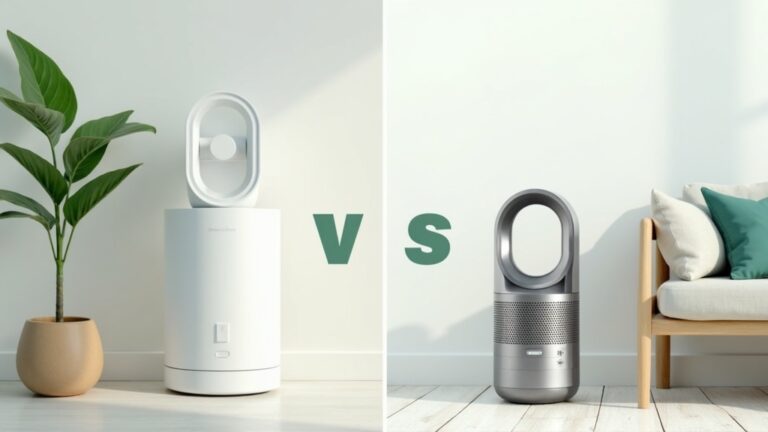
You may be considering the Dyson Purifier Big Quiet BP04 (approximately $1,299) or the Austin Air HealthMate Plus (approximately $1,100-1,400). Both are legitimate HEPA units. Neither is the best choice for most Australian pet owners.
The Dyson BP04 is engineered for whole-room air circulation with a focus on noise reduction and aesthetic design. Its HEPA H13 filter and carbon layer are effective, but its CADR (officially unspecified by Dyson, estimated at 350-400 m³/h by independent testers) is comparable to the Levoit Core 400S at roughly 4x the price. You are paying for the Dyson industrial design, the formaldehyde sensor, and the brand. If those matter to you, it is a fine product. If your priority is dander and odour removal per dollar spent, the Breville delivers better measurable performance at less than half the price.
The Austin Air HealthMate Plus uses a massive 6.8 kg activated carbon and zeolite blend that is actually best-in-class for chemical and odour filtration. It is used in hospitals and clinical settings for chemical sensitivity patients. For extreme pet odour situations (animal rescue facilities, multi-cat households with 5+ cats, veterinary clinics), it is the right tool. For a typical Australian home with 1-3 pets, it is overkill — and the filter replacement cost ($400+ every 3-5 years) reflects that clinical grade.
For a comprehensive comparison of all major units available in Australia, see our full air purifier rankings for 2026. If you are specifically in Sydney dealing with bushfire smoke on top of pet dander, our best air purifier for Sydney 2026 guide covers smoke-season performance testing.
Our Top-Rated Air Purifiers for Pets
Final Verdict
For most Australian pet owners, the Breville Protect Max is the best air purifier you can buy in 2026. It handles the full spectrum of pet-related air quality problems — hair, dander, and odour — with a HEPA H13 filter, substantial activated carbon. At $0.73/day over 5 years, it costs less than the daily antihistamine many pet owners currently rely on.
If your budget is under $300, the Levoit Core 400S delivers dander removal performance that matches the Breville at nearly half the upfront cost. Its only weakness is odour handling in heavy-pet situations.
If you live in NSW, Victoria, or QLD, smoke season is the argument that closes this purchase. A HEPA purifier handles pet dander year-round and bushfire smoke when it matters most. Two problems. One machine. One purchase you will not regret.
Last reviewed: June 2026 — Clean and Native
Ready to breathe cleaner air with your pets?
The Breville Protect Max is the top-rated air purifier for Australian pet owners — HEPA H13, 400g+ activated carbon, auto-sensor that responds to dander spikes in seconds, and sleep mode at 24 dB.
Frequently Asked Questions
Do HEPA air purifiers actually remove pet dander?
Yes. True HEPA H13 filters capture 99.97% of particles at 0.3 micrometres. Cat dander allergen (Fel d 1) ranges from 1-5 µm and dog dander allergen (Can f 1) ranges from 5-10 µm — both well within the capture range. The key requirement is “true HEPA H13” — products labelled “HEPA-type” or “HEPA-style” are not tested to this standard.
Can an air purifier remove pet odour from a room?
Only if it has a substantial activated carbon filter. HEPA filters capture particles but cannot absorb gases or volatile organic compounds responsible for pet smell. Look for units with at least 200 grams of pelletised or granular activated carbon. Thin carbon meshes under 100 grams provide negligible odour reduction after the first few weeks.
How often should I replace the filter in a pet household?
In a multi-pet household running 12+ hours daily, expect to replace the HEPA and carbon filter every 6-8 months. Single-pet homes with regular pre-filter maintenance can stretch to 8-12 months. Check your unit’s filter-life indicator and replace when prompted — running a saturated filter reduces airflow and can push trapped allergens back into the room.
Is a HEPA air purifier safe to use around birds and small pets?
Pure HEPA filtration (no ozone-producing ioniser) is safe for all pets including birds. Avoid any unit that produces ozone — birds are extremely sensitive to ozone and can suffer respiratory distress at concentrations undetectable to humans. If your unit has an ioniser, ensure it can be disabled. Units like the Winix Zero Pro allow you to toggle PlasmaWave off entirely.
Where should I place an air purifier in a home with pets?
Place it in the room where your pet spends the most time, ideally within 2-3 metres of the animal’s primary resting area. Dander concentration is highest near the source. Do not place the purifier in a hallway expecting it to clean the whole house — this is the most common placement mistake and results in minimal allergen reduction where it matters most.
Does an air purifier replace vacuuming in a pet home?
No. Air purifiers capture airborne particles. Settled dander on carpets, furniture, and bedding requires vacuuming with a HEPA-bagged vacuum (weekly minimum) and washing pet bedding at 60°C. The two strategies are complementary — the purifier handles what is in the air, the vacuum handles what has landed on surfaces.
Will an air purifier help with pet allergies during bushfire season in Australia?
Yes — this is one of the strongest arguments for owning a HEPA purifier as a pet owner. During NSW and Victorian bushfire season (October-March), your purifier simultaneously removes PM2.5 smoke particles and pet dander. According to NEPM standards, safe PM2.5 is below 25 µg/m³, but bushfire events can push indoor levels to 100+ µg/m³ without filtration. A single HEPA unit handles both problems.
How much electricity does a HEPA air purifier use running 24/7?
On auto or sleep mode, most modern HEPA purifiers draw 8-15 watts — comparable to a phone charger. At an average Australian electricity tariff of $0.30/kWh, running a Levoit Core 400S on auto mode 24/7 costs approximately $26-39 per year. Running on high continuously costs more ($60-80/year) but auto mode keeps costs low by only ramping up when particles are detected.
Get the Australian Home Environment Checklist
30 checks across water, air and EMF. Most of them free. Ranked by impact.
No spam. Unsubscribe any time.

Former Royal Australian Navy Clearance Diver and TAG-E counter-terrorism operator. Founded Clean and Native to apply the same rigorous thinking to the home environment.
Full biography →