Best Water Filter for Renters Australia 2026: No Plumbing, No Landlord
The best water filter for renters in Australia needs no drilling, no plumbing modification, and, if you live in Brisbane, Sydney, Adelaide, Gold Coast, or Darwin, proper chloramine filtration. I’m Jayce Love, former Royal Australian Navy Clearance Diver. This guide is built from manufacturer specifications, NSF/ANSI certification records, and the EcoHero RO system installed at my own Palm Beach QLD home. Most water filter guides for renters miss the real problem: the Brita pitcher in your fridge removes chloramine at 1/40th the rate it removes free chlorine, meaning you’re paying for filtration you’re not getting.
Quick Verdict
Best Water Filter for Renters Australia
The best water filter for Australian renters is the PWS Stainless Steel Benchtop — it installs without drilling, is rated for chloramine (used in Brisbane, Sydney, Adelaide, Gold Coast and Darwin), and costs ~$299. If you need fluoride or PFAS removal, the AquaTru Countertop RO is the only no-plumbing RO option.
| Best overall — all cities | PWS Stainless Steel Benchtop — NSF-rated carbon block, handles chloramine, no drilling, ~$299. |
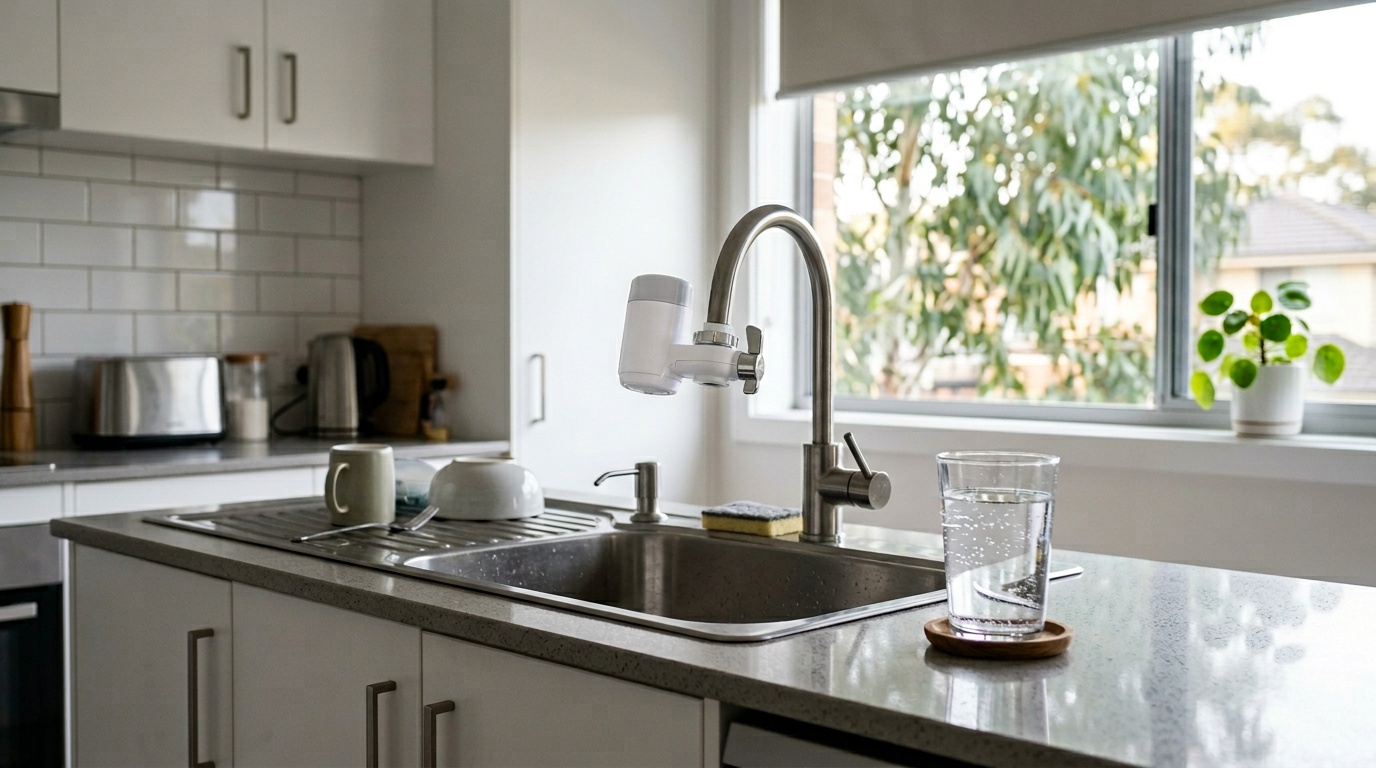
| Best value clip-on | TAPP EcoPro — attaches to existing tap, catalytic carbon removes chloramine, no plumbing, ~$80 + cartridges |
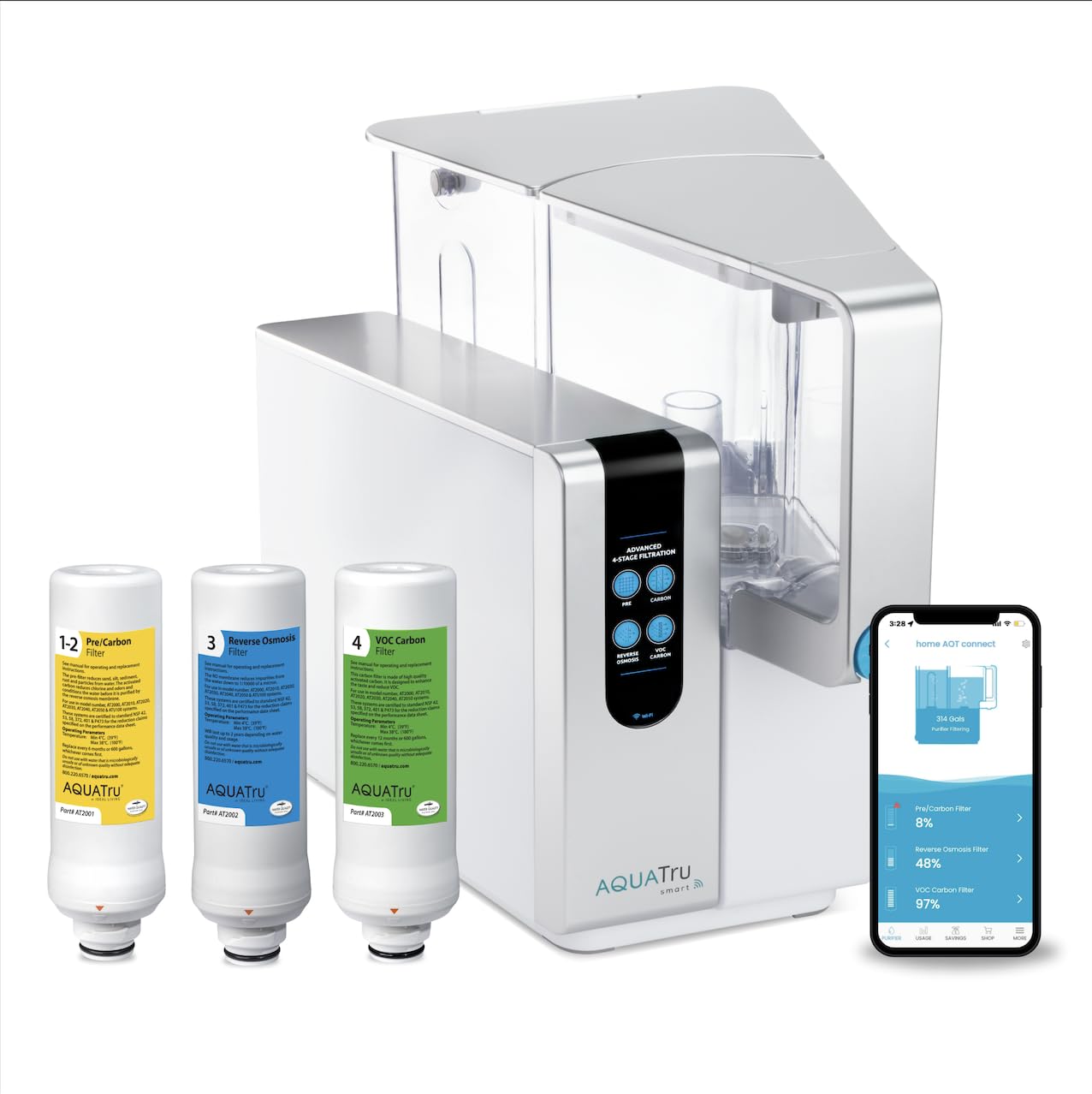
| Best for fluoride + PFAS removal | AquaTru Countertop RO — benchtop reverse osmosis, NSF P473 certified, removes fluoride + PFAS + chloramine, no install, ~$400–500 |
| Melbourne & Hobart only | A standard Brita pitcher or gravity filter works — Melbourne and Hobart use free chlorine (not chloramine), so GAC is effective |
| ⚠ Critical — 5 cities use chloramine | Brisbane, Gold Coast, Adelaide, Sydney, Darwin — Brita pitchers and standard gravity filters do NOT remove chloramine. You need catalytic carbon or RO. |
| Shower — no landlord approval needed | A vitamin C inline shower filter screws onto your existing showerhead — no drilling, no plumbing, removes chloramine at the shower |
✓ Who This Is For
- Renters who can’t modify plumbing or drill holes in cabinetry
- Brisbane, Sydney, Adelaide, Gold Coast, and Darwin residents who need chloramine removal
- Apartment dwellers wanting benchtop or countertop filtration with no landlord permission needed
- Anyone who wants filtered drinking water portable enough to move between rentals
- Parents mixing formula or households with health concerns about chloramine disinfection byproducts
× Who It Is Not For
- Homeowners who can install under-sink or whole-house filtration — dedicated guides for those exist
- Melbourne and Hobart residents who just want to remove chlorine taste — a standard Brita works fine in free-chlorine cities
- Anyone expecting a pitcher filter to work in Brisbane, Perth, or Adelaide — GAC cannot adequately remove chloramine
- Households wanting whole-house hardness removal — see our water softener guide
The three products we own are measured first-hand by Jayce Love, former Royal Australian Navy Clearance Diver; every other product is assessed on published manufacturer specifications and independent certification using our documented methodology — no gifted units, no brand payments.
The majority of Australian capital cities — Brisbane, Gold Coast, Adelaide, Sydney, and Darwin — use chloramine as the primary drinking water disinfectant. Standard activated carbon filters, including all Brita products, Pur pitchers, and most “fridge filters,” remove chloramine at approximately 1/40th the rate they remove free chlorine. A renter in Brisbane who buys a Brita pitcher believing it filters their water is receiving almost no benefit for the primary disinfectant concern. Only Melbourne, Hobart, and Canberra use free chlorine, where standard carbon filters are effective.
This guide covers no-plumbing-modification filters that actually work for Australian water — with city-specific recommendations based on what your tap water actually contains.
The Chloramine Problem: Why City Matters More Than Filter Brand
Chloramine (monochloramine, NH₂Cl) is formed by combining chlorine with ammonia. Water utilities switched to chloramine from free chlorine because it forms fewer regulated disinfection byproducts (DBPs) and maintains residual through distribution networks better. The tradeoff: chloramine is far harder to remove with carbon filtration.
The chemistry is straightforward: standard granular activated carbon (GAC) removes free chlorine through a rapid catalytic reaction. The same carbon removes chloramine through a much slower adsorptive mechanism — requiring approximately 40x the contact time or carbon mass. In a pitcher filter or clip-on tap filter using standard GAC, water passes through in seconds. Standard GAC at that contact time removes essentially no chloramine.
| City | Disinfection | Does Brita work? | Best renter filter |
|---|---|---|---|
| Brisbane / SEQ | Chloramine | No | TAPP EcoPro or AquaTru |
| Perth | Chloramine | No | TAPP EcoPro or AquaTru |
| Adelaide | Chloramine | No | AquaTru (TDS problem too) |
| Sydney | Chloramine | No | TAPP EcoPro or AquaTru |
| Darwin | Chloramine | No | AquaTru (PFAS risk too) |
| Melbourne | Free chlorine | Yes | Brita or TAPP EcoPro |
| Hobart | Free chlorine | Yes | Brita adequate (very clean water) |
The Best Water Filters for Australian Renters — Reviewed
1. Pure Water Systems Stainless Steel Benchtop Filter — Best Overall

✓ Pros
- Rated for chloramine — the correct filter for most Australian cities
- 12-month cartridge, 1,892L capacity — lowest ongoing cost in this category
- 3L per minute flow — instant filtered water direct from the tap
- No plumbing modification — three tap adapters included
- HTO+ variant adds PFAS + arsenic + microcystin reduction
- Australian brand, ships domestically, 4.9/5 from 100+ reviews
✗ Cons
- $299 upfront (though 12-month cartridge offsets lifetime cost)
- Requires a tap with a standard aerator thread — pull-out spray taps need an adapter
- Does not remove fluoride or TDS — carbon block only
- Currently on backorder — allow 6–8 weeks dispatch
Buy this if: You want a proper multi-stage benchtop filter with chloramine removal, a 12-month cartridge, and instant 3L/min tap flow — without any plumbing modification. Best for renters in Brisbane, Sydney, Gold Coast, Adelaide, or Darwin who want set-and-forget filtration.
The PWS Stainless Steel Benchtop connects to the tap aerator thread via one of three included adapters — fitting most standard Australian kitchen mixer taps in under a minute. The compressed carbon block in the HTO cartridge is specifically rated for chloramine removal (unlike granular carbon), which makes it appropriate for every Australian chloramine city. The 12-month cartridge life and 1,892L capacity makes it one of the lowest cost-per-litre options in the benchtop category. For renters wanting real filtration performance without the setup complexity of an RO unit, this is the correct starting point.
2. TAPP EcoPro — Best Budget Clip-On for Chloramine Cities

✓ Pros
- Catalytic carbon block — effective against chloramine (most clip-ons are not)
- Attaches in 30 seconds, no tools, no modification — ideal for renters
- Lowest entry price for genuine chloramine removal (~$80)
- Removes microplastics to 2 µm
- Multiple tap adapters included
✗ Cons
- Shorter cartridge life — 1,200L (~3 months) versus 12 months for PWS
- No fluoride or TDS reduction
- Not compatible with pull-out spray taps or non-standard fittings
- Ongoing cartridge cost ~$160–200/year
Buy this if: You want the quickest, cheapest entry point to real chloramine filtration. Perfect for renters in Brisbane, Sydney, Perth, or Darwin who have a standard aerator tap and want filtered water in under a minute of setup.
The TAPP EcoPro is the correct choice when you need effective chloramine removal and want to spend the minimum to get it. The compressed catalytic carbon distinguishes it from all standard GAC clip-ons. Its limitation is cartridge life — at 1,200 litres per cartridge, a two-person household replaces it approximately every three months. Over two years, total cost is roughly $80 initial + ~$360 cartridges = $440. The PWS benchtop beats that on a per-litre basis, but the TAPP wins on upfront cost if you’re not sure you’ll stay in the rental long-term.
3. AquaTru Countertop Reverse Osmosis — Best for TDS, Fluoride, and PFAS
✓ Pros
- RO-quality water from a benchtop unit — no under-sink installation needed
- NSF P473 certified for PFAS reduction
- Removes fluoride (90–97%), TDS, chloramine, nitrates, and heavy metals
- Portable — disconnects and moves in minutes
✗ Cons
- $400–500 purchase price — highest upfront cost in this guide
- Slow fill rate — 1.5–2L reservoir fills in 10–15 minutes
- Wastes some water (RO reject stream) — higher water bill
- Requires remineralisation if used as sole drinking water source
Buy this if: You’re in Adelaide (high TDS Murray River water), Darwin (PFAS proximity), or any chloramine city where you also want fluoride reduction. The only renter-appropriate path to full RO-quality water without a plumber.
The AquaTru countertop RO is not for every renter — at $400–500 it is the most expensive unit in this guide, and its slow reservoir fill means it is not a direct tap replacement for high-volume households. But it is the only product in this category that removes fluoride, addresses PFAS (NSF P473 certified), and brings TDS down to near-zero — all without any permanent modification. For Adelaide renters dealing with 300–500 mg/L TDS Murray River water, or Darwin renters within proximity of PFAS-contaminated sites, no other renter-appropriate filter addresses all three problems simultaneously.
5. Waters Co BIO 500 — Best Premium Gravity Filter

✓ Pros
- 12,000L / 36-month filter life — replace once every three years
- 13-stage filtration including bio-ceramics and mineral media
- Removes chloramine, fluoride, PFAS, bacteria, heavy metals
- Gravity-fed — no tap connection or electricity required
- 4.9/5 from 300+ reviews — well-established Australian brand
✗ Cons
- $729 — highest upfront cost in the gravity category
- Slow gravity fill rate — must manually refill top reservoir
- Heavy at 5.5kg — less portable than smaller units
Buy this if: You’re planning to stay in the rental for 2–3+ years and want to maximise filter cost-per-litre. The 36-month cartridge means you replace it once while a renter, keeping total cost of ownership lower than it appears at the $729 sticker price.
The Waters Co BIO 500 justifies its $729 price through filter longevity: at 12,000 litres per cartridge, the ongoing consumable cost drops to approximately 3 cents per litre — among the lowest of any filter type. For a renter committed to a 2–3 year tenancy, the 36-month filter life means one cartridge replacement across the entire stay. The 5.25L tank is adequate for one or two people but may require twice-daily refilling for larger households. No plumbing, no electricity — purely gravity-driven.
6. Brita Pitcher — Melbourne and Hobart Only

✓ Pros
- $40–60 — lowest entry price of any filter in this guide
- No setup required — fill and drink
- Works perfectly in Melbourne and Hobart (free chlorine cities)
- Compact, fridge-friendly design
✗ Cons
- Does NOT work for chloramine — ineffective in Brisbane, Sydney, Gold Coast, Adelaide, Darwin
- Small capacity — 2.2L requires frequent refilling
- Cartridge must be replaced every 4 weeks (150L)
Buy this if: You are a Melbourne or Hobart renter. Melbourne has the best baseline water quality of any Australian capital — a $30–60 Brita pitcher is entirely adequate and represents good value. Do not buy a Brita if you are anywhere else.
The Brita Liquelli is the correct choice for Melbourne and Hobart renters — and only for those cities. Melbourne’s source water is drawn from high-altitude mountain catchments with naturally low TDS, minimal agricultural runoff, and free chlorine as the sole disinfectant. A standard GAC pitcher is genuinely adequate in this context. The Liquelli’s fridge-fit 2.2L design works well in smaller rentals where bench space is limited. The main limitation is cartridge replacement every 150L (approximately 4 weeks at 5L per day usage) — budget around $100–150 per year in consumables. If you are in any other Australian city, the Brita does not address the primary disinfectant concern and you should buy the TAPP EcoPro or the PWS Stainless Steel Benchtop instead.
7. Vitamin C Inline Shower Filter — No Plumbing Required

✓ Pros
- Vitamin C neutralises chloramine instantly — works in every Australian city
- 60-second install — no tools, no landlord permission required
- Low upfront cost (~$30–50)
- Works with existing showerhead — keeps your current fixtures
✗ Cons
- Cartridge replacement every 3–6 months (ongoing cost)
- Does not filter drinking water — shower only
- Some flow restriction compared to unfiltered
Buy this if: You want chloramine-free shower water in any Australian city. Do not buy a KDF-55 shower filter if you are in a chloramine city — they do not work.
The vitamin C inline shower filter is the correct solution for renters who want chloramine-free shower water in any Australian city. Unlike KDF-55 shower filters widely sold at hardware stores, vitamin C chemistry works against both free chlorine and chloramine through immediate chemical neutralisation — not adsorption. This distinction is critical in Brisbane, Gold Coast, Adelaide, Sydney, and Darwin, all chloramine cities where KDF-55 units provide minimal benefit. The inline fitting connects at the wall hose outlet and keeps your existing showerhead intact, leaving no marks or modifications to the rental property. Replace the cartridge every 3–6 months at average household usage, or when you notice chlorine odour returning to the shower water.
Renter-Specific Considerations: What to Check Before Buying
Tap compatibility for clip-on filters
Clip-on tap filters like the TAPP EcoPro attach to the aerator thread at the end of the tap spout. Most standard Australian mixer taps have a male M22 or M24 thread. However, some taps have:
- Pull-out spray heads (no fixed spout to attach to)
- Non-standard or recessed threads
- Waterfall or flat-edge spout designs without threads
- Built-in aerators that cannot be removed without tools
Before purchasing a clip-on filter, check your tap type. Most brands include thread adapters in the box; the TAPP EcoPro comes with multiple adapters for common Australian tap sizes. If your rental has an unusual pull-out spray tap, a countertop pitcher or benchtop RO system is the practical alternative.
Lease agreements and permanent modifications
Clip-on tap filters, benchtop RO units, and gravity filters require zero modification to the rental property. Under-sink filters, inline filters plumbed into supply lines, and whole-house filters require permanent modification. In most states, permanent plumbing modifications require landlord written consent under residential tenancy legislation. The products covered in this guide are all modification-free.
What Needs Landlord Approval — and What Doesn’t
Based on residential tenancy legislation across Australian states. Modification-free filters require no landlord consent and can be removed on vacating, leaving no trace. Always remove and return the original aerator on departure.
Cartridge cost and ongoing commitment
The total cost of ownership matters more than the purchase price. TAPP EcoPro cartridges at ~$40–50 per quarter cost approximately $160–200/year. AquaTru filters at $60–100/year. A Brita pitcher with filter replacements approximately $80–120/year. Calculate 2-year total cost when comparing options.
City-Specific Renter Recommendations
Brisbane / Gold Coast / SEQ renters
Chloramine water, moderate TDS (~100 mg/L), moderate hardness. The TAPP EcoPro is the correct primary choice for chloramine removal. If fluoride reduction is also a goal, the AquaTru countertop RO is the renter-appropriate option. Do not buy a Brita pitcher for Brisbane tap water.
For a full comparison including under-sink RO systems, see our best water filter Australia 2026 guide and our dedicated reverse osmosis filter Australia guide.
Sydney renters
Chloramine water, low TDS (~80 mg/L), soft. TAPP EcoPro for chloramine. Lower TDS makes the water quality baseline better than Brisbane or Perth — TAPP EcoPro alone is sufficient for most taste concerns. AquaTru if fluoride reduction desired.
Perth renters
Chloramine + hard water (~180 mg/L CaCO₃) + moderate TDS (~170 mg/L). TAPP EcoPro handles chloramine but not hardness or TDS. AquaTru countertop RO handles all three. Perth has the strongest case for AquaTru among the eastern states chloramine cities due to the additional hardness dimension.
Adelaide renters
Chloramine + highest TDS of any capital (~300–500 mg/L Murray River) + high fluoride (~0.9 mg/L). Adelaide renters have the strongest case for the AquaTru — it addresses all three problems simultaneously. The TAPP EcoPro helps with chloramine but cannot address the distinctive high TDS and mineral taste that defines Adelaide water.
Melbourne renters
Free chlorine + very low TDS (~60 mg/L) + very soft. Standard Brita pitcher or TAPP EcoPro both work effectively. Melbourne has the best baseline water quality of any major Australian city, so any basic carbon filter provides adequate improvement. No strong case for AquaTru unless fluoride reduction is specifically desired.
Darwin renters
Chloramine + moderate TDS (~100–250 mg/L seasonal) + PFAS risk near military sites. AquaTru with NSF P473 certification is the recommended choice given the PFAS proximity context. TAPP EcoPro handles chloramine if PFAS is not a concern.
Final Verdict
For most Australian renters, the TAPP EcoPro is the right call: it installs in two minutes without tools, removes chloramine (the disinfectant used in Brisbane, Sydney, Adelaide, Gold Coast and Darwin), and leaves no permanent mark on the tap. If you are in Darwin, near a defence base, or specifically concerned about fluoride, upgrade to the AquaTru Classic — a countertop RO that removes PFAS and fluoride without any plumbing. Avoid benchtop gravity filters with paper certifications but no NSF testing; they handle free chlorine only and underperform badly in chloramine cities.
- You rent and cannot modify plumbing
- You live in a chloramine city (Brisbane, Sydney, Adelaide, Gold Coast, Darwin)
- You want NSF-certified filtration without landlord approval
- You move regularly and need a portable solution
- Your primary goal is PFAS removal — get an NSF P473-certified RO instead
- You want fluoride removal — only reverse osmosis achieves this
- You own your home — an under-sink system delivers better value long-term
Last reviewed: June 2026 — Clean and Native
The best water filter for your rental
The Tappwater EcoPro and PWS Stainless Benchtop both need zero plumbing modification. Choose based on your city’s disinfectant and whether you need fluoride removal.
Frequently Asked Questions
Our Top Picks
The PWS Stainless Steel Benchtop is our top pick for most Australian renters — multi-stage chloramine removal, 12-month cartridge, no plumbing. For fluoride + PFAS coverage, the AquaTru countertop RO is the only renter-appropriate solution.
Get the Australian Home Environment Checklist
30 checks across water, air and EMF. Most of them free. Ranked by impact.
No spam. Unsubscribe any time.

Former Royal Australian Navy Clearance Diver and TAG-E counter-terrorism operator. Founded Clean and Native to apply the same rigorous thinking to the home environment.
Full biography →