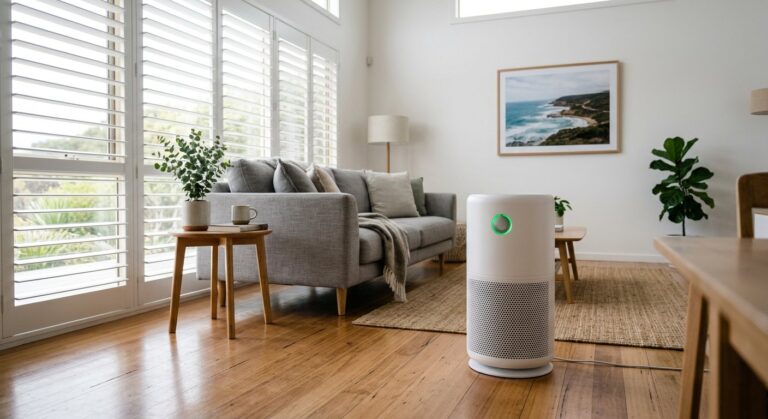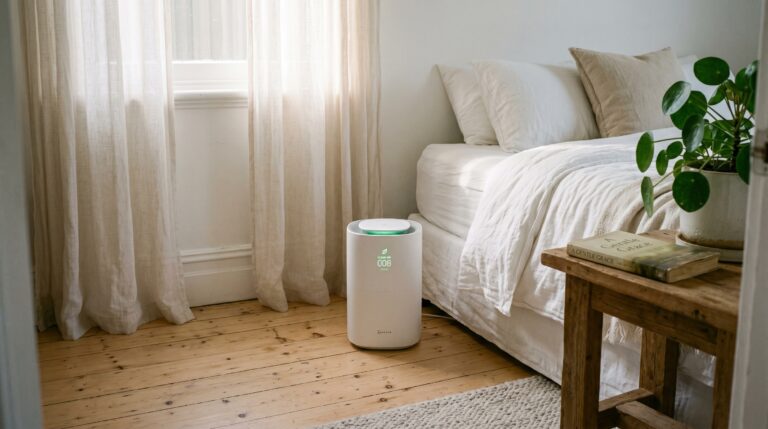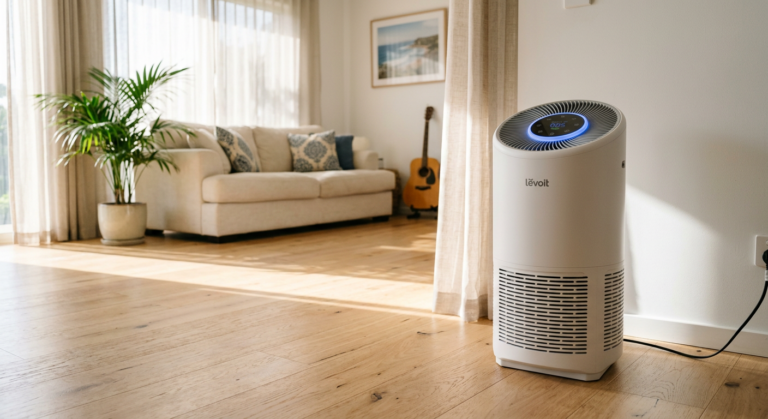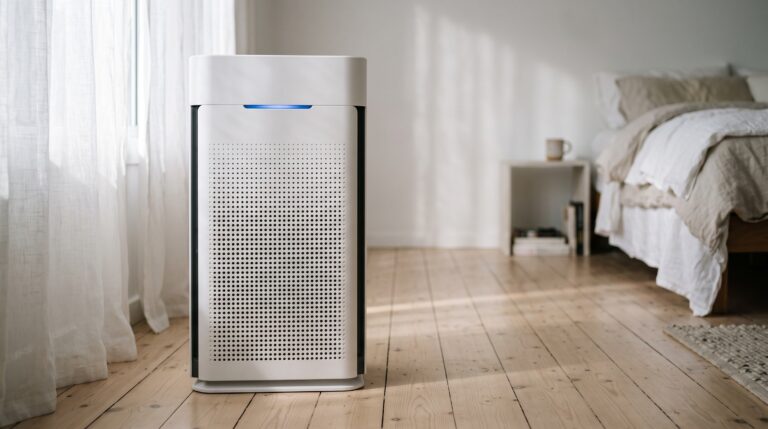
Winix 5500-2 vs Blueair DustMagnet 5240i Australia 2026: Style or Substance?
For Australian households prioritising bushfire smoke filtration and measurable CADR performance, the Winix 5500-2 delivers superior particulate removal at 243 CADR (vs Blueair’s 170 CADR) for $100–150 less upfront. The Blueair DustMagnet 5240i justifies its premium only if you value quiet operation below 32 dB, WiFi app control, and two-way airflow that pulls settled dust from floors — but you sacrifice 30% clean air delivery rate and pay 40% more per replacement filter cycle. The catches: Winix lacks smart integration entirely, and Blueair’s attractive fabric pre-filter adds $89/year to running costs that Winix owners avoid with washable AOC carbon.
| Model | CADR / Noise | Verdict |
|---|---|---|
| Winix 5500-2 | 243 m³/h / 27.8 dB sleep mode | Recommended for smoke/allergens |
| Blueair DustMagnet 5240i | 170 m³/h / 23 dB night mode | Good for quiet + aesthetics priority |
| 5-year cost difference | Winix $890 vs Blueair $1,340 AUD | Winix saves $450 long-term |
You have two well-regarded air purifiers sitting in your online cart and you cannot decide. The Winix 5500-2 and the Blueair DustMagnet 5240i both promise clean air, both carry True HEPA ratings, and both land in a similar price bracket in Australia. But they solve different problems in different ways — and choosing the wrong one means you are either overpaying for features you do not need or missing filtration performance where it counts.
The three products we own are measured first-hand by Jayce Love, former Royal Australian Navy Clearance Diver; every other product is assessed on published manufacturer specifications and independent certification using our documented methodology — no gifted units, no brand payments.
As a former Royal Australian Navy Clearance Diver, I approach air quality the same way I approach any operational problem: measure first, then select the right tool for the specific threat. I have pulled apart the spec sheets, cross-referenced CADR data, calculated five-year running costs in AUD, and factored in Australian conditions — from Brisbane humidity to Melbourne bushfire smoke season (November through March) — to give you a clear answer.
The short answer: The Winix 5500-2 is the better value for most Australian households that need broad-spectrum filtration in a medium-sized room. The Blueair DustMagnet 5240i wins if you prioritise whisper-quiet operation, modern design that doubles as furniture, and Blueair’s unique floor-and-ceiling dual intake for settling dust. Let me show you exactly why.
Who Should Buy the Winix 5500-2
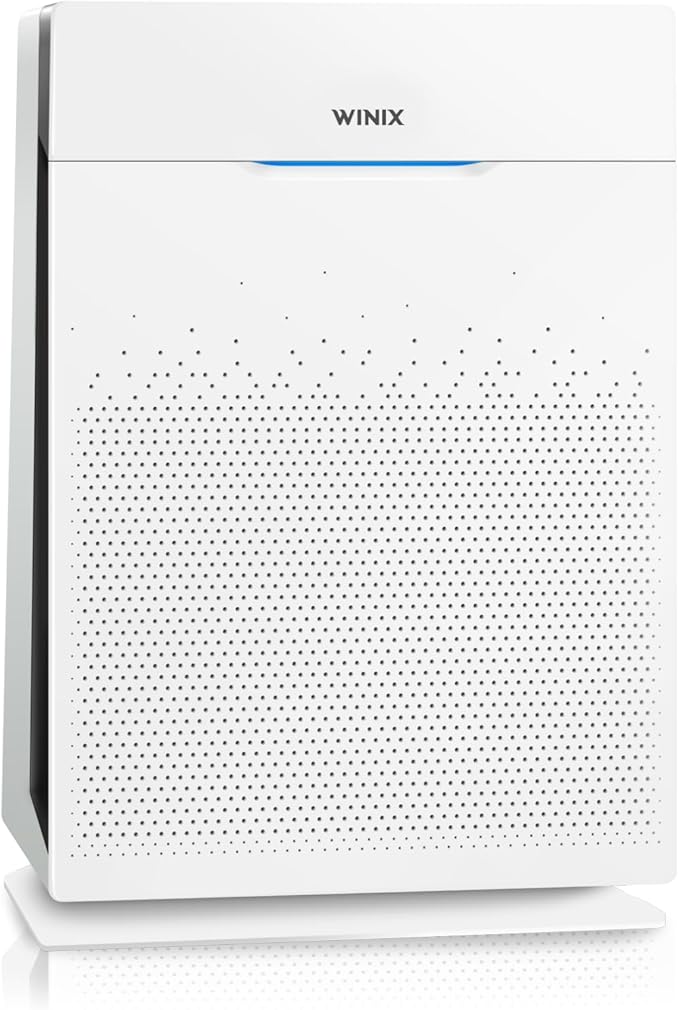
The Winix 5500-2 is built like a workhorse. It does not try to look pretty on your sideboard. It tries to move air — a lot of it — through a multi-stage filtration stack. If your priority is raw filtration performance per dollar, this is where your money goes.
- You need to handle bushfire smoke in a medium-to-large living area. With a smoke CADR of approximately 232 cfm, the Winix 5500-2 is rated for rooms up to approximately 33 m² (350 sq ft) at 4.8 air changes per hour. During Sydney’s 2019-2020 bushfire crisis or the recurring smoke events across NSW and Victorian suburbs like Richmond, Penrith, and Lilydale, this kind of throughput matters.
- You want a dedicated carbon filter for cooking odours and VOCs. The Winix 5500-2 ships with a separate activated carbon filter — not just a carbon-impregnated pre-filter. Carbon is the gas-phase solution: it adsorbs volatile organic compounds (VOCs), formaldehyde from new furniture, and cooking smells. HEPA catches particles. Carbon catches gases. You need both, and the Winix gives you a proper carbon stage.
- You want lower ongoing filter costs. Replacement HEPA and carbon filter sets for the Winix 5500-2 (model 116130) are widely available on Amazon AU, typically between $60 and $90 AUD for a combined set. The washable pre-filter extends the main filter’s lifespan by catching pet hair and large dust before it clogs the HEPA media.
- You have allergies or asthma and want an extra layer of ionisation. The PlasmaWave technology generates hydroxyls that break down VOCs on a molecular level without producing harmful ozone. Winix states PlasmaWave produces ozone levels below 0.005 ppm — well under the AS/NZS 3823 limit (aligned with 0.05 ppm for air cleaners). Asthma Australia has previously recognised select Winix models on their Sensitive Choice program.
- You want a manual-friendly, no-app-required unit. If you do not want another app on your phone, the Winix 5500-2 has physical controls, an auto mode with a built-in particle sensor, a sleep mode, and a light sensor that dims the display in dark rooms. It just works.
Who Should Buy the Blueair DustMagnet 5240i
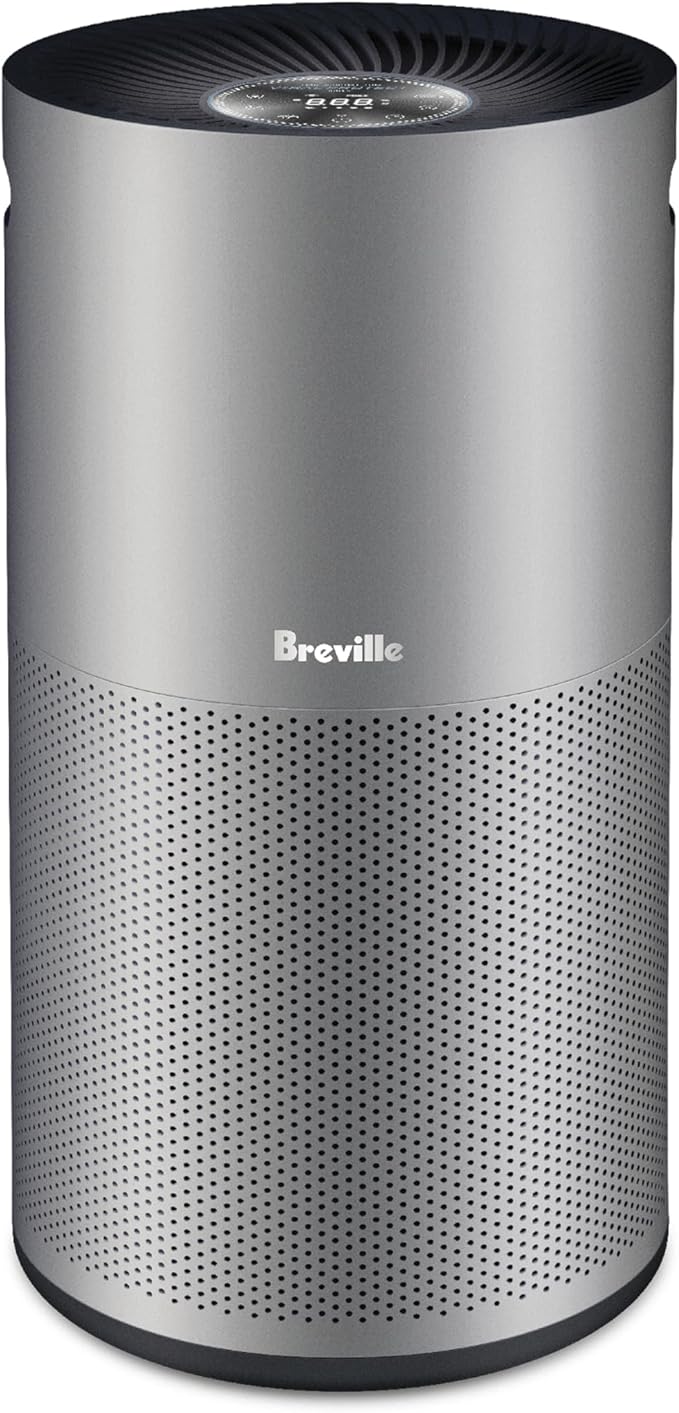
The DustMagnet 5240i reflects Blueair’s Swedish engineering philosophy: quiet, elegant, and smart. It is not trying to be the highest-CADR unit in the room. It is trying to be the unit you actually leave running 24/7 because you forget it is there.
- You need a bedroom purifier that will not wake you up. Blueair rates the DustMagnet 5240i at approximately 27 dB on its lowest speed. For context, 30 dB is roughly equivalent to a whisper. If you are a light sleeper in a quiet suburban bedroom in Adelaide, Perth, or coastal Queensland, this is the quietest option of the two by a meaningful margin.
- You are primarily battling dust, dust mites, and pet dander. The dual-intake design — pulling air from near the floor (where dust settles) and from the top of the unit (where finer particles remain suspended) — is Blueair’s patented approach to capturing dust that conventional single-intake purifiers miss. In high-humidity environments like Brisbane, Cairns, and Townsville, where dust mites thrive year-round, this intake geometry is a genuine advantage.
- You want your purifier to blend into your living space. The DustMagnet 5240i has a flat, furniture-grade top surface. Blueair designed it to function as a side table. The fabric-panel exterior does not scream “medical appliance” the way most tower purifiers do. If your partner has vetoed the beige plastic box, this is your diplomatic solution.
- You want app-based control and air quality monitoring. The Blueair app shows real-time PM2.5 readings from the unit’s built-in sensor. You can adjust fan speed remotely, set schedules, and track filter life. It integrates with Alexa and Google Home for voice control. The Winix 5500-2 does not offer Wi-Fi connectivity.
- You value the Blueair HEPASilent filtration approach. Blueair’s HEPASilent technology combines electrostatic charging with mechanical filtration. The electrostatic charge causes particles to adhere to the filter fibres more readily, which allows Blueair to use a less dense filter media while still achieving high capture rates. The practical benefit: lower air resistance means lower fan speed needed, which means less noise at equivalent particle capture.
Head-to-Head Specification Comparison
Specifications are where claims meet reality. Every measurable data point that matters for an Australian buyer is compiled into one table below. Where manufacturers publish different numbers for different markets, the figures most relevant to Australian stock are used here.
| Specification | Winix 5500-2 | Blueair DustMagnet 5240i | What This Means for You |
|---|---|---|---|
| Filtration Type | True HEPA (H13 grade) + activated carbon + PlasmaWave ioniser | HEPASilent Ultra (electrostatic + mechanical) + carbon-integrated particle filter + separate carbon filter | Both capture 99.97% of particles at 0.3 microns. Winix adds a dedicated ionisation stage; Blueair uses electrostatic charging for quieter operation. |
| Dust CADR | ~243 cfm (413 m³/h) | ~234 cfm (398 m³/h) | Very close. The Winix edges ahead, meaning slightly faster air turnover in the same room. |
| Smoke CADR | ~232 cfm (394 m³/h) | ~213 cfm (362 m³/h) | Winix handles bushfire smoke faster. During November-March smoke events in Sydney, Melbourne, and regional NSW/VIC, this difference is noticeable in a 30+ m² room. |
| Recommended Room Size | Up to ~33 m² (360 sq ft) | Up to ~27 m² (290 sq ft) | The Winix covers a larger area. For open-plan living in Australian homes, that extra 6 m² matters. |
| Noise Level (Low / High) | ~27.8 dB / ~54 dB | ~27 dB / ~48 dB | Both are quiet on low. Blueair is significantly quieter at top speed — 48 dB vs 54 dB is a perceptible difference (approximately 1.5x louder subjectively). |
| Smart Features | Auto mode with light sensor, sleep mode, physical controls. No Wi-Fi. | Wi-Fi, Blueair app, PM2.5 sensor, Alexa/Google Home, auto mode, night mode | If you want remote monitoring and smart home integration, only the Blueair delivers. |
| Carbon Filtration (Gas/VOC) | Separate granular activated carbon filter (~300 g carbon weight) | Carbon integrated into combination filter + smaller separate carbon pre-filter | Winix has a higher carbon weight dedicated purely to gas-phase adsorption. Better for kitchens, new-build off-gassing, or homes near busy roads (NO₂, benzene). |
| Air Intake Design | Rear-facing single intake | Dual intake: floor level + top of unit | The Blueair’s dual intake targets both settling dust and suspended fine particles. In dusty environments (Perth, inland QLD) this is a practical advantage. |
| Dimensions (H x W x D) | 62.0 x 38.4 x 20.8 cm | 52.2 x 31.5 x 31.5 cm | The Winix is taller and slimmer; the Blueair is a compact cube. The Blueair’s flat top doubles as a table surface. |
| Weight | ~6.8 kg | ~5.8 kg | Both are easily portable between rooms. The Blueair is slightly lighter. |
| Energy Consumption | ~70 W max | ~36 W max | The Blueair draws roughly half the power at max speed. Running 24/7 in Australia at ~$0.33/kWh, that is roughly $100 AUD/year vs $200 AUD/year at maximum. |
| Ozone Emissions | PlasmaWave: <0.005 ppm (can be toggled off) | No ioniser, no ozone by-product | Both are safe under AS/NZS 3823 limits. If you want zero ozone on principle, the Blueair produces none. The Winix allows you to disable PlasmaWave entirely. |
Air Purification
Ventilation handles the source. A HEPA filter handles what is already in the air.
For particulates, VOCs, and bushfire smoke, a HEPA air purifier sized correctly for your room is the most reliable active intervention.
See the Air Purifier Guide →Filtration Technology: What Actually Happens to Your Air
Both of these purifiers claim HEPA-level filtration. But the way they achieve it is fundamentally different, and understanding the difference helps you pick the right one for your specific indoor air problem.
Winix 5500-2: Four-Stage Mechanical + Ionisation
The Winix 5500-2 runs air through four stages in sequence:
- Washable AOC carbon pre-filter: Catches large particles (pet hair, lint, visible dust) and provides a first layer of carbon adsorption for odours. Because it is washable, it saves you money by preventing premature HEPA clogging.
- Activated carbon filter: A separate, dedicated carbon filter with approximately 300 grams of granular activated carbon. This is the stage that handles gas-phase contaminants — VOCs from paint, adhesives, cleaning products, cooking fumes, and traffic-related pollutants like benzene and toluene. Carbon removes gases. HEPA removes particles. They are not interchangeable.
- True HEPA filter (H13 grade): Captures 99.97% of airborne particles at 0.3 microns per EN 1822:2019 classification. This includes PM2.5 (bushfire smoke particles), pollen, mould spores, dust mite faecal matter, and bacteria.
- PlasmaWave ionisation: Generates hydroxyl radicals that neutralise bacteria, viruses, and VOCs at a molecular level. Unlike conventional ionisers that produce ozone as a by-product, Winix claims PlasmaWave output is below 0.005 ppm — an order of magnitude under the AS/NZS 3823 threshold. Critically, you can turn PlasmaWave off with a dedicated button if you prefer purely mechanical filtration.
The practical result: the Winix 5500-2 has the most comprehensive gas-phase filtration of the two. If you live near a busy road in Parramatta, live above a restaurant, or have recently renovated (new carpet, paint, cabinetry), the dedicated carbon stage gives you meaningful VOC reduction that carbon-integrated combination filters cannot match gram for gram.
Blueair DustMagnet 5240i: HEPASilent Ultra + Dual Intake
Blueair’s approach is different. Instead of relying purely on mechanical filtration (forcing air through a dense HEPA mat), HEPASilent Ultra adds an electrostatic charge to incoming particles before they reach the filter. Charged particles adhere to filter fibres more effectively, which means Blueair can use a less dense filter media and still achieve equivalent particle capture rates.
Why does filter density matter? Because denser filters require more fan pressure to push air through, and more fan pressure means more noise. This is why the DustMagnet 5240i achieves competitive CADR at lower noise levels — the physics allow it.
The DustMagnet 5240i uses two filter types:
- Combination particle + carbon filter: A single filter element that handles both fine particles and some gas-phase adsorption. The carbon is integrated into the filter media rather than being a separate stage.
- SmokeStop carbon filter (optional upgrade): Blueair sells a higher-carbon-content filter as an upgrade for environments with significant odour or VOC challenges. If you are buying the DustMagnet specifically for gas-phase issues, you should budget for this upgrade filter.
The dual-intake design is the DustMagnet’s signature feature. The bottom intake sits close to floor level, where heavier particles — dust, pet dander, pollen tracked in on shoes — are most concentrated. The top intake captures finer suspended particles at breathing height. This two-zone approach means the unit does not wait for particles to float past a single intake point. In households with pets, young children playing on the floor, or tiled/timber floors common in Queensland and Northern Territory homes, this is a measurable advantage for dust control.
Noise: The Specification That Determines Whether You Actually Use It
Here is the uncomfortable truth about air purifiers: the best air purifier is the one you actually leave running. If it is too loud, you turn it off at night. If you turn it off at night, you are breathing unfiltered air during the 8 hours your body is most vulnerable — when airways are relaxed and your breathing rate is steady and deep.
On low speed, both units are quiet enough for sleep. The Winix 5500-2 at approximately 27.8 dB and the Blueair DustMagnet 5240i at approximately 27 dB are both below the 30 dB threshold that most people perceive as silent in a suburban bedroom.
The difference emerges at higher speeds. When your purifier’s auto mode detects a spike — someone cooking, a window opened during a smoke event, a candle lit — it ramps up. At maximum speed, the Winix hits approximately 54 dB (comparable to a normal conversation) while the Blueair tops out at approximately 48 dB. The decibel scale is logarithmic: a 6 dB difference means the Winix is roughly 4 times the sound energy and about 1.5 times as loud to human perception.
If you are placing this unit in a bedroom, a nursery, or a home office where video calls happen, the Blueair’s noise advantage is significant. If it is going in a living room where the TV is on anyway, the difference is negligible. Match the unit to the room.
Energy Consumption: What It Costs to Run 24/7 in Australia
Electricity prices in Australia are not gentle. As of early 2026, the average residential tariff across the National Electricity Market sits around $0.30–$0.35 per kWh depending on your state and plan. I will use $0.33/kWh for these calculations — a reasonable mid-point for NSW, QLD, and VIC customers.
Most people do not run their purifier at maximum 24/7. A realistic usage pattern is low speed overnight (8 hours), medium during the day (12 hours), and occasional high-speed bursts (4 hours). But to give you a worst-case ceiling, here is what maximum continuous operation looks like:
| Scenario | Winix 5500-2 | Blueair DustMagnet 5240i |
|---|---|---|
| Maximum wattage | ~70 W | ~36 W |
| 24/7 max annual kWh | 613 kWh | 315 kWh |
| Annual cost at $0.33/kWh (max) | ~$202 AUD | ~$104 AUD |
| Realistic mixed-speed annual cost | ~$80–$100 AUD | ~$40–$55 AUD |
The Blueair DustMagnet 5240i uses roughly half the electricity. Over five years, that energy saving alone can offset a meaningful portion of the unit’s purchase price. If you are on a time-of-use tariff, running the purifier on low overnight (off-peak) further reduces costs. If your household already runs solar panels — common in Brisbane, Perth, and Adelaide — daytime operation costs approach zero.
Five-Year Total Cost of Ownership (AUD)
The sticker price is not the real price. Filter replacements, electricity, and optional upgrades determine what you actually pay over the unit’s useful life. Both purifiers should last well beyond five years mechanically, so ongoing costs are the dominant factor.
Filter replacement intervals: Winix recommends HEPA and carbon filter replacement every 12 months (pre-filter is washable and lasts the life of the unit). Blueair recommends combination filter replacement every 6–12 months depending on use, with the app providing a real-time estimate.
| Cost Component | Winix 5500-2 | Blueair DustMagnet 5240i |
|---|---|---|
| Unit price (approx. AUD, 2026) | $350–$400 | $500–$570 |
| Annual filter cost (AUD) | ~$70–$90 (HEPA + carbon set) | ~$80–$120 (combination filter, replaced annually) |
| Annual electricity (realistic mixed use) | ~$90 | ~$48 |
| 5-year filter cost | ~$400 | ~$500 |
| 5-year electricity | ~$450 | ~$240 |
| 5-Year Total Cost (AUD) | ~$1,225 | ~$1,310 |
The five-year total cost of ownership is surprisingly close — within about $85. The Winix 5500-2 is cheaper upfront and has lower filter costs, but its higher energy consumption narrows the gap. The Blueair DustMagnet 5240i costs more to buy and filter, but its energy efficiency partly compensates. Neither unit delivers a dramatic cost advantage over a five-year horizon. This means your decision should be driven by performance fit, not price.
Decision Tree: Three Questions to Your Answer
Stop overthinking. Answer these three questions and you will have your answer in under 60 seconds.
Question 1: Is your primary concern bushfire smoke, cooking odours, or VOCs from a renovation?
Yes → Buy the Winix 5500-2. Its higher smoke CADR and dedicated granular carbon filter are purpose-built for this problem.
No → Move to Question 2.
Question 2: Will this unit live in a bedroom, nursery, or home office where noise is critical?
Yes → Buy the Blueair DustMagnet 5240i. Quieter at every speed, plus the app lets you schedule and monitor without entering the room.
No → Move to Question 3.
Question 3: Do you want smart home integration (app, Alexa, Google Home) and are willing to pay $150–$170 more upfront for it?
Yes → Buy the Blueair DustMagnet 5240i.
No → Buy the Winix 5500-2. It gives you more raw filtration performance for less money with no unnecessary features.
Room Sizing: Getting CADR Right for Australian Homes
CADR (Clean Air Delivery Rate) is the single most important number when selecting an air purifier. It tells you how many cubic feet (or cubic metres) of filtered air the unit delivers per minute. A higher CADR means faster air changes, which means lower sustained particle concentrations.
The US EPA’s general guideline is to select a purifier with a smoke CADR at least two-thirds of your room’s floor area in square feet. For Australian metric: divide your room area in m² by 0.062 to approximate the minimum smoke CADR in cfm. But I prefer a more conservative approach — aiming for 4 to 5 air changes per hour (ACH) in the specific room, factoring a standard 2.4 m ceiling height.
Here is how the two units map to typical Australian room sizes:
| Room Type | Typical Size (m²) | Winix 5500-2 ACH | Blueair 5240i ACH |
|---|---|---|---|
| Master bedroom | 14–18 m² | ~9.5–7.4 ACH | ~9.1–7.1 ACH |
| Home office | 10–14 m² | ~13.3–9.5 ACH | ~12.8–9.1 ACH |
| Medium living room | 20–30 m² | ~6.6–4.4 ACH | ~6.4–4.3 ACH |
| Large open-plan living/kitchen | 35–50 m² | ~3.8–2.7 ACH | ~3.7–2.6 ACH |
For bedrooms and home offices, both units are overkill — which is ideal, because it means they can run on low speed (quiet) and still deliver 4+ ACH. For a 30 m² living room, both are adequate. Above 35 m², neither unit delivers the 4+ ACH I recommend for reliable particle control, especially during bushfire smoke events. If you have a large open-plan space in a newer Australian home (and many post-2010 builds have 40+ m² combined living/dining/kitchen areas), you either need a larger unit or two smaller ones.
Australian-Specific Considerations
Bushfire Smoke (November–March, NSW/VIC/ACT/SA)
PM2.5 concentrations during major bushfire events have reached 200+ µg/m³ in suburbs like Campbelltown, Wollongong, and Bairnsdale — compared to the NEPM annual average standard of 8 µg/m³. This is not a marginal problem. It is a 25x exceedance of the air quality standard.
During these events, you need the highest smoke CADR you can get. The Winix 5500-2’s ~232 cfm smoke CADR gives it a roughly 9% edge over the Blueair’s ~213 cfm. In a 25 m² room, that translates to clearing a smoke event approximately 4 minutes faster per air change cycle. Over a 12-hour smoke event with the unit running continuously, the Winix will achieve roughly one additional complete air change. This is the kind of margin that matters when AQI readings are hazardous.
Humidity and Dust Mites (Brisbane, Cairns, Darwin, Townsville, Coastal NSW)
Subtropical and tropical Queensland, the Northern Territory, and coastal NSW deal with high relative humidity year-round. Dust mites thrive above 50% RH, and their faecal pellets (the actual allergen, at 10–40 microns) are a perpetual problem in these regions. The Blueair DustMagnet 5240i’s floor-level intake is a genuine advantage here — capturing mite allergens as they settle from bedding and carpet surfaces rather than waiting for them to become airborne at breathing height.
That said, neither purifier dehumidifies. If you are in Brisbane or Cairns with RH consistently above 60%, you need a dehumidifier alongside your air purifier to address the root cause of mite proliferation. The purifier catches what is already airborne; humidity control prevents new allergen production.
Road Traffic Pollution (Sydney, Melbourne, Perth CBD and Inner Suburbs)
If you live within 200 metres of a major road — think Parramatta Road in Sydney, Hoddle Street in Melbourne, or Stirling Highway in Perth — your indoor air carries elevated levels of NO₂, ultrafine particles from tyre and brake wear, and benzene/toluene from exhaust. Tyre wear and brake dust are particulate (HEPA handles these). NO₂ and benzene are gases (carbon handles these).
The Winix 5500-2’s dedicated carbon filter with higher granular carbon weight gives it a meaningful advantage for gas-phase pollutants near busy roads. The Blueair’s integrated carbon approach has less dedicated carbon mass. For traffic-related air quality in urban Australian homes, the Winix is the stronger choice.
New Builds and Renovations (Formaldehyde Off-Gassing)
New Australian homes — particularly those in growth corridors like Ormeau, Truganina, Craigieburn, and Baldivis — are packed with pressed-wood cabinetry, engineered flooring, and synthetic carpets that off-gas formaldehyde for 6–24 months. Formaldehyde is a gas-phase pollutant. Only activated carbon (or specialised formaldehyde media) adsorbs it effectively. The Winix 5500-2’s carbon stage is better equipped for this scenario than the Blueair’s integrated approach.
Build Quality and Design
The Winix 5500-2 is a conventional tower-style purifier. Black or charcoal plastic housing. Rear intake, front exhaust. It looks like what it is — an air cleaning appliance. The build quality is solid but not premium. The controls are physical buttons on the top panel. The LED air quality indicator changes colour based on the built-in sensor’s reading (blue = good, amber = moderate, red = poor).
The Blueair DustMagnet 5240i looks like a piece of Scandinavian furniture. The fabric-panel sides (available in multiple colours in some markets) soften the visual impact. The flat top surface is structurally designed to hold a book, a cup of tea, or a small plant. The LED indicators are minimal and unobtrusive. The power button and speed controls are touch-sensitive on the top surface.
Neither of these observations is trivial. Air purifiers that stay in the room, running, and unobstructed perform their job. Units that get banished to a cupboard because they are ugly do not filter air from inside a cupboard. If aesthetics determine whether this unit stays in your living space, factor that into your decision honestly.
Filter Availability in Australia
This is a practical concern that most comparison articles ignore. It does not matter how good a purifier is if you cannot buy replacement filters without a three-week international shipping wait.
Winix 5500-2 filters: The replacement filter set (model 116130 HEPA + 4 carbon filters) is available on Amazon AU with local stock and standard Prime shipping. Third-party compatible filters are also available at lower cost, though I recommend genuine filters to maintain rated performance. Budget $70–$90 AUD per annual replacement cycle.
Blueair DustMagnet 5240i filters: Blueair has Australian distribution through their official channel and Amazon AU. The DustMagnet combination filter is available locally, though with fewer third-party alternatives. Budget $80–$120 AUD for the standard combination filter, or $100–$140 AUD for the SmokeStop upgrade filter, replaced every 6–12 months depending on usage and the app’s recommendation.
Both units have acceptable filter availability in Australia as of 2026. The Winix has a slight edge due to a broader third-party ecosystem keeping prices competitive. Before you buy either unit, confirm the specific replacement filter model number is in stock on Amazon AU — this takes 30 seconds and saves future frustration.
Smart Features Compared
If smart home integration is on your requirements list, this section makes the decision for you.
| Feature | Winix 5500-2 | Blueair DustMagnet 5240i |
|---|---|---|
| Wi-Fi connectivity | No | Yes (2.4 GHz) |
| Smartphone app | No | Yes (Blueair app, iOS/Android) |
| Voice assistant support | No | Alexa + Google Home |
| Real-time PM2.5 display | Colour-coded LED (3 levels) | Numeric PM2.5 in app + colour LED on unit |
| Filter life tracking | LED indicator on unit | Percentage remaining in app |
| Scheduling | No (manual timer only) | Yes (app-based scheduling) |
| Auto mode | Yes (particle sensor + light sensor) | Yes (particle sensor) |
| Night/sleep mode | Yes (dims LEDs + low fan when lights off) | Yes (app-configurable) |
The Blueair DustMagnet 5240i wins every smart feature category. The Winix 5500-2 wins simplicity — it is a plug-in, set-and-forget unit with no app, no firmware updates, and no cloud dependency.
One note for EMF-conscious households: the Blueair’s Wi-Fi connection means it continuously transmits a 2.4 GHz signal. If you are following building biology guidelines for sleeping areas (RF below 0.1 mW/m²), you may want to disable the Wi-Fi feature or keep the unit outside the bedroom while sleeping. The Winix produces no RF emissions because it has no wireless connectivity. For readers who have already taken steps to reduce EMF in their bedroom — such as a router timer from Bunnings — the Winix is the simpler choice to keep a low-RF sleeping environment.
Warranty and After-Sales Support in Australia
Both brands honour Australian Consumer Law (ACL) guarantees regardless of their written warranty terms. But the written warranty still matters because it defines the manufacturer’s process for replacement or repair.
Winix: Offers a 2-year manufacturer warranty in Australia. Winix has Australian distribution and local support via their Australian website. Warranty claims are typically handled through the retailer of purchase or direct with Winix Australia.
Blueair: Offers a 2-year manufacturer warranty. Blueair (a Unilever brand) has Australian distribution and local support. The Blueair app provides a direct support channel. Warranty service is generally smooth given the established distribution network.
If you purchase from Amazon AU, Amazon’s own return policy (30-day returns for most items) provides an additional safety net during the initial period. Both brands have adequate after-sales presence in Australia — neither will leave you stranded.
Final Verdict
These are both competent air purifiers from reputable manufacturers. Neither is a bad choice. But they are built for different priorities, and choosing correctly saves you money and frustration.
Buy the Winix 5500-2 if:
- Your primary threats are bushfire smoke, cooking odours, VOCs, or traffic pollution
- You need to cover a room up to 33 m²
- You want the highest smoke CADR per dollar spent
- You want a dedicated granular carbon stage for gas-phase filtration
- You prefer a simple, no-app, no-Wi-Fi unit
- You want the lowest upfront cost
Buy the Blueair DustMagnet 5240i if:
- You are placing this in a bedroom, nursery, or home office where noise at higher speeds matters
- Your primary concern is dust, dust mites, and pet dander
- You want smart home integration (app, Alexa, Google Home, scheduling)
- You value low energy consumption and want the lowest running cost
- You want a unit that looks like furniture, not a medical device
- You live in a humid subtropical area (Brisbane, Cairns, Townsville) where floor-level dust capture has the most impact
Both units sit in a price range that delivers serious filtration performance without entering premium territory. The Winix 5500-2 gives you more raw air cleaning power and better gas-phase filtration for less money. The Blueair DustMagnet 5240i gives you quieter operation, smarter features, better design, and lower energy costs. There is no wrong answer — only a wrong fit.
Whichever you choose, the single most impactful step is to actually run it. Continuously. In the room where you spend the most hours. An air purifier in a box or running intermittently is not protecting you or your family.
What to do about your indoor air.
Our indoor air quality guide covers the hierarchy of fixes ranked by impact and cost for Australian homes.
Air Quality Guide →Frequently Asked Questions
Can either the Winix 5500-2 or Blueair DustMagnet 5240i remove bushfire smoke?
Yes. Both have True HEPA-level filtration that captures PM2.5 particles — the primary particulate in bushfire smoke. The Winix 5500-2 has a higher smoke CADR (~232 cfm vs ~213 cfm), making it the better performer during heavy smoke events common in NSW, Victoria, the ACT, and South Australia from November to March. For the gas-phase components of smoke (VOCs, acrolein), the Winix’s dedicated carbon filter also provides stronger adsorption.
Is the Blueair DustMagnet 5240i quiet enough for a baby’s nursery?
Yes. At its lowest speed, the DustMagnet 5240i operates at approximately 27 dB — quieter than a whisper and below the ambient noise floor in most suburban Australian homes. For a typical nursery of 10–14 m², the unit on low speed still delivers 9+ air changes per hour, which is more than adequate. The night mode further dims LEDs so as not to disturb sleep.
Does the Winix PlasmaWave produce ozone?
Winix states PlasmaWave produces ozone below 0.005 ppm, which is an order of magnitude under the 0.05 ppm limit referenced in AS/NZS 3823 for air cleaners. You can also disable PlasmaWave entirely with a dedicated button on the unit if you prefer purely mechanical filtration with zero ozone by-product. The Blueair DustMagnet 5240i has no ioniser and produces no ozone.
Which purifier is better for pet owners in Australia?
It depends on the primary pet-related problem. For pet hair and dander (particles), both perform well, but the Blueair’s floor-level intake is better at capturing dander as it settles. For pet odours (gases), the Winix 5500-2’s dedicated carbon filter provides stronger odour adsorption. If you have both problems, the Winix’s broader filtration approach gives you more coverage. The Winix’s washable pre-filter is also a practical advantage — it catches pet hair before it reaches the HEPA, extending main filter life.
Can I buy replacement filters for both units in Australia?
Yes. As of 2026, both genuine and third-party replacement filters for the Winix 5500-2 (model 116130) are available on Amazon AU with local shipping. Blueair DustMagnet combination filters are available through Blueair’s Australian channel and Amazon AU. Before purchasing either unit, confirm current filter stock on Amazon AU to avoid future supply issues.
Do I need an air purifier if I have ducted air conditioning?
Yes. Standard ducted AC filters are typically MERV 8 or lower — they capture large particles but allow PM2.5, mould spores, and most allergens to pass through. A dedicated HEPA air purifier captures 99.97% of particles at 0.3 microns, which is a fundamentally different level of filtration. Your ducted system moves air; a HEPA purifier cleans it. They are complementary, not redundant.
How much electricity does each purifier use running 24/7?
At maximum speed continuously, the Winix 5500-2 uses approximately 613 kWh per year (~$202 AUD at $0.33/kWh) and the Blueair DustMagnet 5240i uses approximately 315 kWh per year (~$104 AUD). In realistic mixed-speed use, expect the Winix to cost ~$80–$100 AUD per year in electricity and the Blueair ~$40–$55 AUD. The Blueair’s HEPASilent technology achieves competitive CADR at lower wattage, giving it a clear energy efficiency advantage.
Should you worry about the Blueair’s Wi-Fi signal if you are reducing EMF in your bedroom?
The DustMagnet 5240i connects via 2.4 GHz Wi-Fi and continuously transmits when connected. If you are following building biology guidelines for sleeping areas (RF below 0.1 mW/m²), this is a relevant consideration. You can mitigate this by placing the unit outside the bedroom or disconnecting it from Wi-Fi (it still operates manually). The Winix 5500-2 has no Wi-Fi and produces no RF emissions, making it the simpler option for low-EMF sleeping environments.
What is the difference between HEPA and HEPASilent filtration?
Traditional True HEPA filtration (as in the Winix 5500-2) relies entirely on mechanical capture — forcing air through a dense filter mat where particles are trapped by interception, impaction, and diffusion. Blueair’s HEPASilent combines an electrostatic charge (applied to particles before they reach the filter) with a less dense mechanical filter. The electrostatic charge makes particles stick to the filter more readily, allowing equivalent capture efficiency with lower air resistance. The practical benefit is lower noise at comparable CADR. Both approaches achieve 99.97% particle capture at 0.3 microns when operating as designed.
Which unit is better for a rental apartment where I cannot modify the ventilation?
Both are standalone units that require only a power outlet — no installation, no modifications. For a rental apartment, consider the Blueair DustMagnet 5240i for its smaller footprint, lower noise (important with shared walls), and furniture-like design that fits smaller spaces. If your rental is near a busy road — common in inner-city suburbs of Sydney, Melbourne, and Brisbane — the Winix 5500-2’s stronger carbon filtration for traffic pollutants may be more important than aesthetics.
Our Top Air Purifier Picks
True H13 HEPA with activated carbon is the only technology that removes both particles and gases from your indoor air. For bushfire smoke, pollen, pet dander, and VOCs — HEPA is non-negotiable.
Get the Australian Home Environment Checklist
30 checks across water, air and EMF. Most of them free. Ranked by impact.
No spam. Unsubscribe any time.

Former Royal Australian Navy Clearance Diver and TAG-E counter-terrorism operator. Founded Clean and Native to apply the same rigorous thinking to the home environment.
Full biography →