Does a Shower Filter Help with Hair Loss? Hard Water + Chlorine Explained for Australia (2026)
Drafted with AI assistance and checked against published specifications and certifications. First-hand measurements appear only where stated. How we make content
Hard water minerals — calcium and magnesium at concentrations above 120 mg/L CaCO₃ — accumulate on the hair shaft and scalp with every shower, raising scalp pH above the optimal 4.5–5.5 range and creating physical deposits that weaken the cuticle. A shower filter removes the chlorine and heavy metals that strip protective sebum from your scalp, but it cannot soften hard water — that is a critical distinction most guides miss, and getting it wrong means buying a filter that only half-solves the problem.
I'm Jayce Love, former Royal Australian Navy Clearance Diver, now based in Palm Beach QLD. I followed our documented methodology — including TDS measurements of my own Palm Beach mains supply (69 ppm, Seqwater-treated with chloramine) and reviewing the peer-reviewed dermatology literature on water chemistry and hair loss. This guide gives you the honest picture: what hard water actually does to your hair, what a shower filter genuinely fixes, and what it cannot.
Quick Verdict — Shower Filters and Hair Loss in Australia
A shower filter reliably reduces chlorine exposure that strips protective oils from your scalp and hair shaft — this addresses one of two major water-related hair damage mechanisms. It cannot remove calcium and magnesium (hardness minerals), which physically deposit on the hair cuticle. If you are in Melbourne or Canberra (soft water, free chlorine), the AquaBliss SF100 solves the problem completely. If you are in Adelaide (hard water plus chloramine), you need a filter AND a scalp protocol — no single shower filter fully addresses both issues. Perth has hard water but is disinfected with free chlorine, not chloramine. Every dollar of filter spend reduces ongoing chemical damage — even in hard water cities.
| Approach | Removes Chlorine | Removes Hardness | Verdict |
|---|---|---|---|
| AquaBliss SF100 | ✓ Yes | ✗ No | Recommended |
| Whole-house softener | ✗ No | ✓ Yes | Complement, not replacement |
| No filter | ✗ No | ✗ No | Ongoing chemical damage |
✓ Who This Is For
- Anyone in a chlorine or chloramine-treated Australian city experiencing hair thinning or breakage
- People in Perth or Adelaide (hardest water in AU) noticing dull, brittle hair after showering
- Renters who cannot install whole-house water treatment
- People who have already ruled out medical causes for hair loss (iron deficiency, thyroid, DHT genetics)
- Anyone spending money on keratin treatments or salon conditioning to manage hard water damage
✗ Who It Is Not For
- Anyone whose hair loss has not been assessed by a GP or dermatologist first — water chemistry is a contributing factor, not the primary cause of androgenetic alopecia or alopecia areata
- People expecting a shower filter to regrow lost hair — it prevents ongoing damage, it does not reverse follicle miniaturisation
- Anyone in Melbourne or Hobart (very soft water, <30 mg/L CaCO₃) — your hair loss is unlikely to be water-related
The Science: Does Hard Water Actually Cause Hair Loss?
The honest answer from the dermatology literature is nuanced. A 2016 study published in the International Journal of Trichology (Luqman et al., University of L'Aquila) found that washing hair in hard water significantly decreased tensile strength compared to distilled water — hair became measurably easier to break. A separate 2010 study in the same journal (Srinivasan et al., University of Mysore) found no significant difference in tensile strength or elasticity. The contradiction is instructive: both studies looked at breakage, not true hair loss from follicle miniaturisation.
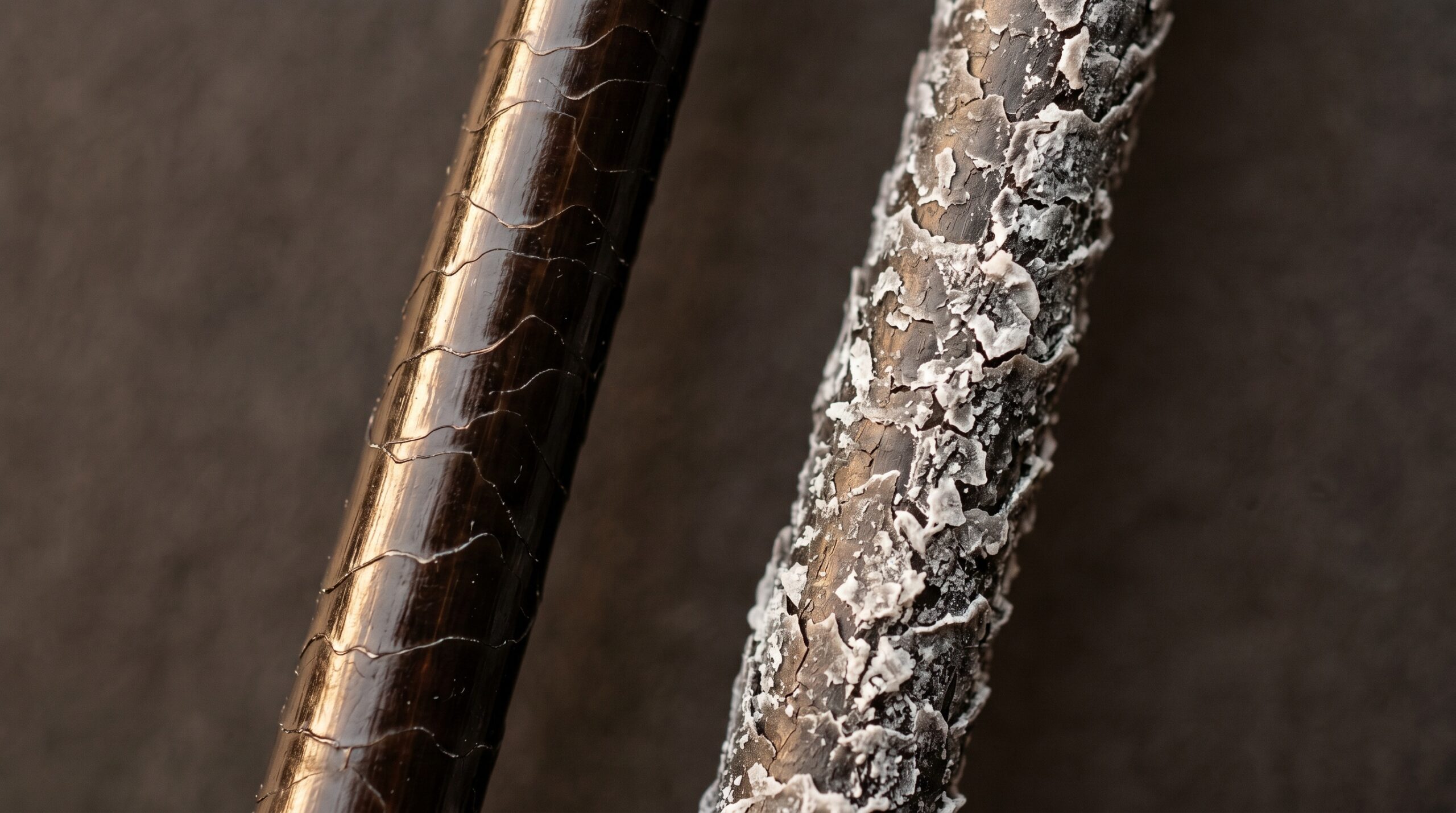
Here is the mechanism that matters. Hard water deposits — primarily calcium carbonate (CaCO₃) and magnesium carbonate (MgCO₃) — form a mineral film on the hair shaft. This film: raises the hair cuticle (the overlapping scale-like outer layer), increasing friction and tangling; creates a rough surface that traps oxidative disinfectants against the hair protein; and when combined with chlorine or chloramine, accelerates the oxidation of cysteine bonds that give hair its tensile strength. The result is not follicle death — it is accelerated breakage of the hair shaft itself, creating the appearance of thinning and increased shedding without true hair loss.
The scalp-level effect is separate and more directly related to actual follicle health. Hard water combined with chlorine raises scalp pH from its optimal 4.5–5.5 to above 6.5 in some cases. According to a 2014 review in the International Journal of Cosmetic Science (Dias, University of Bradford), alkaline scalp conditions disrupt the acid mantle — the protective barrier of sebum and lactic acid that keeps follicles healthy. Disrupted acid mantles are associated with seborrheic dermatitis, an inflammatory scalp condition that can accelerate the telogen (shedding) phase of the hair cycle in susceptible individuals. This is the closest documented mechanism linking water chemistry to true hair loss — via chronic scalp inflammation, not direct follicle damage.
What this means practically: hard water and chlorine cause two distinct problems. First, physical weakening of the hair shaft (breakage — looks like loss, is not). Second, scalp inflammation via pH disruption (can accelerate real shedding in inflammation-susceptible individuals). A shower filter directly addresses the chlorine component of this equation. It partially addresses the hardness issue through the mineral conditioning media in some 12-stage filter cartridges, but it does not remove calcium and magnesium ions from the water.
Australian City Water: Where Your Hair Is Most at Risk
Australia has some of the largest variation in water hardness of any developed country — from Melbourne's mountain snowmelt supply (25 mg/L CaCO₃) to Perth's Integrated Water Supply Scheme drawing from harder groundwater (average 180 mg/L, classified 'hard' by the WHO scale). If you are in a hard water city and experiencing hair breakage, your water supply is a plausible contributing factor. If you are in Melbourne or Hobart, water chemistry should be low on your investigation list.
Adelaide is the standout dual-threat city: it has both hard water AND chloramine as the disinfectant. Chloramine is more chemically stable than free chlorine — it does not off-gas as easily and sits in the water longer, meaning your shower water in Brisbane, Sydney, Adelaide, the Gold Coast, and Darwin contains a disinfectant that is harder to remove than free chlorine. Perth also has hard water, but it is disinfected with free chlorine, so its mineral load is the main hair concern there.
Darwin is also chloramine-disinfected, with moderate hardness (~100 mg/L CaCO₃ in the Dry and higher during the Wet season). Townsville and Cairns use free chlorine, and their water is moderately hard (60–90 mg/L depending on the season and reservoir). If you are in coastal Queensland north of Brisbane, chlorine is your primary shower water concern, not hardness.
What a Shower Filter Can (and Cannot) Do for Your Hair
A shower filter intercepts water between your wall fitting and shower head, pushing it through filtration media before it contacts your skin and hair. The key question is what the media actually removes — and what it cannot. Here is the honest breakdown of the two most relevant hair-damage compounds.
Chlorine and heavy metals: Most shower filter media (KDF-55, calcium sulfite, activated carbon) remove free chlorine effectively — typically 90–99% reduction at normal shower flow rates and temperatures. KDF-55 is an electrochemical filter that oxidises chlorine and reduces heavy metals like lead, mercury, and iron. Calcium sulfite is an NSF/ANSI 177-tested media for free chlorine removal. Activated carbon adsorbs residual chlorine and some VOCs. For chloramine (the disinfectant used in Brisbane, Sydney, Adelaide, the Gold Coast, and Darwin), the chemistry is different: chloramine is far less reactive, and KDF-55, calcium sulfite, and catalytic carbon do not meaningfully reduce it at shower flow rates. Only ascorbic acid (Vitamin C) neutralises chloramine effectively at the short contact times a shower filter allows. Check your specific filter cartridge specifications — a KDF-55 and calcium sulfite stack such as the AquaBliss SF100 targets free chlorine and heavy metals, not chloramine.
Calcium and magnesium (hardness minerals): A shower filter cannot remove calcium and magnesium ions through any of the standard media described above. Ion exchange — the only way to actually soften water — requires resin beads and a salt regeneration cycle. This is what a whole-house water softener does. No inline shower filter available on Amazon AU performs true ion exchange. Some shower filter marketing claims to “condition” or “soften” hard water through the tourmaline and infrared mineral balls included in 12-stage filters — these slightly alter water surface tension but do not remove calcium or magnesium. Do not buy a shower filter expecting it to solve hard water mineral deposition on your hair. It will reduce chemical damage from chlorine; it will not eliminate scale buildup on the hair shaft.
What this means for your decision: if your hair breakage is driven primarily by chemical damage (bleached, brittle, snapping at the scalp), a shower filter is a high-value intervention. If your hair feels coated, looks dull, and tangles despite conditioning, mineral buildup is your primary issue — and a filter helps with the chemical layer but you will still need to address the mineral layer with acidic rinses (diluted apple cider vinegar at pH 3 disrupts mineral deposits) or seek a whole-house softener.
AquaBliss SF100 — Best Shower Filter for Hair in Australia
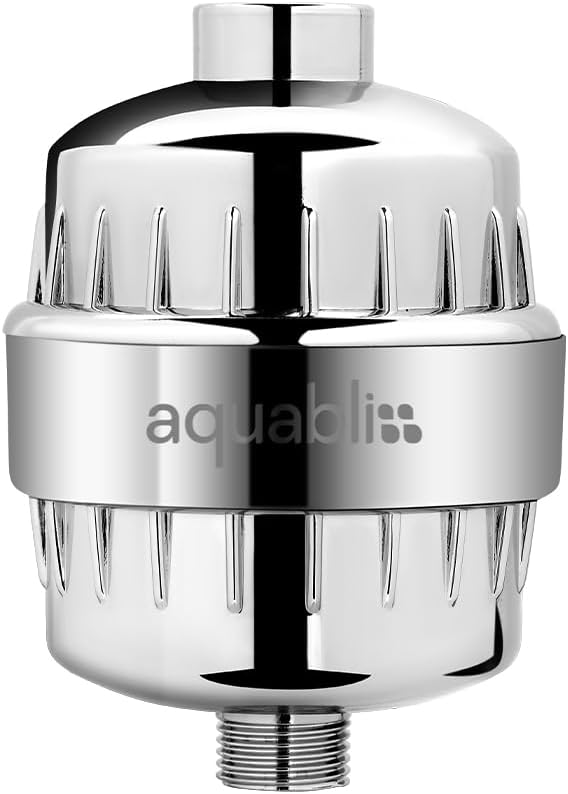
The AquaBliss SF100 is the most recommended shower filter for hair on Amazon AU, with more reviews in the hair/skin improvement category than any competing unit at its price point (~$44 AUD). Its 12-stage filtration stack is what makes it the pick for Australian conditions: KDF-55 for chlorine and heavy metal reduction, calcium sulfite for additional free chlorine removal, activated carbon for VOC and odour reduction, and a suite of mineral ceramic balls (infrared, tourmaline, Maifan stone) that alter water's oxidation-reduction potential and surface tension.
Installation takes under five minutes and requires no tools. Thread the filter body onto your existing shower arm, then attach your existing shower head to the top of the filter — universal 1/2-inch threads fit all standard Australian shower fittings. You do not need a plumber. The filter housing is chrome-finished and visually unobtrusive, matching most standard bathroom hardware.
Filter cartridge replacement is recommended every 6–8 months depending on local water quality. In Adelaide (high-TDS hard water with chloramine) or hard-water Perth (free chlorine), budget for replacement at the 5–6 month mark. In Melbourne or Canberra (soft, free-chlorine water), cartridges last the full 8 months comfortably. Replacement cartridges are available on Amazon AU, keeping the total annual running cost under $50.
The effect on hair typically becomes noticeable at 4–6 weeks. Hair breakage reduces first — because the shaft is no longer being chemically oxidised with every shower. Scalp texture improvements (less dryness, reduced flaking in chloramine-sensitive scalps) typically follow at 6–8 weeks. You will not see regrowth from a shower filter — that is not what it does. What you will see is hair that stops breaking off at the same rate, which creates the appearance of thickening over time as the shaft length increases.
The Full Hair Protection Protocol for Hard Water Australian Cities
A shower filter is step one, not the complete solution for hard water cities. If you are in Perth, Adelaide, or Brisbane, here is the protocol I would run in parallel:
Step 1 — Install the shower filter (day one). The AquaBliss SF100 eliminates the chlorine oxidation layer and heavy metals that compound mineral damage. This is the lowest-cost, highest-ROI intervention. At ~$44 once and ~$30/year in cartridges, you are spending less than one salon keratin treatment that temporarily addresses the same symptoms.
Step 2 — Weekly apple cider vinegar (ACV) rinse. After shampooing and conditioning, apply a solution of 1 tablespoon ACV in 250mL cool water to the full length of your hair. Leave 2 minutes, rinse. ACV at approximately pH 3 disrupts the calcium carbonate mineral film that hard water deposits on the hair shaft. This is the closest thing to a shower-based softening protocol available without plumbing changes. Note: do not use if your scalp has open sores or chemical damage. Start with once per week, not more — ACV at full strength is acidic enough to damage the cuticle with overuse.
Step 3 — Sulphate-free shampoo. Standard shampoos with sodium lauryl sulphate (SLS) are aggressive emulsifiers that strip sebum — the same protective oil that chlorine is already attacking. In hard water, combining SLS shampoo with unfiltered chloramine water maximises sebum stripping and scalp pH elevation. Switch to a sulphate-free shampoo (SLES-free, not just SLS-free — both are similarly aggressive in hard water conditions). You do not need an expensive product; most pharmacy-brand “sensitive” shampoos are now sulphate-free.
Step 4 — Address iron if your water supply shows it. High iron content in the water supply stains hair and promotes free radical oxidation of the hair shaft. Perth's groundwater-sourced supply occasionally has higher iron periods — if your hair has a reddish-gold tinge that worsens after showering, iron may be contributing. The KDF-55 in the AquaBliss SF100 reduces iron through oxidation-reduction reactions.
What this protocol cannot do: restore hair that has shed from follicle miniaturisation (androgenetic alopecia, the most common form of permanent hair loss). That is a DHT-driven hormonal process. If you are losing hair in a classic pattern (receding temples, crown thinning) rather than diffuse breakage, see a GP or dermatologist. A shower filter is not a treatment for pattern baldness — it is an environmental damage reduction tool.
Sources and Methodology
City water hardness figures in this guide are drawn from published water quality reports: Water Corporation WA (Perth), SA Water (Adelaide), Seqwater (Brisbane), Sydney Water (Sydney), Icon Water (Canberra), Melbourne Water, and TasWater. The hair loss research cited is drawn from peer-reviewed dermatology journals accessed via PubMed; we do not cite brand-sponsored studies or anecdotal testimonials as primary evidence.
Decision Tree — Which Approach Is Right for You?
1. Are you in Melbourne, Hobart, or Canberra?
Yes → Your water is soft (low hardness) and free-chlorine. The AquaBliss SF100 solves the disinfectant damage issue completely. Hardness is not a significant factor for you.
No → go to question 2
2. Is your primary hair complaint brittle/snapping hair or coated/dull hair?
Brittle/snapping → Chemical damage (chlorine) is likely primary. AquaBliss SF100 + sulphate-free shampoo addresses this directly.
Coated/dull → Mineral deposition is likely primary. AquaBliss SF100 + weekly ACV rinse — the filter handles chemical damage, the ACV disrupts the mineral film.
3. Have you ruled out medical causes?
No → See a GP or dermatologist first. Iron deficiency anaemia, thyroid dysfunction, and androgenetic alopecia are far more common causes of hair loss than water chemistry. Address these first, then optimise your water quality on top.
Protect your hair from Australian shower water
The AquaBliss SF100 removes the chlorine and heavy metals that oxidise your hair shaft with every shower. At ~$44 on Amazon AU, it costs less than a single salon treatment. Install in under five minutes — no plumber, no tools.
Last reviewed: May 2026 — Clean and Native
Frequently Asked Questions
Does hard water cause hair loss in Australia?
Hard water is associated with increased hair shaft breakage — particularly in cities like Perth (~180 mg/L CaCO₃) and Adelaide (~140 mg/L) — but it is not a proven cause of permanent hair loss (follicle miniaturisation). A 2016 study in the International Journal of Trichology found hard water measurably decreases hair tensile strength. The practical effect is more shedding-looking breakage, not true follicle loss. True hair loss from androgenetic alopecia, thyroid dysfunction, or nutritional deficiency is more common and should be assessed by a GP first.
Will a shower filter stop my hair from falling out?
A shower filter reduces chemical damage (chlorine and heavy metals that oxidise the hair shaft and strip scalp sebum). It can reduce breakage and improve scalp health in chlorine/chloramine-disinfected cities. It cannot remove hardness minerals (calcium/magnesium) and cannot reverse follicle miniaturisation from pattern baldness. Expect fewer broken hairs in the shower within 4–6 weeks — not regrowth of shed follicles.
Which Australian cities have the worst water for hair?
Perth (~180 mg/L CaCO₃, free chlorine) and Adelaide (~140 mg/L, chloramine) have the hardest water of any Australian capital. Adelaide adds chloramine, a more persistent disinfectant, so mineral deposition plus chloramine oxidation is the worst-case scenario for hair. Brisbane (~100 mg/L, chloramine) and Sydney (~80 mg/L, chloramine) are moderate risk. Melbourne (~25 mg/L, free chlorine) and Hobart are the lowest-risk capitals.
Can a shower filter remove calcium and magnesium from water?
No. Standard shower filter media (KDF-55, calcium sulfite, activated carbon, ceramic balls) do not remove calcium or magnesium ions. True softening requires ion exchange resin — the technology used in whole-house water softeners. Marketing claims about shower filters “conditioning” or “softening” water refer to changes in water surface tension, not mineral removal. For mineral deposition on hair, use weekly apple cider vinegar rinses (pH 3 disrupts mineral film) in addition to the shower filter.
Does the AquaBliss SF100 work for chloramine (Brisbane, Sydney, Adelaide, Gold Coast)?
The AquaBliss SF100 uses KDF-55, calcium sulfite, and activated carbon, which reduce free chlorine and heavy metals but do not meaningfully reduce chloramine at shower flow rates. For chloramine cities, only a vitamin C (ascorbic acid) stage neutralises chloramine effectively — see our shower filter for chloramine guide for a full city-by-city breakdown.
How long does it take to see results from a shower filter on hair?
Hair breakage reduction is typically noticeable at 4–6 weeks — the existing hair shaft stops being oxidised with every shower, so it stops breaking at the same rate. Scalp improvements (less dryness, reduced flaking) follow at 6–8 weeks. You will not see regrowth of shed hairs — the filter prevents new damage, it does not repair existing follicle issues. Hair that appears to “thicken” at 2–3 months is typically hair that has stopped breaking off at the same rate.
How often should I replace my shower filter cartridge in Australia?
Every 6–8 months is the standard recommendation. In Perth (high TDS, hard water) and Adelaide (high TDS, chloramine), replace at 5–6 months. In Melbourne and Canberra (soft, low-TDS supply), extend to 7–8 months. A saturated cartridge provides little filtration — it does not harm your water, it just passes everything through unfiltered. If your shower water smells of chlorine despite having a filter, the cartridge is exhausted.
Is the AquaBliss SF100 available in Australia and does it fit Australian shower fittings?
Yes. The AquaBliss SF100 is available on Amazon Australia (ASIN B01MUBU0YC) and ships domestically. It uses universal 1/2-inch NPT threads — the same standard used on all Australian shower arms. No adapter is needed. Installation requires no tools: hand-tighten the filter body onto the shower arm, then thread your existing shower head onto the top of the filter.
What is the difference between hard water hair damage and pattern baldness?
Hard water hair damage causes hair shaft breakage (the hair strand itself snaps) and diffuse shedding via scalp inflammation — hair comes out evenly across the whole head and the new hair is the same calibre as the hair that shed. Pattern baldness (androgenetic alopecia) causes follicle miniaturisation — each new hair grown by an affected follicle is progressively finer and shorter until the follicle stops producing visible hair. Pattern baldness follows a characteristic distribution (temples, crown for men; diffuse thinning at the crown for women). Hard water damage does not follow a pattern and does not affect follicle calibre.
What else can I do alongside a shower filter to protect my hair from hard water damage?
Weekly apple cider vinegar rinse (1 tablespoon in 250mL water, 2 minutes post-conditioning) disrupts the mineral film that hard water deposits on the hair shaft. Sulphate-free shampoo (SLS and SLES-free) prevents additional stripping of protective sebum on top of what chlorine already removes. Rinsing with cold water after conditioning — which closes the hair cuticle — reduces mineral penetration into the hair shaft. These three interventions, combined with the AquaBliss SF100, represent the full non-plumbing-change protocol for hard water hair protection in Australian conditions.
What to Actually Look For in a Shower Filter for Hair Loss
1. Chloramine vs Free Chlorine Removal — Check Your City First
This is the decision that makes or breaks every other specification. Search “[your city] water chloramine” or call your water authority. If you’re in a chloramine city (Brisbane, Sydney, Adelaide, Gold Coast, Darwin), you need a filter with a vitamin C (ascorbic acid) stage or NSF-tested chloramine performance data. KDF-55 and calcium sulfite are primarily effective against free chlorine, not chloramine. If you’re in Melbourne or Hobart, a standard KDF-55 + activated carbon filter is genuinely effective. Buying a Melbourne-optimised filter for a Brisbane shower is a category error.
2. KDF-55 vs Vitamin C vs Calcium Sulfite — The Media Comparison
KDF-55 (zinc-copper alloy): reduces free chlorine and heavy metals such as lead, mercury, and iron. It does not meaningfully reduce chloramine. Vitamin C (ascorbic acid): the only shower-filter media that neutralises chloramine effectively at the short contact times a shower allows. Some formulations degrade at higher temperatures, so check the temperature rating before buying. Best for chloramine cities, colour-treated hair, and sensitive scalps. Calcium sulfite: reduces free chlorine and is cost-effective, but it does not meaningfully reduce chloramine at shower flow rates. For hair loss in chloramine cities, look for a vitamin C stage; KDF-55 and calcium sulfite are valuable mainly for free chlorine and heavy metals.
3. NSF Certification — What It Actually Means
NSF/ANSI 177 is the only certification specific to shower filters. It tests free chlorine reduction performance against a standardised challenge concentration (2.0 mg/L) at standard flow rates and temperatures. An NSF 177 rating means an independent laboratory has verified the performance claim. Products without NSF certification may perform identically — or may not. If the performance claim matters to you and you want independent verification, NSF 177 is the signal to look for. For chloramine cities, note that NSF 177 currently tests primarily for free chlorine reduction; chloramine-specific lab data is the equivalent verification for chloramine markets.
4. Filter Life and Running Cost
Look at the cost per litre, not the sticker price. A $60 filter that lasts 3 months costs more per year than a $120 filter that lasts 12 months. Using a filter beyond its rated life is counterproductive — exhausted KDF and carbon media can release concentrated contaminants back into the water.
5. Hard Water: When a Filter Isn’t Enough
Perth residents with hair hardness (mechanical breakage, mineral deposits, dull finish that doesn’t respond to conditioner) have a hard water problem; Perth is disinfected with free chlorine, not chloramine. A shower filter removes free chlorine and heavy metals; it does not meaningfully reduce water hardness (total dissolved solids). For Perth and Adelaide households where mineral deposits are the primary driver of hair quality issues, consider a combined approach: a shower filter for the disinfectant plus a dedicated water softener for mineral removal.
Do I need a special shower filter if I’m in Perth?
Perth’s main shower-water challenge is very hard water (around 180 mg/L calcium carbonate); it is disinfected with free chlorine, not chloramine. A standard shower filter will address the free chlorine that oxidises keratin. However, the high mineral hardness that causes calcium and magnesium deposits on the hair shaft requires a separate intervention. A water softener, or a post-shower vitamin C rinse to chelate residual minerals, is recommended for Perth residents who experience significant mechanical breakage that doesn’t improve after 8 weeks of using a shower filter.
Can a shower filter help with scalp conditions like psoriasis or dandruff?
Chlorine and chloramine can irritate the scalp and disrupt its microbial balance, which may worsen inflammatory conditions such as seborrhoeic dermatitis and psoriasis. A shower filter that removes free chlorine reduces one chemical stressor. Chloramine specifically requires a vitamin C (ascorbic acid) stage, as KDF-55 and calcium sulfite do not meaningfully remove it at shower flow rates.
Is vitamin C or KDF-55 better for hair loss in Australia?
In chloramine cities (Brisbane, Sydney, Adelaide, Gold Coast, Darwin): vitamin C (ascorbic acid) is the media to prioritise, because it is the only shower-filter media that neutralises chloramine effectively at typical shower flow rates and contact times. KDF-55 does not meaningfully reduce chloramine and is better suited to free chlorine and heavy metals. In free chlorine cities (Melbourne, Hobart, Perth, Canberra): KDF-55 with activated carbon is effective and practical for free chlorine removal. Filters that combine a vitamin C stage with KDF-55 cover the widest range of Australian supplies.
Choosing the right filter: The filter media matters more than the brand. See our full best shower filter Australia guide — we rank 6 models by city water type (chloramine vs free chlorine) with tested results.
Get the Australian Home Environment Checklist
30 checks across water, air and EMF. Most of them free. Ranked by impact.
No spam. Unsubscribe any time.

Former Royal Australian Navy Clearance Diver and TAG-E counter-terrorism operator. Founded Clean and Native to apply the same rigorous thinking to the home environment.
Full biography →