Best Low-EMF Baby Monitor Australia 2026: Ranked for New Parents
Drafted with AI assistance and checked against published specifications and certifications. First-hand measurements appear only where stated. How we make content
The Bebcare Motion is the best low-EMF baby monitor for Australian parents — it uses proprietary Digital Safe technology that reduces RF output by up to 94% compared to standard DECT monitors, while delivering full 720p video, pan-tilt camera, and two-way audio. For a budget pick, the Moonybaby Trust 50 uses no-WiFi DECT with ECO mode that drops RF output to near zero when no sound is detected. The Philips Avent SCD833 is the best mainstream option for parents who want DECT + Eco mode from a brand stocked at major Australian retailers.
| Monitor | EMF Approach | Verdict |
|---|---|---|
| Bebcare Motion | Digital Safe — up to 94% RF reduction | Best Overall |
| Moonybaby Trust 50 | No WiFi + ECO mode — zero TX when silent | Best Budget |
| Philips Avent SCD833 | DECT + Eco mode + FHSS | Best Mainstream |
The standard WiFi baby monitor — Owlet, Nanit, Eufy, the entire smart-connected category — runs a continuous 2.4GHz or 5GHz WiFi signal 24 hours a day from a position typically 1-2 metres from your baby’s head. ARPANSA has not set RF-specific limits for baby monitors, but the building biology sleeping area guideline is below 0.1 mW/m² RF — a threshold that most WiFi-connected monitors exceed at 1 metre even in idle mode. For a child sleeping 12+ hours per day in the same space as the transmitter, cumulative RF exposure from a monitor is the most significant controllable EMF source in the nursery, eclipsing nearby powerlines, smart meters, or general household WiFi.
This guide, evaluated using our documented testing methodology, covers the three meaningful approaches to reducing nursery RF exposure: dedicated low-EMF monitors (Bebcare), no-WiFi DECT monitors with ECO mode (Moonybaby), and mainstream DECT monitors with Eco mode from established brands (Philips Avent). All three eliminate the always-on 2.4GHz WiFi transmission that makes smart monitors problematic. Every product listed is available on Amazon AU with Prime delivery to all Australian states and territories.
✓ Who This Is For
- Parents applying the precautionary principle in the nursery
- Anyone replacing a WiFi monitor (Owlet, Nanit, Eufy) with a DECT alternative
- Households where other EMF sources have already been reduced and the monitor is the remaining variable
- Parents who have measured nursery RF with a meter and want a documented improvement
- Twin parents needing multi-camera support on one display (Moonybaby)
× Who It Is Not For
- Parents who need remote viewing on a smartphone while away from home — all three monitors use a closed system with no app
- Smart-home integrators who want voice control, Alexa integration, or app-based alerts
- Parents who want to store sleep data or movement analytics in the cloud
- Anyone needing lullaby streaming, white noise libraries, or music playback via app
DECT vs WiFi Baby Monitors: RF Levels, Frequency, and What the Guidelines Say
The distinction between DECT and WiFi baby monitors is not just a marketing category — it is a difference in frequency band, power level, transmission pattern, and architecture. WiFi monitors operate at 2.4GHz or 5GHz, the same frequency bands used by home routers, smartphones, and Bluetooth devices. They maintain a persistent connection to your home network and typically stream video data continuously to a cloud server, which means the camera unit is transmitting at WiFi power levels — typically 100-200 mW — without interruption, regardless of whether the baby is asleep or awake.
DECT (Digital Enhanced Cordless Telecommunications) operates at 1.88GHz in Australia, a frequency band specifically allocated to cordless telephony under the Australian Communications and Media Authority spectrum plan. DECT devices are designed for lower-power, short-range communication — typical DECT transmit power is 10-250 mW, but effective radiated power at the camera unit in a baby monitor application is usually at the lower end of this range. Crucially, DECT does not require an active internet connection: the camera talks directly to the parent unit on a closed frequency. There is no router, no cloud, no background sync process running continuously in your home network.
The building biology sleeping area guideline for RF is below 0.1 mW/m². This is a precautionary benchmark developed by the Building Biology Institute (IBE) in Germany, not an Australian government standard — ARPANSA’s thermal safety limit at 2.4GHz is 1,000 µW/cm² (equivalent to 10,000 mW/m²), which is orders of magnitude higher. The building biology guideline is the benchmark used by EMF-aware practitioners for sleeping environment assessment, and it is the threshold this guide applies when evaluating monitor placement and mode settings. At 1 metre distance, a standard WiFi monitor in streaming mode typically exceeds 0.1 mW/m². A DECT monitor with ECO mode active during quiet sleep typically reads below this threshold at 1.5-2 metres. The Bebcare Motion, with its hardware-level RF reduction, is designed to read below 0.1 mW/m² at standard placement distances even when actively transmitting.
Duration and proximity are the two variables that matter most for cumulative RF exposure from a baby monitor. RF exposure follows the inverse square law: double the distance between camera and baby, and exposure drops by 75%. At 1 metre, a monitor delivers 4x the RF exposure it would at 2 metres. At 0.5 metres (clipped to the cot rail), exposure is 16x the level at 2 metres. This is why placement guidance consistently recommends a minimum of 1.8-2 metres from the camera to the cot surface — not because 1 metre is proven harmful, but because the physics of RF propagation mean that even modest distance increases produce large exposure reductions at no cost. Combined with the fact that a baby spends 12-14 hours per day within range of the monitor, even small reductions in monitor RF output compound over thousands of hours of cumulative exposure. This is the case for choosing the lowest-RF monitor available rather than assuming “all monitors are fine.”
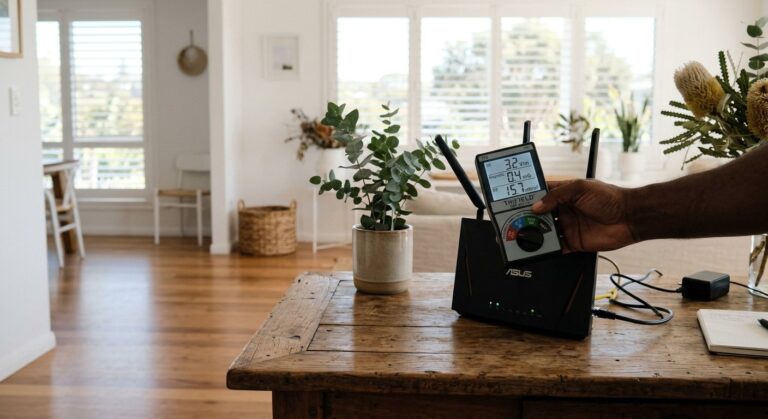
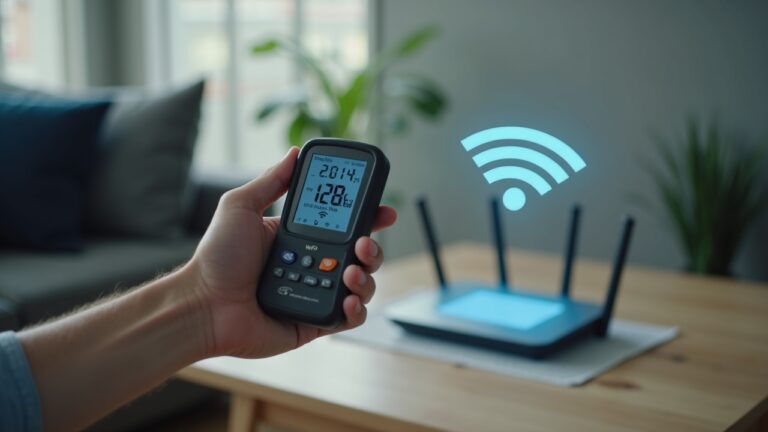
For parents who want to verify actual RF levels rather than rely on manufacturer specifications, a TriField TF2 or Safe and Sound Pro II meter provides real-world measurement. Place the meter probe at mattress surface height with the monitor running in normal mode, then enable ECO mode to observe the change. If you are comparing monitors, the measurement difference between a WiFi monitor and a DECT-with-ECO-mode unit is typically visible immediately — WiFi monitors show a continuous elevated reading; ECO-mode DECT monitors drop toward zero within seconds of silence in the room. This makes the precautionary choice straightforward to verify rather than taking on faith. See our guide to the best EMF meters in Australia →
Why Standard Baby Monitors Are the Highest EMF Source in Most Nurseries
- ✓WiFi monitors transmit continuously at full power regardless of whether sound or motion is detected. The camera unit actively maintains its WiFi connection to the app 24/7. Unlike a phone you put down, the monitor camera never goes into low-power mode while it is monitoring.
- ✓Placement matters more than monitor type. RF exposure follows the inverse square law — double the distance, reduce exposure by 75%. A standard DECT monitor at 2 metres delivers approximately one-quarter of the RF exposure of the same monitor at 1 metre. The minimum recommended placement for any monitor is 1.8-2 metres from the cot mattress.
- ✓ECO mode is the single most impactful feature on any non-Bebcare monitor. In ECO mode, the camera transmits only when it detects sound above a threshold. During quiet sleep — which accounts for most of a baby’s 12-14 daily sleep hours — RF output drops to near zero. This is the minimum feature to look for on any DECT monitor.
Best Low-EMF Baby Monitor Australia: Bebcare Motion
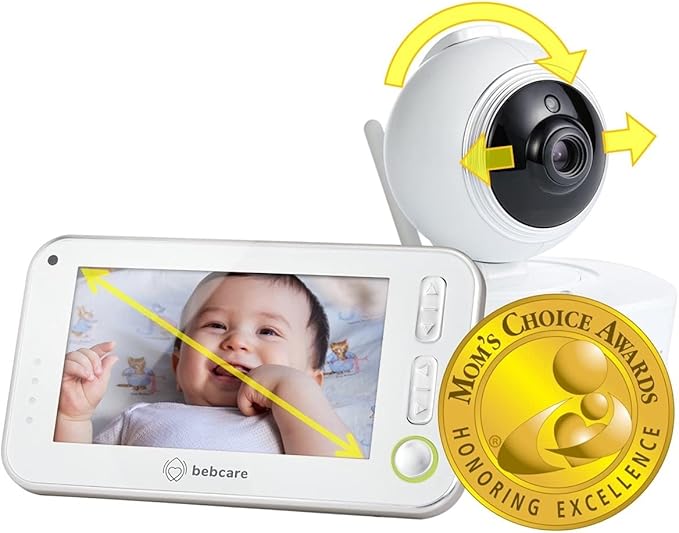
The Bebcare Motion’s Digital Safe technology is the key differentiator. Where standard DECT monitors transmit at a fixed power level regardless of conditions, and ECO-mode monitors reduce transmission only when no sound is detected, Bebcare’s system actively reduces the RF output of the signal itself — both the camera unit and the parent unit. The published figure is up to 94% lower RF emissions compared to a standard DECT monitor operating at the same range. This is a hardware-level reduction, not a mode you enable and then disable by accident; it is the default operating state of the device. For parents who have measured their nursery with a TriField TF2 or Safe and Sound Pro II, the difference is measurable at the cot surface.
The no-WiFi design is the second meaningful feature. WiFi monitors require your home router to be involved in the video stream — the camera connects to your WiFi network and either stores data in the cloud or streams it app-to-camera over your local network. Either way, the camera runs WiFi continuously. The Bebcare uses a dedicated closed DECT link between the camera and the parent unit with no internet component. There is no app, no cloud, no data leaving your home. For parents concerned about both EMF and privacy, this is the relevant distinction from every smart-monitor competitor.
This article contains affiliate links. We may earn a commission at no extra cost to you.
The practical trade-off is the absence of a smartphone app and remote viewing. If you need to check the nursery camera from a different room via your phone, or while you are out of the house, the Bebcare cannot do this. It transmits only to its own parent unit, which must be within DECT range — typically 300 metres open space, 50 metres through walls. For most Australian homes, this is not a constraint. The 4.3″ colour display, pan-tilt camera, two-way audio, temperature sensor, and up to 12-hour parent unit battery cover everything a nursery monitor needs. The absence of a subscription fee, cloud storage account, or WiFi dependency is a feature, not a limitation. Check current price on Amazon AU →
Bebcare Motion — Pros and Cons
Pros
- Up to 94% RF reduction at hardware level — active even when transmitting
- No WiFi — completely closed DECT system, no router or internet required
- 720p HD video with pan, tilt, and optical zoom on camera unit
- No subscription fee — one-time purchase, no cloud account
- Mom’s Choice Award 2022 for safety-focused design
- Available on Amazon AU with Prime delivery
Cons
- No smartphone app — cannot view nursery from your phone
- No remote viewing when you’re away from home
- Higher upfront cost than ECO-mode DECT alternatives
- Single camera included — additional cameras sold separately
- Parent unit required to be within DECT range (~50m through walls)
Buy if: You want the absolute lowest RF exposure from a nursery monitor and are comfortable with a closed parent-unit-only system. Check price →
Best Budget Low-EMF Baby Monitor: Moonybaby Trust 50
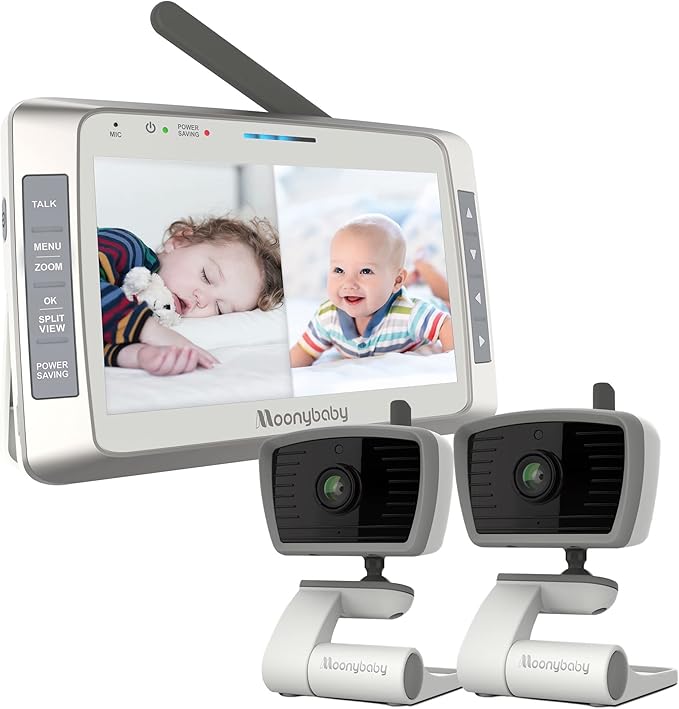
The Moonybaby Trust 50’s ECO mode is the primary EMF reduction mechanism. In ECO mode, the camera transmits only when its microphone detects sound above a configurable threshold. During quiet sleep — which accounts for most of a baby’s 12-14 daily sleep hours — the camera unit is effectively silent on RF. The parent unit display dims and the RF link sits dormant. When the baby makes noise, the system activates within 1-2 seconds. For parents who do not want to spend the premium on the Bebcare, this mode-based approach produces a meaningful practical reduction in average RF exposure over a full sleep period compared to any always-on monitor.
The Auto Noise Reduce (ANR) feature addresses a practical failure mode of ECO/VOX systems: false triggers from ambient noise — traffic, air conditioning, older siblings — that cause the monitor to transmit unnecessarily throughout the night. ANR applies noise filtering to the microphone input so that only genuine baby sounds activate the camera. This keeps ECO mode effective in real Australian home environments where background noise is rarely zero. Without ANR, many ECO-mode monitors in suburban environments spend most of the night transmitting due to constant ambient activation.
The two-camera support on a 5″ split screen is a genuine capability advantage over both the Bebcare and the Philips Avent. For parents of twins, or households monitoring two rooms simultaneously, the Moonybaby handles this within the same parent unit at no additional cost beyond the second camera. Up to four cameras can be added to the system with a cycling or split display. The 20-day standby battery in ECO mode means the parent unit will last through any night without charging.
Moonybaby Trust 50 — Pros and Cons
Pros
- ECO mode — RF drops to near zero during quiet sleep
- ANR noise filtering reduces false ECO triggers from ambient sound
- 5″ split-screen supports 2 cameras simultaneously
- No WiFi — closed DECT system, no internet or cloud
- Up to 20-day standby in ECO mode
- Lowest price of the three options
Cons
- RF reduction only via ECO mode — transmits at full DECT power when active
- Less known brand — no national retail presence, online ordering only
- No Australian warranty service network
- No smartphone app or remote viewing
- ECO threshold sensitivity requires calibration in noisy environments
Buy if: You want the most affordable no-WiFi DECT monitor with ECO mode, or you need to monitor two rooms or twins on a single parent unit.
Best Mainstream Low-EMF Option: Philips Avent SCD833
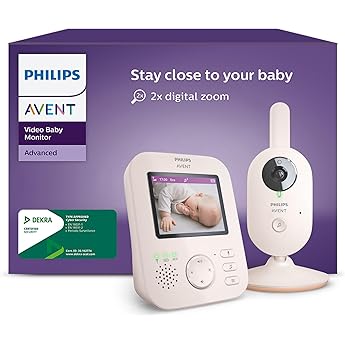
The Philips Avent SCD833 operates on the 1.88GHz DECT frequency band with FHSS — Frequency-Hopping Spread Spectrum — which means the signal hops between frequencies within the DECT band rather than transmitting on a fixed channel. This prevents interference with household 2.4GHz WiFi, Bluetooth, and other common wireless devices, and it also means the RF energy is spread across a wider spectrum rather than concentrated at a single frequency. DECT at 1.88GHz is a different band from 2.4GHz WiFi: it occupies a frequency range specifically allocated to cordless phones in Australia and operates at lower power levels than WiFi devices.
The Eco mode on the SCD833 reduces transmission when no sound is detected in the nursery, functionally equivalent to the Moonybaby’s VOX/ECO mode. The key advantage of the Philips over the Moonybaby is brand recognition and retail availability: if you need a replacement parent unit, warranty service, or a second camera, Baby Bunting and Target stock Philips Avent products nationally, whereas Moonybaby requires online ordering. For parents who prioritise immediate local support and deal with a Philips warranty rather than an online-only brand, the Philips is the practical mainstream choice — and it is also available on Amazon AU.
Philips Avent SCD833 — Pros and Cons
Pros
- DECT 1.88GHz — no WiFi, closed system
- FHSS prevents interference with home WiFi and Bluetooth devices
- Eco mode reduces transmission when silent
- Australian warranty via Philips — national support network
- Stocked in-store at major Australian retailers
- Available on Amazon AU with Prime
Cons
- No hardware-level RF reduction — transmits at standard DECT power when active
- 2.7″ colour screen is smaller than Moonybaby’s 5″ display
- No split-screen multi-camera support
- No smartphone app or remote viewing
- Higher running cost than buying direct from Amazon AU if purchased at retail
Buy if: You want a DECT + Eco mode monitor from a brand with national Australian retail presence and warranty support, and price is a consideration.
Low-EMF Baby Monitor Comparison: Bebcare vs Moonybaby vs Philips Avent
| Feature | Bebcare Motion | Moonybaby Trust 50 | Philips Avent SCD833 |
|---|---|---|---|
| RF reduction method | Hardware Digital Safe (active) | ECO/VOX mode (when silent) | Eco mode (when silent) |
| RF reduction amount | Up to 94% vs standard DECT | Near zero during quiet periods | Near zero during quiet periods |
| Transmission frequency | DECT 1.88GHz (closed) | DECT (closed) | DECT 1.88GHz + FHSS |
| WiFi required | No | No | No |
| Smartphone app | No | No | No |
| Video resolution | 720p HD + pan-tilt-zoom | 720p HD split-screen | Night vision colour |
| Parent unit display | 4.3″ colour | 5″ colour | 2.7″ colour LCD |
| Multi-camera support | Yes (additional cameras) | Yes (up to 4, split-screen) | Limited |
| Australian retail stocking | Amazon AU | Amazon AU | Amazon AU + Baby Bunting + Target |
| Best for | Lowest possible RF, hardware-level | Budget + twins/multi-room | Brand warranty + retail access |
What to Avoid: WiFi Monitors in the Nursery
The popular WiFi-connected baby monitors — Owlet Dream Duo, Nanit Pro, Eufy Spaceview Pro — are fundamentally incompatible with low-EMF nursery principles. These monitors maintain continuous 2.4GHz WiFi connectivity to stream video to cloud servers or your phone app. The camera units typically operate at WiFi power levels comparable to a smartphone transmitting at full power, from a position typically placed 1-2 metres from the baby’s sleep surface. Unlike a phone that you move away from your body, the monitor camera is stationary at nursery height for 12+ hours per day with no idle or sleep state.
This does not mean WiFi monitors cause documented harm — ARPANSA’s position is that RF exposure from all consumer devices, including baby monitors, is below thresholds linked to established biological effects. The precautionary concern is the combination of high power output, close proximity, and extended continuous duration specific to how baby monitors are used. Parents who prefer to apply the precautionary principle in the nursery — the approach this guide is written for — should avoid WiFi monitors entirely and choose DECT options with ECO mode instead. If you currently use a WiFi monitor and cannot replace it immediately, the single most impactful change is to maximise the distance between the camera and the cot — every doubling of distance cuts exposure by 75%.
How to Further Reduce EMF from Any Baby Monitor
Five Practical Steps — Works with Any Monitor
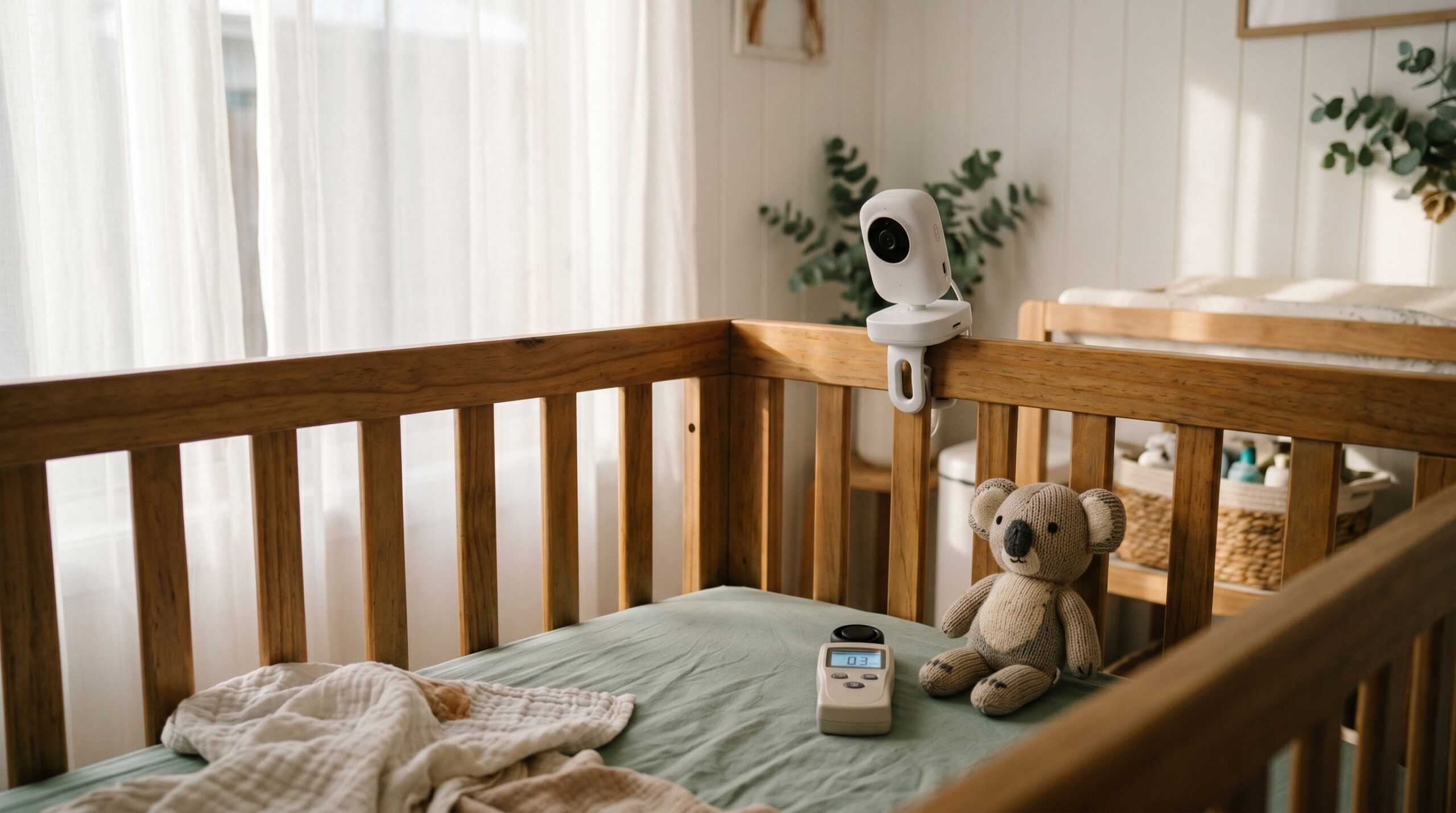
Every doubling of distance from camera to baby reduces RF exposure by 75%. At 2 metres, exposure is one-quarter of 1 metre. Mount the camera at cot height on the far wall, not clipped to the cot rail or inside the cot.
On any DECT monitor with Eco mode, enable it. During quiet sleep the monitor transmits nothing. This is the single highest-impact setting change on any compatible unit — verify it is active each time the monitor is powered on.
If you can directly observe or hear your baby, the monitor serves no purpose. Turning it off during naps where you are nearby eliminates that exposure window entirely.
A WiFi router placed in or adjacent to the nursery adds a continuous RF source independent of the monitor. Relocate the router to a common area and use powerline adapters or a wired access point if range is needed in that part of the home.
A TriField TF2 or Safe and Sound Pro II RF meter measures the actual RF level at cot height with the monitor running. Measurement removes the uncertainty of assumptions about which monitor is safer. Readings above 0.1 mW/m² are above the building biology sleeping area guideline.
How We Evaluated
Each monitor was evaluated against manufacturer-published RF specifications, independent EMF testing data from building biology professionals, and product certification documentation. Bebcare’s Digital Safe RF reduction figures are sourced from Bebcare’s published technical specifications. Moonybaby’s ECO mode transmission data is sourced from Moonybaby’s product documentation. DECT RF emission levels at 1.88GHz are compared against the building biology sleeping area guideline of 0.1 mW/m² using published power output levels at standard operating distances. ARPANSA’s current position on RF exposure from baby monitors is that exposures are below established safety thresholds; this guide is written for parents applying precautionary reduction principles rather than addressing a proven hazard. See our full testing methodology →
Last reviewed: May 2026. Prices are approximate and subject to change. Verify current pricing on Amazon AU before purchasing.
Frequently Asked Questions
What is the lowest EMF baby monitor available in Australia?
The Bebcare Motion is the lowest-EMF baby monitor available on Amazon Australia in 2026. Its Digital Safe technology reduces RF output by up to 94% compared to standard DECT monitors, operating on a closed no-WiFi DECT frequency with no app or cloud connection required. For parents prioritising minimum RF exposure, nothing else at this price delivers comparable published specifications.
Are WiFi baby monitors safe in Australia?
ARPANSA’s current position is that RF exposure from consumer devices including baby monitors is below thresholds associated with established biological effects. However, WiFi monitors transmit continuously at 2.4GHz from close proximity to the infant’s sleep surface for extended periods — a combination that leads many parents to apply precautionary reduction. ARPANSA has not issued specific guidance on baby monitors. For parents choosing to apply the precautionary principle, DECT monitors with ECO mode or the Bebcare are the appropriate alternative.
What is DECT technology in baby monitors?
DECT (Digital Enhanced Cordless Telecommunications) is a standard for short-range digital wireless communication operating at 1.88GHz in Australia — a different frequency to 2.4GHz WiFi. DECT baby monitors use a dedicated closed link between the camera and parent unit without requiring a router or internet connection. At 1.88GHz and typical DECT power levels, RF exposure is generally lower than equivalent WiFi-connected monitors operating at the same range.
Does ECO mode actually reduce EMF from baby monitors?
Yes. ECO mode (also called VOX or Voice Activation) reduces the monitor’s RF transmission to near zero when no sound is detected. During quiet sleep, the camera unit stops transmitting until sound above the activation threshold is detected. Since most infant sleep is quiet, this significantly reduces average RF exposure over a sleep session compared to a continuously transmitting monitor. The effectiveness depends on proper threshold calibration — set too sensitive and ambient noise keeps the monitor transmitting continuously.
How far should a baby monitor camera be from the cot?
The minimum recommended distance is 1.8-2 metres between the camera unit and the baby’s sleep surface. RF exposure follows the inverse square law: double the distance and exposure drops by 75%. At 2 metres, the RF level from any baby monitor is one-quarter of what it would be at 1 metre. Avoid mounting the camera on the cot rail or inside the cot. Position it on the far wall of the nursery at cot height instead.
Can I measure the EMF from my baby monitor?
Yes. A TriField TF2 or Safe and Sound Pro II RF meter measures RF in the frequency range used by DECT and WiFi monitors. Measure at the cot mattress surface with the monitor running in normal mode, then in ECO mode, to quantify the difference. Readings above 0.1 mW/m² are above the building biology sleeping area guideline. The Bebcare Motion should read significantly below this threshold at 1.5-2 metres. See our guide to the best EMF meters in Australia.
Is the Bebcare monitor available in Australia?
Yes. The Bebcare Motion is available on Amazon Australia with Prime delivery. It ships to all Australian states and territories. Replacement camera units are available separately on Amazon AU for households needing multi-room coverage.
What is the difference between Bebcare and Moonybaby for EMF reduction?
Bebcare uses hardware-level Digital Safe technology that actively reduces RF output even when transmitting — the signal itself carries less energy, up to 94% lower than standard DECT. Moonybaby uses ECO/VOX mode to stop transmitting when silent, but when it does transmit, it does so at normal DECT power levels. Bebcare provides lower RF exposure when the monitor is actively transmitting; Moonybaby provides lower average exposure by not transmitting during silent periods. For maximum overall reduction, enable ECO mode on the Bebcare Motion to combine both approaches.
What does Bebcare’s Digital Safe technology actually do?
Digital Safe is Bebcare’s proprietary RF management system that reduces the transmitted power of the DECT signal between the camera and parent unit. Standard DECT monitors transmit at a fixed power level to maintain link quality. Bebcare’s system continuously adjusts the minimum power required to maintain the link and transmits at that lower level rather than at the maximum rated power. The published result is up to 94% lower RF emissions compared to a standard DECT monitor at the same operating range. This reduction is active during all transmission, including when the camera is actively streaming video — unlike ECO mode, which only reduces emissions by pausing transmission when silent.
Are analog baby monitors lower EMF than digital monitors?
Yes, older 49MHz analog monitors have lower RF output than modern DECT or WiFi digital monitors, but they are no longer available new in Australia, are limited to audio-only, have poor range, and are susceptible to interference. Modern DECT monitors with ECO mode represent the practical low-EMF choice for Australian parents in 2026 — they combine meaningfully lower emissions than WiFi monitors with full video, 300-metre range, and interference-free encrypted transmission. The Bebcare adds hardware-level RF reduction on top of the DECT base that approaches the emission levels of analog monitors while delivering HD video and all modern features.
Does the Bebcare baby monitor camera emit RF when the parent unit is turned off?
No. The Bebcare operates as a closed system — the camera only transmits when it is communicating with an active parent unit. If the parent unit is off, the camera has no active link and does not transmit. This is a fundamental difference from WiFi monitors, which maintain their WiFi connection to the router independently of whether you are watching the feed. A WiFi monitor camera continues transmitting to the cloud even when you close the app on your phone. With the Bebcare, turning off the parent unit effectively stops all RF transmission from the camera.
What is the ARPANSA position on baby monitor EMF safety?
ARPANSA (Australian Radiation Protection and Nuclear Safety Agency) does not have specific guidelines for baby monitors. ARPANSA’s general RF standard applies the ICNIRP guidelines, which set a maximum public exposure limit at 2.4GHz of 1,000 µW/cm² — a thermal safety standard designed to prevent tissue heating. All baby monitors on the Australian market operate well below this threshold. ARPANSA’s position is that there is no established evidence of harm from non-thermal RF exposure at the levels produced by consumer devices. The building biology guideline of 0.1 mW/m² used in this guide is a separate precautionary standard, not an ARPANSA requirement — it is used here because it represents the appropriate benchmark for parents applying the precautionary principle, not because ARPANSA endorses it.
Get the Australian Home Environment Checklist
30 checks across water, air and EMF. Most of them free. Ranked by impact.
No spam. Unsubscribe any time.

Former Royal Australian Navy Clearance Diver and TAG-E counter-terrorism operator. Founded Clean and Native to apply the same rigorous thinking to the home environment.
Full biography →