Best Air Purifier for Large Rooms Australia 2026: Ranked by CADR, ACH, and Running Cost
Drafted with AI assistance and checked against published specifications and certifications. First-hand measurements appear only where stated. How we make content
Quick Verdict
Best Air Purifier for Large Rooms Australia 2026
The Breville Smart Air Viral Protect Max (LAP608) is the best air purifier for large rooms in Australia in 2026 — it delivers a verified CADR of 530 m³/h, HEPA-13 AntiViral certification, and covers a practical 53 m² at the medically recommended 4 air changes per hour, all for $499 AUD.
| Pick | Model | Price | CADR |
|---|---|---|---|
| Recommended | Breville Protect Max | $499 | 530 m³/h |
| Best Value | Winix Zero Pro | $429 | 470 m³/h |
| Premium Quietest | Dyson BP04 | $1,599 | Not published |
Large rooms punish undersized air purifiers silently — the unit runs, the indicator light stays green, and you never realise you are turning the air over twice an hour instead of four times. This comparison draws on manufacturer specifications, published third-party CADR data, and certification standards. See our methodology for how we compare units.
How We Compare Large Room Air Purifiers
This comparison relies on manufacturer specifications and published third-party data rather than our own measurements. Where CADR figures exist from third-party testing bodies (GB/T 18801-2015 for the Breville, AS 4260 for the Winix), we use those numbers as the baseline. Where manufacturers decline to publish CADR (as Dyson does), we note the omission explicitly rather than repeating the manufacturer’s room-size marketing claim.
Noise figures are drawn from manufacturer specifications and published third-party sources. Filter running cost is normalised to Australian retail pricing at the time of writing, using manufacturer-recommended replacement intervals as a ceiling, and a more conservative 6-month interval as a floor for households in bushfire-affected areas. Full methodology is published at our testing methodology page.
ACH (air changes per hour) is calculated from the published CADR, the room’s floor area, and a standard 2.4 m ceiling height — the actual measurement standard that determines whether an air purifier is doing useful work in your room, not the manufacturer’s peak m² claim.
The Practical Room Size Problem
This is the single most misrepresented figure in every air purifier comparison you will find online. Manufacturers rate their products at 2 air changes per hour. Medical and occupational health standards — including those used by the US CDC and referenced by the National Asthma Council Australia — recommend a minimum of 4 ACH for normal residential use, and 5 or more ACH during active smoke events or for occupants with asthma or severe allergies. A unit rated “138 m²” at 2 ACH is only covering 69 m² at 4 ACH. That is not a rounding error — it is the difference between adequate filtration and theatre.
The formula is straightforward. CADR (m³/h) divided by ceiling height (2.4 m) divided by target ACH (4) gives you the practical floor area in m². At standard ceiling height, this simplifies neatly to: practical m² ≈ CADR ÷ 10. This is the number you should use when comparing units, not the headline m² on the box.
Room Size Formula
Practical m² = CADR (m³/h) ÷ ceiling height (m) ÷ 4 ACH × 60 ÷ 60
Simplified (2.4 m ceiling, 4 ACH): practical m² ≈ CADR ÷ 10
- Breville (CADR 530) → ~53 m² at 4 ACH
- Winix (CADR 470) → ~47 m² at 4 ACH
- Manufacturer “138 m²” claim → only 2 ACH, inadequate for air quality purposes
- During bushfire smoke: target 5+ ACH — reduce practical m² by 20%
Applying this to the three units in this guide: the Breville’s CADR of 530 m³/h gives you a practical coverage of around 53 m² at the 4 ACH standard. The Winix at 470 m³/h covers around 47 m². Dyson does not publish a CADR at all, so we cannot run the same calculation — we have estimated approximately 42 m² based on room-chamber testing data Dyson has made available, but this number should be treated as indicative rather than verified. The practical upshot: none of these units will genuinely service an 80 m² open-plan space at medical-grade air change rates without running at or near maximum speed, which introduces noise trade-offs discussed below.
Our Top Picks at a Glance
| Feature | Breville Protect Max | Winix Zero Pro | Dyson BP04 |
|---|---|---|---|
| Price | $499 | $429 | $1,599 |
| CADR | 530 m³/h | 470 m³/h | Not published |
| Practical room (4 ACH) | ~53 m² | ~47 m² | ~42 m² (est.) |
| Noise (low / max) | 26 / 54 dB | 27 / 49.5 dB | 38 / 56 dB |
| Annual filter cost | ~$200/yr | ~$169/yr | ~$85/yr |
| HEPA grade | H13 AntiViral | True HEPA | H13 |
| Formaldehyde removal | No | No | Yes (SCO catalyst) |
| Smart app | Yes | Yes | Yes |
Breville Smart Air Viral Protect Max — Best Overall
Best Overall
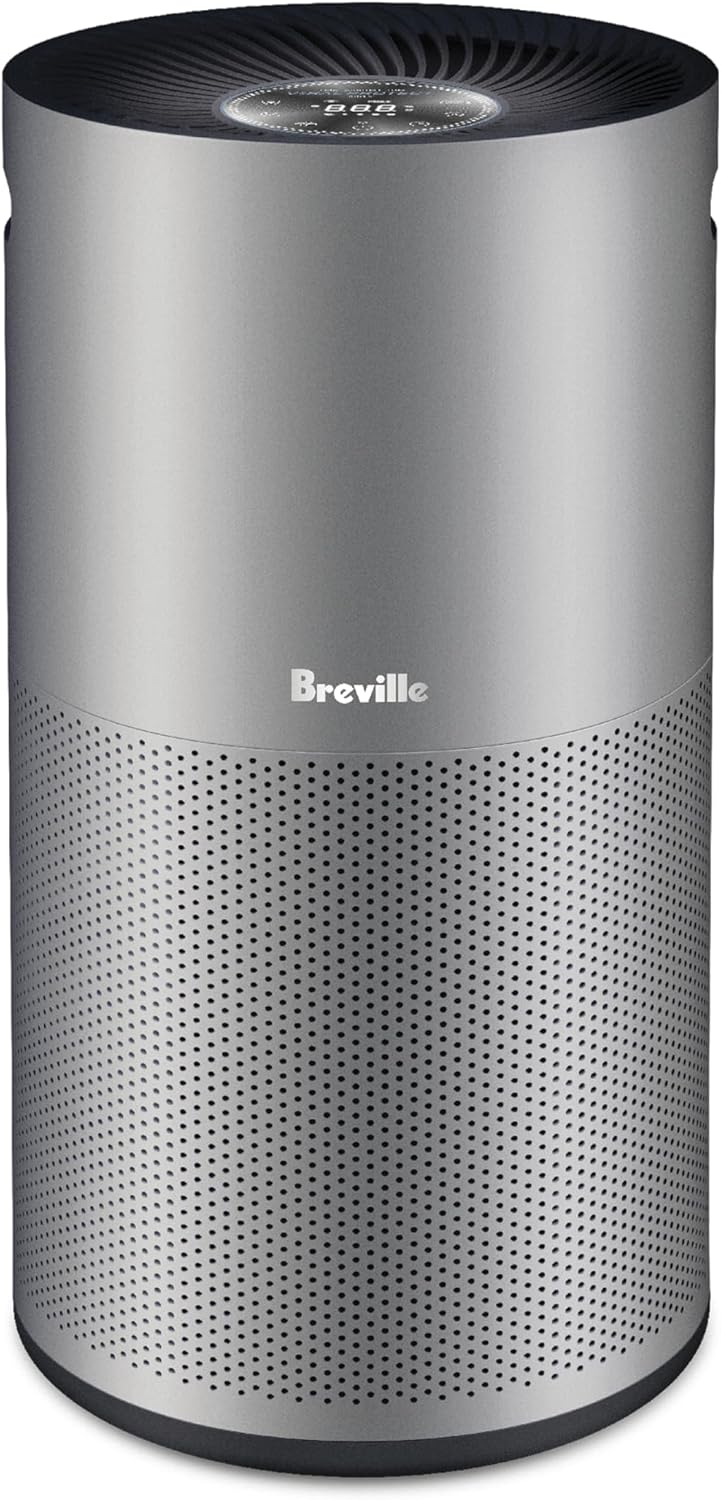
Breville Smart Air Viral Protect Max
CADR 530 m³/h — HEPA-13 AntiViral — 54 dB max — $200/yr filters
The Breville LAP608 is the only unit in this comparison with a CADR verified against a named international standard (GB/T 18801-2015) and antiviral certification tested to ISO 18184 against SARS-CoV-2, H1N1, and H3N2. That is not marketing copy — those are specific test protocols with documented methodology. At 530 m³/h CADR, it delivers the highest verified clean-air delivery rate in this comparison, and at max speed the 50 W motor is economical to run — roughly $1.10 per day at 24/7 operation at Sydney average grid rates. The four-stage filtration sequence — pre-filter, activated carbon, H13 HEPA, and Breville’s AntiViral coating — means you are addressing particulates, VOCs, and biological contaminants in a single pass.
Low-speed operation registers around 26 dB per CHOICE testing — that is quieter than a library and below the threshold most adults notice in a sleeping space. This matters because the speed you will actually run this unit 90% of the time is low or medium; the 54 dB max speed figure is relevant during bushfire smoke events when you want maximum CADR, not during a normal weeknight. The app integration is functional rather than feature-rich: air quality readings, speed scheduling, and filter life tracking all work without requiring an account, which is a detail worth appreciating. Filter replacement every six months under the manufacturer’s 12-hour-per-day usage guideline costs around $100 per set — plan for the 6-month interval in bushfire seasons rather than waiting for the indicator light.
The catches are real. At $200 per year in filters, the Breville has the highest ongoing running cost of the three units here. If you are comparing the Breville’s $499 purchase price against the Winix at $429 and concluding the difference is $70, you are missing the full picture: the Winix filter set runs $169 per year versus $200 for the Breville, meaning the Breville costs more to operate year-on-year despite being priced higher at purchase. Neither unit removes formaldehyde — if that is your primary concern, the Dyson is the only option in this comparison. The Breville also lacks the Winix’s National Asthma Council Sensitive Choice certification, though the H13 AntiViral HEPA is a higher technical specification than standard True HEPA.
Key Takeaway
Highest verified CADR in this comparison, antiviral-certified HEPA-13, and a noise floor low enough to run in a bedroom. The higher filter cost is the only meaningful downside versus the Winix.
Clean and Native — Air Quality
Want to understand what else is in your indoor air? Read our full indoor air quality guide for Australian homes →
Check Breville Protect Max Price →Winix Zero Pro — Best Value
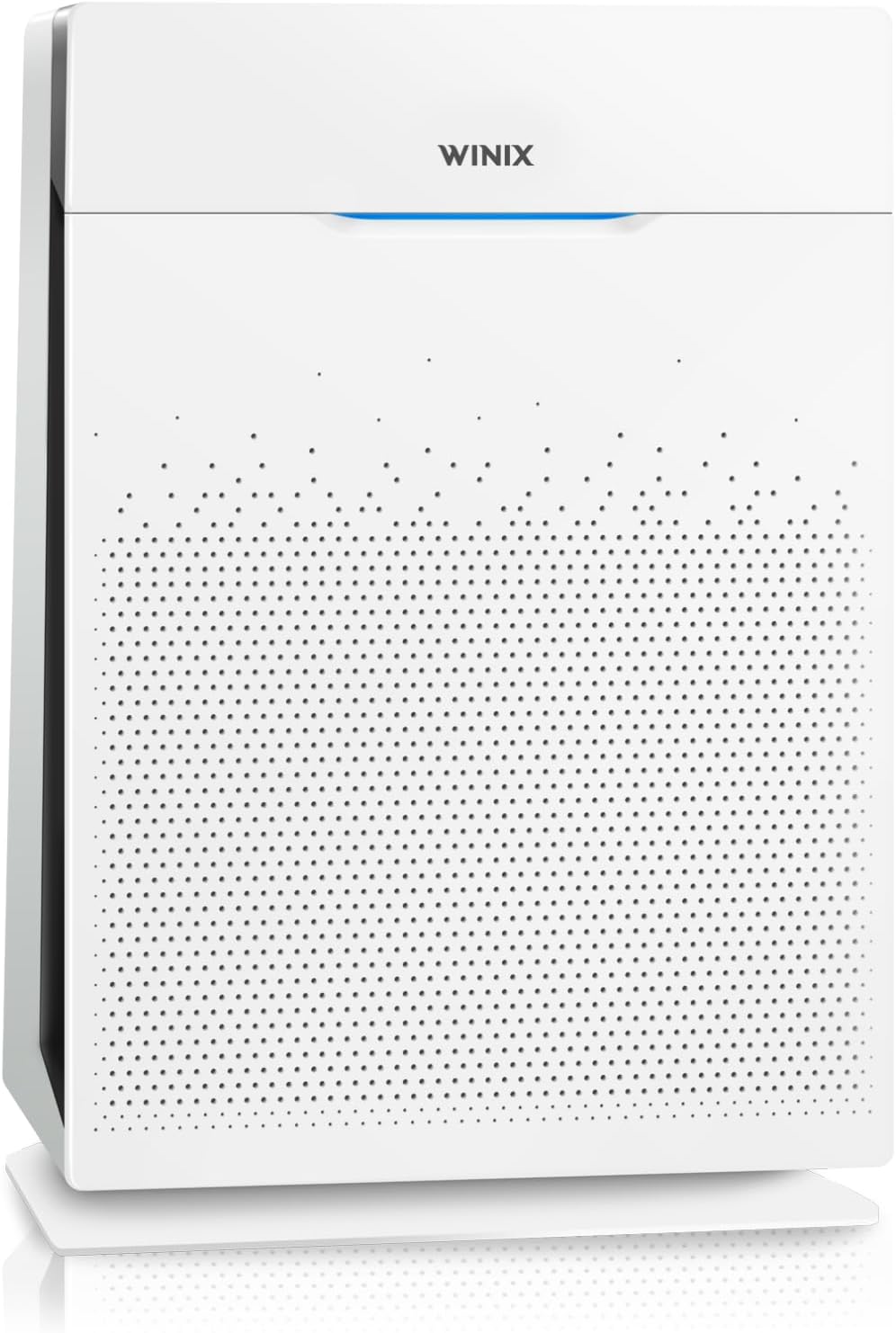
Best Value
Winix Zero Pro
CADR 470 m³/h — True HEPA 99.97% — 49.5 dB max — $169/yr filters
The Winix Zero Pro was CHOICE’s Best Performer in 2020 and the specification has not meaningfully changed since — which is either reassuring proof of a mature, well-validated design or a missed opportunity to push CADR higher, depending on your perspective. At 470 m³/h CADR verified against AS 4260, it covers roughly 47 m² at 4 ACH, which is sufficient for most Australian living rooms in the 40–50 m² bracket. The variable wattage range — 5 W on the lowest setting to 50 W at max — means idle power draw is genuinely low; this unit costs materially less to run on electricity than leaving a single LED bulb on overnight. Its National Asthma Council Sensitive Choice certification is the most directly relevant credential for households managing asthma or allergies and is specific to Australian conditions, which the Breville’s antiviral testing is not.
The low-speed noise floor of 27 dB is essentially indistinguishable from the Breville’s 26 dB in a real room — the difference is within measurement error. More usefully, the Winix’s maximum speed tops out at 49.5 dB versus the Breville’s 54 dB. During a bushfire smoke event when you need both units running at max, the Winix is noticeably quieter. This is a genuinely relevant distinction for households where the purifier is in a shared living space rather than a separate mechanical room. The official Winix AU filter set costs around $169 per year at standard replacement intervals — $31 less than the Breville annually, which compounds meaningfully over a four or five year ownership period.
The limitations are worth stating clearly. The Winix does not remove formaldehyde. It does not carry antiviral certification — True HEPA at 99.97% capture efficiency will capture virus-bearing particles, but the Breville’s ISO 18184 certification documents specific virucidal activity that the Winix cannot claim. At current AU pricing the Winix retails at $429 (down from RRP $499), making the gap versus the Breville narrow enough that the choice often comes down to whether antiviral certification justifies the extra $70 upfront and $31 annually in filter costs. For most households, it does not — but for anyone with a compromised immune system or young children, the Breville’s additional certification is worth the premium.
Key Takeaway
CHOICE-validated, Asthma Council certified, the quietest at max speed of the three, and $31/yr cheaper to run than the Breville. The right choice if antiviral testing is not your priority.
Dyson Purifier Big+Quiet BP04 — Quietest (Premium)
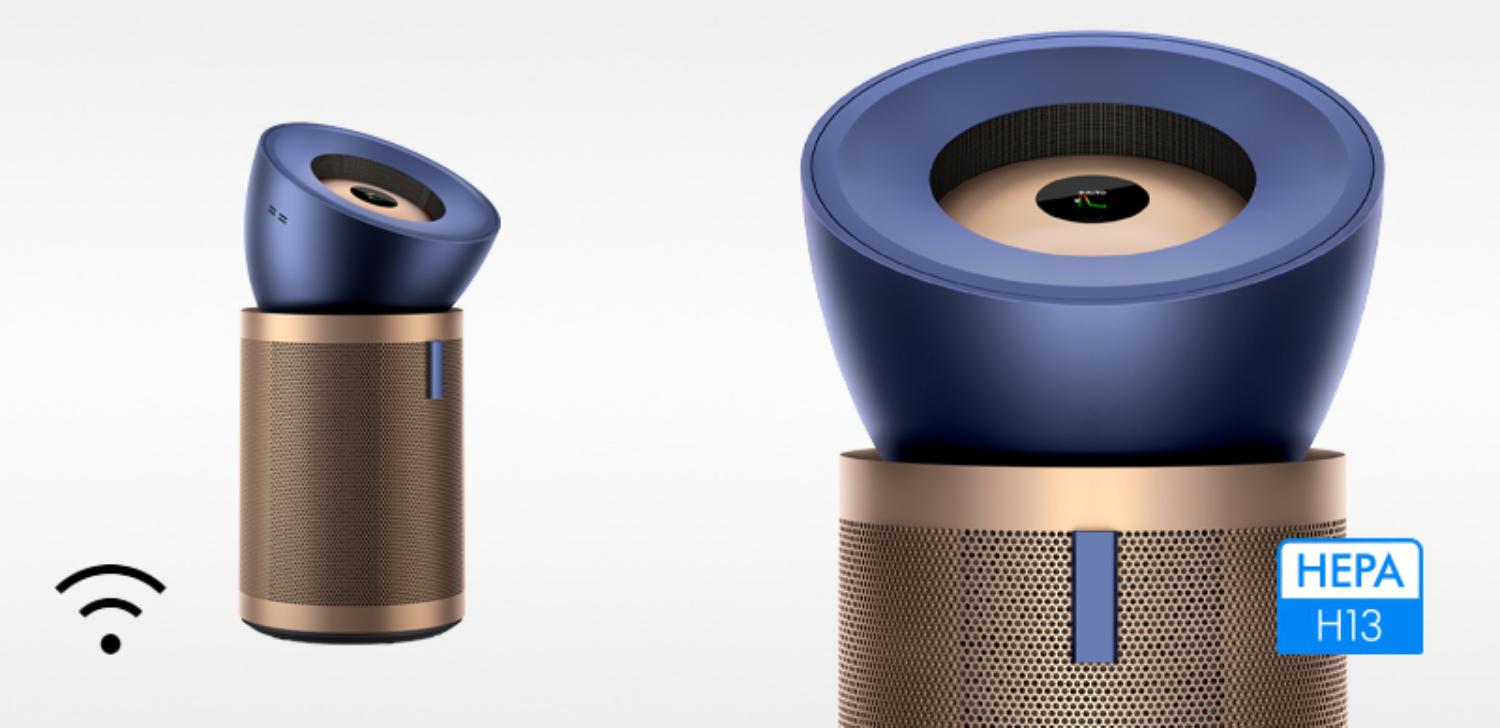
Premium Quietest
Dyson Purifier Big+Quiet Formaldehyde (BP04)
HEPA H13 — SCO formaldehyde catalyst — 38 dB quiet mode — $85/yr filters
The Dyson BP04 occupies a different market position than the other two units in this comparison — it is three times the purchase price of the Winix and carries unique capabilities that neither of the other units can match. The selective catalytic oxidation (SCO) catalyst permanently destroys formaldehyde at a molecular level, converting it to CO₂ and water vapour without the catalyst degrading or requiring replacement. This is not a marginal benefit for specific households: new furniture, laminate flooring, particleboard cabinetry, and fresh paint all off-gas formaldehyde at measurable levels for months to years after installation. If you have recently renovated, moved into a new build, or have significant engineered timber furniture, the Dyson is the only unit here addressing that exposure source. The HEPA H13 filter is certified to EN1822 and the unit carries ASTM F3150 certification for particle removal from a whole-room space.
The noise profile is the other distinguishing factor. At 38 dB in quiet mode, the Dyson is meaningfully louder at its lowest setting than either the Breville (26 dB) or Winix (27 dB) at their lowest settings. However, the BP04 was specifically engineered to push air volume at low fan speeds via its larger-diameter outlet, which means it achieves reasonable room coverage without needing to run at max speed as often. In practice, open-plan living rooms between 40 and 60 m² can be adequately served at mid-speed settings that keep the unit below 45 dB. The max speed figure of 56 dB is the loudest of the three units here — but you are less likely to need maximum speed in normal use given the BP04’s design intent.
The catches for the Dyson are substantial and worth examining without the softening language most reviews apply. Dyson does not publish CADR. This is a deliberate commercial decision, not an oversight — Dyson tests in a proprietary 100 m² chamber and reports room-coverage claims derived from those tests, which are not directly comparable to the CADR methodology used by every other manufacturer in this category. We cannot independently verify the claimed 100 m² coverage because we cannot replicate the proprietary test protocol. At $1,599, the upfront cost is $1,100 more than the Breville and $1,170 more than the Winix. The annual filter cost of approximately $85 is the lowest of the three — the HEPA filter is rated for five years and the K-Carbon filter for two years at Australian pricing — but it takes over ten years of filter savings to recover the purchase price premium over the Breville on running costs alone. The Dyson is the correct choice for formaldehyde exposure, for households where noise is genuinely the overriding constraint, or as a long-term investment in a premium appliance. It is not the correct choice if you are primarily optimising for clean-air delivery per dollar.
Key Takeaway
The only unit here that destroys formaldehyde permanently. Lowest annual filter cost. But no published CADR, no independent verification of room-coverage claims, and a $1,599 price that is difficult to justify on air quality alone unless formaldehyde is a specific concern.
Annual Running Cost Comparison
The upfront purchase price is the figure most buyers focus on. The filter replacement cost over a typical 3–5 year ownership period often exceeds the initial price difference between units. The chart below shows annual filter cost only, at manufacturer-recommended replacement intervals using current Australian retail pricing.
Annual Filter Cost (AUD)
Annual filter replacement cost at manufacturer-recommended intervals using AU pricing. Electricity cost excluded for Dyson (wattage not published). Breville cost assumes 12h/day use per manufacturer guidelines; 6-month interval recommended in bushfire-affected areas. Sources: Breville AU, Winix AU, Dyson AU.
The counterintuitive finding here — the Dyson, which costs $1,599 upfront, has the lowest annual filter cost — is explained by filter longevity. The Dyson HEPA H13 is rated for five years and the K-Carbon for two years, whereas the Breville filters require replacement every six to twelve months. Over a 5-year ownership period, the Dyson’s total cost of ownership (purchase price plus filters, electricity excluded) is approximately $2,024. The Breville’s is approximately $1,499. The Winix’s is approximately $1,274. On a pure TCO basis, the Winix remains the most cost-efficient option in this comparison over five years, despite the Dyson’s filter cost advantage.
CADR Comparison
CADR — Clean Air Delivery Rate — is the only standardised measure of how much filtered air an air purifier actually produces. Higher numbers mean more clean air delivered per hour. Dyson is excluded from this chart because they do not publish a CADR figure.
CADR m³/h (verified, third-party standard)
Dyson BP04 CADR not published — Dyson uses proprietary chamber testing and does not provide comparable third-party CADR data. CADR figures sourced from GB/T 18801-2015 (Breville) and AS 4260 (Winix).
Australian Considerations
Generic air purifier comparisons written for US or UK audiences miss several factors that are directly relevant to Australian households. The three most significant are bushfire smoke season, coastal humidity and mould, and the practical question of how long your filters will actually last in Australian conditions.
Bushfire smoke season (October–March, primarily NSW, VIC, and QLD): Fine particulate matter from bushfire smoke — PM2.5 and smaller — is the primary health concern, and it is exactly what HEPA filters are designed to capture. However, smoke events change the calculus on room coverage. During an active smoke event, the standard 4 ACH target is inadequate; you want 5 or more air changes per hour, which reduces the practical coverage area of every unit in this comparison by approximately 20%. During a smoke event, run your purifier at maximum speed regardless of noise, close all windows and doors, and treat the unit as undersized for any room larger than 45 m² for the Breville or 40 m² for the Winix. The Breville’s AntiViral HEPA-13 filter is rated to capture particles down to 0.1 µm — bushfire PM2.5 particles typically range from 0.4 to 2.5 µm, well within HEPA capture range.
Queensland and coastal mould and humidity: HEPA filtration captures mould spores — which are typically 2–10 µm and comfortably above HEPA’s 0.3 µm capture threshold — but it does not reduce relative humidity. In coastal Queensland and other high-humidity environments where indoor RH regularly exceeds 60%, running an air purifier alone will not prevent mould growth. The air purifier captures spores already airborne; a dehumidifier reduces the humidity that allows mould to grow in the first place. For households in Brisbane, Cairns, Gold Coast, or anywhere with a sustained wet season, the correct approach is both: a dehumidifier to control RH and an air purifier to capture particulates and airborne spores. Neither replaces the other. See our indoor air quality guide for Australian homes for a full breakdown of how to address both.
Pollen season (September–November across Australia): Spring pollen — from grasses, trees, and flowering plants — is typically 10–100 µm in diameter. Every HEPA filter in this comparison captures 99.97% of particles at 0.3 µm, meaning pollen at 10+ µm is captured at essentially 100% efficiency. If spring pollen is your primary driver, any of these three units will perform well. The differentiating factor during pollen season is CADR — a higher CADR means the unit turns the air over faster, reducing the dwell time of newly introduced pollen before it is captured.
Filter lifespan in Australian conditions: Manufacturer-stated filter intervals are typically calibrated for moderate Northern Hemisphere conditions. In Australia — particularly in QLD, NT, and bushfire-affected regions of NSW, VIC, and SA — higher particulate loads from dust, smoke, and humidity put additional stress on filters. The stated 12-month interval for both the Breville and Winix filters should be treated as a ceiling, not a guideline. Inspect your pre-filter at 6 months; if it is visibly grey and the unit’s air quality sensor is showing elevated readings, replace the full filter set regardless of the indicator light. Filter indicators on most units track hours of operation, not actual particulate load — in a bushfire-prone area running maximum speed through October and November, 6-month replacement is the correct interval.
What to Look For
Most buying guides for air purifiers give you a list of ten or twelve criteria, which is a reliable way to generate decision paralysis without improving the decision. Three factors cover 90% of what matters for a large room in Australia.
1. CADR matched to your actual floor area. Use CADR ÷ 10 to get your practical room size in m² at 4 ACH (2.4 m ceiling). Do not use the manufacturer’s headline m² figure — it is calculated at 2 ACH, which is half the recommended rate. A unit claiming “100 m² coverage” with a CADR of 300 m³/h only covers 30 m² at 4 ACH. If your open-plan living room is 55 m², you need a CADR of at least 550 m³/h to hit 4 ACH — and if that is the case, none of the three units in this comparison will serve you at 4 ACH without running at near-maximum speed. Size up rather than relying on claimed headroom.
2. Filter running cost — the cheaper unit is not always cheaper to run. The Breville at $499 costs more to run in filters than the Winix at $429. The Dyson at $1,599 has the lowest annual filter cost of the three. Before committing to a purchase, multiply the annual filter cost by five (a reasonable ownership period) and add it to the purchase price. That number is the actual cost of the unit, not the sticker price. For the Breville, five-year cost is around $1,499. For the Winix, around $1,274. For the Dyson, around $2,024.
3. Noise at LOW speed — not max speed. Every review headline emphasises sleep-mode dB figures, which are the lowest the unit can achieve. But the more relevant number for everyday use is how loud the unit is on the speed setting you will run it 90% of the time — typically low or medium. The Breville and Winix are both around 26–27 dB at low speed, which is essentially inaudible in a living environment. The Dyson is 38 dB at its quietest — still very quiet by household standards, but noticeably louder than the other two at equivalent settings. Max-speed noise (54 dB Breville, 49.5 dB Winix, 56 dB Dyson) is the figure relevant for bushfire events when you need maximum CADR regardless of noise, not for daily operation.
Frequently Asked Questions
What CADR do I need for a large room in Australia?
For a 50 m² room at 4 ACH (the recommended minimum), you need a CADR of at least 480 m³/h. For 60 m², aim for 580+ m³/h. Use CADR ÷ 10 to calculate practical coverage — ignore manufacturer m² claims, which are based on inadequate 2 ACH testing.
How do I calculate the right air purifier size for my room?
Multiply your room area (m²) by 10 to get the minimum CADR you need at 4 ACH with a 2.4 m ceiling. A 45 m² living room needs CADR ≥ 450 m³/h. During smoke events or for asthma households, multiply by 12.5 to target 5 ACH instead.
Does a large room air purifier help with bushfire smoke?
Yes — HEPA filters capture PM2.5 smoke particles at over 99.97% efficiency. During smoke events, run at maximum speed, close all windows and doors, and note that your effective coverage area drops by roughly 20% compared to normal use. Replace filters more frequently in bushfire-affected seasons.
How often should I replace air purifier filters in Australia?
Manufacturer intervals (typically 12 months) are calibrated for moderate conditions. In bushfire-prone areas, coastal QLD, or dusty inland regions, inspect at 6 months and replace if visibly grey. Filter indicators track hours, not actual particulate load — do not rely on them alone in high-pollution environments.
Is the Dyson air purifier worth the extra cost?
If formaldehyde from new furniture, flooring, or renovations is a concern — yes, the Dyson is the only unit here that permanently destroys it. For general particle filtration only, the Breville or Winix deliver better verified performance per dollar. The Dyson’s low filter cost does not offset its $1,100 purchase price premium within a normal ownership period.
Can an air purifier help with mould in a humid climate like Brisbane?
Partially — HEPA filters capture airborne mould spores, reducing the spore count you breathe. But an air purifier does not reduce humidity, which is what allows mould to grow. In high-humidity environments (RH >60%), pair an air purifier with a dehumidifier. The purifier handles spores; the dehumidifier prevents new mould forming.
What is the difference between HEPA and HEPA-13?
Standard True HEPA captures 99.97% of particles at 0.3 µm — the hardest particle size to capture. HEPA-13 (per EN1822) captures 99.95% of particles at the most penetrating particle size, which is a more rigorous test standard. In practice, both capture essentially all pollen, dust mites, mould spores, and smoke particles. HEPA-13 is the relevant designation when antiviral or surgical-grade performance is the requirement.
How much does it cost to run an air purifier 24/7 in Australia?
At Sydney average grid rates of approximately $0.30/kWh, a 50 W unit running 24/7 costs around $1.32/day — approximately $482/year at constant maximum speed. Running at low speed (5 W for the Winix) drops this to $0.13/day, or around $48/year. Most households run at low speed the majority of the time, so actual electricity cost is well below the maximum-speed figure.
Final Verdict
For most Australian households with open-plan living areas between 40 and 55 m², the Breville Smart Air Viral Protect Max is the right choice. It has the highest verified CADR in this comparison at 530 m³/h, HEPA-13 AntiViral certification documented against specific viral strains, and a noise floor quiet enough to run continuously without intrusion. At $499 it is not cheap, but it is the unit with the most independently verified performance data — and in an air purifier, verified performance is the only figure that matters. Budget $200 annually for filters, and set a 6-month inspection reminder if you are in a bushfire-affected area.
If antiviral certification is not a priority and you want to keep ongoing costs lower, the Winix Zero Pro is the better financial decision over a 5-year ownership period. Its CADR of 470 m³/h covers 47 m² at 4 ACH — sufficient for most Australian living rooms — CHOICE has independently validated it as a best performer, the National Asthma Council Sensitive Choice certification is directly relevant for households managing asthma, and the $169/yr filter cost saves $31 annually compared to the Breville. At $429 current pricing, the Winix is the clear recommendation for anyone without a specific requirement for antiviral certification or formaldehyde removal.
Our Top Pick
Breville Smart Air Viral Protect Max
CADR 530 m³/h · HEPA-13 AntiViral · $499 AUD
Last reviewed: June 2026 — Clean and Native
Get the Australian Home Environment Checklist
30 checks across water, air and EMF. Most of them free. Ranked by impact.
No spam. Unsubscribe any time.

Former Royal Australian Navy Clearance Diver and TAG-E counter-terrorism operator. Founded Clean and Native to apply the same rigorous thinking to the home environment.
Full biography →