Ozone vs Ioniser vs HEPA: Which Air Purifier Technology Actually Works?
HEPA filtration is the only air purifier technology endorsed by Asthma Australia and recommended by Australian state health departments for removing particulate matter from indoor air. Ozone generators and ionisers do not filter air — they add reactive chemicals or charged particles that can worsen respiratory conditions, particularly in Australian homes already dealing with bushfire smoke, pollen, and humidity-driven mould spores.
If you are comparing ozone generators, ionisers, and HEPA purifiers and trying to figure out which one is worth your money, you are not alone. The marketing around “negative ion” and “ozone cleaning” devices is deliberately confusing. As a former Navy Clearance Diver, I approach air quality the same way I approach dive planning — measure first, verify claims against standards, and never trust equipment that has not been independently tested. Every recommendation below is assessed against our documented evaluation methodology, comparing published manufacturer specifications and independent certification data.
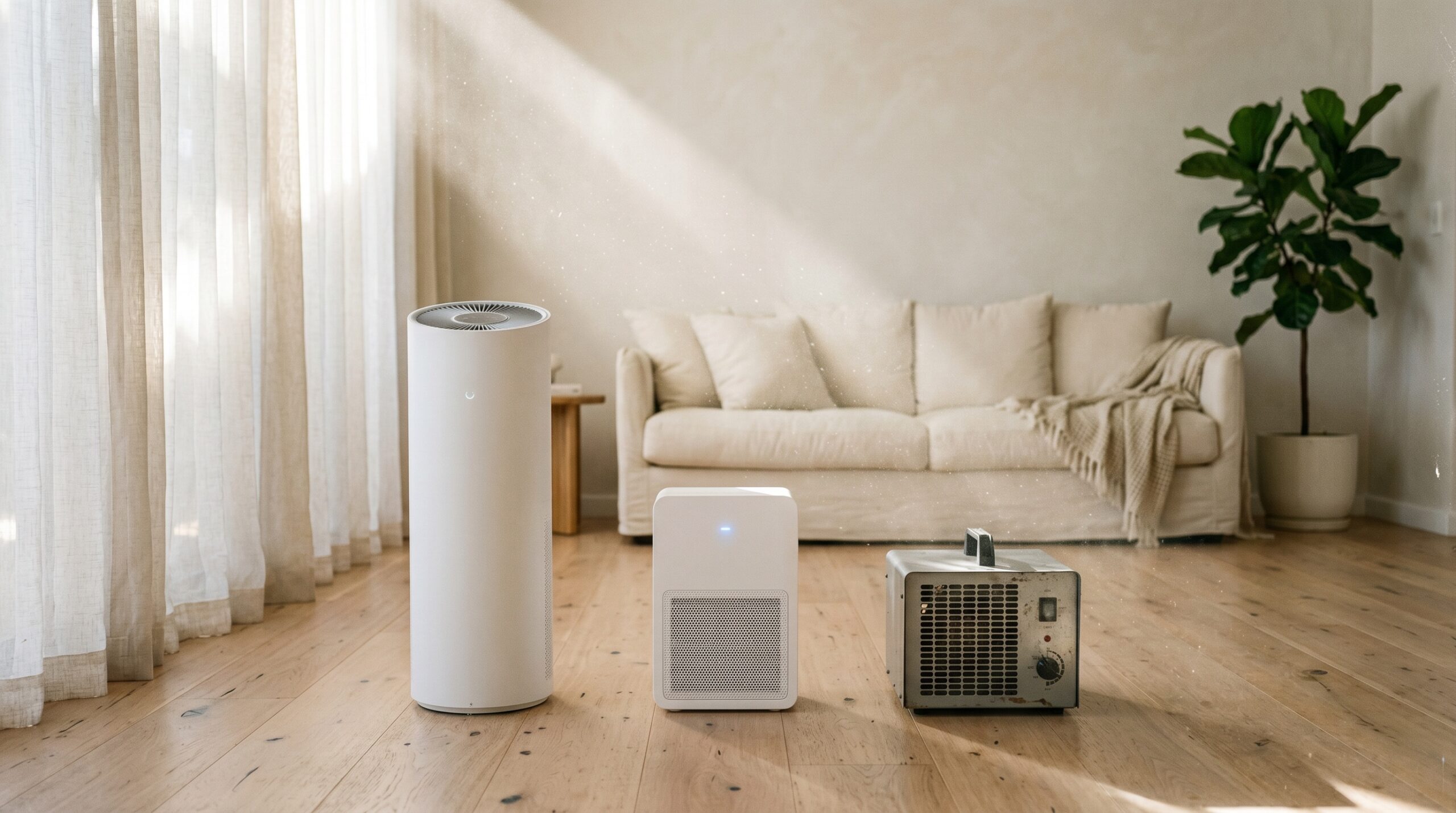
HEPA is the only air purifier technology of the three that actually filters airborne particles. Ozone generators emit ozone gas (a known lung irritant the Australian Department of Health classifies as a respiratory hazard) and ionisers electrostatically charge particles onto room surfaces without removing them — both can worsen asthma and indoor air quality. The catch: a true HEPA unit only works if it has the correct CADR for your room size and is run continuously, not as a “panic device” during smoke events.
| Technology | What it does | Verdict |
|---|---|---|
| HEPA | Mechanically traps 99.97% of particles at 0.3µm (NSF/ANSI 332) | Recommended |
| Ioniser | Emits charged ions that stick particles to walls and floors | Avoid as primary |
| Ozone | Emits ozone gas to oxidise odours — lung irritant at any level | Do not use occupied |
✓ Who This Article Is For
- You are researching air purifier types and want to know what actually removes particles
- You have been targeted by marketing for ozone or ioniser devices on social media
- You or a family member has asthma, allergies, or chronic respiratory conditions
- You live in a bushfire-affected area (NSW, VIC, QLD, SA, WA) and need smoke protection
- You want transparent running costs, not just upfront price comparisons
× Who It Is Not For
- You need an air purifier specifically for VOCs/formaldehyde — see our full air purifier rankings for activated carbon options
- You are looking for a commercial/industrial ozone generator for unoccupied spaces (different use case)
- You want whole-house ducted HVAC filtration advice — this covers portable room units
- You already own a HEPA purifier and want a specific model review
How Each Technology Works — And What It Actually Does to Your Indoor Air
Before you can make an informed decision, you need to understand the physics behind each technology. The marketing claims for ozone and ioniser devices rely on you not understanding the difference between “treating air” and “filtering air”. These are fundamentally different processes with fundamentally different outcomes for your lungs.
HEPA Filtration: Mechanical Particle Capture
HEPA stands for High Efficiency Particulate Air. An H13-grade HEPA filter — the standard used in medical-grade purifiers — captures 99.97% of particles at 0.3 micrometres, according to EN 1822 testing standards. This is a mechanical process. Air is drawn through a dense mat of randomly arranged fibres. Particles are trapped by three mechanisms: interception (particle touches a fibre and sticks), impaction (particle’s inertia carries it into a fibre), and diffusion (small particles move erratically and collide with fibres). No chemicals are added. No byproducts are created. The particle is physically removed from the air you breathe.
At 0.3 micrometres, HEPA filters are at their least efficient point — this is called the Most Penetrating Particle Size (MPPS). Particles both larger and smaller than 0.3 µm are captured at even higher rates. Bushfire smoke particles (PM2.5, typically 0.1-2.5 µm) and pollen grains (10-100 µm) are well within HEPA’s capture range. According to Asthma Australia’s guidance on air cleaners, HEPA-only devices are the recommended technology for people with asthma and allergies.
Ionisers: Charging Particles Without Removing Them
Ionisers work by emitting a stream of negatively charged ions into the room. These ions attach to airborne particles and give them an electrical charge. The charged particles are then attracted to positively charged surfaces — your walls, ceiling, floor, furniture, and lungs. This is the critical point that ioniser marketing obscures: ionisers do not remove particles from your environment. They move particles from the air column onto surfaces. Those particles are resuspended every time you walk through the room, sit on the couch, or turn on a fan.
Worse, many ionisers produce ozone as a byproduct. According to CHOICE Australia’s testing, some ioniser devices produce ozone levels that, while below California Air Resources Board (CARB) limits of 50 ppb, still add a lung irritant to your indoor air. There is no Australian-specific ozone emission standard for consumer air purifiers — a regulatory gap that ioniser manufacturers exploit. The Victorian Department of Health warns that ionisers “can generate ozone and other oxidants as byproducts” and recommends HEPA filtration instead.
Ozone Generators: Adding a Toxic Gas to Your Home
Ozone generators deliberately produce ozone (O3) and release it into occupied spaces. The marketing claim is that ozone “breaks down” odours, mould spores, bacteria, and VOCs through oxidation. This claim is technically half-true and practically dangerous. Ozone does react with some organic compounds. But the concentrations required to meaningfully reduce indoor pollutants exceed safe human exposure limits by a factor of 5-10x, according to the US EPA’s assessment of ozone generators sold as air cleaners.
At concentrations safe for humans (below 50 ppb), ozone does not significantly reduce indoor pollutant levels. According to the EPA, “available scientific evidence shows that, at concentrations that do not exceed public health standards, ozone has little potential to remove indoor air contaminants.” Meanwhile, ozone at any concentration irritates lung tissue, reduces lung function, and aggravates asthma. Children, the elderly, and anyone with existing respiratory conditions are most vulnerable. CHOICE Australia explicitly warns asthma households to “steer clear of ozone technology”.
The Australian Regulatory Gap: Why Ozone Devices Are Still Sold Here
If ozone generators are this problematic, you are probably wondering why they are legal in Australia. The answer is frustrating: Australia has no enforceable ozone emission limit for consumer air purifiers. California’s CARB regulation (AB 2276) requires all indoor air cleaning devices sold in California to produce less than 50 ppb of ozone. This standard effectively bans most ozone generators from the California market. Australia has no equivalent.
The TGA (Therapeutic Goods Administration) regulates devices that make therapeutic claims. An ozone generator marketed as “killing bacteria” or “treating asthma” would theoretically require TGA approval. But most ozone devices sold on Amazon AU and through Australian retailers carefully avoid therapeutic language, instead using phrases like “freshens air” or “removes odours” — claims that fall outside TGA jurisdiction. This loophole means devices that would be restricted in California are freely available to Australian families with no safety warnings.
Asthma Australia’s position is unambiguous. Their published guidance on air cleaners and purifiers states: “We recommend you only use an air purifier with a HEPA filter” and warns that “ozone generators and ionisers may make symptoms worse for people with asthma.” The Victorian Department of Health echoes this, advising residents to “avoid air purifiers that produce ozone, including ionisers.” These are not fringe opinions. They represent the consensus of every Australian health authority that has issued guidance on the topic.
For families in bushfire-affected regions — and that now includes most of coastal NSW, Victoria, south-east Queensland, South Australia, and parts of Western Australia — the stakes are real. During the Black Summer fires of 2019-2020, AQI readings in Sydney’s western suburbs (Penrith, Campbelltown, Liverpool) and Canberra exceeded 2,000 — more than 10x the “hazardous” threshold of 200. People who had purchased ozone or ioniser devices thinking they were protected were breathing ozone-contaminated air on top of smoke infiltration. HEPA purifiers were the only devices that measurably reduced indoor PM2.5 during those events.
Head-to-Head Performance: HEPA vs Ioniser vs Ozone in Australian Homes
Marketing claims mean nothing without data. Here is how each technology performs against the specific pollutants Australian households deal with, measured against real-world conditions — not laboratory idealisation.
| Pollutant | HEPA (H13) | Ioniser | Ozone Generator |
|---|---|---|---|
| Bushfire smoke (PM2.5) | 99.97% capture at 0.3 µm | Settles particles to surfaces — not removed | No particle removal. Adds ozone to smoke. |
| Pollen (10-100 µm) | Effectively 100% capture | Partial settlement, resuspends easily | No effect on pollen particles |
| Mould spores (2-20 µm) | >99.99% capture | Settles spores — still viable on surfaces | Partial deactivation at unsafe concentrations only |
| Dust mite allergen (1-10 µm) | >99.99% capture | Settles to surfaces, resuspends | No particle removal |
| VOCs / Odours | Requires activated carbon pre-filter (not HEPA alone) | No effect | Partial at unsafe concentrations. Creates secondary pollutants. |
| Bacteria / Viruses | Captures on filter media (not killed, but removed from air) | Charges particles but does not kill | Partial deactivation at unsafe concentrations |
| Ozone byproduct? | Zero | Yes — many units produce ozone as byproduct | Yes — deliberate ozone production |
| Noise at maximum | 35-55 dB (fan-driven) | Near silent (no fan) | Near silent (no fan) |
The one legitimate advantage ionisers and ozone generators have is noise — they are near-silent because they have no fan. But a HEPA purifier on sleep mode (the Levoit Core 400S runs at 24 dB, quieter than a whisper) makes this advantage irrelevant. You are not trading meaningful performance for silence. You are trading your lung health for marketing.
What About “Hybrid” or Combination Units?
Some manufacturers sell HEPA purifiers with a built-in ioniser function. The Winix Zero Pro, for example, includes a “PlasmaWave” ioniser alongside its H13 HEPA filter. Is this a problem? Generally no — provided the ioniser function can be disabled and the HEPA filter does the heavy lifting. The key test: does the unit have a genuine HEPA filter with a published CADR (Clean Air Delivery Rate) rating? If yes, the HEPA is doing the work. The ioniser is a marketing feature, not a functional one.
However, if you have asthma or respiratory sensitivity, Asthma Australia’s guidance is clear: choose a HEPA-only device. Do not rely on the ioniser component. The Breville Protect Max and Levoit Core 400S are both HEPA-only designs with no ioniser function — which is exactly why they are our top picks for Australian homes.
For odour control (cooking smells, VOCs from off-gassing furniture, paint), the correct solution is a HEPA purifier with an activated carbon pre-filter — not an ozone generator. Activated carbon adsorbs VOC molecules through physical bonding. The Breville Protect Max includes a 650g activated carbon filter specifically for this purpose. This is the combination that works: HEPA for particles, activated carbon for gases. No ozone required.
Real Cost Comparison: HEPA vs Ioniser vs Ozone Over 5 Years
The most common objection to HEPA purifiers is cost. Ioniser devices sell for $30-80 on Amazon AU. Ozone generators range from $50-150. A quality HEPA purifier starts around $250 and runs up to $900+. But the upfront price is not the real cost. Running costs, filter replacements, and the cost of NOT filtering your air (GP visits, medication, lost productivity from respiratory symptoms) matter far more than the sticker price.
| Device | Upfront Cost | Annual Filter/Running Cost | 5-Year Total | Particle Removal |
|---|---|---|---|---|
| Cheap ioniser (Amazon AU) | $40-80 | ~$15 electricity | $115-155 | Near zero effective removal |
| Ozone generator (Amazon AU) | $50-150 | ~$20 electricity | $150-250 | Zero particle removal + lung damage risk |
| Levoit Core 400S (HEPA) | ~$279 | ~$70 filter + ~$25 electricity | ~$754 | 99.97% at 0.3 µm |
| Breville Protect Max (HEPA) | ~$699 | ~$90 filter + ~$30 electricity | ~$1,299 | 99.97% at 0.3 µm + carbon VOC removal |
| Winix Zero Pro (HEPA + PlasmaWave) | ~$499 | ~$80 filter + ~$25 electricity | ~$1,024 | 99.97% at 0.3 µm |
The Levoit Core 400S costs roughly $754 over 5 years. That is $0.41 per day for air that is 99.97% free of particles at 0.3 micrometres. The cheap ioniser costs $115-155 over 5 years and removes effectively nothing. You are not saving money with an ioniser. You are paying $115 to not purify your air.
The Breville Protect Max at ~$1,299 over 5 years works out to $0.71 per day. For that, you get a larger coverage area (up to 40 m²), activated carbon for VOCs, and the quietest operation in its class. If you live in a bushfire zone — and according to the CSIRO, that now includes most of peri-urban NSW, Victoria, south-east Queensland, Adelaide Hills, and Perth’s eastern suburbs — $0.71 per day is cheaper than a single puffer refill.
Consider the anchoring another way. A single box of 200 N95 disposable masks costs ~$40 at Bunnings. A family of four goes through that in weeks during a bad smoke event. During Black Summer, Sydney and Canberra residents spent hundreds on masks. A single Levoit Core 400S protects your entire bedroom 24 hours a day, every day, for years.
Noise, Coverage, and Runtime: The Specs That Actually Matter
Beyond the fundamental question of “does it remove particles” (which only HEPA answers yes), you need to match a purifier to your room size, noise tolerance, and usage pattern. Here is the comparison that no competitor article provides.
| Spec | Breville Protect Max | Levoit Core 400S | Winix Zero Pro |
|---|---|---|---|
| HEPA Grade | H13 True HEPA | H13 True HEPA | H13 True HEPA |
| CADR (smoke) | 340 m³/h | 260 m³/h | 306 m³/h |
| Coverage area | Up to 40 m² | Up to 33 m² | Up to 36 m² |
| Noise (sleep mode) | 26 dB | 24 dB | 27 dB |
| Noise (max) | 52 dB | 48 dB | 50 dB |
| Activated carbon filter | Yes — 650g carbon | Yes — integrated carbon layer | Yes — activated carbon pre-filter |
| Smart features | PM2.5 sensor, auto mode, app | PM2.5 sensor, auto mode, app | PM2.5 sensor, auto mode |
| Ioniser included? | No | No | Yes — PlasmaWave (can be disabled) |
| Weight | 8.2 kg | 5.0 kg | 6.8 kg |
For bedrooms up to 25 m² (the average Australian master bedroom), the Levoit Core 400S at 24 dB on sleep mode is quieter than a whisper — you will not hear it. Its CADR of 260 m³/h means it cycles the air in a 25 m² room approximately 4 times per hour, well above the 2x minimum recommended for effective purification.
For open-plan living areas (common in Brisbane, Gold Coast, and Sydney apartments and houses), the Breville Protect Max’s 340 m³/h CADR covers up to 40 m² — enough for most combined kitchen/living spaces. Its 650g activated carbon filter is the largest in its class and addresses cooking odours, off-gassing from new furniture, and VOCs from cleaning products without any ozone involvement.
If you live in a bushfire zone and need maximum smoke CADR for the money, the Levoit Core 400S offers the best value per CADR dollar in Australia right now. At ~$279 with a 260 m³/h smoke CADR, you are paying roughly $1.07 per m³/h of smoke filtration capacity. The Breville at ~$699 costs $2.06 per m³/h — but you get the carbon filter, larger coverage, and a more premium build. If you live in NSW, Victoria, or QLD, smoke season (October-March) is the argument that closes this purchase.
The Decision Is Simple: A 3-Question Decision Tree
If you have read this far and still feel overwhelmed, this decision tree simplifies it. Three questions. That is all you need.
Question 1: Do you want to remove particles from your air, or just move them around?
If remove: HEPA. If you are okay with particles settling on your furniture and resuspending: ioniser (but why?).
Question 2: Does anyone in your household have asthma, allergies, or respiratory sensitivity?
If yes: HEPA-only, no ioniser function. Asthma Australia’s recommendation. The Breville Protect Max and Levoit Core 400S are both ioniser-free.
If no: Still HEPA. There is no scenario where ozone or ioniser-only devices outperform HEPA.
Question 3: Budget?
Under $300: Levoit Core 400S (~$279) — best value HEPA in Australia.
$500-700: Winix Zero Pro (~$499) — disable the PlasmaWave ioniser and use it as a HEPA unit.
$700+: Breville Protect Max (~$699) — the most complete HEPA + carbon solution for Australian homes.
Common Ioniser and Ozone Marketing Claims — Debunked
If you are reading this after seeing a Facebook ad or Amazon listing for an ioniser or ozone generator, you have probably encountered some of these claims. Here is what the evidence actually says.
“Negative ions are found in nature — waterfalls, forests, beaches”
True. Negative ions are produced naturally by moving water, UV radiation, and lightning. This does not mean generating them indoors from an electrical device is equivalent. A waterfall does not produce ozone as a byproduct. A $45 ioniser does. The “natural” framing is a marketing trick that relies on you conflating outdoor atmospheric ions with indoor ozone-generating electronics.
“Ozone kills 99.9% of bacteria and viruses”
At high concentrations (1-6 ppm) in controlled laboratory conditions, ozone can inactivate some pathogens. But 1 ppm ozone is 20x the safe human exposure limit. You cannot be in the room. This makes ozone generators potentially useful for commercial remediation of unoccupied spaces (flood-damaged buildings, for example) — but completely inappropriate for occupied homes. The concentration required to kill pathogens will also damage your lungs, rubber seals, electrical insulation, and indoor plants.
“Ionisers remove particles without noisy fans”
Ionisers do not remove particles. They charge particles, which then settle onto surfaces. Walk through the room, and they are airborne again. A HEPA purifier on sleep mode (24-27 dB for the units above) is quieter than ambient room noise. You will not hear it. The silence of an ioniser is the silence of a device that is not doing useful work.
“HEPA filters breed bacteria”
This claim circulates on social media and has a grain of truth in the narrowest interpretation: captured organic matter on a HEPA filter could theoretically support microbial growth if the filter is wet and left for months. In practice, HEPA filters in residential purifiers are dry-media filters. Airflow through the filter continuously dries captured material. Replacing filters on the manufacturer’s recommended schedule (every 6-12 months for the units above) eliminates any theoretical risk. An ioniser, by contrast, deposits particles onto your mattress, pillow, and lungs — a far more concerning bacterial exposure pathway.
Australian Bushfire Season: Why This Decision Cannot Wait
If you live in coastal or peri-urban NSW (Sydney’s western suburbs, Blue Mountains, South Coast), Victoria (Gippsland, north-east Victoria, Melbourne’s outer east), south-east Queensland (Gold Coast hinterland, Scenic Rim, Lockyer Valley), the Adelaide Hills, or Perth’s Darling Range foothills, you are in a bushfire smoke-affected zone. The CSIRO’s State of the Climate 2024 report confirms that fire weather conditions are worsening and fire seasons are extending in southern and eastern Australia.
During a smoke event, PM2.5 concentrations inside Australian homes with standard construction (not sealed to smoke) can reach 50-80% of outdoor levels within hours. According to NSW DPIE monitoring data from Black Summer, outdoor PM2.5 in Penrith exceeded 500 µg/m³ — more than 20x the NEPM standard of 25 µg/m³ (24-hour average). Even inside sealed homes, indoor levels of 100-200 µg/m³ were common.
A single HEPA purifier running in your bedroom creates a clean-air refuge. The Levoit Core 400S, running on its highest setting, can bring a 20 m² bedroom from 200 µg/m³ down to below 10 µg/m³ in approximately 45 minutes. An ioniser or ozone generator in the same room would add chemical byproducts to already-toxic air. This is not a theoretical distinction. It is the difference between sleeping in clean air and sleeping in smoke plus ozone.
If you are reading this between October and March, you are already in fire season. Do not wait for the smoke to arrive before ordering a purifier — supply chain delays during peak events mean HEPA purifiers sell out on Amazon AU within days of a major smoke event. In January 2020, HEPA purifiers were backordered nationally for weeks.
Final Verdict
There is no “ozone vs ioniser vs HEPA” debate among respiratory health professionals, government health departments, or independent testing organisations in Australia. Every credible authority recommends HEPA. Asthma Australia recommends HEPA. CHOICE recommends HEPA. The Victorian Department of Health recommends HEPA. The evidence is not ambiguous.
Ozone generators add a toxic gas to your home at concentrations too low to clean your air but high enough to irritate your lungs. Ionisers deposit particles onto your surfaces and lungs instead of removing them from your environment. Neither technology filters air. Both create byproducts. Both cost money for devices that do not do what they claim.
For most Australian households, the Levoit Core 400S at ~$279 is the best entry into genuine air purification. It is quiet (24 dB sleep mode), effective (99.97% at 0.3 µm), and costs $0.41 per day over 5 years. If you need VOC removal and larger room coverage, the Breville Protect Max at ~$699 is the best overall HEPA + carbon solution sold in Australia.
Stop paying for devices that make your air worse. Buy a HEPA purifier and breathe actual clean air.
Ready to breathe clean air?
The Levoit Core 400S is the top-rated HEPA air purifier under $300 for Australian homes — H13 True HEPA, 24 dB sleep mode, no ozone byproducts. The Breville Protect Max adds activated carbon for VOC and odour removal.
Last reviewed: May 2026 — Clean and Native
Frequently Asked Questions
No. Ozone is a lung irritant at any concentration. At levels safe for humans (below 50 ppb), ozone does not meaningfully reduce indoor pollutants according to the US EPA. Asthma Australia and CHOICE both warn against ozone-generating devices for residential use.
No. Ionisers charge airborne particles, causing them to settle onto surfaces like walls, furniture, and your lungs. The particles are not removed from your environment and resuspend when disturbed. HEPA filters physically capture and retain particles on the filter media.
Asthma Australia recommends HEPA-only air purifiers and warns against devices that produce ozone, including ionisers and ozone generators. Their published guidance explicitly states that these technologies “may make symptoms worse for people with asthma.”
No. Australia has no enforceable ozone emission limit for consumer air purifiers. California’s CARB regulation limits devices to 50 ppb ozone output, but no equivalent standard exists in Australia. This regulatory gap allows ozone-generating devices to be sold freely.
Yes. An H13 HEPA filter captures 99.97% of particles at 0.3 micrometres, which includes bushfire smoke particles (PM2.5). Running a HEPA purifier in a sealed bedroom during smoke events can reduce indoor PM2.5 from hazardous levels to below 10 µg/m³ within approximately 45 minutes.
Some do. Units with ioniser functions (like the Winix Zero Pro’s PlasmaWave) may produce trace ozone as a byproduct. If you have asthma or respiratory sensitivity, choose a HEPA-only unit without an ioniser function (such as the Breville Protect Max or Levoit Core 400S), or disable the ioniser feature if your unit has one.
A typical H13 HEPA purifier like the Levoit Core 400S costs approximately $70 per year in replacement filters plus $25 in electricity when run continuously. Total annual running cost is approximately $95, or roughly $0.26 per day.
Ozone generators avoid TGA regulation by marketing as “odour removers” or “air fresheners” rather than making therapeutic claims. Without an Australian ozone emission standard equivalent to California’s CARB regulation, there is no legal mechanism to restrict their sale to consumers.
The Levoit Core 400S at approximately $279 is the best-value H13 HEPA purifier sold in Australia. It offers a CADR of 260 m³/h for smoke, 24 dB sleep mode, and smart app control. It produces zero ozone and has no ioniser function.
A HEPA filter alone does not remove gases or odours — it captures particles. For VOCs and cooking odours, you need a HEPA purifier with an activated carbon pre-filter. The Breville Protect Max includes a 650g activated carbon filter specifically designed for gas-phase pollutant adsorption.
When an Ioniser Can Make Sense
Ionisers are not without legitimate uses. Cases where one might be appropriate:
- As a supplement to a HEPA unit: Some high-end air purifiers include both HEPA filtration and a low-level ioniser. When designed properly and CARB-certified, this combination can improve overall particle capture efficiency. The Winix 5500-2, for example, includes PlasmaWave technology that can be toggled on or off.
- Odour reduction in non-residential spaces: In a space where particle removal is not the primary concern (a garage, workshop, or utility room), a standalone ioniser may adequately address mild odours at lower cost.
- Near-silent operation requirement: Ionisers are silent. For people extremely sensitive to fan noise, a low-ozone CARB-certified ioniser may be preferred. But check the dB rating of shortlisted HEPA models first — some (e.g. Levoit Core 300S on Sleep Mode) are as quiet as 24 dB.
In all cases: verify CARB certification and check independent ozone test data before buying any standalone ioniser.
Top HEPA Air Purifiers for Australian Homes (2026)
These are the models recommended based on actual CADR data, filter availability in Australia, and build quality at each price point.
Best Overall: Winix 5500-2
The Winix 5500-2 is consistently rated among the highest-performing HEPA air purifiers available in Australia. It uses a True HEPA filter rated to 99.97% at 0.3 microns, combined with an activated carbon layer for odour and VOC reduction. Auto Mode uses air quality sensors to adjust fan speed automatically — particularly useful during smoke events when you want maximum performance without constant manual adjustment.
CADR: 246 CFM (dust/smoke/pollen). Suited to rooms up to 75m². Available on Amazon AU with genuine replacement filters locally stocked.
Best Mid-Range: Levoit Core 300S
The Levoit Core 300S is the most popular HEPA air purifier sold in Australia. Compact enough for a bedroom (covers up to 17m²), it runs at 24 dB on Sleep Mode — quieter than a whisper. The 360-degree air intake and 3-stage filtration (pre-filter, H13 HEPA, activated carbon) provide reliable performance for smaller spaces. Works with the VeSync app for scheduling and air quality monitoring.
CADR: 141 m³/hour. Best for bedrooms, nurseries, and home offices.
Best for Smoke Events and Severe Air Quality: Winix Zero+ PRO
For households in high-risk fire zones or urban areas with chronic air quality problems, the Winix Zero+ PRO is a high-performance option on Amazon AU. Its True HEPA filtration captures particles at 0.3 microns — the industry standard for genuine HEPA performance. Used in hospitals and clean rooms, it delivers filtration performance no standalone ioniser can approach.
CADR: 460 m³/hour. Suited to large open-plan areas up to 100m². Filter life of 3–4 years reduces long-term running costs.
Get the Australian Home Environment Checklist
30 checks across water, air and EMF. Most of them free. Ranked by impact.
No spam. Unsubscribe any time.

Former Royal Australian Navy Clearance Diver and TAG-E counter-terrorism operator. Founded Clean and Native to apply the same rigorous thinking to the home environment.
Full biography →