Bushfire Smoke & Air Quality: How to Stay Safe Indoors
Bushfire smoke is not a nuisance — it is a documented health hazard with no safe level of exposure, according to the Royal Australian College of General Practitioners. The PM2.5 particles in smoke are small enough to bypass your nose and throat entirely, lodge in lung tissue, and enter your bloodstream. This guide gives you a measured, systematic approach to protecting indoor air quality during smoke events — starting with how to know whether your indoor air is actually safe.
What Bushfire Smoke Actually Contains — and Why Indoor Air Is Not Automatically Safe
Bushfire smoke is not a single substance. It is a complex mixture of fine particulate matter (PM2.5 and PM10), carbon monoxide, nitrogen dioxide, polycyclic aromatic hydrocarbons (PAHs), volatile organic compounds (VOCs), and toxic metals released from burning vegetation, soil, and any built structures in the fire’s path. The particles that cause the most damage are PM2.5 — those smaller than 2.5 micrometres in diameter. They are invisible to the naked eye and small enough to penetrate deep into lung alveoli and cross into the bloodstream.
The 2019-20 Black Summer fires pushed PM2.5 readings above 2,000 µg/m³ in parts of Sydney — the WHO 24-hour guideline is 15 µg/m³. During that event, air quality monitoring stations in western Sydney suburbs like Penrith and Parramatta recorded some of the worst urban air quality readings in recorded Australian history. According to research published in The Lancet Planetary Health (Borchers Arriagada et al., 2022, doi:10.1016/S2542-5196(22)00067-5), long-term smoke exposure from those fires was associated with increased risk of COPD, cardiovascular disease, lung cancer, and — more recently identified — cognitive decline and dementia. The health consequences extend well beyond the immediate smoke event.
The assumption most Australians make — that closing windows and staying inside is sufficient — is wrong. Research consistently shows that unsealed residential homes in smoke-affected areas reach 60–70% of outdoor PM2.5 concentrations within a few hours, even with all windows and doors shut. Older homes, homes with evaporative cooling systems (common across inland NSW, Victoria, and SA), and homes in areas like Adelaide’s northern suburbs or Perth’s outer eastern corridor are particularly vulnerable due to air leakage. Evaporative coolers draw outdoor air directly inside and must be turned off immediately during a smoke event.
The Health Risks — What the Evidence Actually Says
The RACGP position is clear: there is no established safe level of exposure to air pollution from bushfire smoke. Every increase in PM2.5 concentration carries incremental health risk. The question is not “is it safe?” but “how much risk are you accepting and for whom?”
Short-term exposure triggers respiratory irritation, coughing, eye and throat inflammation, and worsening of asthma. These effects are well-documented. What is less commonly communicated — and what competitor content consistently omits — is the long-term risk profile. The Lancet Planetary Health study linked sustained Black Summer smoke exposure to measurable increases in COPD hospitalisations and lung cancer diagnoses in the years following the fires. Research cited in The Conversation (June 2025) documents elevated cardiovascular and neurological risk from repeated seasonal exposure.
Specific populations face disproportionate risk. Pregnant women exposed to elevated PM2.5 show increased rates of reduced birthweight and elevated risk of childhood asthma development in the exposed infants. Children, the elderly, and anyone with existing cardiac or respiratory conditions face amplified short-term risk from the same PM2.5 concentrations that cause only mild symptoms in healthy adults. If you have a pregnant household member or young children in NSW, Victoria, or QLD during the October-to-March fire season, the bar for taking action is lower — not higher.
Smoke also contains VOCs and PAHs, which are gaseous-phase carcinogens. Standard HEPA filtration captures particulates but does not address gaseous compounds. This is why the activated carbon stage in a quality purifier matters — not just for odour removal, but for genuine chemical contaminant reduction.
How to Measure Indoor Air Quality During a Smoke Event
This is the section competitors skip entirely. Telling people to “stay indoors” without telling them how to verify that their indoor air is actually safe is incomplete advice. You need a number — a PM2.5 reading in µg/m³ — not a guess based on whether you can smell smoke.
You cannot rely on smell as a proxy for PM2.5 concentration. The human nose detects the gases and VOCs in smoke, not the particles. By the time an indoor space smells strongly of smoke, PM2.5 concentrations are already at a level that causes physiological harm. Conversely, a house can have elevated PM2.5 readings with little perceptible odour, particularly during low-intensity regional smoke events.
What to measure
PM2.5 (particles under 2.5 micrometres) is the primary health metric. AQI (Air Quality Index) as reported by NSW EPA, Victoria EPA, and Queensland’s Air Quality Monitoring Network converts PM2.5 µg/m³ readings into a 0–200+ index. An AQI above 100 triggers health advisory messaging; above 200 is “Hazardous”. During Black Summer, Sydney’s AQI exceeded 2,000 in some monitoring zones. A consumer-grade PM2.5 monitor allows you to track your indoor concentration in real time and verify that your HEPA purifier is actually dropping it.
Consumer-grade PM2.5 monitors
Purpose-built laser particle counters like the IQAir AirVisual, the Temtop M2000C, or the Govee Air Quality Monitor give continuous PM2.5 readings accurate to ±10 µg/m³ — sufficient for real-time home decision-making. Place the monitor in your primary sleeping room or living area. Before running the purifier, note your baseline indoor reading. Run the purifier on its highest setting for 30 minutes, then check again. A properly sized HEPA unit in a standard Australian bedroom (15–25 m²) should drop PM2.5 by 80% or more within that time. If it does not, your purifier is undersized for the space or the filter is clogged.
Target thresholds for indoor air during smoke events
The Australian Department of Health references the WHO 24-hour PM2.5 guideline of 15 µg/m³ as a health benchmark. During bushfire smoke events, achieving that threshold indoors may not be feasible without a high-CADR purifier running continuously. A realistic and defensible indoor target during a smoke event is below 35 µg/m³ — the US EPA’s 24-hour PM2.5 standard, which is the value used by Safe Work Australia‘s indoor air quality guidance. Below 12 µg/m³ (annual mean standard) is excellent. Above 55 µg/m³ sustained for hours represents meaningful risk for vulnerable populations.
Recommended Smoke-Season Purifiers
How to Choose and Use a HEPA Air Purifier for Smoke — Sizing, Specs, and What Matters
Not all HEPA purifiers are equal, and choosing the wrong one for your room size is the most common mistake. The critical metric is CADR — Clean Air Delivery Rate — measured in cubic metres per hour (m³/h) or cubic feet per minute (CFM). CADR tells you the actual volume of clean air the unit delivers at a given fan speed. It is an AHAM-verified number, not a marketing claim.
Sizing rule
For smoke events, the standard sizing recommendation is to achieve at least 5 air changes per hour (ACH) in the protected room. At 5 ACH, you replace the entire room’s air volume with filtered air every 12 minutes — sufficient to maintain low PM2.5 concentrations even with moderate infiltration. The formula is: Required CADR (m³/h) = Room volume (m³) × 5. A 20 m² room with 2.4 m ceilings has a volume of 48 m³. You need a CADR of at least 240 m³/h. Size up if the room has high infiltration, an open floor plan, or if you are running the unit on lower speeds to reduce noise during sleep.
Filter specification — H13 HEPA minimum
The European HEPA standard classifies filters by their single-pass efficiency at the most penetrating particle size (0.3 micrometres — the hardest size to capture). H13 HEPA achieves 99.97% single-pass capture efficiency at 0.3 µm. H14 achieves 99.995%. For bushfire smoke protection, H13 is the minimum standard worth specifying. Many purifiers sold in Australia use “HEPA-type” or “HEPA-like” filters that are not rated to H13 — check the product specification sheet, not just the box copy.
Why activated carbon matters for smoke specifically
Bushfire smoke contains benzene, formaldehyde, acrolein, and polycyclic aromatic hydrocarbons in its gaseous phase. HEPA filters do not capture gases — they capture particles. An activated carbon stage adsorbs these VOCs and PAHs, which is why it matters beyond odour control. Look for at least 1.5–2 kg of activated carbon pellets in any purifier you are sizing for bushfire smoke use. Thin carbon-impregnated foam layers, common in cheaper units, have insufficient adsorption capacity for sustained smoke events.
The Breville Protect Max — why it is the benchmark
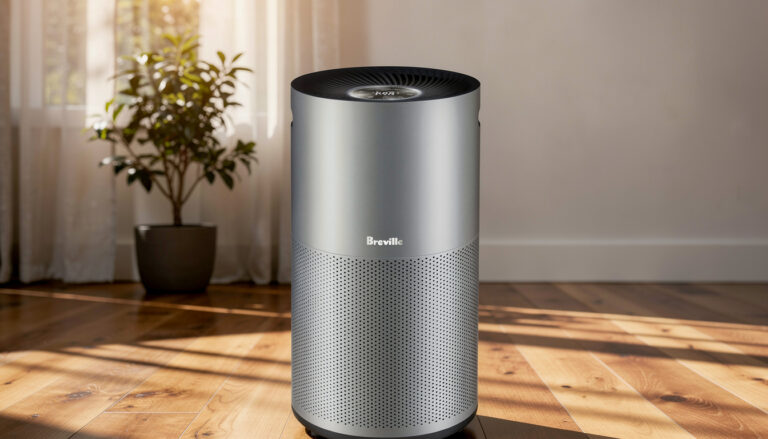
At 550 m³/h CADR with a verified H13 HEPA and a substantial activated carbon stage, the Breville Protect Max (ASIN B0CV5PKL3V) is the highest-CADR purifier currently available on Amazon AU from a brand with Australian warranty support. It covers rooms up to 90 m² at 3 ACH, or approximately 55 m² at the more protective 5 ACH threshold. The auto mode reads the unit’s internal PM2.5 sensor and adjusts fan speed in real time — useful during a smoke event when outdoor conditions fluctuate.
The Levoit Core 400S — best value for single-room smoke protection
The Levoit Core 400S (ASIN B08R794ZMX) delivers 260 m³/h CADR with H13 HEPA, an activated carbon layer, and app-based control with a built-in air quality sensor. At roughly half the price of the Breville, it is the correct choice for a single bedroom or home office — approximately 30 m² at 5 ACH. The auto mode, real-time air quality display, and quiet Sleep mode (24 dB) make it practical for overnight use during extended smoke events.
CADR Comparison — Leading HEPA Purifiers for Smoke, Australia 2026
A Step-by-Step Indoor Protection Protocol for Smoke Events
The following protocol is derived from guidance issued by the Australian Department of Health, NSW Health, Safe Work Australia’s indoor air quality framework, and peer-reviewed research on residential PM2.5 infiltration. It is organised by action priority — the steps that deliver the largest risk reduction first.
Step 1: Monitor the outdoor AQI before you seal up
Check your state EPA’s air quality monitoring network. NSW EPA’s AirWatch, Victoria EPA’s AirWatch, and Queensland’s AirQuality portal provide suburb-level AQI in real time. Once outdoor AQI exceeds 100 (Unhealthy for Sensitive Groups) in your area, begin the indoor protocol. Do not wait for “Hazardous” readings — by then, significant infiltration has already occurred in most homes.
Step 2: Turn off evaporative coolers immediately
This is the single most impactful action for homes in inland NSW, Victoria, South Australia, and WA. Evaporative coolers work by drawing unfiltered outdoor air into the home and evaporating water through it. During a smoke event, they are PM2.5 delivery systems. Switch to reverse-cycle air conditioning (which recirculates indoor air) or accept the heat. There is no workaround for evaporative cooling — it must be off.
Step 3: Seal infiltration points
Wet towels under external doors reduce infiltration at the base gap. Close all windows and external doors. Check that exhaust fans are off — bathroom and kitchen exhausts create negative pressure that draws smoke in. Block fireplace openings if applicable. These measures will not make your home airtight, but they reduce the smoke load your purifier needs to overcome.
Step 4: Run your HEPA purifier on maximum for the first 30 minutes
Turn the unit to its highest fan setting and let it clear the room. Most quality HEPA purifiers with adequate CADR will reduce PM2.5 by 80%+ in a properly sized room within 30 minutes on maximum. Once your indoor PM2.5 reading drops below 35 µg/m³, you can reduce fan speed to reduce noise. Do not run it on low from the start — the initial clearance phase requires maximum airflow.
Step 5: Verify with a PM2.5 monitor
A $60–150 consumer PM2.5 monitor placed in your main living area or bedroom gives you the feedback loop that makes every other step in this protocol verifiable. Without it, you are operating on assumption. Check the reading before you sleep. If your bedroom PM2.5 is above 35 µg/m³ with the purifier running, either the unit is undersized, the filter is loaded, or there is a significant infiltration source you have not sealed.
Step 6: Use P2/N95 masks for any necessary outdoor movement
Standard surgical masks do not filter PM2.5 — they filter larger droplets and particles. You need a P2 (Australian standard equivalent to N95) or higher rated mask for meaningful particle filtration. Ensure fit — gaps at the nose bridge or jaw completely defeat the filtration. The TGA notes that P2/N95 masks provide substantial but not complete protection, particularly during exertion when breathing rate increases. Masks are the outdoor layer. HEPA filtration is the indoor layer.
Step 7: Designate a clean room
If your home has multiple rooms, designate the smallest liveable space as a clean room and concentrate your HEPA capacity there. A single high-CADR purifier in a 20 m² bedroom is far more effective than spreading the same air cleaning capacity across an open-plan 80 m² living area. Close the clean room door. Move vulnerable family members — children, pregnant women, elderly relatives — into this room during peak smoke events.
Workplace considerations
Safe Work Australia’s Code of Practice for managing workplace hazards requires employers to control PM2.5 exposure as a health hazard. This includes providing adequate indoor air filtration when outdoor air quality triggers health advisories. If your workplace has only standard HVAC with no HEPA-rated filtration, the system is not equipped for bushfire smoke events. HEPA-rated commercial air cleaners with CADR appropriate to the floor area are the correct technical control. The hierarchy of controls places engineering solutions (filtration) above administrative controls (masks) — masks are the last resort for a reason.
Longer-Term Resilience: Preparing Before Fire Season Starts
Smoke season in NSW, Victoria, and QLD runs October to March. In Western Australia’s southwest, the risk period extends from November through February. Do not wait until an active fire event to buy, install, and test your equipment — delivery times and stock availability drop sharply once fires are burning and everyone has the same idea simultaneously.
Pre-season filter check
Replace HEPA and carbon filters before October. A loaded filter running at the start of a major smoke event will fail to maintain adequate CADR within days. Most manufacturers recommend annual replacement under normal use — during smoke season, replace every 6 months if you run the unit for extended periods. Check the filter indicator light, but also physically inspect the filter. A darkened, grey HEPA filter has reduced capture capacity even if the indicator has not triggered.
Whole-home filtration consideration
If you have ducted reverse-cycle air conditioning, upgrading to a MERV 13 or HEPA-compatible filter in the return-air plenum provides whole-home smoke filtration. Standard ducted HVAC ships with MERV 7-8 filters that do not adequately capture PM2.5. MERV 13 achieves approximately 80–90% capture efficiency for PM2.5 in a single pass. Note that higher-MERV filters increase system resistance and may reduce airflow — consult your HVAC technician before upgrading filter grade to ensure the system’s blower can handle the increased static pressure.
Structural sealing
Draught-sealing — door sweeps, weather stripping, gap sealing around pipe penetrations — reduces baseline infiltration year-round and significantly reduces the smoke load during events. A well-sealed home requires less purifier capacity to maintain the same indoor PM2.5 target. This is a home improvement that pays dividends for both energy efficiency and smoke resilience simultaneously.
Stockpile P2 masks
Keep a box of TGA-listed P2 masks (or N95 equivalents) at home before fire season. During major smoke events in 2019-20, P2 masks sold out across NSW and Victoria within 48 hours of significant smoke reaching urban areas. Two masks per household member, stored in a sealed bag, represents a minimal preparation cost with a clear return if conditions deteriorate.
Last reviewed: June 2026 — Clean and Native
Final Verdict
Bushfire smoke is a documented multi-system health hazard with no safe exposure threshold — reactive measures alone are not enough. The combination of a correctly sized H13 HEPA purifier running on maximum during the clearance phase, a PM2.5 monitor to verify it is working, and basic infiltration reduction (evaporative cooler off, doors sealed) gives you a verifiable, measurable level of indoor protection that no amount of general avoidance advice replicates. For most Australian households, the Breville Protect Max is the right primary tool — 550 CADR, H13 HEPA, activated carbon for VOCs and PAHs, and Australian warranty support. For single-room or bedroom protection, the Levoit Core 400S delivers H13 HEPA performance at a price that makes the decision simple.
The Breville Protect Max is the most capable HEPA purifier for bushfire smoke currently available on Amazon AU.
550 CADR, H13 HEPA, substantial activated carbon stage for VOC and PAH removal, and auto mode that responds to real-time PM2.5 readings. Covers up to 55 m² at 5 air changes per hour — the protective standard for smoke events.
Frequently Asked Questions
Partially — but not completely. Research shows sealed residential homes still reach 60–70% of outdoor PM2.5 concentrations during sustained smoke events. Staying indoors reduces exposure significantly but requires a running HEPA air purifier to actually maintain safe PM2.5 levels. Shelter-in-place alone is insufficient as a standalone measure.
The WHO 24-hour guideline is 15 µg/m³. During an active smoke event, achieving that indoors requires a well-sized HEPA purifier running continuously. A practical and defensible indoor target during a smoke event is below 35 µg/m³ — the US EPA’s 24-hour standard referenced by Safe Work Australia for indoor air quality assessments. Above 55 µg/m³ sustained represents meaningful risk for vulnerable individuals.
No. Standard ducted HVAC systems typically ship with MERV 7–8 filters, which have low PM2.5 capture efficiency. Upgrading to MERV 13 filters improves single-pass PM2.5 capture to approximately 80–90%, but this requires a technician check to confirm your blower can handle the increased static pressure. Reverse-cycle split systems recirculate indoor air without drawing in outdoor smoke, making them safe to run during smoke events — but they do not purify the air already inside.
No. Surgical masks are designed to filter large droplets, not PM2.5 particulate matter. You need a P2 (Australian standard) or N95 mask for meaningful smoke particle filtration. Fit is critical — a poorly fitted P2 mask provides minimal protection due to face-seal leakage. The TGA provides guidance on P2 mask selection and fit-checking.
No. Evaporative coolers work by drawing unfiltered outdoor air into the home as a core part of their operating mechanism. There is no operating mode for an evaporative cooler that does not introduce outdoor air. It must be turned off during any smoke event, regardless of outdoor temperature. Switch to reverse-cycle air conditioning or fans operating on recirculation mode.
Use a consumer PM2.5 monitor. Place it in the room you are purifying, note the baseline reading, run the purifier on maximum for 30 minutes, and re-check. A correctly sized HEPA purifier should reduce the PM2.5 reading by 80% or more within that timeframe. If it does not, the unit is either undersized for the room, the filter is clogged and needs replacing, or there is a significant infiltration source (open gap, evaporative cooler running) counteracting the purification.
Yes. Research published in The Lancet Planetary Health (Borchers Arriagada et al., 2022) linked sustained Black Summer fire smoke exposure to increased COPD hospitalisations and elevated lung cancer risk in the years following the fires. Epidemiological evidence also supports associations with cardiovascular disease, dementia, and adverse pregnancy outcomes including reduced birthweight and childhood asthma development in exposed infants. The RACGP’s position is that there is no established safe level of exposure.
The Breville Protect Max (550 m³/h CADR, H13 HEPA, activated carbon) is the highest-performing unit available on Amazon AU for whole-room or open-plan smoke protection, covering up to 55 m² at 5 air changes per hour. For single bedrooms or smaller rooms, the Levoit Core 400S (260 m³/h CADR, H13 HEPA) provides verified performance at a lower price point. Both units include activated carbon stages for VOC and PAH removal — critical for bushfire smoke, not just generic particulate filtration.
By September at the latest for NSW, VIC, and QLD households — fire season runs October to March. Replace HEPA and carbon filters before the season starts, check your home for draught-sealing opportunities, and stockpile P2 masks. During the 2019-20 Black Summer, P2 masks and portable HEPA purifiers sold out in NSW and Victoria within 48 hours of major smoke reaching urban areas. Prepare before the season, not during the event.
Get the Australian Home Environment Checklist
30 checks across water, air and EMF. Most of them free. Ranked by impact.
No spam. Unsubscribe any time.
Former Royal Australian Navy Clearance Diver and TAG-E counter-terrorism operator. Founded Clean and Native to apply the same rigorous thinking to the home environment.
Full biography →